

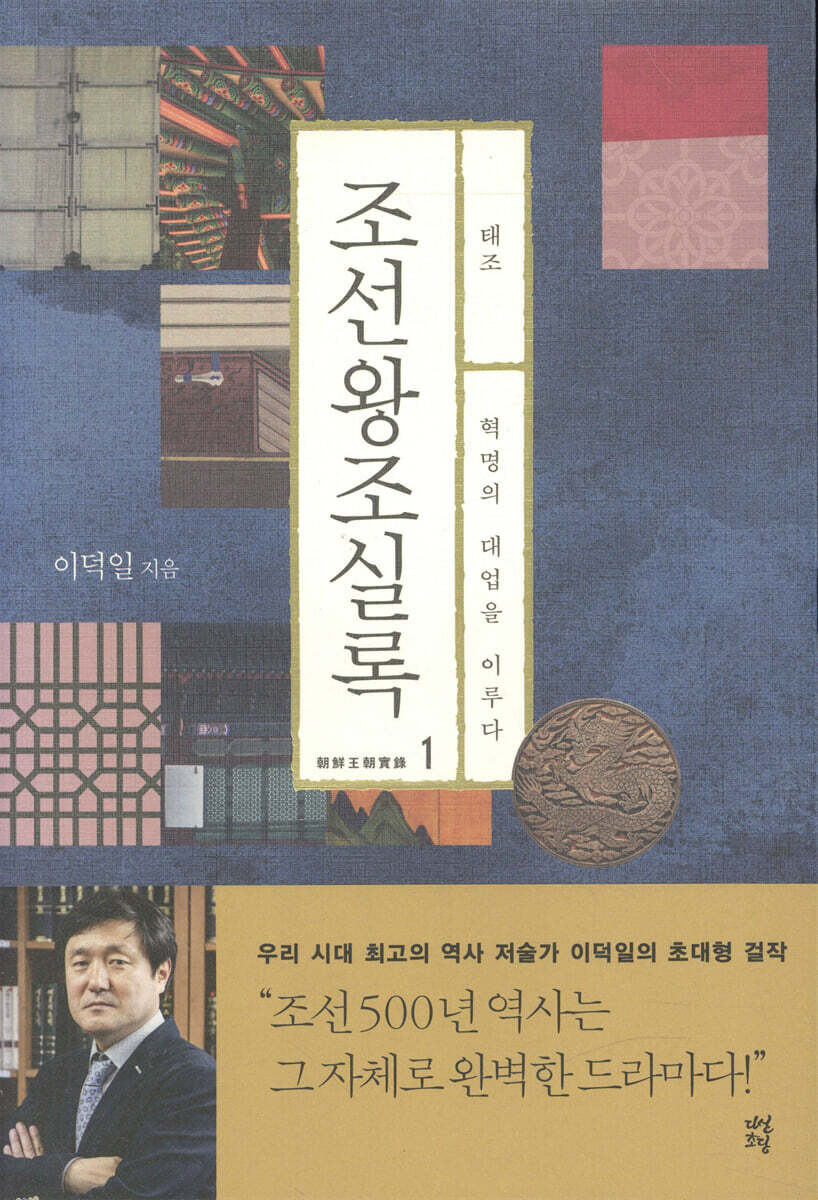
Annals of the Joseon Dynasty 1 King Taejo
 |
Description
Book Introduction
10 years of planning and research, 5 years of writing! The first authentic Joseon Dynasty Annals by Lee Deok-il, the greatest historian of our time “The 500 years of Joseon history are a perfect drama in themselves!” There are 78 historical dramas set in Joseon! Joseon's history itself is a perfect drama. All of this is because there was an annals that recorded everything about the Joseon Dynasty, but unfortunately, there are not many readers who have properly read the annals of the Joseon Dynasty. Because of its vastness, only digest history books focused on imparting knowledge have been published. Here, Lee Deok-il, the greatest historian of our time, publishes the authentic 10-volume Annals of the Joseon Dynasty, with fascinating storytelling and insight that penetrates the essence of human life. This history book was born after 10 years of planning and research, and 5 years of writing. In a publishing market where there were only introductory books, the 'Authentic Annals of the Joseon Dynasty' was finally born. Lee Deok-il, who has been creating a new style for historical textbooks, uses his characteristically sharp and solid writing style to question existing interpretations and find modern meaning in this book. In particular, the original assessment of the key figures who led Joseon provides readers with an opportunity to deeply reflect on their own lives. Because it fully embodies the national aspiration and zeitgeist to create a "country worthy of being called a country," the message it conveys to our society today is also incredibly powerful. Our history, which is several times more interesting and moving than the Romance of the Three Kingdoms or the history of Rome, will now make your heart race. |
- You can preview some of the book's contents.
Preview
index
Introduction: Reading the Annals of the Joseon Dynasty
Part 1: In the Shaking Kingdom
A petition for land reform by frontier military commander Yi Seong-gye
-There will be a rebellion among the soldiers in the border region.
-Gaegyeong as seen through the eyes of Yi Seong-gye
-Returning home after 100 years
King Gongmin, the King of Storms and Clouds
-A lonely wedding
-The Gicheol family on the royal family
-May 18th, the day of destiny
-Lee Ja-chun joins the Buk River recovery movement
-Choi Young and King Gongmin
The Shaking Goryeo Dynasty, the Rise of Yi Seong-gye
-Lee Ja-chun's sudden death and feng shui
-The Red Turban Army, pushing in like a tidal wave
-Lee Seong-gye crosses the Yalu River
-A Midsummer Night's Dream by the reformist monk Shin Don
-King Gongmin and King U were assassinated
The emergence of Jeong Do-jeon, the architect of the founding of the nation
-Lee Seong-gye, fighting throughout the country
-Jeong Do-jeon in exile
-What can't be done with this army?
Part 2: The Long Road to National Foundation
Turn your head
-Yodong was originally the northern territory of Goryeo.
-The northward advance of the Liaodong Expeditionary Force and the retreat of the Wihwado Army
-Choi Young, removed
-Jo Min-su, he participated in the retreat
The struggle for leadership in the withdrawal situation
-Jojun's Land Reform Petition
- Divide the land among all the people.
-Jo Min-soo, removed
- King Chang's prayer for court and King Woo's counterattack
The Founding of a Nation, a Cold Road
-Heungguk Temple accuses King U and King Chang of being descendants of Shin Don.
-Opposition of Goryeo's old officials
-Back on the path of land reform
-Execution of Goryeo military commander Byeon An-yeol
-Continuous political maneuvering
King Gongyang's last resistance
-Goryeo loyalists gathered at Mt. Chiak
-The Overcharge Act is promulgated
-King Gongyang's counterattack and Yi Bang-won's counterattack
The position of the third founding monarch
Wang Dynasty, King Lee
-Gaegyeong Private Residence, a long day in the fall and winter
-The alliance of founding fathers
-Opposition to the appointment of the crown prince
Conflict with the Ming Dynasty
-The tyranny of the Ming Dynasty was due to fear.
-The Ming Dynasty demands the extradition of Jeong Do-jeon.
Dreams and Frustration of an Empire
-Ming Taizu Zhu Yuanzhang kills Joseon envoys
- Accelerate preparations for the Northern Expedition
The Prince's Rebellion: Changing the Course of History
-The path of the princely state
King Taejo, an outstanding leader who accomplished the great task of founding a nation
Chronology
Search
Part 1: In the Shaking Kingdom
A petition for land reform by frontier military commander Yi Seong-gye
-There will be a rebellion among the soldiers in the border region.
-Gaegyeong as seen through the eyes of Yi Seong-gye
-Returning home after 100 years
King Gongmin, the King of Storms and Clouds
-A lonely wedding
-The Gicheol family on the royal family
-May 18th, the day of destiny
-Lee Ja-chun joins the Buk River recovery movement
-Choi Young and King Gongmin
The Shaking Goryeo Dynasty, the Rise of Yi Seong-gye
-Lee Ja-chun's sudden death and feng shui
-The Red Turban Army, pushing in like a tidal wave
-Lee Seong-gye crosses the Yalu River
-A Midsummer Night's Dream by the reformist monk Shin Don
-King Gongmin and King U were assassinated
The emergence of Jeong Do-jeon, the architect of the founding of the nation
-Lee Seong-gye, fighting throughout the country
-Jeong Do-jeon in exile
-What can't be done with this army?
Part 2: The Long Road to National Foundation
Turn your head
-Yodong was originally the northern territory of Goryeo.
-The northward advance of the Liaodong Expeditionary Force and the retreat of the Wihwado Army
-Choi Young, removed
-Jo Min-su, he participated in the retreat
The struggle for leadership in the withdrawal situation
-Jojun's Land Reform Petition
- Divide the land among all the people.
-Jo Min-soo, removed
- King Chang's prayer for court and King Woo's counterattack
The Founding of a Nation, a Cold Road
-Heungguk Temple accuses King U and King Chang of being descendants of Shin Don.
-Opposition of Goryeo's old officials
-Back on the path of land reform
-Execution of Goryeo military commander Byeon An-yeol
-Continuous political maneuvering
King Gongyang's last resistance
-Goryeo loyalists gathered at Mt. Chiak
-The Overcharge Act is promulgated
-King Gongyang's counterattack and Yi Bang-won's counterattack
The position of the third founding monarch
Wang Dynasty, King Lee
-Gaegyeong Private Residence, a long day in the fall and winter
-The alliance of founding fathers
-Opposition to the appointment of the crown prince
Conflict with the Ming Dynasty
-The tyranny of the Ming Dynasty was due to fear.
-The Ming Dynasty demands the extradition of Jeong Do-jeon.
Dreams and Frustration of an Empire
-Ming Taizu Zhu Yuanzhang kills Joseon envoys
- Accelerate preparations for the Northern Expedition
The Prince's Rebellion: Changing the Course of History
-The path of the princely state
King Taejo, an outstanding leader who accomplished the great task of founding a nation
Chronology
Search
Detailed image

Into the book
Jeong Do-jeon, an unfortunate intellectual who visited the northeastern military commander Lee Seong-gye, had two proverbs engraved in his heart.
One is Sunja's words.
“The king is the boat, and the people are the water.
“Water can float a boat, but it can also overturn it.” Another is a saying by Mencius.
“The people are precious, the country is secondary, and the king is light.”
However, the most precious people were deprived of their land and reduced to slavery, and they harbored resentment.
The people of the water harbored resentment against the ship that enjoyed pleasure on top of their suffering.
When the resentment of these people moves heaven, it is the will of heaven.
Xunzi and Mencius pointed this out.
Yi Seong-gye's petition was the first step toward the Mandate of Heaven.
Goryeo, who failed to read the meaning of this first step, was soon sucked into a violent whirlwind.
_From 〈The Land Reform Petition of Frontier Warlord Lee Seong-gye〉 (pages 30-31)
There was a brave young general among the Japanese pirates.
As he rode a white horse and swung his spear, the Goryeo soldiers fell like fallen leaves.
The Goryeo army avoided him, calling him Ajibaldo.
… When Lee Seong-gye literally hit the target, the helmet strap broke and tilted.
Ajibaldo quickly put on his helmet, but Lee Seong-gye hit him again with his sword, causing the helmet to fall off.
Lee Ji-ran took advantage of the gap and shot him dead, instantly breaking the enemy's spirit.
When the Goryeo military saw this and rushed forward, the situation changed.
The Japanese pirates abandoned their horses and began to flee into the mountains.
The Goryeo army pursued them and achieved a great victory.
The stream was so stained with the blood of the Japanese that one had to fill a bowl with water and wait for it to clear before drinking it.
_From 〈The Appearance of Jeong Do-jeon, the Architect of the Founding of the Nation〉 (page 125)
It wasn't a time to only study Confucian classics.
During the Red Turban Rebellion, war against the Japanese pirates became a daily occurrence, and the rulers were incompetent.
He studied the military strategies of Sun Tzu from the Spring and Autumn Period and Wu Tzu from the Warring States Period, but no one was willing to buy the strategies in his head.
Jeong Do-jeon, who threw away the military strategy book on the dusty desk, went to see Yi Seong-gye.
Jeong Do-jeon had the knowledge to devise a plan a thousand miles away, and Yi Seong-gye had the military power to put that plan into practice.
Yi Seong-gye willingly took Jeong Do-jeon, who was seven years younger, as his teacher.
Jeong Do-jeon took Yi Seong-gye as his lord.
Jeong Do-jeon was Yi Seong-gye's subject and teacher, and Yi Seong-gye was Jeong Do-jeon's monarch and disciple.
The meeting between the two was in itself a sign that the Goryeo Dynasty would be thrown into a storm.
_[The emergence of Jeong Do-jeon, the architect of the founding of the nation] (page 145)
Following the claim by colonial historian Hiroshi Ikeuchi regarding the location of Cheoryeongwi, which was southern Hamgyeongnam-do and northern Gangwon-do, the same claim is still included in national history textbooks.
However, as can be seen from the fact that Cheoryeongwi is described as one of the areas under the jurisdiction of the Liaodong Taoist priest in the 《Myeongsa》[Byeongji], Cheoryeong was naturally in Liaodong.
This land was already included in Goryeo territory 18 years ago when Ji Yong-su led Yi Seong-gye to capture Yosong.
_[Turn the Head](pp. 149-150)
On April 4, 1392, the 4th year of King Gongyang's reign, the life of Jeong Mong-ju, a Confucian scholar, pro-Ming collaborator, and the last defender of Goryeo, ended.
When looking at the world from a Confucian perspective, Zhu Yuanzhang appeared to be the emperor.
The core of Jeong Mong-ju's contradictory actions was here.
To Choi Young, the Goryeo king was the Son of Heaven, but to Jeong Mong-ju, he was the king of a vassal state.
So, I agreed to the return of the army to Wihwado.
I did not know that the end of the Wihwado Rebellion was the founding of a new dynasty.
It was also a Confucian scholar's behavior to try to capture the Goryeo royal family so late.
Just as Confucius was loyal to the monarch of the vassal state of Lu, he tried to hold on to the royal family of Goryeo.
So, when Lee Bang-won tried to persuade him with [Ha-yo-ga], “What if it were this way? What if it were that way?”, he refused with [Dan-sim-ga], “If this body dies and dies, I will be reborn a hundred times and die.”
His death marked the failure of the last attempt to preserve the Goryeo Dynasty.
_From [King Gongyang's Last Resistance] (page 272)
If the Joseon army had crossed the Yalu River and advanced north, the war would not have ended with only the current Liaodong being taken over.
The new Ming Dynasty, founded in 1368, and the new Joseon Dynasty, founded in 1392, were competing for world hegemony.
As the discussion at the time reached this point, it became clear that the previous four-party talks were a disguised strategy to seize world hegemony.
Jeong Do-jeon, who had visited Yi Seong-gye in Hamju 14 years ago (1383) and suggested a path to becoming king by saying, “What could not be accomplished with this army?”, now suggested a path to becoming the emperor of the Central Plains.
For Yi Seong-gye, who was born in the northeastern border region and achieved the feat of founding a new nation, “recovering the old territory of King Dongmyeong” and becoming the emperor of the Central Plains was a task worthy of his next life’s work following the founding of a new nation.
Although he was well over 60 years old, age did not mean much to Lee Seong-gye, who was eternally young.
_[Conflict with the Ming Dynasty](page 323)
King Taejo Lee Seong-gye wanted to hand over the empire to his son by completing his final task, but he passed away without being able to achieve that dream.
He was unable to escape the trap of the Wihwado Retreat, which he had set aside under the pretext of a four-year war.
And so, the era of Taejo was coming to an end.
He left this world bearing both the highest love a human being can enjoy and the most extreme hatred a human being can bear, having carried out revolutionary land reform and destroyed Goryeo.
In the afterlife he was going to, there were many people waiting who had created this kingdom together with him but had left the kingdom first.
And the future, as always, belongs to the survivors.
_From [The Dream and Frustration of the Empire] (page 356)
One is Sunja's words.
“The king is the boat, and the people are the water.
“Water can float a boat, but it can also overturn it.” Another is a saying by Mencius.
“The people are precious, the country is secondary, and the king is light.”
However, the most precious people were deprived of their land and reduced to slavery, and they harbored resentment.
The people of the water harbored resentment against the ship that enjoyed pleasure on top of their suffering.
When the resentment of these people moves heaven, it is the will of heaven.
Xunzi and Mencius pointed this out.
Yi Seong-gye's petition was the first step toward the Mandate of Heaven.
Goryeo, who failed to read the meaning of this first step, was soon sucked into a violent whirlwind.
_From 〈The Land Reform Petition of Frontier Warlord Lee Seong-gye〉 (pages 30-31)
There was a brave young general among the Japanese pirates.
As he rode a white horse and swung his spear, the Goryeo soldiers fell like fallen leaves.
The Goryeo army avoided him, calling him Ajibaldo.
… When Lee Seong-gye literally hit the target, the helmet strap broke and tilted.
Ajibaldo quickly put on his helmet, but Lee Seong-gye hit him again with his sword, causing the helmet to fall off.
Lee Ji-ran took advantage of the gap and shot him dead, instantly breaking the enemy's spirit.
When the Goryeo military saw this and rushed forward, the situation changed.
The Japanese pirates abandoned their horses and began to flee into the mountains.
The Goryeo army pursued them and achieved a great victory.
The stream was so stained with the blood of the Japanese that one had to fill a bowl with water and wait for it to clear before drinking it.
_From 〈The Appearance of Jeong Do-jeon, the Architect of the Founding of the Nation〉 (page 125)
It wasn't a time to only study Confucian classics.
During the Red Turban Rebellion, war against the Japanese pirates became a daily occurrence, and the rulers were incompetent.
He studied the military strategies of Sun Tzu from the Spring and Autumn Period and Wu Tzu from the Warring States Period, but no one was willing to buy the strategies in his head.
Jeong Do-jeon, who threw away the military strategy book on the dusty desk, went to see Yi Seong-gye.
Jeong Do-jeon had the knowledge to devise a plan a thousand miles away, and Yi Seong-gye had the military power to put that plan into practice.
Yi Seong-gye willingly took Jeong Do-jeon, who was seven years younger, as his teacher.
Jeong Do-jeon took Yi Seong-gye as his lord.
Jeong Do-jeon was Yi Seong-gye's subject and teacher, and Yi Seong-gye was Jeong Do-jeon's monarch and disciple.
The meeting between the two was in itself a sign that the Goryeo Dynasty would be thrown into a storm.
_[The emergence of Jeong Do-jeon, the architect of the founding of the nation] (page 145)
Following the claim by colonial historian Hiroshi Ikeuchi regarding the location of Cheoryeongwi, which was southern Hamgyeongnam-do and northern Gangwon-do, the same claim is still included in national history textbooks.
However, as can be seen from the fact that Cheoryeongwi is described as one of the areas under the jurisdiction of the Liaodong Taoist priest in the 《Myeongsa》[Byeongji], Cheoryeong was naturally in Liaodong.
This land was already included in Goryeo territory 18 years ago when Ji Yong-su led Yi Seong-gye to capture Yosong.
_[Turn the Head](pp. 149-150)
On April 4, 1392, the 4th year of King Gongyang's reign, the life of Jeong Mong-ju, a Confucian scholar, pro-Ming collaborator, and the last defender of Goryeo, ended.
When looking at the world from a Confucian perspective, Zhu Yuanzhang appeared to be the emperor.
The core of Jeong Mong-ju's contradictory actions was here.
To Choi Young, the Goryeo king was the Son of Heaven, but to Jeong Mong-ju, he was the king of a vassal state.
So, I agreed to the return of the army to Wihwado.
I did not know that the end of the Wihwado Rebellion was the founding of a new dynasty.
It was also a Confucian scholar's behavior to try to capture the Goryeo royal family so late.
Just as Confucius was loyal to the monarch of the vassal state of Lu, he tried to hold on to the royal family of Goryeo.
So, when Lee Bang-won tried to persuade him with [Ha-yo-ga], “What if it were this way? What if it were that way?”, he refused with [Dan-sim-ga], “If this body dies and dies, I will be reborn a hundred times and die.”
His death marked the failure of the last attempt to preserve the Goryeo Dynasty.
_From [King Gongyang's Last Resistance] (page 272)
If the Joseon army had crossed the Yalu River and advanced north, the war would not have ended with only the current Liaodong being taken over.
The new Ming Dynasty, founded in 1368, and the new Joseon Dynasty, founded in 1392, were competing for world hegemony.
As the discussion at the time reached this point, it became clear that the previous four-party talks were a disguised strategy to seize world hegemony.
Jeong Do-jeon, who had visited Yi Seong-gye in Hamju 14 years ago (1383) and suggested a path to becoming king by saying, “What could not be accomplished with this army?”, now suggested a path to becoming the emperor of the Central Plains.
For Yi Seong-gye, who was born in the northeastern border region and achieved the feat of founding a new nation, “recovering the old territory of King Dongmyeong” and becoming the emperor of the Central Plains was a task worthy of his next life’s work following the founding of a new nation.
Although he was well over 60 years old, age did not mean much to Lee Seong-gye, who was eternally young.
_[Conflict with the Ming Dynasty](page 323)
King Taejo Lee Seong-gye wanted to hand over the empire to his son by completing his final task, but he passed away without being able to achieve that dream.
He was unable to escape the trap of the Wihwado Retreat, which he had set aside under the pretext of a four-year war.
And so, the era of Taejo was coming to an end.
He left this world bearing both the highest love a human being can enjoy and the most extreme hatred a human being can bear, having carried out revolutionary land reform and destroyed Goryeo.
In the afterlife he was going to, there were many people waiting who had created this kingdom together with him but had left the kingdom first.
And the future, as always, belongs to the survivors.
_From [The Dream and Frustration of the Empire] (page 356)
--- From the text
Publisher's Review
We also finally have a 'Roman story'
I have a history book that surpasses all others!
1.
Korea's first 10-volume authentic Joseon Dynasty Annals
The Annals of the Joseon Dynasty are a UNESCO World Heritage Site and are the world's best written heritage, recording the rise and fall of 500 years of history without omission.
This was possible because there were historians who recorded reality harshly without being swayed by interference from those in power.
Lee Deok-il's "Annals of the Joseon Dynasty" focused on fully conveying the original value of the Annals of the Joseon Dynasty to today's readers by inheriting the spirit of the historian.
Thanks to this, we can look at each character and event from a balanced perspective and read the real story hidden behind what appears on the surface.
Additionally, this book helps readers understand Joseon history in a more three-dimensional way by arranging the text in terms of causal relationships that influence events rather than in simple chronological order.
Starting with the recently published 'Volume 1: Taejo' and 'Volume 2: Jeongjong and Taejong', writing will continue with the goal of completing all 10 volumes.
2.
A storytelling history filled with fascinating details
History is not knowledge, it is stories.
It is also a living story that exerts powerful force in the present and future.
That is why works such as the historical book “The Story of the Romans” that strengthens storytelling and the historical novel “Romance of the Three Kingdoms” capture the hearts of the public and are read continuously for a long time.
In this context, Lee Deok-il's "Annals of the Joseon Dynasty" is a masterpiece that succeeded in writing a history book centered on stories that are directly related to our history.
The Annals of the Joseon Dynasty, a world-renowned historical record that meticulously records everything, has finally seen the light of day thanks to the skillful work of a master.
As a result, we can approach history, which used to seem difficult and boring, in a more interesting way than any drama.
3.
Brilliant insights that guide life
Readers can gain three important pieces of wisdom that will help them in life through Lee Deok-il's "Annals of the Joseon Dynasty."
First, we can predict and prepare for the future of our society or an organization.
Through the big and small decisions of key figures, we come to understand the path we should take going forward, and this is the most important reason why we should study history.
Second, you can find out who is needed in the society or organization you belong to.
By observing the activities of the famous advisors who create successful leadership and the tolerance of the leaders who handle them, you will learn the secrets of recruiting talented people.
Third, readers can reflect on their personal lives.
If we encounter the scholarly spirit of our ancestors, who protected what they had to protect even at the risk of a knife to their throat, we, who are easily swayed by the world, will be able to establish a firm sense of self-centeredness.
4.
Vivid Korean history through photos and drawings
In Lee Deok-il's "Annals of the Joseon Dynasty," fragmentary knowledge becomes vivid and real through various relics and materials.
For example, we can directly appreciate the horse 'Hongungol' that Yi Seong-gye rode in the battle with Nahachu through An Gyeon's [Paljundo], and we can vividly experience the scene of Yi Seong-gye playing gyeokgu in Gaegyeong through Yi Yeo-seong's [Gyeokgudo].
In addition, portraits of key figures and various cultural assets appear throughout the book to aid readers' understanding and add life to the interesting story.
By allowing readers to embark on a museum tour in the palm of their hand, they will be able to immerse themselves more deeply in the grand drama that is the Annals of the Joseon Dynasty.
5.
A sharp eye to correct distorted history
A backward and stagnant country, a country that is weak and dependent on others, a country that is immersed in the metaphysics of Neo-Confucianism, a country where the ruling class only engages in factional strife and is the first to flee when disaster strikes, a cowardly country.
When we think of Joseon, a critical impression comes to mind.
However, a dynasty that lasted for a long time of 518 years cannot be simply defined in such a few words.
We need to be able to look at the institutions, systems, and spirit of the country called Joseon with a more balanced perspective.
In this context, Lee Deok-il's Annals of the Joseon Dynasty made every effort to correct distorted history.
By distinguishing between the 'practical vassalage' of the early Joseon Dynasty and the 'ideological vassalage' of the late Joseon Dynasty, we clearly assessed their merits and demerits, and we also corrected misconceptions about the territorial consciousness of our ancestors from the Goryeo Dynasty to the Joseon Dynasty.
If you remember the saying, "A nation that forgets its history has no future," let us now open this book, face the truth of our history, and prepare to move forward into a new future.
6.
The protagonists of Joseon history, met through new interpretations and historical imagination.
Ultimately, it is people who make history and change the course of history.
Lee Deok-il's "Annals of the Joseon Dynasty" breaks away from the fragmentary character critiques of the past and provides a three-dimensional evaluation of the key figures who shaped Joseon's history, seeking out their modern significance.
In particular, it attempts to approach each character's desires and will, as well as the situations and dilemmas they face. Through this process, we come to understand each character more deeply, and learn what we can learn from them and what we can use as a stepping stone.
Through the delicate observation and historical imagination of Lee Deok-il, the greatest historian of our time, the protagonists of Joseon history were given new life.
How did the frontier warrior Lee Seong-gye achieve 500 years of great accomplishments?
Could you dream of becoming the emperor of the Central Plains?
The person who opens the curtain on the Annals of the Joseon Dynasty is none other than King Taejo, Yi Seong-gye.
Before he followed his father to Goryeo, he was nothing more than a 'country bumpkin' from the Yuan Dynasty living with the Jurchen people in the northeast.
In Volume 1 of Lee Deok-il's "The Annals of the Joseon Dynasty," the grand epic unfolds about how Lee Seong-gye established a dynasty that would last 500 years and, furthermore, dreamed of a "proud nation" that would become the emperor of the Central Plains.
This book reads two lessons from Lee Seong-gye's success.
One is the insight to read the spirit of the times.
Unlike Yi Saek and Jeong Mong-ju, who maintained loyalty to Goryeo but failed to read the spirit of the times, Yi Seong-gye was able to win the hearts of the people by keenly grasping the fundamental contradictions of his time and proposing the Gwajeon Law as an alternative.
Another is leadership of humility and service.
Lee Seong-gye knew what he lacked, and if there was someone who could fill that void, he humbled himself and made them his own, trusting them to the end.
Jeong Do-jeon, Jo Jun, and others founded Joseon with this trust and laid a solid foundation for the new dynasty.
The leadership demonstrated by Lee Seong-gye transcends time and provides us with much insight into modern society.
From Goryeo's greatest warrior to the founder of the Joseon Dynasty, and even to a man who dreamed of becoming the emperor of the Central Plains but met the cruel fate of his children killing each other in his later years, the story of the life of one man, King Taejo Yi Seong-gye, whose successes and failures intersect with glory and shame, makes the first step of a long journey into 500 years of history even more brisk.
I have a history book that surpasses all others!
1.
Korea's first 10-volume authentic Joseon Dynasty Annals
The Annals of the Joseon Dynasty are a UNESCO World Heritage Site and are the world's best written heritage, recording the rise and fall of 500 years of history without omission.
This was possible because there were historians who recorded reality harshly without being swayed by interference from those in power.
Lee Deok-il's "Annals of the Joseon Dynasty" focused on fully conveying the original value of the Annals of the Joseon Dynasty to today's readers by inheriting the spirit of the historian.
Thanks to this, we can look at each character and event from a balanced perspective and read the real story hidden behind what appears on the surface.
Additionally, this book helps readers understand Joseon history in a more three-dimensional way by arranging the text in terms of causal relationships that influence events rather than in simple chronological order.
Starting with the recently published 'Volume 1: Taejo' and 'Volume 2: Jeongjong and Taejong', writing will continue with the goal of completing all 10 volumes.
2.
A storytelling history filled with fascinating details
History is not knowledge, it is stories.
It is also a living story that exerts powerful force in the present and future.
That is why works such as the historical book “The Story of the Romans” that strengthens storytelling and the historical novel “Romance of the Three Kingdoms” capture the hearts of the public and are read continuously for a long time.
In this context, Lee Deok-il's "Annals of the Joseon Dynasty" is a masterpiece that succeeded in writing a history book centered on stories that are directly related to our history.
The Annals of the Joseon Dynasty, a world-renowned historical record that meticulously records everything, has finally seen the light of day thanks to the skillful work of a master.
As a result, we can approach history, which used to seem difficult and boring, in a more interesting way than any drama.
3.
Brilliant insights that guide life
Readers can gain three important pieces of wisdom that will help them in life through Lee Deok-il's "Annals of the Joseon Dynasty."
First, we can predict and prepare for the future of our society or an organization.
Through the big and small decisions of key figures, we come to understand the path we should take going forward, and this is the most important reason why we should study history.
Second, you can find out who is needed in the society or organization you belong to.
By observing the activities of the famous advisors who create successful leadership and the tolerance of the leaders who handle them, you will learn the secrets of recruiting talented people.
Third, readers can reflect on their personal lives.
If we encounter the scholarly spirit of our ancestors, who protected what they had to protect even at the risk of a knife to their throat, we, who are easily swayed by the world, will be able to establish a firm sense of self-centeredness.
4.
Vivid Korean history through photos and drawings
In Lee Deok-il's "Annals of the Joseon Dynasty," fragmentary knowledge becomes vivid and real through various relics and materials.
For example, we can directly appreciate the horse 'Hongungol' that Yi Seong-gye rode in the battle with Nahachu through An Gyeon's [Paljundo], and we can vividly experience the scene of Yi Seong-gye playing gyeokgu in Gaegyeong through Yi Yeo-seong's [Gyeokgudo].
In addition, portraits of key figures and various cultural assets appear throughout the book to aid readers' understanding and add life to the interesting story.
By allowing readers to embark on a museum tour in the palm of their hand, they will be able to immerse themselves more deeply in the grand drama that is the Annals of the Joseon Dynasty.
5.
A sharp eye to correct distorted history
A backward and stagnant country, a country that is weak and dependent on others, a country that is immersed in the metaphysics of Neo-Confucianism, a country where the ruling class only engages in factional strife and is the first to flee when disaster strikes, a cowardly country.
When we think of Joseon, a critical impression comes to mind.
However, a dynasty that lasted for a long time of 518 years cannot be simply defined in such a few words.
We need to be able to look at the institutions, systems, and spirit of the country called Joseon with a more balanced perspective.
In this context, Lee Deok-il's Annals of the Joseon Dynasty made every effort to correct distorted history.
By distinguishing between the 'practical vassalage' of the early Joseon Dynasty and the 'ideological vassalage' of the late Joseon Dynasty, we clearly assessed their merits and demerits, and we also corrected misconceptions about the territorial consciousness of our ancestors from the Goryeo Dynasty to the Joseon Dynasty.
If you remember the saying, "A nation that forgets its history has no future," let us now open this book, face the truth of our history, and prepare to move forward into a new future.
6.
The protagonists of Joseon history, met through new interpretations and historical imagination.
Ultimately, it is people who make history and change the course of history.
Lee Deok-il's "Annals of the Joseon Dynasty" breaks away from the fragmentary character critiques of the past and provides a three-dimensional evaluation of the key figures who shaped Joseon's history, seeking out their modern significance.
In particular, it attempts to approach each character's desires and will, as well as the situations and dilemmas they face. Through this process, we come to understand each character more deeply, and learn what we can learn from them and what we can use as a stepping stone.
Through the delicate observation and historical imagination of Lee Deok-il, the greatest historian of our time, the protagonists of Joseon history were given new life.
How did the frontier warrior Lee Seong-gye achieve 500 years of great accomplishments?
Could you dream of becoming the emperor of the Central Plains?
The person who opens the curtain on the Annals of the Joseon Dynasty is none other than King Taejo, Yi Seong-gye.
Before he followed his father to Goryeo, he was nothing more than a 'country bumpkin' from the Yuan Dynasty living with the Jurchen people in the northeast.
In Volume 1 of Lee Deok-il's "The Annals of the Joseon Dynasty," the grand epic unfolds about how Lee Seong-gye established a dynasty that would last 500 years and, furthermore, dreamed of a "proud nation" that would become the emperor of the Central Plains.
This book reads two lessons from Lee Seong-gye's success.
One is the insight to read the spirit of the times.
Unlike Yi Saek and Jeong Mong-ju, who maintained loyalty to Goryeo but failed to read the spirit of the times, Yi Seong-gye was able to win the hearts of the people by keenly grasping the fundamental contradictions of his time and proposing the Gwajeon Law as an alternative.
Another is leadership of humility and service.
Lee Seong-gye knew what he lacked, and if there was someone who could fill that void, he humbled himself and made them his own, trusting them to the end.
Jeong Do-jeon, Jo Jun, and others founded Joseon with this trust and laid a solid foundation for the new dynasty.
The leadership demonstrated by Lee Seong-gye transcends time and provides us with much insight into modern society.
From Goryeo's greatest warrior to the founder of the Joseon Dynasty, and even to a man who dreamed of becoming the emperor of the Central Plains but met the cruel fate of his children killing each other in his later years, the story of the life of one man, King Taejo Yi Seong-gye, whose successes and failures intersect with glory and shame, makes the first step of a long journey into 500 years of history even more brisk.
GOODS SPECIFICS
- Date of issue: July 3, 2018
- Page count, weight, size: 372 pages | 662g | 153*215*30mm
- ISBN13: 9791130617589
- ISBN10: 1130617580
You may also like
카테고리
korean


korean

![GQ KOREA Mark (Monthly): December [2025]](http://librairie.coreenne.fr/cdn/shop/files/8ef265dbbfbf186523ed75ba7319009d.jpg?v=1765340328&width=3840)


