

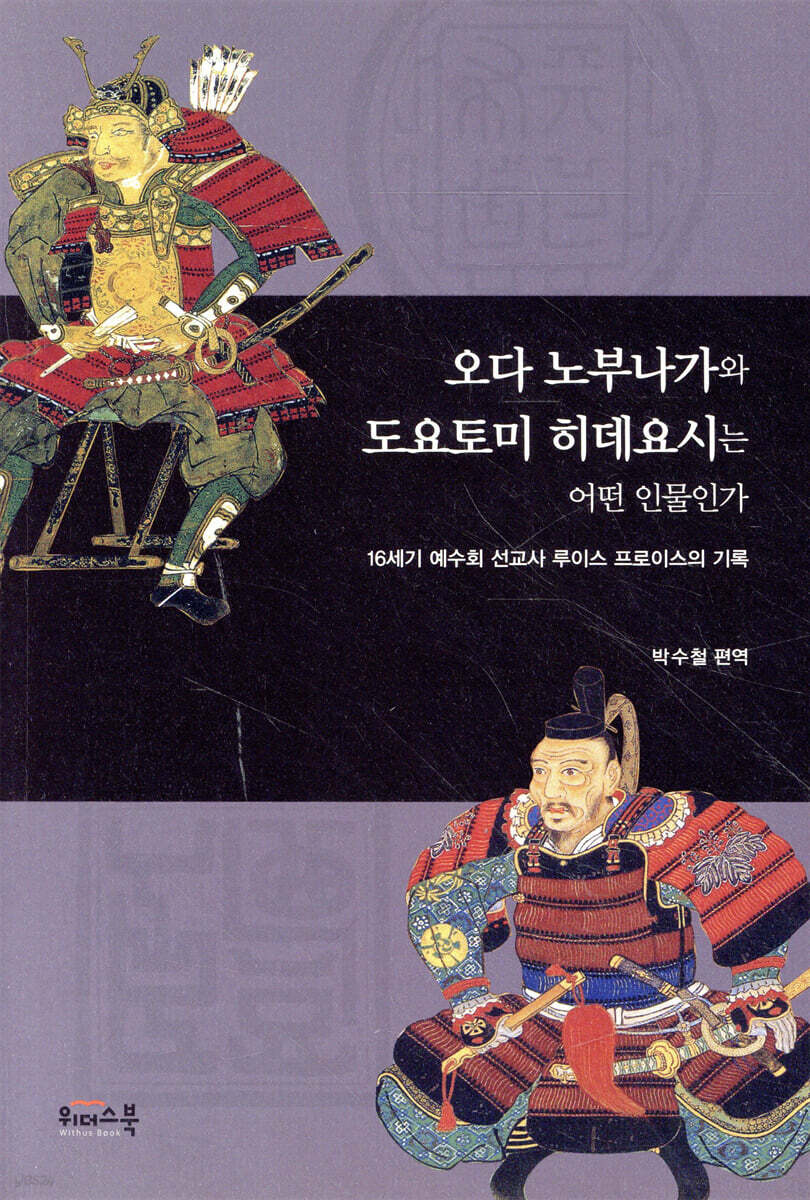
Who were Oda Nobunaga and Toyotomi Hideyoshi?
 |
Description
Book Introduction
This translation mainly refers to 『Frois's History of Japan』 published by Chuo Koron Publishing Co., Ltd. in Japan, but also to two books published in Korea: 『Records of the Imjin War - The Imjin War as Seen by Louis Frois』, 『The Imjin War and Toyotomi Hideyoshi Revisited through Frois's 『History of Japan』, and Robin D.
Refer to Gill's translation (Topsy-Turvy 1585 -a translation and explication of Luis Frois SJ's TRATADO listing 611 ways Europeans & Japanese are contrary-, Paraverse press, 2004).
In particular, to avoid duplicate translations with two books published domestically, the part after the Imjin War was omitted, and above all, the book was composed primarily of content necessary for understanding the personalities of Nobunaga and Hideyoshi and Japanese society at the time.
Refer to Gill's translation (Topsy-Turvy 1585 -a translation and explication of Luis Frois SJ's TRATADO listing 611 ways Europeans & Japanese are contrary-, Paraverse press, 2004).
In particular, to avoid duplicate translations with two books published domestically, the part after the Imjin War was omitted, and above all, the book was composed primarily of content necessary for understanding the personalities of Nobunaga and Hideyoshi and Japanese society at the time.
index
Oda Nobunaga's side
Part 1: From Gifu to Kyoto
Chapter 1.
Cheonhapomu
Unification of Owari and Mino
Go up to Kyoto
Chapter 2.
Missionaries in Kyoto
First meeting with a missionary
Buddhist forces attack Christianity
Missionaries Go to Climate
Part 2 Expansion_Azuchi Castle
Chapter 1.
Nobunaga's enemy forces
Fighting the temple forces
banish the shogun
Chapter 2.
Azuchi Castle
Establish a monastery
establish a government
Part 3: Incomplete_Remaining Tasks
Chapter 1.
Crisis and Stability
Overcoming the rebellion
Religious debates erupt in Azuchi
Patrol officers in Kyoto and Azuchi
Nobunaga, seeking to become a god
Chapter 2.
Nobunaga's death
Destroy the Takeda
Die at Honnoji
The emergence of Toyotomi Hideyoshi
Toyotomi Hideyoshi side
Part 1: Success_The Lord of the World
Chapter 1.
Warrior: From commoner to warrior
A man named Hideyoshi
Chapter 2.
The Path to Succession
Promote Nobunaga's grandson
Fighting Tokugawa Ieyasu
Chapter 3.
Creation of a regime
Eliminate the soldiers
ascend to the position of Gwanbaek
Building a castle in Osaka
Part 2 Exchange_Jesuits
Chapter 1.
Jesuits in the Kokinai region
Meeting the Japanese Vice President
Granting the Jesuits a missionary charter
What happened in Sakai
Chapter 2.
Jesuits in the Kyushu region
A few things to do in Kyoto
Departure to Kyushu
The first European ship I saw
Promote the expulsion of missionaries
Part 3: Unification_The Emperor and Reign
Chapter 1.
Emperor and Unification
Welcome the Emperor
Unify Japan
Chapter 2.
Diplomacy and War
Envoy of the Viceroy of India
Receiving the envoy in Kyoto
Building a castle in Nagoya
Kyoto City Center and Major Buildings
Part 1: From Gifu to Kyoto
Chapter 1.
Cheonhapomu
Unification of Owari and Mino
Go up to Kyoto
Chapter 2.
Missionaries in Kyoto
First meeting with a missionary
Buddhist forces attack Christianity
Missionaries Go to Climate
Part 2 Expansion_Azuchi Castle
Chapter 1.
Nobunaga's enemy forces
Fighting the temple forces
banish the shogun
Chapter 2.
Azuchi Castle
Establish a monastery
establish a government
Part 3: Incomplete_Remaining Tasks
Chapter 1.
Crisis and Stability
Overcoming the rebellion
Religious debates erupt in Azuchi
Patrol officers in Kyoto and Azuchi
Nobunaga, seeking to become a god
Chapter 2.
Nobunaga's death
Destroy the Takeda
Die at Honnoji
The emergence of Toyotomi Hideyoshi
Toyotomi Hideyoshi side
Part 1: Success_The Lord of the World
Chapter 1.
Warrior: From commoner to warrior
A man named Hideyoshi
Chapter 2.
The Path to Succession
Promote Nobunaga's grandson
Fighting Tokugawa Ieyasu
Chapter 3.
Creation of a regime
Eliminate the soldiers
ascend to the position of Gwanbaek
Building a castle in Osaka
Part 2 Exchange_Jesuits
Chapter 1.
Jesuits in the Kokinai region
Meeting the Japanese Vice President
Granting the Jesuits a missionary charter
What happened in Sakai
Chapter 2.
Jesuits in the Kyushu region
A few things to do in Kyoto
Departure to Kyushu
The first European ship I saw
Promote the expulsion of missionaries
Part 3: Unification_The Emperor and Reign
Chapter 1.
Emperor and Unification
Welcome the Emperor
Unify Japan
Chapter 2.
Diplomacy and War
Envoy of the Viceroy of India
Receiving the envoy in Kyoto
Building a castle in Nagoya
Kyoto City Center and Major Buildings
Publisher's Review
What about Nobunaga and Hideyoshi?
16th century Japanese society was a time of chaos, division, and war, collectively known as the Sengoku period.
Many 'warlords' with diverse backgrounds and characteristics fought fiercely against each other as they spread their power across the country.
Even among them, there were temple powers based on the common people, such as the Honganji Temple, which was based in Osaka, in addition to the samurai.
This Warring States period came to an end in the late 16th century under Oda Nobunaga and his successor, Toyotomi Hideyoshi.
So, what kind of people were Oda Nobunaga and Toyotomi Hideyoshi, who were able to overcome the unprecedented chaos of the Warring States period and unify it?
During the Edo period, the Japanese people created the following haikai, comparing them to three figures: Nobunaga, Hideyoshi, and Tokugawa Ieyasu, who succeeded Hideyoshi in taking control of Japan.
If you don't cry, I'll kill you, cuckoo
If you don't cry, I'll make you cry, cuckoo
If you don't cry, don't wait until you cry, cuckoo
Haikai is a collective literary style that emphasizes playfulness derived from orthodox renga, and is the origin of the later perfected haiku. The first verse refers to Nobunaga, the second to Hideyoshi, and the third to Ieyasu.
Through this haikai consisting of 5, 7, and 5 verses, the people of the Edo period beautifully expressed Nobunaga, who opposed the existing authority, denied it, and pushed through his will 'through coercion and violence' (by not killing); Hideyoshi, who achieved his goal 'by mobilizing all kinds of skills and means' (by making people cry); and Ieyasu, who achieved what he wanted 'by enduring to the end' (by not waiting until he cried) even in difficult adversities.
It would be impossible to encapsulate the personalities of these three people better in one sentence.
Motivation for translation
Furthermore, 『Frois's History of Japan』, which served as the basis for writing this book, was a textbook for a study group that the editor and translator used to teach Japanese to graduate and undergraduate students when he was appointed to the Department of History at Chonnam National University in the early to mid-2000s.
I didn't initially intend to translate this book, but as I read it, I realized that it contained a lot of interesting information about Nobunaga and Hideyoshi, so I thought it would be a good idea to introduce it widely.
Moreover, Frois's perspective on 16th-century Japanese society as a foreigner was also very stimulating to me, who specializes in this era as a "foreign historian."
Scope of translation
This translation mainly refers to 『Frois's History of Japan』 published by Chuo Koron Publishing Co., Ltd. in Japan, but also to two books published in Korea: 『Records of the Imjin War - The Imjin War as Seen by Louis Frois』, 『The Imjin War and Toyotomi Hideyoshi Revisited through Frois's 『History of Japan』, and Robin D.
Refer to Gill's translation (Topsy-Turvy 1585 -a translation and explication of Luis Frois SJ's TRATADO listing 611 ways Europeans & Japanese are contrary-, Paraverse press, 2004).
In particular, to avoid duplicate translations with two books published domestically, the part after the Imjin War was omitted, and above all, the book was composed primarily of content necessary for understanding the personalities of Nobunaga and Hideyoshi and Japanese society at the time.
16th century Japanese society was a time of chaos, division, and war, collectively known as the Sengoku period.
Many 'warlords' with diverse backgrounds and characteristics fought fiercely against each other as they spread their power across the country.
Even among them, there were temple powers based on the common people, such as the Honganji Temple, which was based in Osaka, in addition to the samurai.
This Warring States period came to an end in the late 16th century under Oda Nobunaga and his successor, Toyotomi Hideyoshi.
So, what kind of people were Oda Nobunaga and Toyotomi Hideyoshi, who were able to overcome the unprecedented chaos of the Warring States period and unify it?
During the Edo period, the Japanese people created the following haikai, comparing them to three figures: Nobunaga, Hideyoshi, and Tokugawa Ieyasu, who succeeded Hideyoshi in taking control of Japan.
If you don't cry, I'll kill you, cuckoo
If you don't cry, I'll make you cry, cuckoo
If you don't cry, don't wait until you cry, cuckoo
Haikai is a collective literary style that emphasizes playfulness derived from orthodox renga, and is the origin of the later perfected haiku. The first verse refers to Nobunaga, the second to Hideyoshi, and the third to Ieyasu.
Through this haikai consisting of 5, 7, and 5 verses, the people of the Edo period beautifully expressed Nobunaga, who opposed the existing authority, denied it, and pushed through his will 'through coercion and violence' (by not killing); Hideyoshi, who achieved his goal 'by mobilizing all kinds of skills and means' (by making people cry); and Ieyasu, who achieved what he wanted 'by enduring to the end' (by not waiting until he cried) even in difficult adversities.
It would be impossible to encapsulate the personalities of these three people better in one sentence.
Motivation for translation
Furthermore, 『Frois's History of Japan』, which served as the basis for writing this book, was a textbook for a study group that the editor and translator used to teach Japanese to graduate and undergraduate students when he was appointed to the Department of History at Chonnam National University in the early to mid-2000s.
I didn't initially intend to translate this book, but as I read it, I realized that it contained a lot of interesting information about Nobunaga and Hideyoshi, so I thought it would be a good idea to introduce it widely.
Moreover, Frois's perspective on 16th-century Japanese society as a foreigner was also very stimulating to me, who specializes in this era as a "foreign historian."
Scope of translation
This translation mainly refers to 『Frois's History of Japan』 published by Chuo Koron Publishing Co., Ltd. in Japan, but also to two books published in Korea: 『Records of the Imjin War - The Imjin War as Seen by Louis Frois』, 『The Imjin War and Toyotomi Hideyoshi Revisited through Frois's 『History of Japan』, and Robin D.
Refer to Gill's translation (Topsy-Turvy 1585 -a translation and explication of Luis Frois SJ's TRATADO listing 611 ways Europeans & Japanese are contrary-, Paraverse press, 2004).
In particular, to avoid duplicate translations with two books published domestically, the part after the Imjin War was omitted, and above all, the book was composed primarily of content necessary for understanding the personalities of Nobunaga and Hideyoshi and Japanese society at the time.
GOODS SPECIFICS
- Date of publication: September 15, 2017
- Page count, weight, size: 444 pages | 179*251*30mm
- ISBN13: 9788996235088
- ISBN10: 8996235083
You may also like
카테고리
korean


korean

![GQ KOREA Mark (Monthly): December [2025]](http://librairie.coreenne.fr/cdn/shop/files/8ef265dbbfbf186523ed75ba7319009d.jpg?v=1765340328&width=3840)


