

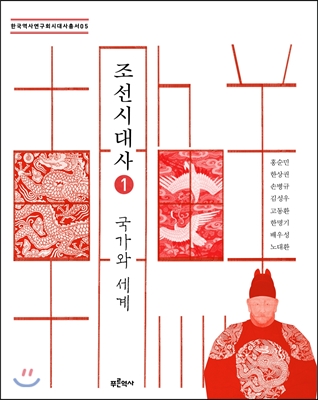
Joseon Dynasty History 1
 |
Description
Book Introduction
Dreaming of a history book where the present and the past communicate,
Open another window to read history!
The Korean History Research Association, which was founded to contribute to the democratization and independence of Korean society through the establishment of scientific and practical historiography and has now established itself as a representative academic society of Korean history with over 700 participating scholars, and Blue History, which has opened new horizons in the popularization of history, are jointly publishing the 'Korean History Research Association Historical Series'.
The 'Korean History Research Association's Historical Series' is scheduled to be published in 10 volumes (2 each on ancient, Goryeo, Joseon, modern, and contemporary periods) with the participation of leading scholars in the field of history, and will take its first step with the publication of 'History of the Joseon Dynasty 1 - State and World' and 'History of the Joseon Dynasty 2 - Humans and Society'.
Instead of covering all fields of the entire era, the 'Korean History Research Society's Historical Series' presents a new framework for viewing each era, and based on this, selects sub-topics and compresses and organizes the academic research results accumulated over time, attempting to provide an in-depth reading of history.
Open another window to read history!
The Korean History Research Association, which was founded to contribute to the democratization and independence of Korean society through the establishment of scientific and practical historiography and has now established itself as a representative academic society of Korean history with over 700 participating scholars, and Blue History, which has opened new horizons in the popularization of history, are jointly publishing the 'Korean History Research Association Historical Series'.
The 'Korean History Research Association's Historical Series' is scheduled to be published in 10 volumes (2 each on ancient, Goryeo, Joseon, modern, and contemporary periods) with the participation of leading scholars in the field of history, and will take its first step with the publication of 'History of the Joseon Dynasty 1 - State and World' and 'History of the Joseon Dynasty 2 - Humans and Society'.
Instead of covering all fields of the entire era, the 'Korean History Research Society's Historical Series' presents a new framework for viewing each era, and based on this, selects sub-topics and compresses and organizes the academic research results accumulated over time, attempting to provide an in-depth reading of history.
- You can preview some of the book's contents.
Preview
index
Political Operations and the Trend of Royal Power: An Overview of Joseon Political History Based on the Changing Status of Royal Power
Early Joseon: System Establishment Period | Mid Joseon: Purges and Factional Politics | Late Joseon: Restoration of the State and Tangpyeong Politics |
Late Joseon Dynasty: Sedo politics
Education and Justice - How to Govern the People
Establishing a system of governance centered on education | Transforming society into one that values criminal justice | Raising awareness of citizens' rights
Farmers' Obligations, State Responsibilities - Finance from a National Redistribution Perspective
Principles of National Economic Management | Reorganization of the Late Joseon Dynasty National Tax System | Realizing the Financial System
The Shackles of Bloodline, the Bindings of Status: The Emergence of the Yangban Class and the Changing Class Structure in the Joseon Dynasty
Hamyang, Gyeongsang Province, immediately following the Imjin War | A society striving for national equality | A duet of changing social status
Exchange, Markets, and Cities - The Birth and Development of the Joseon Market
Forms of Electric Exchange in Joseon | Development of Markets in the Late Joseon Dynasty | Growth of Cities
International Relations and War: The Troubled Diplomatic History of Joseon, the "Caught Nation"
Ming-Ming relations and perception of the Ming Dynasty in the 15th and 16th centuries | Joseon-Japan relations in the 15th and 16th centuries | Joseon-Jurchen relations in the 15th and 16th centuries | The prelude to the Imjin War and the transition from the Ming to the Qing | The transition from the Ming to the Qing and the reorganization of East Asian order
The Image of the World Drawn by Joseon People - From Sinocentrism to the Wide World
A New Frontier in Reality | Huai Thought and the Chinese Worldview | Western World Maps and the Horizons of World Perception | Western World Maps and the Joseon Worldview
The global historical trend of openness and Joseon's choices: isolation and opening of ports
The East Asian International Order and Its Changes in the 17th and 18th Centuries | The Collapse of the East Asian International Order and Joseon in the First Half of the 19th Century | Joseon's Opening of the World in the Late 19th Century
Early Joseon: System Establishment Period | Mid Joseon: Purges and Factional Politics | Late Joseon: Restoration of the State and Tangpyeong Politics |
Late Joseon Dynasty: Sedo politics
Education and Justice - How to Govern the People
Establishing a system of governance centered on education | Transforming society into one that values criminal justice | Raising awareness of citizens' rights
Farmers' Obligations, State Responsibilities - Finance from a National Redistribution Perspective
Principles of National Economic Management | Reorganization of the Late Joseon Dynasty National Tax System | Realizing the Financial System
The Shackles of Bloodline, the Bindings of Status: The Emergence of the Yangban Class and the Changing Class Structure in the Joseon Dynasty
Hamyang, Gyeongsang Province, immediately following the Imjin War | A society striving for national equality | A duet of changing social status
Exchange, Markets, and Cities - The Birth and Development of the Joseon Market
Forms of Electric Exchange in Joseon | Development of Markets in the Late Joseon Dynasty | Growth of Cities
International Relations and War: The Troubled Diplomatic History of Joseon, the "Caught Nation"
Ming-Ming relations and perception of the Ming Dynasty in the 15th and 16th centuries | Joseon-Japan relations in the 15th and 16th centuries | Joseon-Jurchen relations in the 15th and 16th centuries | The prelude to the Imjin War and the transition from the Ming to the Qing | The transition from the Ming to the Qing and the reorganization of East Asian order
The Image of the World Drawn by Joseon People - From Sinocentrism to the Wide World
A New Frontier in Reality | Huai Thought and the Chinese Worldview | Western World Maps and the Horizons of World Perception | Western World Maps and the Joseon Worldview
The global historical trend of openness and Joseon's choices: isolation and opening of ports
The East Asian International Order and Its Changes in the 17th and 18th Centuries | The Collapse of the East Asian International Order and Joseon in the First Half of the 19th Century | Joseon's Opening of the World in the Late 19th Century
Publisher's Review
For a history of communication
The compilation of the Korean History Research Society's Historical Series began in 2002.
Afterwards, the 'Korean History Research Society Historical Series Compilation Committee' was formed, writing principles and a compilation schedule were established, and teams were formed for each era, including ancient, Goryeo, Joseon, modern, and contemporary times, to prepare a plan, select appropriate writers, and begin writing.
It was a arduous process, with nearly 60 authors participating and working collaboratively to produce 10 books.
From coordinating and gathering the opinions of various authors to reviewing and revising the completed manuscripts several times by team, heated discussions took place.
This process also makes us look back on our present times.
As symbolized by the fall of the Berlin Wall in the past, the world entered the 21st century moving toward reconciliation and exchange rather than confrontation between systems and ideologies, as the Cold War ended with the reform and opening of Eastern European socialist countries.
The Korean Peninsula also moved toward reconciliation, exchange, and cooperation between the South and the North, starting with the visit of Chairman Chung Ju-young of Hyundai to the North in 1998 and the inter-Korean summit in 2000.
But now, 15 years into the 21st century, the world is once again heading towards conflict.
Conflicts and disputes within the Middle East, such as the conflict between Israel and Palestine, the confrontation between the United States and the Islamic camp including Al Qaeda, the Syrian civil war and the emergence of an Islamic state, and the conflict between Russia and Ukraine, continue, and historical and territorial disputes are fiercely unfolding in Northeast Asia.
The difference from before is that it is more of a religious and civilizational conflict than an ideological one.
So what about Korean society?
Unfortunately, Korean society is still plagued by anachronistic ideologies and regional conflicts, while neoliberalism is rapidly leading to economic and social polarization, deepening conflicts between generations and classes.
And even the safety of everyday life is threatened by the shallow profit logic of capitalism and the chains of political and social corruption.
The Sewol ferry disaster, which killed 304 people, including 250 young students, can be said to be an incident that symbolically represents the contradictions in Korean society.
In a society where courtesy and consideration for humanity have vanished, where the safety and welfare that should be the state's responsibility are now left to the citizens themselves, where justice has vanished and trust and hope are replaced by distrust and resignation, what role can history play? This "Korean History Research Society Historical Series" hopes to contribute to the systematization and communication of Korean history.
History has been said to be 'a conversation between the present and the past.'
It is about examining the past from the present standpoint and looking forward to the future based on that.
To achieve this, historians must constantly rewrite history.
With this in mind, the Korean History Research Society's Historical Series examines Korean history from ancient times to the present day from a new perspective.
The history of the Joseon Dynasty, not a history of fiction and virtuality
For a history of evidence and facts
Recently, many books that can be considered educational books about the Joseon Dynasty have been published.
Along with this, video productions such as documentary educational programs and historical dramas based on history are also providing support.
This phenomenon has emerged thanks to the ease of access to various materials, including original and translated versions of chronicles such as the Annals of the Joseon Dynasty, which are now available online. It is also a result of the growing interest of the general public in history and their mutual influence.
While the growing interest and desire for culture among the general public and the resulting production of a large number of cultural products, videos, and other educational materials are welcome phenomena, there are also concerns.
Historical narrative is a combination of data and interpretation of facts, built on a foundation of empirical evidence that reconstructs facts.
A story that has not been verified, no matter how interesting, cannot be called history, and a narrative that is not supported by accurate historical criticism and interpretation cannot be included in the category of history.
However, around us today, there are countless cases of fiction and illusion that run counter to historical facts and truth being disguised as history and spread.
Mistaking something that is not history for history cannot but have great repercussions.
16 authorities from various fields of academia,
The Joseon Dynasty as viewed through the framework of individual-society-state-world
These circumstances, both within and outside the scope of research, have given scholars studying the Joseon Dynasty a sense of obligation to answer the questions of what history is and how to understand and describe the Joseon Dynasty.
Researchers specializing in the Joseon Dynasty belonging to the Medieval 2 Division of the Korean History Research Association, who wrote ≪History of the Joseon Dynasty 1 - State and World≫ (Hong Sun-min, Han Sang-kwon, Son Byeong-gyu, Kim Seong-woo, Ko Dong-hwan, Han Myeong-gi, Bae Woo-seong, Noh Dae-hwan) and ≪History of the Joseon Dynasty 2 - Humans and Society≫ (Kim Hoon-sik, Ko Yeong-jin, Jeong Jin-yeong, Lee Hae-jun, Kim Geon-tae, Jeong Yeon-sik, Kim Ho, Han Hee-sook), decided to examine the Joseon Dynasty centered on the framework of individual (family) - society - state - world, and selected 16 subtopics that fit each category and put them into two books.
For example, among the subtopics, [The Formation of a Neo-Confucian Man] and [From Family to Clan] look at the Joseon Dynasty from the individual (family) level; [The Formation of an Academic Network] and [Local Nobility Becomes the Ruler of the Rural Area] look at the Joseon Dynasty from the social level; [The Progress of Political Operations and Royal Power] and [Education and Criminal Justice] look at the Joseon Dynasty from the national level; and [International Relations and War] and [The Image of the World Drawn by Joseon People] look at the Joseon Dynasty from the global level.
At first glance, it may seem unsystematic, but the book is written in a way that allows readers to come up with a single 'Joseon Dynasty theme' after reading the entire book.
Just like Robert Darnton's classic work in Western history, "The Cat Massacre."
Therefore, this book is not an introductory or comprehensive history like existing books covering the history of the times.
In order to understand the reality of the Joseon Dynasty more deeply, experts in each field have condensed and organized the academic research results accumulated over time to look at the Joseon Dynasty through the windows of individuals (families), society, the nation, and the world.
It can be said that the authors' common understanding is based on their desire to look at the Joseon Dynasty in a new way, going beyond the existing perspective.
This book, which develops and deeply describes subtopics that cannot be covered in existing introductory books or general histories under a new explanatory framework, will serve as a valuable guide for understanding the Joseon Dynasty.
The composition and contents of ≪History of the Joseon Dynasty 1 - The State and the World≫ and ≪History of the Joseon Dynasty 2 - Humans and Society≫ are as follows.
Joseon Dynasty History 1 - The Structure and Content of the Nation and the World
In 'History of the Joseon Dynasty 1', the political system and class relations of Joseon, as well as Joseon's perception of the world and war, are examined as subtopics under the categories of 'nation' and 'world'.
[Political Operations and Trends in Royal Power] provides an overview of Joseon political history according to the changes in the status of royal power.
Politics is achieved through power.
The early period would be from the time when a new social force called the Sinheung Sadaebu emerged at the end of the Goryeo Dynasty and established a new nation called Joseon, to the reign of King Seongjong, who put an end to the establishment of the system by promulgating Gyeongguk Daejeon; the middle period would be from the time when the political force called the Sarim faction emerged after the reign of King Seongjong, and through the Sahwa, they created and maintained a form of political operation called factional politics; the late period would be from the time when the Hwanguk appeared when King Sukjong ascended the throne and the framework of factional politics collapsed, to the reign of King Jeongjo, when Tangpyeong politics was formed and operated, in which the king was the central subject of political operation; and the final period would be from the reign of King Sunjo, when the center of political power moved from the king to a small number of influential families in Seoul, and the political power moved to and was exercised by the king's biological father, Heungseon Daewongun, around the 10th year of the reign of King Gojong.
This paper examines the political history of Joseon by examining how the content of political operations changed with the change in the status of royal authority during these four periods.
[Education and Penalty] summarized Joseon's view on punishment regarding how to govern the people.
The Joseon Dynasty, which adopted Neo-Confucianism as its national ideology, placed greater importance on the rule of courtesy and education than on the rule of law through laws and punishments.
The ultimate goal of using punishment was to fully promote virtue and ultimately create a society where punishment was no longer necessary.
This is the concept of Deokjuhyeongbo, which states that virtue is central and punishment is merely a tool to help education.
A characteristic of the criminal administration in pre-modern society was that the application of punishment was differentiated based on social status.
The right to legal equality, which states that all people are equal before the law, was only established in modern society when the class system was abolished.
It was only in modern society that the rule of law became completely independent from the rule of deposit, and the rule of law was established.
[Farmers' Duties, State Responsibilities] provides an overview of Joseon's finances from the perspective of national redistribution.
In all areas within the king's public power, he rules over the land, the people who live there, and the produce they harvest.
Based on this rule, the king distributes land to the people to support their livelihood, and the people repay this favor by providing the king with labor or products.
In other words, the state, symbolized by royal authority, must take responsibility for the livelihood of its people, and the people, as a matter of course, must contribute a portion of their production and fulfill their national service obligations.
The system for running the national economy of the Joseon Dynasty was based on these principles.
[The Shackles of Bloodline, the Bindings of Status] examines the emergence of the yangban class and changes in the status structure during the Joseon Dynasty.
The Joseon Dynasty did not define social status or establish a social status system through a legal code, so it is very difficult to organize it clearly.
The conflict between the 'four-class theory' and the 'Yangcheonje theory' in the early Joseon Dynasty, the problem of interpreting the aristocratic class in the mid-Joseon Dynasty, and the tense tension between the 'theory of dismantling the class system' and the 'theory of strengthening the class system' in the late Joseon Dynasty clearly show this situation.
Here, based on the recognition of the existence of these theories, we have outlined the changing aspects of the Joseon Dynasty's class system, which lasted for an unprecedentedly long time for a single dynasty.
[Exchange, Market, and City] summarizes the birth and development of the Joseon market.
The forms of education in pre-modern Joseon society consisted of three types: reciprocity, national redistribution, and market economy.
In the past, reciprocity and national redistribution were the dominant forms of exchange, but after the Imjin War, agricultural productivity increased and rural surpluses entered the market, leading to the growth of rural markets.
Based on the growth of rural markets, port and urban markets grew together, and international trade with China and Japan also became active.
With the advancement of agricultural commodity production in the late Joseon Dynasty and the growth of nationwide markets, market exchange based on profit became the dominant form of exchange.
[International Relations and War] tells the arduous diplomatic history of Joseon, the 'trapped nation.'
In the process of conducting diplomatic negotiations and implementing policies with specific countries among the Ming, Japan, and Jurchen, Joseon had to simultaneously consider the influence and repercussions that the direction of the negotiations and policies might have on other countries.
How did Joseon cope with this challenging task? This book examines the true nature of Joseon's relationships with its neighbors, from the Yuan-Ming transition in the late 14th century to the Ming-Qing transition in the mid-17th century. It also examines the nature and aftermath of the wars that followed the breakdown of those relationships, taking into account the perspective of the three East Asian kingdoms as a whole.
[Image of the World Drawn by Joseon People] provides an overview of the worldview of Joseon people, from Sinocentrism to the wider world.
Like everyone else, the Joseon people also imagined places they had never been to.
According to traditional Chinese ideas, the Central Plains is at the center of the flat world, and its culture is the essence of human culture.
The Korean people also inherited this idea and considered themselves to be a small country.
But as European powers approached East Asia, new variables emerged.
How did the Korean people respond to this situation?
Many Joseon people focused on the 'relationship' between the two.
This book provides an overview of how the Joseon people viewed "China" and how they attempted to construct an image of the world by arranging Chinese ideas with the wider world.
[The World Historical Flow of Openness and Joseon's Choice] examines Joseon's relationship with the world at the end of the Joseon Dynasty through isolation and the opening of ports.
After the founding of the Ming Dynasty, a China-centered international order was established in East Asia through tribute and investiture.
Each country in East Asia was connected through tributary and friendly relations with China as the center.
Although formal negotiations continued between the countries, mutual exchanges were not active.
This East Asian international order revealed its limitations as East Asian countries developed socioeconomically and the movement for free trade became more active.
In particular, as European countries gained access to East Asia as a result of the great voyages, conflicts surrounding openness intensified.
Openness was an inevitable trend, but the ruling classes of each East Asian country sought to control foreign relations.
Entering the 19th century, Joseon also minimized contact with China and Japan.
The compilation of the Korean History Research Society's Historical Series began in 2002.
Afterwards, the 'Korean History Research Society Historical Series Compilation Committee' was formed, writing principles and a compilation schedule were established, and teams were formed for each era, including ancient, Goryeo, Joseon, modern, and contemporary times, to prepare a plan, select appropriate writers, and begin writing.
It was a arduous process, with nearly 60 authors participating and working collaboratively to produce 10 books.
From coordinating and gathering the opinions of various authors to reviewing and revising the completed manuscripts several times by team, heated discussions took place.
This process also makes us look back on our present times.
As symbolized by the fall of the Berlin Wall in the past, the world entered the 21st century moving toward reconciliation and exchange rather than confrontation between systems and ideologies, as the Cold War ended with the reform and opening of Eastern European socialist countries.
The Korean Peninsula also moved toward reconciliation, exchange, and cooperation between the South and the North, starting with the visit of Chairman Chung Ju-young of Hyundai to the North in 1998 and the inter-Korean summit in 2000.
But now, 15 years into the 21st century, the world is once again heading towards conflict.
Conflicts and disputes within the Middle East, such as the conflict between Israel and Palestine, the confrontation between the United States and the Islamic camp including Al Qaeda, the Syrian civil war and the emergence of an Islamic state, and the conflict between Russia and Ukraine, continue, and historical and territorial disputes are fiercely unfolding in Northeast Asia.
The difference from before is that it is more of a religious and civilizational conflict than an ideological one.
So what about Korean society?
Unfortunately, Korean society is still plagued by anachronistic ideologies and regional conflicts, while neoliberalism is rapidly leading to economic and social polarization, deepening conflicts between generations and classes.
And even the safety of everyday life is threatened by the shallow profit logic of capitalism and the chains of political and social corruption.
The Sewol ferry disaster, which killed 304 people, including 250 young students, can be said to be an incident that symbolically represents the contradictions in Korean society.
In a society where courtesy and consideration for humanity have vanished, where the safety and welfare that should be the state's responsibility are now left to the citizens themselves, where justice has vanished and trust and hope are replaced by distrust and resignation, what role can history play? This "Korean History Research Society Historical Series" hopes to contribute to the systematization and communication of Korean history.
History has been said to be 'a conversation between the present and the past.'
It is about examining the past from the present standpoint and looking forward to the future based on that.
To achieve this, historians must constantly rewrite history.
With this in mind, the Korean History Research Society's Historical Series examines Korean history from ancient times to the present day from a new perspective.
The history of the Joseon Dynasty, not a history of fiction and virtuality
For a history of evidence and facts
Recently, many books that can be considered educational books about the Joseon Dynasty have been published.
Along with this, video productions such as documentary educational programs and historical dramas based on history are also providing support.
This phenomenon has emerged thanks to the ease of access to various materials, including original and translated versions of chronicles such as the Annals of the Joseon Dynasty, which are now available online. It is also a result of the growing interest of the general public in history and their mutual influence.
While the growing interest and desire for culture among the general public and the resulting production of a large number of cultural products, videos, and other educational materials are welcome phenomena, there are also concerns.
Historical narrative is a combination of data and interpretation of facts, built on a foundation of empirical evidence that reconstructs facts.
A story that has not been verified, no matter how interesting, cannot be called history, and a narrative that is not supported by accurate historical criticism and interpretation cannot be included in the category of history.
However, around us today, there are countless cases of fiction and illusion that run counter to historical facts and truth being disguised as history and spread.
Mistaking something that is not history for history cannot but have great repercussions.
16 authorities from various fields of academia,
The Joseon Dynasty as viewed through the framework of individual-society-state-world
These circumstances, both within and outside the scope of research, have given scholars studying the Joseon Dynasty a sense of obligation to answer the questions of what history is and how to understand and describe the Joseon Dynasty.
Researchers specializing in the Joseon Dynasty belonging to the Medieval 2 Division of the Korean History Research Association, who wrote ≪History of the Joseon Dynasty 1 - State and World≫ (Hong Sun-min, Han Sang-kwon, Son Byeong-gyu, Kim Seong-woo, Ko Dong-hwan, Han Myeong-gi, Bae Woo-seong, Noh Dae-hwan) and ≪History of the Joseon Dynasty 2 - Humans and Society≫ (Kim Hoon-sik, Ko Yeong-jin, Jeong Jin-yeong, Lee Hae-jun, Kim Geon-tae, Jeong Yeon-sik, Kim Ho, Han Hee-sook), decided to examine the Joseon Dynasty centered on the framework of individual (family) - society - state - world, and selected 16 subtopics that fit each category and put them into two books.
For example, among the subtopics, [The Formation of a Neo-Confucian Man] and [From Family to Clan] look at the Joseon Dynasty from the individual (family) level; [The Formation of an Academic Network] and [Local Nobility Becomes the Ruler of the Rural Area] look at the Joseon Dynasty from the social level; [The Progress of Political Operations and Royal Power] and [Education and Criminal Justice] look at the Joseon Dynasty from the national level; and [International Relations and War] and [The Image of the World Drawn by Joseon People] look at the Joseon Dynasty from the global level.
At first glance, it may seem unsystematic, but the book is written in a way that allows readers to come up with a single 'Joseon Dynasty theme' after reading the entire book.
Just like Robert Darnton's classic work in Western history, "The Cat Massacre."
Therefore, this book is not an introductory or comprehensive history like existing books covering the history of the times.
In order to understand the reality of the Joseon Dynasty more deeply, experts in each field have condensed and organized the academic research results accumulated over time to look at the Joseon Dynasty through the windows of individuals (families), society, the nation, and the world.
It can be said that the authors' common understanding is based on their desire to look at the Joseon Dynasty in a new way, going beyond the existing perspective.
This book, which develops and deeply describes subtopics that cannot be covered in existing introductory books or general histories under a new explanatory framework, will serve as a valuable guide for understanding the Joseon Dynasty.
The composition and contents of ≪History of the Joseon Dynasty 1 - The State and the World≫ and ≪History of the Joseon Dynasty 2 - Humans and Society≫ are as follows.
Joseon Dynasty History 1 - The Structure and Content of the Nation and the World
In 'History of the Joseon Dynasty 1', the political system and class relations of Joseon, as well as Joseon's perception of the world and war, are examined as subtopics under the categories of 'nation' and 'world'.
[Political Operations and Trends in Royal Power] provides an overview of Joseon political history according to the changes in the status of royal power.
Politics is achieved through power.
The early period would be from the time when a new social force called the Sinheung Sadaebu emerged at the end of the Goryeo Dynasty and established a new nation called Joseon, to the reign of King Seongjong, who put an end to the establishment of the system by promulgating Gyeongguk Daejeon; the middle period would be from the time when the political force called the Sarim faction emerged after the reign of King Seongjong, and through the Sahwa, they created and maintained a form of political operation called factional politics; the late period would be from the time when the Hwanguk appeared when King Sukjong ascended the throne and the framework of factional politics collapsed, to the reign of King Jeongjo, when Tangpyeong politics was formed and operated, in which the king was the central subject of political operation; and the final period would be from the reign of King Sunjo, when the center of political power moved from the king to a small number of influential families in Seoul, and the political power moved to and was exercised by the king's biological father, Heungseon Daewongun, around the 10th year of the reign of King Gojong.
This paper examines the political history of Joseon by examining how the content of political operations changed with the change in the status of royal authority during these four periods.
[Education and Penalty] summarized Joseon's view on punishment regarding how to govern the people.
The Joseon Dynasty, which adopted Neo-Confucianism as its national ideology, placed greater importance on the rule of courtesy and education than on the rule of law through laws and punishments.
The ultimate goal of using punishment was to fully promote virtue and ultimately create a society where punishment was no longer necessary.
This is the concept of Deokjuhyeongbo, which states that virtue is central and punishment is merely a tool to help education.
A characteristic of the criminal administration in pre-modern society was that the application of punishment was differentiated based on social status.
The right to legal equality, which states that all people are equal before the law, was only established in modern society when the class system was abolished.
It was only in modern society that the rule of law became completely independent from the rule of deposit, and the rule of law was established.
[Farmers' Duties, State Responsibilities] provides an overview of Joseon's finances from the perspective of national redistribution.
In all areas within the king's public power, he rules over the land, the people who live there, and the produce they harvest.
Based on this rule, the king distributes land to the people to support their livelihood, and the people repay this favor by providing the king with labor or products.
In other words, the state, symbolized by royal authority, must take responsibility for the livelihood of its people, and the people, as a matter of course, must contribute a portion of their production and fulfill their national service obligations.
The system for running the national economy of the Joseon Dynasty was based on these principles.
[The Shackles of Bloodline, the Bindings of Status] examines the emergence of the yangban class and changes in the status structure during the Joseon Dynasty.
The Joseon Dynasty did not define social status or establish a social status system through a legal code, so it is very difficult to organize it clearly.
The conflict between the 'four-class theory' and the 'Yangcheonje theory' in the early Joseon Dynasty, the problem of interpreting the aristocratic class in the mid-Joseon Dynasty, and the tense tension between the 'theory of dismantling the class system' and the 'theory of strengthening the class system' in the late Joseon Dynasty clearly show this situation.
Here, based on the recognition of the existence of these theories, we have outlined the changing aspects of the Joseon Dynasty's class system, which lasted for an unprecedentedly long time for a single dynasty.
[Exchange, Market, and City] summarizes the birth and development of the Joseon market.
The forms of education in pre-modern Joseon society consisted of three types: reciprocity, national redistribution, and market economy.
In the past, reciprocity and national redistribution were the dominant forms of exchange, but after the Imjin War, agricultural productivity increased and rural surpluses entered the market, leading to the growth of rural markets.
Based on the growth of rural markets, port and urban markets grew together, and international trade with China and Japan also became active.
With the advancement of agricultural commodity production in the late Joseon Dynasty and the growth of nationwide markets, market exchange based on profit became the dominant form of exchange.
[International Relations and War] tells the arduous diplomatic history of Joseon, the 'trapped nation.'
In the process of conducting diplomatic negotiations and implementing policies with specific countries among the Ming, Japan, and Jurchen, Joseon had to simultaneously consider the influence and repercussions that the direction of the negotiations and policies might have on other countries.
How did Joseon cope with this challenging task? This book examines the true nature of Joseon's relationships with its neighbors, from the Yuan-Ming transition in the late 14th century to the Ming-Qing transition in the mid-17th century. It also examines the nature and aftermath of the wars that followed the breakdown of those relationships, taking into account the perspective of the three East Asian kingdoms as a whole.
[Image of the World Drawn by Joseon People] provides an overview of the worldview of Joseon people, from Sinocentrism to the wider world.
Like everyone else, the Joseon people also imagined places they had never been to.
According to traditional Chinese ideas, the Central Plains is at the center of the flat world, and its culture is the essence of human culture.
The Korean people also inherited this idea and considered themselves to be a small country.
But as European powers approached East Asia, new variables emerged.
How did the Korean people respond to this situation?
Many Joseon people focused on the 'relationship' between the two.
This book provides an overview of how the Joseon people viewed "China" and how they attempted to construct an image of the world by arranging Chinese ideas with the wider world.
[The World Historical Flow of Openness and Joseon's Choice] examines Joseon's relationship with the world at the end of the Joseon Dynasty through isolation and the opening of ports.
After the founding of the Ming Dynasty, a China-centered international order was established in East Asia through tribute and investiture.
Each country in East Asia was connected through tributary and friendly relations with China as the center.
Although formal negotiations continued between the countries, mutual exchanges were not active.
This East Asian international order revealed its limitations as East Asian countries developed socioeconomically and the movement for free trade became more active.
In particular, as European countries gained access to East Asia as a result of the great voyages, conflicts surrounding openness intensified.
Openness was an inevitable trend, but the ruling classes of each East Asian country sought to control foreign relations.
Entering the 19th century, Joseon also minimized contact with China and Japan.
GOODS SPECIFICS
- Date of issue: June 25, 2015
- Page count, weight, size: 384 pages | 709g | 153*224*23mm
- ISBN13: 9791156120476
- ISBN10: 1156120470
You may also like
카테고리
korean


korean

![GQ KOREA Mark (Monthly): December [2025]](http://librairie.coreenne.fr/cdn/shop/files/8ef265dbbfbf186523ed75ba7319009d.jpg?v=1765340328&width=3840)


