

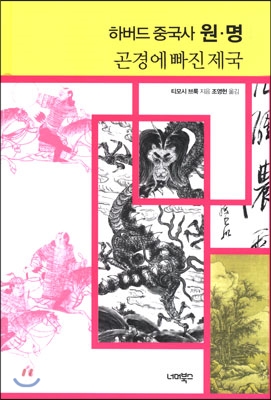
Harvard Chinese History Yuan and Ming
 |
Description
Book Introduction
The Mongol invasion of China in the 1270s was an event that changed the course of Chinese history, as the Confucian empire that had lasted for 1,500 years was suddenly pushed aside by foreign invasion.
The image of China as it had been formed before its unification into the Yuan Dynasty in 1279 disappeared and was no longer visible.
Four centuries later, another invading force from the steppes overthrew the Ming Dynasty.
Harvard's History of China: The Yuan and Ming Dynasties: An Empire in Trouble is a book that illuminates the reality of China between these two dramatic foreign invasions.
Timothy Brook, the author of this book and the editor-in-chief of the six-volume Harvard History of China, states in the preface to the Korean edition, “Since most ordinary people lived lives far removed from philosophy and politics, I also hoped that this Harvard History of China series would sufficiently show the lives and experiences of ordinary people.”
This book traces the energy and vicissitudes of life in the Yuan-Ming era through paintings, diverse episodes, and vibrant voices, unfolding the history of the time like a story.
As the title, "An Empire in Trouble," suggests, the book interestingly begins with a story of fear.
It was the moment when a dragon appeared in the world called China.
The author interprets countless articles about the appearance of dragons in terms of climate change and natural disasters, bringing them into historical time and space.
This means that it is not only one or more of the many factors that influenced the lives of the rulers and people of the Yuan and Ming dynasties for over 400 years from the 13th to the 17th centuries, but it is also 'strangely' closely related to the numerous political, economic, and social changes that occurred during that period.
Furthermore, the nine "swamps" (the author's metaphor for serious climate disasters and the large-scale catastrophes they cause) presented in Chapter 3 occurred three times in Yuan and six times in Ming. This attention to the climate changes of the Little Ice Age that occurred globally is the highlight of this book.
The image of China as it had been formed before its unification into the Yuan Dynasty in 1279 disappeared and was no longer visible.
Four centuries later, another invading force from the steppes overthrew the Ming Dynasty.
Harvard's History of China: The Yuan and Ming Dynasties: An Empire in Trouble is a book that illuminates the reality of China between these two dramatic foreign invasions.
Timothy Brook, the author of this book and the editor-in-chief of the six-volume Harvard History of China, states in the preface to the Korean edition, “Since most ordinary people lived lives far removed from philosophy and politics, I also hoped that this Harvard History of China series would sufficiently show the lives and experiences of ordinary people.”
This book traces the energy and vicissitudes of life in the Yuan-Ming era through paintings, diverse episodes, and vibrant voices, unfolding the history of the time like a story.
As the title, "An Empire in Trouble," suggests, the book interestingly begins with a story of fear.
It was the moment when a dragon appeared in the world called China.
The author interprets countless articles about the appearance of dragons in terms of climate change and natural disasters, bringing them into historical time and space.
This means that it is not only one or more of the many factors that influenced the lives of the rulers and people of the Yuan and Ming dynasties for over 400 years from the 13th to the 17th centuries, but it is also 'strangely' closely related to the numerous political, economic, and social changes that occurred during that period.
Furthermore, the nine "swamps" (the author's metaphor for serious climate disasters and the large-scale catastrophes they cause) presented in Chapter 3 occurred three times in Yuan and six times in Ming. This attention to the climate changes of the Little Ice Age that occurred globally is the highlight of this book.
- You can preview some of the book's contents.
Preview
index
Preface to the Korean edition
Introduction
1.
The emergence of the dragon
The Dragon Ruler | The Ming Emperors | The Dragons of Europe | The True Nature of Dragons | Historical Significance
2.
administrative system
Unification Strategy | Post Office System | Gangnam and Gangbuk | Administrative Districts | Population Census | Population Movement | Administrative Network
3.
Nine Swamps
Cold wave | Drought | Flood | Locust swarm | Earthquake and volcano | Plague | Famine | Nine swamps | Moral meteorology | Good times
4.
Khan and Emperor
The Yuan Emperor's Succession | The Ming's Despotism | The Hu Youyong Incident | The Jeongnan Incident | The Civil War Incident | The Great Rites Debate | The Crisis of the National Foundation | The Dilemma of Loyalty
5.
economic growth
Agricultural Empire | Transportation | City Empire | Silver Coins | Governing the World and Saving the People | Mental Chaos | The Lost Tiger
6.
family
Kinship Network | Women's Lives | Men's Lives | Hereditary Occupations | Gentleman's Society | Ritual and Property
7.
trust
Thoughts on the Soul | Confucianism, Buddhism, and Taoism | Cosmology | Ideological Autonomy | Sameness and Difference
8.
Goods transaction
Living | Appreciation | Books | Furniture | Ceramics | Calligraphy and Painting | Markets and Tastes
9.
South China Sea
Maritime Trade | Tribute and Trade | Coasts at a Crossroads | The Global Economy of the South China Sea | The Influx of Silver | European Expansion into China | The Return of the Fugitive
10.
Collapse of the name
Various Theories of Responsibility | The Two Swamps of Wanli | The Emergence of the Manchus | The Swamp of Chongzhen | Rebellion | Living to the End
Words that come out
Temperature and precipitation conditions
Nine Swamps
Emperor Chronology
Translator's Note
References
Search
Introduction
1.
The emergence of the dragon
The Dragon Ruler | The Ming Emperors | The Dragons of Europe | The True Nature of Dragons | Historical Significance
2.
administrative system
Unification Strategy | Post Office System | Gangnam and Gangbuk | Administrative Districts | Population Census | Population Movement | Administrative Network
3.
Nine Swamps
Cold wave | Drought | Flood | Locust swarm | Earthquake and volcano | Plague | Famine | Nine swamps | Moral meteorology | Good times
4.
Khan and Emperor
The Yuan Emperor's Succession | The Ming's Despotism | The Hu Youyong Incident | The Jeongnan Incident | The Civil War Incident | The Great Rites Debate | The Crisis of the National Foundation | The Dilemma of Loyalty
5.
economic growth
Agricultural Empire | Transportation | City Empire | Silver Coins | Governing the World and Saving the People | Mental Chaos | The Lost Tiger
6.
family
Kinship Network | Women's Lives | Men's Lives | Hereditary Occupations | Gentleman's Society | Ritual and Property
7.
trust
Thoughts on the Soul | Confucianism, Buddhism, and Taoism | Cosmology | Ideological Autonomy | Sameness and Difference
8.
Goods transaction
Living | Appreciation | Books | Furniture | Ceramics | Calligraphy and Painting | Markets and Tastes
9.
South China Sea
Maritime Trade | Tribute and Trade | Coasts at a Crossroads | The Global Economy of the South China Sea | The Influx of Silver | European Expansion into China | The Return of the Fugitive
10.
Collapse of the name
Various Theories of Responsibility | The Two Swamps of Wanli | The Emergence of the Manchus | The Swamp of Chongzhen | Rebellion | Living to the End
Words that come out
Temperature and precipitation conditions
Nine Swamps
Emperor Chronology
Translator's Note
References
Search
Into the book
Like most people, Lee Gwang-hwa's story almost ended like this in the spring of 1613.
It was an ordinary story about a man who aspired to become a government official, went into business, and lived well until his death.
His memorial tablet would have been placed in the shrine and would have been the subject of regular ancestral rites.
He would have been remembered among his family for generations to come, and his name would have long been preserved in the family shrine, but eventually he would have been completely forgotten, except for a single page in the genealogy.
But his legacy did not end there, as his tombstones were swept into the everyday goods market.
His tombstone appeared at a large antiques market in Seoul, South Korea, and was then sold as a garden decoration to a furniture store in Toronto, Canada.
I rescued this stone from my garden in 2002 and it has been in my laboratory in Vancouver ever since.
This stele was not elaborately crafted.
The inscription was carved in an uneven script on a surface cut from a large stone slab.
Although some of it was indecipherable due to the long turbulence, it was enough to shed new light on Lee Gwang-hwa's ordinary success story.
The most striking element is the two characters engraved on the top of the stone: the character for 'day' on the left and the character for 'month' on the right.
When these two characters are combined, they become 'Myeong', which means bright, and is the name of the dynasty in which he lived.
Marking the sun and moon on a grave represents a wish to welcome the deceased into the world of the dead and protect them.
Just like he protected the emperor while he was alive.
--- p.266~267
One of them was the “Honilgangnido,” a map from the Yuan Dynasty that was created in Joseon and passed down intact.
This map was created in 1402, and was based on an original map obtained by a Joseon person who went to Ming as an envoy three years earlier.
The creation of this map was largely due to the contributions of the monk Cheongjun, who participated in the land and water ceremony held in Nanjing in 1372 to commemorate the souls of the fallen soldiers.
The only map of Qingjun remaining in China is from 1360, and it extends west only to Burma (present-day Myanmar).
However, on the southeastern coast of Myanmar, it is written that “It takes 60 days from Chennai to Java, 128 days to Malabar, and 200 days to Hormuz.”
Cheongjun's map was titled "Gwangryun River Map."
On this map, a Korean cartographer added Korea to the right, greatly enlarged, and added other Asian countries and Africa to the left.
This left-hand section is likely modeled after an Arab map, as the Saudi Arabian peninsula is strangely elongated, Africa is shrunken, and the Mediterranean and Black Seas are clearly visible.
This map demonstrates that the Chinese of the Yuan and early Ming dynasties possessed a much broader knowledge base than previously thought.
It was an ordinary story about a man who aspired to become a government official, went into business, and lived well until his death.
His memorial tablet would have been placed in the shrine and would have been the subject of regular ancestral rites.
He would have been remembered among his family for generations to come, and his name would have long been preserved in the family shrine, but eventually he would have been completely forgotten, except for a single page in the genealogy.
But his legacy did not end there, as his tombstones were swept into the everyday goods market.
His tombstone appeared at a large antiques market in Seoul, South Korea, and was then sold as a garden decoration to a furniture store in Toronto, Canada.
I rescued this stone from my garden in 2002 and it has been in my laboratory in Vancouver ever since.
This stele was not elaborately crafted.
The inscription was carved in an uneven script on a surface cut from a large stone slab.
Although some of it was indecipherable due to the long turbulence, it was enough to shed new light on Lee Gwang-hwa's ordinary success story.
The most striking element is the two characters engraved on the top of the stone: the character for 'day' on the left and the character for 'month' on the right.
When these two characters are combined, they become 'Myeong', which means bright, and is the name of the dynasty in which he lived.
Marking the sun and moon on a grave represents a wish to welcome the deceased into the world of the dead and protect them.
Just like he protected the emperor while he was alive.
--- p.266~267
One of them was the “Honilgangnido,” a map from the Yuan Dynasty that was created in Joseon and passed down intact.
This map was created in 1402, and was based on an original map obtained by a Joseon person who went to Ming as an envoy three years earlier.
The creation of this map was largely due to the contributions of the monk Cheongjun, who participated in the land and water ceremony held in Nanjing in 1372 to commemorate the souls of the fallen soldiers.
The only map of Qingjun remaining in China is from 1360, and it extends west only to Burma (present-day Myanmar).
However, on the southeastern coast of Myanmar, it is written that “It takes 60 days from Chennai to Java, 128 days to Malabar, and 200 days to Hormuz.”
Cheongjun's map was titled "Gwangryun River Map."
On this map, a Korean cartographer added Korea to the right, greatly enlarged, and added other Asian countries and Africa to the left.
This left-hand section is likely modeled after an Arab map, as the Saudi Arabian peninsula is strangely elongated, Africa is shrunken, and the Mediterranean and Black Seas are clearly visible.
This map demonstrates that the Chinese of the Yuan and early Ming dynasties possessed a much broader knowledge base than previously thought.
--- p.427~428
Publisher's Review
The invasions of the Mongols in the 13th century and the Manchus 400 years later
All triggered by climate change
The first book to depict the Yuan-Ming dynasty in China in one volume, focusing on the issue of the environment.
The Mongol invasion of China in the 1270s was an event that changed the course of Chinese history, as the Confucian empire that had lasted for 1,500 years was suddenly pushed aside by foreign invasion.
The image of China as it had been formed before its unification into the Yuan Dynasty in 1279 disappeared and was no longer visible.
Four centuries later, another invading force from the steppes overthrew the Ming Dynasty.
『Harvard Chinese History: The Yuan and Ming Dynasties: An Empire in Trouble』 is a book that elucidates the reality of China between these two dramatic foreign invasions.
The key to defining the complex dynamics of this period was none other than climate change.
In the 13th century, when Kublai Khan advanced south and conquered China, Asia, like Europe, was in the midst of the Little Ice Age.
Although the Yuan dynasty collapsed after less than a century, Mongol values lived on in the institutions of the Ming dynasty.
When a second severe cold spell and drought swept across the continent in the 1630s, the Ming Dynasty could no longer hold out and was overthrown by the invading Manchus.
Professor Timothy Brook (University of British Columbia, Canada), who captured this period with the unfamiliar issue of "environment," explores the rise of authoritarian politics and the complex and diverse social landscape and commercialization based on an environmental approach, while paying special attention to the extensive economic system of the South China Sea.
These changes not only shaped China's future, but also contributed significantly to laying the foundation for early modern society.
It goes without saying that the 'global historical perspective', which has been a hot topic in the history world recently, is fully incorporated.
Timothy Brook, the author of this book and the editor-in-chief of the six-volume Harvard History of China, states in the preface to the Korean edition, “Since most ordinary people lived lives far removed from philosophy and politics, I also hoped that this Harvard History of China series would sufficiently show the lives and experiences of ordinary people.”
This book traces the energy and vicissitudes of life in the Yuan-Ming era through paintings, diverse episodes, and vibrant voices, unfolding the history of the time like a story.
Professor Cho Young-heon (Department of History Education, Korea University), who translated this book, said, “I am confident that this book will provide the intellectual interest that crosses over Chinese and world history, and the pleasure of reading like a storybook full of human touch,” and called it a rare work that will satisfy both researchers and general readers.
“Weather isn’t the only factor that explains major historical events like the fall of the Ming Dynasty, but it should be a part of the explanation.”
As the title, "An Empire in Trouble," suggests, the book interestingly begins with a story of fear.
It was the moment when a dragon appeared in the world called China.
The author interprets countless articles about the appearance of dragons in terms of climate change and natural disasters, bringing them into historical time and space.
This means that it is not only one or more of the many factors that influenced the lives of the rulers and people of the Yuan and Ming dynasties for over 400 years from the 13th to the 17th centuries, but it is also 'strangely' closely related to the numerous political, economic, and social changes that occurred during that period.
Furthermore, the nine "swamps" (the author's metaphor for serious climate disasters and the large-scale catastrophes they cause) presented in Chapter 3 occurred three times in Yuan and six times in Ming. This attention to the climate changes of the Little Ice Age that occurred globally is the highlight of this book.
The information on the nine swamps, extracted from basic historical sources of Chinese history such as official histories, annals, local records, and various written records, is also significantly consistent with recent meteorological discoveries and research results on age rings, sunspots, glaciers, grapevine growth, and volcanic eruptions, adding to its credibility.
The fact that the Yuan Dynasty's serious natural disasters did not appear during the reign of the energetic Kublai Khan but began after his death, during the chaotic political upheaval of the mid-Yuan Dynasty; that the natural disasters that were severe until the end of the Yuan Dynasty did not occur for nearly a hundred years after the founding of the Ming Dynasty; that two "swamps" occurred during the reign of the Wanli Emperor, who is said to have aggravated the political chaos of the Ming; and that during the Ming Dynasty's last natural disaster, the "Chongzhen Swamp," an unprecedentedly severe famine, cold, floods, earthquakes, epidemics, gusty winds, and locust swarms occurred and spread nationwide, making it difficult to dismiss the simultaneity of social change and climate change as a coincidence.
This book suggests that political changes and peasant rebellions during the fall of the Ming Dynasty had a certain correlation with abnormal climate, but it never leans toward environmental determinism.
The author incorporates various narrative structures, including the history of the Manchu expansion in the northeastern border, the history of the largest rebellion that had swept China since the 14th century, and the history of the collapse of Ming politics.
The author says that although the stories contained in the narrative structure are different, they overlap to form a single history, namely the downfall of the Ming Dynasty.
It is worth considering the observation that “weather is not the only factor that explains these major historical events, but it must be part of the explanation.”
Meanwhile, the author points out the belief that the state should be responsible for the welfare of its people as a characteristic of the Chinese Empire that clearly differs from the European dynasties of the same period.
This belief, rooted in the Confucian principle of reciprocity, required the emperor to always show concern for the people's lives, and officials to do their best to protect and improve their lives.
Nevertheless, a failed dynasty, where the emperor failed to live up to expectations or the officials were too busy filling their own stomachs to properly feed the people, is seen as having lost the Mandate of Heaven, and the story of the 'dragon' is seen as proof of this.
“In the 17th century, the last century of the Ming Dynasty, officials continued to experiment with new policies regarding the gray area between state and economy.
··· They viewed famine relief as a grand plan to improve the quality of life of the people, and called it ‘gyeongse’, or ‘correcting the world.’
··· The statesmen understood that their duty as devoted to the nation was to mobilize all the resources available to the nation so that the people would not decline in difficult times and would prosper in good times.
Their concern was for the people, and their practice was reflected in the economy.
The power of this dedication was so strong that when a new term was needed to translate the 19th century European concept of 'economy', a new word, 'economy', was born from 'gyeongsejemin' (to benefit the people)." - From pages 246-247 of the text
Professor Hiroshi Miyajima of Sungkyunkwan University pointed out that those who translated it as “economy” had a deep knowledge of Confucianism and that it contained political implications, but it is questionable whether current economists are conscious of this and are conducting their research.
This is a message that our times must re-evaluate, as it is in line with the author's argument in this book.
The year 1368 was not a turning point in Chinese history, but rather a period of connection between the Yuan and Ming dynasties.
Along with the issue of 'environment', the unique feature of this book is that it covers the Yuan-Ming era in 'one volume'.
There are quite a few books that introduce the Ming and Qing dynasties as one in Chinese history, but there are almost no books, let alone academic papers, that can compare the Yuan and Ming dynasties.
On the one hand, the Chinese recognized the year 1368, when Zhu Yuanzhang drove out the Mongols and established the Ming Dynasty, as a turning point and a turning point for the Han people to rebuild their 'motherland', and historians outside of China also attributed importance to 1368 as the starting point of the long journey toward modern times, distinguishing it as the 'late Chinese Empire' period.
But Timothy Brook interprets the meaning differently.
In other words, 1368 is not seen as a turning point that changed the direction of Chinese history, but rather as a period that connected the Yuan and Ming dynasties.
A rebellion during this period ended Mongol rule and returned power to the Ming (Han) Chinese, but it also established the foundation for the Mongol legacy to be firmly established in the centuries that followed.
The Yuan-Ming dynasty was distinguished from the Song dynasty by three characteristics: first, it established China's despotic system; second, it reorganized Chinese society into an extended family; and third, it was a dynasty that readjusted Chinese values to facilitate the concentration of commercial wealth.
In this book, the author focuses on how the legacy of the circle is inherited and transformed in the Ming Dynasty in these three dimensions.
The focus here is on the capital, Beijing.
In Chinese history, it was Kublai Khan's work that broke away from the long-standing tradition of "residence in the center of the world" and established the capital in Beijing, the northeastern corner of China but with easy access to both the continent and the ocean, marking the beginning of a new era.
From the late 13th century to the 14th century, as the world economy of the Eurasian continent developed, the Yuan Dynasty expanded westward across the steppes to Persia and Europe. On the other hand, during the 16th and 17th centuries, as a maritime world economy was formed centered around the South China Sea, the Ming Dynasty created a trading system that traveled between the Indian Ocean and the Pacific Ocean.
While these two different world economies shaped China's development in different ways, the vitality and emphasis of this trade were all centered around the capital, Beijing.
Kublai Khan's legacy of 700 years ago, when he boldly combined Beijing's capital with inland canals and post stations, as well as seaborne shipping and expeditions, effectively lasted beyond the Ming and into the 19th-century Qing.
Professor Cho Young-heon, the translator, said that the examination of the continuity and changes between the Yuan and Ming dynasties attempted in this book will provide an endless amount of material for looking at existing knowledge from a new perspective, and that it will lay the foundation for future academic research comparing not only the relationship between the Ming and Qing dynasties, but also the continuity and changes between the Yuan, Ming, and Qing dynasties.
The section in Chapter 4 of this book comparing the Mongol khans and the Han emperors is very interesting.
The changes in worldview contained in the emergence and transformation of the world map, highlighted in Chapter 7, and the understanding of the South China Sea as a space where China would ultimately integrate with the global economy in Chapter 9 portray the Yuan-Ming dynasty as a key player in creating the early modern world.
As 'trade' surpassed 'tribute' and the commercial network established by the Chinese developed, the global economic network stretching from the South China Sea to the Indian Ocean became active even before the arrival of Europeans. Europeans such as Portugal, Spain, and the Netherlands, who joined later, were able to easily take advantage of the trade in this region.
Timothy Brooke criticizes the claim that Europeans alone created the early modern world, saying that this ignores the existing commercial networks in which they had participated, denies the producers who made that trade possible, and even denies themselves for recognizing the changes.
One noteworthy anecdote is that in 1379, the Hongwu Emperor of the Ming Dynasty sent back a Goryeo delegation that brought 100 geun of gold and 10,000 nyang of silver.
The reason was that the gift was excessive and went beyond diplomatic protocol.
There may have been circumstances, but this is a case that calls for a new understanding of the tribute and trade system in East Asia at the time.
“The history of the time was told in a narrative format, using anecdotes, pictures, and vivid voices.”
As the author states in the preface to the Korean edition, his intention was to show the lives and experiences of ordinary people rather than focusing on the emperor, and he focuses primarily on daily life and material civilization that can be captured in the context of long-term changes rather than political ones.
The author devotes considerable space to the internal affairs of the Yuan-Ming period, including urbanization, family, women and men, rituals and household affairs, books, furniture, and beliefs, as well as to the political, administrative, and military issues of the empire, which were related to conquest, prosperity, and destruction, and captures in fluent prose what life was like at the time.
In addition, this book makes very sensitive use of visual materials such as paintings, maps, and inscriptions along with literary materials.
Representative examples include presenting Dae Jin and Wen Jingming's "Snow Landscape Painting" as evidence of the unusually cold and snowy times, or capturing the chiaroscuro expressed in Wu Bin's painting "Arhat" (1601) as evidence of the cultural fusion phenomenon in which European painting styles introduced by Jesuit missionaries were superimposed on Chinese painting styles.
Above all, the storytelling technique of summarizing the extensive social and economic changes of the time using just a few small episodes extracted from numerous local newspapers and other collected materials such as notes will provide readers with both intellectual joy and the pleasure of reading.
Among the numerous episodes, there are two interesting cases selected by Harvard University Professor Peter Boll.
First, there is the tomb-related lawsuit between Wang Jin and Jang Eung-gi (see Chapter 6), which is presented to illustrate the property and ceremonial issues that sustain a family; second, there is the story of Gwan Bang-ju, an unscrupulous silversmith who operated amid the tensions between the silver trade with foreign countries and the maritime ban policy that was spreading in the southeastern coastal region (see Chapter 9).
In addition, the part explaining how to reconstruct the family network of a family at the time through a tombstone belonging to an ordinary family living in the Yangtze River basin, which appeared in an antique market in Seoul, Korea, was sold to a furniture store in Toronto, Canada, and then the author purchased and brought it to his lab, is a representative example of how he reconstructed a potentially boring content in an interesting way.
The author's interest in women's lives is evident throughout the book, and by quoting numerous poems written by women, he effectively reveals the suffering endured by men at the time due to forced labor and war, as well as the perspective of women who had to endure such suffering.
Harvard's 21st Century Chinese History (6 volumes) series
This is a special project by Harvard University on the topic of the 21st century: “How should we view China?”
Professor Timothy Brook, the author of 『The Chaos of Pleasure』, 『Vermeer's Hat』, and 『The Crucifixion of a Blind Man』, who is already widely known to Korean readers, took on the role of editor-in-chief.
The series traces the history of the Chinese Empire from the unification of the Jin Empire in the 3rd century BC to the end of the Qing Empire in the early 20th century.
Written with clarity and precision, these books cover a wide range of topics in concise length, yet are based on the latest scholarly achievements.
A must-read series for anyone interested in Chinese history and culture.
In July of this year, 『Harvard Chinese History Qing_China's Last Empire』, which deals with the Qing Dynasty, was published, and with the recent publication of 『Harvard Chinese History Yuan·Ming_Empires in Trouble』, which deals with the Yuan and Ming Dynasties, an understanding of China's 'Yuan-Ming-Qing' has become possible.
A four-volume series covering the first imperial period, from the Qin to the Song dynasty, is also due out soon.
Harvard History of China: The Qin and Han Dynasties: The First Chinese Empire (by Mark Edward Lewis, translated by Lee Seong-won) (forthcoming)
It examines the characteristics of the Qin Empire, which lasted for two thousand years, and highlights the key challenges faced by officials and scholars.
Harvard Chinese History: The Southern and Northern Dynasties: China in the Age of Division (by Mark Edward Lewis, translated by Seong-Woo Cho) (Upcoming)
From the 3rd century onwards, it traces the interactions with the outside world that brought about significant changes in family, academics, and religion, starting from the division between North and South.
Harvard's China: The Open World Empire (by Mark Edward Lewis, translated by Kim Han-shin) (forthcoming)
It was a golden age of commerce, religion, and culture, connecting Korea to the Persian Gulf.
It also captures the role of women and the works of Wang You, Li Bai, and Du Fu.
Harvard Chinese History: Song: The Age of Confucian Principles (by Dieter Kuhn, translated by Yuk Jeong-im) (Geungan)
The Song Dynasty at that time was the most civilized empire on earth, and Neo-Confucianism in particular became a fixture in not only politics but also daily life in East Asian society.
Harvard Chinese History: The Yuan and Ming Dynasties: Empires in Trouble (by Timothy Brook, translated by Jo Young-heon)
It explores what happened in China during the four centuries following Mongol rule around 1270, including the rise of bureaucracy and commercialization.
Harvard Chinese History: The Qing Dynasty: China's Last Empire (by William Law, translated by Ki Se-chan)
This vast territory and the ever-growing population that accompanied it, along with all the tensions, were left as a legacy to the Qing's successor, the Republic of China, and to present-day China.
The Qing Dynasty marked the end of the two thousand year history of the Chinese Empire.
All triggered by climate change
The first book to depict the Yuan-Ming dynasty in China in one volume, focusing on the issue of the environment.
The Mongol invasion of China in the 1270s was an event that changed the course of Chinese history, as the Confucian empire that had lasted for 1,500 years was suddenly pushed aside by foreign invasion.
The image of China as it had been formed before its unification into the Yuan Dynasty in 1279 disappeared and was no longer visible.
Four centuries later, another invading force from the steppes overthrew the Ming Dynasty.
『Harvard Chinese History: The Yuan and Ming Dynasties: An Empire in Trouble』 is a book that elucidates the reality of China between these two dramatic foreign invasions.
The key to defining the complex dynamics of this period was none other than climate change.
In the 13th century, when Kublai Khan advanced south and conquered China, Asia, like Europe, was in the midst of the Little Ice Age.
Although the Yuan dynasty collapsed after less than a century, Mongol values lived on in the institutions of the Ming dynasty.
When a second severe cold spell and drought swept across the continent in the 1630s, the Ming Dynasty could no longer hold out and was overthrown by the invading Manchus.
Professor Timothy Brook (University of British Columbia, Canada), who captured this period with the unfamiliar issue of "environment," explores the rise of authoritarian politics and the complex and diverse social landscape and commercialization based on an environmental approach, while paying special attention to the extensive economic system of the South China Sea.
These changes not only shaped China's future, but also contributed significantly to laying the foundation for early modern society.
It goes without saying that the 'global historical perspective', which has been a hot topic in the history world recently, is fully incorporated.
Timothy Brook, the author of this book and the editor-in-chief of the six-volume Harvard History of China, states in the preface to the Korean edition, “Since most ordinary people lived lives far removed from philosophy and politics, I also hoped that this Harvard History of China series would sufficiently show the lives and experiences of ordinary people.”
This book traces the energy and vicissitudes of life in the Yuan-Ming era through paintings, diverse episodes, and vibrant voices, unfolding the history of the time like a story.
Professor Cho Young-heon (Department of History Education, Korea University), who translated this book, said, “I am confident that this book will provide the intellectual interest that crosses over Chinese and world history, and the pleasure of reading like a storybook full of human touch,” and called it a rare work that will satisfy both researchers and general readers.
“Weather isn’t the only factor that explains major historical events like the fall of the Ming Dynasty, but it should be a part of the explanation.”
As the title, "An Empire in Trouble," suggests, the book interestingly begins with a story of fear.
It was the moment when a dragon appeared in the world called China.
The author interprets countless articles about the appearance of dragons in terms of climate change and natural disasters, bringing them into historical time and space.
This means that it is not only one or more of the many factors that influenced the lives of the rulers and people of the Yuan and Ming dynasties for over 400 years from the 13th to the 17th centuries, but it is also 'strangely' closely related to the numerous political, economic, and social changes that occurred during that period.
Furthermore, the nine "swamps" (the author's metaphor for serious climate disasters and the large-scale catastrophes they cause) presented in Chapter 3 occurred three times in Yuan and six times in Ming. This attention to the climate changes of the Little Ice Age that occurred globally is the highlight of this book.
The information on the nine swamps, extracted from basic historical sources of Chinese history such as official histories, annals, local records, and various written records, is also significantly consistent with recent meteorological discoveries and research results on age rings, sunspots, glaciers, grapevine growth, and volcanic eruptions, adding to its credibility.
The fact that the Yuan Dynasty's serious natural disasters did not appear during the reign of the energetic Kublai Khan but began after his death, during the chaotic political upheaval of the mid-Yuan Dynasty; that the natural disasters that were severe until the end of the Yuan Dynasty did not occur for nearly a hundred years after the founding of the Ming Dynasty; that two "swamps" occurred during the reign of the Wanli Emperor, who is said to have aggravated the political chaos of the Ming; and that during the Ming Dynasty's last natural disaster, the "Chongzhen Swamp," an unprecedentedly severe famine, cold, floods, earthquakes, epidemics, gusty winds, and locust swarms occurred and spread nationwide, making it difficult to dismiss the simultaneity of social change and climate change as a coincidence.
This book suggests that political changes and peasant rebellions during the fall of the Ming Dynasty had a certain correlation with abnormal climate, but it never leans toward environmental determinism.
The author incorporates various narrative structures, including the history of the Manchu expansion in the northeastern border, the history of the largest rebellion that had swept China since the 14th century, and the history of the collapse of Ming politics.
The author says that although the stories contained in the narrative structure are different, they overlap to form a single history, namely the downfall of the Ming Dynasty.
It is worth considering the observation that “weather is not the only factor that explains these major historical events, but it must be part of the explanation.”
Meanwhile, the author points out the belief that the state should be responsible for the welfare of its people as a characteristic of the Chinese Empire that clearly differs from the European dynasties of the same period.
This belief, rooted in the Confucian principle of reciprocity, required the emperor to always show concern for the people's lives, and officials to do their best to protect and improve their lives.
Nevertheless, a failed dynasty, where the emperor failed to live up to expectations or the officials were too busy filling their own stomachs to properly feed the people, is seen as having lost the Mandate of Heaven, and the story of the 'dragon' is seen as proof of this.
“In the 17th century, the last century of the Ming Dynasty, officials continued to experiment with new policies regarding the gray area between state and economy.
··· They viewed famine relief as a grand plan to improve the quality of life of the people, and called it ‘gyeongse’, or ‘correcting the world.’
··· The statesmen understood that their duty as devoted to the nation was to mobilize all the resources available to the nation so that the people would not decline in difficult times and would prosper in good times.
Their concern was for the people, and their practice was reflected in the economy.
The power of this dedication was so strong that when a new term was needed to translate the 19th century European concept of 'economy', a new word, 'economy', was born from 'gyeongsejemin' (to benefit the people)." - From pages 246-247 of the text
Professor Hiroshi Miyajima of Sungkyunkwan University pointed out that those who translated it as “economy” had a deep knowledge of Confucianism and that it contained political implications, but it is questionable whether current economists are conscious of this and are conducting their research.
This is a message that our times must re-evaluate, as it is in line with the author's argument in this book.
The year 1368 was not a turning point in Chinese history, but rather a period of connection between the Yuan and Ming dynasties.
Along with the issue of 'environment', the unique feature of this book is that it covers the Yuan-Ming era in 'one volume'.
There are quite a few books that introduce the Ming and Qing dynasties as one in Chinese history, but there are almost no books, let alone academic papers, that can compare the Yuan and Ming dynasties.
On the one hand, the Chinese recognized the year 1368, when Zhu Yuanzhang drove out the Mongols and established the Ming Dynasty, as a turning point and a turning point for the Han people to rebuild their 'motherland', and historians outside of China also attributed importance to 1368 as the starting point of the long journey toward modern times, distinguishing it as the 'late Chinese Empire' period.
But Timothy Brook interprets the meaning differently.
In other words, 1368 is not seen as a turning point that changed the direction of Chinese history, but rather as a period that connected the Yuan and Ming dynasties.
A rebellion during this period ended Mongol rule and returned power to the Ming (Han) Chinese, but it also established the foundation for the Mongol legacy to be firmly established in the centuries that followed.
The Yuan-Ming dynasty was distinguished from the Song dynasty by three characteristics: first, it established China's despotic system; second, it reorganized Chinese society into an extended family; and third, it was a dynasty that readjusted Chinese values to facilitate the concentration of commercial wealth.
In this book, the author focuses on how the legacy of the circle is inherited and transformed in the Ming Dynasty in these three dimensions.
The focus here is on the capital, Beijing.
In Chinese history, it was Kublai Khan's work that broke away from the long-standing tradition of "residence in the center of the world" and established the capital in Beijing, the northeastern corner of China but with easy access to both the continent and the ocean, marking the beginning of a new era.
From the late 13th century to the 14th century, as the world economy of the Eurasian continent developed, the Yuan Dynasty expanded westward across the steppes to Persia and Europe. On the other hand, during the 16th and 17th centuries, as a maritime world economy was formed centered around the South China Sea, the Ming Dynasty created a trading system that traveled between the Indian Ocean and the Pacific Ocean.
While these two different world economies shaped China's development in different ways, the vitality and emphasis of this trade were all centered around the capital, Beijing.
Kublai Khan's legacy of 700 years ago, when he boldly combined Beijing's capital with inland canals and post stations, as well as seaborne shipping and expeditions, effectively lasted beyond the Ming and into the 19th-century Qing.
Professor Cho Young-heon, the translator, said that the examination of the continuity and changes between the Yuan and Ming dynasties attempted in this book will provide an endless amount of material for looking at existing knowledge from a new perspective, and that it will lay the foundation for future academic research comparing not only the relationship between the Ming and Qing dynasties, but also the continuity and changes between the Yuan, Ming, and Qing dynasties.
The section in Chapter 4 of this book comparing the Mongol khans and the Han emperors is very interesting.
The changes in worldview contained in the emergence and transformation of the world map, highlighted in Chapter 7, and the understanding of the South China Sea as a space where China would ultimately integrate with the global economy in Chapter 9 portray the Yuan-Ming dynasty as a key player in creating the early modern world.
As 'trade' surpassed 'tribute' and the commercial network established by the Chinese developed, the global economic network stretching from the South China Sea to the Indian Ocean became active even before the arrival of Europeans. Europeans such as Portugal, Spain, and the Netherlands, who joined later, were able to easily take advantage of the trade in this region.
Timothy Brooke criticizes the claim that Europeans alone created the early modern world, saying that this ignores the existing commercial networks in which they had participated, denies the producers who made that trade possible, and even denies themselves for recognizing the changes.
One noteworthy anecdote is that in 1379, the Hongwu Emperor of the Ming Dynasty sent back a Goryeo delegation that brought 100 geun of gold and 10,000 nyang of silver.
The reason was that the gift was excessive and went beyond diplomatic protocol.
There may have been circumstances, but this is a case that calls for a new understanding of the tribute and trade system in East Asia at the time.
“The history of the time was told in a narrative format, using anecdotes, pictures, and vivid voices.”
As the author states in the preface to the Korean edition, his intention was to show the lives and experiences of ordinary people rather than focusing on the emperor, and he focuses primarily on daily life and material civilization that can be captured in the context of long-term changes rather than political ones.
The author devotes considerable space to the internal affairs of the Yuan-Ming period, including urbanization, family, women and men, rituals and household affairs, books, furniture, and beliefs, as well as to the political, administrative, and military issues of the empire, which were related to conquest, prosperity, and destruction, and captures in fluent prose what life was like at the time.
In addition, this book makes very sensitive use of visual materials such as paintings, maps, and inscriptions along with literary materials.
Representative examples include presenting Dae Jin and Wen Jingming's "Snow Landscape Painting" as evidence of the unusually cold and snowy times, or capturing the chiaroscuro expressed in Wu Bin's painting "Arhat" (1601) as evidence of the cultural fusion phenomenon in which European painting styles introduced by Jesuit missionaries were superimposed on Chinese painting styles.
Above all, the storytelling technique of summarizing the extensive social and economic changes of the time using just a few small episodes extracted from numerous local newspapers and other collected materials such as notes will provide readers with both intellectual joy and the pleasure of reading.
Among the numerous episodes, there are two interesting cases selected by Harvard University Professor Peter Boll.
First, there is the tomb-related lawsuit between Wang Jin and Jang Eung-gi (see Chapter 6), which is presented to illustrate the property and ceremonial issues that sustain a family; second, there is the story of Gwan Bang-ju, an unscrupulous silversmith who operated amid the tensions between the silver trade with foreign countries and the maritime ban policy that was spreading in the southeastern coastal region (see Chapter 9).
In addition, the part explaining how to reconstruct the family network of a family at the time through a tombstone belonging to an ordinary family living in the Yangtze River basin, which appeared in an antique market in Seoul, Korea, was sold to a furniture store in Toronto, Canada, and then the author purchased and brought it to his lab, is a representative example of how he reconstructed a potentially boring content in an interesting way.
The author's interest in women's lives is evident throughout the book, and by quoting numerous poems written by women, he effectively reveals the suffering endured by men at the time due to forced labor and war, as well as the perspective of women who had to endure such suffering.
Harvard's 21st Century Chinese History (6 volumes) series
This is a special project by Harvard University on the topic of the 21st century: “How should we view China?”
Professor Timothy Brook, the author of 『The Chaos of Pleasure』, 『Vermeer's Hat』, and 『The Crucifixion of a Blind Man』, who is already widely known to Korean readers, took on the role of editor-in-chief.
The series traces the history of the Chinese Empire from the unification of the Jin Empire in the 3rd century BC to the end of the Qing Empire in the early 20th century.
Written with clarity and precision, these books cover a wide range of topics in concise length, yet are based on the latest scholarly achievements.
A must-read series for anyone interested in Chinese history and culture.
In July of this year, 『Harvard Chinese History Qing_China's Last Empire』, which deals with the Qing Dynasty, was published, and with the recent publication of 『Harvard Chinese History Yuan·Ming_Empires in Trouble』, which deals with the Yuan and Ming Dynasties, an understanding of China's 'Yuan-Ming-Qing' has become possible.
A four-volume series covering the first imperial period, from the Qin to the Song dynasty, is also due out soon.
Harvard History of China: The Qin and Han Dynasties: The First Chinese Empire (by Mark Edward Lewis, translated by Lee Seong-won) (forthcoming)
It examines the characteristics of the Qin Empire, which lasted for two thousand years, and highlights the key challenges faced by officials and scholars.
Harvard Chinese History: The Southern and Northern Dynasties: China in the Age of Division (by Mark Edward Lewis, translated by Seong-Woo Cho) (Upcoming)
From the 3rd century onwards, it traces the interactions with the outside world that brought about significant changes in family, academics, and religion, starting from the division between North and South.
Harvard's China: The Open World Empire (by Mark Edward Lewis, translated by Kim Han-shin) (forthcoming)
It was a golden age of commerce, religion, and culture, connecting Korea to the Persian Gulf.
It also captures the role of women and the works of Wang You, Li Bai, and Du Fu.
Harvard Chinese History: Song: The Age of Confucian Principles (by Dieter Kuhn, translated by Yuk Jeong-im) (Geungan)
The Song Dynasty at that time was the most civilized empire on earth, and Neo-Confucianism in particular became a fixture in not only politics but also daily life in East Asian society.
Harvard Chinese History: The Yuan and Ming Dynasties: Empires in Trouble (by Timothy Brook, translated by Jo Young-heon)
It explores what happened in China during the four centuries following Mongol rule around 1270, including the rise of bureaucracy and commercialization.
Harvard Chinese History: The Qing Dynasty: China's Last Empire (by William Law, translated by Ki Se-chan)
This vast territory and the ever-growing population that accompanied it, along with all the tensions, were left as a legacy to the Qing's successor, the Republic of China, and to present-day China.
The Qing Dynasty marked the end of the two thousand year history of the Chinese Empire.
GOODS SPECIFICS
- Date of publication: October 30, 2014
- Format: Hardcover book binding method guide
- Page count, weight, size: 568 pages | 704g | 148*212*34mm
- ISBN13: 9788994606316
- ISBN10: 8994606319
You may also like
카테고리
korean


korean

![GQ KOREA Mark (Monthly): December [2025]](http://librairie.coreenne.fr/cdn/shop/files/8ef265dbbfbf186523ed75ba7319009d.jpg?v=1765340328&width=3840)


