

To you who asks about Jeju 4.3
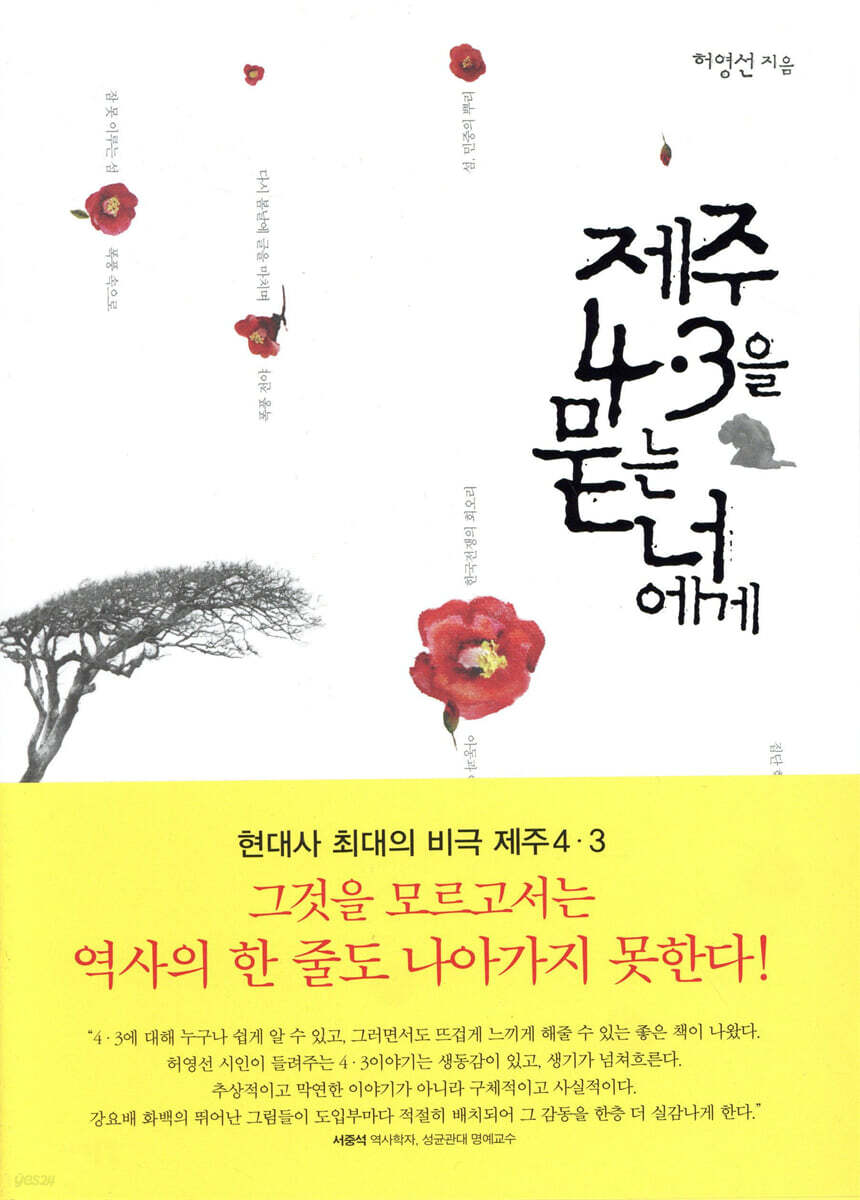 |
Description
Book Introduction
The greatest tragedy in modern history
Jeju April 3 Incident 70th Anniversary Revised Edition
Without knowing this, you cannot advance even a single line in history!
Remember the sorrowful cries of 30,000 people!
Remember the history of resistance and pain!
70th anniversary of the Jeju April 3 Incident
Do you still not know about April 3rd?
Countless years of living with my mouth shut, eyes closed, and head bowed.
There were times when we had to hide even the ancestral rites, let alone shed tears, over the deaths of our parents, siblings, and relatives.
After all these long years, when even the souls could not find freedom, the survivors and the dead have finally found the freedom to mourn in their own place.
However, this does not mean that 'April 3rd' was just a case of resentment and sadness being kept in silence.
The 'correcting history' movement, which began with the April 19 Revolution in 1960, was defeated by the May 16 Coup and was suppressed by the Yushin regime and the military dictatorship, but eventually raised its voice through the June Struggle in 1987.
In 2000, the ‘Jeju 4.3 Special Act’ was enacted, and in 2003, a truth report titled ‘Massacre of Innocent People by the State’ was adopted.
In response, President Roh Moo-hyun issued an apology on behalf of the nation, and the 66th anniversary was designated as a "national memorial day." Then, another period of silence passed, and finally, as we approach the 70th anniversary in 2018, we have once again completed preparations for freedom to mourn and to move forward in history.
To mark the 70th anniversary, author Heo Young-seon, director of the Jeju 4?3 Research Institute and poet, added an autobiography, which concisely captures the past, present, and future of Jeju 4?3.
“Now the heart of the island is covered with red camellias.
A full-blooming flower that emerged from a snowstorm, full of red
From winter to spring that year, not a single tear, not a single cry
It takes on the fate of the islanders who were sinners.
Remember, this flower of memory that you must remember,
In place of the young eyes that could no longer bloom
Living eyes see.
Those who have seen scenes that should not be seen by human eyes
Swallowing tears, I spend another winter and see spring.
At that time, I was a citizen of the Republic of Korea, but I was not a citizen.
Countless flower lives were tragically lost.
Forget it, erase it, be quiet
A history of forced oblivion
Finally breaking through the tomb of distortion, it surges like a wave.
April 3rd is the truth that Jeju Island has been searching for for 70 years.
It is the last voice that did not want the division of this land.
Now, 70 years later, April 3rd must find a just solution.
“This is the strict history of the Republic of Korea.”
The people of Jeju say, "Salam citizens, come alive."
The April 3rd Chronicle Written with My Whole Body
“To You Who Ask About Jeju April 3” is not an easy book to read.
It's not because it's difficult.
Rather, it is the story of April 3rd told to readers in an extremely easy-to-understand style by the author, who is a poet.
However, the writing contains a depth both inside and outside that makes it difficult to pass over a single character, line, or page.
The author closely approached the islanders, capturing the origins and development of the April 3 Incident and its unfinished history, their voices, gestures, and even silence.
Since the author is also one of them, the reader will feel the vividness and heartache even more.
In addition to the book "Jeju 4.3," which was published eight years ago by the Memorial Society for the Democratization Movement and has been translated and published in Japan and China, the author delves deeply into the testimonies of the massacre and the suffering of the children and women who suffered the most in the midst of the chaos of history.
Additionally, several works from artist Kang Yo-bae's 'April 3rd Series' are included, vividly adding to the horror and injustice of that day.
But this book is not written solely based on their voices.
Since April 3rd is history, we did not forget to attach the historical situation before and after liberation as a separate page.
Moreover, there is an appendix at the back of the book that explains 'that day' while accompanying the 4.3 historical sites in Jeju Island, which are not an exaggeration to say that the entire island was a massacre site.
Without knowing this, we would be playing golf, holding corporate retreats, honeymoons, filial piety tours, and walking tours on the slaughterhouse.
It is not that far away that 'ignorance is a sin'.
A book that reminds us of the saying, “History is not in textbooks, it’s on the road.”
If 'tomorrow' asks about 'today' and 'yesterday', we must tell 'April 3rd' without hesitation.
“To You Who Ask About Jeju April 3” is that kind of book.
Jeju April 3 Incident 70th Anniversary Revised Edition
Without knowing this, you cannot advance even a single line in history!
Remember the sorrowful cries of 30,000 people!
Remember the history of resistance and pain!
70th anniversary of the Jeju April 3 Incident
Do you still not know about April 3rd?
Countless years of living with my mouth shut, eyes closed, and head bowed.
There were times when we had to hide even the ancestral rites, let alone shed tears, over the deaths of our parents, siblings, and relatives.
After all these long years, when even the souls could not find freedom, the survivors and the dead have finally found the freedom to mourn in their own place.
However, this does not mean that 'April 3rd' was just a case of resentment and sadness being kept in silence.
The 'correcting history' movement, which began with the April 19 Revolution in 1960, was defeated by the May 16 Coup and was suppressed by the Yushin regime and the military dictatorship, but eventually raised its voice through the June Struggle in 1987.
In 2000, the ‘Jeju 4.3 Special Act’ was enacted, and in 2003, a truth report titled ‘Massacre of Innocent People by the State’ was adopted.
In response, President Roh Moo-hyun issued an apology on behalf of the nation, and the 66th anniversary was designated as a "national memorial day." Then, another period of silence passed, and finally, as we approach the 70th anniversary in 2018, we have once again completed preparations for freedom to mourn and to move forward in history.
To mark the 70th anniversary, author Heo Young-seon, director of the Jeju 4?3 Research Institute and poet, added an autobiography, which concisely captures the past, present, and future of Jeju 4?3.
“Now the heart of the island is covered with red camellias.
A full-blooming flower that emerged from a snowstorm, full of red
From winter to spring that year, not a single tear, not a single cry
It takes on the fate of the islanders who were sinners.
Remember, this flower of memory that you must remember,
In place of the young eyes that could no longer bloom
Living eyes see.
Those who have seen scenes that should not be seen by human eyes
Swallowing tears, I spend another winter and see spring.
At that time, I was a citizen of the Republic of Korea, but I was not a citizen.
Countless flower lives were tragically lost.
Forget it, erase it, be quiet
A history of forced oblivion
Finally breaking through the tomb of distortion, it surges like a wave.
April 3rd is the truth that Jeju Island has been searching for for 70 years.
It is the last voice that did not want the division of this land.
Now, 70 years later, April 3rd must find a just solution.
“This is the strict history of the Republic of Korea.”
The people of Jeju say, "Salam citizens, come alive."
The April 3rd Chronicle Written with My Whole Body
“To You Who Ask About Jeju April 3” is not an easy book to read.
It's not because it's difficult.
Rather, it is the story of April 3rd told to readers in an extremely easy-to-understand style by the author, who is a poet.
However, the writing contains a depth both inside and outside that makes it difficult to pass over a single character, line, or page.
The author closely approached the islanders, capturing the origins and development of the April 3 Incident and its unfinished history, their voices, gestures, and even silence.
Since the author is also one of them, the reader will feel the vividness and heartache even more.
In addition to the book "Jeju 4.3," which was published eight years ago by the Memorial Society for the Democratization Movement and has been translated and published in Japan and China, the author delves deeply into the testimonies of the massacre and the suffering of the children and women who suffered the most in the midst of the chaos of history.
Additionally, several works from artist Kang Yo-bae's 'April 3rd Series' are included, vividly adding to the horror and injustice of that day.
But this book is not written solely based on their voices.
Since April 3rd is history, we did not forget to attach the historical situation before and after liberation as a separate page.
Moreover, there is an appendix at the back of the book that explains 'that day' while accompanying the 4.3 historical sites in Jeju Island, which are not an exaggeration to say that the entire island was a massacre site.
Without knowing this, we would be playing golf, holding corporate retreats, honeymoons, filial piety tours, and walking tours on the slaughterhouse.
It is not that far away that 'ignorance is a sin'.
A book that reminds us of the saying, “History is not in textbooks, it’s on the road.”
If 'tomorrow' asks about 'today' and 'yesterday', we must tell 'April 3rd' without hesitation.
“To You Who Ask About Jeju April 3” is that kind of book.
- You can preview some of the book's contents.
Preview
index
A Re-Written Autobiography on the 70th Anniversary of the Jeju 4?3 Incident
Recommendation
Before going in_To you who asks about 4·3
Entering Jeju Island: Two Faces of Sorrow and Splendor
01 Island, the roots of the people
First step to liberation
The entire island is a fortress
“We do our own work.”
Great famine, a difficult barley pass
02 The Calm Before the Storm
Gunshots echoed through Gwandeokjeong Square
General strike!
Oppression, the flame of resistance
03 Into the Storm
April 3, 1948!
May Day
04 Sleepless Island
The defiant Hallasan Mountain
The island is a dark fortress, blockade the coastline.
Proclamation: “Five kilometers from the coastline!”
It's a sin to be young
05 Ah, the sad middle class
Scorched Earth Operation Sweeps Through Mountainous Villages
Martial law!
Camellia Lives
People leaving for Japan
People who returned from Japan and died, people who left
A winter that seemed like eternity
06 The Whirlwind of the Korean War
Preliminary arrest, a resurgent whirlwind
prisoners, missing persons
The lock on Hallasan Mountain opens
Two Faces of America
07 Genocide, Testimonies
“Would a person kill another person?”
The whirlwind, the people who disappeared
Ah! Bukchon-ri, a sorrow that cannot be lamented
08 Children and Women, Their Silent Suffering
Children are like withered flower petals
Women carrying children on their chests
profound sadness
Pregnant women, their hushed agony
Memories of the longest day of my life
09 4·3 After that
The Unfinished April 3 Incident and Its Aftereffects
Torture, twisting lives
Still, there was a face of hope
I'm finishing up this piece on a spring day again.
The truth buried in the pit
A Journey to a Century of Peace and Human Rights
The nation finally responded to the April 3rd victims' memorial day.
Jeju Island, a Bastion of Peace
Once again on a spring day… I recall the smile behind the sadness
References
Jeju April 3rd Key Dates
April 3rd Field Trip_Following the Traces of April 3rd
Author's Note
Recommendation
Before going in_To you who asks about 4·3
Entering Jeju Island: Two Faces of Sorrow and Splendor
01 Island, the roots of the people
First step to liberation
The entire island is a fortress
“We do our own work.”
Great famine, a difficult barley pass
02 The Calm Before the Storm
Gunshots echoed through Gwandeokjeong Square
General strike!
Oppression, the flame of resistance
03 Into the Storm
April 3, 1948!
May Day
04 Sleepless Island
The defiant Hallasan Mountain
The island is a dark fortress, blockade the coastline.
Proclamation: “Five kilometers from the coastline!”
It's a sin to be young
05 Ah, the sad middle class
Scorched Earth Operation Sweeps Through Mountainous Villages
Martial law!
Camellia Lives
People leaving for Japan
People who returned from Japan and died, people who left
A winter that seemed like eternity
06 The Whirlwind of the Korean War
Preliminary arrest, a resurgent whirlwind
prisoners, missing persons
The lock on Hallasan Mountain opens
Two Faces of America
07 Genocide, Testimonies
“Would a person kill another person?”
The whirlwind, the people who disappeared
Ah! Bukchon-ri, a sorrow that cannot be lamented
08 Children and Women, Their Silent Suffering
Children are like withered flower petals
Women carrying children on their chests
profound sadness
Pregnant women, their hushed agony
Memories of the longest day of my life
09 4·3 After that
The Unfinished April 3 Incident and Its Aftereffects
Torture, twisting lives
Still, there was a face of hope
I'm finishing up this piece on a spring day again.
The truth buried in the pit
A Journey to a Century of Peace and Human Rights
The nation finally responded to the April 3rd victims' memorial day.
Jeju Island, a Bastion of Peace
Once again on a spring day… I recall the smile behind the sadness
References
Jeju April 3rd Key Dates
April 3rd Field Trip_Following the Traces of April 3rd
Author's Note
Into the book
Do you understand now?
Sad history, since that day, Jeju's lyricism has not been just lyricism.
Why do islanders live with inner wounds that cannot be forgotten, like the rising and setting of the sun?
The sea where countless corpses float, Hallasan Mountain covered in heavy snow that made it impossible to see even an inch ahead, there was no place that people had not set foot on in their desperate struggle to survive, and the question was, where on this island was there a safe place?
Sad history, since that day, Jeju's lyricism has not been just lyricism.
Why do islanders live with inner wounds that cannot be forgotten, like the rising and setting of the sun?
The sea where countless corpses float, Hallasan Mountain covered in heavy snow that made it impossible to see even an inch ahead, there was no place that people had not set foot on in their desperate struggle to survive, and the question was, where on this island was there a safe place?
--- From the text
Publisher's Review
From the author's words
An old woman from a mountain village who had become a 'mountain person' because she only went to the mountains to survive has also passed away.
Those who left this land to go to Japan to survive, what were their thoughts as they left?
How I trembled as I sailed along the dark and uncertain course of the ship.
As I was writing, the eyes of those who had to live through that time came to mind.
Nevertheless, he recalled people who brought up difficult memories, saying that April 3rd should be a hope for future generations and descendants.
An old woman from a mountain village who had become a 'mountain person' because she only went to the mountains to survive has also passed away.
Those who left this land to go to Japan to survive, what were their thoughts as they left?
How I trembled as I sailed along the dark and uncertain course of the ship.
As I was writing, the eyes of those who had to live through that time came to mind.
Nevertheless, he recalled people who brought up difficult memories, saying that April 3rd should be a hope for future generations and descendants.
GOODS SPECIFICS
- Date of publication: March 25, 2014
- Page count, weight, size: 272 pages | 472g | 153*215*20mm
- ISBN13: 9788974836504
- ISBN10: 8974836505
You may also like
카테고리
korean


korean

![GQ KOREA Mark (Monthly): December [2025]](http://librairie.coreenne.fr/cdn/shop/files/8ef265dbbfbf186523ed75ba7319009d.jpg?v=1765340328&width=3840)


