

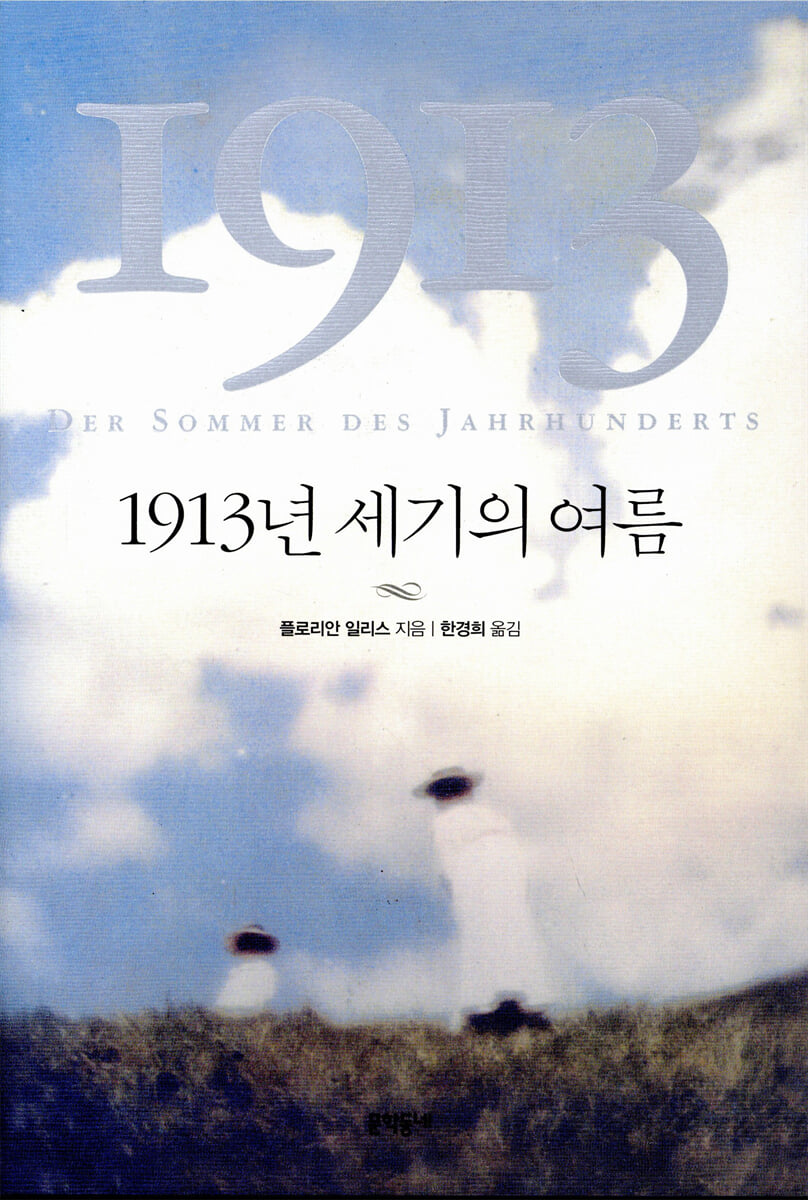
Summer of the Century, 1913
 |
Description
Book Introduction
Is this the summer of the century?
The European Landscape of 1913: A Look at Intellectual and Cultural History
This book is about 1913, the year when imperialism reached its peak, nationalism spread, territorial disputes, including the Balkan Wars, continued unabated, technological advancements accelerated, cities teemed with people suffering from self-alienation and neurosis, and modernism overturned traditional concepts of the arts, including music, painting, and literature.
This book depicts the landscape of European society in 1913, 100 years ago, divided into months from January to December.
There are over 300 characters that appear.
Franz Kafka, Rainer Maria Rilke, Marcel Proust, James Joyce, Thomas Mann, Arthur Schnitzler, Sigmund Freud, Carl Gustav Jung, Pablo Picasso, Ernst Ludwig Kirchner, Gustav Klimt, Egon Schiele, Franz Marc, Marcel Duchamp, Kazimir Malevich, Arnold Schönberg, Adolf Loos, Ludwig Wittgenstein, Coco Chanel, etc., all left unforgettable marks on the intellectual and cultural history of modern Europe.
Author Florian Illis meticulously and precisely reconstructs the actions of these figures in 1913, taking into account the historical context.
Over the course of three years, he collected, organized, and reconstructed a vast amount of relevant data from numerous figures, including biographies, autobiographies, letters, diaries, photographs, and newspaper articles, to dramatically recreate the landscape of Europe in 1913.
The European Landscape of 1913: A Look at Intellectual and Cultural History
This book is about 1913, the year when imperialism reached its peak, nationalism spread, territorial disputes, including the Balkan Wars, continued unabated, technological advancements accelerated, cities teemed with people suffering from self-alienation and neurosis, and modernism overturned traditional concepts of the arts, including music, painting, and literature.
This book depicts the landscape of European society in 1913, 100 years ago, divided into months from January to December.
There are over 300 characters that appear.
Franz Kafka, Rainer Maria Rilke, Marcel Proust, James Joyce, Thomas Mann, Arthur Schnitzler, Sigmund Freud, Carl Gustav Jung, Pablo Picasso, Ernst Ludwig Kirchner, Gustav Klimt, Egon Schiele, Franz Marc, Marcel Duchamp, Kazimir Malevich, Arnold Schönberg, Adolf Loos, Ludwig Wittgenstein, Coco Chanel, etc., all left unforgettable marks on the intellectual and cultural history of modern Europe.
Author Florian Illis meticulously and precisely reconstructs the actions of these figures in 1913, taking into account the historical context.
Over the course of three years, he collected, organized, and reconstructed a vast amount of relevant data from numerous figures, including biographies, autobiographies, letters, diaries, photographs, and newspaper articles, to dramatically recreate the landscape of Europe in 1913.
- You can preview some of the book's contents.
Preview
index
january
february
March
april
May
June
July
August
September
october
November
december
References
Acknowledgements
Translator's Note
List of characters
List of illustrations
february
March
april
May
June
July
August
September
october
November
december
References
Acknowledgements
Translator's Note
List of characters
List of illustrations
Into the book
It was the month when Hitler and Stalin met by chance while strolling in Schönbrunn Palace Park, when Thomas Mann almost came out, and when Franz Kafka almost went mad with love.
A cat crawls onto Sigmund Freud's sofa.
The weather is cold, and the snow crunches underfoot.
Else Laskerschuler, now penniless, falls in love with Gottfried Benn, receives a horse postcard from Franz Marc, and calls Gabriele Münter nothing.
Ernst Ludwig Kirchner paints pictures of high-class prostitutes in Potsdamer Platz.
Russian pilot Pyotr Nikolayevich Nesterov performs the first somersault in human history.
But it's all useless.
Oswald Spengler is already writing The Decline of the West. --- "January"
Okay, now it's time for the real start.
In New York, the Armory Show sparks a big bang in modern art, and Marcel Duchamp presents Nude Descending a Staircase.
After that, Duchamp rose to prominence.
Besides that, nudity is rampant everywhere.
In Vienna in particular, there are nudes of Alma Mahler by Oskar Kokoschka and nudes of Viennese women by Gustav Klimt and Egon Schiele.
Other women gave Freud 100 kroner to strip their souls bare for an hour.
Meanwhile, Adolf Hitler paints moving watercolors of St. Stephen's Cathedral in his men's shelter room.
Heinrich Mann, who is writing "The Servant" in Munich, celebrates his forty-second birthday at his brother Thomas Mann's house.
There is still a lot of snow piled up.
The next day, Thomas Mann buys land and builds a house.
Rilke continues to suffer, and Kafka continues to hesitate.
But Coco Chanel's small hat shop is thriving and growing by the day.
Archduke Franz Ferdinand, heir to the Austrian throne, speeds through Vienna in a gold-spoked car, plays with model railroads, and frets over assassinations in Serbia.
Stalin meets Trotsky for the first time.
And in that same month, a boy was born in Barcelona who would later assassinate Trotsky on Stalin's orders.
Was 1913 really a bad year?--- "February"
In March, Kafka actually goes to Berlin to meet Felice Bauer, and the two take a walk together, but it doesn't go well.
Robert Musil is treated by a neurologist and released safely, but Camille Claudel ends up in a neurologist's hospital and is imprisoned for 30 years.
And in Vienna, there will be a great 'Cheek Slap Concert' on March 31st.
Arnold Schoenberg was publicly slapped for composing music with too sharp a tone.
Albert Schweitzer and Ernst Jünger dream of Africa.
In Cambridge, Ludwig Wittgenstein begins a new lecture on logic with Outing, Virginia Woolf finishes her first book, and Rilke catches a cold.
The overall important question is, "Where are we going?"--- March
Hitler celebrates his twenty-fourth birthday on April 20th at a men's shelter in Vienna.
Thomas Mann is agonizing over The Magic Mountain, and his wife is already leaving for recuperation again.
Lionel Feininger discovers a tiny village church in Gelmeroda and transforms it into an expressionist cathedral.
To cure his 'burnout', Franz Kafka volunteered to work for a vegetable farmer, pulling weeds every afternoon.
Bernhard Kellermann writes this year's bestseller, The Tunnel.
It is a science fiction novel about a story that connects America and Europe underground.
Frank Wedekind's 'Lulu' becomes a banned book.
Oskar Kokoschka buys a canvas the same size as his lover Alma Mahler's bed and begins to paint her portrait on it.
Alma says she will marry him if the work becomes a masterpiece.
I'll definitely get married if I do that.--- "April"
A warm spring night in Vienna.
Schnitzler, after a bitter quarrel with his wife, dreams of shooting himself on May 25, but does not realize it.
However, on the same night in Vienna, Colonel Redl, whose spy activities were exposed, commits suicide with a pistol.
That same night in Vienna, Adolf Hitler packs his bags and boards the first train to Munich.
And the painter group 'Daripa' is disbanded.
In Paris, Stravinsky's The Rite of Spring premieres, and it is at the theater that Stravinsky first meets Coco Chanel, who would later become his lover.
Brecht is bored at school and suffers from palpitations.
So he starts writing poetry.
Alma Mahler runs away from Oskar Kokoschka for the first time.
Rilke has not been able to write since his fight with Rodin. --- "May"
This is the month when it becomes clear that war will never happen.
Georg Trakl searches for his sister and seeks salvation from the fires of hell.
Thomas Mann just wants peace.
Franz Kafka makes a sort of proposal, but it doesn't go well.
He confused the oath of office with the proposal.
DH
Lawrence publishes Sons and Lovers and flees to Upper Bavaria with Frieda von Richthofen, the mother of his three children.
She becomes the model for Lady Chatterley.
Elsewhere, people's nerves are on edge.
In the cinema, Asta Nielsen ruins an unknown masterpiece in Sins of the Fathers.
German forces continue to strengthen.
Henkel Trocken welcomes the German-French friendship. --- "June"
It's vacation time! Egon Schiele and Archduke Franz Ferdinand of Austria are playing with a model railway.
Prussian officers swim naked in Lake Jacques.
Frank Wedekind leaves for Rome, while Robis Corinth and Käthe Kollwitz leave for Tyrol (but in different hotels).
Alma Mahler flees to Franzensbad.
Because Oskar Kokoschka had requested a marriage certificate.
Kokoschka consoles himself by drinking with Georg Trakl.
It keeps raining.
Everyone is half crazy in their hotel rooms.
Still, Matisse brings Picasso a bouquet of flowers. --- "July"
Is this the summer of the century?
Anyway, it's a month where Freud faints and Kirchner becomes happy.
Emperor Franz Joseph goes hunting, while Ernst Jünger sits for hours in a hot greenhouse wearing his winter coat.
The novel "The Man Without Qualities" begins with misinformation.
Georg Trakl is planning to spend his vacation in Venice.
The same goes for Schnitzler.
Rilke is in Heiligendamm, where he is visited by a woman.
Picasso and Matisse go horseback riding together.
Franz Marc receives a tamed deer as a gift.
No one is working.--- "August"
A death in Venice shakes Berlin.
Virginia Woolf and Carl Schmitt attempt suicide.
September 9th is not a good day.
The Duel in Munich.
Freud and Jung point their swords at each other.
Rilke goes to the dentist to have his cavity filled with amalgam, and Karl Kraus falls head over heels in love with Sidonie.
Kafka, who went on a trip to Venice, falls in love with Riva without dying.
The 'First German Autumn Salon' opens, and Rudolf Steiner lays the cornerstone in Dornach.
Louis Armstrong appears on a public stage for the first time.
Charlie Chaplin signs his first film contract.
The rest is silence.--- "September"
It's Thomas Mann's month to make up for the past.
Avant-garde artists meet at a religious play performed in Hellerau, near Dresden.
German teenagers go on a walking tour in Meissner.
This mountain has since been called “Hore Meisner”.
Emil Nolde leaves Berlin with his expedition to the South Pacific.
August Macke discovers paradise on Switzerland's sunny Lake Thunersee.
One important issue.
Can we feel disgust in Franz Werfel's face? And another thing.
How much can Berlin tolerate avant-garde art? Ludwig Meitner, striking from the blue, paints a battlefield scene and titles it "Apocalyptic Landscape."
Emperor Wilhelm II attends the inauguration of the Victory Monument in Leipzig.
Freud takes off his hat and throws it at the mushrooms. --- "October"
Adolf Loos said that ornamentation was a crime, and he built houses and tailor shops full of clarity.
The relationship between Else Laskershüler and Gottfried Benn is over.
Else Laskershüler falls into despair.
Alfred Döblin, who happened to be Kirchner's model, administered morphine to her.
When Proust's "In Search of Lost Time," the first volume, "The Way to Swann's House," was published, Rilke read it immediately.
Kafka goes to the cinema and cries.
Prada opens its first boutique in Milan.
Eighteen-year-old Ernst Jünger packs his bags and joins the African Foreign Legion.
The weather in Germany is bad.
But Bertolt Brecht believes that anyone can catch a cold.--- "November"
Everything is open.
The future, and the lips of beautiful women.
Kazimir Malevich paints a black square.
Robert Musil thinks Germany is too dark.
The Mona Lisa was rediscovered in Florence and became one of the most important paintings in the world.
Rilke wants to be a hedgehog.
Thomas Mann clearly states, “I am writing The Magic Mountain, not The Magic Apprentice!”
Emil Nolde finds only confused humans in the South Pacific paradise, while Karl Kraus finds happiness in Janowitz.
Ernst Jünger is discovered in Africa and returns home to celebrate Christmas in Bad Reburg.
How do the stars stand?
A cat crawls onto Sigmund Freud's sofa.
The weather is cold, and the snow crunches underfoot.
Else Laskerschuler, now penniless, falls in love with Gottfried Benn, receives a horse postcard from Franz Marc, and calls Gabriele Münter nothing.
Ernst Ludwig Kirchner paints pictures of high-class prostitutes in Potsdamer Platz.
Russian pilot Pyotr Nikolayevich Nesterov performs the first somersault in human history.
But it's all useless.
Oswald Spengler is already writing The Decline of the West. --- "January"
Okay, now it's time for the real start.
In New York, the Armory Show sparks a big bang in modern art, and Marcel Duchamp presents Nude Descending a Staircase.
After that, Duchamp rose to prominence.
Besides that, nudity is rampant everywhere.
In Vienna in particular, there are nudes of Alma Mahler by Oskar Kokoschka and nudes of Viennese women by Gustav Klimt and Egon Schiele.
Other women gave Freud 100 kroner to strip their souls bare for an hour.
Meanwhile, Adolf Hitler paints moving watercolors of St. Stephen's Cathedral in his men's shelter room.
Heinrich Mann, who is writing "The Servant" in Munich, celebrates his forty-second birthday at his brother Thomas Mann's house.
There is still a lot of snow piled up.
The next day, Thomas Mann buys land and builds a house.
Rilke continues to suffer, and Kafka continues to hesitate.
But Coco Chanel's small hat shop is thriving and growing by the day.
Archduke Franz Ferdinand, heir to the Austrian throne, speeds through Vienna in a gold-spoked car, plays with model railroads, and frets over assassinations in Serbia.
Stalin meets Trotsky for the first time.
And in that same month, a boy was born in Barcelona who would later assassinate Trotsky on Stalin's orders.
Was 1913 really a bad year?--- "February"
In March, Kafka actually goes to Berlin to meet Felice Bauer, and the two take a walk together, but it doesn't go well.
Robert Musil is treated by a neurologist and released safely, but Camille Claudel ends up in a neurologist's hospital and is imprisoned for 30 years.
And in Vienna, there will be a great 'Cheek Slap Concert' on March 31st.
Arnold Schoenberg was publicly slapped for composing music with too sharp a tone.
Albert Schweitzer and Ernst Jünger dream of Africa.
In Cambridge, Ludwig Wittgenstein begins a new lecture on logic with Outing, Virginia Woolf finishes her first book, and Rilke catches a cold.
The overall important question is, "Where are we going?"--- March
Hitler celebrates his twenty-fourth birthday on April 20th at a men's shelter in Vienna.
Thomas Mann is agonizing over The Magic Mountain, and his wife is already leaving for recuperation again.
Lionel Feininger discovers a tiny village church in Gelmeroda and transforms it into an expressionist cathedral.
To cure his 'burnout', Franz Kafka volunteered to work for a vegetable farmer, pulling weeds every afternoon.
Bernhard Kellermann writes this year's bestseller, The Tunnel.
It is a science fiction novel about a story that connects America and Europe underground.
Frank Wedekind's 'Lulu' becomes a banned book.
Oskar Kokoschka buys a canvas the same size as his lover Alma Mahler's bed and begins to paint her portrait on it.
Alma says she will marry him if the work becomes a masterpiece.
I'll definitely get married if I do that.--- "April"
A warm spring night in Vienna.
Schnitzler, after a bitter quarrel with his wife, dreams of shooting himself on May 25, but does not realize it.
However, on the same night in Vienna, Colonel Redl, whose spy activities were exposed, commits suicide with a pistol.
That same night in Vienna, Adolf Hitler packs his bags and boards the first train to Munich.
And the painter group 'Daripa' is disbanded.
In Paris, Stravinsky's The Rite of Spring premieres, and it is at the theater that Stravinsky first meets Coco Chanel, who would later become his lover.
Brecht is bored at school and suffers from palpitations.
So he starts writing poetry.
Alma Mahler runs away from Oskar Kokoschka for the first time.
Rilke has not been able to write since his fight with Rodin. --- "May"
This is the month when it becomes clear that war will never happen.
Georg Trakl searches for his sister and seeks salvation from the fires of hell.
Thomas Mann just wants peace.
Franz Kafka makes a sort of proposal, but it doesn't go well.
He confused the oath of office with the proposal.
DH
Lawrence publishes Sons and Lovers and flees to Upper Bavaria with Frieda von Richthofen, the mother of his three children.
She becomes the model for Lady Chatterley.
Elsewhere, people's nerves are on edge.
In the cinema, Asta Nielsen ruins an unknown masterpiece in Sins of the Fathers.
German forces continue to strengthen.
Henkel Trocken welcomes the German-French friendship. --- "June"
It's vacation time! Egon Schiele and Archduke Franz Ferdinand of Austria are playing with a model railway.
Prussian officers swim naked in Lake Jacques.
Frank Wedekind leaves for Rome, while Robis Corinth and Käthe Kollwitz leave for Tyrol (but in different hotels).
Alma Mahler flees to Franzensbad.
Because Oskar Kokoschka had requested a marriage certificate.
Kokoschka consoles himself by drinking with Georg Trakl.
It keeps raining.
Everyone is half crazy in their hotel rooms.
Still, Matisse brings Picasso a bouquet of flowers. --- "July"
Is this the summer of the century?
Anyway, it's a month where Freud faints and Kirchner becomes happy.
Emperor Franz Joseph goes hunting, while Ernst Jünger sits for hours in a hot greenhouse wearing his winter coat.
The novel "The Man Without Qualities" begins with misinformation.
Georg Trakl is planning to spend his vacation in Venice.
The same goes for Schnitzler.
Rilke is in Heiligendamm, where he is visited by a woman.
Picasso and Matisse go horseback riding together.
Franz Marc receives a tamed deer as a gift.
No one is working.--- "August"
A death in Venice shakes Berlin.
Virginia Woolf and Carl Schmitt attempt suicide.
September 9th is not a good day.
The Duel in Munich.
Freud and Jung point their swords at each other.
Rilke goes to the dentist to have his cavity filled with amalgam, and Karl Kraus falls head over heels in love with Sidonie.
Kafka, who went on a trip to Venice, falls in love with Riva without dying.
The 'First German Autumn Salon' opens, and Rudolf Steiner lays the cornerstone in Dornach.
Louis Armstrong appears on a public stage for the first time.
Charlie Chaplin signs his first film contract.
The rest is silence.--- "September"
It's Thomas Mann's month to make up for the past.
Avant-garde artists meet at a religious play performed in Hellerau, near Dresden.
German teenagers go on a walking tour in Meissner.
This mountain has since been called “Hore Meisner”.
Emil Nolde leaves Berlin with his expedition to the South Pacific.
August Macke discovers paradise on Switzerland's sunny Lake Thunersee.
One important issue.
Can we feel disgust in Franz Werfel's face? And another thing.
How much can Berlin tolerate avant-garde art? Ludwig Meitner, striking from the blue, paints a battlefield scene and titles it "Apocalyptic Landscape."
Emperor Wilhelm II attends the inauguration of the Victory Monument in Leipzig.
Freud takes off his hat and throws it at the mushrooms. --- "October"
Adolf Loos said that ornamentation was a crime, and he built houses and tailor shops full of clarity.
The relationship between Else Laskershüler and Gottfried Benn is over.
Else Laskershüler falls into despair.
Alfred Döblin, who happened to be Kirchner's model, administered morphine to her.
When Proust's "In Search of Lost Time," the first volume, "The Way to Swann's House," was published, Rilke read it immediately.
Kafka goes to the cinema and cries.
Prada opens its first boutique in Milan.
Eighteen-year-old Ernst Jünger packs his bags and joins the African Foreign Legion.
The weather in Germany is bad.
But Bertolt Brecht believes that anyone can catch a cold.--- "November"
Everything is open.
The future, and the lips of beautiful women.
Kazimir Malevich paints a black square.
Robert Musil thinks Germany is too dark.
The Mona Lisa was rediscovered in Florence and became one of the most important paintings in the world.
Rilke wants to be a hedgehog.
Thomas Mann clearly states, “I am writing The Magic Mountain, not The Magic Apprentice!”
Emil Nolde finds only confused humans in the South Pacific paradise, while Karl Kraus finds happiness in Janowitz.
Ernst Jünger is discovered in Africa and returns home to celebrate Christmas in Bad Reburg.
How do the stars stand?
--- "december"
Publisher's Review
Germany's best non-fiction novel of 2012-2013
“It’s like reading a scene from a magical realist novel.” —The Guardian
Translated and published in 17 countries, including Brazil, China, Croatia, Czech Republic, Denmark, Italy, Hungary, Japan, Netherlands, Norway, Poland, Romania, Russia, Spain, Sweden, and the United Kingdom.
1913, the beginning of what we call the present
According to Marxist historian Eric Hobsbawm, the period we call the 20th century refers to the period from the outbreak of World War I in 1914 to the collapse of the Soviet Union in 1991.
Considering that the terms 'fin de siecle' and 'Belle Époque' actually refer to the period from the late 19th century to the early 20th century, the turning point between the 19th and 20th centuries in cultural history would likely have been around 1914, the year World War I broke out.
This book assumes that 1913 marked the end of the long 19th century, at least in cultural history, and the beginning of a truly new century, the time we call the present.
It is often said that modernity arose from the horrors of World War I, but art had already declared a break with tradition long before the war, and by 1913 modernity had already departed the starting line.
Contrary to economists like Norman Angell, who boasted that a world war could never happen because of the globalized economic system, many far-sighted artists of the time anticipated war amidst an atmosphere of anxiety, lived as if there was no tomorrow, and the art they presented to the world at the time simultaneously announced the end of the 19th century and the beginning of the 20th.
This book, 『Summer of the Century, 1913』 (original title: 1913.
The Summer of 1913 is a book about the year 1913, a year when imperialism was at its peak, nationalism was spreading, territorial disputes, including the Balkan Wars, were incessant, technological development was accelerating, cities were teeming with people suffering from self-alienation and neurosis, and modernism was overturning traditional concepts of the arts, such as music, painting, and literature.
The European Landscape of 1913: A Look at Intellectual and Cultural History
This book depicts the landscape of European society in 1913, 100 years ago, divided into months from January to December.
Weather-wise, the summer of 1913 was terrible.
The average temperature in Vienna in August was 16 degrees.
People didn't know it at the time, but in 1913, it was the coldest August of the entire 20th century.
Even in this climate of extremes, European culture was experiencing a unique heyday.
In all cultural fields, including literature, art, music, architecture, photography, theater, film, and fashion, artists endured and overcame social and spiritual crises, and brought modernism to life in a brilliant way.
There are over 300 characters in this book.
Franz Kafka, Rainer Maria Rilke, Marcel Proust, James Joyce, Thomas Mann, Arthur Schnitzler, Sigmund Freud, Carl Gustav Jung, Pablo Picasso, Ernst Ludwig Kirchner, Gustav Klimt, Egon Schiele, Franz Marc, Marcel Duchamp, Kazimir Malevich, Arnold Schönberg, Adolf Loos, Ludwig Wittgenstein, Coco Chanel, etc., all left unforgettable marks on the intellectual and cultural history of modern Europe.
Author Florian Illis meticulously and precisely reconstructs the actions of these figures in 1913, taking into account the historical context.
Over the course of three years, he collected, organized, and reconstructed a vast amount of relevant data from numerous figures, including biographies, autobiographies, letters, diaries, photographs, and newspaper articles, to dramatically recreate the landscape of Europe in 1913.
Life, love, art… all of this is one great struggle.
1913 was a year filled with countless cultural events and achievements.
In literature, Marcel Proust's "In Search of Lost Time" was born, which is considered one of the three classics of 20th-century modernist novels along with James Joyce's "Ulysses" and Robert Musil's "The Man Without Qualities". In art, while the "Armory Show" in New York caused a big bang in modern art, the "First German Autumn Salon" was held in Berlin, featuring works by 90 painters from 12 countries. Marcel Duchamp's ready-made art "Bicycle Wheel", which can be said to be the two zero points of modern painting, made its debut in Paris, and Kazimir Malevich's "Black Square" made its debut in Moscow.
In music, Schoenberg, the founder of atonal music, is publicly slapped in the face for his avant-garde concerts, and Stravinsky's The Rite of Spring is premiered in Paris.
In architecture, Adolf Loos presents functionalist modern houses and tailor shops based on the proposition that “ornament is a crime,” while in fashion, Coco Chanel’s small hat shop flourishes and Prada opens its first store.
The highlight of this book is the portrayal of the characters' inner selves and the capture of the coincidence that places contemporary figures on the same stage in 1913.
Kafka, who wrote the longest and most indecisive love letters in the world; Oskar Kokoschka, who completed the modern art masterpiece “The Bride of the Wind” while obsessed with his mad love for Alma Mahler; Georg Trakl, who suffered from self-loathing while addicted to sex, alcohol, and drugs, but still left behind exquisite poetry; Klimt and Egon Schiele, who each obsessively delved into the female body for different reasons—these artists who literally lived for love, lived for art, and lived their lives as if they were struggling—these stories vividly reveal the inner human side hidden behind the brilliant achievements.
1913 was the year when Hitler, who had been rejected from the Academy of Fine Arts and was making a living by painting cheap watercolors, and Stalin, who was holed up in the guest room of a house studying the national question, may have encountered each other several times while taking a walk in the Schönbrunn Palace Park in Vienna, and when Franz Kafka, James Joyce, and Robert Musil may have sat side by side for a moment and had coffee in a café in Trieste.
Also, in February 1913, the same year Stalin first met Trotsky, Ramón Mercader, who would later assassinate Trotsky on Stalin's orders, was born in Barcelona.
In Vienna in 1913, Josip Broz Tito, who would go on to conquer Yugoslavia, also worked as a car mechanic, so three of the most vicious tyrants and dictators of the 20th century were briefly together.
If they had truly met by chance, or if they had never met at all, would modern human history have changed even a little? The novelistic delight of this book stems from these endlessly pervasive hypotheses.
As you travel across Europe, including Vienna, Berlin, Paris, and Moscow, and encounter scenes that recreate the historical stage of 1913 with outstanding imagination and composition, you will naturally realize that “this book is a montage of unrelated episodes, a cubist collage in which diaries, letters, photographs, paintings, novels, poems, newspapers, and magazines are stuck together as if they were materials with different textures, showing various perspectives” (translator’s note).
Has the world really progressed over the past 100 years?
“The past is never dead.
Even without recalling William Faulkner's words, "Even the past has not passed," the past is never that far from the present.
How far have we come from the beginning of time, a hundred years ago, in what we call the present? People back then, too, must have been struggling, depressed, and unbearable amidst industrialization, mechanization, urbanization, and globalization, and perhaps found themselves reminiscing about another past.
Asking the question, 'How different are we now?'
Has the world truly progressed over the past century? This is the first and last question the author poses to readers who close the book after finishing it.
Press reviews
A book that erases the 100 years between 1913 and its readers.
― Süddeutsche Zeitung
Another brilliant portrayal of a world crumbling on the edge of a precipice of cognitive values.
― Frankfurter Allgemeine Zeitung
It seems like every word in every sentence has been measured and remeasured hundreds of times.
Few books offer a more accessible answer to the question of art's impact on society.
― Tageszeitung
This book weaves an adventure into the present from a year that spiraled into disaster.
― Spiegel
The best books to read during the holiday season.
― Irish Times
The pace and scale of the book can sometimes be breathtaking.
― Financial Times
A book like a jewel.
A very unique historical record.
― Observer
The madness of artistic activity in London, Paris, Vienna, Berlin and Trieste is conveyed with lively humor in a wonderfully entertaining and offbeat narrative.
― Daily Telegraph
A fascinating and lucid study of a special era.
― The Independent
“It’s like reading a scene from a magical realist novel.” —The Guardian
Translated and published in 17 countries, including Brazil, China, Croatia, Czech Republic, Denmark, Italy, Hungary, Japan, Netherlands, Norway, Poland, Romania, Russia, Spain, Sweden, and the United Kingdom.
1913, the beginning of what we call the present
According to Marxist historian Eric Hobsbawm, the period we call the 20th century refers to the period from the outbreak of World War I in 1914 to the collapse of the Soviet Union in 1991.
Considering that the terms 'fin de siecle' and 'Belle Époque' actually refer to the period from the late 19th century to the early 20th century, the turning point between the 19th and 20th centuries in cultural history would likely have been around 1914, the year World War I broke out.
This book assumes that 1913 marked the end of the long 19th century, at least in cultural history, and the beginning of a truly new century, the time we call the present.
It is often said that modernity arose from the horrors of World War I, but art had already declared a break with tradition long before the war, and by 1913 modernity had already departed the starting line.
Contrary to economists like Norman Angell, who boasted that a world war could never happen because of the globalized economic system, many far-sighted artists of the time anticipated war amidst an atmosphere of anxiety, lived as if there was no tomorrow, and the art they presented to the world at the time simultaneously announced the end of the 19th century and the beginning of the 20th.
This book, 『Summer of the Century, 1913』 (original title: 1913.
The Summer of 1913 is a book about the year 1913, a year when imperialism was at its peak, nationalism was spreading, territorial disputes, including the Balkan Wars, were incessant, technological development was accelerating, cities were teeming with people suffering from self-alienation and neurosis, and modernism was overturning traditional concepts of the arts, such as music, painting, and literature.
The European Landscape of 1913: A Look at Intellectual and Cultural History
This book depicts the landscape of European society in 1913, 100 years ago, divided into months from January to December.
Weather-wise, the summer of 1913 was terrible.
The average temperature in Vienna in August was 16 degrees.
People didn't know it at the time, but in 1913, it was the coldest August of the entire 20th century.
Even in this climate of extremes, European culture was experiencing a unique heyday.
In all cultural fields, including literature, art, music, architecture, photography, theater, film, and fashion, artists endured and overcame social and spiritual crises, and brought modernism to life in a brilliant way.
There are over 300 characters in this book.
Franz Kafka, Rainer Maria Rilke, Marcel Proust, James Joyce, Thomas Mann, Arthur Schnitzler, Sigmund Freud, Carl Gustav Jung, Pablo Picasso, Ernst Ludwig Kirchner, Gustav Klimt, Egon Schiele, Franz Marc, Marcel Duchamp, Kazimir Malevich, Arnold Schönberg, Adolf Loos, Ludwig Wittgenstein, Coco Chanel, etc., all left unforgettable marks on the intellectual and cultural history of modern Europe.
Author Florian Illis meticulously and precisely reconstructs the actions of these figures in 1913, taking into account the historical context.
Over the course of three years, he collected, organized, and reconstructed a vast amount of relevant data from numerous figures, including biographies, autobiographies, letters, diaries, photographs, and newspaper articles, to dramatically recreate the landscape of Europe in 1913.
Life, love, art… all of this is one great struggle.
1913 was a year filled with countless cultural events and achievements.
In literature, Marcel Proust's "In Search of Lost Time" was born, which is considered one of the three classics of 20th-century modernist novels along with James Joyce's "Ulysses" and Robert Musil's "The Man Without Qualities". In art, while the "Armory Show" in New York caused a big bang in modern art, the "First German Autumn Salon" was held in Berlin, featuring works by 90 painters from 12 countries. Marcel Duchamp's ready-made art "Bicycle Wheel", which can be said to be the two zero points of modern painting, made its debut in Paris, and Kazimir Malevich's "Black Square" made its debut in Moscow.
In music, Schoenberg, the founder of atonal music, is publicly slapped in the face for his avant-garde concerts, and Stravinsky's The Rite of Spring is premiered in Paris.
In architecture, Adolf Loos presents functionalist modern houses and tailor shops based on the proposition that “ornament is a crime,” while in fashion, Coco Chanel’s small hat shop flourishes and Prada opens its first store.
The highlight of this book is the portrayal of the characters' inner selves and the capture of the coincidence that places contemporary figures on the same stage in 1913.
Kafka, who wrote the longest and most indecisive love letters in the world; Oskar Kokoschka, who completed the modern art masterpiece “The Bride of the Wind” while obsessed with his mad love for Alma Mahler; Georg Trakl, who suffered from self-loathing while addicted to sex, alcohol, and drugs, but still left behind exquisite poetry; Klimt and Egon Schiele, who each obsessively delved into the female body for different reasons—these artists who literally lived for love, lived for art, and lived their lives as if they were struggling—these stories vividly reveal the inner human side hidden behind the brilliant achievements.
1913 was the year when Hitler, who had been rejected from the Academy of Fine Arts and was making a living by painting cheap watercolors, and Stalin, who was holed up in the guest room of a house studying the national question, may have encountered each other several times while taking a walk in the Schönbrunn Palace Park in Vienna, and when Franz Kafka, James Joyce, and Robert Musil may have sat side by side for a moment and had coffee in a café in Trieste.
Also, in February 1913, the same year Stalin first met Trotsky, Ramón Mercader, who would later assassinate Trotsky on Stalin's orders, was born in Barcelona.
In Vienna in 1913, Josip Broz Tito, who would go on to conquer Yugoslavia, also worked as a car mechanic, so three of the most vicious tyrants and dictators of the 20th century were briefly together.
If they had truly met by chance, or if they had never met at all, would modern human history have changed even a little? The novelistic delight of this book stems from these endlessly pervasive hypotheses.
As you travel across Europe, including Vienna, Berlin, Paris, and Moscow, and encounter scenes that recreate the historical stage of 1913 with outstanding imagination and composition, you will naturally realize that “this book is a montage of unrelated episodes, a cubist collage in which diaries, letters, photographs, paintings, novels, poems, newspapers, and magazines are stuck together as if they were materials with different textures, showing various perspectives” (translator’s note).
Has the world really progressed over the past 100 years?
“The past is never dead.
Even without recalling William Faulkner's words, "Even the past has not passed," the past is never that far from the present.
How far have we come from the beginning of time, a hundred years ago, in what we call the present? People back then, too, must have been struggling, depressed, and unbearable amidst industrialization, mechanization, urbanization, and globalization, and perhaps found themselves reminiscing about another past.
Asking the question, 'How different are we now?'
Has the world truly progressed over the past century? This is the first and last question the author poses to readers who close the book after finishing it.
Press reviews
A book that erases the 100 years between 1913 and its readers.
― Süddeutsche Zeitung
Another brilliant portrayal of a world crumbling on the edge of a precipice of cognitive values.
― Frankfurter Allgemeine Zeitung
It seems like every word in every sentence has been measured and remeasured hundreds of times.
Few books offer a more accessible answer to the question of art's impact on society.
― Tageszeitung
This book weaves an adventure into the present from a year that spiraled into disaster.
― Spiegel
The best books to read during the holiday season.
― Irish Times
The pace and scale of the book can sometimes be breathtaking.
― Financial Times
A book like a jewel.
A very unique historical record.
― Observer
The madness of artistic activity in London, Paris, Vienna, Berlin and Trieste is conveyed with lively humor in a wonderfully entertaining and offbeat narrative.
― Daily Telegraph
A fascinating and lucid study of a special era.
― The Independent
GOODS SPECIFICS
- Date of publication: October 19, 2013
- Format: Hardcover book binding method guide
- Page count, weight, size: 396 pages | 734g | 153*224*30mm
- ISBN13: 9788954622608
- ISBN10: 8954622607
You may also like
카테고리
korean


korean

![GQ KOREA Mark (Monthly): December [2025]](http://librairie.coreenne.fr/cdn/shop/files/8ef265dbbfbf186523ed75ba7319009d.jpg?v=1765340328&width=3840)


