

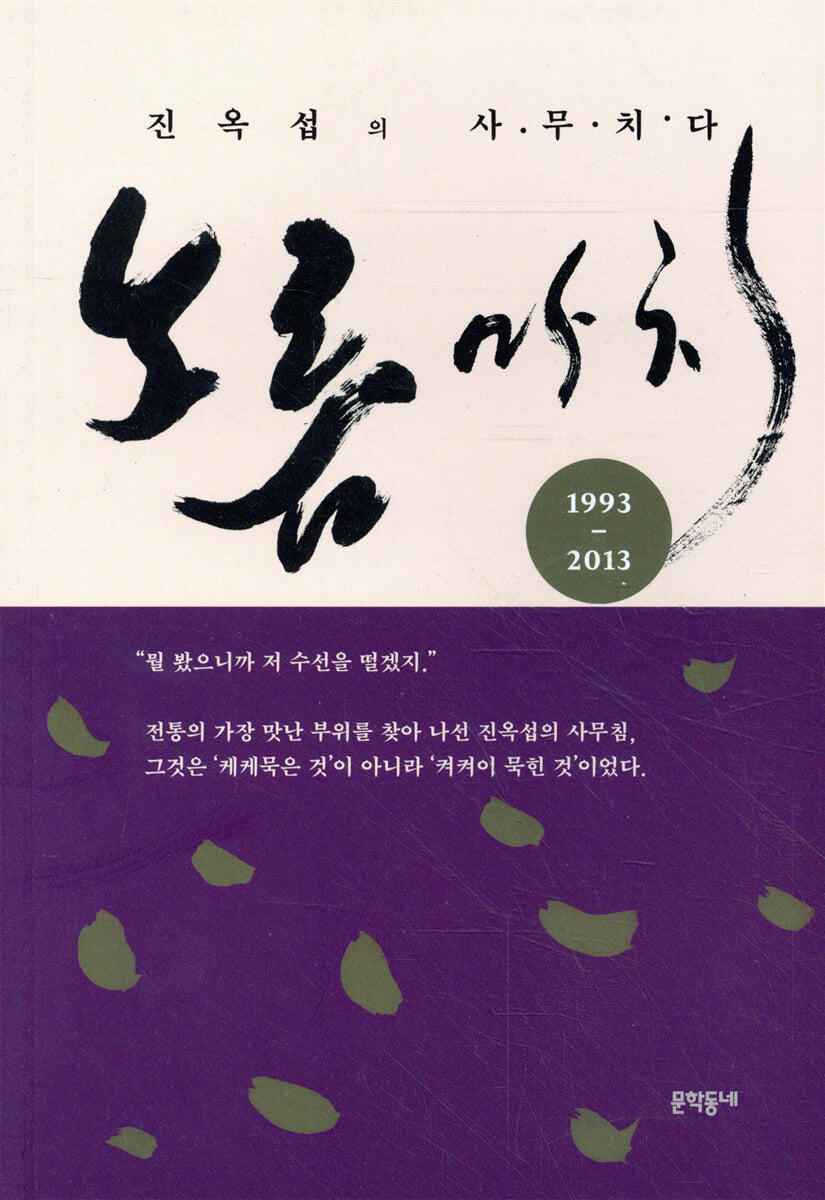
Normachi
 |
Description
Book Introduction
The wild bastard Jin Ok-seop, the monster of the other guys, Jin Ok-seop,
His 20 years of dedication have rewritten our art history!
'Noreummachi' is a slang term of Namsadangpae that means the best performer, and is a combination of the word 'noreum' in 'play' and 'machi' in 'finish'.
Soon, when he comes out and plays a game, it becomes meaningless for anyone else to step forward, so the game has to end. The best among the best who can end the game at this time is called 'Noreummachi'.
This book is a revised and expanded edition of a book published in 2007.
It is also a record of the obsession and hardship of a man who has lived for over 20 years.
It is divided into a total of 6 chapters.
Looking at the structure of each chapter, it consists of an introduction that is an introductory story, followed by the lives and art of three people, and on the last page, there is a review that is close to their current situation, titled 'Today in 2013'.
You can see what kind of genius talents these celebrities displayed in each field.
Although most of them were people who had lived difficult lives, such as gisaengs, shamans, and clowns, their blood, flesh, and bones were nothing less than those of an incomparable artist who dared to be compared to gods.
The late Gong Ok-jin, the famous Shim Hwa-yeong, also known as the elder of Shim Su-bong's family, the great shaman Kim Geum-hwa, who is often called out everywhere, these people whose names are popular, these are still alive and well, but these people who seem to have been buried whole with the rhetoric of being "buried in the wilderness" are also these people, 『Gorummachi』 appeals to us with only one goal, without leaning towards any one side.
His 20 years of dedication have rewritten our art history!
'Noreummachi' is a slang term of Namsadangpae that means the best performer, and is a combination of the word 'noreum' in 'play' and 'machi' in 'finish'.
Soon, when he comes out and plays a game, it becomes meaningless for anyone else to step forward, so the game has to end. The best among the best who can end the game at this time is called 'Noreummachi'.
This book is a revised and expanded edition of a book published in 2007.
It is also a record of the obsession and hardship of a man who has lived for over 20 years.
It is divided into a total of 6 chapters.
Looking at the structure of each chapter, it consists of an introduction that is an introductory story, followed by the lives and art of three people, and on the last page, there is a review that is close to their current situation, titled 'Today in 2013'.
You can see what kind of genius talents these celebrities displayed in each field.
Although most of them were people who had lived difficult lives, such as gisaengs, shamans, and clowns, their blood, flesh, and bones were nothing less than those of an incomparable artist who dared to be compared to gods.
The late Gong Ok-jin, the famous Shim Hwa-yeong, also known as the elder of Shim Su-bong's family, the great shaman Kim Geum-hwa, who is often called out everywhere, these people whose names are popular, these are still alive and well, but these people who seem to have been buried whole with the rhetoric of being "buried in the wilderness" are also these people, 『Gorummachi』 appeals to us with only one goal, without leaning towards any one side.
- You can preview some of the book's contents.
Preview
index
prolog
Hunger is also a type of extreme hunger.
1.
Yegi (藝妓), Lee Hwa-woo will be scattered
There's a promise on the horizon
The sad dancing mother, Jang Geumdo
The woman who sings the dance, Yu Geum-seon
The Last Sound of the Secondhand Market, Sim Hwa-young
2.
Nammu (male dance), dancing Cheoyong fathers
Going a thousand miles down to meet Yeongnam dance
Moon Jang-won, the last Dongrae vagabond who lived his life through dance
Ha Yong-bu, the eldest son of the Miryang Riverside Dance
Kim Deok-myeong, the 'Dancing Crane Taoist' who plays the Ujo (羽調)
3.
Deuk-eum (得音), the longest climb in the world
Go see the rumor
A Hundred Years' Guest, Jeong Gwang-su
"Let's go set fire to the Red Cliffs," Han Seung-ho
The Sound of a Grassland Buried in the Wilderness, Han Ae-soon
4.
A wandering path, shaking off the dew of wild strawberries
White poppy flowers on the hill of Borigogae
Kim Woon-tae, the boy prodigy of the packaging theater
Simcheong's mother in white, Gong Ok-jin
The Last Wandering Clown, Kang Jun-seop
5.
The spirit gives you wisdom, but you learn the skills yourself.
In search of Hanyang Manshin
Still a 'Wangsimni ant', Kim Yu-gam
Lee Sang-soon, a guide to the hometown flower garden
The Silk Flower Woman Who Rides a Sledgehammer, Kim Geum-hwa
6.
Pungryu (風流), the people of the 'Dance Triangle'
People of the Dance Town
Lee Yun-seok, the farmer who cultivates dance
The last great mountain of Hallyeohaesangdo, Jeong Yeong-man
Jinju-ra Cheonri Jeilmu, Kim Soo-ak
Epilogue
Even if the ink written here fades
Hunger is also a type of extreme hunger.
1.
Yegi (藝妓), Lee Hwa-woo will be scattered
There's a promise on the horizon
The sad dancing mother, Jang Geumdo
The woman who sings the dance, Yu Geum-seon
The Last Sound of the Secondhand Market, Sim Hwa-young
2.
Nammu (male dance), dancing Cheoyong fathers
Going a thousand miles down to meet Yeongnam dance
Moon Jang-won, the last Dongrae vagabond who lived his life through dance
Ha Yong-bu, the eldest son of the Miryang Riverside Dance
Kim Deok-myeong, the 'Dancing Crane Taoist' who plays the Ujo (羽調)
3.
Deuk-eum (得音), the longest climb in the world
Go see the rumor
A Hundred Years' Guest, Jeong Gwang-su
"Let's go set fire to the Red Cliffs," Han Seung-ho
The Sound of a Grassland Buried in the Wilderness, Han Ae-soon
4.
A wandering path, shaking off the dew of wild strawberries
White poppy flowers on the hill of Borigogae
Kim Woon-tae, the boy prodigy of the packaging theater
Simcheong's mother in white, Gong Ok-jin
The Last Wandering Clown, Kang Jun-seop
5.
The spirit gives you wisdom, but you learn the skills yourself.
In search of Hanyang Manshin
Still a 'Wangsimni ant', Kim Yu-gam
Lee Sang-soon, a guide to the hometown flower garden
The Silk Flower Woman Who Rides a Sledgehammer, Kim Geum-hwa
6.
Pungryu (風流), the people of the 'Dance Triangle'
People of the Dance Town
Lee Yun-seok, the farmer who cultivates dance
The last great mountain of Hallyeohaesangdo, Jeong Yeong-man
Jinju-ra Cheonri Jeilmu, Kim Soo-ak
Epilogue
Even if the ink written here fades
Into the book
In tradition, the word 'baksu' exists between 'bak' and 'bak'.
It's not something like a flare-up, but an unbearable elasticity that pops out at any moment.
For example, if you dance, you can push and step on the beat to create anxiety and make the audience's backs fall off the backs of their chairs.
And then he pulls it back and steps on it, making his body bend.
By involving the audience in the rhythm of the stage like this, they gradually gather silent applause, and finally, unable to endure the dazzling and dizzying moment, they exclaim, “Oh my!” ---「Prologue」
The shoes were worn on the ornate flower-patterned stone, and the outer shoes were pulled tight enough to make a creaking sound, creating a thin and thick outer shoe. The streamlined shape of the outer shoe seemed as if it would spread out like waves as it lightly stepped on the flower bed.
Footsteps that make your heart flutter like the blue of petals that fell into a spring well.
Before the dance even began, the dance was already in full swing.---「Kim Yu-gam」
After the performance, I touched the teacher's sandals.
The front was made of cotton and the heel was made of single-layered cotton.
For a moment, I felt a tingling sensation again.
Ah! This is the secret of the master.
When you stand on your heels, you have to be extremely sensitive to whether your skin touches your flesh or whether it touches your bones.
However, the front feet should be covered with cotton socks and the outer socks should be worn tightly over them to create a streamlined outer appearance.
Because the hem of the skirt needs to be slightly visible to shake the hearts of those who see it.
In the end, he devised his own pair of socks, with a cotton sole in the front and a single sole in the back, and achieved both temptation and restraint in one pair. ---「Epilogue」
I started to get scared.
Because the moment you look into absolute time, that becomes the standard.
For the rest of my life, I will put this moment on one side of the scale and put the new thing I saw on the other side.
People around me will blame my brain for dismissing today's masterpiece with a single word, and shake their heads at the masterpiece they haven't seen, saying it's an exaggeration.
So it is a sin to look into what cannot be seen.
It is a punishment that forces one to cower in solitude without anyone to rule over them.
What's even more frightening is that we still dream again.
So, I'll go into the closet again and shake hands with those scaly, shining hands.
Outside, cherry blossoms fall as the short spring passes, inside the room, scales with saliva marks fall, and I talk about a gigantic fish called Gon.
It is said that the time has come for the gon to shed its scales and rise up as a bird called the Peng.
The stage is a passageway that the bungee has to fly through, so let's get on there now.
As I looked into my future, dreaming of a journey of ten thousand miles, I heard the sound of my own gasping breath again.
It's not something like a flare-up, but an unbearable elasticity that pops out at any moment.
For example, if you dance, you can push and step on the beat to create anxiety and make the audience's backs fall off the backs of their chairs.
And then he pulls it back and steps on it, making his body bend.
By involving the audience in the rhythm of the stage like this, they gradually gather silent applause, and finally, unable to endure the dazzling and dizzying moment, they exclaim, “Oh my!” ---「Prologue」
The shoes were worn on the ornate flower-patterned stone, and the outer shoes were pulled tight enough to make a creaking sound, creating a thin and thick outer shoe. The streamlined shape of the outer shoe seemed as if it would spread out like waves as it lightly stepped on the flower bed.
Footsteps that make your heart flutter like the blue of petals that fell into a spring well.
Before the dance even began, the dance was already in full swing.---「Kim Yu-gam」
After the performance, I touched the teacher's sandals.
The front was made of cotton and the heel was made of single-layered cotton.
For a moment, I felt a tingling sensation again.
Ah! This is the secret of the master.
When you stand on your heels, you have to be extremely sensitive to whether your skin touches your flesh or whether it touches your bones.
However, the front feet should be covered with cotton socks and the outer socks should be worn tightly over them to create a streamlined outer appearance.
Because the hem of the skirt needs to be slightly visible to shake the hearts of those who see it.
In the end, he devised his own pair of socks, with a cotton sole in the front and a single sole in the back, and achieved both temptation and restraint in one pair. ---「Epilogue」
I started to get scared.
Because the moment you look into absolute time, that becomes the standard.
For the rest of my life, I will put this moment on one side of the scale and put the new thing I saw on the other side.
People around me will blame my brain for dismissing today's masterpiece with a single word, and shake their heads at the masterpiece they haven't seen, saying it's an exaggeration.
So it is a sin to look into what cannot be seen.
It is a punishment that forces one to cower in solitude without anyone to rule over them.
What's even more frightening is that we still dream again.
So, I'll go into the closet again and shake hands with those scaly, shining hands.
Outside, cherry blossoms fall as the short spring passes, inside the room, scales with saliva marks fall, and I talk about a gigantic fish called Gon.
It is said that the time has come for the gon to shed its scales and rise up as a bird called the Peng.
The stage is a passageway that the bungee has to fly through, so let's get on there now.
As I looked into my future, dreaming of a journey of ten thousand miles, I heard the sound of my own gasping breath again.
---「Kim Soo-ak」
Publisher's Review
I'm not sure if there are many of you who know the exact meaning of the word 'norummachi'.
Judging by the nuance, it seems similar to Korean, but I guess most people have no idea what it means.
Even I, the author of this book, was like, "Huh, what is this?" for a long time when I first saw it.
It's so strange.
In front of unfamiliar English words, they are embarrassed by not knowing the meaning and look for a mouse hole, but in front of Korean words, they are so shameless and confident in front of ignorance, regardless of what it means.
'Noreummachi' is a slang term of Namsadangpae, meaning the best performer, and is a combination of the word 'noreum' in 'play' and 'machi' in 'finish'.
Soon, when he comes out and plays a game, it becomes meaningless for anyone else to step forward, so the game has to end. The best among the best who can end the game at this point is called a 'noreummachi'.
Okay, the introduction was a bit long, but the reason I had to start talking loudly about 'Norummachi' is because I realized that this book gave me a sense of mission to recognize our true artists who have sustained their lives with a certain earnest desire for 'art' throughout their lives.
How much did we have to pretend not to know about our own things for the words of a famous singer who said that our things are precious to remain as a catchphrase that has dominated the times?
Of course, that's the case, so let's leave that aside and now I'd like to guide you through the book "Normachi."
For reference, this book was previously published in 2007, but it was comprehensively expanded in June 2013 when it was planned to be published again.
This book features eighteen of our masters, and it couldn't be otherwise, as the lives of these seniors, whose average age is approaching eighty, have undergone countless life-or-death changes over the past six years.
This must have been a difficult task for the author of this book, Jin Ok-seop.
They say it's a compilation of press releases written to promote performances while planning and directing traditional arts, but it goes without saying that each and every one of them lived their lives on stage, not to mention their lives in "guts and dances that are held without notice," but even beyond that, in the living room, in the kitchen, at the dinner table, and made them vomit out the last bit of their pent-up tears. This would not have been possible if the sincerity and sincerity of one man who set out to find the most delicious part of tradition had not been true.
"Norummachi" is a record of the obsession and hardships of a man who has lived through 20 years of his life.
There was no original intention to pit the four martial arts, dance, shamanism, and nothingness, against the samuchim, but it is true that the 'emptiness' of the 'nothingness' that we will return to in the future and the 'unknowingness' of the emotion of 'samuchim' are similar, like a male and female body.
What difference could there be between the essence of life, art, and death?
Everything is 'by itself'.
“What did you see that made you want to make that fuss?”
Jin Ok-seop's office was not 'old' but 'deeply aged'!
This book is divided into six chapters.
Looking at the structure of each chapter, it consists of an introduction that is an introductory story, followed by the lives and art of three people, and on the last page, there is a review that is close to their current situation, titled 'Today in 2013'.
The following explanation will help you understand what kind of genius talents these celebrities displayed in each field.
The three introduced in Yegi (藝妓) are the sad dancing mother, Jang Geum.
The woman who sings the dance, Yu Geum-seon.
The last sound of the second-hand goods, Sim Hwa-young.
The three introduced in Nammu (male dance) are the last Dongrae vagabond who lived through dance, Moon Jang-won.
The eldest son of the Miryang Riverside Dance, Ha Yong-bu.
Kim Myeong-deok, the 'unlearned scholar' who rides the Ujo.
The three introduced in Deuk-eum (得音) are a hundred-year-old singer, Jeong Gwang-su.
“Let’s go set fire to the Red Cliffs,” Han Seung-ho.
The sound of a dandelion buried in the wilderness, Han Ae-soon.
The three introduced in Yurang (流浪) are the boy prodigy of the packaging theater, Kim Woon-tae.
Simcheong's mother, Gong Ok-jin, dressed in white.
The last wandering clown, Kang Jun-seop.
The three introduced in Gangsin (降神) are still the 'Ants of Wangsimni', Kim Yu-gam.
A guide to the flower garden of my hometown, Lee Sang-soon.
The woman who rides a hoe and wears silk flowers, Kim Geum-hwa.
The three introduced in Pungryu are Lee Yun-seok, a farmer who cultivates dance.
The last great mountain of Hallyeohaesangdo is Jeongyeongman.
Jinju, the best in Cheonri, Kim Soo-ak.
Although most of them were people who had lived difficult lives, such as gisaengs, shamans, and clowns, their flesh, blood, and bones were nothing less than those of an artist so extraordinary that they dared to be compared to gods.
In short, let's say that these are bodies that have already experienced the lightness of a moment passing into eternity.
The eighteen celebrities we met on stage said that after they left the stage, when we were all aging like you and me, we would meet again at senior centers, teahouses, and noodle shops in the market.
So, I asked the people of 'One Road' and had them write their own resumes about their lives.
The late Gong Ok-jin, the famous Shim Hwa-yeong, also known as the elder of Shim Su-bong's family, the great shaman Kim Geum-hwa, who is often called out everywhere, these people whose names are popular, these are still alive and well, but these people who seem to have been buried entirely with the rhetoric of being "buried in the wilderness" are also these people, and we know that 『Gorummachi』 appeals to us with only one goal, without leaning to any side.
“If you wish to touch the great presence even once in your life, look! Our art history will never be able to avoid this one!”
I got up and had a few shouts, but then I fell down again.
On January 28, 2010, the conversation among the mourners turned to the teacher's passionate drinking.
One time, while singing Simcheongga, he put alcohol in a water bottle on the tray and drank it from time to time.
When Simcheong jumped into the water, she fell down with a splash and fell asleep.
It is said that when the master noticed the situation and poked him in the side with a drumstick, he woke up with a start and continued calmly saying, “No matter how deep the water was, I was still falling in!”
As laughter filled the shopping district, someone whispered to me.
In his later years, he said that he would go to LA because pansori was no longer popular in Korea.
“I have to learn English.
“You help me!” Both he and I said, our eyes turning red.
-From "Han Seung-ho" section on pages 208-209
In May 2010, he was designated as the holder of the Jeollanam-do Intangible Cultural Property, the Il-in Changmugeuk Simcheongga.
The lineage is important, and the reason it was designated as a creative Changmugeuk is probably because it could not ignore the respect of the entire nation.
The following month, in June, he performed at the National Theater and said, “If I don’t die, I’ll come again,” but passed away at Yeonggwang Christian Hospital in Jeonnam Province in the early morning of July 9, 2012.
A scene from a performance at the Dure Theater was hung as a memorial photo at the funeral home.
At that performance, they invited singer Park Jin-young.
I vividly remember the melody of the song and the delicious dance.
He, who has become an all-round entertainer, posted a memorial message and confessed that Gong Ok-jin was his mentor.
Anyone who saw that performance at its peak knows without a doubt.
A one-man dance play, it was the most perfect way to capture the audience.
On the morning of July 12th, when the funeral was held in front of the Yeonggwang Art Research Institute, the grandmothers of Gyochon-ri all gathered and said, “Gong Ok-jin is leaving.”
He was neither a dancer nor a traditional Korean musician.
It was just a neighborhood gong-ok-jin.
It's hard to be both a celebrity and a local neighbor.
Gong Ok-jin, life off stage was also art and a religion of giving.
-p270~271 From the "Gongokjin" section
Around Chuseok in 2006, while I was weeding my ancestors' grave, my right index finger was cut off by a weeder.
“Our ancestors took it so people wouldn’t point fingers at it,” he laughs.
The problem is that the Gosung dance developed by mocking the nobles, so pointing fingers is important.
The severed right index finger is the final vertex of the geometric gradient.
In the end, I made a rubber index finger and put it on and danced.
As the dance scene expands, people go to Mongolia, China, Southeast Asia, and even Europe to dance.
In the past, only the Goseong O-Gwangdae play was invited, but now they want his “Ddeotbaegi dance” during the intermission as well.
It's like traveling the world in a single set of clothes.
After the performance, the crowd gathered and their eyes stopped on the large farmer's hand.
Then, when the performance is over, he takes out his index finger as if removing his makeup and puts it in his pocket, smiling brightly.
-p381 From the "Lee Yun-seok" section
The stage is a scale where all decorations are discarded and only the body stands on it.
Our gamblers, full of style, played there their whole lives.
If it weren't for that one person's persistent 'goodness,' I would have had a hard time meeting them even if I died soon. As I persistently read about the lives and deaths of our artists, their gods and fates, I was overcome with a desire to present their lives in today's times in a way different from that of the author, Jin Ok-seop.
Even with the different occupations of parasites, clowns, and shamans, if we look closely at each and every phrase of the life they have lived, even the most ordinary family lineages are portrayed as extraordinary.
I am convinced that the movie is a story that unfolds the twists and turns of life.
Because it is a genre characteristic that cannot help but flow along the course of our history, we have encountered situations where contempt has turned into hospitality, and preferential treatment has turned into contempt, like a ship capsizing, more than once or twice.
But now I've had this thought.
If dance, sound, and music were to be passed down to us as precious art, would it have maintained such deep-rooted vitality? Perhaps, in this process of ‘not having and enjoying less,’ their blood and tears have dragged the art down even deeper, turning it into the ‘soil,’ the foundation of all things.
『Norummachi』 is a book with such a terrifying fate that once you pick it up, you can never put it down.
Take a look at the author's sentences.
The bones and flesh each move individually, each with an amazing sense of timing and stretch.
I have strength.
Those who read it have no choice but to obey it.
I just pick out the right words and say them.
He writes on the paper with sound and with music, with a dance that he has been so eager to follow, without overflowing or lacking.
“Exploring that solitude where only bones remain” is not only evidence of the ‘dance’ he praised.
It is important to read the book and make time to see Jin Ok-seop and the performances he plans.
Time passes, and these days, there are more and more of us artists who are losing our breath in the process.
Judging by the nuance, it seems similar to Korean, but I guess most people have no idea what it means.
Even I, the author of this book, was like, "Huh, what is this?" for a long time when I first saw it.
It's so strange.
In front of unfamiliar English words, they are embarrassed by not knowing the meaning and look for a mouse hole, but in front of Korean words, they are so shameless and confident in front of ignorance, regardless of what it means.
'Noreummachi' is a slang term of Namsadangpae, meaning the best performer, and is a combination of the word 'noreum' in 'play' and 'machi' in 'finish'.
Soon, when he comes out and plays a game, it becomes meaningless for anyone else to step forward, so the game has to end. The best among the best who can end the game at this point is called a 'noreummachi'.
Okay, the introduction was a bit long, but the reason I had to start talking loudly about 'Norummachi' is because I realized that this book gave me a sense of mission to recognize our true artists who have sustained their lives with a certain earnest desire for 'art' throughout their lives.
How much did we have to pretend not to know about our own things for the words of a famous singer who said that our things are precious to remain as a catchphrase that has dominated the times?
Of course, that's the case, so let's leave that aside and now I'd like to guide you through the book "Normachi."
For reference, this book was previously published in 2007, but it was comprehensively expanded in June 2013 when it was planned to be published again.
This book features eighteen of our masters, and it couldn't be otherwise, as the lives of these seniors, whose average age is approaching eighty, have undergone countless life-or-death changes over the past six years.
This must have been a difficult task for the author of this book, Jin Ok-seop.
They say it's a compilation of press releases written to promote performances while planning and directing traditional arts, but it goes without saying that each and every one of them lived their lives on stage, not to mention their lives in "guts and dances that are held without notice," but even beyond that, in the living room, in the kitchen, at the dinner table, and made them vomit out the last bit of their pent-up tears. This would not have been possible if the sincerity and sincerity of one man who set out to find the most delicious part of tradition had not been true.
"Norummachi" is a record of the obsession and hardships of a man who has lived through 20 years of his life.
There was no original intention to pit the four martial arts, dance, shamanism, and nothingness, against the samuchim, but it is true that the 'emptiness' of the 'nothingness' that we will return to in the future and the 'unknowingness' of the emotion of 'samuchim' are similar, like a male and female body.
What difference could there be between the essence of life, art, and death?
Everything is 'by itself'.
“What did you see that made you want to make that fuss?”
Jin Ok-seop's office was not 'old' but 'deeply aged'!
This book is divided into six chapters.
Looking at the structure of each chapter, it consists of an introduction that is an introductory story, followed by the lives and art of three people, and on the last page, there is a review that is close to their current situation, titled 'Today in 2013'.
The following explanation will help you understand what kind of genius talents these celebrities displayed in each field.
The three introduced in Yegi (藝妓) are the sad dancing mother, Jang Geum.
The woman who sings the dance, Yu Geum-seon.
The last sound of the second-hand goods, Sim Hwa-young.
The three introduced in Nammu (male dance) are the last Dongrae vagabond who lived through dance, Moon Jang-won.
The eldest son of the Miryang Riverside Dance, Ha Yong-bu.
Kim Myeong-deok, the 'unlearned scholar' who rides the Ujo.
The three introduced in Deuk-eum (得音) are a hundred-year-old singer, Jeong Gwang-su.
“Let’s go set fire to the Red Cliffs,” Han Seung-ho.
The sound of a dandelion buried in the wilderness, Han Ae-soon.
The three introduced in Yurang (流浪) are the boy prodigy of the packaging theater, Kim Woon-tae.
Simcheong's mother, Gong Ok-jin, dressed in white.
The last wandering clown, Kang Jun-seop.
The three introduced in Gangsin (降神) are still the 'Ants of Wangsimni', Kim Yu-gam.
A guide to the flower garden of my hometown, Lee Sang-soon.
The woman who rides a hoe and wears silk flowers, Kim Geum-hwa.
The three introduced in Pungryu are Lee Yun-seok, a farmer who cultivates dance.
The last great mountain of Hallyeohaesangdo is Jeongyeongman.
Jinju, the best in Cheonri, Kim Soo-ak.
Although most of them were people who had lived difficult lives, such as gisaengs, shamans, and clowns, their flesh, blood, and bones were nothing less than those of an artist so extraordinary that they dared to be compared to gods.
In short, let's say that these are bodies that have already experienced the lightness of a moment passing into eternity.
The eighteen celebrities we met on stage said that after they left the stage, when we were all aging like you and me, we would meet again at senior centers, teahouses, and noodle shops in the market.
So, I asked the people of 'One Road' and had them write their own resumes about their lives.
The late Gong Ok-jin, the famous Shim Hwa-yeong, also known as the elder of Shim Su-bong's family, the great shaman Kim Geum-hwa, who is often called out everywhere, these people whose names are popular, these are still alive and well, but these people who seem to have been buried entirely with the rhetoric of being "buried in the wilderness" are also these people, and we know that 『Gorummachi』 appeals to us with only one goal, without leaning to any side.
“If you wish to touch the great presence even once in your life, look! Our art history will never be able to avoid this one!”
I got up and had a few shouts, but then I fell down again.
On January 28, 2010, the conversation among the mourners turned to the teacher's passionate drinking.
One time, while singing Simcheongga, he put alcohol in a water bottle on the tray and drank it from time to time.
When Simcheong jumped into the water, she fell down with a splash and fell asleep.
It is said that when the master noticed the situation and poked him in the side with a drumstick, he woke up with a start and continued calmly saying, “No matter how deep the water was, I was still falling in!”
As laughter filled the shopping district, someone whispered to me.
In his later years, he said that he would go to LA because pansori was no longer popular in Korea.
“I have to learn English.
“You help me!” Both he and I said, our eyes turning red.
-From "Han Seung-ho" section on pages 208-209
In May 2010, he was designated as the holder of the Jeollanam-do Intangible Cultural Property, the Il-in Changmugeuk Simcheongga.
The lineage is important, and the reason it was designated as a creative Changmugeuk is probably because it could not ignore the respect of the entire nation.
The following month, in June, he performed at the National Theater and said, “If I don’t die, I’ll come again,” but passed away at Yeonggwang Christian Hospital in Jeonnam Province in the early morning of July 9, 2012.
A scene from a performance at the Dure Theater was hung as a memorial photo at the funeral home.
At that performance, they invited singer Park Jin-young.
I vividly remember the melody of the song and the delicious dance.
He, who has become an all-round entertainer, posted a memorial message and confessed that Gong Ok-jin was his mentor.
Anyone who saw that performance at its peak knows without a doubt.
A one-man dance play, it was the most perfect way to capture the audience.
On the morning of July 12th, when the funeral was held in front of the Yeonggwang Art Research Institute, the grandmothers of Gyochon-ri all gathered and said, “Gong Ok-jin is leaving.”
He was neither a dancer nor a traditional Korean musician.
It was just a neighborhood gong-ok-jin.
It's hard to be both a celebrity and a local neighbor.
Gong Ok-jin, life off stage was also art and a religion of giving.
-p270~271 From the "Gongokjin" section
Around Chuseok in 2006, while I was weeding my ancestors' grave, my right index finger was cut off by a weeder.
“Our ancestors took it so people wouldn’t point fingers at it,” he laughs.
The problem is that the Gosung dance developed by mocking the nobles, so pointing fingers is important.
The severed right index finger is the final vertex of the geometric gradient.
In the end, I made a rubber index finger and put it on and danced.
As the dance scene expands, people go to Mongolia, China, Southeast Asia, and even Europe to dance.
In the past, only the Goseong O-Gwangdae play was invited, but now they want his “Ddeotbaegi dance” during the intermission as well.
It's like traveling the world in a single set of clothes.
After the performance, the crowd gathered and their eyes stopped on the large farmer's hand.
Then, when the performance is over, he takes out his index finger as if removing his makeup and puts it in his pocket, smiling brightly.
-p381 From the "Lee Yun-seok" section
The stage is a scale where all decorations are discarded and only the body stands on it.
Our gamblers, full of style, played there their whole lives.
If it weren't for that one person's persistent 'goodness,' I would have had a hard time meeting them even if I died soon. As I persistently read about the lives and deaths of our artists, their gods and fates, I was overcome with a desire to present their lives in today's times in a way different from that of the author, Jin Ok-seop.
Even with the different occupations of parasites, clowns, and shamans, if we look closely at each and every phrase of the life they have lived, even the most ordinary family lineages are portrayed as extraordinary.
I am convinced that the movie is a story that unfolds the twists and turns of life.
Because it is a genre characteristic that cannot help but flow along the course of our history, we have encountered situations where contempt has turned into hospitality, and preferential treatment has turned into contempt, like a ship capsizing, more than once or twice.
But now I've had this thought.
If dance, sound, and music were to be passed down to us as precious art, would it have maintained such deep-rooted vitality? Perhaps, in this process of ‘not having and enjoying less,’ their blood and tears have dragged the art down even deeper, turning it into the ‘soil,’ the foundation of all things.
『Norummachi』 is a book with such a terrifying fate that once you pick it up, you can never put it down.
Take a look at the author's sentences.
The bones and flesh each move individually, each with an amazing sense of timing and stretch.
I have strength.
Those who read it have no choice but to obey it.
I just pick out the right words and say them.
He writes on the paper with sound and with music, with a dance that he has been so eager to follow, without overflowing or lacking.
“Exploring that solitude where only bones remain” is not only evidence of the ‘dance’ he praised.
It is important to read the book and make time to see Jin Ok-seop and the performances he plans.
Time passes, and these days, there are more and more of us artists who are losing our breath in the process.
GOODS SPECIFICS
- Date of publication: June 10, 2013
- Page count, weight, size: 437 pages | 680g | 210*498*30mm
- ISBN13: 9788954621489
- ISBN10: 8954621481
You may also like
카테고리
korean


korean

![GQ KOREA Mark (Monthly): December [2025]](http://librairie.coreenne.fr/cdn/shop/files/8ef265dbbfbf186523ed75ba7319009d.jpg?v=1765340328&width=3840)


