

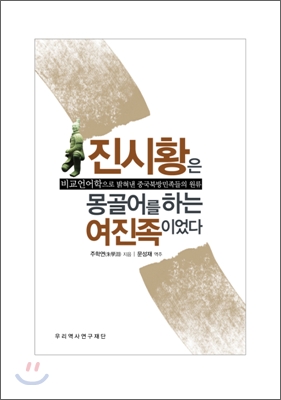
Qin Shi Huang was a Mongolian-speaking Jurchen.
 |
Description
Book Introduction
Tracing the History of China's Ethnic Minorities Through Empirical Linguistics
Chinese historian Zhu Xueyuan has compiled his research findings into a book.
As this book is a compilation of sporadically published papers, the unity and consistency of the book itself are somewhat weak, but it allows one to experience the author's free-spirited scholarship.
As the title, “Qin Shi Huang was a Mongolian-speaking Jurchen,” suggests, the author makes several claims that run counter to the prevailing understanding of history in China.
"Qin Shi Huang was a Mongolian-speaking Jurchen" mainly explores China's ethnic issues.
The book mainly covers the history of ethnic minorities active in northern China, such as the Huns, Turks, Xianbei, and Mongols.
In particular, the author reconstructs the history of each ethnic group in China through empirical evidence from linguistics. By analyzing the linguistic traces contained in ancient Chinese personal names, place names, and ethnic names, he concludes that the Suksin, Malgal, Jurchen, and Manchu peoples, which were previously recognized as separate ethnic groups, share a common root.
Although the author of this book is said to be a minority opinion within Chinese historiography, this book will provide a taste of the currents in Chinese historical scholarship.
Chinese historian Zhu Xueyuan has compiled his research findings into a book.
As this book is a compilation of sporadically published papers, the unity and consistency of the book itself are somewhat weak, but it allows one to experience the author's free-spirited scholarship.
As the title, “Qin Shi Huang was a Mongolian-speaking Jurchen,” suggests, the author makes several claims that run counter to the prevailing understanding of history in China.
"Qin Shi Huang was a Mongolian-speaking Jurchen" mainly explores China's ethnic issues.
The book mainly covers the history of ethnic minorities active in northern China, such as the Huns, Turks, Xianbei, and Mongols.
In particular, the author reconstructs the history of each ethnic group in China through empirical evidence from linguistics. By analyzing the linguistic traces contained in ancient Chinese personal names, place names, and ethnic names, he concludes that the Suksin, Malgal, Jurchen, and Manchu peoples, which were previously recognized as separate ethnic groups, share a common root.
Although the author of this book is said to be a minority opinion within Chinese historiography, this book will provide a taste of the currents in Chinese historical scholarship.
index
Note
Translator's Preface
introduction
Preface to the first edition
In search of the origins of the Chinese people
1. The End of Research on Northern Chinese Peoples
2 Northern peoples of China
3. Oje is Aesin, Hwahwa is Hweheul
4. Study of the Hundred Poems
5 Tungusic clans: Hee and Guseong
6 Yeojin and Goocheon
7 Qin Shi Huang was a Mongolian-speaking Jurchen.
8. Finding the Roots of the Central Plains People through 'Dool'
9 Blood and Language of the Xiongnu People
10 The Rise and Fall of the Huns and Their Migration Routes
11 Attila and the Huns
12 The Origin and Prosperity of the Turkic People
13 Hungary and Jurchen are of the same ethnicity
14 The Xianbei Tribe and Their Language
15 Tungus bloodline of the Mongols
16 Northern ethnic elements of the Tibetan people
17 The Sabbath is the land of love
18. The country of George is a land of women.
19 The Great Battle is not the Roman Empire
20 European peoples from the East
21 Humanistic information from the Book of the Later Han (Yuan Yi)
22. Hungarian Surnames and Their Return to the Country
23 Northern Ethnic Characteristics of Ancient Central Plains People
24 For a Practical Chinese Historiography
Translator's Preface
introduction
Preface to the first edition
In search of the origins of the Chinese people
1. The End of Research on Northern Chinese Peoples
2 Northern peoples of China
3. Oje is Aesin, Hwahwa is Hweheul
4. Study of the Hundred Poems
5 Tungusic clans: Hee and Guseong
6 Yeojin and Goocheon
7 Qin Shi Huang was a Mongolian-speaking Jurchen.
8. Finding the Roots of the Central Plains People through 'Dool'
9 Blood and Language of the Xiongnu People
10 The Rise and Fall of the Huns and Their Migration Routes
11 Attila and the Huns
12 The Origin and Prosperity of the Turkic People
13 Hungary and Jurchen are of the same ethnicity
14 The Xianbei Tribe and Their Language
15 Tungus bloodline of the Mongols
16 Northern ethnic elements of the Tibetan people
17 The Sabbath is the land of love
18. The country of George is a land of women.
19 The Great Battle is not the Roman Empire
20 European peoples from the East
21 Humanistic information from the Book of the Later Han (Yuan Yi)
22. Hungarian Surnames and Their Return to the Country
23 Northern Ethnic Characteristics of Ancient Central Plains People
24 For a Practical Chinese Historiography
Into the book
The Mongols are descendants of the Donghu (東胡) lineage Xianbei (鮮卑) people, and the Jurchen (女眞) were a representative of the Tungusic people.
The reason for using expressions like, "Qin Shi Huang was a Mongolian-speaking Jurchen," was to examine the blood ties and linguistic affiliations of ancient people using the representation of modern humans, and because without such expressions, the essence of the problem could not be clearly explained.
--- p.26
This book far surpasses the achievements of previous scholars.
Zhu Xueyan not only explored the origins of the northern Chinese peoples, but also achieved unprecedented feats by pointing out the correlation between their origins and the fusion of Eurasian races and languages.
What's even more amazing is that he originally majored in physics.
It is truly remarkable that he has pioneered a new field on his own, free from the constraints of traditional humanities.
--- p.32
Language is a fossil of human history.
Clan names are linguistic markers that can be used to estimate human blood ties. Since they originated in the early stages of language development, they can be said to be the oldest fossils in human history. These were later converted into surnames, personal names, and place names, and have been passed down to the present day.
...Northern Chinese society can be said to be a mirror of prehistoric Central Plains society.
It is for this very reason that this book provides clues to the tribal names of the northern peoples.
--- pp.66-84
In the Central Plains, there are place names such as Muji (武陟) and Wulji (尉氏)* (both in Henan Province), Wugeuk (無極) and Wonji (元氏) (both in Hebei Province), Muche (無?) (in Shandong Province), and Wuji (吳旗) (in Shaanxi Province), personal names such as Muji (無忌) and Muji (無知), and surnames such as Wulji (尉遲), all of which are modified pronunciations of Olja (兀者).
Through this, we can see that they are a people with a long history of making the Central Plains their home.
(Translator's note) *Ulji (尉氏): Also written as Ulji (尉遲).
It was a prestigious clan of the Xianbei lineage that enjoyed considerable fame in Northeast Asia during the Three Kingdoms period of Korea, when the northern Altaic peoples were competing for power in the Central Plains, and during the Southern and Northern Dynasties and Sui and Tang periods of Chinese history. When the Northern Wei Dynasty, founded by the Tuoba clan of the Xianbei lineage, advanced into the Central Plains, they began to use their clan name as their surname.
Goguryeo's famous general Eulji Mundeok is thought to have been a member of this clan.
Although the Chinese characters for 'Ulji (尉遲)' and 'Eulji (乙支)' are different, they clearly correspond to each other in pronunciation.
--- p.72
The Wusun, a Western Regions tribe that appears in the "Biographies of the Great Wan" of the "Historical Records," was a nomadic tribe that advanced through the Hexi Corridor, and was actually a Tungusic Aixin clan.
In the 『History of Jin (金史)』「Records of a Hundred Officials (百官志)」, Aesin is written as Asan (阿鮮), and in the 『Study of Manchurian Origins (滿洲原流考)』, Asan is written as Oshin (烏新), so Oshin was definitely used as Oson.
Therefore, it can be assumed that Ohsun is Aesin, and that the Yellow Emperor is Aesinheonwon (愛新軒轅) of the “Golden Clan” - Kim (金) surname.
--- p.94
When the Jurchen people changed their surnames to Chinese ones, they thought that pig (Olan) was vulgar as a surname and that using sky (Gabulhap) was also disrespectful, so they changed it to Ju (朱) and Jeon (田).
The Qi and Lu regions, which are now Shandong Province, were the land of the Dongyi people in ancient times.
And Dongyi was also the ancestor of the Jurchen people.
Therefore, when the language of the Dongyi people changed thousands of years ago, it seems that the Pig People and Sky People, who were part of it, were transformed into the two surnames Ju (朱) and Jeon (田), respectively.
The reason for using expressions like, "Qin Shi Huang was a Mongolian-speaking Jurchen," was to examine the blood ties and linguistic affiliations of ancient people using the representation of modern humans, and because without such expressions, the essence of the problem could not be clearly explained.
--- p.26
This book far surpasses the achievements of previous scholars.
Zhu Xueyan not only explored the origins of the northern Chinese peoples, but also achieved unprecedented feats by pointing out the correlation between their origins and the fusion of Eurasian races and languages.
What's even more amazing is that he originally majored in physics.
It is truly remarkable that he has pioneered a new field on his own, free from the constraints of traditional humanities.
--- p.32
Language is a fossil of human history.
Clan names are linguistic markers that can be used to estimate human blood ties. Since they originated in the early stages of language development, they can be said to be the oldest fossils in human history. These were later converted into surnames, personal names, and place names, and have been passed down to the present day.
...Northern Chinese society can be said to be a mirror of prehistoric Central Plains society.
It is for this very reason that this book provides clues to the tribal names of the northern peoples.
--- pp.66-84
In the Central Plains, there are place names such as Muji (武陟) and Wulji (尉氏)* (both in Henan Province), Wugeuk (無極) and Wonji (元氏) (both in Hebei Province), Muche (無?) (in Shandong Province), and Wuji (吳旗) (in Shaanxi Province), personal names such as Muji (無忌) and Muji (無知), and surnames such as Wulji (尉遲), all of which are modified pronunciations of Olja (兀者).
Through this, we can see that they are a people with a long history of making the Central Plains their home.
(Translator's note) *Ulji (尉氏): Also written as Ulji (尉遲).
It was a prestigious clan of the Xianbei lineage that enjoyed considerable fame in Northeast Asia during the Three Kingdoms period of Korea, when the northern Altaic peoples were competing for power in the Central Plains, and during the Southern and Northern Dynasties and Sui and Tang periods of Chinese history. When the Northern Wei Dynasty, founded by the Tuoba clan of the Xianbei lineage, advanced into the Central Plains, they began to use their clan name as their surname.
Goguryeo's famous general Eulji Mundeok is thought to have been a member of this clan.
Although the Chinese characters for 'Ulji (尉遲)' and 'Eulji (乙支)' are different, they clearly correspond to each other in pronunciation.
--- p.72
The Wusun, a Western Regions tribe that appears in the "Biographies of the Great Wan" of the "Historical Records," was a nomadic tribe that advanced through the Hexi Corridor, and was actually a Tungusic Aixin clan.
In the 『History of Jin (金史)』「Records of a Hundred Officials (百官志)」, Aesin is written as Asan (阿鮮), and in the 『Study of Manchurian Origins (滿洲原流考)』, Asan is written as Oshin (烏新), so Oshin was definitely used as Oson.
Therefore, it can be assumed that Ohsun is Aesin, and that the Yellow Emperor is Aesinheonwon (愛新軒轅) of the “Golden Clan” - Kim (金) surname.
--- p.94
When the Jurchen people changed their surnames to Chinese ones, they thought that pig (Olan) was vulgar as a surname and that using sky (Gabulhap) was also disrespectful, so they changed it to Ju (朱) and Jeon (田).
The Qi and Lu regions, which are now Shandong Province, were the land of the Dongyi people in ancient times.
And Dongyi was also the ancestor of the Jurchen people.
Therefore, when the language of the Dongyi people changed thousands of years ago, it seems that the Pig People and Sky People, who were part of it, were transformed into the two surnames Ju (朱) and Jeon (田), respectively.
--- p.102
Publisher's Review
Zhu Xueyuan's 『Qin Shi Huang was a Mongolian-speaking Jurchen (秦始皇是說蒙古語的女眞人)』 is a collection of articles the author published in the form of theses over the past 10 years. Although the structure is relatively free and there are some parts that overlap, it accesses the Central Plains society of the ancient times through the mirror of the 'northern peoples' and analyzes the linguistic information of the northern peoples, such as personal names, clan names, place names, and vocabulary, on the premise that the Central Plains language of the ancient times was an Altaic language, a language of the northern peoples, as well as the blood relations between the Eastern and Western peoples.
By tracing the origins and history of northern peoples using this unique research methodology, the author provides unique and advanced clues to issues that have been persistently debated in academic circles, such as the exact location of the ancient state that existed in the Persian region.
The great nation was not Rome or Egypt!
A representative example would be the case of the Great Qin Dynasty.
In the early 20th century, Japanese scholar Hakuro Kokichi identified this city as the ancient Egyptian city of Alexandria, citing the fact that place names such as 'Yeoheon' in 'Records of the Grand Historian' and 'Biographies of Daiwan' and 'Igeon' in 'Book of the Later Han' matched with 'Lekan' with some pronunciations such as 'a' and 's' omitted. French Sinologist Pelliot and others agreed with this, and it was accepted as an established theory for over a hundred years.
The fact that 'Yeoheon' was introduced as Egypt in a recent domestic TV drama about Queen Seondeok is also a result of reflecting this argument.
However, in chapters 17, 18, and 19, Ju Hak-yeon, through in-depth analysis of the original text, comparative linguistic analysis of place names and personal names, and human-geographical examination of the local area, concludes that the Oyishan-ri appearing in Chinese historical books is not Alexandria in Egypt, but the area around Khurasan in Iran, and that the Daejin-guk, also called Yeoheon-guk or Buleum, is the northwestern region of Iran.
The Magyars, the origin of the Hungarian people, were the Malgal people!
Even more interesting is the interpretation of the ethnic origins of the Magyars, the present-day Hungarian people.
Through an analysis of the Magyar people's tribal names, personal names, place names, and basic vocabulary, the author makes the unique claim that the ancestors of Hungarians are the Malgal people (靺鞨族) belonging to the Tungusic people, and that they ultimately settled in Hungary as a result of a chain reaction that lasted hundreds of years, namely the great migration of peoples to Europe, triggered by the Liaodong War and the fall of Goguryeo (高句麗) in the mid-7th century.
Suksin, Malgal, Jurchen, and Manchu are of the same bloodline, originating from the same root.
However, I think the part the author put the most emphasis on was the reinterpretation of the Jurchen people.
Through the work of comparing and analyzing the linguistic codes hidden in ancient Chinese names of people, places, and tribes, he reached the conclusion that the Suxin, Malgal, Jurchen, and Manchu people, who had been recognized as separate tribes by existing scholars, were all Tungusic northern peoples of the same bloodline originating from a single root.
In addition, in chapters 5, 6, and 7, through examination of mythology, archaeology, and philology, he goes beyond conventional wisdom and discovers mythological motifs such as the Sanxingdui culture, the Ji clan of the Zhou Dynasty, the Goujian of the Yue State of the Spring and Autumn Period, and even the Tungusic oviparous tales, bird totems, and bird feather decorations among American Indians, and expresses the view that the founding tales and tribal beliefs of the Qin Dynasty also share such mythological and bloodline affinities.
The Caspian Sea is also known as the Jurjan Sea, or the "Sea of Jurchens"
The interpretation of history that breaks common sense does not stop here.
In chapters 17, 18, and 19, a new interpretation is presented through a phonetic and linguistic approach that the ancient Persian states of Anshi and George were in fact the territory of the Tungusic Jurchen people, and that the Caspian Sea is called the Jurjan Sea, or the “Sea of the Jurchens,” which is in fact a historical fact.
Even leaving aside the western regions of Central Asia, it is no exaggeration to say that the Central Plains, the heart of the Han cultural sphere, has been an arena of competition between northern peoples, including the Tungus peoples who continued from the Shang Dynasty to the Qing Dynasty, as well as the Mongols and Turks, since ancient times.
Although his arguments often appear to be logical leaps due to insufficient archaeological and literary evidence, his unique approach and interpretation directly contradict the traditional Sinocentrism view of history that holds that the Han Chinese are the main actors in Chinese history.
Zhu Xueyan's linguistic positivism that breaks stereotypes in modern Chinese history academia
Of course, these technical details that break conventional wisdom are largely intentional devices.
I think what the author is really trying to clarify through these devices is to break academic taboos.
He advocates linguistic positivism, which takes ancient languages as the primary basis rather than archaeological and literary artifacts, and fiercely criticizes the existing research culture in Chinese academia, which ignores the value of language as a “fossil of human history” despite the fact that it is clearly another cultural transmission system, and that it is obsessed with knowledge while ignoring new awakenings through diverse backgrounds and methodologies of perception, and thus ends up producing only trashy writings and rotten scholars.
Just as Kalgren broke down the wall of traditional Chinese phonology, he also calls on the Chinese academic community to overcome the wall of Kalgren and provide everyone with the opportunity to freely pursue their studies.
The reason this book has had such a huge impact in China and Taiwan is likely due to the historical facts the author describes, but more than anything, it is his unconventional and groundbreaking spirit of challenge and synthesis that breaks the stereotypes of traditional historical discourse.
Another Possibility of Chinese Characters: Interpreting Oracle Bone Script as Phonetic Markers
The second thing the author wants to say is to rediscover another possibility of Chinese characters.
As can be seen from the fact that the oracle bone script, which previous scholars had recognized as semantic symbols (meaning symbols), is now being interpreted as phonetic symbols (sound symbols), it is necessary to pay attention not only to the meaning and ideology of Chinese characters, but also to the sound and phonetic nature of Chinese characters, which are another possibility.
If we consider that Chinese characters were created in the Shang Dynasty, a dynasty of the Eastern Yi dynasty, and that they belong to the Altaic language family, which is the phonetic language used by ancient and present-day Eastern Yi peoples, we can see that this claim has some merit.
Although the translator is currently conducting research on etymology, it cannot be denied that research on language, especially etymology, as in this book, is truly important in the study of ancient history.
Some problems with this book
As with many scholarly works, this book suffers from several shortcomings.
That is, the comparative linguistic hypotheses that the author presents to the reader are not always perfect.
The biggest problem of all is
1. Since ancient times, there has been a period of barbarian presence in the Central Plains.
2 The real protagonists of Central Plains culture were the barbarians—northern peoples.
3 The language of the Central Plains at that time was the language of the northern peoples of the early modern period.
The point is that he, who presents new claims such as this, allows for logical leaps by occasionally mentioning conflicting positions that have lost their vitality even in Chinese academic circles - the 'Central Plains Origin Theory' that Chinese civilization and northern peoples originated in the Central Plains and the 'Han-Ru Dongwon Theory' that the Han Chinese and northern peoples have the same roots.
These contradictory aspects, despite the author's own explanation that they are "a manifestation of pure anthropological inquiry," are a real eyesore because they raise concerns that they could become a pretext for the Northeast Project or the Ha Sang-ju Project.
Perhaps because the author is Chinese, it is also somewhat disappointing that there is a lack of consideration or mention of very interesting and important issues in our ancient history.
I think it would have been a better book if the author had paid attention to the historical and archaeological correlations between Gojoseon and the Hongshan and Xiajiajiao cultures, such as comb-pattern pottery, lute-shaped bronze swords, and stone-piled tombs, or the blood and historical kinship between Goguryeo, Baekje, and Silla and the northern peoples, and the Altaic characteristics of their languages.
However, if we can be generous in understanding these problems and regrets that sometimes hinder rational thinking, the author's questions will provide us with a new way to observe and interpret numerous historical issues that have been taken for granted or overlooked.
A book exploring the "connection" between the northern Chinese and Korean peoples.
In fact, even as evidence supporting the validity of the author's claims is continuously being confirmed through excavations and research in various fields such as anthropology, genetics, archaeology, and linguistics, I believe that the author's new perspectives and fresh stimulation contained in this book are quite important from the perspective of those of us who seek the identity and origins of the Korean people today.
Perhaps we should be grateful that the author has shown us the possibility of reinterpreting and re-examining not only Chinese history but also our own history using historical linguistics methodology.
Because, in the realm of Korean history, the task of exploring the 'relationship' between the northern peoples and our own Korean people is a task we must now tackle on our own.
By tracing the origins and history of northern peoples using this unique research methodology, the author provides unique and advanced clues to issues that have been persistently debated in academic circles, such as the exact location of the ancient state that existed in the Persian region.
The great nation was not Rome or Egypt!
A representative example would be the case of the Great Qin Dynasty.
In the early 20th century, Japanese scholar Hakuro Kokichi identified this city as the ancient Egyptian city of Alexandria, citing the fact that place names such as 'Yeoheon' in 'Records of the Grand Historian' and 'Biographies of Daiwan' and 'Igeon' in 'Book of the Later Han' matched with 'Lekan' with some pronunciations such as 'a' and 's' omitted. French Sinologist Pelliot and others agreed with this, and it was accepted as an established theory for over a hundred years.
The fact that 'Yeoheon' was introduced as Egypt in a recent domestic TV drama about Queen Seondeok is also a result of reflecting this argument.
However, in chapters 17, 18, and 19, Ju Hak-yeon, through in-depth analysis of the original text, comparative linguistic analysis of place names and personal names, and human-geographical examination of the local area, concludes that the Oyishan-ri appearing in Chinese historical books is not Alexandria in Egypt, but the area around Khurasan in Iran, and that the Daejin-guk, also called Yeoheon-guk or Buleum, is the northwestern region of Iran.
The Magyars, the origin of the Hungarian people, were the Malgal people!
Even more interesting is the interpretation of the ethnic origins of the Magyars, the present-day Hungarian people.
Through an analysis of the Magyar people's tribal names, personal names, place names, and basic vocabulary, the author makes the unique claim that the ancestors of Hungarians are the Malgal people (靺鞨族) belonging to the Tungusic people, and that they ultimately settled in Hungary as a result of a chain reaction that lasted hundreds of years, namely the great migration of peoples to Europe, triggered by the Liaodong War and the fall of Goguryeo (高句麗) in the mid-7th century.
Suksin, Malgal, Jurchen, and Manchu are of the same bloodline, originating from the same root.
However, I think the part the author put the most emphasis on was the reinterpretation of the Jurchen people.
Through the work of comparing and analyzing the linguistic codes hidden in ancient Chinese names of people, places, and tribes, he reached the conclusion that the Suxin, Malgal, Jurchen, and Manchu people, who had been recognized as separate tribes by existing scholars, were all Tungusic northern peoples of the same bloodline originating from a single root.
In addition, in chapters 5, 6, and 7, through examination of mythology, archaeology, and philology, he goes beyond conventional wisdom and discovers mythological motifs such as the Sanxingdui culture, the Ji clan of the Zhou Dynasty, the Goujian of the Yue State of the Spring and Autumn Period, and even the Tungusic oviparous tales, bird totems, and bird feather decorations among American Indians, and expresses the view that the founding tales and tribal beliefs of the Qin Dynasty also share such mythological and bloodline affinities.
The Caspian Sea is also known as the Jurjan Sea, or the "Sea of Jurchens"
The interpretation of history that breaks common sense does not stop here.
In chapters 17, 18, and 19, a new interpretation is presented through a phonetic and linguistic approach that the ancient Persian states of Anshi and George were in fact the territory of the Tungusic Jurchen people, and that the Caspian Sea is called the Jurjan Sea, or the “Sea of the Jurchens,” which is in fact a historical fact.
Even leaving aside the western regions of Central Asia, it is no exaggeration to say that the Central Plains, the heart of the Han cultural sphere, has been an arena of competition between northern peoples, including the Tungus peoples who continued from the Shang Dynasty to the Qing Dynasty, as well as the Mongols and Turks, since ancient times.
Although his arguments often appear to be logical leaps due to insufficient archaeological and literary evidence, his unique approach and interpretation directly contradict the traditional Sinocentrism view of history that holds that the Han Chinese are the main actors in Chinese history.
Zhu Xueyan's linguistic positivism that breaks stereotypes in modern Chinese history academia
Of course, these technical details that break conventional wisdom are largely intentional devices.
I think what the author is really trying to clarify through these devices is to break academic taboos.
He advocates linguistic positivism, which takes ancient languages as the primary basis rather than archaeological and literary artifacts, and fiercely criticizes the existing research culture in Chinese academia, which ignores the value of language as a “fossil of human history” despite the fact that it is clearly another cultural transmission system, and that it is obsessed with knowledge while ignoring new awakenings through diverse backgrounds and methodologies of perception, and thus ends up producing only trashy writings and rotten scholars.
Just as Kalgren broke down the wall of traditional Chinese phonology, he also calls on the Chinese academic community to overcome the wall of Kalgren and provide everyone with the opportunity to freely pursue their studies.
The reason this book has had such a huge impact in China and Taiwan is likely due to the historical facts the author describes, but more than anything, it is his unconventional and groundbreaking spirit of challenge and synthesis that breaks the stereotypes of traditional historical discourse.
Another Possibility of Chinese Characters: Interpreting Oracle Bone Script as Phonetic Markers
The second thing the author wants to say is to rediscover another possibility of Chinese characters.
As can be seen from the fact that the oracle bone script, which previous scholars had recognized as semantic symbols (meaning symbols), is now being interpreted as phonetic symbols (sound symbols), it is necessary to pay attention not only to the meaning and ideology of Chinese characters, but also to the sound and phonetic nature of Chinese characters, which are another possibility.
If we consider that Chinese characters were created in the Shang Dynasty, a dynasty of the Eastern Yi dynasty, and that they belong to the Altaic language family, which is the phonetic language used by ancient and present-day Eastern Yi peoples, we can see that this claim has some merit.
Although the translator is currently conducting research on etymology, it cannot be denied that research on language, especially etymology, as in this book, is truly important in the study of ancient history.
Some problems with this book
As with many scholarly works, this book suffers from several shortcomings.
That is, the comparative linguistic hypotheses that the author presents to the reader are not always perfect.
The biggest problem of all is
1. Since ancient times, there has been a period of barbarian presence in the Central Plains.
2 The real protagonists of Central Plains culture were the barbarians—northern peoples.
3 The language of the Central Plains at that time was the language of the northern peoples of the early modern period.
The point is that he, who presents new claims such as this, allows for logical leaps by occasionally mentioning conflicting positions that have lost their vitality even in Chinese academic circles - the 'Central Plains Origin Theory' that Chinese civilization and northern peoples originated in the Central Plains and the 'Han-Ru Dongwon Theory' that the Han Chinese and northern peoples have the same roots.
These contradictory aspects, despite the author's own explanation that they are "a manifestation of pure anthropological inquiry," are a real eyesore because they raise concerns that they could become a pretext for the Northeast Project or the Ha Sang-ju Project.
Perhaps because the author is Chinese, it is also somewhat disappointing that there is a lack of consideration or mention of very interesting and important issues in our ancient history.
I think it would have been a better book if the author had paid attention to the historical and archaeological correlations between Gojoseon and the Hongshan and Xiajiajiao cultures, such as comb-pattern pottery, lute-shaped bronze swords, and stone-piled tombs, or the blood and historical kinship between Goguryeo, Baekje, and Silla and the northern peoples, and the Altaic characteristics of their languages.
However, if we can be generous in understanding these problems and regrets that sometimes hinder rational thinking, the author's questions will provide us with a new way to observe and interpret numerous historical issues that have been taken for granted or overlooked.
A book exploring the "connection" between the northern Chinese and Korean peoples.
In fact, even as evidence supporting the validity of the author's claims is continuously being confirmed through excavations and research in various fields such as anthropology, genetics, archaeology, and linguistics, I believe that the author's new perspectives and fresh stimulation contained in this book are quite important from the perspective of those of us who seek the identity and origins of the Korean people today.
Perhaps we should be grateful that the author has shown us the possibility of reinterpreting and re-examining not only Chinese history but also our own history using historical linguistics methodology.
Because, in the realm of Korean history, the task of exploring the 'relationship' between the northern peoples and our own Korean people is a task we must now tackle on our own.
GOODS SPECIFICS
- Date of issue: December 27, 2009
- Format: Hardcover book binding method guide
- Page count, weight, size: 432 pages | 778g | 153*224*30mm
- ISBN13: 9788996197546
- ISBN10: 8996197548
You may also like
카테고리
korean


korean

![GQ KOREA Mark (Monthly): December [2025]](http://librairie.coreenne.fr/cdn/shop/files/8ef265dbbfbf186523ed75ba7319009d.jpg?v=1765340328&width=3840)


