

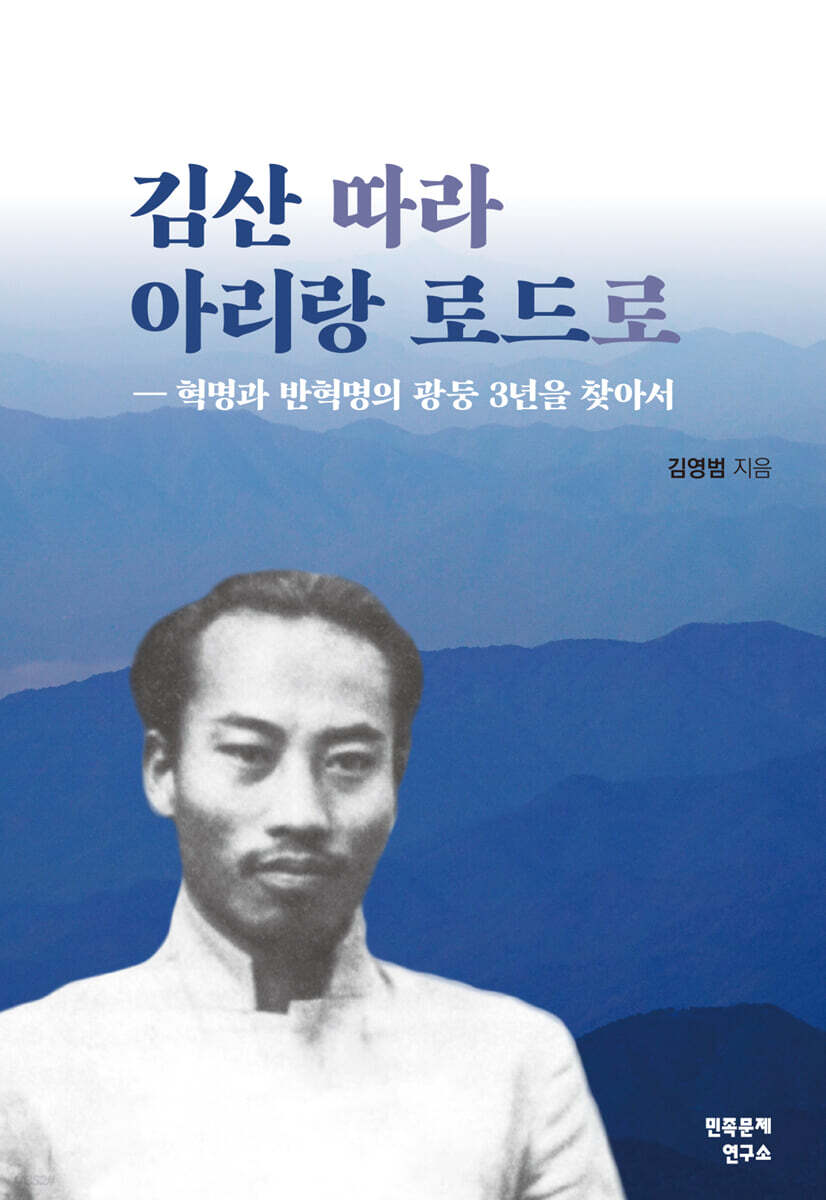
Follow Gimsan to Arirang Road
 |
Description
Book Introduction
This short story, which is both a travelogue and a commentary, is about the 'Guangdong period' of Kim San, the protagonist of Nym Wales's famous 'Arirang Song'.
The records of that period, which lasted about four years or three years, are only three chapters out of the total 25 chapters of the book, which is about one-fifth of the book's volume.
Most chapters have no verses, or if they do, they only have about two, but these three chapters have 8, 5, and 7 verses, respectively.
Doesn't this show that Kim San's experiences in Guangdong were numerous and of great magnitude?
It is felt that he had much to say about those events, and that he recounted them in detail, even the anecdotes, and that he desperately wanted them to be known and passed down to future generations.
It must have been because those were such important experiences for him and the memories were deeply engraved in his mind.
With these points in mind, this book was born from a simple attempt to sequentially restore the scenes, historical background, and overall context of the profound story, reconstructing them as closely as possible to the actual events.
- From the author's words
The records of that period, which lasted about four years or three years, are only three chapters out of the total 25 chapters of the book, which is about one-fifth of the book's volume.
Most chapters have no verses, or if they do, they only have about two, but these three chapters have 8, 5, and 7 verses, respectively.
Doesn't this show that Kim San's experiences in Guangdong were numerous and of great magnitude?
It is felt that he had much to say about those events, and that he recounted them in detail, even the anecdotes, and that he desperately wanted them to be known and passed down to future generations.
It must have been because those were such important experiences for him and the memories were deeply engraved in his mind.
With these points in mind, this book was born from a simple attempt to sequentially restore the scenes, historical background, and overall context of the profound story, reconstructing them as closely as possible to the actual events.
- From the author's words
index
At the beginning of the book·3
Note 11
Opening story
1.
Hey, Guangdong? 12
2.
Who is Kim San? 17
3.
What kind of book is "Arirang"? 20
4.
What kind of song is "Arirang"? 24
5.
Overview of Guangdong and Guangzhou 27
6.
A few additions 30
Part 1: Kim San and the Guangzhou Uprising
Ⅰ.
Guangzhou, 1925: The Uiyeoldan and Kim San's fascination
1.
The Ignited National Revolutionary Movement 36
2.
Korean youth's desire to participate in the Chinese revolution 40
3.
The Righteous Army's Journey to Guangzhou and Kim San's Follow-up 42
Ⅱ.
New Hope and Shining Days in 1926
1.
Busy movement since the beginning of the year 48
2.
Kim San and his active activities at Jungsan University 51
3.
Solidarity and Exchange with Ho Chi Minh 54
4.
The Northern Expedition unfolds smoothly, Part 56
Ⅲ.
1927, the year of abrupt political upheaval and the abyss of the split between the Communist and Kuomintang factions
1.
Chiang Kai-shek and the Betrayal of the Right Wing of the Kuomintang 62
2.
Stalin and the Comintern's Choices and the Responses of the Two Lefts 65
3.
The Red Army's Nanchang Uprising and its southward march to Guangdong 70
4.
Fengpai and Hailufeng Soviet 73
5.
The urgent movements of two forces and three factions 78
Ⅳ.
The Outbreak and Failure of the Guangzhou Uprising
1.
Uprising and Division of Duties 86
2.
The first day of the uprising, the general attack situation 88
3.
The situation on the second day of the uprising, 94
4.
The Three-Day Retreat and the End of the Uprising 96
5.
Kim Won-bong's Choices and Path 100
6.
Some Mistakes and Limitations Revisited 103
Part 2: Traces of Old Roads and Passion 100 Years Later
Ⅰ.
Departure on 'Arirang Road'
1.
Excitement and Nervousness 112
2.
Change course at the entrance to Guangzhou 114
Ⅱ.
Retracing the path of Kim San and Hong Gun to Donggang District
1.
First, stop by the Hong 4th Company's establishment site 120
2.
Jiphajin Revolutionary Martyrs Memorial and Prisons 127
3.
129 via Longmen County to Baimangang
4.
From Manrokho to Namgujin, 134 Yongwaro
5.
Godamjin's Night and Morning 140
6.
The Majesty of the Middle East Village and the Voice of Hong 2 145
Ⅲ.
Kim San and the Hong Four in Haifeng
1.
In Search of Gongpyeongjin's Zhou Feng Birthplace 152
2.
154 in Seonindong, Yeonhwasan
3.
A Look Back at the Honggong and Hongjang Guji in Haifeng 157
4.
Exploring the Hong 4th Division Garrison and Guerrilla Base 162
5.
Kimsan and Donggangdanggyo Guji in Haifeng 164
6.
Other Relics and People of Haifeng 167
Ⅳ.
Scenes of crisis and traces of battle
1.
The Battle of Hailufeng and the Movement Trajectories of the Hong Fourth Company 176
2.
Traces of Repeated Retreats and Hardships 179
3.
Yeyong 184, captured and murdered
4.
Donggang Special Committee Guji and Heroes' Cave 185 on Daenamsan Mountain
5.
Finding a way from Shantou to Hong Kong 192
6.
A Few Epilogues 195
V.
Memories and historical relics from the Guangzhou Uprising
1.
The Huangpu Military Academy, the birthplace and gateway to the Guangdong Revolution, is a legacy of 202 years.
2.
The Silence of the Dongjeong Martyrs' Cemetery 207
3.
The Charm of Zhongshan University's Guji and the Lu Xun Memorial Hall 211
4.
The Versatility and Curiosity of the Guangzhou Memorial Hall 219
5.
222 Things the Guangzhou Martyrs' Cemetery Eloquently Speaks
6.
The pride and leisure of the Hwangwha River 72 Martyrs' Tomb 231
Conclusion
1.
Returning home after a long journey 234
2.
Passion and Sorrow, or Fate and Form 235
References 241
Search 245
Note 11
Opening story
1.
Hey, Guangdong? 12
2.
Who is Kim San? 17
3.
What kind of book is "Arirang"? 20
4.
What kind of song is "Arirang"? 24
5.
Overview of Guangdong and Guangzhou 27
6.
A few additions 30
Part 1: Kim San and the Guangzhou Uprising
Ⅰ.
Guangzhou, 1925: The Uiyeoldan and Kim San's fascination
1.
The Ignited National Revolutionary Movement 36
2.
Korean youth's desire to participate in the Chinese revolution 40
3.
The Righteous Army's Journey to Guangzhou and Kim San's Follow-up 42
Ⅱ.
New Hope and Shining Days in 1926
1.
Busy movement since the beginning of the year 48
2.
Kim San and his active activities at Jungsan University 51
3.
Solidarity and Exchange with Ho Chi Minh 54
4.
The Northern Expedition unfolds smoothly, Part 56
Ⅲ.
1927, the year of abrupt political upheaval and the abyss of the split between the Communist and Kuomintang factions
1.
Chiang Kai-shek and the Betrayal of the Right Wing of the Kuomintang 62
2.
Stalin and the Comintern's Choices and the Responses of the Two Lefts 65
3.
The Red Army's Nanchang Uprising and its southward march to Guangdong 70
4.
Fengpai and Hailufeng Soviet 73
5.
The urgent movements of two forces and three factions 78
Ⅳ.
The Outbreak and Failure of the Guangzhou Uprising
1.
Uprising and Division of Duties 86
2.
The first day of the uprising, the general attack situation 88
3.
The situation on the second day of the uprising, 94
4.
The Three-Day Retreat and the End of the Uprising 96
5.
Kim Won-bong's Choices and Path 100
6.
Some Mistakes and Limitations Revisited 103
Part 2: Traces of Old Roads and Passion 100 Years Later
Ⅰ.
Departure on 'Arirang Road'
1.
Excitement and Nervousness 112
2.
Change course at the entrance to Guangzhou 114
Ⅱ.
Retracing the path of Kim San and Hong Gun to Donggang District
1.
First, stop by the Hong 4th Company's establishment site 120
2.
Jiphajin Revolutionary Martyrs Memorial and Prisons 127
3.
129 via Longmen County to Baimangang
4.
From Manrokho to Namgujin, 134 Yongwaro
5.
Godamjin's Night and Morning 140
6.
The Majesty of the Middle East Village and the Voice of Hong 2 145
Ⅲ.
Kim San and the Hong Four in Haifeng
1.
In Search of Gongpyeongjin's Zhou Feng Birthplace 152
2.
154 in Seonindong, Yeonhwasan
3.
A Look Back at the Honggong and Hongjang Guji in Haifeng 157
4.
Exploring the Hong 4th Division Garrison and Guerrilla Base 162
5.
Kimsan and Donggangdanggyo Guji in Haifeng 164
6.
Other Relics and People of Haifeng 167
Ⅳ.
Scenes of crisis and traces of battle
1.
The Battle of Hailufeng and the Movement Trajectories of the Hong Fourth Company 176
2.
Traces of Repeated Retreats and Hardships 179
3.
Yeyong 184, captured and murdered
4.
Donggang Special Committee Guji and Heroes' Cave 185 on Daenamsan Mountain
5.
Finding a way from Shantou to Hong Kong 192
6.
A Few Epilogues 195
V.
Memories and historical relics from the Guangzhou Uprising
1.
The Huangpu Military Academy, the birthplace and gateway to the Guangdong Revolution, is a legacy of 202 years.
2.
The Silence of the Dongjeong Martyrs' Cemetery 207
3.
The Charm of Zhongshan University's Guji and the Lu Xun Memorial Hall 211
4.
The Versatility and Curiosity of the Guangzhou Memorial Hall 219
5.
222 Things the Guangzhou Martyrs' Cemetery Eloquently Speaks
6.
The pride and leisure of the Hwangwha River 72 Martyrs' Tomb 231
Conclusion
1.
Returning home after a long journey 234
2.
Passion and Sorrow, or Fate and Form 235
References 241
Search 245
Publisher's Review
The author also learned of the name Kim San through 『Arirang Song』, which was first published in 1984 as a Korean translation under the title 『Arirang』.
As almost all readers of the book said, the revival of the terms was deeply moving and provided a great deal of new insight.
I felt like certain aspects of Kim San's personality and thinking were deeply resonating with me.
Being honest with yourself and being sincere with others was one of them.
About ten years later, in my dissertation and my first book based on it, I dealt with the Uiyoldan's national revolutionary movement, and also looked into the future of the Chinese national revolutionary movement.
There, I revived and discussed the activities and consequences of Jang Ji-rak, that is, Kim San, and his comrades, one by one, using 『Arirang』 as a reference.
In the 2000s, I had the opportunity to speak and write about him and his book on television and in print.
In 2005, Kim San was recognized as a 'person of merit for independence' and was posthumously awarded the Order of Merit for National Foundation, Patriotic Medal, which I felt was a fitting end to his misfortune. I was very happy.
Since then, I have been reading every article and paper related to Kim San without fail, but I never dreamed that I would write a book about him.
But now that I've been given this job, I keep wondering, "What on earth is the reason for this?"
Even so, since I have already started the work, I have written down everything I want to say or need to say in the text.
So there is really no reason to write a long introduction.
But it looks like there are three or four things I want to tell you in advance.
I feel like I can't just bury it and move on, so I'm borrowing some space to talk about it.
First, about the term ‘Arirang Road’.
It might have been more desirable and better to call it ‘Arirang Road’.
However, the term above was coined and used before my trip to Guangdong to write this book.
So, I decided not to try to reject or erase it, and just accepted it and used it.
Instead, I try to give it my own meaning.
Here, 'Road' is said to be a combination of the first letters of the words 'Revolution over ancient dream'.
If we engrave this phrase as 'a revolution beyond old dreams, an imminent one,' it fits well with the material and content of this book.
This is because in 1927, Kim San and his comrades in Guangdong, China, attempted to open a new chapter in the ‘revolution’ that had been dreamed of and attempted by outstanding visionaries since at least the mid-Joseon period until the end of the 19th century, but had failed every time.
The project of retracing all the details and traces of the three years before and after that course, which eventually ran into the huge wall of counterrevolution, was directly connected to the publication of the book.
If the original duties and plans were followed, I would only have to write a report.
That's part 2 of this book.
But as I was writing it, I realized that there were a lot of issues here and there that needed to be resolved and explained first.
I realized that I couldn't write a proper travelogue unless I first thoroughly uncovered and organized the details of the events that were even remotely related to the Guangdong sites I visited, the interconnectedness and overall flow of events, and the individual backgrounds and actions of the people involved.
So I stopped writing and started looking for literature, focusing on books and papers.
Although the reference materials to support the study were minimal from the beginning, I still looked through various sources and collected and organized as much information as possible, even if it was fragmentary.
I've collected all of them, even those that seem conflicting and poor in content, to be fair.
By diligently reading them, comparing and contrasting them, reviewing and confirming them, analyzing them one by one, and making connections, I was able to fill my knowledge base with the necessary amount.
Domestic and international online encyclopedias, biographical dictionaries, and maps have also been of great help in confirming facts and filling in gaps in perception.
The unplanned additional research results are described in several sections and Part 1 of the "Opening Story."
There will be quite a few stories that readers will encounter for the first time, and there will also be several parts that will be worth looking at again.
You will also notice parts that correct misconceptions and remove the veil of ambiguity.
However, since it is a book designed more as a popular reading material than an academic book, it was customary to not include any footnotes or references.
Instead, please refer to the list of references and materials I have consulted at the end of the book.
We would like to apologize in advance to the authors of the relevant literature for any unintentional errors.
This book is full of the circumstances of Kim San's miserable defeat, subsequent failure, and futile death.
As I was writing the book, and even after I finished it, I felt very bitter and sad.
Still, I tried to follow the trend and calmly trace it from beginning to end, and draw a cold-blooded picture of the reality and circumstances.
As to how effective such self-commitment was, I think we will have to leave it to the judgment and evaluation of discerning readers.
It still seems that there are times when the author's passions go beyond his strict self-restraint and give rise to dogmatism and leaps of faith.
It would be best to read Part 1 first and then move on to Part 2, but you may find the content and description of Part 1 a bit stiff or difficult.
In that case, wouldn't it be a good idea to read part 2 briefly first, then go back and read part 1, and then reread part 2?
The fact that I was suddenly inspired to write this book after a cross-country trip not only to Guangzhou but also to the easternmost tip of Guangdong Province, coupled with a recent discovery, has given me a renewed sense of realization that some events in life conceal exquisite inevitability beneath the facade of chance.
In that sense, I feel a special connection with Director Bang Hak-jin of the Planning Department at the Institute for Research in Collaborationist Activities, and I would like to express my gratitude for the loving consideration of Executive Director Jo Se-yeol and the meticulous efforts of Professors Son Gi-sun and Yoo Yeon-yeong.
The new friendship I formed with Moon Gye-jun and Park Ho-gyun, who accompanied me on this expedition, is truly profound, and the kindness of Kim Yu, Shin Gwang-yong, and Jang Du-in, whom I met in Guangzhou, will remain as fond memories.
I hope and believe that Mr. Kim Yu, who effortlessly completed and published 『Commander-in-Chief of the Korean Revolutionary Army, Yang Se-bong』 even while sick, will recover quickly and recover.
As almost all readers of the book said, the revival of the terms was deeply moving and provided a great deal of new insight.
I felt like certain aspects of Kim San's personality and thinking were deeply resonating with me.
Being honest with yourself and being sincere with others was one of them.
About ten years later, in my dissertation and my first book based on it, I dealt with the Uiyoldan's national revolutionary movement, and also looked into the future of the Chinese national revolutionary movement.
There, I revived and discussed the activities and consequences of Jang Ji-rak, that is, Kim San, and his comrades, one by one, using 『Arirang』 as a reference.
In the 2000s, I had the opportunity to speak and write about him and his book on television and in print.
In 2005, Kim San was recognized as a 'person of merit for independence' and was posthumously awarded the Order of Merit for National Foundation, Patriotic Medal, which I felt was a fitting end to his misfortune. I was very happy.
Since then, I have been reading every article and paper related to Kim San without fail, but I never dreamed that I would write a book about him.
But now that I've been given this job, I keep wondering, "What on earth is the reason for this?"
Even so, since I have already started the work, I have written down everything I want to say or need to say in the text.
So there is really no reason to write a long introduction.
But it looks like there are three or four things I want to tell you in advance.
I feel like I can't just bury it and move on, so I'm borrowing some space to talk about it.
First, about the term ‘Arirang Road’.
It might have been more desirable and better to call it ‘Arirang Road’.
However, the term above was coined and used before my trip to Guangdong to write this book.
So, I decided not to try to reject or erase it, and just accepted it and used it.
Instead, I try to give it my own meaning.
Here, 'Road' is said to be a combination of the first letters of the words 'Revolution over ancient dream'.
If we engrave this phrase as 'a revolution beyond old dreams, an imminent one,' it fits well with the material and content of this book.
This is because in 1927, Kim San and his comrades in Guangdong, China, attempted to open a new chapter in the ‘revolution’ that had been dreamed of and attempted by outstanding visionaries since at least the mid-Joseon period until the end of the 19th century, but had failed every time.
The project of retracing all the details and traces of the three years before and after that course, which eventually ran into the huge wall of counterrevolution, was directly connected to the publication of the book.
If the original duties and plans were followed, I would only have to write a report.
That's part 2 of this book.
But as I was writing it, I realized that there were a lot of issues here and there that needed to be resolved and explained first.
I realized that I couldn't write a proper travelogue unless I first thoroughly uncovered and organized the details of the events that were even remotely related to the Guangdong sites I visited, the interconnectedness and overall flow of events, and the individual backgrounds and actions of the people involved.
So I stopped writing and started looking for literature, focusing on books and papers.
Although the reference materials to support the study were minimal from the beginning, I still looked through various sources and collected and organized as much information as possible, even if it was fragmentary.
I've collected all of them, even those that seem conflicting and poor in content, to be fair.
By diligently reading them, comparing and contrasting them, reviewing and confirming them, analyzing them one by one, and making connections, I was able to fill my knowledge base with the necessary amount.
Domestic and international online encyclopedias, biographical dictionaries, and maps have also been of great help in confirming facts and filling in gaps in perception.
The unplanned additional research results are described in several sections and Part 1 of the "Opening Story."
There will be quite a few stories that readers will encounter for the first time, and there will also be several parts that will be worth looking at again.
You will also notice parts that correct misconceptions and remove the veil of ambiguity.
However, since it is a book designed more as a popular reading material than an academic book, it was customary to not include any footnotes or references.
Instead, please refer to the list of references and materials I have consulted at the end of the book.
We would like to apologize in advance to the authors of the relevant literature for any unintentional errors.
This book is full of the circumstances of Kim San's miserable defeat, subsequent failure, and futile death.
As I was writing the book, and even after I finished it, I felt very bitter and sad.
Still, I tried to follow the trend and calmly trace it from beginning to end, and draw a cold-blooded picture of the reality and circumstances.
As to how effective such self-commitment was, I think we will have to leave it to the judgment and evaluation of discerning readers.
It still seems that there are times when the author's passions go beyond his strict self-restraint and give rise to dogmatism and leaps of faith.
It would be best to read Part 1 first and then move on to Part 2, but you may find the content and description of Part 1 a bit stiff or difficult.
In that case, wouldn't it be a good idea to read part 2 briefly first, then go back and read part 1, and then reread part 2?
The fact that I was suddenly inspired to write this book after a cross-country trip not only to Guangzhou but also to the easternmost tip of Guangdong Province, coupled with a recent discovery, has given me a renewed sense of realization that some events in life conceal exquisite inevitability beneath the facade of chance.
In that sense, I feel a special connection with Director Bang Hak-jin of the Planning Department at the Institute for Research in Collaborationist Activities, and I would like to express my gratitude for the loving consideration of Executive Director Jo Se-yeol and the meticulous efforts of Professors Son Gi-sun and Yoo Yeon-yeong.
The new friendship I formed with Moon Gye-jun and Park Ho-gyun, who accompanied me on this expedition, is truly profound, and the kindness of Kim Yu, Shin Gwang-yong, and Jang Du-in, whom I met in Guangzhou, will remain as fond memories.
I hope and believe that Mr. Kim Yu, who effortlessly completed and published 『Commander-in-Chief of the Korean Revolutionary Army, Yang Se-bong』 even while sick, will recover quickly and recover.
GOODS SPECIFICS
- Date of issue: November 10, 2025
- Page count, weight, size: 252 pages | 152*225*20mm
- ISBN13: 9788993741476
- ISBN10: 8993741476
You may also like
카테고리
korean


korean

![GQ KOREA Mark (Monthly): December [2025]](http://librairie.coreenne.fr/cdn/shop/files/8ef265dbbfbf186523ed75ba7319009d.jpg?v=1765340328&width=3840)


