

Production, Destruction, Connection 4
 |
Description
Book Introduction
Volumes 15-18 of the Cambridge World History series examine the changing world since 1750 as it has become increasingly interconnected.
First, volumes 15 and 16 deal with the structure, space, and process by which the modern world was created.
It covers a wide range of topics, including the environment, energy, technology, population, disease, law, industrialization, imperialism, decolonization, nationalism, socialism, and the history of major regions.
Additionally, volumes 17 and 18 examine social phenomena such as urbanization, population movement (migration), and changes in family and gender.
It also covers various cultural exchanges such as religion, science, music, and sports.
We also looked at the history of rubber, drugs, and automobiles, which are key elements of globalization.
First, volumes 15 and 16 deal with the structure, space, and process by which the modern world was created.
It covers a wide range of topics, including the environment, energy, technology, population, disease, law, industrialization, imperialism, decolonization, nationalism, socialism, and the history of major regions.
Additionally, volumes 17 and 18 examine social phenomena such as urbanization, population movement (migration), and changes in family and gender.
It also covers various cultural exchanges such as religion, science, music, and sports.
We also looked at the history of rubber, drugs, and automobiles, which are key elements of globalization.
- You can preview some of the book's contents.
Preview
index
PART 3 A Turning Point in History
CHAPTER 12: Reinterpreting the Atlantic Revolution
CHAPTER 13 World War II, 1914–1945
CHAPTER 14 The Cold War
CHAPTER 15 1956
CHAPTER 16 1989
PART 4 The Forces Driving Globalization
CHAPTER 17 TRANSPORTATION AND COMMUNICATION
CHAPTER 18 THE RUBBER INDUSTRY
CHAPTER 19 Drugs
CHAPTER 20 Automobiles
CHAPTER 21 Globalization, Anglo-American Style
CHAPTER 12: Reinterpreting the Atlantic Revolution
CHAPTER 13 World War II, 1914–1945
CHAPTER 14 The Cold War
CHAPTER 15 1956
CHAPTER 16 1989
PART 4 The Forces Driving Globalization
CHAPTER 17 TRANSPORTATION AND COMMUNICATION
CHAPTER 18 THE RUBBER INDUSTRY
CHAPTER 19 Drugs
CHAPTER 20 Automobiles
CHAPTER 21 Globalization, Anglo-American Style
Publisher's Review
The 18th book in the Cambridge World History series (18 volumes total)
The Cambridge World History Series is a vast world history series in which over 200 scholars from around the world have participated.
The Korean version will be published in 18 volumes.
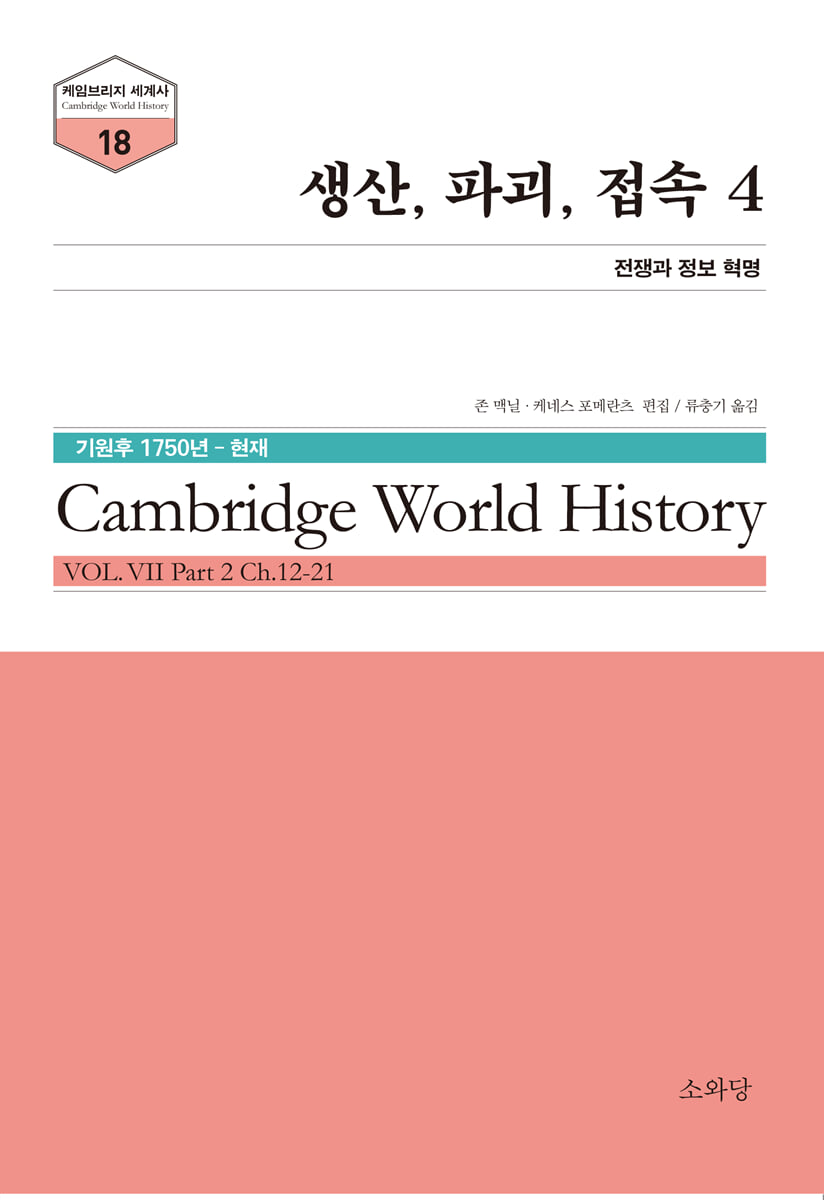
This book is the 18th and final volume in the series, and the fourth of four volumes discussing the modern and contemporary period.
Part 3 reexamines the turning points of world history.
The turning point in history from modern to contemporary times can vary depending on one's perspective on world history.
Rather than setting a single turning point, this book explores possible turning points from various perspectives.
The French Revolution, the American Revolution, and the two World Wars that swept the Atlantic coast were undeniable turning points in world history.
But it is not impossible that one year, uniquely, may have been a turning point in world history.
This book uses the examples of 1956 and 1989 to show how those years became turning points in world history.
In Part 4, we looked at the forces driving the modern world.
The most significant characteristic of the modern world is globalization, and the force that accelerated this was, above all, the development of transportation and communication.
This book uses specific examples from several industries to demonstrate the power of industrialization in a world increasingly interconnected through the development of transportation and communication.
We looked at the reality of the world's shrinking diversity and the intensification of Anglo-American-style globalization, and reexamined its implications, both now and in the future.
The Cambridge World History Series is a vast world history series in which over 200 scholars from around the world have participated.
The Korean version will be published in 18 volumes.
This book is the 18th and final volume in the series, and the fourth of four volumes discussing the modern and contemporary period.
Part 3 reexamines the turning points of world history.
The turning point in history from modern to contemporary times can vary depending on one's perspective on world history.
Rather than setting a single turning point, this book explores possible turning points from various perspectives.
The French Revolution, the American Revolution, and the two World Wars that swept the Atlantic coast were undeniable turning points in world history.
But it is not impossible that one year, uniquely, may have been a turning point in world history.
This book uses the examples of 1956 and 1989 to show how those years became turning points in world history.
In Part 4, we looked at the forces driving the modern world.
The most significant characteristic of the modern world is globalization, and the force that accelerated this was, above all, the development of transportation and communication.
This book uses specific examples from several industries to demonstrate the power of industrialization in a world increasingly interconnected through the development of transportation and communication.
We looked at the reality of the world's shrinking diversity and the intensification of Anglo-American-style globalization, and reexamined its implications, both now and in the future.
GOODS SPECIFICS
- Date of issue: October 25, 2025
- Page count, weight, size: 460 pages | 150*215*30mm
- ISBN13: 9788967220464
- ISBN10: 8967220464
You may also like
카테고리
korean


korean

![GQ KOREA Mark (Monthly): December [2025]](http://librairie.coreenne.fr/cdn/shop/files/8ef265dbbfbf186523ed75ba7319009d.jpg?v=1765340328&width=3840)


