

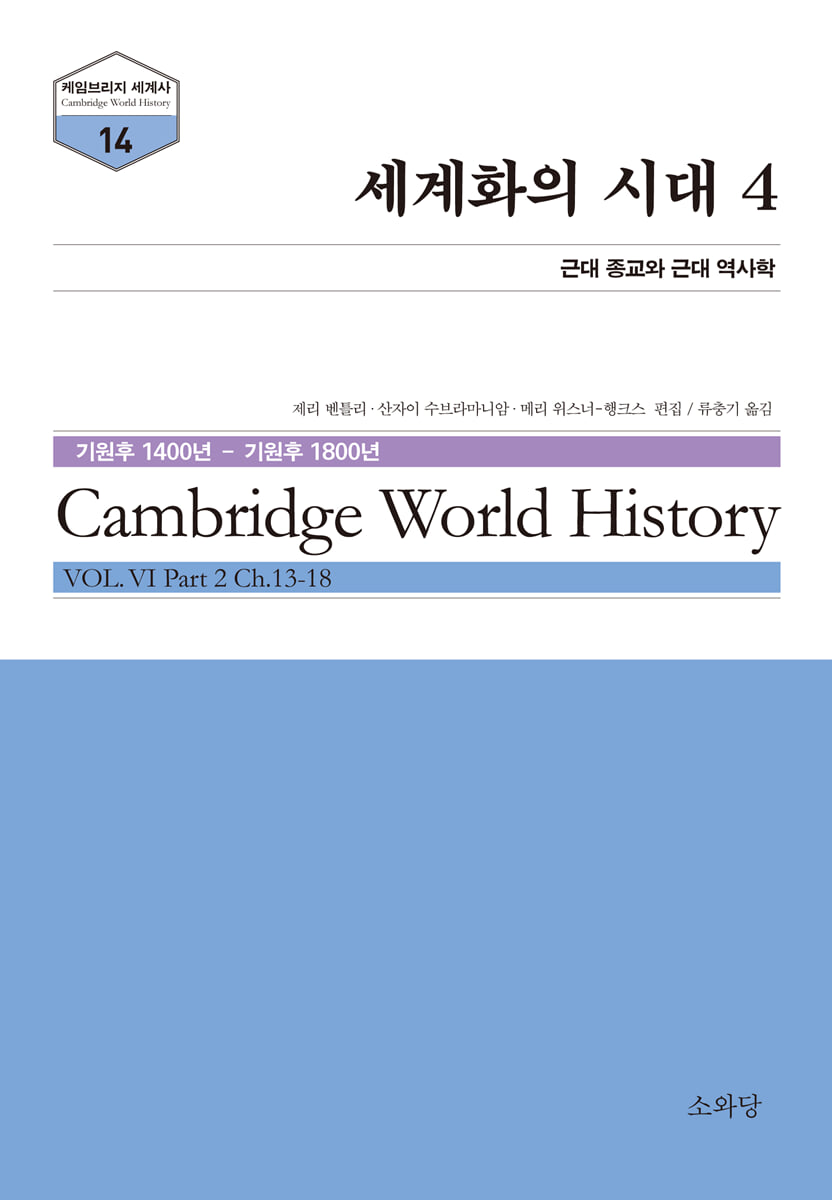
The Age of Globalization 4
 |
Description
Book Introduction
Volumes 11 through 14 of the Cambridge World History series cover the early modern world.
Specifically, it is the period from approximately 1400 to 1800.
At that time, the world was a time of active biological, commercial, and cultural exchange.
So the world at that time was connected more closely than ever before.
Volume 14 analyzes the changing perception of early modern religion and its impact on the modern world.
It also revealed that in the early modern period, attempts were made to narrate world history based on the traditions of each cultural sphere, not only in Europe but also in Islam, India, China, and Native America.
Specifically, it is the period from approximately 1400 to 1800.
At that time, the world was a time of active biological, commercial, and cultural exchange.
So the world at that time was connected more closely than ever before.
Volume 14 analyzes the changing perception of early modern religion and its impact on the modern world.
It also revealed that in the early modern period, attempts were made to narrate world history based on the traditions of each cultural sphere, not only in Europe but also in Islam, India, China, and Native America.
- You can preview some of the book's contents.
Preview
index
(Continued from Volume 13)
PART 3 Migration and Encounters
CHAPTER 13: The Birth of Modern Religious Studies and Cultural Criticism
CHAPTER 14 Christianity in Europe and Abroad
CHAPTER 15 The Islamic World of the Early Modern Period
CHAPTER 16: Changes in East Asian Religion
PART 4 HISTORICAL THEORY
CHAPTER 17 On Early Modern Historiography
CHAPTER 18 Microhistory and World History
PART 3 Migration and Encounters
CHAPTER 13: The Birth of Modern Religious Studies and Cultural Criticism
CHAPTER 14 Christianity in Europe and Abroad
CHAPTER 15 The Islamic World of the Early Modern Period
CHAPTER 16: Changes in East Asian Religion
PART 4 HISTORICAL THEORY
CHAPTER 17 On Early Modern Historiography
CHAPTER 18 Microhistory and World History
Publisher's Review
The 14th book in the Cambridge World History series (18 volumes)
The Cambridge World History Series is a vast world history series in which over 200 scholars from around the world have participated.
The Korean version is scheduled to be published in 18 volumes.
This book, the 14th in the series, focuses on how world perception changed in the early modern period.
Representatively, from the perspectives of religious studies and history, we analyzed how different cultural spheres were compared and, through this, how religions changed in all cultural spheres of the world.
In addition, we compared and analyzed the fact that the awareness of universality has grown not only in Europe but also in major cultural spheres around the world, and that attempts have been made to describe a universal world history as a result.
Part 3 deals with religion and religious change.
One of the greatest changes in the modern world has been the change in religion.
The authors of this book believe that as exchanges in the modern world expanded, religion became an object of comparison and, therefore, objectification.
So, the discipline of religious studies was born, but Christianity, Islam, Buddhism, and Confucianism each underwent different changes.
Ultimately, religion also had a profound impact on the exchanges, conflicts, and transitions of the modern world.
Part 4 reexamines early modern historiography.
While attempts at universal history, encompassing the entire world beyond the scope of individual cultures, are often attributed to modern Europe, the author specifically reveals that similar attempts were made in various cultures during a similar period, namely, in the early modern period.
In the Indo-Persian cultural sphere, world history was written based on the chronicle tradition of the Mughal Empire, and in East Asia, there were achievements such as expanding existing history by obtaining information from Jesuit missionaries, and there were also surprising achievements in the Native American and Islamic cultural spheres.
Carlo Ginzburg, a renowned expert on microhistory, argued that microhistory is not an opposing concept to world history, but rather an indispensable tool.
The Cambridge World History Series is a vast world history series in which over 200 scholars from around the world have participated.
The Korean version is scheduled to be published in 18 volumes.
This book, the 14th in the series, focuses on how world perception changed in the early modern period.
Representatively, from the perspectives of religious studies and history, we analyzed how different cultural spheres were compared and, through this, how religions changed in all cultural spheres of the world.
In addition, we compared and analyzed the fact that the awareness of universality has grown not only in Europe but also in major cultural spheres around the world, and that attempts have been made to describe a universal world history as a result.
Part 3 deals with religion and religious change.
One of the greatest changes in the modern world has been the change in religion.
The authors of this book believe that as exchanges in the modern world expanded, religion became an object of comparison and, therefore, objectification.
So, the discipline of religious studies was born, but Christianity, Islam, Buddhism, and Confucianism each underwent different changes.
Ultimately, religion also had a profound impact on the exchanges, conflicts, and transitions of the modern world.
Part 4 reexamines early modern historiography.
While attempts at universal history, encompassing the entire world beyond the scope of individual cultures, are often attributed to modern Europe, the author specifically reveals that similar attempts were made in various cultures during a similar period, namely, in the early modern period.
In the Indo-Persian cultural sphere, world history was written based on the chronicle tradition of the Mughal Empire, and in East Asia, there were achievements such as expanding existing history by obtaining information from Jesuit missionaries, and there were also surprising achievements in the Native American and Islamic cultural spheres.
Carlo Ginzburg, a renowned expert on microhistory, argued that microhistory is not an opposing concept to world history, but rather an indispensable tool.
GOODS SPECIFICS
- Date of issue: September 15, 2025
- Page count, weight, size: 300 pages | 150*215*20mm
- ISBN13: 9788967220426
- ISBN10: 8967220421
You may also like
카테고리
korean


korean

![GQ KOREA Mark (Monthly): December [2025]](http://librairie.coreenne.fr/cdn/shop/files/8ef265dbbfbf186523ed75ba7319009d.jpg?v=1765340328&width=3840)


