

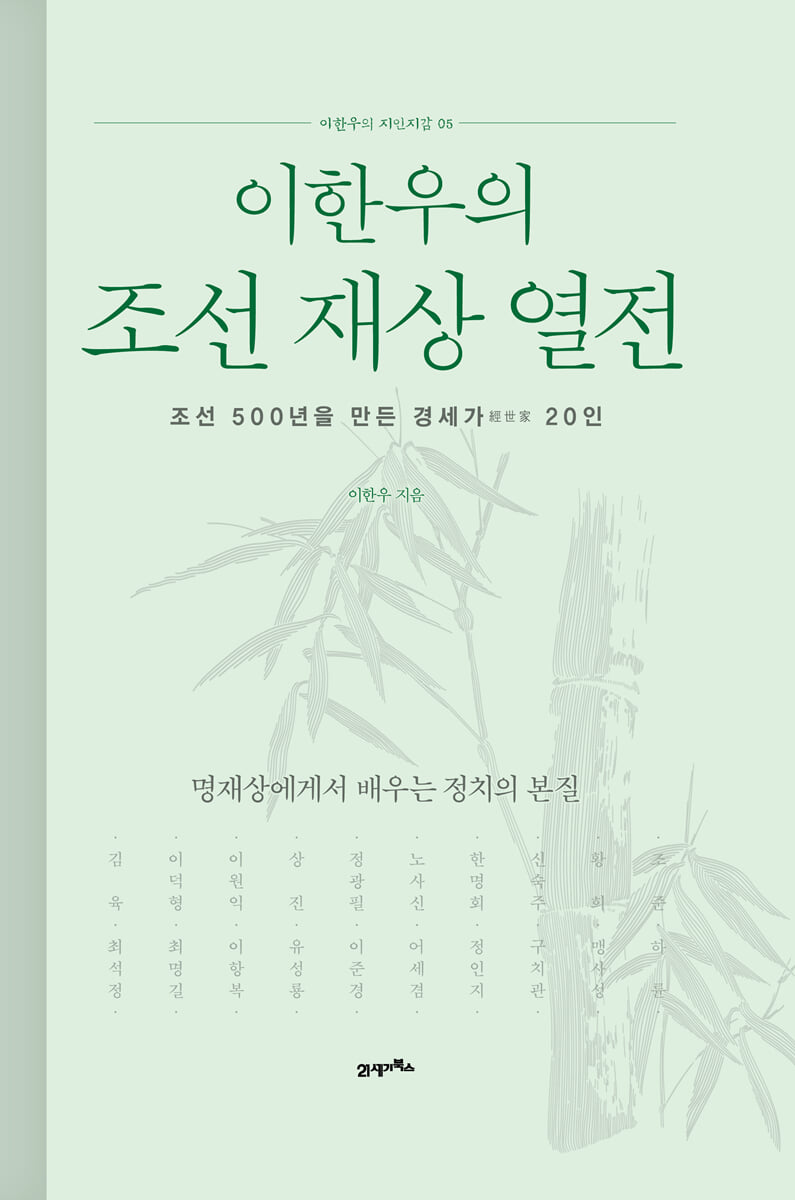
Lee Han-woo's Biographies of Joseon Prime Ministers
 |
Description
Book Introduction
It was not the king but the prime minister who moved the country!
The governing techniques and ideology of 20 prominent ministers who stood at the center of Joseon's rule
『Lee Han-woo's Biographies of Joseon's Prime Ministers』 sheds new light on the ruling techniques and ideology of the renowned prime ministers who stood at the pinnacle of Joseon's rule.
When we talk about Joseon history, we usually think of a few kings, Confucian scholars, and generals, but the ministers who were actually at the center of running the country are not easily remembered.
This is also a result of academic research being biased towards Neo-Confucian discourse rather than practical politics.
However, it was the prime ministers who led Joseon's history as statesmen.
Through consistent research and translation of classics, author Lee Han-woo has explored the aspects of a prime minister skilled in practical politics, transcending the traditional view of subjects confined to the framework of Neo-Confucian theory of legitimacy.
In this book, he selects 20 prominent prime ministers representing Joseon and analyzes them in a three-dimensional way to understand the times and develop political strategies.
The prime minister emphasizes that loyalty and integrity alone are not enough, and that reality must be governed through a balance of integrity, law, and strategy.
The famous ministers of Joseon, such as Jo Jun, Ha Ryun, and Hwang Hui, were people with virtue, practical ability, and learning, and they rose to the positions of Prime Minister, Left State Councillor, and Right State Councillor, known as the “Three Prime Ministers of the State Council.”
This book reveals the true nature of these ministers by examining their relationships with the kings they served, the political context of the time, and their interactions with their contemporaries.
Beyond simply reviewing the past, 『Lee Han-woo's Biographies of Joseon Prime Ministers』 suggests the potential of "prime minister studies," which are essential for nurturing future politicians.
Moving away from historical narratives that focus on virtue and idealism, it conveys the wisdom of governance that is still valid today through the image of a capable politician who embraced both reality and power.
The governing techniques and ideology of 20 prominent ministers who stood at the center of Joseon's rule
『Lee Han-woo's Biographies of Joseon's Prime Ministers』 sheds new light on the ruling techniques and ideology of the renowned prime ministers who stood at the pinnacle of Joseon's rule.
When we talk about Joseon history, we usually think of a few kings, Confucian scholars, and generals, but the ministers who were actually at the center of running the country are not easily remembered.
This is also a result of academic research being biased towards Neo-Confucian discourse rather than practical politics.
However, it was the prime ministers who led Joseon's history as statesmen.
Through consistent research and translation of classics, author Lee Han-woo has explored the aspects of a prime minister skilled in practical politics, transcending the traditional view of subjects confined to the framework of Neo-Confucian theory of legitimacy.
In this book, he selects 20 prominent prime ministers representing Joseon and analyzes them in a three-dimensional way to understand the times and develop political strategies.
The prime minister emphasizes that loyalty and integrity alone are not enough, and that reality must be governed through a balance of integrity, law, and strategy.
The famous ministers of Joseon, such as Jo Jun, Ha Ryun, and Hwang Hui, were people with virtue, practical ability, and learning, and they rose to the positions of Prime Minister, Left State Councillor, and Right State Councillor, known as the “Three Prime Ministers of the State Council.”
This book reveals the true nature of these ministers by examining their relationships with the kings they served, the political context of the time, and their interactions with their contemporaries.
Beyond simply reviewing the past, 『Lee Han-woo's Biographies of Joseon Prime Ministers』 suggests the potential of "prime minister studies," which are essential for nurturing future politicians.
Moving away from historical narratives that focus on virtue and idealism, it conveys the wisdom of governance that is still valid today through the image of a capable politician who embraced both reality and power.
- You can preview some of the book's contents.
Preview
Into the book
According to the typology of Yu So's 『Inmulji』, Jo Jun was a man of deep and solid principles, worthy of being called a man of integrity. He also reformed the legal system to benefit the people, so he clearly had the aspects of a Legalist. He also knew how to make big decisions without a doubt, so he was equipped with the strategies of a master of arts, and he could be called the first prime minister of Joseon who reached the national level.
--- From “Chapter 1: Jo Jun, a Meritorious Subject of King Taejo and a Renowned Prime Minister”
But in the end, Seongjong was unable to deal with Han Myeong-hoe according to the law.
Han Myeong-hoe had already seen through Seongjong's weakness.
This is once again an incident that shines with Han Myeong-hoe's insight into humanity and reason.
Han Myeong-hoe was a unique figure who was not bound by the doctrines of Neo-Confucianism and reached the pinnacle of power that a subject of the dynasty could enjoy almost single-handedly.
There are indeed many paths to becoming a prime minister.
--- From "Chapter 7: Han Myeong-hoe, a strategist who rose from a mere squire to a prime minister"
The most important principle is that we must pursue the politics of proper harmony through ‘centralization and harmony.’
The specific implementation plan for this is the Gumok.
First, discipline within the palace must be strictly enforced [宮禁不可不嚴], second, discipline within the court must be rectified [紀綱不可不正], third, talent must be carefully selected and employed [人才不可不辨], fourth, ancestral rites must be properly performed according to the rites [祭祀不可不謹], fifth, relief from the people's poverty must be provided [民隱不可不恤], sixth, enlightenment of the people must be made clear [敎化不可不明], seventh, punishments must be carried out carefully [刑獄不可不愼], eighth, extravagance must be prohibited [奢侈不可不禁], ninth, the opinions of the ministers must not be accepted. If not, it cannot be accepted.
--- From “Chapter 12: Lee Jun-gyeong, the Renowned Prime Minister Who Overcame Troubled Times”
When the Byeongjahoran broke out in 1627 (the 5th year of King Injo's reign), he boldly advocated for the theory of peace when no one could come up with a theory of peace.
On November 8, 1636, the 14th year of King Injo's reign, when the Second Manchu Invasion of Korea was imminent, Choi Myung-gil consistently faced the reality of his inability to withstand the Qing invasion and pushed for peace, but Bugyoli Yun Jip submitted a petition denouncing Choi Myung-gil.
“Among those who advocated peace in ancient times, there was no one greater than Qin Hui. At that time, his words and deeds could not escape the commentary of the historians. It is clear that even the great wicked Qin Hui could not dare to reject the historians.
“Choi Myeong-gil did something that even Jin-hoe would not dare to do, so he is not only Your Majesty’s sinner, but also Jin-hoe’s sinner.” In short, it means that he is worse than Jin-hoe.
--- From “Chapter 18: Choi Myeong-gil, the Pragmatic Prime Minister Who Saved the People from the Calamity of War”
Trust in Choi Seok-jeong did not wane despite Jang Hui-bin's opposition to his death.
This is because Choi Seok-jeong was the prime minister who could best realize the political situation he envisioned.
On December 2, 1702, the 28th year of King Sukjong's reign, King Sukjong ordered the employment of Choi Seok-jeong and then appointed him to the position of Panjungchu.
Choi Seok-jeong first submitted a petition in Jincheon requesting dismissal.
King Sukjong did not accept it.
Rather, on February 11th of the following year, Choi Seok-jeong was appointed Prime Minister again.
From this time on, Choi Seok-jeong repeatedly removed and appointed Prime Ministers.
On April 13, 1705, the 31st year of King Sukjong's reign, Choi Seok-jeong was appointed as Prime Minister again. The Annals of the Joseon Dynasty commented on this as follows:
This can be said to be an evaluation that clearly shows that King Sukjong and Choi Seok-jeong depended on each other emotionally.
--- From “Chapter 1: Jo Jun, a Meritorious Subject of King Taejo and a Renowned Prime Minister”
But in the end, Seongjong was unable to deal with Han Myeong-hoe according to the law.
Han Myeong-hoe had already seen through Seongjong's weakness.
This is once again an incident that shines with Han Myeong-hoe's insight into humanity and reason.
Han Myeong-hoe was a unique figure who was not bound by the doctrines of Neo-Confucianism and reached the pinnacle of power that a subject of the dynasty could enjoy almost single-handedly.
There are indeed many paths to becoming a prime minister.
--- From "Chapter 7: Han Myeong-hoe, a strategist who rose from a mere squire to a prime minister"
The most important principle is that we must pursue the politics of proper harmony through ‘centralization and harmony.’
The specific implementation plan for this is the Gumok.
First, discipline within the palace must be strictly enforced [宮禁不可不嚴], second, discipline within the court must be rectified [紀綱不可不正], third, talent must be carefully selected and employed [人才不可不辨], fourth, ancestral rites must be properly performed according to the rites [祭祀不可不謹], fifth, relief from the people's poverty must be provided [民隱不可不恤], sixth, enlightenment of the people must be made clear [敎化不可不明], seventh, punishments must be carried out carefully [刑獄不可不愼], eighth, extravagance must be prohibited [奢侈不可不禁], ninth, the opinions of the ministers must not be accepted. If not, it cannot be accepted.
--- From “Chapter 12: Lee Jun-gyeong, the Renowned Prime Minister Who Overcame Troubled Times”
When the Byeongjahoran broke out in 1627 (the 5th year of King Injo's reign), he boldly advocated for the theory of peace when no one could come up with a theory of peace.
On November 8, 1636, the 14th year of King Injo's reign, when the Second Manchu Invasion of Korea was imminent, Choi Myung-gil consistently faced the reality of his inability to withstand the Qing invasion and pushed for peace, but Bugyoli Yun Jip submitted a petition denouncing Choi Myung-gil.
“Among those who advocated peace in ancient times, there was no one greater than Qin Hui. At that time, his words and deeds could not escape the commentary of the historians. It is clear that even the great wicked Qin Hui could not dare to reject the historians.
“Choi Myeong-gil did something that even Jin-hoe would not dare to do, so he is not only Your Majesty’s sinner, but also Jin-hoe’s sinner.” In short, it means that he is worse than Jin-hoe.
--- From “Chapter 18: Choi Myeong-gil, the Pragmatic Prime Minister Who Saved the People from the Calamity of War”
Trust in Choi Seok-jeong did not wane despite Jang Hui-bin's opposition to his death.
This is because Choi Seok-jeong was the prime minister who could best realize the political situation he envisioned.
On December 2, 1702, the 28th year of King Sukjong's reign, King Sukjong ordered the employment of Choi Seok-jeong and then appointed him to the position of Panjungchu.
Choi Seok-jeong first submitted a petition in Jincheon requesting dismissal.
King Sukjong did not accept it.
Rather, on February 11th of the following year, Choi Seok-jeong was appointed Prime Minister again.
From this time on, Choi Seok-jeong repeatedly removed and appointed Prime Ministers.
On April 13, 1705, the 31st year of King Sukjong's reign, Choi Seok-jeong was appointed as Prime Minister again. The Annals of the Joseon Dynasty commented on this as follows:
This can be said to be an evaluation that clearly shows that King Sukjong and Choi Seok-jeong depended on each other emotionally.
--- From “Chapter 23: Choi Seok-jeong, who was appointed Prime Minister more than ten times during the reign of King Sukjong”
Publisher's Review
A renowned prime minister with the capabilities of a scholar, legalist, and artisan, the national body
One must be skilled in the middle rather than the right, and in the way of authority rather than the way of the common.
In his 『Inmulji』, Yu So divided the types of subjects into **Cheonjeolga (淸節家), Legalga (法家), and Sulga (術家).**
A person with integrity and honesty is called a Cheongjeolga, a Beopja is called a person with a firm sense of the rule of law and the operation of the system, and a Sulja is called a person who excels in devising grand plans and strategies for running the country.
A state that possesses all three of these virtues in a balanced manner is called a **national system**, and this can be said to be the requirement for a 'good prime minister'.
Conversely, a person who excels in a specific ability but is not balanced is called a **functionalist**.
The author cites Jo Jun, Hwang Hui, Shin Suk-ju, and Lee Jun-gyeong as the prime ministers of Joseon who reached the heights of national power.
Jo Jun laid the foundation for Joseon politics by establishing the foundation for the early system of the nation's founding, and Hwang Hui firmly supported Sejong's reign with fair personnel administration and balanced judgment.
Although Shin Suk-ju was criticized by the legitimacy advocates as a person without integrity, he was actually a person skilled in practical politics who assisted three kings, and became a model for the national system.
Even under pressure from powerful officials, Lee Jun-gyeong supported the inexperienced King Seonjo with his integrity and practical skills, thereby stabilizing the government.
On the other hand, Ha Ryun was exceptional in strategy and discipline, but he lacked integrity and was unable to achieve national success.
Additionally, many ministers are evaluated as remaining in the category of functionalists rather than nationalists.
For example, Kim Sa-hyeong, Maeng Sa-seong, and Jeong In-ji were outstanding in academic knowledge and integrity, but they were somewhat lacking in the artistic ability to decide on grand national strategies.
This distinction presents a new standard for evaluating Joseon ministers.
Rather than judging a person solely on loyalty and integrity, a three-dimensional standard is needed that encompasses political practical ability, strategic insight, and a sense of the rule of law.
Ultimately, Prime Minister Myeong was a nationally oriented figure who possessed a balanced blend of integrity, law, and strategy, and this still provides meaningful guidance for those considering the qualifications for leaders today.
The source of power that built the nation, the brilliant ministers who stood up to the times
20 Prime Ministers Who Set Joseon Straight
Jo Jun, considered the first famous prime minister of Joseon, was a friend-like subject to Taejo and a teacher-like subject to Taejong, and contributed greatly to the founding of the nation and the establishment of its institutions.
Ha Ryun, who stayed by Taejong's side, was a realist with strong legalist and wine-loving aspects, but was evaluated as lacking in integrity.
Hwang Hui is often known as an indecisive person, but he was actually a prime minister with an upright personality and decisiveness, and Maeng Sa-seong was a pure-hearted prime minister who supported King Sejong's reign.
Shin Suk-ju was criticized as a person without integrity due to the Neo-Confucian theory of justification, but in reality, he was an excellent politician who faithfully served three kings, and the prison guard of King Sejo's reign was trusted by the king for his integrity and rule of law.
Han Myeong-hoe, who was born in Po and quickly rose to the position of prime minister, was a master of strategy and execution who dominated his time, and Jeong In-ji left a name for himself as a historian with his extensive knowledge.
Although No Sa-shin assisted King Seongjong, he could not avoid the misfortunes of the reign of King Yeonsangun, and Eo Se-gyeom also met a tragic end in the Gapja Massacre.
In this way, the ministers who emerged during the process of founding the nation and establishing its foundation each possessed their own virtues and limitations, but they also led the foundation of Joseon politics.
During the reign of King Jungjong, Jeong Gwang-pil was a renowned prime minister who prevented the spread of the Gimyo Incident with his upright and humble national character, and Lee Jun-gyeong played a decisive role in overcoming the checks of the powerful Yun Won-hyeong and helping the immature King Seonjo establish himself as king.
Sangjin maintained his reputation for integrity while accepting the twists and turns of real-world politics, and Yu Seong-ryong suffered during the tragedy of the Imjin War, but devoted himself to the people and the country.
Lee Won-ik was a prime minister who supported three kings with uprightness and integrity and upheld the value of 'Jeong', and Lee Hang-bok was a strong support during the chaotic period of the Imjin War.
Han Eum Lee Deok-hyeong became prime minister at a young age and legitimized Gwanghaegun's ascension to the throne with his prudent conduct, while Choi Myeong-gil was a 'old-timer' who risked being criticized as a traitor to advocate for peace in order to save the people.
Kim Yuk was a reformist prime minister who led the implementation of the Daedong Law and placed the lives of the people at the center of politics, and Choi Seok-jeong of King Sukjong's reign was a special figure who enjoyed the king's deep trust, rising to the position of Prime Minister ten times.
Even amidst war and political upheaval, these illustrious ministers, despite the misfortunes and limitations of their time, strived to protect the lives of the people and establish the nation. He was repeatedly summoned.
After retiring from public office, Choi Seok-jeong devoted himself to the study of arithmetic and letters.
The era when the famous prime minister disappeared
Partisan strife and the Office of Military Affairs, taking away the influence of the prime minister
In Sima Qian's "Records of the Grand Historian" (陳丞相世家), the duties of the prime minister are recorded as follows:
“The prime minister assists the emperor above, governing yin and yang and regulating the four seasons; below, he nurtures all things appropriately; externally, he comforts the barbarians and feudal lords; internally, he fosters friendship among the people and ensures that the officials are faithful to their respective duties.” In this way, the prime minister’s role in running the country was crucial.
In fact, the famous ministers of the early Joseon Dynasty faithfully carried out these duties and laid the foundation for the country.
However, after the mid-period, the prime minister gradually began to lose real power.
As the intensification of factional strife and the strengthening of the power of the Office of Military Affairs coincided, the authority and influence of the prime minister were rapidly reduced.
When the Office of the Inspector General was established during the reign of King Myeongjong, important national affairs were discussed at the Office of the Inspector General, and the three prime ministers only participated formally with the title of Dojejo and did not exercise any real authority.
In particular, when the Imjin War broke out during the reign of King Seonjo, the authority of the Office of Military Affairs, which was in charge of wartime administration, was further strengthened, and from then until the end of the Joseon Dynasty, the entire state administration was run with the Office of Military Affairs at its center.
With the addition of partisan strife, the prime minister was no longer the ‘prime minister of the country’ but was reduced to the ‘prime minister of the political faction.’
In the past, the prime minister was sometimes called the 'Minister of the State', but after the factional strife, he was simply called the 'Minister of the Party'.
After all, after King Seonjo, notable prime ministers or phenomena rarely appeared, and the center of gravity of Joseon politics gradually collapsed.
This meant that the central axis of Joseon politics occupied by the prime minister had collapsed, and the absence of a famous prime minister became a crucial turning point directly related to the rise and fall of the nation.
One must be skilled in the middle rather than the right, and in the way of authority rather than the way of the common.
In his 『Inmulji』, Yu So divided the types of subjects into **Cheonjeolga (淸節家), Legalga (法家), and Sulga (術家).**
A person with integrity and honesty is called a Cheongjeolga, a Beopja is called a person with a firm sense of the rule of law and the operation of the system, and a Sulja is called a person who excels in devising grand plans and strategies for running the country.
A state that possesses all three of these virtues in a balanced manner is called a **national system**, and this can be said to be the requirement for a 'good prime minister'.
Conversely, a person who excels in a specific ability but is not balanced is called a **functionalist**.
The author cites Jo Jun, Hwang Hui, Shin Suk-ju, and Lee Jun-gyeong as the prime ministers of Joseon who reached the heights of national power.
Jo Jun laid the foundation for Joseon politics by establishing the foundation for the early system of the nation's founding, and Hwang Hui firmly supported Sejong's reign with fair personnel administration and balanced judgment.
Although Shin Suk-ju was criticized by the legitimacy advocates as a person without integrity, he was actually a person skilled in practical politics who assisted three kings, and became a model for the national system.
Even under pressure from powerful officials, Lee Jun-gyeong supported the inexperienced King Seonjo with his integrity and practical skills, thereby stabilizing the government.
On the other hand, Ha Ryun was exceptional in strategy and discipline, but he lacked integrity and was unable to achieve national success.
Additionally, many ministers are evaluated as remaining in the category of functionalists rather than nationalists.
For example, Kim Sa-hyeong, Maeng Sa-seong, and Jeong In-ji were outstanding in academic knowledge and integrity, but they were somewhat lacking in the artistic ability to decide on grand national strategies.
This distinction presents a new standard for evaluating Joseon ministers.
Rather than judging a person solely on loyalty and integrity, a three-dimensional standard is needed that encompasses political practical ability, strategic insight, and a sense of the rule of law.
Ultimately, Prime Minister Myeong was a nationally oriented figure who possessed a balanced blend of integrity, law, and strategy, and this still provides meaningful guidance for those considering the qualifications for leaders today.
The source of power that built the nation, the brilliant ministers who stood up to the times
20 Prime Ministers Who Set Joseon Straight
Jo Jun, considered the first famous prime minister of Joseon, was a friend-like subject to Taejo and a teacher-like subject to Taejong, and contributed greatly to the founding of the nation and the establishment of its institutions.
Ha Ryun, who stayed by Taejong's side, was a realist with strong legalist and wine-loving aspects, but was evaluated as lacking in integrity.
Hwang Hui is often known as an indecisive person, but he was actually a prime minister with an upright personality and decisiveness, and Maeng Sa-seong was a pure-hearted prime minister who supported King Sejong's reign.
Shin Suk-ju was criticized as a person without integrity due to the Neo-Confucian theory of justification, but in reality, he was an excellent politician who faithfully served three kings, and the prison guard of King Sejo's reign was trusted by the king for his integrity and rule of law.
Han Myeong-hoe, who was born in Po and quickly rose to the position of prime minister, was a master of strategy and execution who dominated his time, and Jeong In-ji left a name for himself as a historian with his extensive knowledge.
Although No Sa-shin assisted King Seongjong, he could not avoid the misfortunes of the reign of King Yeonsangun, and Eo Se-gyeom also met a tragic end in the Gapja Massacre.
In this way, the ministers who emerged during the process of founding the nation and establishing its foundation each possessed their own virtues and limitations, but they also led the foundation of Joseon politics.
During the reign of King Jungjong, Jeong Gwang-pil was a renowned prime minister who prevented the spread of the Gimyo Incident with his upright and humble national character, and Lee Jun-gyeong played a decisive role in overcoming the checks of the powerful Yun Won-hyeong and helping the immature King Seonjo establish himself as king.
Sangjin maintained his reputation for integrity while accepting the twists and turns of real-world politics, and Yu Seong-ryong suffered during the tragedy of the Imjin War, but devoted himself to the people and the country.
Lee Won-ik was a prime minister who supported three kings with uprightness and integrity and upheld the value of 'Jeong', and Lee Hang-bok was a strong support during the chaotic period of the Imjin War.
Han Eum Lee Deok-hyeong became prime minister at a young age and legitimized Gwanghaegun's ascension to the throne with his prudent conduct, while Choi Myeong-gil was a 'old-timer' who risked being criticized as a traitor to advocate for peace in order to save the people.
Kim Yuk was a reformist prime minister who led the implementation of the Daedong Law and placed the lives of the people at the center of politics, and Choi Seok-jeong of King Sukjong's reign was a special figure who enjoyed the king's deep trust, rising to the position of Prime Minister ten times.
Even amidst war and political upheaval, these illustrious ministers, despite the misfortunes and limitations of their time, strived to protect the lives of the people and establish the nation. He was repeatedly summoned.
After retiring from public office, Choi Seok-jeong devoted himself to the study of arithmetic and letters.
The era when the famous prime minister disappeared
Partisan strife and the Office of Military Affairs, taking away the influence of the prime minister
In Sima Qian's "Records of the Grand Historian" (陳丞相世家), the duties of the prime minister are recorded as follows:
“The prime minister assists the emperor above, governing yin and yang and regulating the four seasons; below, he nurtures all things appropriately; externally, he comforts the barbarians and feudal lords; internally, he fosters friendship among the people and ensures that the officials are faithful to their respective duties.” In this way, the prime minister’s role in running the country was crucial.
In fact, the famous ministers of the early Joseon Dynasty faithfully carried out these duties and laid the foundation for the country.
However, after the mid-period, the prime minister gradually began to lose real power.
As the intensification of factional strife and the strengthening of the power of the Office of Military Affairs coincided, the authority and influence of the prime minister were rapidly reduced.
When the Office of the Inspector General was established during the reign of King Myeongjong, important national affairs were discussed at the Office of the Inspector General, and the three prime ministers only participated formally with the title of Dojejo and did not exercise any real authority.
In particular, when the Imjin War broke out during the reign of King Seonjo, the authority of the Office of Military Affairs, which was in charge of wartime administration, was further strengthened, and from then until the end of the Joseon Dynasty, the entire state administration was run with the Office of Military Affairs at its center.
With the addition of partisan strife, the prime minister was no longer the ‘prime minister of the country’ but was reduced to the ‘prime minister of the political faction.’
In the past, the prime minister was sometimes called the 'Minister of the State', but after the factional strife, he was simply called the 'Minister of the Party'.
After all, after King Seonjo, notable prime ministers or phenomena rarely appeared, and the center of gravity of Joseon politics gradually collapsed.
This meant that the central axis of Joseon politics occupied by the prime minister had collapsed, and the absence of a famous prime minister became a crucial turning point directly related to the rise and fall of the nation.
GOODS SPECIFICS
- Date of issue: September 11, 2025
- Page count, weight, size: 436 pages | 724g | 157*230*30mm
- ISBN13: 9791173574504
- ISBN10: 1173574506
You may also like
카테고리
korean


korean

![GQ KOREA Mark (Monthly): December [2025]](http://librairie.coreenne.fr/cdn/shop/files/8ef265dbbfbf186523ed75ba7319009d.jpg?v=1765340328&width=3840)


