

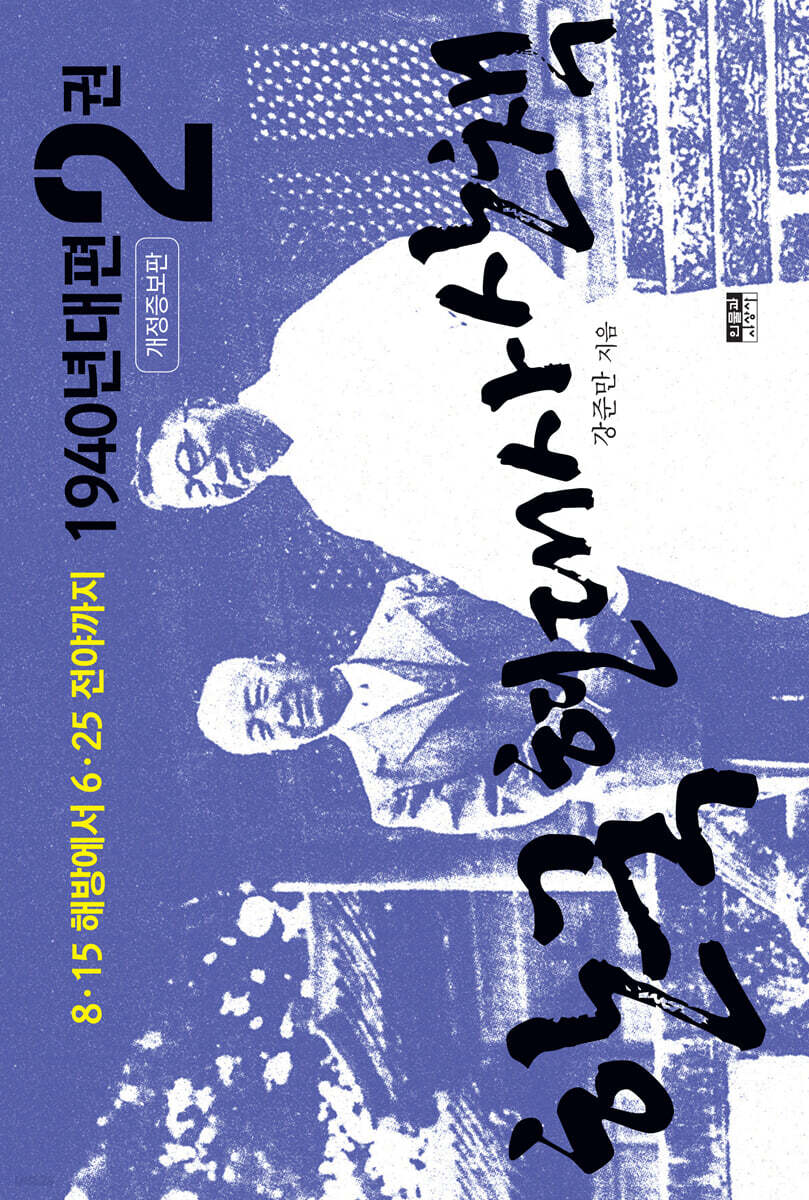
A Walk Through Modern Korean History: 1940s Part 2
 |
Description
Book Introduction
How have Korea's politics, economy, society, and culture evolved over the past decade?
Establishing a culture of recording and evaluating modern Korean history
The modern history of Korea, in which we have lived and in which we live now, is the starting point and the finishing point of history.
Because I have to live in a world where I have to make constant choices.
However, modern history has often been treated as a cold meal in the historical community.
Because these are sensitive topics.
Kang Jun-man presents various positions on controversial issues while also offering his own perspective, thereby providing readers with accurate information and a variety of opportunities for participation.
In that respect, the ‘A Walk Through Modern Korean History’ series is unparalleled.
It is like a Korean's 'treasure trove' that contains everything about the Republic of Korea that made up the 'me' of today.
The "A Walk Through Modern Korean History" series, which meticulously captures 75 years of history from noon on August 15, 1945, to Bong Joon-ho's "Parasite," covers a wide range of fields, from politics, economy, and society to popular culture and sports.
And it brought to life the life and historical stage that modern Koreans had to face.
To this end, the 'A Walk Through Modern Korean History' series attempted a three-dimensional approach through extensive annotations, photographs capturing scenes from the time, and a 'History Walk' corner.
The 'A Walk Through Modern Korean History' series is not limited to a simple listing of events.
'Explosion of Han (恨) and Desire' (1940s), 'Age of Extremes' (1950s), 'Birth of an Opportunist Republic' (1960s), 'Nationalization of Exports' (1970s), 'Gwangju Massacre and the Seoul Olympics' (1980s), 'Division is Our Destiny, Solidarity is My Destiny' (1990s), 'The Light and Shadow of the Roh Moo-hyun Era' (2000s), 'The Age of Hatred and Loathing' (2010s), etc. Numerous events and topics are persistently explored amidst a fierce sense of crisis about the emotions and structures that dominated each era.
And he emphasizes that just as the new generation can seize new values in the name of 'progress', it must also embrace the 'pain' of past generations who had to survive times of extremes and poverty.
Kang Jun-man recognizes that modern Korean history is a history that has excluded 'humanity', and is attempting to restore 'humanity' and, on that basis, to achieve a new reconciliation between ideologies and generations.
The 'A Walk Through Modern Korean History' series can be considered the first Korean book series to establish a culture of recording and evaluating modern Korean history.
Establishing a culture of recording and evaluating modern Korean history
The modern history of Korea, in which we have lived and in which we live now, is the starting point and the finishing point of history.
Because I have to live in a world where I have to make constant choices.
However, modern history has often been treated as a cold meal in the historical community.
Because these are sensitive topics.
Kang Jun-man presents various positions on controversial issues while also offering his own perspective, thereby providing readers with accurate information and a variety of opportunities for participation.
In that respect, the ‘A Walk Through Modern Korean History’ series is unparalleled.
It is like a Korean's 'treasure trove' that contains everything about the Republic of Korea that made up the 'me' of today.
The "A Walk Through Modern Korean History" series, which meticulously captures 75 years of history from noon on August 15, 1945, to Bong Joon-ho's "Parasite," covers a wide range of fields, from politics, economy, and society to popular culture and sports.
And it brought to life the life and historical stage that modern Koreans had to face.
To this end, the 'A Walk Through Modern Korean History' series attempted a three-dimensional approach through extensive annotations, photographs capturing scenes from the time, and a 'History Walk' corner.
The 'A Walk Through Modern Korean History' series is not limited to a simple listing of events.
'Explosion of Han (恨) and Desire' (1940s), 'Age of Extremes' (1950s), 'Birth of an Opportunist Republic' (1960s), 'Nationalization of Exports' (1970s), 'Gwangju Massacre and the Seoul Olympics' (1980s), 'Division is Our Destiny, Solidarity is My Destiny' (1990s), 'The Light and Shadow of the Roh Moo-hyun Era' (2000s), 'The Age of Hatred and Loathing' (2010s), etc. Numerous events and topics are persistently explored amidst a fierce sense of crisis about the emotions and structures that dominated each era.
And he emphasizes that just as the new generation can seize new values in the name of 'progress', it must also embrace the 'pain' of past generations who had to survive times of extremes and poverty.
Kang Jun-man recognizes that modern Korean history is a history that has excluded 'humanity', and is attempting to restore 'humanity' and, on that basis, to achieve a new reconciliation between ideologies and generations.
The 'A Walk Through Modern Korean History' series can be considered the first Korean book series to establish a culture of recording and evaluating modern Korean history.
- You can preview some of the book's contents.
Preview
index
Part 1 1947: From Division to Partition
Chapter 1: Anti-Trusteeship Independence Struggle Committee, March 1st Bloodshed
Anti-Trusteeship Rally Led by Kim Gu · 15 Kim Gu's Formation of the National Assembly · 16 The Growing Distance Between the Left and the Right · 18 March 1st Movement, Which Left 38 Casualties · 20 Jeju March 1st Shooting Incident · 21 Namsan May Day Incident · 23
Historical Walk 1: The Myeongwol Gwan Film Scandal · 25
Chapter 2: The Impact of the Truman Doctrine on Korea
Churchill's "Iron Curtain" Speech · 28 The Truman Doctrine That Delighted Syngman Rhee · 30 The Brilliantly Decorated "Syngman Rhee Diplomacy" · 32 The Welcome Ceremony Upon Syngman Rhee's Return · 34
A Walk Through History 2: The Return of Jeon Jae-min, a Serious Social Problem · 38
Chapter 3: The Second US-Soviet Joint Commission and the June 23 Anti-Trusteeship Demonstrations
The US policy of containment · 41 463 political parties and social organizations reach 70 million members · 43 Syngman Rhee and Kim Gu's "last collaboration" · 46 "Syngman Rhee is the sun, Kim Gu is the moon" · 47 The collapse of the Second US-Soviet Joint Commission · 48 Seo Jae-pil's return from the United States · 50
Chapter 4. The Transitional Legislature's Law on the Punishment of Collaborators
Ahn Jae-hong becomes Minister of Civil Affairs · 53. Launch of the South Korean Interim Government · 54. Special Act on Punishment of Pro-Japanese Collaborators, Traitors, War Criminals, and Pro-Japanese Collaborators · 55. Kim Kyu-sik and Ahn Jae-hong are Communist Spies · 56.
Chapter 5: Yeo Un-hyeong's Assassination and the "Politics of Terror"
The Assassination of Yeo Un-hyeong and the Disintegration of Left-Right Cooperation · 59 Yeo Un-hyeong and Kim Gu · 62 The "Fear of Terror" Among Moderates and Leftists · 64 Right-Wing Political Leaders' Sponsorship of Terrorism · 66 "The U.S. Military Government is the Greatest Protector of Far-Right Terrorism" · 68
Chapter 6: The Breakup Between Syngman Rhee and Kim Gu
Transfer of the Korean Issue to the United Nations · 70 North Korea and the Soviet Union's Population Relocation Policy · 72 Jang Deok-su's Assassination · 74 Kim Gu's Betrayal of Syngman Rhee · 77 Kim Gu and Kim Kyu-sik · 79
Chapter 7: Left-Wing Media and Art Go Underground
The Honam Line Train Rape Incident and Media Suppression · 81. The Eradication of Leftists in the Performing Arts and Broadcasting Sector · 84. The "Newspaper War" of Chasing and Being Chased · 85. The US Military Government's Public Relations Supply Operation · 87. "Wife's Song," "Moonlit Night in Silla," and "Besame Mucho" · 89. "The Bindaetteok Gentleman" and the Golden Age of Gisaeng Houses · 90.
A Walk Through History 3: Madonna and Mona Lisa · 93
Part II, 1948: The Institutionalization of Desire and Violence
Chapter 1: Entry of the UN Commission and Confirmation of the Separate Election
The UN Commission's Entry into Korea · 99 The Far Right's Criticism of Kim Gu · 101 The South Korean Labor Party's February 7 Strike and Kim Gu's February 10 Uprising · 102 The "Pine Tree on Namsan Mountain" Controversy · 104 Krishna Menon and Mo Yun-suk · 106
Historical Walk 4: Abolition of the Public Prostitution System and the Movement to Abolish the Public Prostitution System · 108
Chapter 2: The Movement Against Single-Party Elections and Land Reform
The Joint Statement of the Seven Leaders and Kim Gu's Criticism · 111 The US Military Government's Land Reform for Election Pursuit · 113 Syngman Rhee's Discontent with the Timing of Land Reform · 114 The Interim Legislative Assembly's "Pitiful Prank" · 115
Chapter 3: The Tragedy of the Jeju April 3 Uprising
The catastrophe that killed 10% of Jeju's population · 117 The Orari Incident that broke the peace talks · 119 "All the people of Jeju are now dead" · 121 The indiscriminate arrest operation that drove young people into the mountains · 123 The beginning of the "Red Hunt" · 125
Historical Walk 5: The Fairy of the City That Never Sleeps · 127
Chapter 4: Kim Gu and Kim Kyu-sik's Visit to North Korea
Rhee Syngman and the US Military Government's Ridicule, Support from 108 Cultural Figures · 129 "We must go, even if it means cutting the 38th Parallel and dying!" · 131 Kim Gu, Kim Kyu-sik, Kim Il-sung, and Kim Du-bong's "Four Kims Meeting" · 133 Kim Gu's Self-Contradiction and a Belated Reversal · 135
Chapter 5: May 10 South Korea's Independent General Election
Voter Registration Fraud · 138 Activities of the Hyangbodan and Jokcheong and the May 8th Strike · 140 "Voting is a patriotic duty, abstention is a national shame" · 142 Avoiding the Korean Democratic Party, Independents make great strides · 145 Was boycotting the May 10th elections right? · 147 Power outages in North Korea · 150 The communization of the mountains and the extremes of survival-oriented theft and fraud · 154 Trade that crosses the line between 'theft' and 'fraud' · 156 Importing famine to divide the nation? · 158
Chapter 6: Protestantism's Anti-Communism and Pro-Americanism
Protestantism Dominating the Upper Class · 161 Protestantism as the Foundation of Right-Wing Youth Groups · 164 Protestantism's Inherent Anti-Communism and Pro-Americanism · 165 Oh Gi-young's "Jesus and Joseon" · 167
Chapter 7 Establishment of the Government of the Republic of Korea
Adoption of 'Republic of Korea' and 'People' · 170 Syngman Rhee's election as president · 171 Formation of a cabinet excluding the Korean Democratic Party · 173 Kim Gu and Syngman Rhee's 'indignation and disappointment' · 175 North Korea adopts the North Korean flag instead of the Taegeukgi · 178 Establishment of the Democratic People's Republic of Korea · 180 Seo Jae-pil's declaration of war on Syngman Rhee · 182 The same now as during the Gapsin Coup · 183
Historical Walk 6: The Harmful Effects of "Sabasaba" and Interpreters · 186
Chapter 8 Promulgation of the Anti-National Act Punishment Act
The Heated Conflict Surrounding the Punishment of Pro-Japanese Collaborators · 188 Pro-Japanese Police Depicted in Kim Won-il's "The Rite of Fire" · 189 Syngman Rhee's Thoughts on Pro-Japanese Collaborators · 190 Lawmakers Criticizing Pro-Japanese Collaborators Are Communist Spies · 191
A Walk Through History 7: Korea's 12-0 loss to Sweden · 194
Chapter 9: The Korean Youth League with Syngman Rhee as its President
The Jokcheong with 1.3 million members · 196 The founding of the Korean Youth Corps · 197 The survival of the Daedong Youth Corps · 198 The dual structure of national governance · 200
Chapter 10: The Tragedy of the Yeosun Incident
"We oppose the deployment to Jeju Island, a fratricidal war" · 203 The police and the Coast Guard are enemies · 204 The brutal retaliation of the military and police · 206 The "finger gun" and the beheading of Kim Jong-won · 209 The Syngman Rhee regime's manipulation of public opinion · 211 2,600 deaths · 213 The purge of the military and the arrest of Park Chung-hee · 216
Chapter 11 Promulgation of the National Security Act
The National Security Law Debate · 219 "Communists Must Be Killed Unconditionally" · 220 Strengthening the Military and Police Organization · 221 Right-wing Media Divided into Pro-Government and Pro-Opposition Sectors, Launch of a National Broadcasting System · 222
Chapter 12: The "Human Hunt" in Jeju
The 'Scorched Earth Operation' Proposed by the US Military · 225 The Exploitation of the Seocheong and the 'Forcing of the Minbodan' · 227 The Mass Madness of the Suppression Forces · 230 'Trap Suppression', 'Massacre', 'Don't Let Your Name Be Taken Away' · 233 The Bukchon-ri Massacre, a Shooting Practice · 234 Hyun Ki-young's 'Uncle Sooni' · 236 "If You Don't Stab, You'll Die Instead" · 237 The United States Was Behind the April 3 Incident · 239 The Struggle Against Fabricated Labels, the Murder of Memory · 241 The Fear Still Remains · 243 Roh Moo-hyun's Apology, Compensation and Reparation for the Victims · 244
Part 3, 1949: The Religionization of Anti-Communism
Chapter 1: The Special Committee on Anti-National Activities and the Student Defense Corps
The Conflict Between the Special Committee on Anti-National Activities and Syngman Rhee · 249 The Three-Party System of the 'Fascist Governing Structure' · 252 Ahn Ho-sang and Syngman Rhee's Ilminism · 254 The Formation of the Central Student Defense Corps · 256 The 'Information Politics' of Surveillance and Snitching · 258 The Korean-Style Hyper-Growth State · 259
Historical Walk 8: "Surge in Prices" and "Sabasaba" · 261
Chapter 2: The "National Assembly Spy Incident" and the Disintegration of the Special Committee on Anti-National Activities
Police raid on the Special Committee on Anti-Japanese Collaborators · 263 A rehash of the "National Assembly spy incident" · 265 The collapse of the Special Committee on Anti-Japanese Collaborators · 267 The negative impact of the pro-Japanese issue on national character · 268
Chapter 3: The National Press Union and the Competition for Conversion and Loyalty
The Race to Fill Subscriber Quotas · 271 "A Corruption of the Human Conscience" · 273 Conversion and Loyalty Competition · 276 "Information Networks Infiltrating the People" · 277
Chapter 4: Kim Gu's Assassination
"South Korea is in mourning" · 280 Who Killed Kim Gu? · 282 The Collective Madness Born of Extremism · 285 The Cold Heart of the World · 287
Chapter 5: The Idolization of Syngman Rhee
1949: South Korea: A "Paradise of Human Rights Violations" · 289: All-out Exploitation of the People · 291: Portraits of Syngman Rhee in Schools, Taegeukgi on Birthdays · 293: The Revival of the Joseon Dynasty · 295: What Syngman Rhee and Kim Gu Have in Common · 296: The Unfortunate Karma of Modern Korean History · 299
A Walk Through History 9: Prevalence of After-School Tutoring in Elementary Schools · 301
Chapter 6: "Speech Politics" and "Blood Oath Politics"
Speeches: A Powerful Means of Communication · 303 Kang Won-yong's Activities · 305 The Anti-Trusteeship Student League and the US Military Government · 307 Blood Oaths: An Expression of Truth and Courage · 309 The Mass Production of "Blood Oaths of Loyalty" · 311
Chapter 7: What Happened Just Before the Korean War?
Land Reform and the Korean War · 313 The Withdrawal of U.S. Forces from Korea and North Korea's Propaganda Offensive · 315 Armed Conflicts Near the 38th Parallel and the Theory of Unification Through Northward Advance · 317 Domestic and International Situations Just Before the Korean War · 319 North Korea's Meticulous War Preparations and South Korea's Bluffing · 322 Was the Syngman Rhee Regime a "State"? · 324
Chapter 8: The Activities of the Nakrang Club, the Women's Diplomatic Club
A club centered around English-speaking housekeepers · 328 An event promoting friendship between Korea, the United States, and the United Nations · 330 'Hostess' as 'Bar Hostess', 'Entertainment' as 'Hospitality' · 332 The media's sensational labeling to criticize Syngman Rhee · 334
Historical Walk 10: "Christmas Thread" and "Christmas Tree" · 336
Conclusion: McCarthyism Sells 'Betrayal and Apostasy'
"Extreme Dogma and Immature Ideology" · 338 Labeling that Provokes Fear, Hatred, and Aversion · 340 For a History That Reachs the Public · 342 The True "Subject" is Fact and Truth · 344 The "50/50" Division of Responsibility · 346 The "Need for Safety" That Permeates Kim Gu's Evaluation · 348 The Cultural Curse of Japanese Colonialism · 350 How to Survive in the "Crucible of Chaos" · 352 Now We Must Move to the "Middle" · 354
Week 357
Chapter 1: Anti-Trusteeship Independence Struggle Committee, March 1st Bloodshed
Anti-Trusteeship Rally Led by Kim Gu · 15 Kim Gu's Formation of the National Assembly · 16 The Growing Distance Between the Left and the Right · 18 March 1st Movement, Which Left 38 Casualties · 20 Jeju March 1st Shooting Incident · 21 Namsan May Day Incident · 23
Historical Walk 1: The Myeongwol Gwan Film Scandal · 25
Chapter 2: The Impact of the Truman Doctrine on Korea
Churchill's "Iron Curtain" Speech · 28 The Truman Doctrine That Delighted Syngman Rhee · 30 The Brilliantly Decorated "Syngman Rhee Diplomacy" · 32 The Welcome Ceremony Upon Syngman Rhee's Return · 34
A Walk Through History 2: The Return of Jeon Jae-min, a Serious Social Problem · 38
Chapter 3: The Second US-Soviet Joint Commission and the June 23 Anti-Trusteeship Demonstrations
The US policy of containment · 41 463 political parties and social organizations reach 70 million members · 43 Syngman Rhee and Kim Gu's "last collaboration" · 46 "Syngman Rhee is the sun, Kim Gu is the moon" · 47 The collapse of the Second US-Soviet Joint Commission · 48 Seo Jae-pil's return from the United States · 50
Chapter 4. The Transitional Legislature's Law on the Punishment of Collaborators
Ahn Jae-hong becomes Minister of Civil Affairs · 53. Launch of the South Korean Interim Government · 54. Special Act on Punishment of Pro-Japanese Collaborators, Traitors, War Criminals, and Pro-Japanese Collaborators · 55. Kim Kyu-sik and Ahn Jae-hong are Communist Spies · 56.
Chapter 5: Yeo Un-hyeong's Assassination and the "Politics of Terror"
The Assassination of Yeo Un-hyeong and the Disintegration of Left-Right Cooperation · 59 Yeo Un-hyeong and Kim Gu · 62 The "Fear of Terror" Among Moderates and Leftists · 64 Right-Wing Political Leaders' Sponsorship of Terrorism · 66 "The U.S. Military Government is the Greatest Protector of Far-Right Terrorism" · 68
Chapter 6: The Breakup Between Syngman Rhee and Kim Gu
Transfer of the Korean Issue to the United Nations · 70 North Korea and the Soviet Union's Population Relocation Policy · 72 Jang Deok-su's Assassination · 74 Kim Gu's Betrayal of Syngman Rhee · 77 Kim Gu and Kim Kyu-sik · 79
Chapter 7: Left-Wing Media and Art Go Underground
The Honam Line Train Rape Incident and Media Suppression · 81. The Eradication of Leftists in the Performing Arts and Broadcasting Sector · 84. The "Newspaper War" of Chasing and Being Chased · 85. The US Military Government's Public Relations Supply Operation · 87. "Wife's Song," "Moonlit Night in Silla," and "Besame Mucho" · 89. "The Bindaetteok Gentleman" and the Golden Age of Gisaeng Houses · 90.
A Walk Through History 3: Madonna and Mona Lisa · 93
Part II, 1948: The Institutionalization of Desire and Violence
Chapter 1: Entry of the UN Commission and Confirmation of the Separate Election
The UN Commission's Entry into Korea · 99 The Far Right's Criticism of Kim Gu · 101 The South Korean Labor Party's February 7 Strike and Kim Gu's February 10 Uprising · 102 The "Pine Tree on Namsan Mountain" Controversy · 104 Krishna Menon and Mo Yun-suk · 106
Historical Walk 4: Abolition of the Public Prostitution System and the Movement to Abolish the Public Prostitution System · 108
Chapter 2: The Movement Against Single-Party Elections and Land Reform
The Joint Statement of the Seven Leaders and Kim Gu's Criticism · 111 The US Military Government's Land Reform for Election Pursuit · 113 Syngman Rhee's Discontent with the Timing of Land Reform · 114 The Interim Legislative Assembly's "Pitiful Prank" · 115
Chapter 3: The Tragedy of the Jeju April 3 Uprising
The catastrophe that killed 10% of Jeju's population · 117 The Orari Incident that broke the peace talks · 119 "All the people of Jeju are now dead" · 121 The indiscriminate arrest operation that drove young people into the mountains · 123 The beginning of the "Red Hunt" · 125
Historical Walk 5: The Fairy of the City That Never Sleeps · 127
Chapter 4: Kim Gu and Kim Kyu-sik's Visit to North Korea
Rhee Syngman and the US Military Government's Ridicule, Support from 108 Cultural Figures · 129 "We must go, even if it means cutting the 38th Parallel and dying!" · 131 Kim Gu, Kim Kyu-sik, Kim Il-sung, and Kim Du-bong's "Four Kims Meeting" · 133 Kim Gu's Self-Contradiction and a Belated Reversal · 135
Chapter 5: May 10 South Korea's Independent General Election
Voter Registration Fraud · 138 Activities of the Hyangbodan and Jokcheong and the May 8th Strike · 140 "Voting is a patriotic duty, abstention is a national shame" · 142 Avoiding the Korean Democratic Party, Independents make great strides · 145 Was boycotting the May 10th elections right? · 147 Power outages in North Korea · 150 The communization of the mountains and the extremes of survival-oriented theft and fraud · 154 Trade that crosses the line between 'theft' and 'fraud' · 156 Importing famine to divide the nation? · 158
Chapter 6: Protestantism's Anti-Communism and Pro-Americanism
Protestantism Dominating the Upper Class · 161 Protestantism as the Foundation of Right-Wing Youth Groups · 164 Protestantism's Inherent Anti-Communism and Pro-Americanism · 165 Oh Gi-young's "Jesus and Joseon" · 167
Chapter 7 Establishment of the Government of the Republic of Korea
Adoption of 'Republic of Korea' and 'People' · 170 Syngman Rhee's election as president · 171 Formation of a cabinet excluding the Korean Democratic Party · 173 Kim Gu and Syngman Rhee's 'indignation and disappointment' · 175 North Korea adopts the North Korean flag instead of the Taegeukgi · 178 Establishment of the Democratic People's Republic of Korea · 180 Seo Jae-pil's declaration of war on Syngman Rhee · 182 The same now as during the Gapsin Coup · 183
Historical Walk 6: The Harmful Effects of "Sabasaba" and Interpreters · 186
Chapter 8 Promulgation of the Anti-National Act Punishment Act
The Heated Conflict Surrounding the Punishment of Pro-Japanese Collaborators · 188 Pro-Japanese Police Depicted in Kim Won-il's "The Rite of Fire" · 189 Syngman Rhee's Thoughts on Pro-Japanese Collaborators · 190 Lawmakers Criticizing Pro-Japanese Collaborators Are Communist Spies · 191
A Walk Through History 7: Korea's 12-0 loss to Sweden · 194
Chapter 9: The Korean Youth League with Syngman Rhee as its President
The Jokcheong with 1.3 million members · 196 The founding of the Korean Youth Corps · 197 The survival of the Daedong Youth Corps · 198 The dual structure of national governance · 200
Chapter 10: The Tragedy of the Yeosun Incident
"We oppose the deployment to Jeju Island, a fratricidal war" · 203 The police and the Coast Guard are enemies · 204 The brutal retaliation of the military and police · 206 The "finger gun" and the beheading of Kim Jong-won · 209 The Syngman Rhee regime's manipulation of public opinion · 211 2,600 deaths · 213 The purge of the military and the arrest of Park Chung-hee · 216
Chapter 11 Promulgation of the National Security Act
The National Security Law Debate · 219 "Communists Must Be Killed Unconditionally" · 220 Strengthening the Military and Police Organization · 221 Right-wing Media Divided into Pro-Government and Pro-Opposition Sectors, Launch of a National Broadcasting System · 222
Chapter 12: The "Human Hunt" in Jeju
The 'Scorched Earth Operation' Proposed by the US Military · 225 The Exploitation of the Seocheong and the 'Forcing of the Minbodan' · 227 The Mass Madness of the Suppression Forces · 230 'Trap Suppression', 'Massacre', 'Don't Let Your Name Be Taken Away' · 233 The Bukchon-ri Massacre, a Shooting Practice · 234 Hyun Ki-young's 'Uncle Sooni' · 236 "If You Don't Stab, You'll Die Instead" · 237 The United States Was Behind the April 3 Incident · 239 The Struggle Against Fabricated Labels, the Murder of Memory · 241 The Fear Still Remains · 243 Roh Moo-hyun's Apology, Compensation and Reparation for the Victims · 244
Part 3, 1949: The Religionization of Anti-Communism
Chapter 1: The Special Committee on Anti-National Activities and the Student Defense Corps
The Conflict Between the Special Committee on Anti-National Activities and Syngman Rhee · 249 The Three-Party System of the 'Fascist Governing Structure' · 252 Ahn Ho-sang and Syngman Rhee's Ilminism · 254 The Formation of the Central Student Defense Corps · 256 The 'Information Politics' of Surveillance and Snitching · 258 The Korean-Style Hyper-Growth State · 259
Historical Walk 8: "Surge in Prices" and "Sabasaba" · 261
Chapter 2: The "National Assembly Spy Incident" and the Disintegration of the Special Committee on Anti-National Activities
Police raid on the Special Committee on Anti-Japanese Collaborators · 263 A rehash of the "National Assembly spy incident" · 265 The collapse of the Special Committee on Anti-Japanese Collaborators · 267 The negative impact of the pro-Japanese issue on national character · 268
Chapter 3: The National Press Union and the Competition for Conversion and Loyalty
The Race to Fill Subscriber Quotas · 271 "A Corruption of the Human Conscience" · 273 Conversion and Loyalty Competition · 276 "Information Networks Infiltrating the People" · 277
Chapter 4: Kim Gu's Assassination
"South Korea is in mourning" · 280 Who Killed Kim Gu? · 282 The Collective Madness Born of Extremism · 285 The Cold Heart of the World · 287
Chapter 5: The Idolization of Syngman Rhee
1949: South Korea: A "Paradise of Human Rights Violations" · 289: All-out Exploitation of the People · 291: Portraits of Syngman Rhee in Schools, Taegeukgi on Birthdays · 293: The Revival of the Joseon Dynasty · 295: What Syngman Rhee and Kim Gu Have in Common · 296: The Unfortunate Karma of Modern Korean History · 299
A Walk Through History 9: Prevalence of After-School Tutoring in Elementary Schools · 301
Chapter 6: "Speech Politics" and "Blood Oath Politics"
Speeches: A Powerful Means of Communication · 303 Kang Won-yong's Activities · 305 The Anti-Trusteeship Student League and the US Military Government · 307 Blood Oaths: An Expression of Truth and Courage · 309 The Mass Production of "Blood Oaths of Loyalty" · 311
Chapter 7: What Happened Just Before the Korean War?
Land Reform and the Korean War · 313 The Withdrawal of U.S. Forces from Korea and North Korea's Propaganda Offensive · 315 Armed Conflicts Near the 38th Parallel and the Theory of Unification Through Northward Advance · 317 Domestic and International Situations Just Before the Korean War · 319 North Korea's Meticulous War Preparations and South Korea's Bluffing · 322 Was the Syngman Rhee Regime a "State"? · 324
Chapter 8: The Activities of the Nakrang Club, the Women's Diplomatic Club
A club centered around English-speaking housekeepers · 328 An event promoting friendship between Korea, the United States, and the United Nations · 330 'Hostess' as 'Bar Hostess', 'Entertainment' as 'Hospitality' · 332 The media's sensational labeling to criticize Syngman Rhee · 334
Historical Walk 10: "Christmas Thread" and "Christmas Tree" · 336
Conclusion: McCarthyism Sells 'Betrayal and Apostasy'
"Extreme Dogma and Immature Ideology" · 338 Labeling that Provokes Fear, Hatred, and Aversion · 340 For a History That Reachs the Public · 342 The True "Subject" is Fact and Truth · 344 The "50/50" Division of Responsibility · 346 The "Need for Safety" That Permeates Kim Gu's Evaluation · 348 The Cultural Curse of Japanese Colonialism · 350 How to Survive in the "Crucible of Chaos" · 352 Now We Must Move to the "Middle" · 354
Week 357
Into the book
Even as the US's policy of blockade against the Soviet Union began to become more visible, the two sides of the US-Soviet Joint Commission reached an agreement after much debate over the scope of political parties and social groups to be consulted.
According to the joint statement released on June 11, political parties and social organizations wishing to participate in the US-Soviet Joint Commission consultations were required to sign a declaration supporting the objectives of the Moscow Decision, upholding the US-Soviet Joint Commission resolution on the establishment of the Provisional Government of Korea, and cooperating in drafting proposals for trusteeship, and submit a petition to the US-Soviet Joint Commission with the declaration attached.
The left and centrist camps welcomed this statement, but serious divisions arose within the anti-trusteeship camp over the issue of participation in the US-Soviet Joint Commission consultations.
The Democratic Party of Korea, claiming to participate in the US-Soviet Joint Commission consultations under the pretext of “participating and opposing,” formed the “Provisional Government Establishment Countermeasures Council” on June 19, comprised of 74 political parties and social organizations.
--- From "Part 1, Chapter 3, The 2nd US-Soviet Joint Commission and the 'June 23 Anti-Trusteeship Demonstration'"
The Joint Committee for the Left and Right was effectively dissolved with the breakdown of the US-Soviet Joint Commission and the transfer of the Korean issue to the United Nations.
Instead, the National Independence League (NIIL) was formed, bringing together a new group of middle-class forces.
At the founding ceremony held at the Cheondoism lecture hall on December 20, 1947, Kim Kyu-sik was elected as chairman, and Kim Bong-jun, Hong Myeong-hui, Won Se-hun, Lee Geuk-ro, and Kim Seong-gyu were elected as vice-chairmen.
At this time, Kim Gu took an ambiguous or inconsistent attitude.
He warned on November 24, 1947, that a separate election in South Korea would lead to a tragedy of national division, but a week later, on November 30, he took a completely different stance.
That day, Kim Gu visited Syngman Rhee at the funeral home and, after a brief conversation of about an hour, announced a statement de facto declaring his intention to participate in a separate government, saying that he and Syngman Rhee had no fundamental differences in opinion.
After the statement was released, the two attended the first anniversary ceremony of the Northwest Youth Association and gave speeches.
However, the assassination of Jang Deok-su on December 2nd, when the cooperative relationship between the two was strengthening, became a decisive turning point that led to the breakdown of their relationship.
--- From "Part 1, Chapter 6: The Breakup Between Syngman Rhee and Kim Gu"
Kim Gu's trip to North Korea was a surprising twist.
Hadn't he been North Korea's sworn enemy? North Korea hurriedly removed posters and leaflets slandering Kim Gu, with messages like, "Down with the murderous robbers, Kim Gu and Syngman Rhee!" and "Even if 30 million people die, I will achieve my long-held dream of becoming emperor," just before Kim Gu's arrival.
From April 19 to 23, 1948, a joint conference of representatives of political parties and social organizations from the South and the North was held in Pyongyang.
At the opening of the plenary session, the national anthem, which begins with “The East Sea and Baekdu Mountain,” was sung in unison, and the Taegeukgi flag was displayed at the venue.
From April 26th to 30th, a political meeting was held under the name of the “South-North Korean Political Parties and Social Organizations Leaders’ Council,” with 15 key figures from the South and the North in attendance.
At this meeting, for the first time since liberation, left-wing, right-wing, and centrist figures came together to discuss establishing a unified nation.
--- From “Part 2, Chapter 4, Kim Gu and Kim Kyu-sik’s Visit to North Korea”
On September 23, the day Syngman Rhee promulgated the Anti-Communist Act, the 'National Rally to Celebrate the Transfer of Power and the General Uprising to Save the Nation from Communism' was held at Seoul Stadium, hosted by the Ministry of the Interior.
Although it was formally an anti-communist rally, it was in fact a national rally against the anti-people law, and a significant portion of the crowd was forcibly mobilized.
The police went from house to house, saying, “Plant the flag today.
He threatened, “If you don’t come to Seoul Stadium today, you are a communist and your grain distribution passbook will be taken away.”
The National Assembly resolved to “amend anti-national laws that damage harmony among compatriots and to request the insertion of a clause to eradicate communist traitors.”
Leaflets with the following message were scattered throughout the venue.
"The anti-national law passed by the National Assembly allows for the arrest of even the head of a neighborhood association or a village head, making it a law that traps the entire nation." "The creation of this divisive law is the work of communist spies within the National Assembly." "Kim Il-sung's stooges within the National Assembly must be purged."
--- From “Part 2, Chapter 8, Promulgation of the Anti-National Acts Punishment Act”
Ahn Doo-hee, who was a member of the Korean Independence Party and the Northwest Youth League, stated that he committed the murder because he felt the danger was imminent as the Korean Independence Party led by Kim Gu was attempting to overthrow the South Korean government and was pushing for the withdrawal of US troops at the insistence of the Soviet Union, and he maintained that he had acted alone until the end.
But two days after Kim Gu's assassination, something truly strange happened.
Without the knowledge of Seoul District Prosecutor Choi Dae-kyo, an arrest warrant was issued for seven executives of the Korean Independence Party, including the organization department head Kim Hak-gyu, on charges of instigating murder.
Without any investigation or evidence, Prosecutor General Kim Ik-jin ordered, “Keep the elderly person at the Blue House from knowing about Choi Dae-kyo,” and Kim Ik-jin himself issued the warrant.
As Jang Heung, who was the commander of the military police at the time of the incident, later testified, this was strongly in the nature of a conspiracy to turn the assassination of Kim Gu into a family feud within the Korean Independence Party.
The conspiracy became more concrete on September 30th.
--- From “Part 3, Chapter 4: Assassination of Kim Gu”
Around this time, in Kaesong, the '10 Braves with a Hand Grenade Incident' occurred, in which 10 special forces from the 1st Division of the ROK Army threw grenades at a People's Army pillbox and died in action while trying to recapture the Songaksan Mountain area.
According to an article in the May 25, 1949 edition of the Jayu Shinmun, members of the Nakrang Club visited Minister of National Defense Shin Sung-mo and donated 1 million won to the bereaved families, asking them to donate 100,000 won per household.
The next day, he paid a 'comfort visit' to the 1st Division, and a week later, he held a '10 Soldiers' Families Support Concert' hosted by the Ewha Womans University Alumni Association, and sent all proceeds to the bereaved families.
According to an article in the August 7, 1949 edition of the Kyunghyang Shinmun, in order to entertain foreign guests who had fought for Korea's independence, they staged a performance of music and dance, including the classical play "Queen Seondeok," at Deoksugung Palace Plaza, together with the Foreigners' Club in Seoul. According to an article in the August 26, 1949 edition of the Dong-A Ilbo, they hosted various events to promote friendship between Korea, the United States, and the United Nations, such as holding a banquet to welcome the head of the American military delegation.
According to the joint statement released on June 11, political parties and social organizations wishing to participate in the US-Soviet Joint Commission consultations were required to sign a declaration supporting the objectives of the Moscow Decision, upholding the US-Soviet Joint Commission resolution on the establishment of the Provisional Government of Korea, and cooperating in drafting proposals for trusteeship, and submit a petition to the US-Soviet Joint Commission with the declaration attached.
The left and centrist camps welcomed this statement, but serious divisions arose within the anti-trusteeship camp over the issue of participation in the US-Soviet Joint Commission consultations.
The Democratic Party of Korea, claiming to participate in the US-Soviet Joint Commission consultations under the pretext of “participating and opposing,” formed the “Provisional Government Establishment Countermeasures Council” on June 19, comprised of 74 political parties and social organizations.
--- From "Part 1, Chapter 3, The 2nd US-Soviet Joint Commission and the 'June 23 Anti-Trusteeship Demonstration'"
The Joint Committee for the Left and Right was effectively dissolved with the breakdown of the US-Soviet Joint Commission and the transfer of the Korean issue to the United Nations.
Instead, the National Independence League (NIIL) was formed, bringing together a new group of middle-class forces.
At the founding ceremony held at the Cheondoism lecture hall on December 20, 1947, Kim Kyu-sik was elected as chairman, and Kim Bong-jun, Hong Myeong-hui, Won Se-hun, Lee Geuk-ro, and Kim Seong-gyu were elected as vice-chairmen.
At this time, Kim Gu took an ambiguous or inconsistent attitude.
He warned on November 24, 1947, that a separate election in South Korea would lead to a tragedy of national division, but a week later, on November 30, he took a completely different stance.
That day, Kim Gu visited Syngman Rhee at the funeral home and, after a brief conversation of about an hour, announced a statement de facto declaring his intention to participate in a separate government, saying that he and Syngman Rhee had no fundamental differences in opinion.
After the statement was released, the two attended the first anniversary ceremony of the Northwest Youth Association and gave speeches.
However, the assassination of Jang Deok-su on December 2nd, when the cooperative relationship between the two was strengthening, became a decisive turning point that led to the breakdown of their relationship.
--- From "Part 1, Chapter 6: The Breakup Between Syngman Rhee and Kim Gu"
Kim Gu's trip to North Korea was a surprising twist.
Hadn't he been North Korea's sworn enemy? North Korea hurriedly removed posters and leaflets slandering Kim Gu, with messages like, "Down with the murderous robbers, Kim Gu and Syngman Rhee!" and "Even if 30 million people die, I will achieve my long-held dream of becoming emperor," just before Kim Gu's arrival.
From April 19 to 23, 1948, a joint conference of representatives of political parties and social organizations from the South and the North was held in Pyongyang.
At the opening of the plenary session, the national anthem, which begins with “The East Sea and Baekdu Mountain,” was sung in unison, and the Taegeukgi flag was displayed at the venue.
From April 26th to 30th, a political meeting was held under the name of the “South-North Korean Political Parties and Social Organizations Leaders’ Council,” with 15 key figures from the South and the North in attendance.
At this meeting, for the first time since liberation, left-wing, right-wing, and centrist figures came together to discuss establishing a unified nation.
--- From “Part 2, Chapter 4, Kim Gu and Kim Kyu-sik’s Visit to North Korea”
On September 23, the day Syngman Rhee promulgated the Anti-Communist Act, the 'National Rally to Celebrate the Transfer of Power and the General Uprising to Save the Nation from Communism' was held at Seoul Stadium, hosted by the Ministry of the Interior.
Although it was formally an anti-communist rally, it was in fact a national rally against the anti-people law, and a significant portion of the crowd was forcibly mobilized.
The police went from house to house, saying, “Plant the flag today.
He threatened, “If you don’t come to Seoul Stadium today, you are a communist and your grain distribution passbook will be taken away.”
The National Assembly resolved to “amend anti-national laws that damage harmony among compatriots and to request the insertion of a clause to eradicate communist traitors.”
Leaflets with the following message were scattered throughout the venue.
"The anti-national law passed by the National Assembly allows for the arrest of even the head of a neighborhood association or a village head, making it a law that traps the entire nation." "The creation of this divisive law is the work of communist spies within the National Assembly." "Kim Il-sung's stooges within the National Assembly must be purged."
--- From “Part 2, Chapter 8, Promulgation of the Anti-National Acts Punishment Act”
Ahn Doo-hee, who was a member of the Korean Independence Party and the Northwest Youth League, stated that he committed the murder because he felt the danger was imminent as the Korean Independence Party led by Kim Gu was attempting to overthrow the South Korean government and was pushing for the withdrawal of US troops at the insistence of the Soviet Union, and he maintained that he had acted alone until the end.
But two days after Kim Gu's assassination, something truly strange happened.
Without the knowledge of Seoul District Prosecutor Choi Dae-kyo, an arrest warrant was issued for seven executives of the Korean Independence Party, including the organization department head Kim Hak-gyu, on charges of instigating murder.
Without any investigation or evidence, Prosecutor General Kim Ik-jin ordered, “Keep the elderly person at the Blue House from knowing about Choi Dae-kyo,” and Kim Ik-jin himself issued the warrant.
As Jang Heung, who was the commander of the military police at the time of the incident, later testified, this was strongly in the nature of a conspiracy to turn the assassination of Kim Gu into a family feud within the Korean Independence Party.
The conspiracy became more concrete on September 30th.
--- From “Part 3, Chapter 4: Assassination of Kim Gu”
Around this time, in Kaesong, the '10 Braves with a Hand Grenade Incident' occurred, in which 10 special forces from the 1st Division of the ROK Army threw grenades at a People's Army pillbox and died in action while trying to recapture the Songaksan Mountain area.
According to an article in the May 25, 1949 edition of the Jayu Shinmun, members of the Nakrang Club visited Minister of National Defense Shin Sung-mo and donated 1 million won to the bereaved families, asking them to donate 100,000 won per household.
The next day, he paid a 'comfort visit' to the 1st Division, and a week later, he held a '10 Soldiers' Families Support Concert' hosted by the Ewha Womans University Alumni Association, and sent all proceeds to the bereaved families.
According to an article in the August 7, 1949 edition of the Kyunghyang Shinmun, in order to entertain foreign guests who had fought for Korea's independence, they staged a performance of music and dance, including the classical play "Queen Seondeok," at Deoksugung Palace Plaza, together with the Foreigners' Club in Seoul. According to an article in the August 26, 1949 edition of the Dong-A Ilbo, they hosted various events to promote friendship between Korea, the United States, and the United Nations, such as holding a banquet to welcome the head of the American military delegation.
--- From "Part 3, Chapter 8, 'Women's Diplomatic Club's Activities at Nakrang Club"
Publisher's Review
The revised and expanded edition of the "A Walk Through Modern Korean History" series, covering the 1940s, has been published!
The political situation after liberation in 1945 was a battlefield where neither side could give in.
Compromise and reconciliation were only possible for people living normal lives in normal times.
Only the extreme fighting spirit to push through one's own claims stood out, and no middle ground was allowed.
The preliminary rehearsals for the massacres committed during the Korean War were already well underway in the late 1940s.
There was only a difference in scale, but no difference in brutality.
At that time, the submissive consciousness and behavior of the masses, accustomed to the legacy of the violent state, which could be called a remnant of Japanese imperialism, had not yet been overcome.
Such a clash of polar opposites unfolded on a new stage called the liberation period.
Of course, the extreme political situation after liberation in 1945 can be said to be the responsibility of both the left and the right, who refused to compromise.
However, the right wing, which was more focused on 'desire', probably bears greater responsibility.
The right wing compromised with Japan, but not with the left wing.
The moderate right wing was a minority and had no power.
For the hard-line right wing, compromise with Japan could bring them power and money, but compromise with the left wing was a compromise that threatened their ability to seize power and money or required them to share it.
It is precisely these interests that may have taken precedence over ideology or been mixed with it.
The people jumped into the 'Crucible of Chaos' with fire in their eyes for a spoonful of rice, some for better food and advancement.
The revised and expanded edition of 『A Walk Through Modern Korean History, 1940s: From Liberation on August 15 to the Eve of the Korean War on June 25』 consists of two volumes.
Volume 1 covers the years 1945 and 1946, and Volume 2 covers the years 1947, 1948, and 1949.
Kang Jun-man says that there is no country whose modern history needs constant rewriting, revision, and supplementation as much as Korea, and that he is publishing a revised and expanded edition of "A Walk Through Modern Korean History: The 1940s," which was published 21 years ago, at a time when secret documents from countries that had a great influence on Korea's fate are being declassified, and the truth about the tragic past is being belatedly revealed, leading to discussions about compensation and reparations.
Yeo Un-hyeong's assassination and the politics of terror
On July 19, 1947, Yeo Un-hyeong was shot and killed while returning home after saying goodbye to Kim Yong-jung, the president of the Korean Affairs Council in the United States.
Yeo Woon-hyung was attacked by terrorists starting on August 18, 1945, and was attacked 10 times. He lost his life in the 11th attack.
It was a truly strange fate.
Yeo Woon-hyung's assassin was Han Ji-geun, a far-right youth and member of Baekuisa, where Kim Du-han was an advisor.
Yeo Woon-hyung's assassination was to some extent foreshadowed.
Since his visit to North Korea on February 9, 1946, Yeo Un-hyeong has visited the country five times, meeting Kim Il-sung each time.
This very point later became the reason why it was difficult to evaluate Yeo Un-hyeong in South Korea and why people were cautious when mentioning him, but there is also an evaluation that this very point was Yeo Un-hyeong's strength and advantage.
In the end, with the assassination of Yeo Un-hyeong, the left-leaning leader of the Left-Right Cooperation Committee, the left-right cooperation movement effectively came to a halt.
The terror against Yeo Un-hyeong had a significant chilling effect on centrist and leftist leaders and had the effect of restricting their activities.
Left-wing leaders were even more serious.
The summer of 1947, when the assassination of Yeo Un-hyeong occurred, was a time when terrorism, which had struck throughout the liberation period, was particularly rampant.
In July, there were 128 terrorist attacks, killing 36 people and injuring 385.
In August, 68 terrorist attacks killed 17 people and injured 158. Of the 68, 37 were perpetrated by right-wing terrorists, 16 by left-wing terrorists, and the remaining 15 were unknown.
Furthermore, violence and terrorism were more severe among right-wing youth groups than among left-wing youth groups, as right-wing youth groups enjoyed police protection and, unlike left-wing youth groups, did not have an established chain of command between the central and local governments.
The Northwest Youth Association was the most active terrorist group, and Syngman Rhee stated that he could not and did not want to ban the terrorists' left-wing attacks.
The tragedy of the Jeju April 3rd Uprising
The Jeju April 3rd Uprising involved over 300,000 Jeju residents and resulted in over 30,000 casualties.
30,000 people were one-tenth of Jeju Island's population at the time.
Moreover, among all victims, 21.1% were women, 5.6% were children under 10 years old, and 6.2% were elderly people over 61 years old.
After the March 1st Shooting Incident in 1947, there were frequent clashes between local residents and the police, with the Udo and Jungmun-ri incidents in March 1947, the Jongdal-ri incident in June, and the Bukchon-ri incident in August being representative incidents.
And in March 1948, three young men who had been taken into police custody died one after another due to police torture, causing public sentiment to waver.
The 9th Regiment of the Jeju Garrison, well aware of the anger of the residents toward the police and the Northwest Youth League, regarded the April 3 armed attack as a clash between the residents, the police, and the Northwest Youth League.
The US military government report called the suppression of the military, police, and right-wing youth groups the "Red Hunt."
The people were reduced to subhuman 'animal objects' that had to be 'hunted'.
The most horrific casualties from this 'human hunt' occurred over a period of approximately four months, from mid-November 1948 to March 1949.
On October 11, the Jeju Island Guard Command was established, and on October 17, the 9th Regiment Commander Song Yo-chan issued a proclamation.
The gist of it was that “anyone who violates the proclamation, regardless of the reason, will be considered a rioter and executed.”
This was the infamous 'scorched earth operation', which was essentially an operation to kill men, women, children and adults indiscriminately.
On October 15, 2003, the Jeju 4.3 Incident Committee pointed out that the ultimate responsibility for the scorched-earth operation that resulted in bloodshed and mass casualties lay with Syngman Rhee, the Commander-in-Chief at the time, and on October 31, Roh Moo-hyun apologized to the nation for the mistakes of state power, 55 years after the incident.
Promulgation of the National Security Act
On September 29, 1948, the Special Measures Act on Internal Rebellion was introduced again and submitted to the plenary session of the National Assembly.
The law was soon renamed the 'National Security Act' and became a subject of social controversy.
This law criminalized communism, and its definition and punishment for communism were so vague that the regime could easily exploit it to eliminate political opponents.
There was also a debate for and against in the National Assembly.
However, the National Security Act was passed by the National Assembly on November 20 by a coalition of the Korean Democratic Party and Syngman Rhee supporters and was promulgated on December 1.
Now, the discussion on unification itself has become difficult.
This is because even suggesting something to the North, holding inter-Korean talks, or suggesting joint ventures could be punished under the National Security Act.
The person who most wanted the National Security Act was Syngman Rhee.
Syngman Rhee encouraged Seonwoo Jong-won, who was the first chief of the prosecution department of the Ministry of Justice and a prosecutor at the Supreme Prosecutors' Office at the time and was known as a "prosecutor who catches communists," by saying, "Communists must be killed unconditionally."
According to statistics presented to the UN Commission by Foreign Minister Jang Taek-sang, the number of people arrested under the National Security Act alone by April 1949 was approximately 89,700.
In 1949 alone, more than 110,000 people were arrested.
The purge within the military became more intense, stimulated by the social atmosphere fostered by the National Security Act.
On January 2, 1949, the Special Investigation Division and 15 regional dispatch units under it were established within the Army Intelligence Agency, and on October 21, 1949, the Army Special Forces Unit was established.
Existing military and police force strengthening programs have been further strengthened.
At the end of 1947, the Guard numbered about 17,000, but it was increased to 50,000 in the summer of 1948 and to 65,000 in early 1949.
On September 1, 1948, the Korean Coast Guard and the Korean Coast Guard were incorporated into the Armed Forces, and on September 5, they were renamed the Army and the Navy, respectively. After the Armed Forces Organization Act was promulgated on November 30, the Armed Forces was formally established on December 15.
The police force was also increased to 30,000 in early 1948 and 45,000 in March 1949.
Idolization of Syngman Rhee
Since 1949, Syngman Rhee's return and birthday have been celebrated as national holidays.
On Syngman Rhee's birthday, an official 'Presidential Birthday Celebration' was held by the government at the Central Government Complex Plaza.
His birthday was called his birthday and was even marked by a joint military, navy, and air force review.
Every citizen had to hang a national flag in every house.
The newspapers' flattery was also extreme.
The fact that every school had to hang a portrait of Syngman Rhee and that every home had to raise the Taegeukgi on his birthday is not something that can be taken lightly.
The Syngman Rhee regime, which had no choice but to serve a leader obsessed with imperialism and heroism, eloquently demonstrated that the Joseon Dynasty was not yet over.
And after Syngman Rhee seized power with the support of many right-wing forces, including members of the Korean Democratic Party and anti-communist forces from Pyeongan Province, he began to politically eliminate them and replace them with his own 'close guard' or 'vassal group'.
Syngman Rhee's tradition is extremely Korean and it still lives on to this day.
This is the so-called 'winner takes all' principle.
Once an absolute winner emerges, the culture of absolute obedience and idolization of the winner has dominated Korean politics for over half a century.
It is the karma of history that leaped forward without going through the necessary process.
Syngman Rhee's watch stopped at the end of the Joseon Dynasty.
Syngman Rhee was a man who dedicated his entire life to the struggle for restoration.
So, Syngman Rhee founded the Republic of Korea and became its first president, and ruled over South Korean society like a king for the next 12 years.
Such idolization or leader-worship could not have been achieved solely through coercion.
Although control and manipulation may have been exerted, it cannot be denied that it was built on the foundation of the people's strong emotions, which were only satisfied when they worshipped their leaders, as in the dynastic era.
The political situation after liberation in 1945 was a battlefield where neither side could give in.
Compromise and reconciliation were only possible for people living normal lives in normal times.
Only the extreme fighting spirit to push through one's own claims stood out, and no middle ground was allowed.
The preliminary rehearsals for the massacres committed during the Korean War were already well underway in the late 1940s.
There was only a difference in scale, but no difference in brutality.
At that time, the submissive consciousness and behavior of the masses, accustomed to the legacy of the violent state, which could be called a remnant of Japanese imperialism, had not yet been overcome.
Such a clash of polar opposites unfolded on a new stage called the liberation period.
Of course, the extreme political situation after liberation in 1945 can be said to be the responsibility of both the left and the right, who refused to compromise.
However, the right wing, which was more focused on 'desire', probably bears greater responsibility.
The right wing compromised with Japan, but not with the left wing.
The moderate right wing was a minority and had no power.
For the hard-line right wing, compromise with Japan could bring them power and money, but compromise with the left wing was a compromise that threatened their ability to seize power and money or required them to share it.
It is precisely these interests that may have taken precedence over ideology or been mixed with it.
The people jumped into the 'Crucible of Chaos' with fire in their eyes for a spoonful of rice, some for better food and advancement.
The revised and expanded edition of 『A Walk Through Modern Korean History, 1940s: From Liberation on August 15 to the Eve of the Korean War on June 25』 consists of two volumes.
Volume 1 covers the years 1945 and 1946, and Volume 2 covers the years 1947, 1948, and 1949.
Kang Jun-man says that there is no country whose modern history needs constant rewriting, revision, and supplementation as much as Korea, and that he is publishing a revised and expanded edition of "A Walk Through Modern Korean History: The 1940s," which was published 21 years ago, at a time when secret documents from countries that had a great influence on Korea's fate are being declassified, and the truth about the tragic past is being belatedly revealed, leading to discussions about compensation and reparations.
Yeo Un-hyeong's assassination and the politics of terror
On July 19, 1947, Yeo Un-hyeong was shot and killed while returning home after saying goodbye to Kim Yong-jung, the president of the Korean Affairs Council in the United States.
Yeo Woon-hyung was attacked by terrorists starting on August 18, 1945, and was attacked 10 times. He lost his life in the 11th attack.
It was a truly strange fate.
Yeo Woon-hyung's assassin was Han Ji-geun, a far-right youth and member of Baekuisa, where Kim Du-han was an advisor.
Yeo Woon-hyung's assassination was to some extent foreshadowed.
Since his visit to North Korea on February 9, 1946, Yeo Un-hyeong has visited the country five times, meeting Kim Il-sung each time.
This very point later became the reason why it was difficult to evaluate Yeo Un-hyeong in South Korea and why people were cautious when mentioning him, but there is also an evaluation that this very point was Yeo Un-hyeong's strength and advantage.
In the end, with the assassination of Yeo Un-hyeong, the left-leaning leader of the Left-Right Cooperation Committee, the left-right cooperation movement effectively came to a halt.
The terror against Yeo Un-hyeong had a significant chilling effect on centrist and leftist leaders and had the effect of restricting their activities.
Left-wing leaders were even more serious.
The summer of 1947, when the assassination of Yeo Un-hyeong occurred, was a time when terrorism, which had struck throughout the liberation period, was particularly rampant.
In July, there were 128 terrorist attacks, killing 36 people and injuring 385.
In August, 68 terrorist attacks killed 17 people and injured 158. Of the 68, 37 were perpetrated by right-wing terrorists, 16 by left-wing terrorists, and the remaining 15 were unknown.
Furthermore, violence and terrorism were more severe among right-wing youth groups than among left-wing youth groups, as right-wing youth groups enjoyed police protection and, unlike left-wing youth groups, did not have an established chain of command between the central and local governments.
The Northwest Youth Association was the most active terrorist group, and Syngman Rhee stated that he could not and did not want to ban the terrorists' left-wing attacks.
The tragedy of the Jeju April 3rd Uprising
The Jeju April 3rd Uprising involved over 300,000 Jeju residents and resulted in over 30,000 casualties.
30,000 people were one-tenth of Jeju Island's population at the time.
Moreover, among all victims, 21.1% were women, 5.6% were children under 10 years old, and 6.2% were elderly people over 61 years old.
After the March 1st Shooting Incident in 1947, there were frequent clashes between local residents and the police, with the Udo and Jungmun-ri incidents in March 1947, the Jongdal-ri incident in June, and the Bukchon-ri incident in August being representative incidents.
And in March 1948, three young men who had been taken into police custody died one after another due to police torture, causing public sentiment to waver.
The 9th Regiment of the Jeju Garrison, well aware of the anger of the residents toward the police and the Northwest Youth League, regarded the April 3 armed attack as a clash between the residents, the police, and the Northwest Youth League.
The US military government report called the suppression of the military, police, and right-wing youth groups the "Red Hunt."
The people were reduced to subhuman 'animal objects' that had to be 'hunted'.
The most horrific casualties from this 'human hunt' occurred over a period of approximately four months, from mid-November 1948 to March 1949.
On October 11, the Jeju Island Guard Command was established, and on October 17, the 9th Regiment Commander Song Yo-chan issued a proclamation.
The gist of it was that “anyone who violates the proclamation, regardless of the reason, will be considered a rioter and executed.”
This was the infamous 'scorched earth operation', which was essentially an operation to kill men, women, children and adults indiscriminately.
On October 15, 2003, the Jeju 4.3 Incident Committee pointed out that the ultimate responsibility for the scorched-earth operation that resulted in bloodshed and mass casualties lay with Syngman Rhee, the Commander-in-Chief at the time, and on October 31, Roh Moo-hyun apologized to the nation for the mistakes of state power, 55 years after the incident.
Promulgation of the National Security Act
On September 29, 1948, the Special Measures Act on Internal Rebellion was introduced again and submitted to the plenary session of the National Assembly.
The law was soon renamed the 'National Security Act' and became a subject of social controversy.
This law criminalized communism, and its definition and punishment for communism were so vague that the regime could easily exploit it to eliminate political opponents.
There was also a debate for and against in the National Assembly.
However, the National Security Act was passed by the National Assembly on November 20 by a coalition of the Korean Democratic Party and Syngman Rhee supporters and was promulgated on December 1.
Now, the discussion on unification itself has become difficult.
This is because even suggesting something to the North, holding inter-Korean talks, or suggesting joint ventures could be punished under the National Security Act.
The person who most wanted the National Security Act was Syngman Rhee.
Syngman Rhee encouraged Seonwoo Jong-won, who was the first chief of the prosecution department of the Ministry of Justice and a prosecutor at the Supreme Prosecutors' Office at the time and was known as a "prosecutor who catches communists," by saying, "Communists must be killed unconditionally."
According to statistics presented to the UN Commission by Foreign Minister Jang Taek-sang, the number of people arrested under the National Security Act alone by April 1949 was approximately 89,700.
In 1949 alone, more than 110,000 people were arrested.
The purge within the military became more intense, stimulated by the social atmosphere fostered by the National Security Act.
On January 2, 1949, the Special Investigation Division and 15 regional dispatch units under it were established within the Army Intelligence Agency, and on October 21, 1949, the Army Special Forces Unit was established.
Existing military and police force strengthening programs have been further strengthened.
At the end of 1947, the Guard numbered about 17,000, but it was increased to 50,000 in the summer of 1948 and to 65,000 in early 1949.
On September 1, 1948, the Korean Coast Guard and the Korean Coast Guard were incorporated into the Armed Forces, and on September 5, they were renamed the Army and the Navy, respectively. After the Armed Forces Organization Act was promulgated on November 30, the Armed Forces was formally established on December 15.
The police force was also increased to 30,000 in early 1948 and 45,000 in March 1949.
Idolization of Syngman Rhee
Since 1949, Syngman Rhee's return and birthday have been celebrated as national holidays.
On Syngman Rhee's birthday, an official 'Presidential Birthday Celebration' was held by the government at the Central Government Complex Plaza.
His birthday was called his birthday and was even marked by a joint military, navy, and air force review.
Every citizen had to hang a national flag in every house.
The newspapers' flattery was also extreme.
The fact that every school had to hang a portrait of Syngman Rhee and that every home had to raise the Taegeukgi on his birthday is not something that can be taken lightly.
The Syngman Rhee regime, which had no choice but to serve a leader obsessed with imperialism and heroism, eloquently demonstrated that the Joseon Dynasty was not yet over.
And after Syngman Rhee seized power with the support of many right-wing forces, including members of the Korean Democratic Party and anti-communist forces from Pyeongan Province, he began to politically eliminate them and replace them with his own 'close guard' or 'vassal group'.
Syngman Rhee's tradition is extremely Korean and it still lives on to this day.
This is the so-called 'winner takes all' principle.
Once an absolute winner emerges, the culture of absolute obedience and idolization of the winner has dominated Korean politics for over half a century.
It is the karma of history that leaped forward without going through the necessary process.
Syngman Rhee's watch stopped at the end of the Joseon Dynasty.
Syngman Rhee was a man who dedicated his entire life to the struggle for restoration.
So, Syngman Rhee founded the Republic of Korea and became its first president, and ruled over South Korean society like a king for the next 12 years.
Such idolization or leader-worship could not have been achieved solely through coercion.
Although control and manipulation may have been exerted, it cannot be denied that it was built on the foundation of the people's strong emotions, which were only satisfied when they worshipped their leaders, as in the dynastic era.
GOODS SPECIFICS
- Date of issue: August 18, 2025
- Page count, weight, size: 400 pages | 153*224*30mm
- ISBN13: 9788959068074
- ISBN10: 8959068071
You may also like
카테고리
korean


korean

![GQ KOREA Mark (Monthly): December [2025]](http://librairie.coreenne.fr/cdn/shop/files/8ef265dbbfbf186523ed75ba7319009d.jpg?v=1765340328&width=3840)


