

Reading the Cultural Industry in Contemporary China
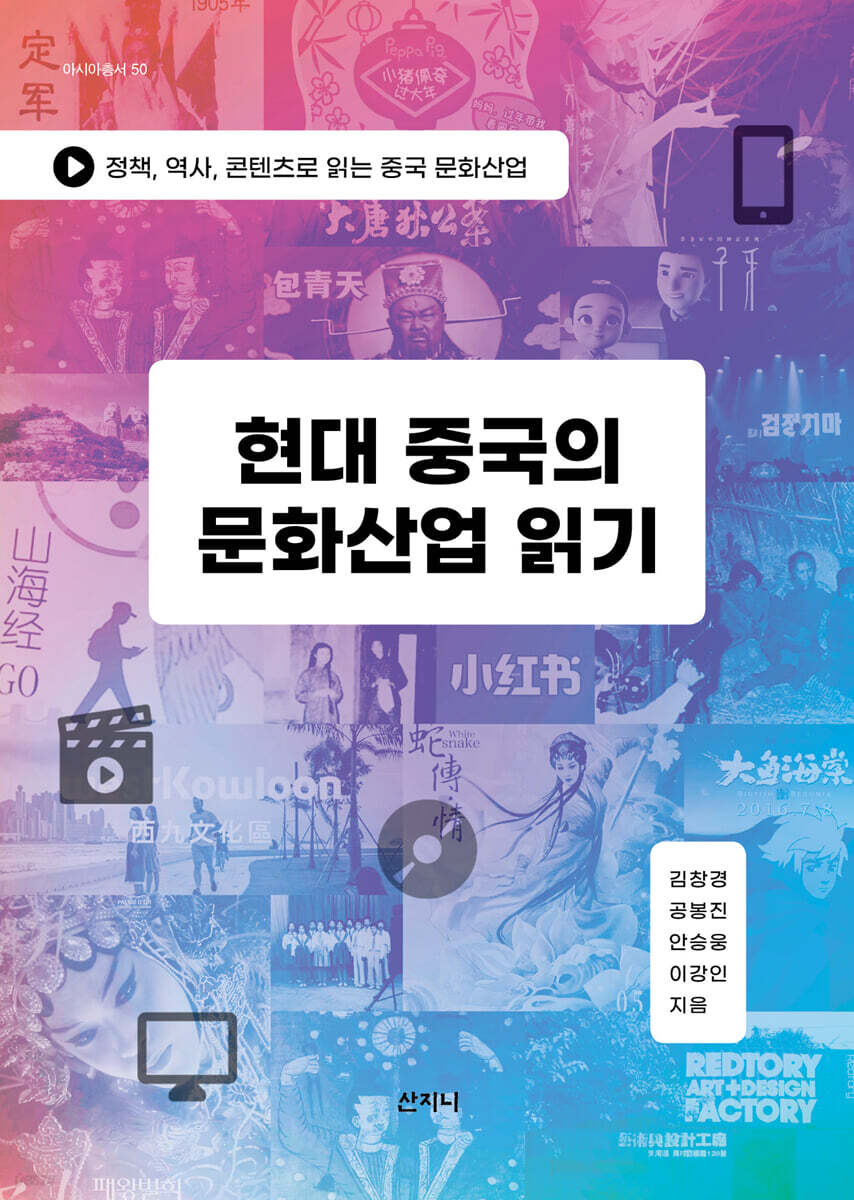 |
Description
Book Introduction
Reading China, the Rising Cultural Powerhouse
The Chinese game "Black Myth: Wukong", released in 2024, has gained worldwide popularity and acclaim, and was selected as the Best Action Game and "Steam Game of the Year" at "The Game Awards," a representative awards ceremony for the American game industry.
China is growing into a center of the global cultural market, demonstrating remarkable achievements not only in games but also in all areas of cultural content, including dramas, movies, animation, and performances.
The Xi Jinping government is pursuing a national strategy to convey the "Chinese story" to the world, with confidence in traditional culture.
"Reading the Cultural Industry in Modern China" focuses on the growth of China's cultural industry and interprets the Chinese government's strategies and structures.
This book goes beyond a basic understanding of China's cultural industry and presents China's ongoing aspirations to become a cultural powerhouse.
Part 1 of the book covers the current state of China's cultural industry and cultural policies during the Xi Jinping era.
Parts 2 and 3 introduce the history, development, and related industrial policies of specific industries such as dramas, movies, animation, games, and performances.
Part 4 explains Chinese cultural archetypes and examines works that transform them into popular cultural content.
Furthermore, it explains the modern reinterpretation and value of these cultural archetypes.
Finally, Part 5 discusses how urban regeneration, which is taking place worldwide, is being realized in China.
The Chinese game "Black Myth: Wukong", released in 2024, has gained worldwide popularity and acclaim, and was selected as the Best Action Game and "Steam Game of the Year" at "The Game Awards," a representative awards ceremony for the American game industry.
China is growing into a center of the global cultural market, demonstrating remarkable achievements not only in games but also in all areas of cultural content, including dramas, movies, animation, and performances.
The Xi Jinping government is pursuing a national strategy to convey the "Chinese story" to the world, with confidence in traditional culture.
"Reading the Cultural Industry in Modern China" focuses on the growth of China's cultural industry and interprets the Chinese government's strategies and structures.
This book goes beyond a basic understanding of China's cultural industry and presents China's ongoing aspirations to become a cultural powerhouse.
Part 1 of the book covers the current state of China's cultural industry and cultural policies during the Xi Jinping era.
Parts 2 and 3 introduce the history, development, and related industrial policies of specific industries such as dramas, movies, animation, games, and performances.
Part 4 explains Chinese cultural archetypes and examines works that transform them into popular cultural content.
Furthermore, it explains the modern reinterpretation and value of these cultural archetypes.
Finally, Part 5 discusses how urban regeneration, which is taking place worldwide, is being realized in China.
- You can preview some of the book's contents.
Preview
index
Part 1: Current Status of China's Cultural Industry and Cultural Policy
1.
cultural industry, storytelling, cultural archetypes
1) Definition and characteristics of cultural industry
2) Concept and types of storytelling
3) Development of cultural archetypes and cultural content
2.
The evolution and classification of China's cultural industry
1) Changes in China's cultural industry
2) Principles and Classification of Chinese Cultural Industries
3) Generation enjoying Chinese cultural industry
3.
Cultural policy during the Xi Jinping era
1) Literary and artistic enrichment
2) Cultural rectification movement
3) Xi Jinping Cultural Thought
Part 2: China's Film Industry
1.
Chinese drama
1) History and development of Chinese drama
2) Changes in Chinese drama production methods and environment
3) Korean dramas entering the Chinese market and Korean-Chinese co-production dramas
4) Policies related to the Chinese drama industry
2.
Chinese movies
1) History and development of Chinese cinema
2) Major film directors, film studios, and film festivals
3) Korean-Chinese co-production films
4) Policies related to the Chinese film industry
3.
Chinese animation
1) History and development of Chinese animation
2) Korean animation's advancement into China and Korean-Chinese joint animation production
3) Policies related to the Chinese animation industry
Part 3: China's Performance, Gaming, and Internet Industries
1.
Chinese performances
1) History of the Chinese performing arts industry
2) Major regional performance culture
3) Korean-Chinese joint performance
4) Policies related to the Chinese performing arts industry
2.
Chinese game industry
1) History and current status of the Chinese game industry
2) Chinese e-sports
3) Policies related to the Chinese game industry
3.
China's Internet Industry
1) Chinese short clips and live broadcasts
2) Chinese Internet companies and the cultural entertainment industry
3) Policies related to China's Internet broadcasting industry
Part 4: Chinese Cultural Archetypes and Cultural Content
1.
Socio-cultural background of Chinese cultural archetypes
1) A long and uninterrupted history
2) Chinese character culture
3) Traditional Confucianism, Buddhism, and Taoism
2.
Myths and legends
1) Shan Hai Jing
2) Three Sovereigns and Five Emperors
3) Yangsan Encyclopedia and Chukyungdae
4) Baek Sa-jeon, Urang Jiknyeo, Maeng Gang-nyeo
3.
historical figures
1) Qin Shi Huang
2) Poppy
3) Bao Qingtian
4) Wong Fei-hung
4.
literature
1) Romance of the Three Kingdoms
2) Journey to the West
3) Water Margin
4) Modern martial arts novels
5.
The modern meaning of Chinese cultural archetypes
1) Modern reinterpretation of traditional myths and legends
2) The role of historical figures as cultural archetypes and their modern significance
3) Cultural value of literary works as a source of creation
Part 5: New Spaces for Cultural Life
1.
Combining urban regeneration and tourism
1) Current status of urban regeneration around the world
2) History of urban regeneration in China
3) Regeneration and tourism of Chinese industrial parks
2.
China's Cultural and Creative Industrial Parks and Key Case Studies
1) Cultural and Creative Industrial Complex
2) Urban regeneration of industrial complexes in Beijing, Shanghai, etc.
3) Regeneration of cultural spaces in Hutong and Shijurong
3.
High-quality tourism industry of cultural heritage
1) Development of Chinese cultural heritage as a tourism resource
2) Major cases in ancient China
4.
Modern meaning as cultural content
Appendix: Key Five-Year Plans for the Cultural Industry
References
Search
1.
cultural industry, storytelling, cultural archetypes
1) Definition and characteristics of cultural industry
2) Concept and types of storytelling
3) Development of cultural archetypes and cultural content
2.
The evolution and classification of China's cultural industry
1) Changes in China's cultural industry
2) Principles and Classification of Chinese Cultural Industries
3) Generation enjoying Chinese cultural industry
3.
Cultural policy during the Xi Jinping era
1) Literary and artistic enrichment
2) Cultural rectification movement
3) Xi Jinping Cultural Thought
Part 2: China's Film Industry
1.
Chinese drama
1) History and development of Chinese drama
2) Changes in Chinese drama production methods and environment
3) Korean dramas entering the Chinese market and Korean-Chinese co-production dramas
4) Policies related to the Chinese drama industry
2.
Chinese movies
1) History and development of Chinese cinema
2) Major film directors, film studios, and film festivals
3) Korean-Chinese co-production films
4) Policies related to the Chinese film industry
3.
Chinese animation
1) History and development of Chinese animation
2) Korean animation's advancement into China and Korean-Chinese joint animation production
3) Policies related to the Chinese animation industry
Part 3: China's Performance, Gaming, and Internet Industries
1.
Chinese performances
1) History of the Chinese performing arts industry
2) Major regional performance culture
3) Korean-Chinese joint performance
4) Policies related to the Chinese performing arts industry
2.
Chinese game industry
1) History and current status of the Chinese game industry
2) Chinese e-sports
3) Policies related to the Chinese game industry
3.
China's Internet Industry
1) Chinese short clips and live broadcasts
2) Chinese Internet companies and the cultural entertainment industry
3) Policies related to China's Internet broadcasting industry
Part 4: Chinese Cultural Archetypes and Cultural Content
1.
Socio-cultural background of Chinese cultural archetypes
1) A long and uninterrupted history
2) Chinese character culture
3) Traditional Confucianism, Buddhism, and Taoism
2.
Myths and legends
1) Shan Hai Jing
2) Three Sovereigns and Five Emperors
3) Yangsan Encyclopedia and Chukyungdae
4) Baek Sa-jeon, Urang Jiknyeo, Maeng Gang-nyeo
3.
historical figures
1) Qin Shi Huang
2) Poppy
3) Bao Qingtian
4) Wong Fei-hung
4.
literature
1) Romance of the Three Kingdoms
2) Journey to the West
3) Water Margin
4) Modern martial arts novels
5.
The modern meaning of Chinese cultural archetypes
1) Modern reinterpretation of traditional myths and legends
2) The role of historical figures as cultural archetypes and their modern significance
3) Cultural value of literary works as a source of creation
Part 5: New Spaces for Cultural Life
1.
Combining urban regeneration and tourism
1) Current status of urban regeneration around the world
2) History of urban regeneration in China
3) Regeneration and tourism of Chinese industrial parks
2.
China's Cultural and Creative Industrial Parks and Key Case Studies
1) Cultural and Creative Industrial Complex
2) Urban regeneration of industrial complexes in Beijing, Shanghai, etc.
3) Regeneration of cultural spaces in Hutong and Shijurong
3.
High-quality tourism industry of cultural heritage
1) Development of Chinese cultural heritage as a tourism resource
2) Major cases in ancient China
4.
Modern meaning as cultural content
Appendix: Key Five-Year Plans for the Cultural Industry
References
Search
Detailed image
Into the book
The Chinese government's cultural industry policies, laws, and regulations have had a profound impact on the development of China's cultural industry.
The main purpose of the Cultural Industry Development Policy enacted in 2000 is to demonstrate the advancedness, uniqueness, cohesion, and influence of Chinese culture.
The main goal is to accelerate the development of the cultural industry and create a new phase in cultural construction.
--- p.39
"My Love from the Star" was finally broadcast in China after two years of retrial.
In China, regulations regarding broadcast content are quite strict.
“My Love from the Star” was not aired on Chinese public TV, which is related to the “Great Wall of Censorship,” which states that “content that ‘promotes superstitions’ such as aliens or ghosts cannot be broadcast.”
Chinese media reported at the time that “the plot of ‘My Love from the Star’ was changed so that Do Min-joon (Kim Soo-hyun) becomes a novelist rather than an alien in the final part.”
--- p.75
Intellectuals who were exposed to new cultures under the influence of the May 4th New Culture Movement began to participate in the movement to reform Chinese theater.
A representative figure is Li Jinhui (黎錦暉, 1891-1967).
Li Jinhui pioneered the development of musicals in China by pioneering a unique method of using music to spread the standard Chinese language in Shanghai and other places.
--- p.128
The aging buildings reflect the trajectory of China's modern industrial development.
Therefore, these metropolitan city governments have come to recognize that it is very important to preserve the historical buildings remaining in the downtown area and maintain the original urban atmosphere.
The movement to protect industrial heritage within China's major cities coincided with the development of creative industry parks in urban areas, and has gone beyond simple preservation to usher in a new era of cultural rebirth.
The main purpose of the Cultural Industry Development Policy enacted in 2000 is to demonstrate the advancedness, uniqueness, cohesion, and influence of Chinese culture.
The main goal is to accelerate the development of the cultural industry and create a new phase in cultural construction.
--- p.39
"My Love from the Star" was finally broadcast in China after two years of retrial.
In China, regulations regarding broadcast content are quite strict.
“My Love from the Star” was not aired on Chinese public TV, which is related to the “Great Wall of Censorship,” which states that “content that ‘promotes superstitions’ such as aliens or ghosts cannot be broadcast.”
Chinese media reported at the time that “the plot of ‘My Love from the Star’ was changed so that Do Min-joon (Kim Soo-hyun) becomes a novelist rather than an alien in the final part.”
--- p.75
Intellectuals who were exposed to new cultures under the influence of the May 4th New Culture Movement began to participate in the movement to reform Chinese theater.
A representative figure is Li Jinhui (黎錦暉, 1891-1967).
Li Jinhui pioneered the development of musicals in China by pioneering a unique method of using music to spread the standard Chinese language in Shanghai and other places.
--- p.128
The aging buildings reflect the trajectory of China's modern industrial development.
Therefore, these metropolitan city governments have come to recognize that it is very important to preserve the historical buildings remaining in the downtown area and maintain the original urban atmosphere.
The movement to protect industrial heritage within China's major cities coincided with the development of creative industry parks in urban areas, and has gone beyond simple preservation to usher in a new era of cultural rebirth.
--- p.258
Publisher's Review
From literary arts to global soft power,
Xi Jinping's Cultural Policy and China's Rise
In 2014, Xi Jinping announced the "Strengthening of Literature and the Arts" and emphasized the important role of literature and the arts in the great rejuvenation of the Chinese nation.
Xi Jinping instructed the literary and artistic community to faithfully fulfill its role in promoting socialist values.
This is similar to Mao Zedong's method of controlling ideology by utilizing the literary world, but Xi Jinping is different in that he seeks to expand this to the spread of global soft power rather than internal control.
Xi Jinping has set "cultural confidence" as one of the four self-confidences and is using the concepts of "main melody" and "zhengrenliang" to spread Chinese values around the world.
Accordingly, a strong cultural rectification campaign was implemented in the entertainment industry starting in 2021, and with the official release of "Xi Jinping Thought on Culture" in 2023, China redefined cultural undertakings and the cultural industry as national strategic projects.
This is even affecting the development of AI software.
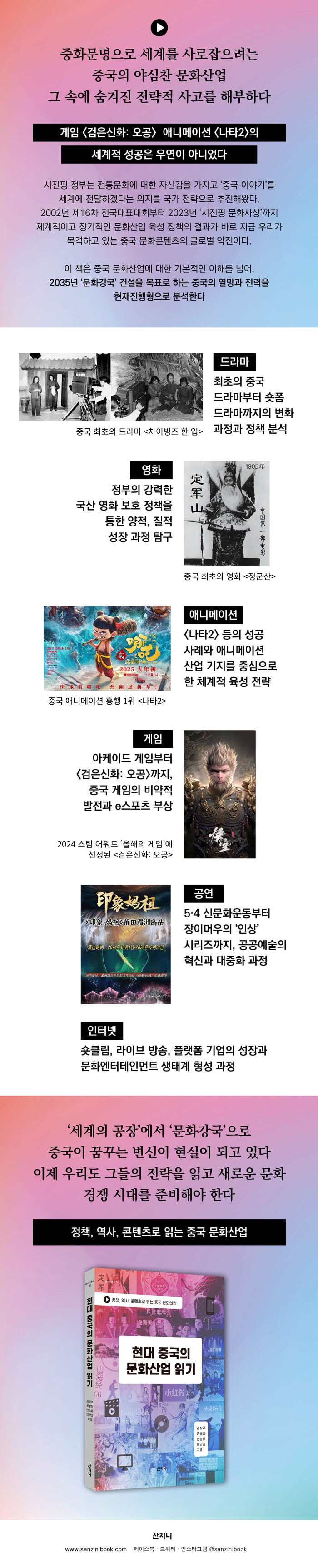
The global success of games like "Black Myth: Wukong" and the animated film "Natha 2" are representative examples of Xi Jinping's cultural policies being realized in industrial achievements, and can be seen as the fruits of China's ambitious strategy to strengthen its national brand and expand its global influence through culture.
This book aims to understand China's rise through culture by systematically analyzing the full scope of China's cultural policy under Xi Jinping.
The strategy and development process of China's cultural policy
Parts 2 and 3 examine the development process and policies of each cultural industry.
Contemporary Chinese cultural industries have developed at an astonishing pace, intertwined with political, economic, and cultural changes in Chinese society.
Part 2 broadly examines the historical flow and changing aspects, production environment, and policy context of China's film industry (drama, film, animation) from the founding of the People's Republic of China in 1949 to the 2020s.
The Chinese government supports high-quality video content with ideological themes such as promoting patriotism, glorifying the Communist Party, moral examples, revolutionary epics, and historical dramas.
The film industry policy provides the most sophisticated illustration of how China's content industry operates as a "national project."
In the field of drama, we examine the evolution from the first Chinese drama, "A Bite of Chai Bing Zi," to short-form dramas.
In the Chinese film section, we examine the quantitative and qualitative growth achieved through the government's policy of protecting domestic films.
In the field of animation, we analyze a training strategy that encompasses talent development, technical support, and creative support centered on the animation industry base.
Part 3 focuses on three axes: performance, games, and the internet industry.
In the performing arts industry, it examines the history of Chinese performing arts from the May Fourth New Culture Movement to the present, vividly recording the process of innovation and popularization of Chinese performing arts culture, from Li Jinhui's children's musicals to Zhang Yimou's "Impression" series.
In the gaming industry, the rapid development of Chinese games, from arcade games to "Genshin Impact" and "Black Myth: Wukong," along with the rise of the e-sports industry and the impact of government policies such as the game shutdown system, were closely analyzed.
The Internet industry section examines in detail the growth of short clips, live broadcasts, platform companies like Tencent and Alibaba, and the formation of a cultural entertainment ecosystem.
"Reading Modern China's Cultural Industry" presents a wealth of relevant policies, laws, and market data for each industry, helping you accurately grasp the current trends in China's cultural industry.
This will serve as an important reference for understanding China's cultural policy and soft power strategy in the Xi Jinping era and for forecasting the future of cultural exchange between Korea and China.
Xi Jinping's Cultural Policy and China's Rise
In 2014, Xi Jinping announced the "Strengthening of Literature and the Arts" and emphasized the important role of literature and the arts in the great rejuvenation of the Chinese nation.
Xi Jinping instructed the literary and artistic community to faithfully fulfill its role in promoting socialist values.
This is similar to Mao Zedong's method of controlling ideology by utilizing the literary world, but Xi Jinping is different in that he seeks to expand this to the spread of global soft power rather than internal control.
Xi Jinping has set "cultural confidence" as one of the four self-confidences and is using the concepts of "main melody" and "zhengrenliang" to spread Chinese values around the world.
Accordingly, a strong cultural rectification campaign was implemented in the entertainment industry starting in 2021, and with the official release of "Xi Jinping Thought on Culture" in 2023, China redefined cultural undertakings and the cultural industry as national strategic projects.
This is even affecting the development of AI software.
The global success of games like "Black Myth: Wukong" and the animated film "Natha 2" are representative examples of Xi Jinping's cultural policies being realized in industrial achievements, and can be seen as the fruits of China's ambitious strategy to strengthen its national brand and expand its global influence through culture.
This book aims to understand China's rise through culture by systematically analyzing the full scope of China's cultural policy under Xi Jinping.
The strategy and development process of China's cultural policy
Parts 2 and 3 examine the development process and policies of each cultural industry.
Contemporary Chinese cultural industries have developed at an astonishing pace, intertwined with political, economic, and cultural changes in Chinese society.
Part 2 broadly examines the historical flow and changing aspects, production environment, and policy context of China's film industry (drama, film, animation) from the founding of the People's Republic of China in 1949 to the 2020s.
The Chinese government supports high-quality video content with ideological themes such as promoting patriotism, glorifying the Communist Party, moral examples, revolutionary epics, and historical dramas.
The film industry policy provides the most sophisticated illustration of how China's content industry operates as a "national project."
In the field of drama, we examine the evolution from the first Chinese drama, "A Bite of Chai Bing Zi," to short-form dramas.
In the Chinese film section, we examine the quantitative and qualitative growth achieved through the government's policy of protecting domestic films.
In the field of animation, we analyze a training strategy that encompasses talent development, technical support, and creative support centered on the animation industry base.
Part 3 focuses on three axes: performance, games, and the internet industry.
In the performing arts industry, it examines the history of Chinese performing arts from the May Fourth New Culture Movement to the present, vividly recording the process of innovation and popularization of Chinese performing arts culture, from Li Jinhui's children's musicals to Zhang Yimou's "Impression" series.
In the gaming industry, the rapid development of Chinese games, from arcade games to "Genshin Impact" and "Black Myth: Wukong," along with the rise of the e-sports industry and the impact of government policies such as the game shutdown system, were closely analyzed.
The Internet industry section examines in detail the growth of short clips, live broadcasts, platform companies like Tencent and Alibaba, and the formation of a cultural entertainment ecosystem.
"Reading Modern China's Cultural Industry" presents a wealth of relevant policies, laws, and market data for each industry, helping you accurately grasp the current trends in China's cultural industry.
This will serve as an important reference for understanding China's cultural policy and soft power strategy in the Xi Jinping era and for forecasting the future of cultural exchange between Korea and China.
GOODS SPECIFICS
- Date of issue: August 8, 2025
- Page count, weight, size: 304 pages | 173*243*15mm
- ISBN13: 9791168614918
You may also like
카테고리
korean


korean

![GQ KOREA Mark (Monthly): December [2025]](http://librairie.coreenne.fr/cdn/shop/files/8ef265dbbfbf186523ed75ba7319009d.jpg?v=1765340328&width=3840)


