

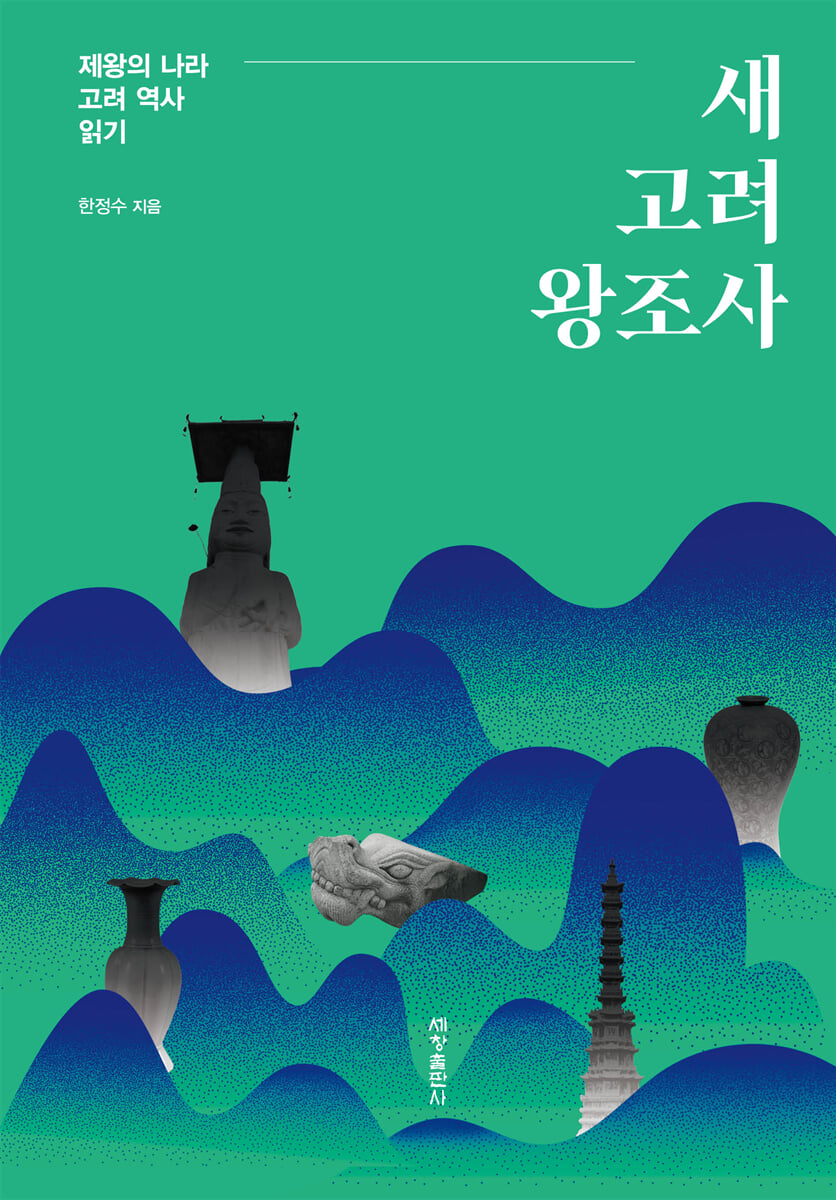
New Goryeo Dynasty
 |
Description
Book Introduction
This book, which organizes the history of the Goryeo Dynasty from its founding to its dynasty's fall and the establishment of Goryeo history in Joseon, attempts to reconstruct the history of the Goryeo Dynasty within the framework of each monarch's ascension to the throne, the composition of the royal family, meritorious retainers, politics and achievements, death, and the challenges of the times.
Goryeo sought to sanctify the royal family and revive and extend the royal legacy by relying on the Mandate of Heaven, the Buddha, the divine spirits of heaven, earth, mountains and rivers, geomancy, and Taoism.
And he sanctified the royal family as the imperial family of the Yongson bloodline and held the Palgwanhoe to declare to the world and the nation that the royal family was protected by the spirits of heaven and the gods of the four heavens.
Yet, he continued to pursue Confucian politics.
The perception that the country was ruled by a divine, saintly monarch was gradually strengthened on this basis.
As a result, Goryeo, starting with Taejo, who established the nation and unified the Three Kingdoms, came to have a perception of the East Asian world centered on Goryeo and a sense of civilization during the reign of King Munjong.
Although Goryeo declined thereafter, the unification of the Three Kingdoms and the unification of the East and the West served as the foundation for Goryeo's civilization and self-esteem.
That is why the Goryeo Dynasty was able to maintain its power for 475 years even after going through military coups, the Goryeo-Mongol War, and the Yuan-Yuan intervention period as a vassal state.
On the other hand, attempts at excessive reform and return to the former king's political model were also poisonous.
Just as Gung Ye was driven out as a tyrant and Taejo ascended to the throne, King Gongyang was also driven out on the grounds that he was a corrupt monarch.
Yi Seong-gye and others forcibly established their legitimacy by eradicating the bloodline of the Goryeo royal family, which had already reached the end of its lifespan.
The Goryeo Dynasty, the kingdom of the emperors, ended with this.
Goryeo sought to sanctify the royal family and revive and extend the royal legacy by relying on the Mandate of Heaven, the Buddha, the divine spirits of heaven, earth, mountains and rivers, geomancy, and Taoism.
And he sanctified the royal family as the imperial family of the Yongson bloodline and held the Palgwanhoe to declare to the world and the nation that the royal family was protected by the spirits of heaven and the gods of the four heavens.
Yet, he continued to pursue Confucian politics.
The perception that the country was ruled by a divine, saintly monarch was gradually strengthened on this basis.
As a result, Goryeo, starting with Taejo, who established the nation and unified the Three Kingdoms, came to have a perception of the East Asian world centered on Goryeo and a sense of civilization during the reign of King Munjong.
Although Goryeo declined thereafter, the unification of the Three Kingdoms and the unification of the East and the West served as the foundation for Goryeo's civilization and self-esteem.
That is why the Goryeo Dynasty was able to maintain its power for 475 years even after going through military coups, the Goryeo-Mongol War, and the Yuan-Yuan intervention period as a vassal state.
On the other hand, attempts at excessive reform and return to the former king's political model were also poisonous.
Just as Gung Ye was driven out as a tyrant and Taejo ascended to the throne, King Gongyang was also driven out on the grounds that he was a corrupt monarch.
Yi Seong-gye and others forcibly established their legitimacy by eradicating the bloodline of the Goryeo royal family, which had already reached the end of its lifespan.
The Goryeo Dynasty, the kingdom of the emperors, ended with this.
- You can preview some of the book's contents.
Preview
index
preface
Chapter 1: The Heaven-Granted Revolution: Wang Geon and Goryeo
1.
Dawn of a New Era Amidst Division
1) Establishment and relationship with the Later Three Kingdoms
2) Establishment of a new Later Three Kingdoms and the challenges of the times
3) Creating the sacred Wang Geon family
4) Feng Shui Cham, Wang Geon, and Buddhism
2.
The Three Kingdoms War and the Ten Commandments
1) The war to unify the Three Kingdoms and the Cheonmyeong Susu
2) Efforts to integrate society and reorganize order after the war
3) Implementation of dynasty stability policy
4) The meaning of the unification of the three kingdoms and the "Hunyo Ten Articles" as a task of the times
Chapter 2: Laying the Foundation for a Five-Hundred-Year Dynasty
1.
Hyejong, Jeongjong, and the Prince's Rebellion
1) King Hyejong's accession to the throne and the appointment of high-ranking officials
2) Shaking royal authority and royal rules
3) Jeongjong and Wang Sik-ryeom
4) Challenges of the times
2.
Gwangjong's unfulfilled dream and great achievement
1) Gwangjong's accession to the throne and his dream
2) The front side of strengthening royal authority: 1st period
3) Reform and Questioning: 2nd Period
4) The Back Side of Reform and the Challenges of the Times: 3rd Period
3.
King Gyeongjong's internal meditation and King Seongjong's ultimate governance
1) King Gyeongjong's accession to the throne and the establishment of King Gaeryeonggun
2) King Seongjong's ascension to the throne and Choi Seung-ro
3) The politics of the Restoration Monarch and the war with the Khitans
4) King Seongjong's death and the challenges of the times
4.
Mokjong and the Shaking Royal Family
1) Mokjong's lineage and accession to the throne
2) Mokjong's politics and the Khitan problem
3) Empress Dowager Cheonchu and Prince Daeryangwon
4) The death of Mokjong and the challenges of the times
Chapter 3: Overcoming the Crisis and Unleashing the East Sea
1.
The ascension of King Hyeonjong, the son of the suffering dragon, and the new Goryeo royal family
1) King Hyeonjong's dragon and royal family
2) Establishing a new sacred royal palace
3) A series of crises and an era of peace
4) King Hyeonjong's death and the challenges of the times
2.
The Haedongcheonha and King Munjong's politics created by the succession of brothers
1) Deokjong's accession to the throne and the regrettable response to heaven
2) King Jeongjong's accession to the throne and the politics of 'seon-gye-seon-sul (善繼善述)'
3) The ascension of King Munjong and his political direction
4) A small China achieved through the longevity of the Holy Spirit
5) King Munjong's death and the challenges of the times
3.
The succession to the throne and politics of King Sunjong, Seonjong, Heonjong, and Sukjong
1) 36 years of successor training vs. 4 months of reign, Sunjong
2) The royal crisis and the continuation of the heavenly kingdom, Seon Buddhism
3) A strong royal family and a weak monarch, Heonjong
4) King Sukjong's accession to the throne and his ten years of rule
5) The challenges of the times left behind by 23 years
Chapter 4: Goryeo's Choices in the Great Transition of the 12th Century
1.
King Yejong's civilization achieved through virtue and admiration for China
1) King Yeongjong's accession to the throne and the royal family
2) King Yeongjong's politics and the conquest of the Jurchen
3) King Yeongjong's death and the challenges of the times
2.
The Great Transformation of the International Order and Race
1) The accession of the king and the royal family
2) Relations with the Jin Dynasty and diplomacy with the Southern Song Dynasty
3) Lee Ja-gyeom, the Joseon Dynasty's national military commander who shook the royal family
4) The reform politics of the race and Myocheong's move of the capital to the West and the founding of the dynasty
5) The Death of Race and the Challenges of the Times
Chapter 5: Emperors and Military Regimes
1.
The peaceful and prosperous era of King Uijong and his forces
1) King Uijong's accession to the throne and the royal family
2) King Uijong, the Suspicious King
3) Excessive doing Buddha and God
4) Sexual intercourse and concubine
5) King Uijong's politics and death, and the challenges of the times
2.
King Myeongjong's royal authority and the beginning of the military era
1) King Myeongjong's accession to the throne and the royal family
2) Yu Eung-gyu and the investiture of King Myeongjong
3) The birth of a monster called the military regime
4) King Myeongjong's politics and the challenges of the times
3.
The Goryeo royal family and the Choi military regime: Sinjong, Heejong, Gangjong, and Gojong
1) The accession of the four monarchs and the formation of the royal family
2) Choi's military regime
3) The Yeomong War and the Jiangdu Era
4) Four monarchs and the challenges of the times
4.
The End of the Military Regime and the Restoration of Royal Authority: Wonjong
1) Wonjong's accession to the throne and the royal family
2) Military regime and return to the capital
3) The resistance of Sambyeolcho and its significance
4) The death of the original king and the challenges of the times
Chapter 6: Goryeo, Yuan, and the King of Goryeo
1.
Establishing relations with the Yuan Dynasty and the politics of King Chungnyeol
1) King Chungnyeol's accession to the throne and the royal family
2) Establishing a relationship with the circle: Use the emperor
3) Changes in customs and systems
4) The death of King Chungnyeol and the challenges of the times left behind by the administration of state affairs
2.
King Chungseon, the two-faced reform monarch
1) King Chungseon's two coronations and the royal family
2) Reform or Power-Making? A Distorted Reform
3) King Chungseon's death and tasks
3.
King Chungsuk, the father-son relationship and the bathing monarch
1) King Chungsuk's accession to the throne and the royal family
2) The gloomy politics of King Chungsuk
3) Movement to support King Sim
4) The theory of the infiltration scheme and the movement to stop it
5) King Chungsuk's death and tasks
4.
Ayamagojina (阿也麻古之那) Akyangmangojinan (岳陽亡故之難) King Chunghye
1) King Chunghye's accession to the throne and the royal family
2) King Chunghye's corrupt administration and greed
3) King Chunghye's death and the challenges of the times
5.
The Young Monarch and the Crisis of the Royal Family: King Chungmok and King Chungjeong
1) King Chungmok's lineage and accession to the throne
2) 4 years of reign and death at the age of 12
3) King Chungjeong's accession to the throne, three-year reign, and expulsion to Ganghwa
4) King Chungjeong's death and Prince Gangneung's homework
Chapter 7: The Fall of the Dynasty and the Revolution
1.
The Light and Shadow of King Gongmin's Great Reform Politics during the Period of Change of the Yuan Dynasty
1) King Gongmin's accession to the throne and the royal family
2) The world of corrupt practices and eunuchs remains intact.
3) Reform initiatives and turning points
4) 1st Reform and its Limitations
5) Second-term reform and its limitations
6) Third-term reform and its limitations
7) Uncomfortable relationship with the Ming
8) King Gongmin's death and tasks
2.
King Woo, King Chang's mismanagement and the beginning of revolution
1) King U's accession to the throne and the royal family
2) Empress Myeongdeok, Gyeongbokhung, and Yi In-im
3) The murder of the famous envoy Chae Bin and its aftermath
4) Establishment of the Iron Ridge and conquest of Liaodong
5) The Wihwado Retreat and King Chang's ascension to the throne
6) The deaths of King U and King Chang and the challenges of the times
3.
King Gongyang's accession to the throne and the revolution
1) King Gongyang and the royal family who ascended the throne as Tamju
2) The emergence of a new power and conflict between ruling powers
3) The alliance between King Gongyang and Jeong Mong-ju
4) The removal of Jeong Mong-ju and the further solidification of Yi Seong-gye's forces
5) King Gongyang's last move, the alliance between the ruler and his subjects
6) King Gongyang in the Age of Innovation
7) Lee Seong-gye's theory of resignation and building a justification
8) King Gongyang's anachronism and justification for his dethronement
9) The logic of the dethronement of King Gongyang and the revolution of the heavens and the people
10) Assistance to the forces of Lee Seong-gye in Ming and ‘self-reliance’ and ‘freedom of sexual intercourse’
11) The death of King Gongyang and the eradication of the Goryeo royal family's power.
12) Rationalization of the founding of the nation and preservation of the descendants of the Goryeo Wang clan
Appendix 1: List of Goryeo Emperors
Appendix 2: World Map of the Goryeo Dynasty
Photo list
References
Search
Chapter 1: The Heaven-Granted Revolution: Wang Geon and Goryeo
1.
Dawn of a New Era Amidst Division
1) Establishment and relationship with the Later Three Kingdoms
2) Establishment of a new Later Three Kingdoms and the challenges of the times
3) Creating the sacred Wang Geon family
4) Feng Shui Cham, Wang Geon, and Buddhism
2.
The Three Kingdoms War and the Ten Commandments
1) The war to unify the Three Kingdoms and the Cheonmyeong Susu
2) Efforts to integrate society and reorganize order after the war
3) Implementation of dynasty stability policy
4) The meaning of the unification of the three kingdoms and the "Hunyo Ten Articles" as a task of the times
Chapter 2: Laying the Foundation for a Five-Hundred-Year Dynasty
1.
Hyejong, Jeongjong, and the Prince's Rebellion
1) King Hyejong's accession to the throne and the appointment of high-ranking officials
2) Shaking royal authority and royal rules
3) Jeongjong and Wang Sik-ryeom
4) Challenges of the times
2.
Gwangjong's unfulfilled dream and great achievement
1) Gwangjong's accession to the throne and his dream
2) The front side of strengthening royal authority: 1st period
3) Reform and Questioning: 2nd Period
4) The Back Side of Reform and the Challenges of the Times: 3rd Period
3.
King Gyeongjong's internal meditation and King Seongjong's ultimate governance
1) King Gyeongjong's accession to the throne and the establishment of King Gaeryeonggun
2) King Seongjong's ascension to the throne and Choi Seung-ro
3) The politics of the Restoration Monarch and the war with the Khitans
4) King Seongjong's death and the challenges of the times
4.
Mokjong and the Shaking Royal Family
1) Mokjong's lineage and accession to the throne
2) Mokjong's politics and the Khitan problem
3) Empress Dowager Cheonchu and Prince Daeryangwon
4) The death of Mokjong and the challenges of the times
Chapter 3: Overcoming the Crisis and Unleashing the East Sea
1.
The ascension of King Hyeonjong, the son of the suffering dragon, and the new Goryeo royal family
1) King Hyeonjong's dragon and royal family
2) Establishing a new sacred royal palace
3) A series of crises and an era of peace
4) King Hyeonjong's death and the challenges of the times
2.
The Haedongcheonha and King Munjong's politics created by the succession of brothers
1) Deokjong's accession to the throne and the regrettable response to heaven
2) King Jeongjong's accession to the throne and the politics of 'seon-gye-seon-sul (善繼善述)'
3) The ascension of King Munjong and his political direction
4) A small China achieved through the longevity of the Holy Spirit
5) King Munjong's death and the challenges of the times
3.
The succession to the throne and politics of King Sunjong, Seonjong, Heonjong, and Sukjong
1) 36 years of successor training vs. 4 months of reign, Sunjong
2) The royal crisis and the continuation of the heavenly kingdom, Seon Buddhism
3) A strong royal family and a weak monarch, Heonjong
4) King Sukjong's accession to the throne and his ten years of rule
5) The challenges of the times left behind by 23 years
Chapter 4: Goryeo's Choices in the Great Transition of the 12th Century
1.
King Yejong's civilization achieved through virtue and admiration for China
1) King Yeongjong's accession to the throne and the royal family
2) King Yeongjong's politics and the conquest of the Jurchen
3) King Yeongjong's death and the challenges of the times
2.
The Great Transformation of the International Order and Race
1) The accession of the king and the royal family
2) Relations with the Jin Dynasty and diplomacy with the Southern Song Dynasty
3) Lee Ja-gyeom, the Joseon Dynasty's national military commander who shook the royal family
4) The reform politics of the race and Myocheong's move of the capital to the West and the founding of the dynasty
5) The Death of Race and the Challenges of the Times
Chapter 5: Emperors and Military Regimes
1.
The peaceful and prosperous era of King Uijong and his forces
1) King Uijong's accession to the throne and the royal family
2) King Uijong, the Suspicious King
3) Excessive doing Buddha and God
4) Sexual intercourse and concubine
5) King Uijong's politics and death, and the challenges of the times
2.
King Myeongjong's royal authority and the beginning of the military era
1) King Myeongjong's accession to the throne and the royal family
2) Yu Eung-gyu and the investiture of King Myeongjong
3) The birth of a monster called the military regime
4) King Myeongjong's politics and the challenges of the times
3.
The Goryeo royal family and the Choi military regime: Sinjong, Heejong, Gangjong, and Gojong
1) The accession of the four monarchs and the formation of the royal family
2) Choi's military regime
3) The Yeomong War and the Jiangdu Era
4) Four monarchs and the challenges of the times
4.
The End of the Military Regime and the Restoration of Royal Authority: Wonjong
1) Wonjong's accession to the throne and the royal family
2) Military regime and return to the capital
3) The resistance of Sambyeolcho and its significance
4) The death of the original king and the challenges of the times
Chapter 6: Goryeo, Yuan, and the King of Goryeo
1.
Establishing relations with the Yuan Dynasty and the politics of King Chungnyeol
1) King Chungnyeol's accession to the throne and the royal family
2) Establishing a relationship with the circle: Use the emperor
3) Changes in customs and systems
4) The death of King Chungnyeol and the challenges of the times left behind by the administration of state affairs
2.
King Chungseon, the two-faced reform monarch
1) King Chungseon's two coronations and the royal family
2) Reform or Power-Making? A Distorted Reform
3) King Chungseon's death and tasks
3.
King Chungsuk, the father-son relationship and the bathing monarch
1) King Chungsuk's accession to the throne and the royal family
2) The gloomy politics of King Chungsuk
3) Movement to support King Sim
4) The theory of the infiltration scheme and the movement to stop it
5) King Chungsuk's death and tasks
4.
Ayamagojina (阿也麻古之那) Akyangmangojinan (岳陽亡故之難) King Chunghye
1) King Chunghye's accession to the throne and the royal family
2) King Chunghye's corrupt administration and greed
3) King Chunghye's death and the challenges of the times
5.
The Young Monarch and the Crisis of the Royal Family: King Chungmok and King Chungjeong
1) King Chungmok's lineage and accession to the throne
2) 4 years of reign and death at the age of 12
3) King Chungjeong's accession to the throne, three-year reign, and expulsion to Ganghwa
4) King Chungjeong's death and Prince Gangneung's homework
Chapter 7: The Fall of the Dynasty and the Revolution
1.
The Light and Shadow of King Gongmin's Great Reform Politics during the Period of Change of the Yuan Dynasty
1) King Gongmin's accession to the throne and the royal family
2) The world of corrupt practices and eunuchs remains intact.
3) Reform initiatives and turning points
4) 1st Reform and its Limitations
5) Second-term reform and its limitations
6) Third-term reform and its limitations
7) Uncomfortable relationship with the Ming
8) King Gongmin's death and tasks
2.
King Woo, King Chang's mismanagement and the beginning of revolution
1) King U's accession to the throne and the royal family
2) Empress Myeongdeok, Gyeongbokhung, and Yi In-im
3) The murder of the famous envoy Chae Bin and its aftermath
4) Establishment of the Iron Ridge and conquest of Liaodong
5) The Wihwado Retreat and King Chang's ascension to the throne
6) The deaths of King U and King Chang and the challenges of the times
3.
King Gongyang's accession to the throne and the revolution
1) King Gongyang and the royal family who ascended the throne as Tamju
2) The emergence of a new power and conflict between ruling powers
3) The alliance between King Gongyang and Jeong Mong-ju
4) The removal of Jeong Mong-ju and the further solidification of Yi Seong-gye's forces
5) King Gongyang's last move, the alliance between the ruler and his subjects
6) King Gongyang in the Age of Innovation
7) Lee Seong-gye's theory of resignation and building a justification
8) King Gongyang's anachronism and justification for his dethronement
9) The logic of the dethronement of King Gongyang and the revolution of the heavens and the people
10) Assistance to the forces of Lee Seong-gye in Ming and ‘self-reliance’ and ‘freedom of sexual intercourse’
11) The death of King Gongyang and the eradication of the Goryeo royal family's power.
12) Rationalization of the founding of the nation and preservation of the descendants of the Goryeo Wang clan
Appendix 1: List of Goryeo Emperors
Appendix 2: World Map of the Goryeo Dynasty
Photo list
References
Search
Into the book
Let's look at the birth of Wang Geon.
He was a holy child, a saint of the three heavens, who had been predicted by his ancestors through geomancy and Taoism.
The land on the southern slope of Songaksan Mountain where he was born was the place where the sacred pig brought by the dragon maiden lay, the place where the energy of Baekdu Mountain descended and gathered, the place of the birth of the emperor, and the place of the heavenly blessing of making 36 houses.
(…) He also grew up to have the physique of a king, with a face like a dragon, a prominent bone in the middle of his forehead, and a square and wide chin.
(…) Although the truth of these contents cannot be known, there are records of official history or tales, and there are devices for reproduction for these, so they become a mechanism for sanctification.
--- p.42
Taejo compiled the tasks and boundaries that the Goryeo Dynasty should keep in mind into “Hunyo” and gave them to Park Sul-hee.
And on the 26th year of King Taejo's reign (943), on the 20th day of the 5th month, he sat down with the support of ministers Yeom Sang, Wang Gyu, and Park Su-mun, and prepared for death by mentioning the words of Emperor Han, "There is nothing in the world that is not born and dies. Death is the law of heaven and earth and the natural course of things, so why should we be so sad?"
(…) The subjects mourned the death of King Taejo, the father of the people.
Taejo finally said, “Life is like a fleeting cloud, it has been like this since ancient times,” and breathed his last.
He was 67 years old.
--- p.85~86
During the reign of King Taejo, the power of the powerful clans and the royal family's relatives were established along with the meritorious retainers of King Taejo and the meritorious retainers of the Three Hans, and those who dreamed of Confucian politics played a supporting role.
However, during the reigns of King Hyejong, King Jeongjong, King Gwangjong, and King Gyeongjong, the powerful officials and powerful clans were purged.
On the other hand, the Confucian political power maintained its power by supporting the royal authority, and it was in line with the new civil service examination candidates who began to appear through the civil service examination during the reign of King Gwangjong.
(…) Seongjong had to harmonize them.
The difficulties of the previous era of chaos became the foundation for the peace that came with the reign of King Seongjong.
--- p.162
In a dynastic society with a one-man ruling structure, royal power was absolute.
But it was not a permanent absolute power.
(…) For this reason, they wanted to symbolize the sacredness by means of a sacred lineage or a orthodox succession.
Furthermore, a method was pursued to create a sacred royal family centered on the direct lineage and create a sacred royal authority based on this.
The narrative of the suffering and sacred bloodline of the Yongson and his Yongbi, that is, the ascension to the throne, had an even more dramatic effect in this respect.
Based on this, King Hyeonjong tried to create and spread the sanctity of himself and the royal family.
--- p.219
This is how King Munjong's era came to an end.
Methods for accumulating merit and virtue were established through Buddhist, Taoist, and Confucian rituals and politics, and a medical system was also established to some extent with the advice of doctors from the Song Dynasty.
Measures have been put in place to ensure the health and well-being of the monarch.
With the relics, exhibition departments, salary system, official positions, and government offices being reorganized, Goryeo came to possess a cultural system comparable to that of Song, which was recognized by all as the most advanced civilization at the time.
The titles of military and military officials spoke volumes about this.
The self-confidence and self-esteem that arose after winning the war against the Khitans and through the maintenance of cultural relics expanded into a sense of civilization.
Here, he was respected by the Khitans and Song.
By receiving support and assistance from the Eastern and Western Jurchens, Japan, and Tamna, a world consciousness centered on Goryeo was formed.
That was the perception of the peaceful world ruled by the Emperor of the East Sea, that is, the world of the East Sea.
--- p.303~304
The two major conquests of the Jurchen were thwarted by the Jurchen led by the Grand Historian of the Eastern Jurchen Wanyan Department, Wu Asu, and the Jurchen grew their power centered around the Wanyan Department.
(…) However, King Yeongjong was proud of the results he had already achieved.
Furthermore, by becoming closer to the Song Dynasty, they sought to absorb its culture and make it their own.
After establishing Cheongyeon Pavilion and Bomun Pavilion, he gave lectures to scholars, symbolizing that Goryeo's civilization was the same as that of Song.
Based on this, King Yeongjong was confident that the Goryeo Dynasty was a country protected by the Buddha, a country protected by the Primordial Heavenly Lord, a country protected by the spirits of famous mountains and rivers, and a country guarded by the spirits of heaven.
--- p.381~382
The choice of race was important in running the country.
In this situation, the race chose an operating method of competition, criticism, communication, and integration rather than one-sided politics.
The decision was made with the intention of being cautious and careful, even if it was a little late.
The political stance of the people became a mechanism to control the relocation of the capital to Seogyeong, the declaration of an emperor, and the theory of conquering the Jin Dynasty, which were strongly promoted by Myo Cheong and others.
On the other hand, it served as a stimulus to those who were too conservative about the existing system or were too fixated on the theory of the Four Great Kings.
--- p.424~425
The Choi military regime controlled Goryeo society for 60 years through ruling organizations such as Jungbang, Gyojeongdogam, Jinjangbu, Jinyangbu, Dobang, Jeongbang, Seobang, Sambyeolcho, and Mabyeolcho.
These organizations included military officials, civil servants, and soldiers appointed by the Choi regime.
And they served as the governor's assistants, paying their loyalty to the Choi family governor rather than to the monarch.
(…) The monarch and the tattoo artists also played their own roles.
This was also necessary for the Choi clan's military regime to maintain its power.
For example, he did not kill King Myeongjong while enthroning a new king.
King Heejong condoned the attempt to kill Choi Chung-heon, but he did not kill him, but rather exiled him.
He restored King Gangjong, who had been deposed as the crown prince of King Myeongjong, to the throne, and had his son, King Gojong, succeed to the throne.
Looking at this, we can see that he displayed power that surpassed royal authority, but he did not try to ascend to the throne himself.
--- p.567
King Chungnyeol's frequent visits to the court and long stays were a great burden to Goryeo in many ways.
Of course, the visit had the aspect of showing the status of the Goryeo king, who was the son-in-law of the vassal, to the outside world.
(…) Even so, King Chungnyeol’s frequent visits to the court and long stays, the accompanying of Goryeo officials, and his participation in the Yuan imperial guard could not help but lead to the aspect of being pro-Yuan or pro-Yuan.
The phenomenon of Koryo people becoming Mongolianized began to occur.
This also led to issues regarding the identity of Koryo people, such as receiving Mongolian names as Koryo people.
--- p.612
King Chunghye's reign was in danger throughout due to his greed, lewdness, extravagance, rape, cowardice, corruption, personnel scandals, and excessive spending that went beyond the limits of politics.
(…) This situation was captured in the lyrics of the following song, which was widely known at the time.
“Ayamagojina, from what time did you come?” At first, no one knew what this meant, but when someone explained it, people began to nod their heads.
The content was like this.
“I am in danger of death in Yueyang. If I leave today, when will I return?”
--- p.705~706
The envoy who wrote the genealogy of King Gongmin wrote about King Gongmin's character, conduct, and politics as follows:
“Before ascending to the throne, the king was intelligent, virtuous, and kind, and he had the people’s expectations. After ascending to the throne, he did everything he could to advance politics.
The people of China and abroad were greatly delighted and looked forward to the coming of an era of peace.
After Princess Noguk passed away, I was so overcome with grief that I lost my sense of purpose.
(…) He was also worried that he would not have an heir, so he took another man’s son and made him the grand prince.
Fearing that others would not believe him, he secretly had his concubine rape him, and when she became pregnant, he killed her to silence her.
“If such an unprincipled act had been committed, could one have avoided death?”
--- p.788
Lee Seong-gye told Choi Young, who had been captured, that this situation was unavoidable because the resentment had reached the heavens, and said, “Goodbye, goodbye [好去好去].”
Choi Young was immediately exiled to Gobong-hyeon.
And then, after a meeting at Jijangsa Temple, they began to select those who had resisted the Liaodong Expeditionary Force and decided to punish them.
(…) Choi Young, 73 years old, died.
However, at this time, the people of Gaegyeong voluntarily held a market and mourned his death, and many people shed tears. When his body was thrown on the roadside, people passing by got off their horses.
We can read that the people of that time had deep respect for Choi Young.
--- p.821
Lee Seong-gye himself claimed to be immoral.
Something was needed that could symbolize that the mandate of heaven belonged to Lee Seong-gye.
However, the long drought was resolved by heavy rain the day after his accession to the throne.
Through this, Yi Seong-gye and the founding forces of Joseon asserted that the mandate of heaven and the hearts of the people were with Yi Seong-gye and left it in record.
It was as if it had the logic of a revolution by virtue of virtue.
That is, although the heavens warned the monarch about drought, floods, and frost, King Gongyang did not practice the virtues of the Book of Changes, and so the heavens went beyond sending down disasters and took away the mandate from the Goryeo royal family.
And the logic of a revolution based on the theory of heaven and man's response, in which the will of heaven and the wishes of the people were fulfilled by transferring the mandate of heaven to a virtuous person who claimed to be immoral, was completed.
--- p.869
In 1413 (the 13th year of King Taejong's reign), King Taejong ordered the Ministry of Rites to search for examples of treatment given to descendants of previous dynasties.
The Ministry of Rites stated that in most cases throughout Chinese history, descendants were preserved, and only the Five Barbarians and the Later Jin Dynasty were cut down and destroyed.
Accordingly, Taejong ordered the preservation of the descendants of the previous dynasty and decided his position by saying, “If the Yi clan has the way, what is there to worry about even if there are a hundred Wang clans?”
(…) After the Goryeo Dynasty suffered the turmoil of the extinction of King Gongyang and the Wang clan, it remained in the historical record, maintaining its lineage only through ancestral rites and historical records with a very small number of descendants.
He was a holy child, a saint of the three heavens, who had been predicted by his ancestors through geomancy and Taoism.
The land on the southern slope of Songaksan Mountain where he was born was the place where the sacred pig brought by the dragon maiden lay, the place where the energy of Baekdu Mountain descended and gathered, the place of the birth of the emperor, and the place of the heavenly blessing of making 36 houses.
(…) He also grew up to have the physique of a king, with a face like a dragon, a prominent bone in the middle of his forehead, and a square and wide chin.
(…) Although the truth of these contents cannot be known, there are records of official history or tales, and there are devices for reproduction for these, so they become a mechanism for sanctification.
--- p.42
Taejo compiled the tasks and boundaries that the Goryeo Dynasty should keep in mind into “Hunyo” and gave them to Park Sul-hee.
And on the 26th year of King Taejo's reign (943), on the 20th day of the 5th month, he sat down with the support of ministers Yeom Sang, Wang Gyu, and Park Su-mun, and prepared for death by mentioning the words of Emperor Han, "There is nothing in the world that is not born and dies. Death is the law of heaven and earth and the natural course of things, so why should we be so sad?"
(…) The subjects mourned the death of King Taejo, the father of the people.
Taejo finally said, “Life is like a fleeting cloud, it has been like this since ancient times,” and breathed his last.
He was 67 years old.
--- p.85~86
During the reign of King Taejo, the power of the powerful clans and the royal family's relatives were established along with the meritorious retainers of King Taejo and the meritorious retainers of the Three Hans, and those who dreamed of Confucian politics played a supporting role.
However, during the reigns of King Hyejong, King Jeongjong, King Gwangjong, and King Gyeongjong, the powerful officials and powerful clans were purged.
On the other hand, the Confucian political power maintained its power by supporting the royal authority, and it was in line with the new civil service examination candidates who began to appear through the civil service examination during the reign of King Gwangjong.
(…) Seongjong had to harmonize them.
The difficulties of the previous era of chaos became the foundation for the peace that came with the reign of King Seongjong.
--- p.162
In a dynastic society with a one-man ruling structure, royal power was absolute.
But it was not a permanent absolute power.
(…) For this reason, they wanted to symbolize the sacredness by means of a sacred lineage or a orthodox succession.
Furthermore, a method was pursued to create a sacred royal family centered on the direct lineage and create a sacred royal authority based on this.
The narrative of the suffering and sacred bloodline of the Yongson and his Yongbi, that is, the ascension to the throne, had an even more dramatic effect in this respect.
Based on this, King Hyeonjong tried to create and spread the sanctity of himself and the royal family.
--- p.219
This is how King Munjong's era came to an end.
Methods for accumulating merit and virtue were established through Buddhist, Taoist, and Confucian rituals and politics, and a medical system was also established to some extent with the advice of doctors from the Song Dynasty.
Measures have been put in place to ensure the health and well-being of the monarch.
With the relics, exhibition departments, salary system, official positions, and government offices being reorganized, Goryeo came to possess a cultural system comparable to that of Song, which was recognized by all as the most advanced civilization at the time.
The titles of military and military officials spoke volumes about this.
The self-confidence and self-esteem that arose after winning the war against the Khitans and through the maintenance of cultural relics expanded into a sense of civilization.
Here, he was respected by the Khitans and Song.
By receiving support and assistance from the Eastern and Western Jurchens, Japan, and Tamna, a world consciousness centered on Goryeo was formed.
That was the perception of the peaceful world ruled by the Emperor of the East Sea, that is, the world of the East Sea.
--- p.303~304
The two major conquests of the Jurchen were thwarted by the Jurchen led by the Grand Historian of the Eastern Jurchen Wanyan Department, Wu Asu, and the Jurchen grew their power centered around the Wanyan Department.
(…) However, King Yeongjong was proud of the results he had already achieved.
Furthermore, by becoming closer to the Song Dynasty, they sought to absorb its culture and make it their own.
After establishing Cheongyeon Pavilion and Bomun Pavilion, he gave lectures to scholars, symbolizing that Goryeo's civilization was the same as that of Song.
Based on this, King Yeongjong was confident that the Goryeo Dynasty was a country protected by the Buddha, a country protected by the Primordial Heavenly Lord, a country protected by the spirits of famous mountains and rivers, and a country guarded by the spirits of heaven.
--- p.381~382
The choice of race was important in running the country.
In this situation, the race chose an operating method of competition, criticism, communication, and integration rather than one-sided politics.
The decision was made with the intention of being cautious and careful, even if it was a little late.
The political stance of the people became a mechanism to control the relocation of the capital to Seogyeong, the declaration of an emperor, and the theory of conquering the Jin Dynasty, which were strongly promoted by Myo Cheong and others.
On the other hand, it served as a stimulus to those who were too conservative about the existing system or were too fixated on the theory of the Four Great Kings.
--- p.424~425
The Choi military regime controlled Goryeo society for 60 years through ruling organizations such as Jungbang, Gyojeongdogam, Jinjangbu, Jinyangbu, Dobang, Jeongbang, Seobang, Sambyeolcho, and Mabyeolcho.
These organizations included military officials, civil servants, and soldiers appointed by the Choi regime.
And they served as the governor's assistants, paying their loyalty to the Choi family governor rather than to the monarch.
(…) The monarch and the tattoo artists also played their own roles.
This was also necessary for the Choi clan's military regime to maintain its power.
For example, he did not kill King Myeongjong while enthroning a new king.
King Heejong condoned the attempt to kill Choi Chung-heon, but he did not kill him, but rather exiled him.
He restored King Gangjong, who had been deposed as the crown prince of King Myeongjong, to the throne, and had his son, King Gojong, succeed to the throne.
Looking at this, we can see that he displayed power that surpassed royal authority, but he did not try to ascend to the throne himself.
--- p.567
King Chungnyeol's frequent visits to the court and long stays were a great burden to Goryeo in many ways.
Of course, the visit had the aspect of showing the status of the Goryeo king, who was the son-in-law of the vassal, to the outside world.
(…) Even so, King Chungnyeol’s frequent visits to the court and long stays, the accompanying of Goryeo officials, and his participation in the Yuan imperial guard could not help but lead to the aspect of being pro-Yuan or pro-Yuan.
The phenomenon of Koryo people becoming Mongolianized began to occur.
This also led to issues regarding the identity of Koryo people, such as receiving Mongolian names as Koryo people.
--- p.612
King Chunghye's reign was in danger throughout due to his greed, lewdness, extravagance, rape, cowardice, corruption, personnel scandals, and excessive spending that went beyond the limits of politics.
(…) This situation was captured in the lyrics of the following song, which was widely known at the time.
“Ayamagojina, from what time did you come?” At first, no one knew what this meant, but when someone explained it, people began to nod their heads.
The content was like this.
“I am in danger of death in Yueyang. If I leave today, when will I return?”
--- p.705~706
The envoy who wrote the genealogy of King Gongmin wrote about King Gongmin's character, conduct, and politics as follows:
“Before ascending to the throne, the king was intelligent, virtuous, and kind, and he had the people’s expectations. After ascending to the throne, he did everything he could to advance politics.
The people of China and abroad were greatly delighted and looked forward to the coming of an era of peace.
After Princess Noguk passed away, I was so overcome with grief that I lost my sense of purpose.
(…) He was also worried that he would not have an heir, so he took another man’s son and made him the grand prince.
Fearing that others would not believe him, he secretly had his concubine rape him, and when she became pregnant, he killed her to silence her.
“If such an unprincipled act had been committed, could one have avoided death?”
--- p.788
Lee Seong-gye told Choi Young, who had been captured, that this situation was unavoidable because the resentment had reached the heavens, and said, “Goodbye, goodbye [好去好去].”
Choi Young was immediately exiled to Gobong-hyeon.
And then, after a meeting at Jijangsa Temple, they began to select those who had resisted the Liaodong Expeditionary Force and decided to punish them.
(…) Choi Young, 73 years old, died.
However, at this time, the people of Gaegyeong voluntarily held a market and mourned his death, and many people shed tears. When his body was thrown on the roadside, people passing by got off their horses.
We can read that the people of that time had deep respect for Choi Young.
--- p.821
Lee Seong-gye himself claimed to be immoral.
Something was needed that could symbolize that the mandate of heaven belonged to Lee Seong-gye.
However, the long drought was resolved by heavy rain the day after his accession to the throne.
Through this, Yi Seong-gye and the founding forces of Joseon asserted that the mandate of heaven and the hearts of the people were with Yi Seong-gye and left it in record.
It was as if it had the logic of a revolution by virtue of virtue.
That is, although the heavens warned the monarch about drought, floods, and frost, King Gongyang did not practice the virtues of the Book of Changes, and so the heavens went beyond sending down disasters and took away the mandate from the Goryeo royal family.
And the logic of a revolution based on the theory of heaven and man's response, in which the will of heaven and the wishes of the people were fulfilled by transferring the mandate of heaven to a virtuous person who claimed to be immoral, was completed.
--- p.869
In 1413 (the 13th year of King Taejong's reign), King Taejong ordered the Ministry of Rites to search for examples of treatment given to descendants of previous dynasties.
The Ministry of Rites stated that in most cases throughout Chinese history, descendants were preserved, and only the Five Barbarians and the Later Jin Dynasty were cut down and destroyed.
Accordingly, Taejong ordered the preservation of the descendants of the previous dynasty and decided his position by saying, “If the Yi clan has the way, what is there to worry about even if there are a hundred Wang clans?”
(…) After the Goryeo Dynasty suffered the turmoil of the extinction of King Gongyang and the Wang clan, it remained in the historical record, maintaining its lineage only through ancestral rites and historical records with a very small number of descendants.
--- p.878
Publisher's Review
How did Taejo Wang Geon ascend to the throne and unify the Three Kingdoms?
What kind of dynasty was the Goryeo Dynasty he ran?
What kind of world did he try to establish and what kind of legacy did he leave behind?
What position does Goryeo occupy in our history?
A new history of the Goryeo Dynasty with a colorful perspective!
Read about the achievements of 34 Goryeo kings and the rise and fall of the 500-year dynasty.
『New History of the Goryeo Dynasty: Reading the History of Goryeo, the Land of Emperors』 is a full-fledged history of the Goryeo Dynasty that views Goryeo as a ‘land of emperors.’
The term 'king' encompasses a variety of perspectives, including a country ruled by the great king of the Three Kingdoms, that is, the divine king; a dynasty ruled by a divine monarch protected by the divine spirits; a country governed by a saintly monarch who received the mandate of heaven; a country that established the Eastern Kingdom and the Eastern World and ushered in an era of peace; and a country that was sometimes called an emperor but also received the title of king.
This book begins with various questions about the Goryeo Dynasty.
How did Taejo Wang Geon manage to overcome the turmoil of the Later Three Kingdoms and unify the Three Hans? What kind of kingdom was Goryeo? Who were the Goryeo emperors, what did they achieve, and how did they fall? Professor Han Jeong-su, author of "The Goryeo Dynasty," delves into these questions, delving into the rise and fall of 34 Goryeo emperors over 475 years, from the ascension of Taejo Wang Geon in 918 to the dethronement of King Gongyang and the founding of the Joseon Dynasty in 1392.
The records of history, revived between the lines
The vivid face of the Goryeo Dynasty
Goryeo, which began in 918, disappeared into the back alleys of history with the ascension of Yi Seong-gye to the throne in 1392.
The subsequent purge of King Gongyang and the Wang clan in 1394 was a historical tragedy, no matter what justification was given.
The measures were taken to root out the suspicion that they were trying to revive the Yongson bloodline that had lasted for 475 years.
Later, the Joseon Dynasty compiled the 『History of Goryeo』 and 『Abridged History of Goryeo』 to organize the history of Goryeo and justify the founding of Joseon.
Due to this establishment of the Joseon version of Goryeo history, Goryeo history was rewritten from a Joseon perspective, and as a result, distortions and disconnections remained in Goryeo history.
Nevertheless, Goryeo's historical heritage remains intact in official histories, anthologies, epigraphs, various documents, and Buddhist scriptures.
It can also be seen between the lines of 『History of Goryeo』 and 『Abridged History of Goryeo』.
Through this, we can see the complex and dynamic aspects of Goryeo, such as the succession to the throne based on the sacred Yongson bloodline ritual, the protection of the Buddhist gods and their gratitude, the holding of the Palgwanhoe for social integration and the practice of precepts for Bodhisattvas, the establishment of Buddhist temples to protect the nation such as Janggyeong Doryang, the construction of the Haedong Cheonha based on the civilization consciousness of Confucianism, Buddhism, and Taoism and Seonrang, diplomatic efforts to maintain the independence of the Goryeo Dynasty, and the promotion of various reform policies to revive the dynasty.
It makes us think again about the rise and fall of dynasties and the depth of civilization.
New Goryeo Dynasty
This book reconstructs the history of the Goryeo Dynasty within the framework of each monarch's ascension to the throne, the composition of the royal family, meritorious retainers, politics and achievements, death, and the challenges of the times.
It is divided into Chapter 1: The Heaven-given Revolution: Wang Geon and Goryeo, Chapter 2: Laying the Foundation for a 500-Year Dynasty (Hyejong to Mokjong), Chapter 3: Overcoming Crisis and Shaping the East (Hyeonjong to Sukjong), Chapter 4: Goryeo's Choices in the Great Transition of the 12th Century (Yejong to Injong), Chapter 5: Emperors and Military Regime (Uijong to Wonjong), Chapter 6: Goryeo, Yuan, and the Son-in-Law of the Goryeo Kings (King Chungnyeol to King Chungjeong), and Chapter 7: The Fall of the Dynasty and the Revolution of Rebellion (King Gongmin to King Gongyang), and it organizes the period from the founding of Goryeo to the fall of the dynasty and the establishment of Goryeo history in Joseon.
At the end of the book, a list of Goryeo kings and a world map of Goryeo kings are included as appendices, allowing readers to grasp the overall flow of Goryeo history at a glance.
Goryeo sought to sanctify the royal family and revive and extend the royal legacy by relying on the Mandate of Heaven, the Buddha, the divine spirits of heaven, earth, mountains and rivers, geomancy, and Taoism.
They built numerous temples and opened Buddhist temples, performed rites for the divine spirits of heaven, earth, mountains, and rivers, and pursued virtuous governance based on the will of heaven, the path of righteousness based on feng shui, and the theory of the way of heaven.
The royal family was sanctified as the royal family of the Yongson bloodline and held the Palgwanhoe to declare to the public and the world that the royal family was protected by the spirits of heaven and the gods of the four heavenly bodies.
Yet, he continued to pursue Confucian politics.
The perception that the country was ruled by a divine, saintly monarch was gradually strengthened on this basis.
As a result, during the reign of King Munjong, Goryeo came to have a perception of the East Sea and civilization centered on Goryeo.
After that, Goryeo declined.
However, the unification of the Three Kingdoms and the unification of the East and the East served as the foundation for the civilization and self-esteem that symbolized Goryeo.
That is why the Goryeo Dynasty was able to maintain its dynasty even through the military coup, the Goryeo-Mongol war, and the Yuan-Yuan intervention period as a vassal state.
On the other hand, attempts at excessive reform and return to the former king's political model were also poisonous.
Just as Gung Ye was driven out as a tyrant and Taejo Wang Geon ascended to the throne, King Gongyang was also driven out on the grounds that he was a corrupt monarch.
Yi Seong-gye and others forcibly established their legitimacy by eradicating the bloodline of the Goryeo royal family, which had already reached the end of its lifespan.
The Goryeo Dynasty, the kingdom of the emperors, ended with this.
Goryeo became a country desperate to survive, and even then, it failed to consider the public sentiment, and the Mandate of Heaven ended up making a different choice.
It is inevitable that there will be some regrets.
But that too was just a part of history.
What kind of dynasty was the Goryeo Dynasty he ran?
What kind of world did he try to establish and what kind of legacy did he leave behind?
What position does Goryeo occupy in our history?
A new history of the Goryeo Dynasty with a colorful perspective!
Read about the achievements of 34 Goryeo kings and the rise and fall of the 500-year dynasty.
『New History of the Goryeo Dynasty: Reading the History of Goryeo, the Land of Emperors』 is a full-fledged history of the Goryeo Dynasty that views Goryeo as a ‘land of emperors.’
The term 'king' encompasses a variety of perspectives, including a country ruled by the great king of the Three Kingdoms, that is, the divine king; a dynasty ruled by a divine monarch protected by the divine spirits; a country governed by a saintly monarch who received the mandate of heaven; a country that established the Eastern Kingdom and the Eastern World and ushered in an era of peace; and a country that was sometimes called an emperor but also received the title of king.
This book begins with various questions about the Goryeo Dynasty.
How did Taejo Wang Geon manage to overcome the turmoil of the Later Three Kingdoms and unify the Three Hans? What kind of kingdom was Goryeo? Who were the Goryeo emperors, what did they achieve, and how did they fall? Professor Han Jeong-su, author of "The Goryeo Dynasty," delves into these questions, delving into the rise and fall of 34 Goryeo emperors over 475 years, from the ascension of Taejo Wang Geon in 918 to the dethronement of King Gongyang and the founding of the Joseon Dynasty in 1392.
The records of history, revived between the lines
The vivid face of the Goryeo Dynasty
Goryeo, which began in 918, disappeared into the back alleys of history with the ascension of Yi Seong-gye to the throne in 1392.
The subsequent purge of King Gongyang and the Wang clan in 1394 was a historical tragedy, no matter what justification was given.
The measures were taken to root out the suspicion that they were trying to revive the Yongson bloodline that had lasted for 475 years.
Later, the Joseon Dynasty compiled the 『History of Goryeo』 and 『Abridged History of Goryeo』 to organize the history of Goryeo and justify the founding of Joseon.
Due to this establishment of the Joseon version of Goryeo history, Goryeo history was rewritten from a Joseon perspective, and as a result, distortions and disconnections remained in Goryeo history.
Nevertheless, Goryeo's historical heritage remains intact in official histories, anthologies, epigraphs, various documents, and Buddhist scriptures.
It can also be seen between the lines of 『History of Goryeo』 and 『Abridged History of Goryeo』.
Through this, we can see the complex and dynamic aspects of Goryeo, such as the succession to the throne based on the sacred Yongson bloodline ritual, the protection of the Buddhist gods and their gratitude, the holding of the Palgwanhoe for social integration and the practice of precepts for Bodhisattvas, the establishment of Buddhist temples to protect the nation such as Janggyeong Doryang, the construction of the Haedong Cheonha based on the civilization consciousness of Confucianism, Buddhism, and Taoism and Seonrang, diplomatic efforts to maintain the independence of the Goryeo Dynasty, and the promotion of various reform policies to revive the dynasty.
It makes us think again about the rise and fall of dynasties and the depth of civilization.
New Goryeo Dynasty
This book reconstructs the history of the Goryeo Dynasty within the framework of each monarch's ascension to the throne, the composition of the royal family, meritorious retainers, politics and achievements, death, and the challenges of the times.
It is divided into Chapter 1: The Heaven-given Revolution: Wang Geon and Goryeo, Chapter 2: Laying the Foundation for a 500-Year Dynasty (Hyejong to Mokjong), Chapter 3: Overcoming Crisis and Shaping the East (Hyeonjong to Sukjong), Chapter 4: Goryeo's Choices in the Great Transition of the 12th Century (Yejong to Injong), Chapter 5: Emperors and Military Regime (Uijong to Wonjong), Chapter 6: Goryeo, Yuan, and the Son-in-Law of the Goryeo Kings (King Chungnyeol to King Chungjeong), and Chapter 7: The Fall of the Dynasty and the Revolution of Rebellion (King Gongmin to King Gongyang), and it organizes the period from the founding of Goryeo to the fall of the dynasty and the establishment of Goryeo history in Joseon.
At the end of the book, a list of Goryeo kings and a world map of Goryeo kings are included as appendices, allowing readers to grasp the overall flow of Goryeo history at a glance.
Goryeo sought to sanctify the royal family and revive and extend the royal legacy by relying on the Mandate of Heaven, the Buddha, the divine spirits of heaven, earth, mountains and rivers, geomancy, and Taoism.
They built numerous temples and opened Buddhist temples, performed rites for the divine spirits of heaven, earth, mountains, and rivers, and pursued virtuous governance based on the will of heaven, the path of righteousness based on feng shui, and the theory of the way of heaven.
The royal family was sanctified as the royal family of the Yongson bloodline and held the Palgwanhoe to declare to the public and the world that the royal family was protected by the spirits of heaven and the gods of the four heavenly bodies.
Yet, he continued to pursue Confucian politics.
The perception that the country was ruled by a divine, saintly monarch was gradually strengthened on this basis.
As a result, during the reign of King Munjong, Goryeo came to have a perception of the East Sea and civilization centered on Goryeo.
After that, Goryeo declined.
However, the unification of the Three Kingdoms and the unification of the East and the East served as the foundation for the civilization and self-esteem that symbolized Goryeo.
That is why the Goryeo Dynasty was able to maintain its dynasty even through the military coup, the Goryeo-Mongol war, and the Yuan-Yuan intervention period as a vassal state.
On the other hand, attempts at excessive reform and return to the former king's political model were also poisonous.
Just as Gung Ye was driven out as a tyrant and Taejo Wang Geon ascended to the throne, King Gongyang was also driven out on the grounds that he was a corrupt monarch.
Yi Seong-gye and others forcibly established their legitimacy by eradicating the bloodline of the Goryeo royal family, which had already reached the end of its lifespan.
The Goryeo Dynasty, the kingdom of the emperors, ended with this.
Goryeo became a country desperate to survive, and even then, it failed to consider the public sentiment, and the Mandate of Heaven ended up making a different choice.
It is inevitable that there will be some regrets.
But that too was just a part of history.
GOODS SPECIFICS
- Date of issue: June 13, 2025
- Page count, weight, size: 956 pages | 153*225*44mm
- ISBN13: 9791166843914
You may also like
카테고리
korean


korean

![GQ KOREA Mark (Monthly): December [2025]](http://librairie.coreenne.fr/cdn/shop/files/8ef265dbbfbf186523ed75ba7319009d.jpg?v=1765340328&width=3840)


