

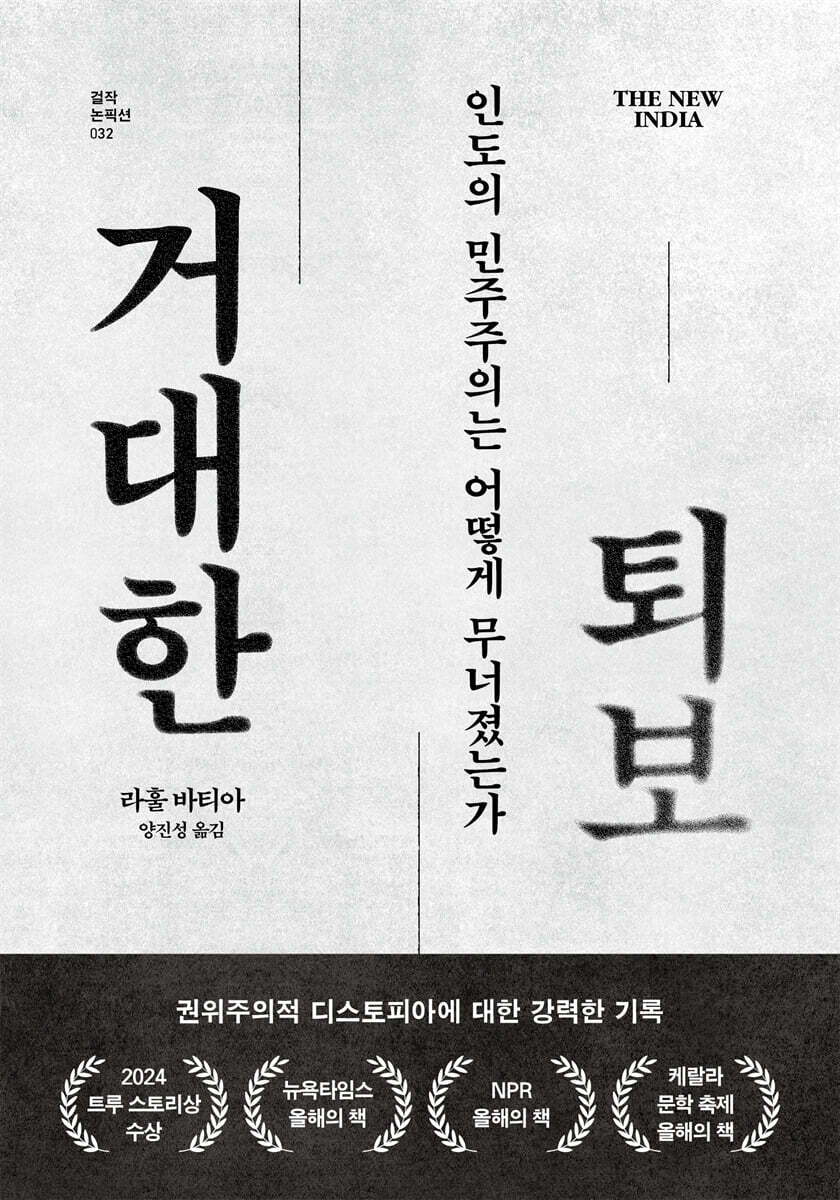
A huge regression
 |
Description
Book Introduction
How does India of this moment become history?
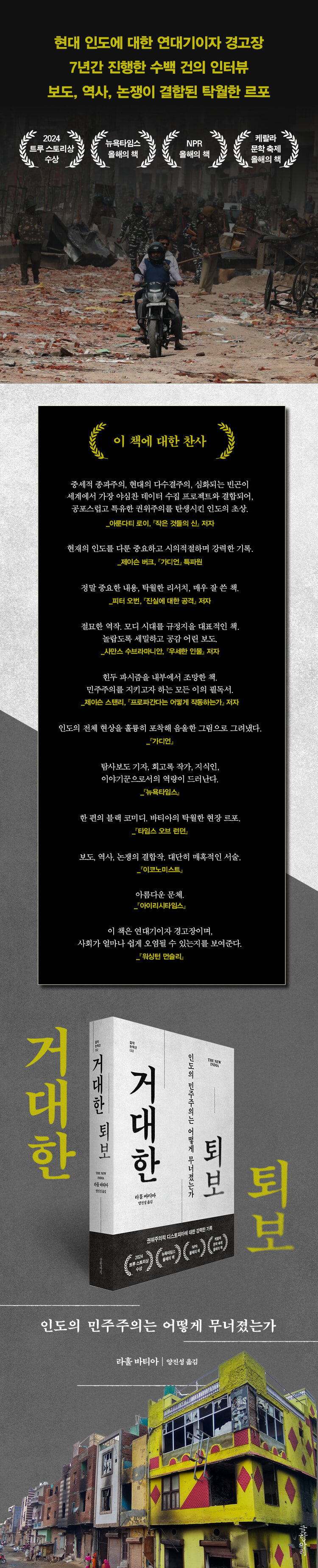
Hundreds of interviews conducted over seven years
An excellent reportage that combines reporting, history, and debate.
Like paper that crumples when it absorbs moisture
Something invisible changes people
“About 10 years ago, my loved ones started going crazy.”
This is the first sentence of this book.
This is a life where ideologies and beliefs from outside have penetrated into families, friends, and neighbors, causing people to kill, criticize, and accuse each other.
One of the author's relatives started belittling Muslims, saying they weren't even human.
It felt so strange when I first heard it.
Because he has never mentioned Muslims before.
But now, whenever you bring it up, it's all about Muslims.
In India, something as invisible as a sheet of paper that crumples with moisture is changing people's lives.
The Great Degeneration is a book that cannot be simply summarized as 'the conflict between Hindus and Muslims.'
In the past decade, ordinary Indians have been shaping their memories more by focusing on 'feelings' than on 'facts'.
Emotions have grown larger and larger as they absorb nutrients from violence.
Now people are starting to openly reject India's pluralistic roots.
This is a landscape that emerged following the rise of right-wing Hindu nationalism following the election of Prime Minister Narendra Modi in 2014.
As they were influenced by politics and the media, they became increasingly cold and unknowable.
This book is a lament for what has been lost, a research-based memoir, and an attempt to unearth the roots of right-wing Hindu nationalism that has driven it to extremism.
Over the past seven years, the author has interviewed hundreds of people, including riot victims, perpetrators, and police officers.
The emotions, the voice, the events that happened are all reborn in the author's sentences.
The Irish Times cited the book's "beautiful writing style" as a distinguishing feature.
Things we witness and interview over the years can lose their meaning or change over time.
For example, the author's record from three years ago, which he had left behind because he was moved by the cries for resistance and freedom, now makes me feel sick when I look at it again.
Because the passion at that time was too naive, and nothing has changed now.
This book does not chronicle how India came to be what it is today.
I try to see the situation clearly by fitting together the pieces of history.
For example, it goes back to the origins of India's identity verification project, which became a big issue a few years ago, and it is an attempt to find the starting point of the poison leaking out of India before it was damaged.
The author, with a journalistic spirit, enters the back alleys of India and completes the book with countless details.
The story jumps between different places and times, but there is one character who stays with us from beginning to end.
It's Nisar.
He is a denim and other clothing maker and witness to the riot that occurred at 3:00 PM on February 24, 2020.
But after the sighting, he put aside his work and spent almost half of the month in court.
And that too all year round.
The author accompanies Nisar through his ordeals with the Indian judicial system, and this becomes a thread running through the entire narrative of the book.
Hundreds of interviews conducted over seven years
An excellent reportage that combines reporting, history, and debate.
Like paper that crumples when it absorbs moisture
Something invisible changes people
“About 10 years ago, my loved ones started going crazy.”
This is the first sentence of this book.
This is a life where ideologies and beliefs from outside have penetrated into families, friends, and neighbors, causing people to kill, criticize, and accuse each other.
One of the author's relatives started belittling Muslims, saying they weren't even human.
It felt so strange when I first heard it.
Because he has never mentioned Muslims before.
But now, whenever you bring it up, it's all about Muslims.
In India, something as invisible as a sheet of paper that crumples with moisture is changing people's lives.
The Great Degeneration is a book that cannot be simply summarized as 'the conflict between Hindus and Muslims.'
In the past decade, ordinary Indians have been shaping their memories more by focusing on 'feelings' than on 'facts'.
Emotions have grown larger and larger as they absorb nutrients from violence.
Now people are starting to openly reject India's pluralistic roots.
This is a landscape that emerged following the rise of right-wing Hindu nationalism following the election of Prime Minister Narendra Modi in 2014.
As they were influenced by politics and the media, they became increasingly cold and unknowable.
This book is a lament for what has been lost, a research-based memoir, and an attempt to unearth the roots of right-wing Hindu nationalism that has driven it to extremism.
Over the past seven years, the author has interviewed hundreds of people, including riot victims, perpetrators, and police officers.
The emotions, the voice, the events that happened are all reborn in the author's sentences.
The Irish Times cited the book's "beautiful writing style" as a distinguishing feature.
Things we witness and interview over the years can lose their meaning or change over time.
For example, the author's record from three years ago, which he had left behind because he was moved by the cries for resistance and freedom, now makes me feel sick when I look at it again.
Because the passion at that time was too naive, and nothing has changed now.
This book does not chronicle how India came to be what it is today.
I try to see the situation clearly by fitting together the pieces of history.
For example, it goes back to the origins of India's identity verification project, which became a big issue a few years ago, and it is an attempt to find the starting point of the poison leaking out of India before it was damaged.
The author, with a journalistic spirit, enters the back alleys of India and completes the book with countless details.
The story jumps between different places and times, but there is one character who stays with us from beginning to end.
It's Nisar.
He is a denim and other clothing maker and witness to the riot that occurred at 3:00 PM on February 24, 2020.
But after the sighting, he put aside his work and spent almost half of the month in court.
And that too all year round.
The author accompanies Nisar through his ordeals with the Indian judicial system, and this becomes a thread running through the entire narrative of the book.
- You can preview some of the book's contents.
Preview
index
preface
Chapter 1: Aftermath
For the Disrespected | Shelter Under a Tin Roof | Cemetery | A World Where Everyone is Suspected | Cries for Freedom | On Their Own | Tears | Testimony | Traitors | His Day in Court | A Gloomy Courtroom | In Search of Relief | Private Memories | Dangerous Times
Chapter 2: A New Country
A Defense of the Faith | The Book and the Rifle | Unreliable Patriots | The Hill of the Dead | The Most Unnatural Way
Chapter 3 Family Issues
Family | Parents and Children | East Delhi Murders | Hindus Wake Up at 6 AM | Reading and Misreading
Chapter 4 Technical Issues
A Visionary's Toy | Design | A Huge Vision | Built-In | This Powerful Power | Identity Verification Program Lawsuit
Chapter 5 Education
Real History | This is Life
Chapter 1: Aftermath
For the Disrespected | Shelter Under a Tin Roof | Cemetery | A World Where Everyone is Suspected | Cries for Freedom | On Their Own | Tears | Testimony | Traitors | His Day in Court | A Gloomy Courtroom | In Search of Relief | Private Memories | Dangerous Times
Chapter 2: A New Country
A Defense of the Faith | The Book and the Rifle | Unreliable Patriots | The Hill of the Dead | The Most Unnatural Way
Chapter 3 Family Issues
Family | Parents and Children | East Delhi Murders | Hindus Wake Up at 6 AM | Reading and Misreading
Chapter 4 Technical Issues
A Visionary's Toy | Design | A Huge Vision | Built-In | This Powerful Power | Identity Verification Program Lawsuit
Chapter 5 Education
Real History | This is Life
Detailed image
Into the book
The threat was felt, and resistance was arduous.
--- p.45
Even if they don't listen to reason, if they grew up together and they love each other, they might be able to approach them.
J? walked down the streets of Delhi at a quiet hour.
When evening came and the people gathered in the park sang a song of unity, I avoided their gaze.
What might have been a romantic sight to some was just ridiculous to him.
His life hasn't changed a bit in decades, so who would be persuaded by their songs? What value do they have? Who are they for? He thought of the man who became his symbol, Barack Obama.
But what exactly does it symbolize? Obama promised hope and change, but his immediate successor was Trump.
What good is a time of hope if it's immediately followed by a time of fear? He learned from experience that the root of the problem runs much deeper.
He sensed what was coming and told his friend.
“Hatred against Muslims is on the rise.
Anything can happen now.
“Mass slaughter too.”
--- p.51~52
The crowd was already awake and no further stimulation was needed.
The threat of forced migration alone was enough motivation.
--- p.54
While I was washing my hands and disinfecting all the surfaces around me, it was only natural that some insignificant politician in Delhi started making threats, which led to violence.
They likened protesters against the Civil Rights Amendment Act to traitors and incited the crowd to shoot them.
All of this happened while the pandemic was growing like a monster.
--- p.56
At that moment, the surroundings were a stage set, and the people were actors rehearsing their lines.
--- p.88
Nisar, like many witnesses, remained motionless, caught somewhere between courage and recklessness.
--- p.91
Men blocking the road in front of his house, a man holding one end of a cutter like a gun, paper and ashes scattered everywhere.
Blurry footage of the riot and his testimony, that was all he had.
Realizing this reality, he drastically reduced the size of his hopes.
--- p.95
Seeing that no one listened to his testimony further strengthened my conviction that this was not a religious issue, but a moral one.
He was a humanist who fought against the reality of public morality disappearing.
--- p.133
Words can be a harbinger of terrible things to come, so there was no point in giving anyone an excuse.
Living so cautiously, Ali's father became sensitive to other people's behavior and his expectations of himself became dull.
--- p.138
While the cow sniffed my palm, I stroked its head and found comfort in its eyes.
How can anyone ever reverse the deep conviction of those who believe that the words of those they love and trust, and of the press whose editorial choices are questioned, are the truth?
--- p.267
In memory, some deaths freeze the surrounding world in time.
Mohammed Arak also met a similar end.
Unfortunately, he became a symbol of the times and their murderous atmosphere.
--- p.339
Over the course of three or four years, in hundreds of conversations, critics from various cities have told me what they know.
I met them in cafes and dark living rooms with plastic-covered sofas (the interviewer's workspace), in parks during lunchtime, in the maze of Delhi's housing estates, in court cafeterias during breaks in proceedings, in underground parking lots (where the interviewers were afraid of being seen), and in stuffy basement offices near Mughal tombs.
They were concerned that the ethical and legal boundaries of this project were unclear.
The simple explanation that this technology was absolutely necessary was difficult to accept.
The reason that explanation feels incomplete is that technological optimism ignores the audience's distrust.
It makes the audience forget about their expertise and real-world experience, and intentionally excludes skepticism.
--- p.409
But this conversation itself was actually a sign that life was getting more and more hectic.
It is not curable and can only be managed.
For a while, I was confused as to why I was so anxious, why this loss felt so irreversible.
The reason may be that, over time, the country's pressure to choose and express itself has become increasingly overwhelming.
--- p.45
Even if they don't listen to reason, if they grew up together and they love each other, they might be able to approach them.
J? walked down the streets of Delhi at a quiet hour.
When evening came and the people gathered in the park sang a song of unity, I avoided their gaze.
What might have been a romantic sight to some was just ridiculous to him.
His life hasn't changed a bit in decades, so who would be persuaded by their songs? What value do they have? Who are they for? He thought of the man who became his symbol, Barack Obama.
But what exactly does it symbolize? Obama promised hope and change, but his immediate successor was Trump.
What good is a time of hope if it's immediately followed by a time of fear? He learned from experience that the root of the problem runs much deeper.
He sensed what was coming and told his friend.
“Hatred against Muslims is on the rise.
Anything can happen now.
“Mass slaughter too.”
--- p.51~52
The crowd was already awake and no further stimulation was needed.
The threat of forced migration alone was enough motivation.
--- p.54
While I was washing my hands and disinfecting all the surfaces around me, it was only natural that some insignificant politician in Delhi started making threats, which led to violence.
They likened protesters against the Civil Rights Amendment Act to traitors and incited the crowd to shoot them.
All of this happened while the pandemic was growing like a monster.
--- p.56
At that moment, the surroundings were a stage set, and the people were actors rehearsing their lines.
--- p.88
Nisar, like many witnesses, remained motionless, caught somewhere between courage and recklessness.
--- p.91
Men blocking the road in front of his house, a man holding one end of a cutter like a gun, paper and ashes scattered everywhere.
Blurry footage of the riot and his testimony, that was all he had.
Realizing this reality, he drastically reduced the size of his hopes.
--- p.95
Seeing that no one listened to his testimony further strengthened my conviction that this was not a religious issue, but a moral one.
He was a humanist who fought against the reality of public morality disappearing.
--- p.133
Words can be a harbinger of terrible things to come, so there was no point in giving anyone an excuse.
Living so cautiously, Ali's father became sensitive to other people's behavior and his expectations of himself became dull.
--- p.138
While the cow sniffed my palm, I stroked its head and found comfort in its eyes.
How can anyone ever reverse the deep conviction of those who believe that the words of those they love and trust, and of the press whose editorial choices are questioned, are the truth?
--- p.267
In memory, some deaths freeze the surrounding world in time.
Mohammed Arak also met a similar end.
Unfortunately, he became a symbol of the times and their murderous atmosphere.
--- p.339
Over the course of three or four years, in hundreds of conversations, critics from various cities have told me what they know.
I met them in cafes and dark living rooms with plastic-covered sofas (the interviewer's workspace), in parks during lunchtime, in the maze of Delhi's housing estates, in court cafeterias during breaks in proceedings, in underground parking lots (where the interviewers were afraid of being seen), and in stuffy basement offices near Mughal tombs.
They were concerned that the ethical and legal boundaries of this project were unclear.
The simple explanation that this technology was absolutely necessary was difficult to accept.
The reason that explanation feels incomplete is that technological optimism ignores the audience's distrust.
It makes the audience forget about their expertise and real-world experience, and intentionally excludes skepticism.
--- p.409
But this conversation itself was actually a sign that life was getting more and more hectic.
It is not curable and can only be managed.
For a while, I was confused as to why I was so anxious, why this loss felt so irreversible.
The reason may be that, over time, the country's pressure to choose and express itself has become increasingly overwhelming.
--- p.449
Publisher's Review
The street becomes history
After Modi was elected in 2014, the Bharatiya Janata Party (BJP), which he belongs to, and the RSS, which supported him, became the forces that drove the current right-wing Hindu nationalism to the extreme.
In this book, the author delves into these organizations by interviewing insiders within the BJP and the RSS. The RSS was founded in 1925, and its founder, Hedgewar, believed that all riots were "Muslim riots" and were spread by "poisonous ironic noises."
Since 2014, the current regime's leaders have encouraged hatred against followers of other religions and have become increasingly overt in their assertions of Hindu superiority.
The biggest turning point was the Citizenship Amendment Bill proposed by the current government's Home Minister Amit Shah.
The author, a keen journalist, begins Chapter 1 with a scene where Amit Shah made a thoughtless remark.
The Shah had always been a good listener, but now he was trying to pass the Citizenship Amendment Act, which would persecute Muslims.
The bill was ostensibly intended to grant citizenship to minorities in Pakistan, Afghanistan, and Bangladesh, but in reality, its implementation resulted in the statelessness of nearly 2 million citizens.
And most of them were Muslims.
“Oppose the Citizenship Amendment Act, oppose the National Register of Citizens.” On December 15, 2019, students gathered at Jamia University to protest, chanting these slogans.
And the police began to suppress the protest from both sides of the barricade.
An assault occurred.
From behind, from the side, and from the front, clubs flew in mercilessly.
Muslims should be “torn to shreds”.
Three months later, the massacre took place.
In February 2020, 53 people were killed in New Delhi due to police violence and anti-Muslim riots.
The author presents the book's main characters as those deeply involved in the idea: the perpetrators, neighbors, witnesses, and victims.
When you open the front door, all that comes in is the city's failures.
Muhammad Meharban.
As a photographer, he introduced the author to numerous interview subjects.
The initially peaceful protests were met with shocking violence.
A new India was emerging, and old norms of secularism and equality were being abandoned.
This strange country has begun to justify even murder when circumstances require it.
The author listened to these people and tried to understand their situation.
However, Muslims who testified about what had happened to them would immediately disappear if they felt threatened.
J—a Muslim, gay, working-class man—was just gone.
The author was again taken by Meharvan to the market burned down by Hindu mobs in February 2020, where he met Nisar.
Nisar is a key witness in this book.
On the evening of February 23, 2020, political leader Kapil Mishra rallied a crowd in northeast Delhi.
This resulted in Muslims being killed in the streets.
The next afternoon, the 24th, the men stopped on a low bridge over a canal a few minutes from Nisar's house.
They set up barricades and brought out loudspeakers.
On the bridge, a local leader of the BJP began to agitate the crowd.
Ominous slogans rang out.
“Drive out the circumcised ones!” “Hindus, wake up! Wake up!” Instead of greeting their neighbors, the crowd began to shout taunts and battle cries.
At around 5 or 6 pm, the men broke into Muslim homes and shops.
He was holding a club and an iron bar in his hand.
The massacre that took place in the darkness was only discernible through sound.
Shouting, jumping, screaming.
Nisar's ordeal began when he visited the police station to report the damage.
When the perpetrator's name was mentioned, the police asked the person to give a candid statement without mentioning the name.
It was to defend the perpetrator.
Then he started interrogating Nisar in reverse.
The same questions were repeated over and over again, and furthermore, they questioned the credibility of Nisar's memory.
These interrogations continued for a whole year in Courtroom 71 on the fifth floor of the Karkarduma court complex in east Delhi.
In fact, for Nisar, hope was a way of life.
But when I opened the front door, all I saw were the city's failures.
And I couldn't help but keep projecting those failures onto myself.
Men blocking the front of their own house, paper and ashes scattered everywhere.
Scenes of the riot are becoming increasingly blurred.
This was all the cards he had.
In this reality, he drastically reduced the size of his hopes.
Although he tirelessly testified in and out of court every day, the author observes that Nisar, like many witnesses, was caught between courage and recklessness, unable to move.
Highly recommended by Arundhati Roy, this book delves into India's greatest democratic crisis and serves as a wake-up call to all those pinning their hopes on its bureaucracy, law enforcement, media, and judiciary.
Based on incredibly detailed and thorough reporting, the record accurately captures India at this very moment.
After Modi was elected in 2014, the Bharatiya Janata Party (BJP), which he belongs to, and the RSS, which supported him, became the forces that drove the current right-wing Hindu nationalism to the extreme.
In this book, the author delves into these organizations by interviewing insiders within the BJP and the RSS. The RSS was founded in 1925, and its founder, Hedgewar, believed that all riots were "Muslim riots" and were spread by "poisonous ironic noises."
Since 2014, the current regime's leaders have encouraged hatred against followers of other religions and have become increasingly overt in their assertions of Hindu superiority.
The biggest turning point was the Citizenship Amendment Bill proposed by the current government's Home Minister Amit Shah.
The author, a keen journalist, begins Chapter 1 with a scene where Amit Shah made a thoughtless remark.
The Shah had always been a good listener, but now he was trying to pass the Citizenship Amendment Act, which would persecute Muslims.
The bill was ostensibly intended to grant citizenship to minorities in Pakistan, Afghanistan, and Bangladesh, but in reality, its implementation resulted in the statelessness of nearly 2 million citizens.
And most of them were Muslims.
“Oppose the Citizenship Amendment Act, oppose the National Register of Citizens.” On December 15, 2019, students gathered at Jamia University to protest, chanting these slogans.
And the police began to suppress the protest from both sides of the barricade.
An assault occurred.
From behind, from the side, and from the front, clubs flew in mercilessly.
Muslims should be “torn to shreds”.
Three months later, the massacre took place.
In February 2020, 53 people were killed in New Delhi due to police violence and anti-Muslim riots.
The author presents the book's main characters as those deeply involved in the idea: the perpetrators, neighbors, witnesses, and victims.
When you open the front door, all that comes in is the city's failures.
Muhammad Meharban.
As a photographer, he introduced the author to numerous interview subjects.
The initially peaceful protests were met with shocking violence.
A new India was emerging, and old norms of secularism and equality were being abandoned.
This strange country has begun to justify even murder when circumstances require it.
The author listened to these people and tried to understand their situation.
However, Muslims who testified about what had happened to them would immediately disappear if they felt threatened.
J—a Muslim, gay, working-class man—was just gone.
The author was again taken by Meharvan to the market burned down by Hindu mobs in February 2020, where he met Nisar.
Nisar is a key witness in this book.
On the evening of February 23, 2020, political leader Kapil Mishra rallied a crowd in northeast Delhi.
This resulted in Muslims being killed in the streets.
The next afternoon, the 24th, the men stopped on a low bridge over a canal a few minutes from Nisar's house.
They set up barricades and brought out loudspeakers.
On the bridge, a local leader of the BJP began to agitate the crowd.
Ominous slogans rang out.
“Drive out the circumcised ones!” “Hindus, wake up! Wake up!” Instead of greeting their neighbors, the crowd began to shout taunts and battle cries.
At around 5 or 6 pm, the men broke into Muslim homes and shops.
He was holding a club and an iron bar in his hand.
The massacre that took place in the darkness was only discernible through sound.
Shouting, jumping, screaming.
Nisar's ordeal began when he visited the police station to report the damage.
When the perpetrator's name was mentioned, the police asked the person to give a candid statement without mentioning the name.
It was to defend the perpetrator.
Then he started interrogating Nisar in reverse.
The same questions were repeated over and over again, and furthermore, they questioned the credibility of Nisar's memory.
These interrogations continued for a whole year in Courtroom 71 on the fifth floor of the Karkarduma court complex in east Delhi.
In fact, for Nisar, hope was a way of life.
But when I opened the front door, all I saw were the city's failures.
And I couldn't help but keep projecting those failures onto myself.
Men blocking the front of their own house, paper and ashes scattered everywhere.
Scenes of the riot are becoming increasingly blurred.
This was all the cards he had.
In this reality, he drastically reduced the size of his hopes.
Although he tirelessly testified in and out of court every day, the author observes that Nisar, like many witnesses, was caught between courage and recklessness, unable to move.
Highly recommended by Arundhati Roy, this book delves into India's greatest democratic crisis and serves as a wake-up call to all those pinning their hopes on its bureaucracy, law enforcement, media, and judiciary.
Based on incredibly detailed and thorough reporting, the record accurately captures India at this very moment.
GOODS SPECIFICS
- Date of issue: July 4, 2025
- Page count, weight, size: 528 pages | 742g | 140*200*32mm
- ISBN13: 9791169094078
You may also like
카테고리
korean


korean

![GQ KOREA Mark (Monthly): December [2025]](http://librairie.coreenne.fr/cdn/shop/files/8ef265dbbfbf186523ed75ba7319009d.jpg?v=1765340328&width=3840)


