

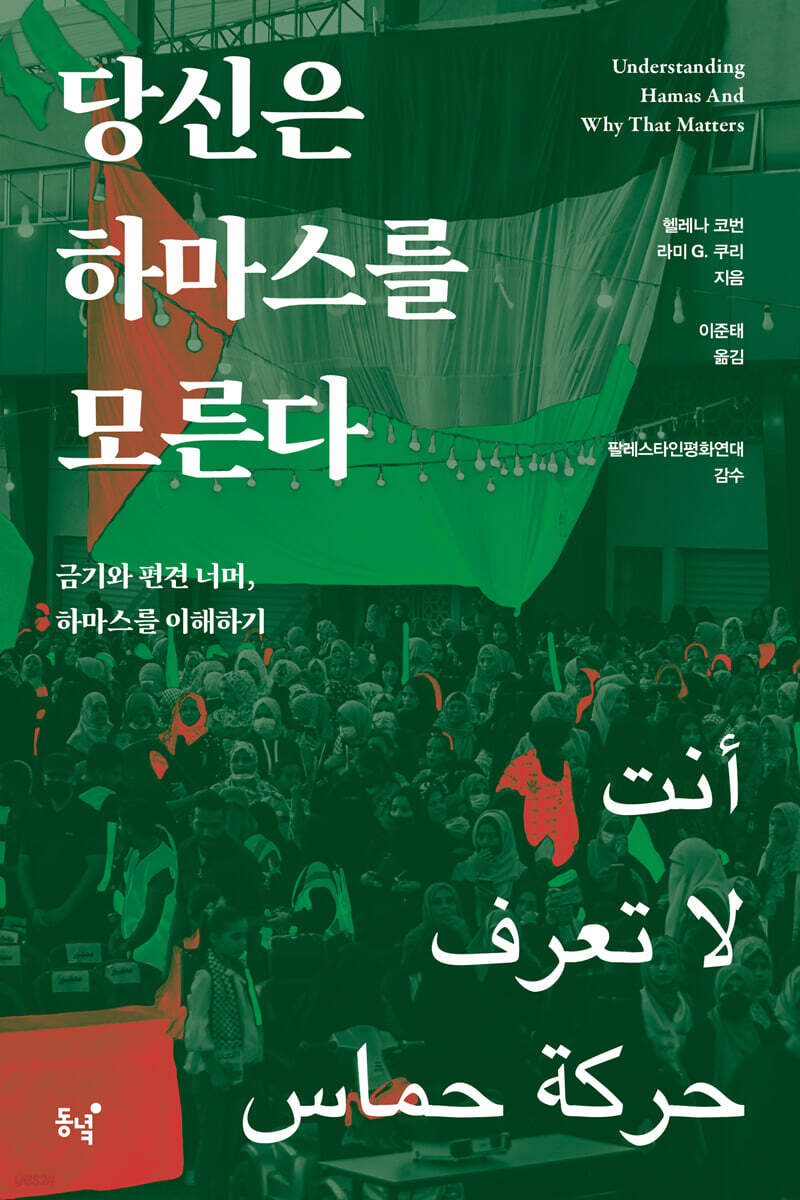
You don't know Hamas
 |
Description
Book Introduction
You blame Hamas for Israel's genocide,
First, let's look at Hamas "as is."
Hamas, the Palestinian armed political party
The only book that will give you a three-dimensional and balanced understanding
The book "You Don't Know Hamas," which provides a foundation for a more three-dimensional and balanced view of Hamas, the Palestinian armed political party often referred to as a "terrorist group" that attacks Israel, has been published by Dongnyok.
Although there have been several books published in Korea that examine the historical context of Palestine, this book, “You Don’t Know Hamas,” is the first to deal with Hamas in depth.
Through interviews with some of the world's leading experts who have closely observed or studied Hamas for a long time, this book thoroughly examines Hamas's ideology, history, organization, and operating methods, which cannot be simply summarized.
(As of May 28, 2025) The number of Palestinian deaths has exceeded 54,000.
The number of Palestinian leaders who have lost their lives in Israeli targeted attacks is already countless.
Pictures of Palestinian children killed by Israel are being shared on social media by the minute.
As unprecedented genocide continues, the international community appears powerless to impose effective sanctions on Israel.
In this context, Hamas is still treated as an entity that makes the international community's "onlookers" reserve judgment.
Even if one believes that the genocide Israel is committing is clearly wrong, it is a very common argument that Israel cannot be held solely responsible if Hamas's "terrorist acts" caused it.
For example, Hamas's Al-Aqsa flood operation (the name of the Israeli surprise operation) on October 7, 2023 has been consistently pointed out as the cause of all this.
Israel justifies its aggressive "retaliation" by claiming that "Hamas started the fight," even though it was Israel that started the fight by occupying the land in the first place.
According to them, Hamas is nothing more than a ruthless terrorist group that knows no humanity.
The task of this book is to help readers understand Hamas in a three-dimensional way, beyond such a linear framework.
First, let's look at Hamas "as is."
Hamas, the Palestinian armed political party
The only book that will give you a three-dimensional and balanced understanding
The book "You Don't Know Hamas," which provides a foundation for a more three-dimensional and balanced view of Hamas, the Palestinian armed political party often referred to as a "terrorist group" that attacks Israel, has been published by Dongnyok.
Although there have been several books published in Korea that examine the historical context of Palestine, this book, “You Don’t Know Hamas,” is the first to deal with Hamas in depth.
Through interviews with some of the world's leading experts who have closely observed or studied Hamas for a long time, this book thoroughly examines Hamas's ideology, history, organization, and operating methods, which cannot be simply summarized.
(As of May 28, 2025) The number of Palestinian deaths has exceeded 54,000.
The number of Palestinian leaders who have lost their lives in Israeli targeted attacks is already countless.
Pictures of Palestinian children killed by Israel are being shared on social media by the minute.
As unprecedented genocide continues, the international community appears powerless to impose effective sanctions on Israel.
In this context, Hamas is still treated as an entity that makes the international community's "onlookers" reserve judgment.
Even if one believes that the genocide Israel is committing is clearly wrong, it is a very common argument that Israel cannot be held solely responsible if Hamas's "terrorist acts" caused it.
For example, Hamas's Al-Aqsa flood operation (the name of the Israeli surprise operation) on October 7, 2023 has been consistently pointed out as the cause of all this.
Israel justifies its aggressive "retaliation" by claiming that "Hamas started the fight," even though it was Israel that started the fight by occupying the land in the first place.
According to them, Hamas is nothing more than a ruthless terrorist group that knows no humanity.
The task of this book is to help readers understand Hamas in a three-dimensional way, beyond such a linear framework.
- You can preview some of the book's contents.
Preview
index
Praise poured in for this book
Release: Damn Hamas as it is_Palestinian Peace Solidarity Deng Yaping
Introduction
Key chronological points in Hamas history
Chapter 1: A Conversation with Dr. Paola Caridi
Chapter 2: A Conversation with Dr. Khaled Hrub
Chapter 3: A Conversation with Dr. Yerun Guning
Chapter 4: A Conversation with the Unmanned Rabbani
Chapter 5: A Conversation with Dr. Azam Tamimi
Appendix 1 Charter of the Islamic Resistance Movement (Hamas)
Appendix 2: Final Report on the Palestinian Authority Council Elections by the International Democratic Institute
Appendix 3 Hamas General Principles and Policy Document 2017
Appendix 4: Explanation of the Process by Which Hamas Was Added to the U.S. Terrorist Organization List
Appendix 5 Our Narrative… …Operation Al-Aqsa Flood
Appendix 6: Palestine Policy Research Institute Poll No. 92
Key figures
Terminology
References
Acknowledgements
Translator's Note: Hamas and Palestine: A Window into Today's Colonialism
Search
Release: Damn Hamas as it is_Palestinian Peace Solidarity Deng Yaping
Introduction
Key chronological points in Hamas history
Chapter 1: A Conversation with Dr. Paola Caridi
Chapter 2: A Conversation with Dr. Khaled Hrub
Chapter 3: A Conversation with Dr. Yerun Guning
Chapter 4: A Conversation with the Unmanned Rabbani
Chapter 5: A Conversation with Dr. Azam Tamimi
Appendix 1 Charter of the Islamic Resistance Movement (Hamas)
Appendix 2: Final Report on the Palestinian Authority Council Elections by the International Democratic Institute
Appendix 3 Hamas General Principles and Policy Document 2017
Appendix 4: Explanation of the Process by Which Hamas Was Added to the U.S. Terrorist Organization List
Appendix 5 Our Narrative… …Operation Al-Aqsa Flood
Appendix 6: Palestine Policy Research Institute Poll No. 92
Key figures
Terminology
References
Acknowledgements
Translator's Note: Hamas and Palestine: A Window into Today's Colonialism
Search
Detailed image

Into the book
Whether we outside Palestine 'like' Hamas' policies and positions is beside the point.
What is important is that the Palestinian people's right to be free from military occupation, to determine their own future, and to build their own national institutions in a way they choose, in peace and security, must be respected.
If this were to happen any time soon, the Islamic resistance movement Hamas would undoubtedly be at the heart of the project.
--- p.35 From the “Introductory Note”
Through the experiences of the prisoners, we can also learn about Hamas's political behavior outside the prison.
That means Hamas is continuing to negotiate and can negotiate.
They negotiated with other political parties both inside and outside the prison.
If we trace Hamas's path as a political movement, we see that it has also negotiated with Israel.
--- p.52 From “Conversation with Dr. Paola Caridi”
I believe that in the Palestinian context, which is experiencing colonialism, the marginalization or mainstreaming of certain political movements is a question of resistance.
So, based on my limited knowledge, I think the primary factor that makes people support Hamas in the West Bank, Gaza, and elsewhere is resistance.
--- p.83 From "A Conversation with Dr. Khaled Hrub"
I want to emphasize that it is important to properly understand Hamas because deliberate disinformation and manipulation have been used to justify Israel's genocidal war on Gaza and to further Israel's stated goal of eradicating Hamas at all costs.
To uncritically accept this Israeli perspective is to be complicit in an entire narrative that condones extreme violence against the Gaza Strip and its inhabitants.
--- p.112 From "A Conversation with Dr. Yerun Guning"
Hamas has proposed a number of approaches that make it quite clear that it would accept an indefinite cessation of hostilities if Israel ultimately ends its occupation of the West Bank and Gaza Strip and establishes a Palestinian state with East Jerusalem as its capital.
In 2017, for the first time, the two-state solution became the official position of the Hamas movement, and Hamas is now officially committed to the two-state solution.
But I think Israel's genocidal attacks on Gaza have caused Hamas to question its own commitments.
--- p.168 From "Conversation with the Unmanned Rabbani"
If this land is Palestinian, and the people of Gaza are the indigenous people of that land, then under international law they have every right to fight and liberate their land.
The right to liberate the land taken from the Palestinian people by those who invaded the region from Europe for European reasons, which had nothing to do with Palestine.
What is important is that the Palestinian people's right to be free from military occupation, to determine their own future, and to build their own national institutions in a way they choose, in peace and security, must be respected.
If this were to happen any time soon, the Islamic resistance movement Hamas would undoubtedly be at the heart of the project.
--- p.35 From the “Introductory Note”
Through the experiences of the prisoners, we can also learn about Hamas's political behavior outside the prison.
That means Hamas is continuing to negotiate and can negotiate.
They negotiated with other political parties both inside and outside the prison.
If we trace Hamas's path as a political movement, we see that it has also negotiated with Israel.
--- p.52 From “Conversation with Dr. Paola Caridi”
I believe that in the Palestinian context, which is experiencing colonialism, the marginalization or mainstreaming of certain political movements is a question of resistance.
So, based on my limited knowledge, I think the primary factor that makes people support Hamas in the West Bank, Gaza, and elsewhere is resistance.
--- p.83 From "A Conversation with Dr. Khaled Hrub"
I want to emphasize that it is important to properly understand Hamas because deliberate disinformation and manipulation have been used to justify Israel's genocidal war on Gaza and to further Israel's stated goal of eradicating Hamas at all costs.
To uncritically accept this Israeli perspective is to be complicit in an entire narrative that condones extreme violence against the Gaza Strip and its inhabitants.
--- p.112 From "A Conversation with Dr. Yerun Guning"
Hamas has proposed a number of approaches that make it quite clear that it would accept an indefinite cessation of hostilities if Israel ultimately ends its occupation of the West Bank and Gaza Strip and establishes a Palestinian state with East Jerusalem as its capital.
In 2017, for the first time, the two-state solution became the official position of the Hamas movement, and Hamas is now officially committed to the two-state solution.
But I think Israel's genocidal attacks on Gaza have caused Hamas to question its own commitments.
--- p.168 From "Conversation with the Unmanned Rabbani"
If this land is Palestinian, and the people of Gaza are the indigenous people of that land, then under international law they have every right to fight and liberate their land.
The right to liberate the land taken from the Palestinian people by those who invaded the region from Europe for European reasons, which had nothing to do with Palestine.
--- p.200 From "Conversation with Dr. Azam Tamimi"
Publisher's Review
Why we need to take a 'proper' look at Hamas again, now and here.
This book, "You Don't Know Hamas," focuses on correcting misunderstandings and prejudices surrounding Hamas in response to Israel's attempts to demonize Hamas.
For example, this book clearly shows that most of the news about the atrocities allegedly committed by Hamas is in fact nothing more than a 'reposting' of false and fabricated information from the Israeli side.
When we recall how international news consumers have come to claim neutrality as a "bystander" by uncritically accepting Israeli "facts" such as "Hamas massacred civilians, including children and women, and committed mass rape," we cannot help but emphasize the importance of accurately "fact-checking" again and making it widely known.
Moreover, through this book, readers will be able to clearly understand that Palestinians have a “right to resist” the occupation, whether under international law or not; the context in which Hamas has enjoyed widespread support among Palestinians as a “resisting entity”; and that Hamas has broadly played the role of not only an armed political party but also a political party and a charity organization.
The importance of this book cannot be overstated, as Israel exploits Hamas as a pretext to justify genocide, and a more accurate understanding of Hamas is called for.
Some might wonder what point there is in discussing Hamas now that Palestine has been reduced to rubble.
However, in a situation where 'eradicating Hamas' has become Israel's official goal, this book also reveals that Hamas, as an organization with decentralized power, is not a force that can be 'eradicated' as easily as Israel hopes, and that it will continue to resist tenaciously as long as the occupation continues.
Hamas as described by the world's leading experts who have studied Hamas for a long time.
This book, "You Don't Know Hamas," possesses unparalleled expertise in that the interviewers and interviewees are people who know the local Palestinian situation, Hamas' ideology, history, organization, and operating methods better than anyone else.
Authors Helena Coburn and Rami G.
Kuri interviews five 'Hamas experts'.
They are Paola Caridi, Khaled Hrub, Jeroon Guning, Muin Rabbani and Azam Tamimi.
These five are among the world's leading Hamas experts, having closely observed the Hamas leadership, conducted in-depth interviews, and published books on the subject.
However, it has received relatively little attention in mainstream Western media and political discourse.
Instead, Israel's voice has dominated the mainstream discourse.
Stories that have never been given a microphone before have finally arrived here.
Five experts use this conversation as an opportunity to help readers develop a new perspective based on a detailed understanding of Hamas.
For example, Paola Caridi corrects the understanding based on the prejudice that Hamas is an "uncompromising force," pointing out that it is a force that has actually negotiated and is flexible enough to continue to do so.
Muin Rabbani also points out that Hamas is open to a "two-state plan" that would involve peaceful coexistence between Israel and Palestine.
Khaled Hrub presents the context in which Hamas has enjoyed Palestinian support as a major force in the 'resistance movement'.
Jerrun Guning, a pioneer in the field of critical terrorism studies, emphasizes that labeling someone a "terrorist" itself hinders negotiation.
Finally, Azam Tamimi emphasizes that Palestinians have the right to resist by any means possible.
Meanwhile, Paola Caridi recommended referring to direct primary sources such as interviews with Hamas leaders and Hamas press statements in order to accurately understand Hamas's perspective from an outsider's perspective. This book, "You Don't Know Hamas," also includes appendices such as the Hamas charter, a report on the Palestinian Authority Council elections, an explanation of the process by which Hamas was listed as a terrorist organization by the United States, and the results of a public opinion poll by the Palestinian Policy Research Institute, in the hope that it will help readers understand Hamas "as it is."
In addition, to help readers understand and save them some effort, “Terminology” and “Key People” were also added at the end.
Moreover, the Korean edition of this book actively utilized translator's notes to ensure that even readers with limited understanding of the Palestinian issue can easily access the context.
If you want to clear up any doubts you had about Hamas,
Even those who are critical of Israel, witnessing unprecedented genocide, tend to fall into a two-faced view when they think of Hamas: “Violence is bad,” and “There’s a problem here, there’s a problem there.”
But is it truly appropriate to equate Hamas's armed struggle with Israel's genocide and simply claim that "all violence is wrong"? This book does not attempt to unilaterally defend Hamas.
Since a "perfect" movement is a non-existent fantasy, the suggestion that we understand Hamas accurately cannot be an argument that they are innocent.
However, before blaming those who chose the last resort of 'resistance', the interviewees insist that we must first examine the 'occupation' situation that led them to resist.
Moreover, for the sake of a 'political solution' to the problem, Hamas must be understood more precisely.
Did Hamas truly "bring all this upon itself"? Do Palestinians deserve "revenge" from Israel for supporting the demonic Hamas? Is Hamas truly a "non-negotiable force"? If you're looking for concrete answers to these questions, this book will serve as your guide.
Political scientist John J., who added a recommendation to this book,
As Mearsheimer (author of The Tragedy of Great Power Politics and Why America Sides with Israel) said, “You don’t have to like Hamas, but you absolutely have to understand exactly what kind of entity they are.”
Moreover, if looking back on Korea's painful experience under colonial rule makes it easy to understand that it is not appropriate to simply view Japan's colonial rule as a conflict between Japan and Korea, then we should be able to take the same stance on the Palestinian issue.
In other words, if Hamas's struggle reminds us even a little of our people's independence movement in the past, we cannot simply dismiss their struggle as a distant, unrelated matter and talk about it with folded arms, saying, "Nonviolence is the only answer."
Therefore, if you want to go beyond talking about Palestine and Israel as if they could be evaluated on equal footing and truly see the essence of the situation, understanding Hamas from various perspectives through this book, "You Don't Know Hamas," will be the first gateway to that goal.
As Palestine Solidarity activist Deng Yaping, who wrote the book's introduction, put it, "Understanding Hamas through the questions this book raises is understanding the current situation of genocide, the essence of genocide."
This book, "You Don't Know Hamas," focuses on correcting misunderstandings and prejudices surrounding Hamas in response to Israel's attempts to demonize Hamas.
For example, this book clearly shows that most of the news about the atrocities allegedly committed by Hamas is in fact nothing more than a 'reposting' of false and fabricated information from the Israeli side.
When we recall how international news consumers have come to claim neutrality as a "bystander" by uncritically accepting Israeli "facts" such as "Hamas massacred civilians, including children and women, and committed mass rape," we cannot help but emphasize the importance of accurately "fact-checking" again and making it widely known.
Moreover, through this book, readers will be able to clearly understand that Palestinians have a “right to resist” the occupation, whether under international law or not; the context in which Hamas has enjoyed widespread support among Palestinians as a “resisting entity”; and that Hamas has broadly played the role of not only an armed political party but also a political party and a charity organization.
The importance of this book cannot be overstated, as Israel exploits Hamas as a pretext to justify genocide, and a more accurate understanding of Hamas is called for.
Some might wonder what point there is in discussing Hamas now that Palestine has been reduced to rubble.
However, in a situation where 'eradicating Hamas' has become Israel's official goal, this book also reveals that Hamas, as an organization with decentralized power, is not a force that can be 'eradicated' as easily as Israel hopes, and that it will continue to resist tenaciously as long as the occupation continues.
Hamas as described by the world's leading experts who have studied Hamas for a long time.
This book, "You Don't Know Hamas," possesses unparalleled expertise in that the interviewers and interviewees are people who know the local Palestinian situation, Hamas' ideology, history, organization, and operating methods better than anyone else.
Authors Helena Coburn and Rami G.
Kuri interviews five 'Hamas experts'.
They are Paola Caridi, Khaled Hrub, Jeroon Guning, Muin Rabbani and Azam Tamimi.
These five are among the world's leading Hamas experts, having closely observed the Hamas leadership, conducted in-depth interviews, and published books on the subject.
However, it has received relatively little attention in mainstream Western media and political discourse.
Instead, Israel's voice has dominated the mainstream discourse.
Stories that have never been given a microphone before have finally arrived here.
Five experts use this conversation as an opportunity to help readers develop a new perspective based on a detailed understanding of Hamas.
For example, Paola Caridi corrects the understanding based on the prejudice that Hamas is an "uncompromising force," pointing out that it is a force that has actually negotiated and is flexible enough to continue to do so.
Muin Rabbani also points out that Hamas is open to a "two-state plan" that would involve peaceful coexistence between Israel and Palestine.
Khaled Hrub presents the context in which Hamas has enjoyed Palestinian support as a major force in the 'resistance movement'.
Jerrun Guning, a pioneer in the field of critical terrorism studies, emphasizes that labeling someone a "terrorist" itself hinders negotiation.
Finally, Azam Tamimi emphasizes that Palestinians have the right to resist by any means possible.
Meanwhile, Paola Caridi recommended referring to direct primary sources such as interviews with Hamas leaders and Hamas press statements in order to accurately understand Hamas's perspective from an outsider's perspective. This book, "You Don't Know Hamas," also includes appendices such as the Hamas charter, a report on the Palestinian Authority Council elections, an explanation of the process by which Hamas was listed as a terrorist organization by the United States, and the results of a public opinion poll by the Palestinian Policy Research Institute, in the hope that it will help readers understand Hamas "as it is."
In addition, to help readers understand and save them some effort, “Terminology” and “Key People” were also added at the end.
Moreover, the Korean edition of this book actively utilized translator's notes to ensure that even readers with limited understanding of the Palestinian issue can easily access the context.
If you want to clear up any doubts you had about Hamas,
Even those who are critical of Israel, witnessing unprecedented genocide, tend to fall into a two-faced view when they think of Hamas: “Violence is bad,” and “There’s a problem here, there’s a problem there.”
But is it truly appropriate to equate Hamas's armed struggle with Israel's genocide and simply claim that "all violence is wrong"? This book does not attempt to unilaterally defend Hamas.
Since a "perfect" movement is a non-existent fantasy, the suggestion that we understand Hamas accurately cannot be an argument that they are innocent.
However, before blaming those who chose the last resort of 'resistance', the interviewees insist that we must first examine the 'occupation' situation that led them to resist.
Moreover, for the sake of a 'political solution' to the problem, Hamas must be understood more precisely.
Did Hamas truly "bring all this upon itself"? Do Palestinians deserve "revenge" from Israel for supporting the demonic Hamas? Is Hamas truly a "non-negotiable force"? If you're looking for concrete answers to these questions, this book will serve as your guide.
Political scientist John J., who added a recommendation to this book,
As Mearsheimer (author of The Tragedy of Great Power Politics and Why America Sides with Israel) said, “You don’t have to like Hamas, but you absolutely have to understand exactly what kind of entity they are.”
Moreover, if looking back on Korea's painful experience under colonial rule makes it easy to understand that it is not appropriate to simply view Japan's colonial rule as a conflict between Japan and Korea, then we should be able to take the same stance on the Palestinian issue.
In other words, if Hamas's struggle reminds us even a little of our people's independence movement in the past, we cannot simply dismiss their struggle as a distant, unrelated matter and talk about it with folded arms, saying, "Nonviolence is the only answer."
Therefore, if you want to go beyond talking about Palestine and Israel as if they could be evaluated on equal footing and truly see the essence of the situation, understanding Hamas from various perspectives through this book, "You Don't Know Hamas," will be the first gateway to that goal.
As Palestine Solidarity activist Deng Yaping, who wrote the book's introduction, put it, "Understanding Hamas through the questions this book raises is understanding the current situation of genocide, the essence of genocide."
GOODS SPECIFICS
- Date of issue: June 13, 2025
- Page count, weight, size: 348 pages | 450g | 140*220*20mm
- ISBN13: 9788972971580
- ISBN10: 8972971588
You may also like
카테고리
korean


korean

![GQ KOREA Mark (Monthly): December [2025]](http://librairie.coreenne.fr/cdn/shop/files/8ef265dbbfbf186523ed75ba7319009d.jpg?v=1765340328&width=3840)


