

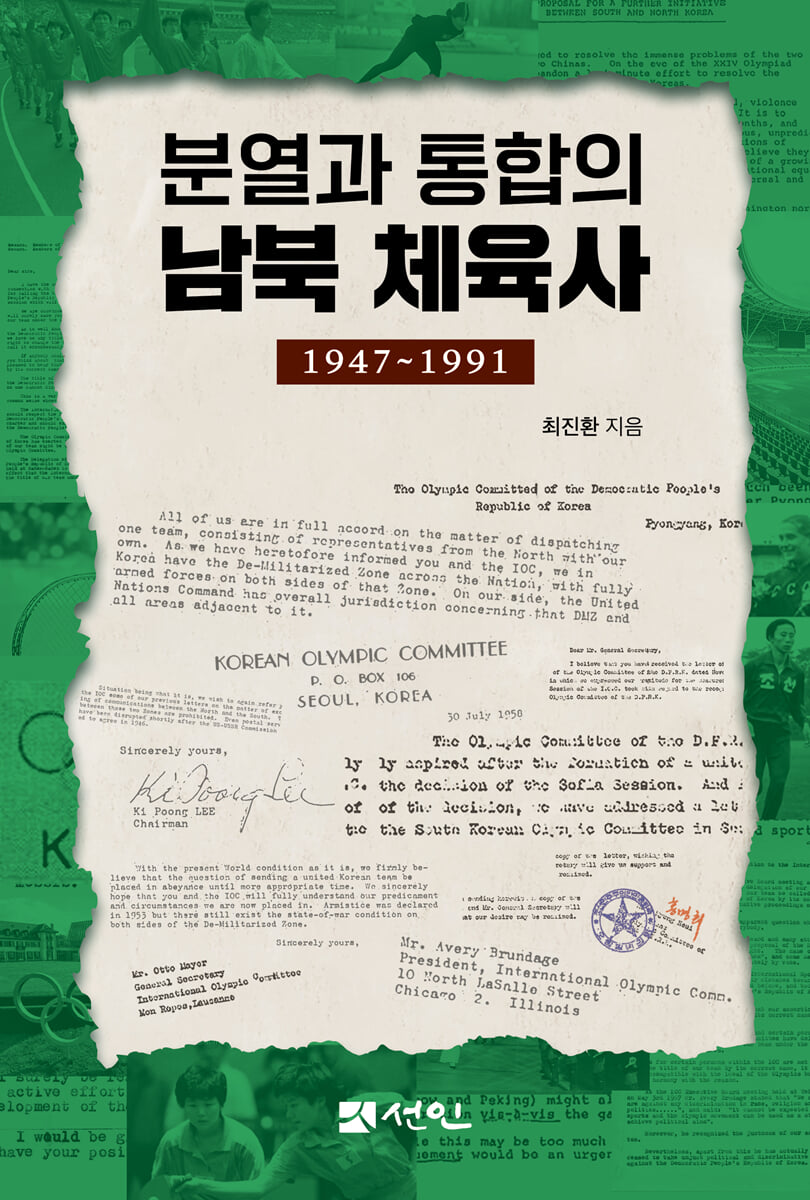
The history of North and South Korean sports: division and unification
 |
Description
Book Introduction
This book is a supplement to the research I did after receiving my doctorate in 2020 and the “Research on the ‘United Team’ between South and North Korea and the ‘Co-Hosting’ of the Olympics” debate.
The author visited the IOC Archives Center in Lausanne, Switzerland, twice in 2019 and 2023 to collect and organize correspondence (official documents at the time) and minutes of meetings between the South and the North and the IOC from 1947 to 1991, as well as the Brundage Collection (a collection of his correspondence as IOC President from 1952 to 1972).
In addition, by referencing the records of inter-Korean sports talks (1979-1991) of the National Archives of Korea and the public documents of the Ministry of Foreign Affairs (1963-1991) on inter-Korean sports exchanges and talks, as well as North Korea's spatial literature, we attempted to reconstruct historical facts that had been overlooked in previous studies and reveal their implications.
When I visited Switzerland in 2019, I was busy writing my doctoral dissertation and the amount of data was so vast that I only had data up to 1972.
I remember collecting the materials with a pounding heart, as they were from the 1950s and 1960s, a time when there wasn't much information on inter-Korean relations.
After finishing my degree, I became very curious about what happened after the 70s.
I was selected as a new researcher at the Ministry of Unification and was planning to go there right away, but it was postponed twice due to COVID-19, so I visited again in 2023 and successfully collected the remaining data.
The 80s data is mainly related to the 88 Seoul Olympics.
We were able to take a closer look at what interactions were behind what we knew.
We were also able to examine the movements in South Korea and North Korea that led to the formation of the first unified team in 1991.
This study was a meaningful time to reexamine Roh Tae-woo's Northern Policy at the time.
In conclusion, the reason why it was difficult to form a unified team between the South and the North until 1990 was because the two sides had distinct goals.
Then, in 1991, thanks to the Roh Tae-woo government's Northern Policy and political decisions, it was possible to form a unified team in table tennis and soccer.
Reconciliation between the North and the South has become a welcome development for our compatriots overseas.
However, with the emergence of new conservatives who sought to abolish the Northern Policy, the Northern Policy disappeared into the past.
That opportunity made me realize that it was a very precious time that would not come again.
The author visited the IOC Archives Center in Lausanne, Switzerland, twice in 2019 and 2023 to collect and organize correspondence (official documents at the time) and minutes of meetings between the South and the North and the IOC from 1947 to 1991, as well as the Brundage Collection (a collection of his correspondence as IOC President from 1952 to 1972).
In addition, by referencing the records of inter-Korean sports talks (1979-1991) of the National Archives of Korea and the public documents of the Ministry of Foreign Affairs (1963-1991) on inter-Korean sports exchanges and talks, as well as North Korea's spatial literature, we attempted to reconstruct historical facts that had been overlooked in previous studies and reveal their implications.
When I visited Switzerland in 2019, I was busy writing my doctoral dissertation and the amount of data was so vast that I only had data up to 1972.
I remember collecting the materials with a pounding heart, as they were from the 1950s and 1960s, a time when there wasn't much information on inter-Korean relations.
After finishing my degree, I became very curious about what happened after the 70s.
I was selected as a new researcher at the Ministry of Unification and was planning to go there right away, but it was postponed twice due to COVID-19, so I visited again in 2023 and successfully collected the remaining data.
The 80s data is mainly related to the 88 Seoul Olympics.
We were able to take a closer look at what interactions were behind what we knew.
We were also able to examine the movements in South Korea and North Korea that led to the formation of the first unified team in 1991.
This study was a meaningful time to reexamine Roh Tae-woo's Northern Policy at the time.
In conclusion, the reason why it was difficult to form a unified team between the South and the North until 1990 was because the two sides had distinct goals.
Then, in 1991, thanks to the Roh Tae-woo government's Northern Policy and political decisions, it was possible to form a unified team in table tennis and soccer.
Reconciliation between the North and the South has become a welcome development for our compatriots overseas.
However, with the emergence of new conservatives who sought to abolish the Northern Policy, the Northern Policy disappeared into the past.
That opportunity made me realize that it was a very precious time that would not come again.
- You can preview some of the book's contents.
Preview
index
preface
Chapter 1 | Introduction
Chapter 2 | KOC Approval and the Emergence of North Korea
1. The birth and role of KOC
2.
North Korea's demand for participation in the Olympics
3.
South Korea's rejection and North Korea's failure to participate in the Olympics
4. Acceptance of single team talks following rumors of KOC expulsion from the IOC
5.
First inter-Korean official sports talks
1) First Lausanne Conference (1963.
1. 24.)
2) First Hong Kong Conference (1963.
5. 17.~6.
1.)
3) Second Hong Kong Conference (1963.
7. 26.)
4) Second Lausanne Conference (1963.
8. 19.)
Chapter 3 | North Korea's IOC Admission Campaign
1.
?North Korea's NOC approval and the 1964 Innsbruck and Tokyo Olympics
2.
Hong Myong-hui, our country's name is the Democratic People's Republic of Korea (DPRK).
1) 67th IOC General Assembly in Mexico (1968.
10.
7.~11.)
2) 68th IOC General Assembly in Warsaw (1969.
6. 7.~9.)
3) Positions and changes among IOC personnel
3.
The division of North and South Korean sports and the strengthening of elite (professional) sports policies
1) 1972 Munich Summer Olympics
2) Strengthening state-led sports policies in the South and North
4.
Sintering
Chapter 4 | Inter-Korean Sports Competition and Attempts at Unification
1.
The fruits of inter-Korean sports competition
2.
1979 World Table Tennis Championships Unified Team Formation Meetings (1st to 4th)
1) First meeting (1979.
2. 27.)
2) 2nd meeting (1979.
3. 5.)
3) 3rd meeting (1979.
3. 9.)
4) 4th meeting (1979.
3. 12.)
3.
Proposal and rejection of a unified team at the 1980 Moscow Olympics
Chapter 5 | The Light and Shadow of North and South Korea: The 1988 Seoul Olympics
1.
1981 Baden-Baden and Seoul's bid for the Olympics
2.
North Korea's Olympic sabotage issue
1) International controversy over changing the Olympic venue (1982-1986)
2) Burma explosion incident (1983.
10.
9.)
3) Gimpo Airport explosion incident (1986)
9. 14.)
4) Geumgangsan Dam development response fraud case (1986.
10.
30.)
5) KAL plane explosion incident (1987.
11.
29.)
3.
1984 LA Olympics (1st to 3rd meetings)
1) First meeting (1984.
4. 9.)
2) 2nd meeting (1984.
4. 30.)
3) 3rd meeting (1984.
5. 25.)
4) North Korea declares boycott of the LA Olympics and South Korea proposes sports talks
4.
88 Seoul, North and South Korea jointly host the Olympics
1) Background of the co-hosting proposal
2) IOC Lausanne 1st Meeting (1985.
10.
8.~9.)
3) IOC Lausanne 2nd Meeting (1986.
1. 8.~9.)
4) IOC Lausanne 3rd Meeting (1986.
6. 10.~11.)
5) IOC Lausanne 4th Meeting (1987.
7. 14.~15.)
6) North Korea's declaration of boycott of the 1988 Seoul Olympics (1988.
1. 12.)
5. IOC Advisor Pisar's Proposal and the Half-Olympic Games
Chapter 6 | The Success and Limitations of a Joint Inter-Korean Team
1.
1990 Beijing Asian Games
1) 1st to 5th regular talks (1989.
3. 9.~11.
24.)
2) 1st to 3rd working-level representative contacts and 6th main meeting (1989.
12.
1.~12.
22.)
3) 4th and 5th working-level representative contacts and 7th main meeting (1990.
1. 10.~1.
18.)
4) 6th working-level representative contact and 8th and 9th main talks (1990.
1. 22.~2.
7.)
2.
President Roh Tae-woo's Northern Policy and the Formation of a Unified Team
1) Background and challenges of the Northern Policy
2) First unified team for the 1991 World Table Tennis Championships and World Youth Soccer Championships
3) 1st to 3rd talks (1990.
11.
29.~1.
30.)
4) 4th meeting (1991.
2. 12.), Final agreement on forming a single team
5) Formation and evaluation of the first unified team between the South and the North
3.
Failure to form a unified team at the 1992 Barcelona Olympics
4.
A Note on the Single Team and Co-hosting Debate
1) Debate over forming a single team
2) Co-hosting debate
Chapter 7 | Conclusion
References
Chapter 1 | Introduction
Chapter 2 | KOC Approval and the Emergence of North Korea
1. The birth and role of KOC
2.
North Korea's demand for participation in the Olympics
3.
South Korea's rejection and North Korea's failure to participate in the Olympics
4. Acceptance of single team talks following rumors of KOC expulsion from the IOC
5.
First inter-Korean official sports talks
1) First Lausanne Conference (1963.
1. 24.)
2) First Hong Kong Conference (1963.
5. 17.~6.
1.)
3) Second Hong Kong Conference (1963.
7. 26.)
4) Second Lausanne Conference (1963.
8. 19.)
Chapter 3 | North Korea's IOC Admission Campaign
1.
?North Korea's NOC approval and the 1964 Innsbruck and Tokyo Olympics
2.
Hong Myong-hui, our country's name is the Democratic People's Republic of Korea (DPRK).
1) 67th IOC General Assembly in Mexico (1968.
10.
7.~11.)
2) 68th IOC General Assembly in Warsaw (1969.
6. 7.~9.)
3) Positions and changes among IOC personnel
3.
The division of North and South Korean sports and the strengthening of elite (professional) sports policies
1) 1972 Munich Summer Olympics
2) Strengthening state-led sports policies in the South and North
4.
Sintering
Chapter 4 | Inter-Korean Sports Competition and Attempts at Unification
1.
The fruits of inter-Korean sports competition
2.
1979 World Table Tennis Championships Unified Team Formation Meetings (1st to 4th)
1) First meeting (1979.
2. 27.)
2) 2nd meeting (1979.
3. 5.)
3) 3rd meeting (1979.
3. 9.)
4) 4th meeting (1979.
3. 12.)
3.
Proposal and rejection of a unified team at the 1980 Moscow Olympics
Chapter 5 | The Light and Shadow of North and South Korea: The 1988 Seoul Olympics
1.
1981 Baden-Baden and Seoul's bid for the Olympics
2.
North Korea's Olympic sabotage issue
1) International controversy over changing the Olympic venue (1982-1986)
2) Burma explosion incident (1983.
10.
9.)
3) Gimpo Airport explosion incident (1986)
9. 14.)
4) Geumgangsan Dam development response fraud case (1986.
10.
30.)
5) KAL plane explosion incident (1987.
11.
29.)
3.
1984 LA Olympics (1st to 3rd meetings)
1) First meeting (1984.
4. 9.)
2) 2nd meeting (1984.
4. 30.)
3) 3rd meeting (1984.
5. 25.)
4) North Korea declares boycott of the LA Olympics and South Korea proposes sports talks
4.
88 Seoul, North and South Korea jointly host the Olympics
1) Background of the co-hosting proposal
2) IOC Lausanne 1st Meeting (1985.
10.
8.~9.)
3) IOC Lausanne 2nd Meeting (1986.
1. 8.~9.)
4) IOC Lausanne 3rd Meeting (1986.
6. 10.~11.)
5) IOC Lausanne 4th Meeting (1987.
7. 14.~15.)
6) North Korea's declaration of boycott of the 1988 Seoul Olympics (1988.
1. 12.)
5. IOC Advisor Pisar's Proposal and the Half-Olympic Games
Chapter 6 | The Success and Limitations of a Joint Inter-Korean Team
1.
1990 Beijing Asian Games
1) 1st to 5th regular talks (1989.
3. 9.~11.
24.)
2) 1st to 3rd working-level representative contacts and 6th main meeting (1989.
12.
1.~12.
22.)
3) 4th and 5th working-level representative contacts and 7th main meeting (1990.
1. 10.~1.
18.)
4) 6th working-level representative contact and 8th and 9th main talks (1990.
1. 22.~2.
7.)
2.
President Roh Tae-woo's Northern Policy and the Formation of a Unified Team
1) Background and challenges of the Northern Policy
2) First unified team for the 1991 World Table Tennis Championships and World Youth Soccer Championships
3) 1st to 3rd talks (1990.
11.
29.~1.
30.)
4) 4th meeting (1991.
2. 12.), Final agreement on forming a single team
5) Formation and evaluation of the first unified team between the South and the North
3.
Failure to form a unified team at the 1992 Barcelona Olympics
4.
A Note on the Single Team and Co-hosting Debate
1) Debate over forming a single team
2) Co-hosting debate
Chapter 7 | Conclusion
References
GOODS SPECIFICS
- Date of issue: June 2, 2025
- Page count, weight, size: 510 pages | 765g | 152*225*35mm
- ISBN13: 9791160689716
- ISBN10: 1160689717
You may also like
카테고리
korean


korean

![GQ KOREA Mark (Monthly): December [2025]](http://librairie.coreenne.fr/cdn/shop/files/8ef265dbbfbf186523ed75ba7319009d.jpg?v=1765340328&width=3840)


