

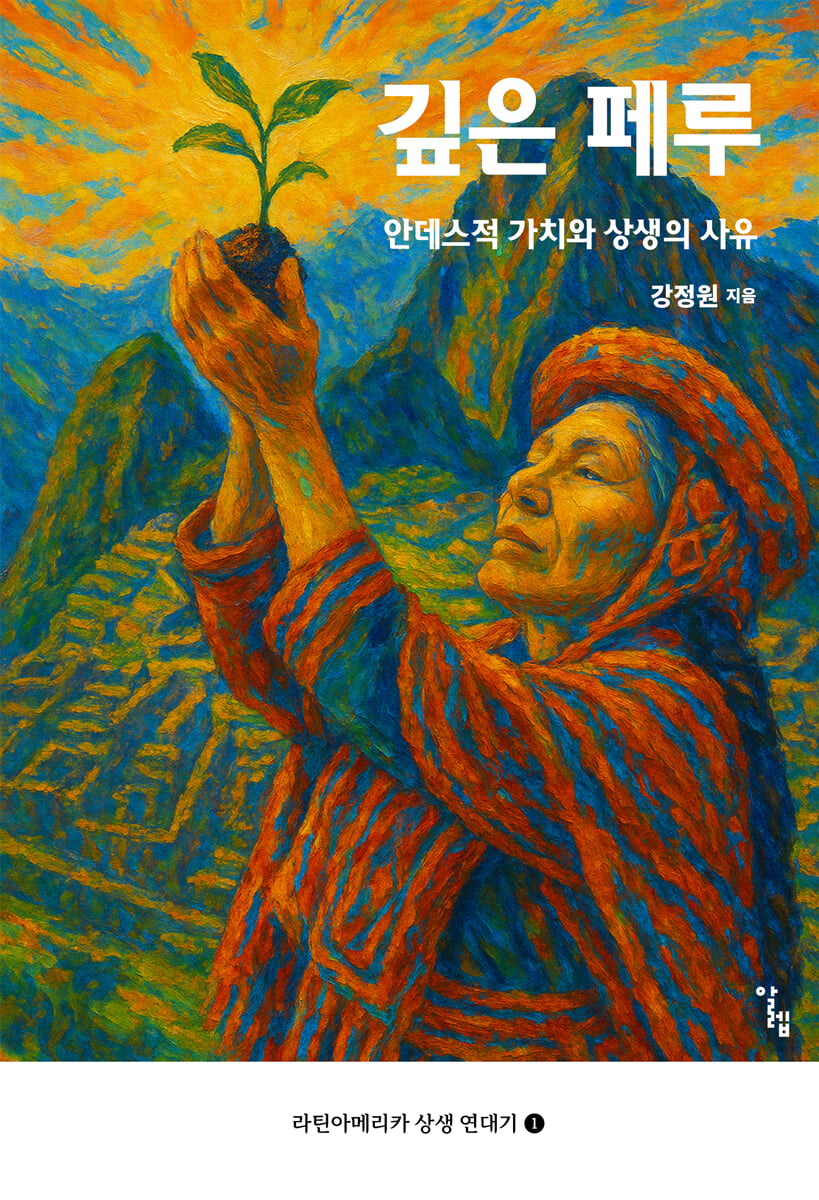
Deep Peru
 |
Description
Book Introduction
Rereading Peru, the Cradle of Ancient Civilization and Ecological Diversity
A humanities journey exploring the complex intersection of civilization, resources, ecology, and politics.
"Deep Peru" explores Peru's unique history, ecological diversity, and cultural hybridity within Latin America through the lens of "Andean values."
Author Kang Jeong-won believes that "Andean values" exist in the community-centered worldview that continues through the Inca civilization, colonial experience, and the ravages of modern developmentalism.
In other words, this book is an attempt to reexamine the past, present, and future of Peru's ecological civilization, focusing on the 'Andean values' that pursue harmonious relationships between humans and nature, individuals and society.
On the one hand, Peru is a land that preserves a splendid ancient heritage, including the Inca civilization, but on the other hand, it is at the forefront of an ecological crisis caused by resource development.
This book explains this dual reality through the framework of 'deep Peru (Peru profundo)' and 'public Peru (Peru legal)', and presents Andean values as an alternative for a truly coexistent society.
A humanities journey exploring the complex intersection of civilization, resources, ecology, and politics.
"Deep Peru" explores Peru's unique history, ecological diversity, and cultural hybridity within Latin America through the lens of "Andean values."
Author Kang Jeong-won believes that "Andean values" exist in the community-centered worldview that continues through the Inca civilization, colonial experience, and the ravages of modern developmentalism.
In other words, this book is an attempt to reexamine the past, present, and future of Peru's ecological civilization, focusing on the 'Andean values' that pursue harmonious relationships between humans and nature, individuals and society.
On the one hand, Peru is a land that preserves a splendid ancient heritage, including the Inca civilization, but on the other hand, it is at the forefront of an ecological crisis caused by resource development.
This book explains this dual reality through the framework of 'deep Peru (Peru profundo)' and 'public Peru (Peru legal)', and presents Andean values as an alternative for a truly coexistent society.
- You can preview some of the book's contents.
Preview
index
Entering deep Peruvian and Andean values
1 Peru, a country of diversity and potential
2 Ancient Andean Civilizations and Colonization
3 Ecological environment of the Andes
4 Ecological environment of the city
As I leave, I reflect on Peru's political crisis and the future of coexistence beyond it.
References
1 Peru, a country of diversity and potential
2 Ancient Andean Civilizations and Colonization
3 Ecological environment of the Andes
4 Ecological environment of the city
As I leave, I reflect on Peru's political crisis and the future of coexistence beyond it.
References
Detailed image
Into the book
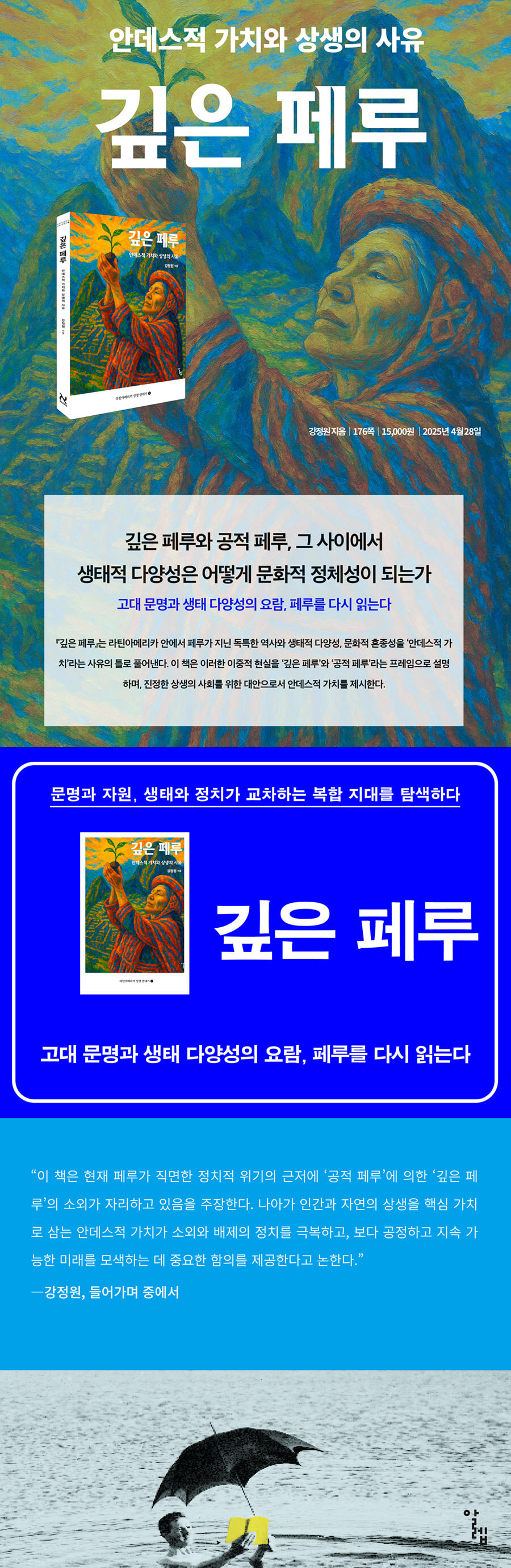
This book argues that the current political crisis facing Peru lies at the root of the marginalization of 'deep Peru' by 'public Peru'.
Furthermore, it argues that Andean values, which prioritize the coexistence of humans and nature, offer important implications for overcoming the politics of alienation and exclusion and seeking a more just and sustainable future.
--- From "Introducing Deep Peruvian and Andean Values"
Peru boasts a high level of ecological diversity due to its rapidly changing topography and the resulting climate diversity and diverse microclimates (ecological zones).
These ecological characteristics are reflected not only in the abundance of natural resources, but also in the diversity of plant species, which includes approximately 1,800 species of birds, over 500 species of mammals, over 300 species of reptiles, and approximately 16,000-20,000 species.
As John Murra's Andean studies and Philippe Descola's Amazonian studies show, Peruvian culture has been shaped by adapting to these diverse ecological environments, leading to cultural diversity.
The unique fusion and expression of ecological and cultural differences is perhaps Peru's true charm.
--- From "Chapter 1 - Peru, a Country of Diversity and Potential"
In the preface to his comprehensive book on Peruvian anthropology, No Country More Diverse: A Compendium of Peruvian Anthropology, published in 2000, Carlos Ivan Degregori, a prominent Peruvian anthropologist, argues that anthropology has contributed to the construction of an “us” with diverse identities, beyond the study of a simple “other.”
Here, he mentions the 'Andean paradigm (paradigma andino)' as an approach that became the mainstream of Peruvian anthropology in the mid-20th century. This refers to an attempt to find an alternative to overcome the contradictions of capitalist reality by viewing Andean peasant communities as representing idealistic Andean values, influenced by the 'indigenismo' ideology of JoseMaria Arguedas and Luis Valcarcel, who explored Peruvian identity through indigenous culture in the early 20th century.
So what elements might we call Andean values? How did the establishment of the Inca Empire, the most expansionist not only in South America but throughout pre-Columbian America, transform Andean cultural traditions?
--- From "Chapter 2 - Ancient Andean Civilization and Colonization"
Jorge Basarde, a prominent Peruvian historian, introduced the concept of “deep Peru” (Peruprofundo) in his 1947 book, “The Crowd, the City, and the Countryside in Peruvian History” (La multitud, la ciudad y el campo de la historia del Peru), to explain Peru’s dual structure.
Basarde defined the Andean indigenous people, peasants, and urban poor, who played a crucial role in shaping Peruvian identity but were marginalized from the nation's public discourse, as a traditional and deeply rooted society, calling them "Deep Peru," while he distinguished the urban elite and those in power who symbolized a modernized Peru in the official sphere as "Public Peru (Perulegal)."
The renowned Peruvian novelist JoseMaria Arguedas, in his third novel, The Deep Rivers (Los rios profundos), published in 1958, literary reinterprets Basarde's concept of "deep Peru," exploring the deep roots of Andean indigenous culture and their marginalization in modern Peruvian society.
The concept of 'Deep Peru' intuitively reveals Peru's dual structure, where a centralized political system centered in Lima marginalizes the Andes and the Amazon.
--- From "Chapter 4 - Ecological Environment of the City"
Analyzing Peru's current political crisis, I argue that, as Meléndez points out, it is rooted in the persistent marginalization of "deep Peruvians" (indigenous and mixed-race groups) by "public Peru" (an elite-centered political structure).
This argues that chronic elitist and social exclusion are key factors in the crisis.
Below, we examine the problems of presidential impeachment based on the "moral incapacity" clause of Congress, one of the main reasons supporting this.
Furthermore, it argues that Andean values, which prioritize the coexistence of humans and nature, offer important implications for overcoming the politics of alienation and exclusion and seeking a more just and sustainable future.
--- From "Introducing Deep Peruvian and Andean Values"
Peru boasts a high level of ecological diversity due to its rapidly changing topography and the resulting climate diversity and diverse microclimates (ecological zones).
These ecological characteristics are reflected not only in the abundance of natural resources, but also in the diversity of plant species, which includes approximately 1,800 species of birds, over 500 species of mammals, over 300 species of reptiles, and approximately 16,000-20,000 species.
As John Murra's Andean studies and Philippe Descola's Amazonian studies show, Peruvian culture has been shaped by adapting to these diverse ecological environments, leading to cultural diversity.
The unique fusion and expression of ecological and cultural differences is perhaps Peru's true charm.
--- From "Chapter 1 - Peru, a Country of Diversity and Potential"
In the preface to his comprehensive book on Peruvian anthropology, No Country More Diverse: A Compendium of Peruvian Anthropology, published in 2000, Carlos Ivan Degregori, a prominent Peruvian anthropologist, argues that anthropology has contributed to the construction of an “us” with diverse identities, beyond the study of a simple “other.”
Here, he mentions the 'Andean paradigm (paradigma andino)' as an approach that became the mainstream of Peruvian anthropology in the mid-20th century. This refers to an attempt to find an alternative to overcome the contradictions of capitalist reality by viewing Andean peasant communities as representing idealistic Andean values, influenced by the 'indigenismo' ideology of JoseMaria Arguedas and Luis Valcarcel, who explored Peruvian identity through indigenous culture in the early 20th century.
So what elements might we call Andean values? How did the establishment of the Inca Empire, the most expansionist not only in South America but throughout pre-Columbian America, transform Andean cultural traditions?
--- From "Chapter 2 - Ancient Andean Civilization and Colonization"
Jorge Basarde, a prominent Peruvian historian, introduced the concept of “deep Peru” (Peruprofundo) in his 1947 book, “The Crowd, the City, and the Countryside in Peruvian History” (La multitud, la ciudad y el campo de la historia del Peru), to explain Peru’s dual structure.
Basarde defined the Andean indigenous people, peasants, and urban poor, who played a crucial role in shaping Peruvian identity but were marginalized from the nation's public discourse, as a traditional and deeply rooted society, calling them "Deep Peru," while he distinguished the urban elite and those in power who symbolized a modernized Peru in the official sphere as "Public Peru (Perulegal)."
The renowned Peruvian novelist JoseMaria Arguedas, in his third novel, The Deep Rivers (Los rios profundos), published in 1958, literary reinterprets Basarde's concept of "deep Peru," exploring the deep roots of Andean indigenous culture and their marginalization in modern Peruvian society.
The concept of 'Deep Peru' intuitively reveals Peru's dual structure, where a centralized political system centered in Lima marginalizes the Andes and the Amazon.
--- From "Chapter 4 - Ecological Environment of the City"
Analyzing Peru's current political crisis, I argue that, as Meléndez points out, it is rooted in the persistent marginalization of "deep Peruvians" (indigenous and mixed-race groups) by "public Peru" (an elite-centered political structure).
This argues that chronic elitist and social exclusion are key factors in the crisis.
Below, we examine the problems of presidential impeachment based on the "moral incapacity" clause of Congress, one of the main reasons supporting this.
--- From “Thinking about Peru’s political crisis and the future of coexistence beyond it”
Publisher's Review
A central worldview exploring Peru's ecological civilization: Andean values
In this book, the author explores how Andean values have contributed to the formation of Peruvian history and culture.
'Andean values' are an important framework for understanding current Peruvian society.
It is presented as a worldview that pursues a harmonious relationship between humans and nature, individuals and society, and functions as a central worldview for exploring Peru's ecological civilization.
Peru was the center of Andean civilization and has maintained cultural continuity and preserved its unique values even through historical upheaval.
Deep Peru illuminates the ecological, geographical, and economic complexity of modern Peru, from the ancient Inca and Norte Chico civilizations, through the framework of Andean values.
This demonstrates that Andean values are a core concept for understanding and connecting various aspects of Peruvian history and culture.
This book argues that the current political crisis facing Peru lies at the root of the marginalization of 'deep Peru' by 'public Peru'.
Furthermore, he argues that Andean values, which prioritize the coexistence of humans and nature, offer important implications for overcoming the politics of alienation and exclusion and seeking a more just and sustainable future.
How do the Deep Peru and Public Peru frames explain Peru's structural inequalities?
The author uses the frames of 'deep Peru (Peru profundo)' and 'public Peru (Peru legal)' as core frameworks for analyzing the reality of Peru's social structure, and through them explains Peru's structural inequality.
Public Peru refers to a centralized, formal order in which power and institutions are concentrated.
It symbolizes the centralized power centered in the capital city of Lima, and the relocation of the capital to Lima in the early colonial period made Lima a symbol of public Peru.
Deep Peru represents the indigenous life and world that is invisible but deeply rooted.
This mainly refers to the indigenous way of life of the Andes and Amazon regions.
This book argues that the political crisis and structural inequality facing Peru today lies at the root of the marginalization of 'deep Peru' by 'public Peru'.
It is a concept that analyzes the structural tension between the central power centered in the capital Lima and the indigenous way of life of the Andes and Amazon regions.
Furthermore, Peru has a core socio-cultural characteristic of hybridity, a fusion of indigenous and Spanish cultures. While this hybridity adds dynamism, it is also sometimes exploited to justify or perpetuate violent and oppressive relationships, leading to conflict.
In particular, Peru's unique mixed-race nature, where various ethnic groups have lived separately in different regions, combined with different ecological environments, has created unique social structures in each region, and these structures may be associated with inequality.
Even within Lima, the symbol of 'public Peru', structural inequalities and dual social structures are reproduced, as analyzed through the informal settlements called 'barriadas' or 'pueblo jovens'.
Here, the lives of various ethnic groups, including indigenous peoples who have migrated to the city to survive, are intertwined, revealing the realities of a 'deeply Peruvian' element within 'public Peru'.
In conclusion, the 'public Peru' and 'deep Peru' frames explain that the structural relationship in which central power (public Peru) marginalizes and excludes indigenous lives and the world of the periphery (deep Peru) causes and deepens inequality in Peru.
How are Peru's ecological diversity and cultural hybridity interconnected?
Peru's mixed culture is a unique feature that distinguishes it from other Latin American countries: its diverse ethnic groups have lived in relatively distinct geographical regions.
This geographical area is soon combined with diverse ecological environments.
Regional racial differentiation, combined with different ecological environments, has formed the background for diverse lifestyles, production activities, and unique social structures in each region.
In other words, Peru's rich ecological diversity (different ecological environments and distinct geographical regions) has provided the basis for different ethnic/cultural groups to adapt to different environments and develop unique lifestyles and social structures, and this regional diversity has contributed to the formation of cultural hybridity throughout Peru.
Beyond simple cultural fusion, differences in ecological environments have deepened regional diversity in cultural characteristics and social structures, creating a unique aspect of Peruvian hybridity.
This connection is also related to the ‘public Peru’ and ‘deep Peru’ frames.
Deep Peru represents the indigenous life and world rooted primarily in ecologically diverse regions such as the Andes and the Amazon, while public Peru refers to the centralized power and institutions centered in Lima.
The profound marginalization of Peru by the public Peruvian state can ultimately be interpreted as a structural inequality in which regional ways of life and cultures based on ecological diversity are excluded by the centralized official order.
Between Deep Peru and Public Peru: How Ecological Diversity Becomes Cultural Identity
"Deep Peru" is a book that illuminates Peru's unique history and culture, including the ancient Inca and Norte Chico civilizations, as well as the ecological, geographical, and economic complexity of modern Peru, through the framework of Andean values.
Author Kang Jeong-won analyzes the structural tension between central power centered in the capital city of Lima and the indigenous ways of life in the Andes and Amazon regions through the concepts of “public Peru” and “deep Peru.”
This book seeks to go beyond the simple consumption of Peru as a tourist destination or ancient ruins, and examine the potential value and potential within it.
In Chapter 1, the author examines Peru's unique charm and potential from cultural, ecological, and economic perspectives.
This chapter illuminates Peru's unique position within the Latin American context and explores its potential.
Beginning with the Norte Chico civilization around 3500 BC, the book traces the lineage of Peruvian civilization, tracing its complex social structures, ecological adaptation strategies, religious rituals, and technological developments through the Moche, Chavín, Wari, Nazca, Chimu, and Inca empires.
Chapter 2 explores how Peru, the center of Andean civilization, maintained cultural continuity and preserved its unique values despite historical upheaval.
Through the conceptual framework of "Andean values," this chapter analyzes how these values have been formed and inherited through historical change, and explores the ways in which Peru's past and present coexist in harmony.
Chapter 3 examines in depth the impact of mining development, a mainstay of the Peruvian economy from colonial times to the present, on Andean communities.
Mining has generated enormous wealth in Peru over the centuries, but it has also led to serious social conflict and environmental destruction.
In particular, Peru's mines are mostly concentrated in the Andes, and have the destructive power to completely shake the lives of Andean indigenous communities.
Drawing on ethnographic research, this chapter analyzes the resistance and survival strategies of indigenous and peasant communities as they seek to preserve their cultural identity and livelihoods against the destructive impacts of mining development.
Chapter 4 examines Lima, the capital city and a symbol of modern Peru, contrasting with the Andes, through Jorge Basarde's concepts of 'deep Peru (Peruprofundo)' and 'public Peru (Peru legal)'.
The transfer of the capital to Lima in the early colonial period made Lima a symbol of 'public Peru'.
However, since the colonial era, indigenous people have been migrating to the city through labor to survive, transforming Lima into a complex space where the lives of Europeans, mestizos, and indigenous peoples are intertwined.
This chapter analyzes Peru's structural inequality and dual social structure as they are reproduced within Lima through informal settlements called 'barriadas' or 'pueblo jovens'.
Beyond a simple history or regional study, "Deep Peru" offers insights into the ecological crisis and social inequality facing humanity.
Through rich data and empirical case studies, it presents a balanced view of the complexity and potential of Peruvian society, and through the rediscovery of Andean values, it allows us to contemplate an alternative future where humans and nature coexist.
This book, which proposes a new way of thinking about coexistence at the boundaries between nature and humanity, tradition and modernity, and colonialism and post-colonialism, will provide profound inspiration to all those seeking an ecological civilization beyond Latin America.
What about the 'Latin American Symbiosis Chronicle'?
The HK+ Project Group of the Institute of Latin American Studies at Hankuk University of Foreign Studies is conducting a project titled “Latin America, a Platform for the Transition of 21st Century Civilization: From Industrial Civilization to Ecological Civilization.” The project is researching the various efforts being made to establish a sustainable ecological civilization paradigm not only in Latin America but also around the world, as well as the alternative worldviews and lifestyles pursued by Latin Americans.
To share the results of our research with the public, our research team is planning and publishing new books: the 'Ecological Civilization Series,' the 'Ecological Civilization Culture Series,' the 'Buen Vivir Series,' and the 'Latin American Coexistence Chronicle.'
The new book, "Latin American Coexistence Chronicle," which deals specifically with the ecological civilization of each Latin American country, broadly introduces the unique challenges and achievements of each Latin American country regarding ecology, as well as their vision for the future.
Through this, readers will gain a deeper and broader understanding of Latin America's ecological diversity and spirit of inclusive solidarity.
In this book, the author explores how Andean values have contributed to the formation of Peruvian history and culture.
'Andean values' are an important framework for understanding current Peruvian society.
It is presented as a worldview that pursues a harmonious relationship between humans and nature, individuals and society, and functions as a central worldview for exploring Peru's ecological civilization.
Peru was the center of Andean civilization and has maintained cultural continuity and preserved its unique values even through historical upheaval.
Deep Peru illuminates the ecological, geographical, and economic complexity of modern Peru, from the ancient Inca and Norte Chico civilizations, through the framework of Andean values.
This demonstrates that Andean values are a core concept for understanding and connecting various aspects of Peruvian history and culture.
This book argues that the current political crisis facing Peru lies at the root of the marginalization of 'deep Peru' by 'public Peru'.
Furthermore, he argues that Andean values, which prioritize the coexistence of humans and nature, offer important implications for overcoming the politics of alienation and exclusion and seeking a more just and sustainable future.
How do the Deep Peru and Public Peru frames explain Peru's structural inequalities?
The author uses the frames of 'deep Peru (Peru profundo)' and 'public Peru (Peru legal)' as core frameworks for analyzing the reality of Peru's social structure, and through them explains Peru's structural inequality.
Public Peru refers to a centralized, formal order in which power and institutions are concentrated.
It symbolizes the centralized power centered in the capital city of Lima, and the relocation of the capital to Lima in the early colonial period made Lima a symbol of public Peru.
Deep Peru represents the indigenous life and world that is invisible but deeply rooted.
This mainly refers to the indigenous way of life of the Andes and Amazon regions.
This book argues that the political crisis and structural inequality facing Peru today lies at the root of the marginalization of 'deep Peru' by 'public Peru'.
It is a concept that analyzes the structural tension between the central power centered in the capital Lima and the indigenous way of life of the Andes and Amazon regions.
Furthermore, Peru has a core socio-cultural characteristic of hybridity, a fusion of indigenous and Spanish cultures. While this hybridity adds dynamism, it is also sometimes exploited to justify or perpetuate violent and oppressive relationships, leading to conflict.
In particular, Peru's unique mixed-race nature, where various ethnic groups have lived separately in different regions, combined with different ecological environments, has created unique social structures in each region, and these structures may be associated with inequality.
Even within Lima, the symbol of 'public Peru', structural inequalities and dual social structures are reproduced, as analyzed through the informal settlements called 'barriadas' or 'pueblo jovens'.
Here, the lives of various ethnic groups, including indigenous peoples who have migrated to the city to survive, are intertwined, revealing the realities of a 'deeply Peruvian' element within 'public Peru'.
In conclusion, the 'public Peru' and 'deep Peru' frames explain that the structural relationship in which central power (public Peru) marginalizes and excludes indigenous lives and the world of the periphery (deep Peru) causes and deepens inequality in Peru.
How are Peru's ecological diversity and cultural hybridity interconnected?
Peru's mixed culture is a unique feature that distinguishes it from other Latin American countries: its diverse ethnic groups have lived in relatively distinct geographical regions.
This geographical area is soon combined with diverse ecological environments.
Regional racial differentiation, combined with different ecological environments, has formed the background for diverse lifestyles, production activities, and unique social structures in each region.
In other words, Peru's rich ecological diversity (different ecological environments and distinct geographical regions) has provided the basis for different ethnic/cultural groups to adapt to different environments and develop unique lifestyles and social structures, and this regional diversity has contributed to the formation of cultural hybridity throughout Peru.
Beyond simple cultural fusion, differences in ecological environments have deepened regional diversity in cultural characteristics and social structures, creating a unique aspect of Peruvian hybridity.
This connection is also related to the ‘public Peru’ and ‘deep Peru’ frames.
Deep Peru represents the indigenous life and world rooted primarily in ecologically diverse regions such as the Andes and the Amazon, while public Peru refers to the centralized power and institutions centered in Lima.
The profound marginalization of Peru by the public Peruvian state can ultimately be interpreted as a structural inequality in which regional ways of life and cultures based on ecological diversity are excluded by the centralized official order.
Between Deep Peru and Public Peru: How Ecological Diversity Becomes Cultural Identity
"Deep Peru" is a book that illuminates Peru's unique history and culture, including the ancient Inca and Norte Chico civilizations, as well as the ecological, geographical, and economic complexity of modern Peru, through the framework of Andean values.
Author Kang Jeong-won analyzes the structural tension between central power centered in the capital city of Lima and the indigenous ways of life in the Andes and Amazon regions through the concepts of “public Peru” and “deep Peru.”
This book seeks to go beyond the simple consumption of Peru as a tourist destination or ancient ruins, and examine the potential value and potential within it.
In Chapter 1, the author examines Peru's unique charm and potential from cultural, ecological, and economic perspectives.
This chapter illuminates Peru's unique position within the Latin American context and explores its potential.
Beginning with the Norte Chico civilization around 3500 BC, the book traces the lineage of Peruvian civilization, tracing its complex social structures, ecological adaptation strategies, religious rituals, and technological developments through the Moche, Chavín, Wari, Nazca, Chimu, and Inca empires.
Chapter 2 explores how Peru, the center of Andean civilization, maintained cultural continuity and preserved its unique values despite historical upheaval.
Through the conceptual framework of "Andean values," this chapter analyzes how these values have been formed and inherited through historical change, and explores the ways in which Peru's past and present coexist in harmony.
Chapter 3 examines in depth the impact of mining development, a mainstay of the Peruvian economy from colonial times to the present, on Andean communities.
Mining has generated enormous wealth in Peru over the centuries, but it has also led to serious social conflict and environmental destruction.
In particular, Peru's mines are mostly concentrated in the Andes, and have the destructive power to completely shake the lives of Andean indigenous communities.
Drawing on ethnographic research, this chapter analyzes the resistance and survival strategies of indigenous and peasant communities as they seek to preserve their cultural identity and livelihoods against the destructive impacts of mining development.
Chapter 4 examines Lima, the capital city and a symbol of modern Peru, contrasting with the Andes, through Jorge Basarde's concepts of 'deep Peru (Peruprofundo)' and 'public Peru (Peru legal)'.
The transfer of the capital to Lima in the early colonial period made Lima a symbol of 'public Peru'.
However, since the colonial era, indigenous people have been migrating to the city through labor to survive, transforming Lima into a complex space where the lives of Europeans, mestizos, and indigenous peoples are intertwined.
This chapter analyzes Peru's structural inequality and dual social structure as they are reproduced within Lima through informal settlements called 'barriadas' or 'pueblo jovens'.
Beyond a simple history or regional study, "Deep Peru" offers insights into the ecological crisis and social inequality facing humanity.
Through rich data and empirical case studies, it presents a balanced view of the complexity and potential of Peruvian society, and through the rediscovery of Andean values, it allows us to contemplate an alternative future where humans and nature coexist.
This book, which proposes a new way of thinking about coexistence at the boundaries between nature and humanity, tradition and modernity, and colonialism and post-colonialism, will provide profound inspiration to all those seeking an ecological civilization beyond Latin America.
What about the 'Latin American Symbiosis Chronicle'?
The HK+ Project Group of the Institute of Latin American Studies at Hankuk University of Foreign Studies is conducting a project titled “Latin America, a Platform for the Transition of 21st Century Civilization: From Industrial Civilization to Ecological Civilization.” The project is researching the various efforts being made to establish a sustainable ecological civilization paradigm not only in Latin America but also around the world, as well as the alternative worldviews and lifestyles pursued by Latin Americans.
To share the results of our research with the public, our research team is planning and publishing new books: the 'Ecological Civilization Series,' the 'Ecological Civilization Culture Series,' the 'Buen Vivir Series,' and the 'Latin American Coexistence Chronicle.'
The new book, "Latin American Coexistence Chronicle," which deals specifically with the ecological civilization of each Latin American country, broadly introduces the unique challenges and achievements of each Latin American country regarding ecology, as well as their vision for the future.
Through this, readers will gain a deeper and broader understanding of Latin America's ecological diversity and spirit of inclusive solidarity.
GOODS SPECIFICS
- Date of issue: April 28, 2025
- Page count, weight, size: 176 pages | 288g | 140*205*12mm
- ISBN13: 9791189333959
You may also like
카테고리
korean


korean

![GQ KOREA Mark (Monthly): December [2025]](http://librairie.coreenne.fr/cdn/shop/files/8ef265dbbfbf186523ed75ba7319009d.jpg?v=1765340328&width=3840)


