

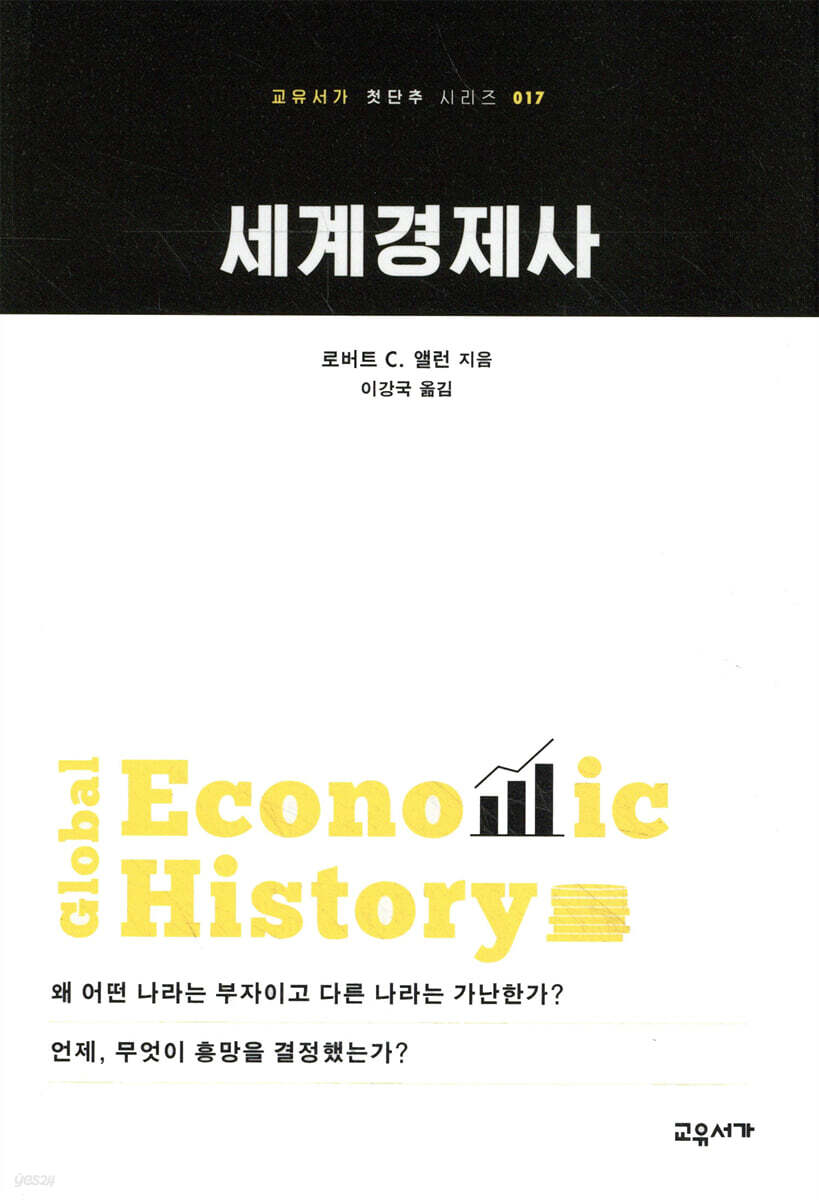
World Economic History
 |
Description
Book Introduction
Why are some countries rich and others poor?
Economic Development: A History of Leading and Chasing
※ This book is a re-release of 『World Economic History』 (Kyoyuseoga, 2017).
'Why are some countries rich and others poor?' This is the fundamental question and subject of study in economic history.
This book answers two questions that arise from this: 'Why did the Industrial Revolution occur in Britain and not elsewhere?' and 'How did other advanced countries catch up with and even surpass Britain?'
By comparing wages, living standards, and prices of major products across the globe over the past 500 years, the author explores the turning points of history, the commonalities of countries that seized the opportunity to become wealthy, and the origins of current inequality.
It also colorfully unravels the turbulence of the world economy, from the dawn of imperialism to Japan's bubble economy and China's rise, through the interplay of geography, globalization, technological change, economic policy, and institutions.
In particular, it is noteworthy that while comprehensively presenting technological progress, government policy, and globalization as factors of growth, technological progress is understood endogenously based on the relative prices of production factors and the role of the government in economic growth is emphasized.
These arguments offer new insights that differ from the mainstream economic perspective that emphasizes the role of institutions and free markets in economic growth.
Economic Development: A History of Leading and Chasing
※ This book is a re-release of 『World Economic History』 (Kyoyuseoga, 2017).
'Why are some countries rich and others poor?' This is the fundamental question and subject of study in economic history.
This book answers two questions that arise from this: 'Why did the Industrial Revolution occur in Britain and not elsewhere?' and 'How did other advanced countries catch up with and even surpass Britain?'
By comparing wages, living standards, and prices of major products across the globe over the past 500 years, the author explores the turning points of history, the commonalities of countries that seized the opportunity to become wealthy, and the origins of current inequality.
It also colorfully unravels the turbulence of the world economy, from the dawn of imperialism to Japan's bubble economy and China's rise, through the interplay of geography, globalization, technological change, economic policy, and institutions.
In particular, it is noteworthy that while comprehensively presenting technological progress, government policy, and globalization as factors of growth, technological progress is understood endogenously based on the relative prices of production factors and the role of the government in economic growth is emphasized.
These arguments offer new insights that differ from the mainstream economic perspective that emphasizes the role of institutions and free markets in economic growth.
index
1.
Great Divergence
2.
The Rise of the West
3.
Industrial Revolution
4.
The power of advanced countries
5.
Great empires
6.
America
7.
Africa
8.
Standard Model and Post-Industrialization
9.
Big Push Industrialization
Acknowledgments/References/Reading Guide/Translator's Note
Great Divergence
2.
The Rise of the West
3.
Industrial Revolution
4.
The power of advanced countries
5.
Great empires
6.
America
7.
Africa
8.
Standard Model and Post-Industrialization
9.
Big Push Industrialization
Acknowledgments/References/Reading Guide/Translator's Note
Into the book
A minimum subsistence level removes the economic incentive for a country to develop economically.
There is a need to get more output from a day's work, but in this case, labor is so cheap that companies have no incentive to develop or introduce machines that would increase productivity.
The minimum standard of living is a poverty trap.
The Industrial Revolution was a direct result of high wages.
The Industrial Revolution wasn't just about higher wages.
--- p.24
Why has the world become increasingly unequal? Both "fundamental factors" like geography, institutions, and culture, as well as "historical accidents," have played a role.
--- p.26
The Industrial Revolution (roughly 1760 to 1850) was a turning point in world history.
Because it opened a new era of sustained economic growth.
The Industrial Revolution wasn't the abrupt break its name suggests, but rather the result of the early modern economic transition discussed in the previous chapter. Compared to the recent growth miracle, where GDP grew by 8 to 10 percent, the economic growth rate for the century after 1760 (1.5 percent per year) was remarkably low.
However, Britain continued to expand its cutting-edge technology as a leader in the world.
--- p.44
Scientific discoveries were known throughout Europe, and upper-class interest in natural philosophy was universal.
Therefore, these cultural developments cannot explain why the Industrial Revolution occurred in Britain.
Instead, the explanation for the Industrial Revolution must be sought in Britain's unique wage and price structure.
In a British economy based on high wages and cheap energy, it was profitable for businesses to invent and use the innovative technologies that fueled the Industrial Revolution.
--- p.49~50
High wages in developed countries have led to increased use of capital, leading to the development of labor-saving products.
This created a chain reaction that promoted progress.
Higher wages encouraged more capital-intensive production, which in turn led to higher wages.
This virtuous cycle has become the basis for income growth in developed countries.
--- p.76~77
Western developed countries have experienced a development trajectory in which higher wages lead to the development of labor-saving technologies, and the use of these technologies leads to increased labor productivity and wages.
This cycle repeats itself.
Today, poor countries have missed the elevator.
In these countries, wages are low and the cost of capital is high, so production must be done using outdated technologies, and thus incomes are low.
The history of industry provides examples of these laws.
--- p.82
Why did the United States and Mexico take such different paths? The demand for literacy and numeracy was much greater in colonial America than in colonial Mexico.
This is because the North American colonies were indigenous product economies, and the settlers there expected to sell much of their products to buy British consumer goods and achieve a European standard of living.
The ability to read and write facilitated commercial activity.
Conversely, Mexico's indigenous population was much less commercially active and therefore less useful in these capacities.
There is a need to get more output from a day's work, but in this case, labor is so cheap that companies have no incentive to develop or introduce machines that would increase productivity.
The minimum standard of living is a poverty trap.
The Industrial Revolution was a direct result of high wages.
The Industrial Revolution wasn't just about higher wages.
--- p.24
Why has the world become increasingly unequal? Both "fundamental factors" like geography, institutions, and culture, as well as "historical accidents," have played a role.
--- p.26
The Industrial Revolution (roughly 1760 to 1850) was a turning point in world history.
Because it opened a new era of sustained economic growth.
The Industrial Revolution wasn't the abrupt break its name suggests, but rather the result of the early modern economic transition discussed in the previous chapter. Compared to the recent growth miracle, where GDP grew by 8 to 10 percent, the economic growth rate for the century after 1760 (1.5 percent per year) was remarkably low.
However, Britain continued to expand its cutting-edge technology as a leader in the world.
--- p.44
Scientific discoveries were known throughout Europe, and upper-class interest in natural philosophy was universal.
Therefore, these cultural developments cannot explain why the Industrial Revolution occurred in Britain.
Instead, the explanation for the Industrial Revolution must be sought in Britain's unique wage and price structure.
In a British economy based on high wages and cheap energy, it was profitable for businesses to invent and use the innovative technologies that fueled the Industrial Revolution.
--- p.49~50
High wages in developed countries have led to increased use of capital, leading to the development of labor-saving products.
This created a chain reaction that promoted progress.
Higher wages encouraged more capital-intensive production, which in turn led to higher wages.
This virtuous cycle has become the basis for income growth in developed countries.
--- p.76~77
Western developed countries have experienced a development trajectory in which higher wages lead to the development of labor-saving technologies, and the use of these technologies leads to increased labor productivity and wages.
This cycle repeats itself.
Today, poor countries have missed the elevator.
In these countries, wages are low and the cost of capital is high, so production must be done using outdated technologies, and thus incomes are low.
The history of industry provides examples of these laws.
--- p.82
Why did the United States and Mexico take such different paths? The demand for literacy and numeracy was much greater in colonial America than in colonial Mexico.
This is because the North American colonies were indigenous product economies, and the settlers there expected to sell much of their products to buy British consumer goods and achieve a European standard of living.
The ability to read and write facilitated commercial activity.
Conversely, Mexico's indigenous population was much less commercially active and therefore less useful in these capacities.
--- p.141~142
Publisher's Review
Bold questions and answers spanning 500 years of history
The author divides the world economic history since 1500 into the mercantilism period, the catch-up period, and the Big Push industrialization period.
And we trace where the driving force behind economic development was in each period.
The period of mercantilism from 1500 to 1800 refers to the colonial period, the global economy, and the Industrial Revolution triggered by the great voyages of discovery.
The period of catching up was the period in the 19th century when Europe and the United States began to pursue Britain, and the period of Big Push industrialization was the period in the 20th century when the Soviet Union, China, and East Asian countries including Japan caught up with the advanced countries.
Based on this extensive period of data, the author presents answers to major historical questions, such as why the North and South of the Americas, which experienced the same colonial history, took different paths; why the Soviet Union and China, which pursued similar planned economies, also had different histories; and why continents like Africa and India remain mired in poverty.
Britain's high wages fueled the Industrial Revolution.
The Industrial Revolution in Britain was a remarkable development.
During the Industrial Revolution, Britain's share of global manufacturing increased from 2 percent to 23 percent, a power powerful enough to devastate Asian manufacturing.
The author cites 'high wages' as the cause of the Industrial Revolution in England.
Because labor costs were high, there was a need to replace labor with new technologies, and the steam engine that emerged in this way brought innovation to the spinning and textile industries of the time.
Conversely, in colonial countries, because labor costs were low, there was little incentive to introduce new technologies, and countries like India, which was eliminated from competition with Britain in the cotton industry, were unable to move beyond being agricultural production sites within the globalizing economic structure.
Standard models that drove development: railways, tariffs, banks, schools
The term "standard model" appears in this book.
In other words, there are policies that countries that joined the ranks of advanced countries in the process of industrialization have adopted in common.
These are the common factors that enabled the development of Germany, which fiercely pursued Britain in the 19th century, the United States, which dominated the 20th century, and Japan and China.
The author lists four standard models.
Railways, customs, banks, and schools.
Railroads helped integrate a country's market into a national one, while tariffs protected the domestic market until growth was underway.
Banks played a role in investing in innovation by financing industrial capital, and as workers with reading, writing, and arithmetic skills earned higher wages, demand for education arose, and this demand was supported by mass education.
The author believes that these four factors, when intertwined, have promoted technological advancement and entered a virtuous cycle of increasing income.
A counterattack by latecomers and a government-led big push
Because advanced countries have entered a virtuous cycle and are recording stable economic growth rates, it is impossible for latecomers to catch up without groundbreaking economic growth.
The author also finds commonalities in several countries that joined the ranks of advanced nations in the 20th century.
This is the government-led big push industrialization.
For example, there are no factories to produce automobiles, and no steel mills to produce the iron used here.
There is no power plant to operate the steel mill.
There may be a lot of demand for cars.
In short, there is neither supply nor demand.
This is when the government steps in.
It's like building an automobile factory with the 'belief' that there will be demand, and building a steel mill with the 'belief' that once the automobile factory is built, there will be demand.
The government intervenes in supply and demand, acting as a "guarantor" to promote construction.
In other words, they argue that the incentives for economic development come from the government, not the market.
The author argues that China achieved its current status through Big Push industrialization.
And if China continues to develop at its current pace, the world economy will complete a massive cycle, returning to the situation before Columbus and Vasco da Gama 'discovered' the New World, before the Great Divergence mentioned in this book.
The author divides the world economic history since 1500 into the mercantilism period, the catch-up period, and the Big Push industrialization period.
And we trace where the driving force behind economic development was in each period.
The period of mercantilism from 1500 to 1800 refers to the colonial period, the global economy, and the Industrial Revolution triggered by the great voyages of discovery.
The period of catching up was the period in the 19th century when Europe and the United States began to pursue Britain, and the period of Big Push industrialization was the period in the 20th century when the Soviet Union, China, and East Asian countries including Japan caught up with the advanced countries.
Based on this extensive period of data, the author presents answers to major historical questions, such as why the North and South of the Americas, which experienced the same colonial history, took different paths; why the Soviet Union and China, which pursued similar planned economies, also had different histories; and why continents like Africa and India remain mired in poverty.
Britain's high wages fueled the Industrial Revolution.
The Industrial Revolution in Britain was a remarkable development.
During the Industrial Revolution, Britain's share of global manufacturing increased from 2 percent to 23 percent, a power powerful enough to devastate Asian manufacturing.
The author cites 'high wages' as the cause of the Industrial Revolution in England.
Because labor costs were high, there was a need to replace labor with new technologies, and the steam engine that emerged in this way brought innovation to the spinning and textile industries of the time.
Conversely, in colonial countries, because labor costs were low, there was little incentive to introduce new technologies, and countries like India, which was eliminated from competition with Britain in the cotton industry, were unable to move beyond being agricultural production sites within the globalizing economic structure.
Standard models that drove development: railways, tariffs, banks, schools
The term "standard model" appears in this book.
In other words, there are policies that countries that joined the ranks of advanced countries in the process of industrialization have adopted in common.
These are the common factors that enabled the development of Germany, which fiercely pursued Britain in the 19th century, the United States, which dominated the 20th century, and Japan and China.
The author lists four standard models.
Railways, customs, banks, and schools.
Railroads helped integrate a country's market into a national one, while tariffs protected the domestic market until growth was underway.
Banks played a role in investing in innovation by financing industrial capital, and as workers with reading, writing, and arithmetic skills earned higher wages, demand for education arose, and this demand was supported by mass education.
The author believes that these four factors, when intertwined, have promoted technological advancement and entered a virtuous cycle of increasing income.
A counterattack by latecomers and a government-led big push
Because advanced countries have entered a virtuous cycle and are recording stable economic growth rates, it is impossible for latecomers to catch up without groundbreaking economic growth.
The author also finds commonalities in several countries that joined the ranks of advanced nations in the 20th century.
This is the government-led big push industrialization.
For example, there are no factories to produce automobiles, and no steel mills to produce the iron used here.
There is no power plant to operate the steel mill.
There may be a lot of demand for cars.
In short, there is neither supply nor demand.
This is when the government steps in.
It's like building an automobile factory with the 'belief' that there will be demand, and building a steel mill with the 'belief' that once the automobile factory is built, there will be demand.
The government intervenes in supply and demand, acting as a "guarantor" to promote construction.
In other words, they argue that the incentives for economic development come from the government, not the market.
The author argues that China achieved its current status through Big Push industrialization.
And if China continues to develop at its current pace, the world economy will complete a massive cycle, returning to the situation before Columbus and Vasco da Gama 'discovered' the New World, before the Great Divergence mentioned in this book.
GOODS SPECIFICS
- Date of issue: April 1, 2025
- Page count, weight, size: 272 pages | 128*188*20mm
- ISBN13: 9791194523390
- ISBN10: 1194523390
You may also like
카테고리
korean


korean

![GQ KOREA Mark (Monthly): December [2025]](http://librairie.coreenne.fr/cdn/shop/files/8ef265dbbfbf186523ed75ba7319009d.jpg?v=1765340328&width=3840)


