

Introduction to Hadonghak
 |
Description
Book Introduction
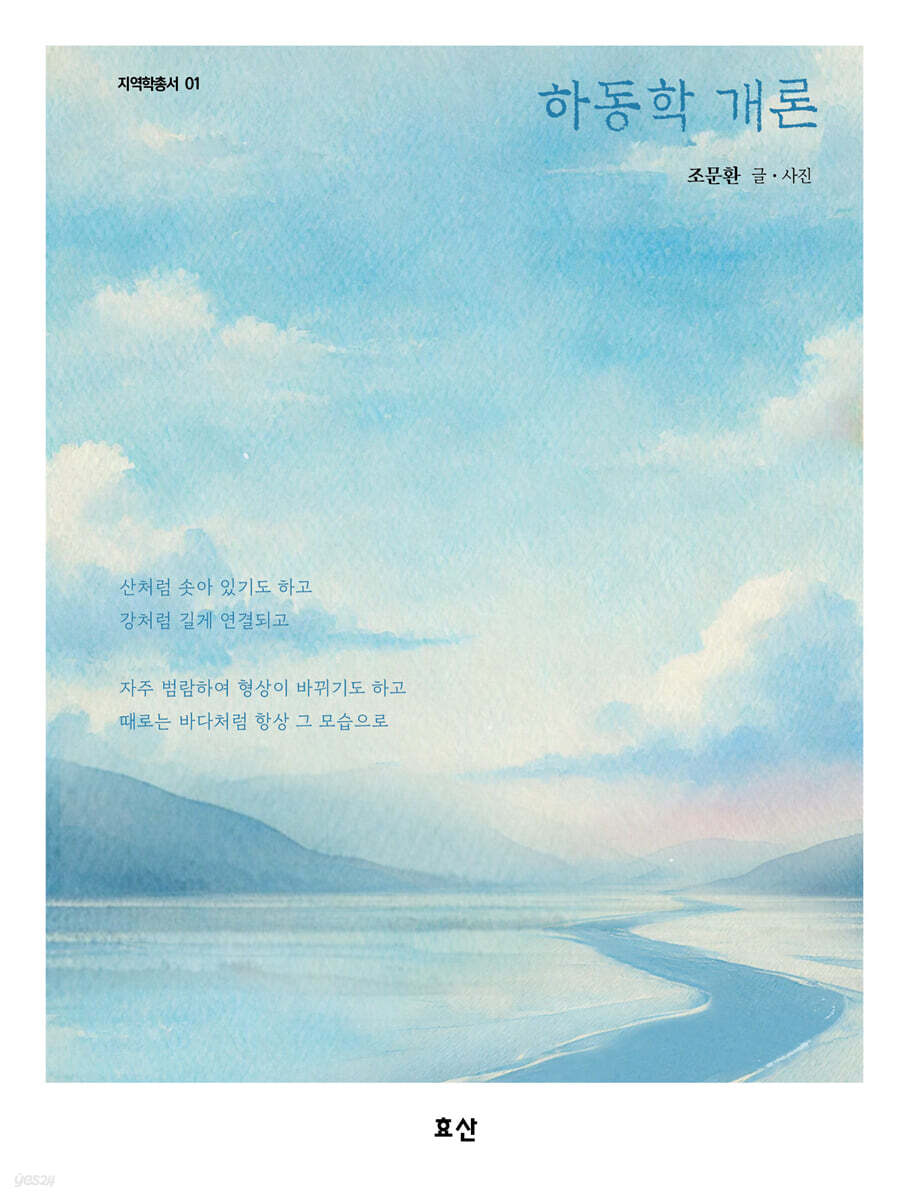
The author, a cultural planner and poet, lives in Hadong and published [Introduction to Hadong Studies], which introduces the regional characteristics and humanistic landscape of Hadong.
The author visited Hadong's Seomjin River, Pyeongsa-ri, Jirisan, and Bul-il Falls in Dadohae, Namhae, and reflected on them, and wrote a book about Hadong's geographical location, history, and people.
Following the author's story of Hadong, you will be able to see the true scenery of Hadong through the book and look into Hadong's past, present, and future that we did not know about.
The author visited Hadong's Seomjin River, Pyeongsa-ri, Jirisan, and Bul-il Falls in Dadohae, Namhae, and reflected on them, and wrote a book about Hadong's geographical location, history, and people.
Following the author's story of Hadong, you will be able to see the true scenery of Hadong through the book and look into Hadong's past, present, and future that we did not know about.
- You can preview some of the book's contents.
Preview
index
Why Hadonghak?
Part 1: The East 'Country'
Chapter 1 Why Hadong?
If you know the riverbed coefficient, you can see the Seomjin River.
It resembles the Yellow River
Rivers and rivers
It must flood
The meaning of Hadong
Diversity, Hadong's tolerance
faraway
Chapter 2: Hadong in the Historical Strata
The birth of a place name
The place name 'Hadong' in history
Seondonghuseo (East first, West second) - Deokcheon River first, Seomjin River later
The Unfinished Gaya, Hadong Within It: Frontier or Weight?
Hadong during the Mongol-Buddhist Struggle: Laying the Foundation for the Tripitaka Koreana
The first DMZ and GOP Duusanseong Fortress
The Peasant Uprising, its Climax: the Battle of Hadong
Chapter 3: People of Hadong
Jeong Du-su, who imbued the nation with his spirit
Poet Jeong Ho-seung, a national comforter
Sammungol anonymous potter
Symbols of love for the people: Jeon Cheon-sang, Lee So-young, and Kim Jin-ho
You, Jeong Gi-ryong, are too far away to see the light
Lee Byeong-ju, the author who left his mark on the era and its fingerprints
Sima Qian Yeo Jae-gyu of Hadong
Jo Ji-seo, the symbol of an upright scholar
Part 2: Seven Windows to Reading Hadong
Preface
Chapter 1 Seomjin River
The mountain gives birth to the river
The name Seomjin River
Naruto, Carrying Life
Hadong's salty taste, a sign of the Hadong women's tough life, Jaecheop
The life of a lecture, the life of a person, they are similar
The arm that raised me
Seomjin River Literature
The fact that the tide and the fresh water wash the white sand beach
The world goes backwards, the river goes forward
Chapter 2 Jirisan
The meaning of south of Jirisan
There is no distinction between Jirisan and Baekunsan.
The innate Jirisan community
Jirisan Trail, We Can Hold Hands
People who toured Jirisan
The last two peaks of Baekdudaegan, Hyeongjebong and Gujaebong
Jirisan Village
Chapter 3: Dadohae South Sea
The gate opens to the sea
Good brother Namhae-gun
Geumosan, rule the Dadohae
Noryang, remembering Yi Sun-sin
scattered islands
Connected to the Pacific and Atlantic Oceans
Chapter 4 Tea
Your meaning, the meaning of tea
The origin theory of Hadong tea
Location of the tea industry
Until a cup of tea enters your mouth
Different names, different tastes depending on the time of birth
Six major types of tea classified by production method
Tea veins and the transmission of Jeda
Chapter 5 Pyeongsa-ri
Hadong of Pyeongsa-ri, Akyang of Pyeongsa-ri
Park Kyung-ni's Pyeongsa-ri, Park Kyung-ni in Pyeongsa-ri
Park Kyung-ni's Origin of Life Philosophy
Siberian Eagle, North Pacific Salmon
People of Pyeongsa-ri
The only field in the world that becomes a painting
Where spring arrives earliest
Hadong of Lee Si-young from Gurye
Chapter 6: Hwagaejang
To 'Hwagaejang'
Port terminal
There was a salt road there
Hwagaejang fire incident
Three paths in front of the reverse horse's genitals
A life dependent on a rope
The Battle of Hwagae and the Last Guerrilla, Lee Hyeon-sang
Chapter 7 Utopia
My Paradise Lost Chronicles
A world in a bottle
Conditions of Utopia
Cheonghak-dong, a place that has endured through the ages
The coolness of Cheonghak-dong
People who visited Cheonghak-dong
Sodo and refuge
Scholars and the utopian Cheonghak-dong
Hadong Confucianism Genealogy
Hadong Confucianism and Hadong Spirit
Conditions for Cheonghak-dong in the 21st century
Epilogue
Part 1: The East 'Country'
Chapter 1 Why Hadong?
If you know the riverbed coefficient, you can see the Seomjin River.
It resembles the Yellow River
Rivers and rivers
It must flood
The meaning of Hadong
Diversity, Hadong's tolerance
faraway
Chapter 2: Hadong in the Historical Strata
The birth of a place name
The place name 'Hadong' in history
Seondonghuseo (East first, West second) - Deokcheon River first, Seomjin River later
The Unfinished Gaya, Hadong Within It: Frontier or Weight?
Hadong during the Mongol-Buddhist Struggle: Laying the Foundation for the Tripitaka Koreana
The first DMZ and GOP Duusanseong Fortress
The Peasant Uprising, its Climax: the Battle of Hadong
Chapter 3: People of Hadong
Jeong Du-su, who imbued the nation with his spirit
Poet Jeong Ho-seung, a national comforter
Sammungol anonymous potter
Symbols of love for the people: Jeon Cheon-sang, Lee So-young, and Kim Jin-ho
You, Jeong Gi-ryong, are too far away to see the light
Lee Byeong-ju, the author who left his mark on the era and its fingerprints
Sima Qian Yeo Jae-gyu of Hadong
Jo Ji-seo, the symbol of an upright scholar
Part 2: Seven Windows to Reading Hadong
Preface
Chapter 1 Seomjin River
The mountain gives birth to the river
The name Seomjin River
Naruto, Carrying Life
Hadong's salty taste, a sign of the Hadong women's tough life, Jaecheop
The life of a lecture, the life of a person, they are similar
The arm that raised me
Seomjin River Literature
The fact that the tide and the fresh water wash the white sand beach
The world goes backwards, the river goes forward
Chapter 2 Jirisan
The meaning of south of Jirisan
There is no distinction between Jirisan and Baekunsan.
The innate Jirisan community
Jirisan Trail, We Can Hold Hands
People who toured Jirisan
The last two peaks of Baekdudaegan, Hyeongjebong and Gujaebong
Jirisan Village
Chapter 3: Dadohae South Sea
The gate opens to the sea
Good brother Namhae-gun
Geumosan, rule the Dadohae
Noryang, remembering Yi Sun-sin
scattered islands
Connected to the Pacific and Atlantic Oceans
Chapter 4 Tea
Your meaning, the meaning of tea
The origin theory of Hadong tea
Location of the tea industry
Until a cup of tea enters your mouth
Different names, different tastes depending on the time of birth
Six major types of tea classified by production method
Tea veins and the transmission of Jeda
Chapter 5 Pyeongsa-ri
Hadong of Pyeongsa-ri, Akyang of Pyeongsa-ri
Park Kyung-ni's Pyeongsa-ri, Park Kyung-ni in Pyeongsa-ri
Park Kyung-ni's Origin of Life Philosophy
Siberian Eagle, North Pacific Salmon
People of Pyeongsa-ri
The only field in the world that becomes a painting
Where spring arrives earliest
Hadong of Lee Si-young from Gurye
Chapter 6: Hwagaejang
To 'Hwagaejang'
Port terminal
There was a salt road there
Hwagaejang fire incident
Three paths in front of the reverse horse's genitals
A life dependent on a rope
The Battle of Hwagae and the Last Guerrilla, Lee Hyeon-sang
Chapter 7 Utopia
My Paradise Lost Chronicles
A world in a bottle
Conditions of Utopia
Cheonghak-dong, a place that has endured through the ages
The coolness of Cheonghak-dong
People who visited Cheonghak-dong
Sodo and refuge
Scholars and the utopian Cheonghak-dong
Hadong Confucianism Genealogy
Hadong Confucianism and Hadong Spirit
Conditions for Cheonghak-dong in the 21st century
Epilogue
Into the book
So what does the name Hadong mean? The character "하" (water) has a unique meaning.
First of all, if you look at it literally, it is poetic.
It is epic and ambiguous.
It has a strong situational and atypical meaning rather than a specific form.
It is indirect, not direct.
It's like saying "there's a river over there" rather than "there's water flowing over there," which is difficult to understand at first glance, but tastes better when you chew on it.
--- p.32
I would like to call the Battle of Goseongsanseong Fortress and the Donghak Peasant Revolution at Hadong Songnim Park and Baeksa Beach a struggle from below toward reform in resistance to foreign powers and the old guard.
The Donghak Peasant Revolution, which broke out in the Jeolla Province, crossed the Seomjin River and reached its peak in Hadong, Gyeongsang Province.
By raising the banner of anti-foreign power and anti-feudalism, it established a milestone in history as a land of protection and transformation.
--- p.65
After Mr. George Seo was eventually executed on the execution ground, he was beheaded and his body was left to rot.
It didn't end there, and Yeonsangun gave the teacher the punishment of being ground up and scattered in the wind, called the "Broken Bone Wind". In the end, the teacher's bones were scattered in the Han River.
When Mrs. Jeong learned of this, she went up to Hanyang, took off her white petticoat in the Han River, soaked it in water, carefully folded the wet skirt, returned, and buried it in the ground. This is the grave of Mr. Jo Ji-seo today.
So, the tomb of Mr. George Seo is ultimately the tomb of Mrs. Jeong's skirt.
--- p.91
The islands of Hadong in this sea are Janggu Island, Namul Island, Tokki Island, Sol Island, and Banga Island.
Beyond that, the small islands of Bito Island and Bito Island, which are like dots, are dazzling like stars in the night sky.
Among the islands in our country, this is almost the only one where these islands are clustered together to form a single work of art.
--- p.162
Beyond Byeoksoryeong Pass, there are mountain villages such as Hamyang Macheon, Namwon Unbong, Inwol, and Sannae. Salt was exchanged for forest products at the markets there, and then passed over Byeoksoryeong Pass to become a valuable guest at Hwagae Market.
Presumably, they passed through Hamyang and Namwon, reaching Muju Gucheondong. They were then loaded onto boats heading down the Seomjin River to Hadong-eup, and then to the Jeolla-do port/harbor from which the salt had departed.
Salt would eventually be traded in the markets of ports, exchanged for forest products such as charcoal, ginseng, and jujubes.
The first place where these goods were traded was none other than Hwagae Market.
Hwagaejang was an intermediary area where people sent, received, and exchanged goods.
--- p.235
Today, the mainstream of Hadong's politics, economy, society, and culture can be said to be a kind of Seomjin River culture.
Considering that it is a well-known fact that rivers have driven culture throughout world history, Hadong simply followed that trend.
It may be that the openness of river culture has had an effect.
Rivers are connections, and connections have the advantage of speed and powerful transmission power, making it easy to connect with maritime culture.
First of all, if you look at it literally, it is poetic.
It is epic and ambiguous.
It has a strong situational and atypical meaning rather than a specific form.
It is indirect, not direct.
It's like saying "there's a river over there" rather than "there's water flowing over there," which is difficult to understand at first glance, but tastes better when you chew on it.
--- p.32
I would like to call the Battle of Goseongsanseong Fortress and the Donghak Peasant Revolution at Hadong Songnim Park and Baeksa Beach a struggle from below toward reform in resistance to foreign powers and the old guard.
The Donghak Peasant Revolution, which broke out in the Jeolla Province, crossed the Seomjin River and reached its peak in Hadong, Gyeongsang Province.
By raising the banner of anti-foreign power and anti-feudalism, it established a milestone in history as a land of protection and transformation.
--- p.65
After Mr. George Seo was eventually executed on the execution ground, he was beheaded and his body was left to rot.
It didn't end there, and Yeonsangun gave the teacher the punishment of being ground up and scattered in the wind, called the "Broken Bone Wind". In the end, the teacher's bones were scattered in the Han River.
When Mrs. Jeong learned of this, she went up to Hanyang, took off her white petticoat in the Han River, soaked it in water, carefully folded the wet skirt, returned, and buried it in the ground. This is the grave of Mr. Jo Ji-seo today.
So, the tomb of Mr. George Seo is ultimately the tomb of Mrs. Jeong's skirt.
--- p.91
The islands of Hadong in this sea are Janggu Island, Namul Island, Tokki Island, Sol Island, and Banga Island.
Beyond that, the small islands of Bito Island and Bito Island, which are like dots, are dazzling like stars in the night sky.
Among the islands in our country, this is almost the only one where these islands are clustered together to form a single work of art.
--- p.162
Beyond Byeoksoryeong Pass, there are mountain villages such as Hamyang Macheon, Namwon Unbong, Inwol, and Sannae. Salt was exchanged for forest products at the markets there, and then passed over Byeoksoryeong Pass to become a valuable guest at Hwagae Market.
Presumably, they passed through Hamyang and Namwon, reaching Muju Gucheondong. They were then loaded onto boats heading down the Seomjin River to Hadong-eup, and then to the Jeolla-do port/harbor from which the salt had departed.
Salt would eventually be traded in the markets of ports, exchanged for forest products such as charcoal, ginseng, and jujubes.
The first place where these goods were traded was none other than Hwagae Market.
Hwagaejang was an intermediary area where people sent, received, and exchanged goods.
--- p.235
Today, the mainstream of Hadong's politics, economy, society, and culture can be said to be a kind of Seomjin River culture.
Considering that it is a well-known fact that rivers have driven culture throughout world history, Hadong simply followed that trend.
It may be that the openness of river culture has had an effect.
Rivers are connections, and connections have the advantage of speed and powerful transmission power, making it easy to connect with maritime culture.
--- p.281
Publisher's Review
In Part 1, the author focuses on the flooding of the Seomjin River, explaining how the river's flooding shaped Hadong, a region blessed with natural beauty. He then introduces the wars in history, the lives of the residents, and the culture.
In Part 2, through the prism of ‘Seven Windows to Read Hadong’, the geographical environment that makes up Hadong and the lives of the people living within it are vividly connected in each chapter with the themes of Seomjin River, Jirisan Mountain, Dadohae Namhae, tea, Pyeongsa-ri, Hwagaejang, and Utopia.
In Part 2, through the prism of ‘Seven Windows to Read Hadong’, the geographical environment that makes up Hadong and the lives of the people living within it are vividly connected in each chapter with the themes of Seomjin River, Jirisan Mountain, Dadohae Namhae, tea, Pyeongsa-ri, Hwagaejang, and Utopia.
GOODS SPECIFICS
- Date of issue: March 10, 2025
- Page count, weight, size: 288 pages | 153*202*20mm
- ISBN13: 9791197319341
- ISBN10: 1197319344
You may also like
카테고리
korean


korean

![GQ KOREA Mark (Monthly): December [2025]](http://librairie.coreenne.fr/cdn/shop/files/8ef265dbbfbf186523ed75ba7319009d.jpg?v=1765340328&width=3840)


