

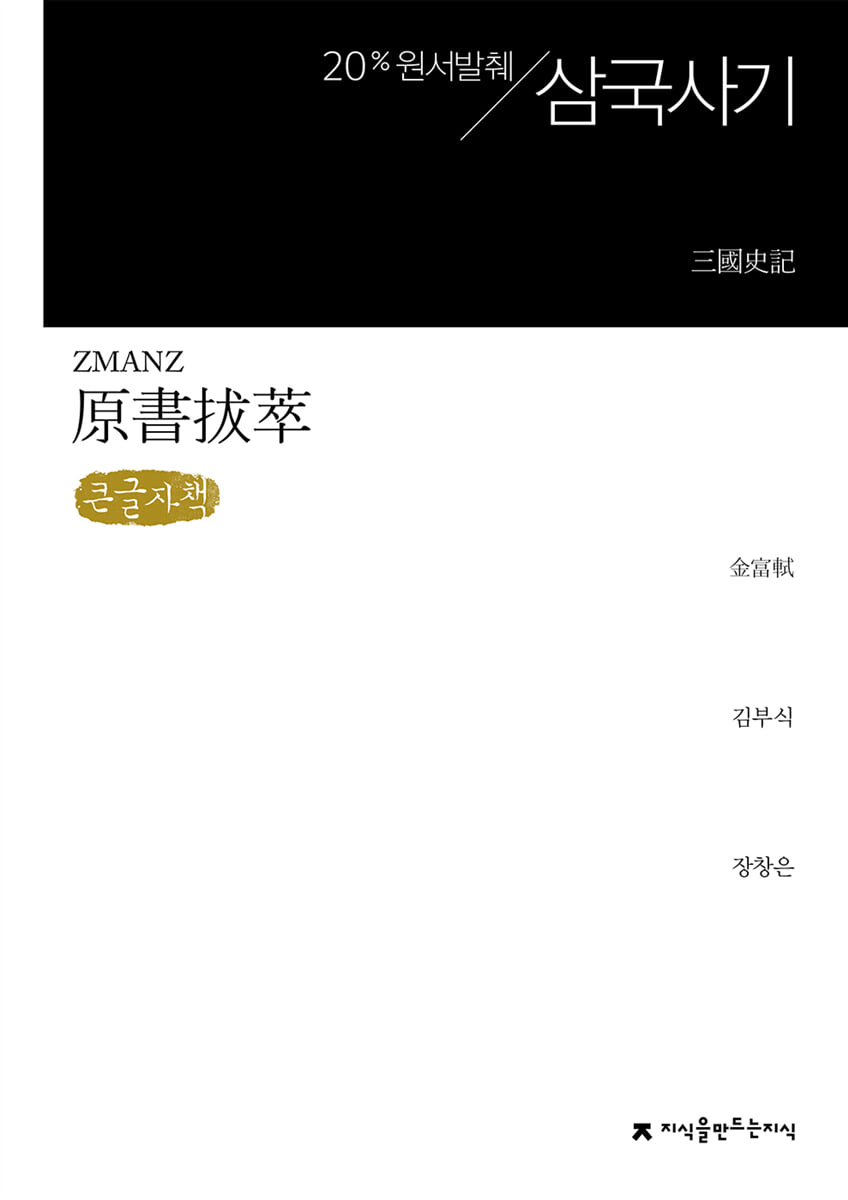
Excerpt from the original text Samguk Sagi (large print book)
 |
Description
Book Introduction
While preserving the overall structure of the Samguk Sagi, the most important and interesting parts were extracted.
History was discussed from the perspective of Confucianism, which has universal globality.
Therefore, Kim Bu-sik's historiography is being re-evaluated as having a historical position in that it established the foundation of Korean medieval historiography.
Not only is it easy to read, but you can also experience the thrill of reading the original text.
History was discussed from the perspective of Confucianism, which has universal globality.
Therefore, Kim Bu-sik's historiography is being re-evaluated as having a historical position in that it established the foundation of Korean medieval historiography.
Not only is it easy to read, but you can also experience the thrill of reading the original text.
index
A note dedicated to the Samguk Sagi (Samguk Sagi) · 3
Silla Annals: Samguk Sagi, Volumes 1-12
Goguryeo Annals: Samguk Sagi, Volumes 13-22
Baekje Annals: Samguk Sagi, Volumes 23-28
Chronology: Samguk Sagi, Volumes 29-31
Miscellaneous Records: Samguk Sagi, Volumes 32-40
Biographies: Samguk Sagi, Volumes 41-50
List of compilers
Appendix: Table of Official Ranks of the Three Kingdoms
commentary
About the author
About the translator
Silla Annals: Samguk Sagi, Volumes 1-12
Goguryeo Annals: Samguk Sagi, Volumes 13-22
Baekje Annals: Samguk Sagi, Volumes 23-28
Chronology: Samguk Sagi, Volumes 29-31
Miscellaneous Records: Samguk Sagi, Volumes 32-40
Biographies: Samguk Sagi, Volumes 41-50
List of compilers
Appendix: Table of Official Ranks of the Three Kingdoms
commentary
About the author
About the translator
Into the book
1.
The scholars and great men of today may have a wide knowledge of the Five Classics of China, the books of the various scholars, and the history of the Jin and Han dynasties, and some of them speak of them in detail, but when it comes to the affairs of our country, they are so vast and distant that they do not know the beginning or the end, which is very regrettable.
Moreover, because the Silla, Goguryeo, and Baekje clans opened their territory and stood like the three legs of a cauldron, they were able to communicate with China through rites, and thus there are biographies of the [Three Kingdoms] in both Fan Ye's 『Book of Han』 and Song Qi's 『Book of Tang』.
However, domestic affairs were detailed and foreign affairs were brief, so [the records of the Three Kingdoms] were not included in detail.
2.
On the 9th day of the 7th month of autumn, Yushin and others advanced to Hwangsanbeol [Yeonsan, South Chungcheong Province], and Baekje General Gyebaek led his army and first occupied a dangerous area, setting up camp in three places and waiting.
Yushin and others divided their army into three groups and fought four times, but they were at a disadvantage and the soldiers' strength was exhausted.
[Silla's] three armies saw that [the heroic deaths of Bangul, the son of Heumsun, and Gwanchang, the son of Pumil, on the side of Silla] and were indignant, so they advanced, beating drums and shouting with the intention of dying, and attacked, causing a great defeat for the Baekje army.
Gyebaek was killed and about 20 people, including Left State Councillor Chungsang and Sangyeong, were captured.
On this day, Jeong Bang and Vice-Commander Kim In-mun also arrived at Gibeolpo [the mouth of the Geumgang River], met the Baekje army, fought them, and defeated them greatly.
On the 12th, the Tang and Silla armies advanced to the plains of Soburi [Buyeo, South Chungcheong Province] to surround the capital city of Uija.
On the 13th, the king fled at night with his entourage and preserved his body in Ungjinseong Fortress [in Gongju, South Chungcheong Province].
The son of the chair, Yung, and the great seat, Cheonbok, came out and surrendered.
On the 18th, the prince and the army of the Ungjin commander surrendered at Ungjinseong Fortress.
The scholars and great men of today may have a wide knowledge of the Five Classics of China, the books of the various scholars, and the history of the Jin and Han dynasties, and some of them speak of them in detail, but when it comes to the affairs of our country, they are so vast and distant that they do not know the beginning or the end, which is very regrettable.
Moreover, because the Silla, Goguryeo, and Baekje clans opened their territory and stood like the three legs of a cauldron, they were able to communicate with China through rites, and thus there are biographies of the [Three Kingdoms] in both Fan Ye's 『Book of Han』 and Song Qi's 『Book of Tang』.
However, domestic affairs were detailed and foreign affairs were brief, so [the records of the Three Kingdoms] were not included in detail.
2.
On the 9th day of the 7th month of autumn, Yushin and others advanced to Hwangsanbeol [Yeonsan, South Chungcheong Province], and Baekje General Gyebaek led his army and first occupied a dangerous area, setting up camp in three places and waiting.
Yushin and others divided their army into three groups and fought four times, but they were at a disadvantage and the soldiers' strength was exhausted.
[Silla's] three armies saw that [the heroic deaths of Bangul, the son of Heumsun, and Gwanchang, the son of Pumil, on the side of Silla] and were indignant, so they advanced, beating drums and shouting with the intention of dying, and attacked, causing a great defeat for the Baekje army.
Gyebaek was killed and about 20 people, including Left State Councillor Chungsang and Sangyeong, were captured.
On this day, Jeong Bang and Vice-Commander Kim In-mun also arrived at Gibeolpo [the mouth of the Geumgang River], met the Baekje army, fought them, and defeated them greatly.
On the 12th, the Tang and Silla armies advanced to the plains of Soburi [Buyeo, South Chungcheong Province] to surround the capital city of Uija.
On the 13th, the king fled at night with his entourage and preserved his body in Ungjinseong Fortress [in Gongju, South Chungcheong Province].
The son of the chair, Yung, and the great seat, Cheonbok, came out and surrendered.
On the 18th, the prince and the army of the Ungjin commander surrendered at Ungjinseong Fortress.
--- From the text
Publisher's Review
The oldest historical document in Korea that proves the errors of the 'Northeast Project'
One of the main arguments behind China's "Northeast Project" is to separate Goguryeo history from the Korean historical framework.
It is the Samguk Sagi that points out that the logic of the 'Northeast Project' is clearly flawed.
Kim Bu-sik distributed the records about Silla, Goguryeo, and Baekje fairly in his own way.
And, by comparing Silla, Goguryeo, and Baekje to the three legs of a cauldron, they are dealt with within the framework of ‘our country.’
An excerpt from the Samguk Sagi that preserves the feel of the original text
The previously published 『Samguk Sagi』 is not easy to read in its entirety due to its boring structure, difficult vocabulary, and vast volume.
This edition of 『Samguk Sagi』 has tried its best to resolve the issues that readers previously had difficulty accessing.
I tried to extract historically important content, but not to leave out interesting content.
And, with sufficient footnotes, it is perfect for readers who want to try reading the Samguk Sagi for the first time.
However, this does not mean that there was a biased attitude of focusing on only the interesting parts.
The original text's structure has been preserved to the greatest extent possible to preserve the feel of the original text of the Samguk Sagi.
Perhaps the greatest strength of this book is that it is an excerpt, yet it retains the format of the original.
Therefore, it is worth reading not only for readers who are encountering the Samguk Sagi for the first time, but also for students and researchers studying this book.
One of the main arguments behind China's "Northeast Project" is to separate Goguryeo history from the Korean historical framework.
It is the Samguk Sagi that points out that the logic of the 'Northeast Project' is clearly flawed.
Kim Bu-sik distributed the records about Silla, Goguryeo, and Baekje fairly in his own way.
And, by comparing Silla, Goguryeo, and Baekje to the three legs of a cauldron, they are dealt with within the framework of ‘our country.’
An excerpt from the Samguk Sagi that preserves the feel of the original text
The previously published 『Samguk Sagi』 is not easy to read in its entirety due to its boring structure, difficult vocabulary, and vast volume.
This edition of 『Samguk Sagi』 has tried its best to resolve the issues that readers previously had difficulty accessing.
I tried to extract historically important content, but not to leave out interesting content.
And, with sufficient footnotes, it is perfect for readers who want to try reading the Samguk Sagi for the first time.
However, this does not mean that there was a biased attitude of focusing on only the interesting parts.
The original text's structure has been preserved to the greatest extent possible to preserve the feel of the original text of the Samguk Sagi.
Perhaps the greatest strength of this book is that it is an excerpt, yet it retains the format of the original.
Therefore, it is worth reading not only for readers who are encountering the Samguk Sagi for the first time, but also for students and researchers studying this book.
GOODS SPECIFICS
- Date of issue: February 28, 2025
- Page count, weight, size: 243 pages | 210*290*11mm
- ISBN13: 9791173070501
You may also like
카테고리
korean


korean

![GQ KOREA Mark (Monthly): December [2025]](http://librairie.coreenne.fr/cdn/shop/files/8ef265dbbfbf186523ed75ba7319009d.jpg?v=1765340328&width=3840)


