

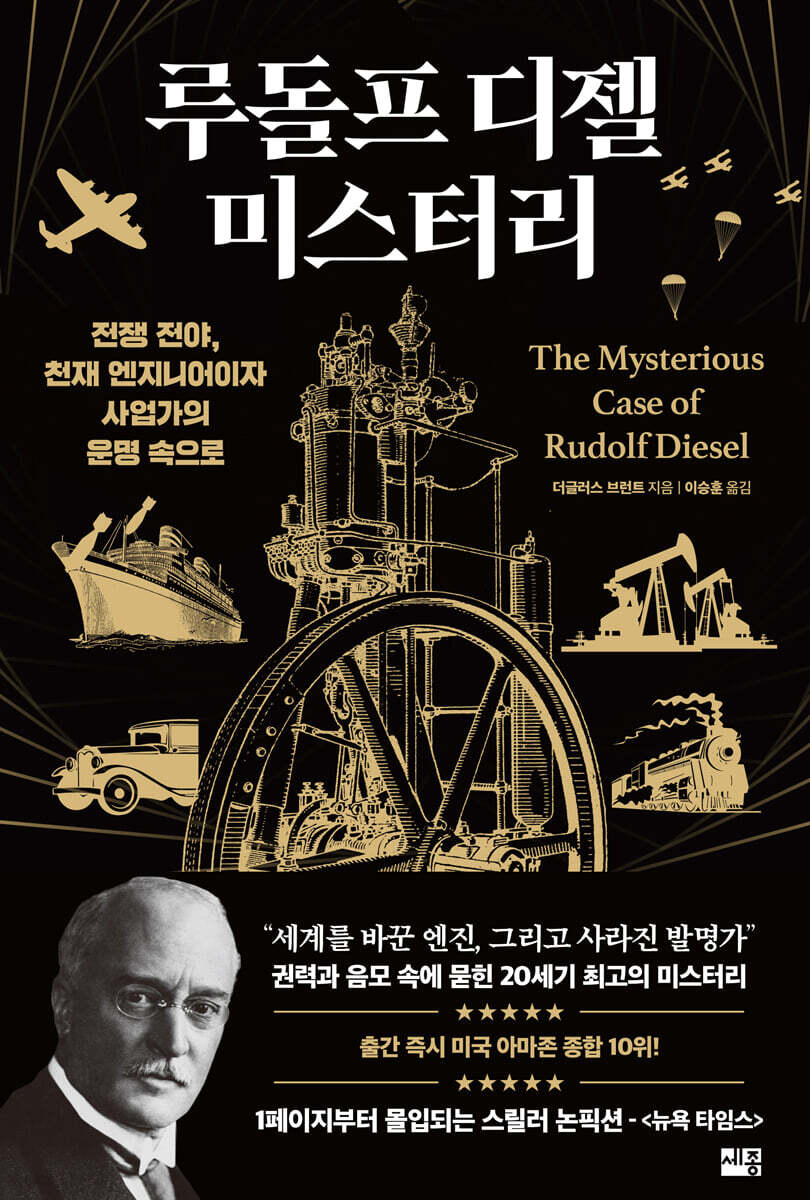
Rudolph Diesel Mystery
 |
Description
Book Introduction
- A word from MD
- [Rudolf Diesel, the inventor of the diesel engine] The eventful life of Rudolf Diesel, the inventor of the diesel engine.
A man who overcame a poor childhood and developed an innovative engine, but whose sudden disappearance gave rise to various conspiracy theories.
We invite readers to the story of his life, which dreamed of improving the lives of workers and changing society for the better.
- Ahn Hyeon-jae, History PD
*Ranked 10th on Amazon US chart immediately after publication
*The greatest mystery of the 20th century, buried in power and conspiracy.
The Engine That Changed the World, and the Vanished Inventor
On September 29, 1913, the world-renowned inventor Rudolf Diesel was on board the passenger ship Dresden bound for London.
The revolutionary internal combustion diesel engine he created was a cutting-edge technology that completely changed the landscape of global industry.
But on that very ship, Diesel disappeared without a trace in the vast ocean in the middle of the night.
This mysterious disappearance shocked the world and raised numerous questions and suspicions, including whether it was an accidental death, suicide, or murder.
Rudolf Diesel barely survived a poor childhood and became a millionaire by developing a powerful engine that could run without expensive petroleum fuel.
He toured the rising power of the United States twice, recording profound insights and interacting with world-renowned figures such as Winston Churchill, Thomas Edison, and the Nobel family.
But with Diesel's disappearance, traces of his exploits also disappeared.
Even though it is still used in the engines of countless cars, trains and ships, it has had a huge impact on modern internal combustion engines.
Diesel wanted his technology to improve the lives of workers and change society for the better.
However, the world on the eve of World War I was unstable, and that instability led to a desire to use the latest technology for war.
In particular, two powerful men of the time, German Emperor Kaiser Wilhelm II and oil magnate John D.
Rockefeller was paying attention to diesel for his own reasons.
Diesel's technology entangled him with the world's most powerful figures, and his sudden disappearance gave rise to various conspiracy theories.
The Rudolph Diesel Mystery traces Diesel's life, his amazing inventions, and the secrets of the night he disappeared.
A mystery that remained unsolved for 100 years is finally brought to the surface.
*The greatest mystery of the 20th century, buried in power and conspiracy.
The Engine That Changed the World, and the Vanished Inventor
On September 29, 1913, the world-renowned inventor Rudolf Diesel was on board the passenger ship Dresden bound for London.
The revolutionary internal combustion diesel engine he created was a cutting-edge technology that completely changed the landscape of global industry.
But on that very ship, Diesel disappeared without a trace in the vast ocean in the middle of the night.
This mysterious disappearance shocked the world and raised numerous questions and suspicions, including whether it was an accidental death, suicide, or murder.
Rudolf Diesel barely survived a poor childhood and became a millionaire by developing a powerful engine that could run without expensive petroleum fuel.
He toured the rising power of the United States twice, recording profound insights and interacting with world-renowned figures such as Winston Churchill, Thomas Edison, and the Nobel family.
But with Diesel's disappearance, traces of his exploits also disappeared.
Even though it is still used in the engines of countless cars, trains and ships, it has had a huge impact on modern internal combustion engines.
Diesel wanted his technology to improve the lives of workers and change society for the better.
However, the world on the eve of World War I was unstable, and that instability led to a desire to use the latest technology for war.
In particular, two powerful men of the time, German Emperor Kaiser Wilhelm II and oil magnate John D.
Rockefeller was paying attention to diesel for his own reasons.
Diesel's technology entangled him with the world's most powerful figures, and his sudden disappearance gave rise to various conspiracy theories.
The Rudolph Diesel Mystery traces Diesel's life, his amazing inventions, and the secrets of the night he disappeared.
A mystery that remained unsolved for 100 years is finally brought to the surface.
- You can preview some of the book's contents.
Preview
index
Author's Note
prolog
Part 1: War and the Oil Engine, 1858–1897
Chapter 1 International Identity
Chapter 2 A Short Stay in London
Chapter 3: Europe's New Empire
Chapter 4: Is there really anyone who has succeeded on their own?
Chapter 5: Oil: Changing the Game
Chapter 6: Pursuit of More
Chapter 7: More than just a salary
Chapter 8: Wilhelm II Envying the Navy
Chapter 9: The Birth of Diesel Power
Part 2: The Diffusion of Diesel Engines, 1897–1910
Chapter 10: Sir Calvin Makes the First Move
Chapter 11: The Grand Prix After Many Twists and Turns
Chapter 12: Holding on to Success
Chapter 13: The Study of the Sleeping Giant
Chapter 14: The Old House Fights for Its Life
Chapter 15: The Kaiser Embraces the "Risk Theory" Chapter 16: A Place Among the World's Weapons
Chapter 17: The Dawn of a New Era
Part 3: Masterpieces 1910–1913
Chapter 18: Rudolf Diesel Breaks the Order
Chapter 19: Churchill on Board the Selandia
Chapter 20: The Secretary of the Navy's Secret
Chapter 21: The Great Light that Illuminated the West
Chapter 22: Rising Pressure
Chapter 23: The Last Months
Chapter 24: The Dresden, September 29, 1913
Part 4: The Truth About the Disappearance
Chapter 25: The World's Reaction
Chapter 26 Possible Theories
Chapter 27: Operation Rudolf Diesel
Chapter 28 Fingerprints
Epilogue
Acknowledgements
Chronology
Appendix 1: Operation and Manufacturers of Diesel Engines
Appendix 2: MAN's Secret - Diesel Engines for Battleships During World War I
prolog
Part 1: War and the Oil Engine, 1858–1897
Chapter 1 International Identity
Chapter 2 A Short Stay in London
Chapter 3: Europe's New Empire
Chapter 4: Is there really anyone who has succeeded on their own?
Chapter 5: Oil: Changing the Game
Chapter 6: Pursuit of More
Chapter 7: More than just a salary
Chapter 8: Wilhelm II Envying the Navy
Chapter 9: The Birth of Diesel Power
Part 2: The Diffusion of Diesel Engines, 1897–1910
Chapter 10: Sir Calvin Makes the First Move
Chapter 11: The Grand Prix After Many Twists and Turns
Chapter 12: Holding on to Success
Chapter 13: The Study of the Sleeping Giant
Chapter 14: The Old House Fights for Its Life
Chapter 15: The Kaiser Embraces the "Risk Theory" Chapter 16: A Place Among the World's Weapons
Chapter 17: The Dawn of a New Era
Part 3: Masterpieces 1910–1913
Chapter 18: Rudolf Diesel Breaks the Order
Chapter 19: Churchill on Board the Selandia
Chapter 20: The Secretary of the Navy's Secret
Chapter 21: The Great Light that Illuminated the West
Chapter 22: Rising Pressure
Chapter 23: The Last Months
Chapter 24: The Dresden, September 29, 1913
Part 4: The Truth About the Disappearance
Chapter 25: The World's Reaction
Chapter 26 Possible Theories
Chapter 27: Operation Rudolf Diesel
Chapter 28 Fingerprints
Epilogue
Acknowledgements
Chronology
Appendix 1: Operation and Manufacturers of Diesel Engines
Appendix 2: MAN's Secret - Diesel Engines for Battleships During World War I
Detailed image
.jpg)
Into the book
On October 11, 1913, something was floating in the water.
The Dutch harbor pilot steamer Körzen approached an object that caught the crew's attention.
The crew of this small ship realized what they had seen in the surging black waters of the Scheldt Estuary at the eastern end of the English Channel.
It was a corpse.
Although horribly decomposed, the sailors recognized the body as being dressed in luxurious attire.
They pulled the body overboard, took four items from the deceased's pockets, and then threw the rotting body back into the sea.
The items included a coin purse, a small pocket knife, a glasses case, and an enamel medicine bottle.
---From the "Prologue"
A somewhat eccentric, lonely, and dreamy boy, he had a talent for engineering but was not trained in it.
He loved art, thanks mainly to his mother's tender care.
There is no definitive information about how Rudolf lived in London, but he was fortunate compared to the unfortunate children who were forced into the factories at the time.
Rudolph, a naive and optimistic boy, spent his time sketching mechanical devices he saw at fairs or imagined.
At that moment, he was determined to create a better machine.
As Rudolph stood on the bridge, he began to harbor a vague ambition to create something that would change the working conditions of working-class people like himself and his family.
---From "Chapter 2 A Short Stay in London"
Wilhelm II, who became the Kaiser of the German Empire, was born with a physical disability.
His left arm was 15 centimeters shorter than his right.
In Prussian culture, which was overwhelmingly male-dominated, this physical weakness was a great shame.
It was a sad thing for young Wilhelm, but his underdeveloped left arm was also a source of shame for his mother.
My mother wrote to Queen Victoria of England:
“Wilhelm would have been a very pretty boy if it weren’t for that pathetic arm, the source of his misery. But the more I look at it, the more distorted his face becomes.
(…) Because of my arms, every time I move, my actions, my gait, and even my figure all look awkward (…) I can’t do anything by myself (…) It’s a sadness that I can’t express in words.”
---From "Chapter 3: Europe's New Empire"
Now sixteen years old, Rudolph came home with a mixture of anger and despair.
The ivory tower of the university was within reach.
The escapist daydreams I had as a child in the technical museums of Paris became a daily experience in Augsburg.
However, the parents, who still did not recognize their son's extraordinary talent, did not understand what it meant to ask him to give up.
An excited Rudolph raised his voice at his mother and protested that it was absurd that his parents, who had always been against math and science, were not supporting their son's education because of immediate financial concerns.
Rudolph told his parents that he was confident that he would receive a scholarship to college and that he would do great things there.
---From Chapter 4, “Is There Really Someone Who Has Succeeded on Their Own?”
The former refugee boy who once traveled alone from Paris to Augsburg in just one shirt is now a well-established 34-year-old engineer who prides himself on having the best ideas about how to power the industrial age.
He worked with some of the most brilliant engineers in Germany and had been working on this idea for over a decade.
Diesel wasn't one to give up because he was rejected.
Diesel knew that the engineering community was struggling with whether to accept him or see him as a threat, and he knew how to force Booz to make a clear choice.
In some ways, the message sent to Booz was similar to the message Rockefeller sent to his rival refineries.
“If you don’t join me, you will be destroyed.”
---From Chapter 9, The Birth of Diesel Power
Many in the engineering community recognized that the diesel engine had the potential to fundamentally change modern power generation.
All advanced countries' companies are actively seeking to sign licensing agreements with diesel.
Diesel followed the same distribution model as Linde and rapidly spread diesel technology.
In just over a year, Diesel has signed more than 20 licensing agreements across Europe and North America.
The successive licensing agreements represented a shift in the direction of diesel engines, a change that Diesel himself must have perceived as a rather subtle one.
He was now dealing with large corporations, as only large corporations could afford to pay the expensive licensing fees.
These big companies were neither thinkers nor dreamers who wanted to find a way to produce small institutions for artisans like dentists, jewelers, and Theodore Diesel.
These companies had already entered the organ manufacturing business in large numbers.
The massive machines they built were used in the centralized economic system of the modern industrial era, and in the era of hyper-nationalism, they were also used for military purposes.
---From Chapter 10, Sir Calvin Makes the First Move
Diesel wrote to his beloved wife Martha about his pioneering sociological treatise, Solidarity.
“Engineers are entering a new era.
In this era, engineers will increasingly wrest decisive influence from lawyers in the nation.”
---From Chapter 12, “Holding on to Success”
Diesel expands the discussion to include alternative fuels, explaining that diesel engines can burn coal tar, vegetable oils, and nut oils in addition to petroleum-derived fuels.
“The use of vegetable oils as fuel may not seem that important now, but over time, these oils will become as important as petroleum and coal tar derivatives are today,” he said.
Because diesel can flexibly burn a variety of fuels, diesel technology can break fuel monopolies and bring political stability to all countries regardless of the supply and demand of natural fuels, he argued.
“Some (countries) produce only coal, some only oil.
And there are countries like the United States that produce both coal and oil.
It is difficult to predict how a particular country will develop.” With diesel engines, this was not a problem.
Oil was available in every country.
He pointed out that the adoption of diesel engines in the United States has been delayed because of the abundance of diesel fuel.
---From "Chapter 21: The Great Light that Illuminated the West"
Rumors of murder began to circulate.
Diesel was assassinated by German intelligence agents before he could deliver his revolutionary submarine engine designs to the Royal Navy.
As Admiral Fisher already knew, the German General Staff, upon learning that the British had designed a new diesel engine, may have shot Diesel “like a dog,” as Fischer had assumed.
There are other theories that are equally credible.
The oil trust hired assassins to eliminate threats to its monopoly.
W., Britain's most famous journalist.
T. Steed had argued that the diesel engine, fueled by coal tar, would be the engine of the future.
The Dutch harbor pilot steamer Körzen approached an object that caught the crew's attention.
The crew of this small ship realized what they had seen in the surging black waters of the Scheldt Estuary at the eastern end of the English Channel.
It was a corpse.
Although horribly decomposed, the sailors recognized the body as being dressed in luxurious attire.
They pulled the body overboard, took four items from the deceased's pockets, and then threw the rotting body back into the sea.
The items included a coin purse, a small pocket knife, a glasses case, and an enamel medicine bottle.
---From the "Prologue"
A somewhat eccentric, lonely, and dreamy boy, he had a talent for engineering but was not trained in it.
He loved art, thanks mainly to his mother's tender care.
There is no definitive information about how Rudolf lived in London, but he was fortunate compared to the unfortunate children who were forced into the factories at the time.
Rudolph, a naive and optimistic boy, spent his time sketching mechanical devices he saw at fairs or imagined.
At that moment, he was determined to create a better machine.
As Rudolph stood on the bridge, he began to harbor a vague ambition to create something that would change the working conditions of working-class people like himself and his family.
---From "Chapter 2 A Short Stay in London"
Wilhelm II, who became the Kaiser of the German Empire, was born with a physical disability.
His left arm was 15 centimeters shorter than his right.
In Prussian culture, which was overwhelmingly male-dominated, this physical weakness was a great shame.
It was a sad thing for young Wilhelm, but his underdeveloped left arm was also a source of shame for his mother.
My mother wrote to Queen Victoria of England:
“Wilhelm would have been a very pretty boy if it weren’t for that pathetic arm, the source of his misery. But the more I look at it, the more distorted his face becomes.
(…) Because of my arms, every time I move, my actions, my gait, and even my figure all look awkward (…) I can’t do anything by myself (…) It’s a sadness that I can’t express in words.”
---From "Chapter 3: Europe's New Empire"
Now sixteen years old, Rudolph came home with a mixture of anger and despair.
The ivory tower of the university was within reach.
The escapist daydreams I had as a child in the technical museums of Paris became a daily experience in Augsburg.
However, the parents, who still did not recognize their son's extraordinary talent, did not understand what it meant to ask him to give up.
An excited Rudolph raised his voice at his mother and protested that it was absurd that his parents, who had always been against math and science, were not supporting their son's education because of immediate financial concerns.
Rudolph told his parents that he was confident that he would receive a scholarship to college and that he would do great things there.
---From Chapter 4, “Is There Really Someone Who Has Succeeded on Their Own?”
The former refugee boy who once traveled alone from Paris to Augsburg in just one shirt is now a well-established 34-year-old engineer who prides himself on having the best ideas about how to power the industrial age.
He worked with some of the most brilliant engineers in Germany and had been working on this idea for over a decade.
Diesel wasn't one to give up because he was rejected.
Diesel knew that the engineering community was struggling with whether to accept him or see him as a threat, and he knew how to force Booz to make a clear choice.
In some ways, the message sent to Booz was similar to the message Rockefeller sent to his rival refineries.
“If you don’t join me, you will be destroyed.”
---From Chapter 9, The Birth of Diesel Power
Many in the engineering community recognized that the diesel engine had the potential to fundamentally change modern power generation.
All advanced countries' companies are actively seeking to sign licensing agreements with diesel.
Diesel followed the same distribution model as Linde and rapidly spread diesel technology.
In just over a year, Diesel has signed more than 20 licensing agreements across Europe and North America.
The successive licensing agreements represented a shift in the direction of diesel engines, a change that Diesel himself must have perceived as a rather subtle one.
He was now dealing with large corporations, as only large corporations could afford to pay the expensive licensing fees.
These big companies were neither thinkers nor dreamers who wanted to find a way to produce small institutions for artisans like dentists, jewelers, and Theodore Diesel.
These companies had already entered the organ manufacturing business in large numbers.
The massive machines they built were used in the centralized economic system of the modern industrial era, and in the era of hyper-nationalism, they were also used for military purposes.
---From Chapter 10, Sir Calvin Makes the First Move
Diesel wrote to his beloved wife Martha about his pioneering sociological treatise, Solidarity.
“Engineers are entering a new era.
In this era, engineers will increasingly wrest decisive influence from lawyers in the nation.”
---From Chapter 12, “Holding on to Success”
Diesel expands the discussion to include alternative fuels, explaining that diesel engines can burn coal tar, vegetable oils, and nut oils in addition to petroleum-derived fuels.
“The use of vegetable oils as fuel may not seem that important now, but over time, these oils will become as important as petroleum and coal tar derivatives are today,” he said.
Because diesel can flexibly burn a variety of fuels, diesel technology can break fuel monopolies and bring political stability to all countries regardless of the supply and demand of natural fuels, he argued.
“Some (countries) produce only coal, some only oil.
And there are countries like the United States that produce both coal and oil.
It is difficult to predict how a particular country will develop.” With diesel engines, this was not a problem.
Oil was available in every country.
He pointed out that the adoption of diesel engines in the United States has been delayed because of the abundance of diesel fuel.
---From "Chapter 21: The Great Light that Illuminated the West"
Rumors of murder began to circulate.
Diesel was assassinated by German intelligence agents before he could deliver his revolutionary submarine engine designs to the Royal Navy.
As Admiral Fisher already knew, the German General Staff, upon learning that the British had designed a new diesel engine, may have shot Diesel “like a dog,” as Fischer had assumed.
There are other theories that are equally credible.
The oil trust hired assassins to eliminate threats to its monopoly.
W., Britain's most famous journalist.
T. Steed had argued that the diesel engine, fueled by coal tar, would be the engine of the future.
---From Chapter 25: The World's Reaction
Publisher's Review
“The genius inventor who created the modern era
Life and the Mystery of Disappearance
*A thriller nonfiction that will have you hooked from page 1 - [The New York Times]
Diesel, a name we often encounter but often overlook
“People around the world today pass the word diesel several times a day.
The word is written on the sides of passenger trains, on ship engines, at gas stations, and on the 500 million diesel vehicles that run on the road.
However, few people know that the word Diesel is a person's name.
And few know that he began life as a poor immigrant and believed in the rigors of capitalism.
“Furthermore, few know that he advocated peace, equality, a craftsman class, a clean environment, and humane working conditions in an age of increasing exploitation, and that he believed that engineers had two roles: as scientists and as social theorists.” - Prologue, p. 16
From a poor Parisian boy to Germany's greatest engineer
Rudolf Diesel was a boy with a delicate sensibility who wandered the back alleys of Paris, helping out in his father's workshop.
As an immigrant family from Germany, the Diesel family's life was not easy.
Diesel, who had been playing with disassembling objects and drawing various machines since childhood, returned to Germany to study engineering with the help of a relative who recognized his talent.
Diesel, who knew well the lives of poor workers and artisans, wanted to create an apparatus that could be used in small workshops to help people like his father.
The engine that was invented in this way is the diesel engine.
Of course, the process was long.
There have been countless failures and huge costs.
Diesel, who tried with perseverance and confidence while keeping an eye on investors and his family, finally created a revolutionary organization.
Perhaps still the engine of the future, the diesel engine
Today's diesel engines run on diesel fuel distilled from crude oil or coal tar, and are known to emit more fine dust than gasoline engines.
But the surprising thing is that at the time of its invention, the diesel engine was an environmentally friendly engine that ran on vegetable oil or nut oil, not just petroleum.
Diesel dreamed of a machine that could run on oil grown by small farms.
Also, diesel engines did not emit black smoke or make loud noises like steam engines.
There was no need for lumps of coal, no need for workers to endlessly dump coal, and no need for space to store the heavy coal.
All you had to do was connect the hose to the fuel filler.
It was also efficient enough to enable ships to travel around the world without refueling or repairs.
This characteristic of the diesel engine was revolutionary at the time when steam engines were taken for granted, and it soon captured the world's attention.
The dark clouds of World War I and the mystery of Diesel's disappearance,
The truth that has been dormant for 100 years awakens.
History is full of examples of wars and militaries using surprising and revolutionary technologies ahead of everyday life, such as the recent use of cutting-edge AI technologies in the Ukraine-Russia war.
The same was true for diesel engines.
Churchill of Britain and Wilhelm II of Germany gradually came to realize the utility of the diesel engine.
Diesel engines began to play a significant role in power generation as they were used not only in battleships but also in submarines.
At the very moment when Britain and Germany were locked in an arms race over naval power, diesel disappeared.
Was it the work of American oil tycoon John D. Rockefeller, who was concerned that the energy landscape would change as diesel engines adopted fuel other than petroleum?
The book begins with Diesel's death and follows his life and achievements in detail, vividly reproducing the international situation during World War I.
And it raises strong questions about Diesel's death after he created the revolutionary organization.
Why did he die? Why did Diesel have to disappear, leaving behind his loving family, his supportive colleagues, and his vast fortune? As you read this book, readers will be struck first by Diesel's genius, and then even more by the world's lack of understanding of him.
By following this book, completed through intense research and reporting, and uncovering the mystery surrounding Diesel's disappearance, we may already be fans of Diesel.
Life and the Mystery of Disappearance
*A thriller nonfiction that will have you hooked from page 1 - [The New York Times]
Diesel, a name we often encounter but often overlook
“People around the world today pass the word diesel several times a day.
The word is written on the sides of passenger trains, on ship engines, at gas stations, and on the 500 million diesel vehicles that run on the road.
However, few people know that the word Diesel is a person's name.
And few know that he began life as a poor immigrant and believed in the rigors of capitalism.
“Furthermore, few know that he advocated peace, equality, a craftsman class, a clean environment, and humane working conditions in an age of increasing exploitation, and that he believed that engineers had two roles: as scientists and as social theorists.” - Prologue, p. 16
From a poor Parisian boy to Germany's greatest engineer
Rudolf Diesel was a boy with a delicate sensibility who wandered the back alleys of Paris, helping out in his father's workshop.
As an immigrant family from Germany, the Diesel family's life was not easy.
Diesel, who had been playing with disassembling objects and drawing various machines since childhood, returned to Germany to study engineering with the help of a relative who recognized his talent.
Diesel, who knew well the lives of poor workers and artisans, wanted to create an apparatus that could be used in small workshops to help people like his father.
The engine that was invented in this way is the diesel engine.
Of course, the process was long.
There have been countless failures and huge costs.
Diesel, who tried with perseverance and confidence while keeping an eye on investors and his family, finally created a revolutionary organization.
Perhaps still the engine of the future, the diesel engine
Today's diesel engines run on diesel fuel distilled from crude oil or coal tar, and are known to emit more fine dust than gasoline engines.
But the surprising thing is that at the time of its invention, the diesel engine was an environmentally friendly engine that ran on vegetable oil or nut oil, not just petroleum.
Diesel dreamed of a machine that could run on oil grown by small farms.
Also, diesel engines did not emit black smoke or make loud noises like steam engines.
There was no need for lumps of coal, no need for workers to endlessly dump coal, and no need for space to store the heavy coal.
All you had to do was connect the hose to the fuel filler.
It was also efficient enough to enable ships to travel around the world without refueling or repairs.
This characteristic of the diesel engine was revolutionary at the time when steam engines were taken for granted, and it soon captured the world's attention.
The dark clouds of World War I and the mystery of Diesel's disappearance,
The truth that has been dormant for 100 years awakens.
History is full of examples of wars and militaries using surprising and revolutionary technologies ahead of everyday life, such as the recent use of cutting-edge AI technologies in the Ukraine-Russia war.
The same was true for diesel engines.
Churchill of Britain and Wilhelm II of Germany gradually came to realize the utility of the diesel engine.
Diesel engines began to play a significant role in power generation as they were used not only in battleships but also in submarines.
At the very moment when Britain and Germany were locked in an arms race over naval power, diesel disappeared.
Was it the work of American oil tycoon John D. Rockefeller, who was concerned that the energy landscape would change as diesel engines adopted fuel other than petroleum?
The book begins with Diesel's death and follows his life and achievements in detail, vividly reproducing the international situation during World War I.
And it raises strong questions about Diesel's death after he created the revolutionary organization.
Why did he die? Why did Diesel have to disappear, leaving behind his loving family, his supportive colleagues, and his vast fortune? As you read this book, readers will be struck first by Diesel's genius, and then even more by the world's lack of understanding of him.
By following this book, completed through intense research and reporting, and uncovering the mystery surrounding Diesel's disappearance, we may already be fans of Diesel.
GOODS SPECIFICS
- Date of issue: March 1, 2025
- Page count, weight, size: 424 pages | 636g | 152*225*27mm
- ISBN13: 9788984078611
- ISBN10: 8984078611
You may also like
카테고리
korean


korean

![GQ KOREA Mark (Monthly): December [2025]](http://librairie.coreenne.fr/cdn/shop/files/8ef265dbbfbf186523ed75ba7319009d.jpg?v=1765340328&width=3840)


