

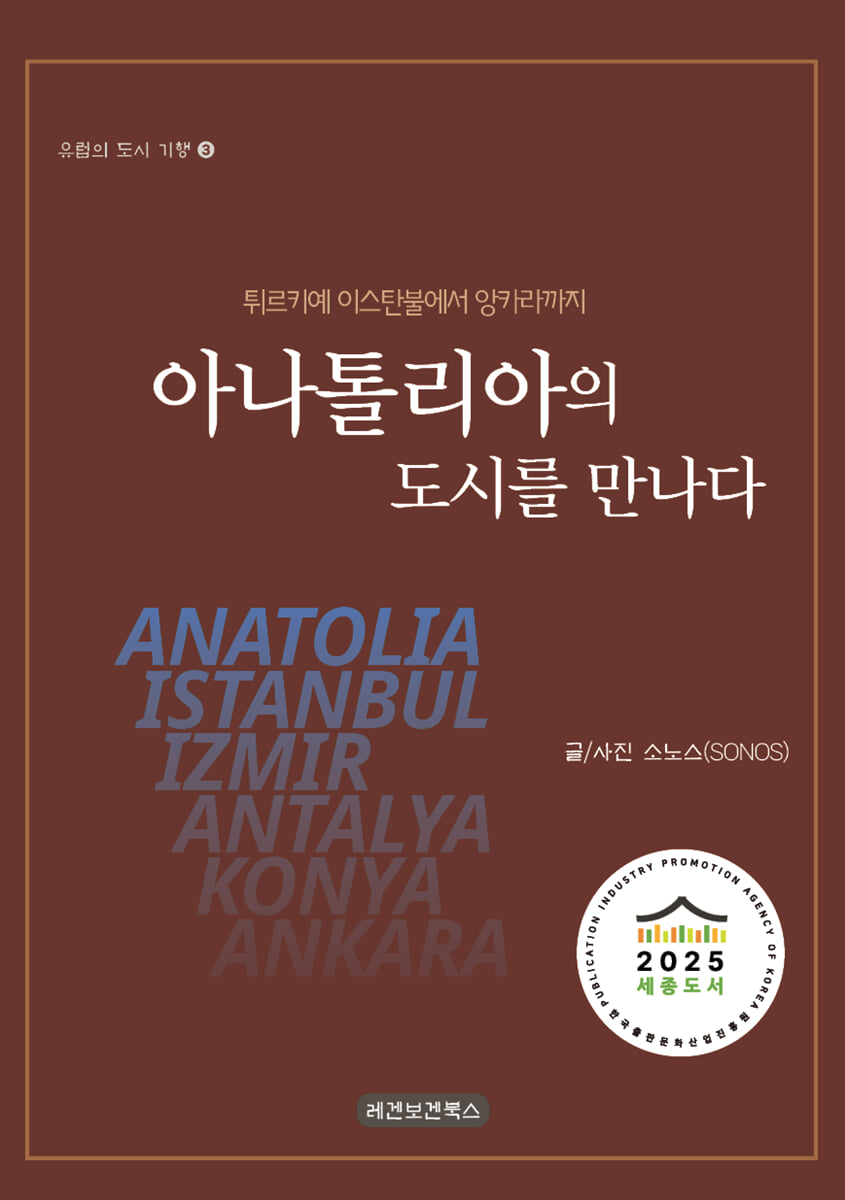
Meet the cities of Anatolia
 |
Description
Book Introduction
Anatolia, meaning 'east' or 'place of the rising sun', has been the center of numerous peoples and empires, from the ancient Hittites to Persia, ancient Greece, Rome, Byzantium, and finally the Ottoman Empire.
Located at the edge where the European and Asian continents meet, it is a place where numerous peoples have passed through since the beginning of human civilization.
From the ancient Hittites to Persia, ancient Greece and Rome, Byzantium, and the Ottoman Empire, they all made Anatolia, the border of the continent, the center of their empires.
Moreover, at the crossroads of Eastern and Western civilizations, it has sometimes been a space of conflict and confrontation, and at other times a space of harmony and communication.
Maybe that's why.
This is a place that anyone interested in the history of human civilization would like to visit at least once.
We visited major cities in the western and central regions of the Anatolian Peninsula, focusing on historical districts that retain the essence of Turkey's past.
And we also visited an Islamic mosque that was a bit unfamiliar to us.
The mosques we encounter in Turkey are holistic works of art, preserving aesthetic traditions and telling the history and culture of the city.
From Istanbul, the capital of two empires, to Izmir, the Ionian civilization embracing the Aegean Sea, to Antalya, a Mediterranean port city, to Konya, the city of Mevlana, and Ankara, the capital of the Turkish Republic and the city of Atatürk! This 40-day journey explores the Anatolian civilization.
Located at the edge where the European and Asian continents meet, it is a place where numerous peoples have passed through since the beginning of human civilization.
From the ancient Hittites to Persia, ancient Greece and Rome, Byzantium, and the Ottoman Empire, they all made Anatolia, the border of the continent, the center of their empires.
Moreover, at the crossroads of Eastern and Western civilizations, it has sometimes been a space of conflict and confrontation, and at other times a space of harmony and communication.
Maybe that's why.
This is a place that anyone interested in the history of human civilization would like to visit at least once.
We visited major cities in the western and central regions of the Anatolian Peninsula, focusing on historical districts that retain the essence of Turkey's past.
And we also visited an Islamic mosque that was a bit unfamiliar to us.
The mosques we encounter in Turkey are holistic works of art, preserving aesthetic traditions and telling the history and culture of the city.
From Istanbul, the capital of two empires, to Izmir, the Ionian civilization embracing the Aegean Sea, to Antalya, a Mediterranean port city, to Konya, the city of Mevlana, and Ankara, the capital of the Turkish Republic and the city of Atatürk! This 40-day journey explores the Anatolian civilization.
- You can preview some of the book's contents.
Preview
index
Prologue
Part 1 - Istanbul, the City of Two Empires
# ISTALNBUL
Panorama 1453 - The Beginning of Istanbul in 1453
Theodosian Walls and the Golden Horn - yes, we are in Istanbul now.
Hippodrome - Those stones have never forgotten their glory
Hagia Sophia - A space open to heaven
Sultan Ahmed Mosque - The Blue Mosque, a masterpiece of Ottoman architecture
Suleymaniye Mosque - The Sacred and Graceful Mosque, Suleymaniye Mosque
The Bosphorus Strait – the key connecting two worlds and two seas
Istiklal Street and Galata Tower - no one knows whether it will be a tragedy or a comedy.
Mimar Sinan District in Üsküdar - Mosque of the Ottoman Imperial Women
Part 2 - Cities of Anatolia
# IZMIR
Konak Square in Izmir - Meeting the Aegean Sea
Kemerald Bazaar - The End of the Ottoman Silk Road
Agora ruins in the Vasbane area - Smyrna's former glory
Selcuk - the city of the temple of Artemis
Ephesus Ruins - Historical Imagination Comes to Life in an Ancient City
The Great Fire of Smyrna - Izmir's Historical Scar
Alsanjak - Izmir, Rising Above the Wounds of History
# ANTALYA
Kaleici - Antalya, embracing the Mediterranean
Mosques of Kaleici - Get Lost in the Alleys of Kaleici
Antalya Old Town - Discovering the Old Cathedral in Antalya
Konyaalti Beach - Walking along the Mediterranean Sea
Cultural Route Association - Experience Antalya's Culture
# KONYA
Mevlana Museum - The City of Mevlana Rumi
Panoramic Konya Museum - The Era of Mevlana Rumi
Alaeddin Keykubat Mosque - the capital of the Seljuk Turkic Dynasty
Pilgrimage to Konya Mosque - The City of Mosques and Ezan
Mevlana Cultural Center - Sema, a gesture toward union with God
#ANKARA
Ulus and Melike Hatun Cami - the capital of Turkiye
Museum of Anatolian Civilizations - Discover the civilizations of Anatolia
Antkabir - Atatürk of Turkiye
Kizilay Square and Kocatepe Cami - Ankara's No. 1
EPILOGUE
References
Part 1 - Istanbul, the City of Two Empires
# ISTALNBUL
Panorama 1453 - The Beginning of Istanbul in 1453
Theodosian Walls and the Golden Horn - yes, we are in Istanbul now.
Hippodrome - Those stones have never forgotten their glory
Hagia Sophia - A space open to heaven
Sultan Ahmed Mosque - The Blue Mosque, a masterpiece of Ottoman architecture
Suleymaniye Mosque - The Sacred and Graceful Mosque, Suleymaniye Mosque
The Bosphorus Strait – the key connecting two worlds and two seas
Istiklal Street and Galata Tower - no one knows whether it will be a tragedy or a comedy.
Mimar Sinan District in Üsküdar - Mosque of the Ottoman Imperial Women
Part 2 - Cities of Anatolia
# IZMIR
Konak Square in Izmir - Meeting the Aegean Sea
Kemerald Bazaar - The End of the Ottoman Silk Road
Agora ruins in the Vasbane area - Smyrna's former glory
Selcuk - the city of the temple of Artemis
Ephesus Ruins - Historical Imagination Comes to Life in an Ancient City
The Great Fire of Smyrna - Izmir's Historical Scar
Alsanjak - Izmir, Rising Above the Wounds of History
# ANTALYA
Kaleici - Antalya, embracing the Mediterranean
Mosques of Kaleici - Get Lost in the Alleys of Kaleici
Antalya Old Town - Discovering the Old Cathedral in Antalya
Konyaalti Beach - Walking along the Mediterranean Sea
Cultural Route Association - Experience Antalya's Culture
# KONYA
Mevlana Museum - The City of Mevlana Rumi
Panoramic Konya Museum - The Era of Mevlana Rumi
Alaeddin Keykubat Mosque - the capital of the Seljuk Turkic Dynasty
Pilgrimage to Konya Mosque - The City of Mosques and Ezan
Mevlana Cultural Center - Sema, a gesture toward union with God
#ANKARA
Ulus and Melike Hatun Cami - the capital of Turkiye
Museum of Anatolian Civilizations - Discover the civilizations of Anatolia
Antkabir - Atatürk of Turkiye
Kizilay Square and Kocatepe Cami - Ankara's No. 1
EPILOGUE
References
Detailed image

Into the book
The final turning point came in 1923, when the Ottoman Empire was defeated in World War I and was replaced by the Turkish Republic.
At this time, Turkey moved its capital to Ankara, freeing Istanbul from the heavy burden it had been carrying.
And today, Istanbul has become a city that is a 'large living museum' that preserves its ancient history.
Just because it's called a museum city doesn't mean it's a stuffed city.
Because Istanbul today is still a bustling, vibrant, and dynamic city.
The history of Istanbul 'began' in 1453 when it became the capital of the Ottoman Empire following the fall of the Byzantine Empire.
So, my first stop in Istanbul was the Historical Museum's Panorama 1453.
--- From "Panorama 1453-1453, The Beginning of Istanbul"
In the war of 1453, the Ottoman army also attempted to attack by sea, but was unable to break through.
Although the Byzantine navy was numerically smaller, it was far superior to the Ottoman navy.
What was more important was that the entrance to the Golden Horn was blocked by chains to prevent attacks.
So Mehmet II takes extraordinary measures.
The boat was taken overnight to Galata Hill to enter the Golden Horn.
The Byzantine garrison, which had been attacked unexpectedly, suffered such a blow that it had to deploy all of its already insufficient forces.
But at that time, Osman was unable to break through here.
--- From "Theodosian Walls and the Golden Horn - Yes, We Are in Istanbul Now"
The wonders of Hagia Sophia are not explained by the dome and arches alone.
Yes, that's right, those are the countless windows that decorate the ceiling.
Hagia Sophia has 40 windows along a circular border under the central dome, 12 large windows in the great arched walls on the north and south sides, and smaller windows in the semi-domes and the lower domes below them.
The sunlight streaming in here mysteriously illuminates the vast and magnificent space composed of domes and arches.
It is the result of man-made structures meeting nature to create a wondrous moment.
--- From "Hagia Sophia - A Space Open to Heaven"
Because the road we are standing on is Arcadian Street, which leads to the port.
Now, the middle of the road is off-limits, but beyond the signpost, several pillars still stand on either side of the road.
At that time, the columns would have formed an arcade with shops and roofs.
The streets welcoming visitors to Ephesus were splendidly decorated, and it is said that the shops in the arcades were lit up at night with about 50 bonfires.
I briefly imagined the past in the vanished landscape.
--- From "Ephesus Ruins - Historical Imagination Comes to Life in an Ancient City"
“The Mediterranean is a miracle,” said historian John Julius Norwich.
At first I thought it was an exaggeration to say that seeing the sea was a miracle, but I think I can understand what Norwich is saying.
The Mediterranean Sea we see today has created and sometimes destroyed many civilizations.
And the civilization of that time still has an influence today.
The Egyptian civilization with its giant pyramids, the splendid Greco-Roman civilization, and the Palestinian civilization, the birthplace of the world's three major religions: Christianity, Judaism, and Islam, all began in the eastern part of the Mediterranean Sea.
The southern coast of Anatolia was a major area through which these civilizations passed.
The reason nomads who came from the east on horseback once boarded ships was to take control of the Mediterranean Sea.
And they finally took control of this sea and established a great empire.
Their descendants are today's Turks.
--- From "Konyaalt Beach - Walking along the Mediterranean Beach"
There were huge mountains to overcome before that.
It was the Taurus Mountains, one of the central mountain ranges of Turkey.
The Taurus Mountains extend from the Teke Peninsula in Antalya, in the southwestern part of the Anatolian Peninsula, across the Syrian border, to the northern border of Mesopotamia.
It is a mountain range that runs between the Anatolian Plateau and the Mediterranean Sea.
The Taurus Mountains, whose name means 'Taurus', are so rugged that many of them are over 3,000 meters above sea level.
--- From "Encounter with an Unfamiliar Landscape"
We needed time to collect our emotions after watching the Sema dance.
Of course, the Sema dance we just saw was not entirely a religious ritual, as it was a patterned ritualistic act for the audience.
But despite it being such a conscious act, the image of the Semazens spinning around and hoping to be led by something remained in my mind.
On the way back to my accommodation, I kept thinking about the Sema performance I had seen earlier.
I paused for a moment and looked around, and the Khubei Hadra of the Mevlana Museum was shining brightly before my eyes.
We paid homage to that green dome.
--- From "Mevlana Cultural Center - Gestures Toward Unity with God"
It is the prototype of the worship of Kybele, the patron goddess of Anatolia, which led to the worship of Artemis in Ephesus.
Next, there was a deer statue symbolizing a Hittite god and a bronze cauldron excavated from Gordion in the Phrygian kingdom, which was astonishing in its beautiful decoration and elaborate craftsmanship.
Looking at various relics, I felt that artistic techniques had already been perfected before the Common Era.
--- From "Museum of Anatolian Civilizations - Seeing the Civilization of Anatolia"
Orhan Pamuk said that life would not be so bad if only we could take a walk along the Bosphorus.
We also found solace in seeing the Bosphorus every day during our stay in Istanbul.
And standing by this sea, it felt as if this place, where many civilizations had clashed, was still alive and moving.
The Bosphorus Bridge was visible in the distance.
I couldn't help but laugh.
In the end, I couldn't cross that bridge.
But I thought it would be okay to leave at least one.
That way, there will be a reason to come back again someday.
At this time, Turkey moved its capital to Ankara, freeing Istanbul from the heavy burden it had been carrying.
And today, Istanbul has become a city that is a 'large living museum' that preserves its ancient history.
Just because it's called a museum city doesn't mean it's a stuffed city.
Because Istanbul today is still a bustling, vibrant, and dynamic city.
The history of Istanbul 'began' in 1453 when it became the capital of the Ottoman Empire following the fall of the Byzantine Empire.
So, my first stop in Istanbul was the Historical Museum's Panorama 1453.
--- From "Panorama 1453-1453, The Beginning of Istanbul"
In the war of 1453, the Ottoman army also attempted to attack by sea, but was unable to break through.
Although the Byzantine navy was numerically smaller, it was far superior to the Ottoman navy.
What was more important was that the entrance to the Golden Horn was blocked by chains to prevent attacks.
So Mehmet II takes extraordinary measures.
The boat was taken overnight to Galata Hill to enter the Golden Horn.
The Byzantine garrison, which had been attacked unexpectedly, suffered such a blow that it had to deploy all of its already insufficient forces.
But at that time, Osman was unable to break through here.
--- From "Theodosian Walls and the Golden Horn - Yes, We Are in Istanbul Now"
The wonders of Hagia Sophia are not explained by the dome and arches alone.
Yes, that's right, those are the countless windows that decorate the ceiling.
Hagia Sophia has 40 windows along a circular border under the central dome, 12 large windows in the great arched walls on the north and south sides, and smaller windows in the semi-domes and the lower domes below them.
The sunlight streaming in here mysteriously illuminates the vast and magnificent space composed of domes and arches.
It is the result of man-made structures meeting nature to create a wondrous moment.
--- From "Hagia Sophia - A Space Open to Heaven"
Because the road we are standing on is Arcadian Street, which leads to the port.
Now, the middle of the road is off-limits, but beyond the signpost, several pillars still stand on either side of the road.
At that time, the columns would have formed an arcade with shops and roofs.
The streets welcoming visitors to Ephesus were splendidly decorated, and it is said that the shops in the arcades were lit up at night with about 50 bonfires.
I briefly imagined the past in the vanished landscape.
--- From "Ephesus Ruins - Historical Imagination Comes to Life in an Ancient City"
“The Mediterranean is a miracle,” said historian John Julius Norwich.
At first I thought it was an exaggeration to say that seeing the sea was a miracle, but I think I can understand what Norwich is saying.
The Mediterranean Sea we see today has created and sometimes destroyed many civilizations.
And the civilization of that time still has an influence today.
The Egyptian civilization with its giant pyramids, the splendid Greco-Roman civilization, and the Palestinian civilization, the birthplace of the world's three major religions: Christianity, Judaism, and Islam, all began in the eastern part of the Mediterranean Sea.
The southern coast of Anatolia was a major area through which these civilizations passed.
The reason nomads who came from the east on horseback once boarded ships was to take control of the Mediterranean Sea.
And they finally took control of this sea and established a great empire.
Their descendants are today's Turks.
--- From "Konyaalt Beach - Walking along the Mediterranean Beach"
There were huge mountains to overcome before that.
It was the Taurus Mountains, one of the central mountain ranges of Turkey.
The Taurus Mountains extend from the Teke Peninsula in Antalya, in the southwestern part of the Anatolian Peninsula, across the Syrian border, to the northern border of Mesopotamia.
It is a mountain range that runs between the Anatolian Plateau and the Mediterranean Sea.
The Taurus Mountains, whose name means 'Taurus', are so rugged that many of them are over 3,000 meters above sea level.
--- From "Encounter with an Unfamiliar Landscape"
We needed time to collect our emotions after watching the Sema dance.
Of course, the Sema dance we just saw was not entirely a religious ritual, as it was a patterned ritualistic act for the audience.
But despite it being such a conscious act, the image of the Semazens spinning around and hoping to be led by something remained in my mind.
On the way back to my accommodation, I kept thinking about the Sema performance I had seen earlier.
I paused for a moment and looked around, and the Khubei Hadra of the Mevlana Museum was shining brightly before my eyes.
We paid homage to that green dome.
--- From "Mevlana Cultural Center - Gestures Toward Unity with God"
It is the prototype of the worship of Kybele, the patron goddess of Anatolia, which led to the worship of Artemis in Ephesus.
Next, there was a deer statue symbolizing a Hittite god and a bronze cauldron excavated from Gordion in the Phrygian kingdom, which was astonishing in its beautiful decoration and elaborate craftsmanship.
Looking at various relics, I felt that artistic techniques had already been perfected before the Common Era.
--- From "Museum of Anatolian Civilizations - Seeing the Civilization of Anatolia"
Orhan Pamuk said that life would not be so bad if only we could take a walk along the Bosphorus.
We also found solace in seeing the Bosphorus every day during our stay in Istanbul.
And standing by this sea, it felt as if this place, where many civilizations had clashed, was still alive and moving.
The Bosphorus Bridge was visible in the distance.
I couldn't help but laugh.
In the end, I couldn't cross that bridge.
But I thought it would be okay to leave at least one.
That way, there will be a reason to come back again someday.
--- From "Epilogue"
Publisher's Review
This is a record of exploring Istanbul and Ankara, cities that preserve the history and culture of Turkey.
It contains a 40-day city tour from Istanbul, the capital of two empires, to Izmir, the Ionian civilization embracing the Aegean Sea, Antalya, a port city on the Mediterranean, Konya, the city of Mevlana, and Ankara, the capital of the Turkish Republic and the city of Ataturk.
The author, who is publishing a series of European city travelogues, tells the story of his epic journey through Anatolian cities, from Freiburg, Germany and Lisbon, Portugal, to Istanbul and Ankara, Turkey.
In Istanbul, you can see the ruins of the Byzantine Empire and the Ottoman Empire.
We introduced the Theodosian Walls and Golden Horn in the historical district, the Hippodrome, Hagia Sophia, the Blue Mosque, Süleymaniye Camii, and Eminönü Port, and even took a boat trip to explore Üsküdar and the Bosphorus Strait in the Asian region.
Izmir is centered around the historical district of Konak, with four districts to focus on: Konak Square, Kemerald, Basmane, and Alsancak.
You can explore the historical imagination of the ancient cities of Ephesus and Seljuk, located on the outskirts.
In Antalya, you can stroll along Kaleici Street, centered around the Old Town, where 19th-century Ottoman houses remain, and hear stories about the city where mosques and churches coexist.
You can also visit Konyaalt Beach in the Mediterranean Sea, which is a trekking course.
Konya is a city that retains the remains of the 13th-century Seljuk dynasty and traces of Mevlana Rumi, the Islamic Sufist.
Here you can enjoy a full-scale performance of Mevlevi's Sema.
Konya, famous as the city of mosques, is home to a variety of mosques dating from the Seljuk era, the Ottoman Empire, and modern times, allowing you to visit each and every one of them.
Ankara is home to the Museum of Anatolian Civilizations, the centerpiece of this tour.
We visited Anatolian relics in sequence from ancient times.
You can hear the story of the Republic's history at Ankara Atatürk's mausoleum, Ankara Ulus Square, and Ulus Square, the center of the Republic's birth.
Author SONOS, who previously published the humanities essay “Meeting the Cities of Anatolia,” now presents the photo essay “Again, Into the Time of Anatolia.”
Starting from the European side of Istanbul, the journey continues to the Asian side of Istanbul, the beginning of the Anatolian Peninsula, and then to Izmir, Antalya, Konya, and Ankara.
While "Meeting the Cities of Anatolia" is a kind and detailed narrative of history and civilization, "Back in Anatolian Time" conveys a poetic aftertaste through photographs, moving between vanished civilizations and remaining cities.
If you want to discover the traces of Anatolia through photo essays and learn more about its history and civilization, humanities essays will help.
It contains a 40-day city tour from Istanbul, the capital of two empires, to Izmir, the Ionian civilization embracing the Aegean Sea, Antalya, a port city on the Mediterranean, Konya, the city of Mevlana, and Ankara, the capital of the Turkish Republic and the city of Ataturk.
The author, who is publishing a series of European city travelogues, tells the story of his epic journey through Anatolian cities, from Freiburg, Germany and Lisbon, Portugal, to Istanbul and Ankara, Turkey.
In Istanbul, you can see the ruins of the Byzantine Empire and the Ottoman Empire.
We introduced the Theodosian Walls and Golden Horn in the historical district, the Hippodrome, Hagia Sophia, the Blue Mosque, Süleymaniye Camii, and Eminönü Port, and even took a boat trip to explore Üsküdar and the Bosphorus Strait in the Asian region.
Izmir is centered around the historical district of Konak, with four districts to focus on: Konak Square, Kemerald, Basmane, and Alsancak.
You can explore the historical imagination of the ancient cities of Ephesus and Seljuk, located on the outskirts.
In Antalya, you can stroll along Kaleici Street, centered around the Old Town, where 19th-century Ottoman houses remain, and hear stories about the city where mosques and churches coexist.
You can also visit Konyaalt Beach in the Mediterranean Sea, which is a trekking course.
Konya is a city that retains the remains of the 13th-century Seljuk dynasty and traces of Mevlana Rumi, the Islamic Sufist.
Here you can enjoy a full-scale performance of Mevlevi's Sema.
Konya, famous as the city of mosques, is home to a variety of mosques dating from the Seljuk era, the Ottoman Empire, and modern times, allowing you to visit each and every one of them.
Ankara is home to the Museum of Anatolian Civilizations, the centerpiece of this tour.
We visited Anatolian relics in sequence from ancient times.
You can hear the story of the Republic's history at Ankara Atatürk's mausoleum, Ankara Ulus Square, and Ulus Square, the center of the Republic's birth.
Author SONOS, who previously published the humanities essay “Meeting the Cities of Anatolia,” now presents the photo essay “Again, Into the Time of Anatolia.”
Starting from the European side of Istanbul, the journey continues to the Asian side of Istanbul, the beginning of the Anatolian Peninsula, and then to Izmir, Antalya, Konya, and Ankara.
While "Meeting the Cities of Anatolia" is a kind and detailed narrative of history and civilization, "Back in Anatolian Time" conveys a poetic aftertaste through photographs, moving between vanished civilizations and remaining cities.
If you want to discover the traces of Anatolia through photo essays and learn more about its history and civilization, humanities essays will help.
GOODS SPECIFICS
- Date of issue: February 24, 2025
- Page count, weight, size: 248 pages | 398g | 148*210*15mm
- ISBN13: 9791197811050
- ISBN10: 1197811052
You may also like
카테고리
korean


korean

![GQ KOREA Mark (Monthly): December [2025]](http://librairie.coreenne.fr/cdn/shop/files/8ef265dbbfbf186523ed75ba7319009d.jpg?v=1765340328&width=3840)


