

Dictionary of Korean History Concepts
 |
Description
Book Introduction
- A word from MD
- [Complete Conquest of Historical Terms] A dictionary of Joseon history concepts, briefly covering 27 kings and 870 terms, from the founding of Joseon to the politics of the powerful factions.
As the name 'Dictionary' suggests, it explains Joseon history in the form of a Korean dictionary.
If you know the terminology, you will be able to see the sentences, and if you read the sentences, you will be able to develop an eye for the times.
- Ahn Hyeon-jae, History PD
“With the hope that history will become familiar and fun to learn.”
The bare minimum for adults these days!
Director Bong Joon-ho's acceptance speech at the Golden Globe Awards in January 2020 became a hot topic.
“Once you overcome the one-inch barrier of subtitles, you can enjoy much better movies.” This was Director Bong’s warning to Americans who avoid non-English movies because they dislike subtitles, and an invitation to enjoy a pleasant movie experience.
Many people like historical dramas and want to learn about actual history, but they are daunted by the unfamiliar and difficult historical terms and thus avoid studying history.
In Director Bong Joon-ho's words, what if we changed 'subtitles' to 'historical terms' and 'film' to 'historical drama'?
This book, "Dictionary of Korean History Concepts," instills in readers who are afraid of studying history the confidence to overcome the obstacle of historical terminology.
It's as if director Bong Joon-ho was suggesting to Americans that they have the courage to overcome the 'one-inch subtitles'.
All that is needed to study is the desire to know.
Those who are immersed in historical dramas and want to understand them more deeply can start by learning about the concepts of historical terminology.
If you start with simple terms, you will quickly become familiar with history and find it interesting.
This book, "Dictionary of Joseon History Concepts," covers approximately 870 items, including 27 kings, people, terms, and books, from the founding of Joseon to the politics of the powerful factions, which we encounter most frequently.
You can read it from the beginning, or you can look up words you are curious about and read them.
First, let's enjoy the moment when studying history becomes fun!
The bare minimum for adults these days!
Director Bong Joon-ho's acceptance speech at the Golden Globe Awards in January 2020 became a hot topic.
“Once you overcome the one-inch barrier of subtitles, you can enjoy much better movies.” This was Director Bong’s warning to Americans who avoid non-English movies because they dislike subtitles, and an invitation to enjoy a pleasant movie experience.
Many people like historical dramas and want to learn about actual history, but they are daunted by the unfamiliar and difficult historical terms and thus avoid studying history.
In Director Bong Joon-ho's words, what if we changed 'subtitles' to 'historical terms' and 'film' to 'historical drama'?
This book, "Dictionary of Korean History Concepts," instills in readers who are afraid of studying history the confidence to overcome the obstacle of historical terminology.
It's as if director Bong Joon-ho was suggesting to Americans that they have the courage to overcome the 'one-inch subtitles'.
All that is needed to study is the desire to know.
Those who are immersed in historical dramas and want to understand them more deeply can start by learning about the concepts of historical terminology.
If you start with simple terms, you will quickly become familiar with history and find it interesting.
This book, "Dictionary of Joseon History Concepts," covers approximately 870 items, including 27 kings, people, terms, and books, from the founding of Joseon to the politics of the powerful factions, which we encounter most frequently.
You can read it from the beginning, or you can look up words you are curious about and read them.
First, let's enjoy the moment when studying history becomes fun!
- You can preview some of the book's contents.
Preview
index
Author's Note
G~H
G~H
Detailed image

Into the book
Gabyeolcho (family book)
When Lee An-sa (Mokjo), the ancestor of King Taejo Lee Seong-gye who migrated to Hamgyeong-do, received the position of Cheonhojang from the Yuan Dynasty, he formed a private army called Gabyeolcho (Gabyeolchi) with about 1,000 Goryeo and Jurchen people.
Yi Seong-gye, based on the Gabyeolcho, won numerous battles against the Red Turbans and Japanese pirates, saving Goryeo from crisis on several occasions.
Afterwards, Gabyeolcho became the military foundation for Yi Seong-gye to found Joseon, but it was disbanded in 1411 (the 11th year of King Taejong's reign) during the process of abolishing the private army to strengthen royal authority.
--- p.10
Kim Man-deok (1739-1812)
Born in Jeju Island, she lost her parents at a young age and lived as a gisaeng before becoming a merchant through rice trade with the mainland.
In 1795, when a severe famine struck Jeju Island, he donated his property to help the people.
King Jeongjo recognized his achievements and invited him to the palace and sent him on a trip to Geumgangsan Mountain.
In the Chogyemun exam, the 'Mandeokjeon' was included as a question and used as an example for everyone.
--- p.80
Damo (tea mother)
It was a term referring to female slaves who cooked and did odd jobs in government offices, but after the mid-Joseon period, they were assigned to the Uigeumbu, Hyeongjo, and Podocheong, and were in charge of investigating cases related to women or searching for female suspects.
When information came in that there was a plot to commit treason, they would hide an iron hammer and a rope in their skirts and capture the criminal.
To become a Damo, one had to be over 5 feet (150 cm) tall and be able to lift 5 mal (40 kg) of rice.
--- p.106
Minmugu's jade
This is an incident in which King Taejong, in an attempt to keep his relatives in check, eliminated four brothers, including Queen Won-gyeong's younger brother, Min Mu-gu.
Min Mu-gu and Min Mu-jil were exiled to Jeju Island and committed suicide, while Min Mu-hyul and Min Mu-hee were executed for appealing to Prince Yangnyeong that their two older brothers' deaths were unjust.
Because of this, Queen Won-gyeong frequently fought with King Taejong and was on the verge of being deposed.
--- p.151
Northern Expedition Theory
In order to avenge the humiliation suffered by the Qing, King Hyojong increased the number of troops in the Military Training Office and reorganized the Royal Guard and the Royal Guard.
In addition, he removed people friendly to the Qing Dynasty, such as Kim Ja-jeom, from the court and appointed military officials such as Lee Wan who supported the Northern Expedition.
However, it was not implemented due to opposition from the Westerners, including Song Si-yeol, to the Northern Expedition.
During the reigns of King Hyeonjong and King Sukjong, the idea of a northern expedition was raised by the Southerners, including Yun Hyu and Heo Jeok, but most of them used it as a means to seize political power.
--- p.179
Commander of the Three Provinces' Naval Forces
As the role of the navy grew during the Imjin War, in 1593 (the 26th year of King Seonjo's reign), a new position called Samdosugun Tongjesa, which oversaw the naval forces of the three southern provinces, was created and Yi Sun-sin was appointed to it.
The Samdosugun Tongjesa was of the same rank as the Gwanchalsa and served a two-year term, but had extensive powers, including the right to punish commanders below the rank of Susajeon if they did not follow orders.
208 people were appointed to the Samdosugun Tongjesa until it was abolished in 1895 (32nd year of King Gojong's reign).
--- p.207~208
Queen Won-gyeong (1365-1420)
As the wife of King Taejong, she gave birth to four princes, Yangnyeong, Hyoryeong, Chungnyeong, and Seongnyeong, and four princesses.
During the First Prince's Rebellion, he provided weapons to King Taejong and helped him rise up.
However, after Taejong ascended to the throne, he had many concubines and killed four of Queen Won-gyeong's younger brothers to check the power of the maternal relatives, which made the relationship very bad and put her in danger of being deposed.
--- p.314~315
King Jeongjo (1752–1800, reigned 1776–1800)
When his father, Crown Prince Sado, died, he was adopted by Crown Prince Hyojang.
He served as regent on behalf of King Yeongjo and ascended to the throne as king at the age of twenty-five.
He stabilized the unstable situation, including the Three Great Conspiracy Incident, at the beginning of his reign with the help of Hong Guk-yeong.
In order to strengthen the royal authority, he fostered a personal guard through Gyujanggak and established Jangyongyeong to counter the five military camps controlled by the Noron faction.
In order to prevent the monopoly of merchants in the city and to check the Noron faction, the gold and silver coins were abolished and a policy of public offering was implemented to protect merchants in the city.
Even in religion, they showed an inclusive attitude by not forcibly suppressing Western learning.
In the latter half of his reign, he worked to strengthen royal authority, including by building Hwaseong Fortress, but died suddenly of an illness at the age of 49.
--- p.408~409
King Taejong (1367–1422, reigned 1400–1418)
As the fifth son of King Taejo, Lee Seong-gye, he passed the civil service examination at the age of seventeen and demonstrated outstanding talent in both literature and martial arts, making a great contribution to the founding of the Joseon Dynasty.
However, when he was excluded from the list of meritorious subjects and faced a crisis due to the abolition of the private army, he started the First Prince's Rebellion and seized power.
After ascending to the throne following the Second Prince's Rebellion, he purged those who could threaten the royal authority, including his brother-in-law Min Mu-gu.
Even after his third son, Prince Chungnyeong, ascended the throne as King Sejong instead of his eldest son, Prince Yangnyeong, he continued to lead the state affairs as the former king.
During his reign, he completed the administrative system centered on the State Council and the Six Ministries and reorganized the Eight Provinces system.
In addition, the foundation of the country was laid by establishing the Office of the Inspector General, implementing policies to suppress Buddhism and promote Confucianism, implementing the Law on the Protection of the Children of the Commoners, and implementing the Law on the Registration of Household Names.
--- p.469~470
Hongipo (紅夷砲)
It was called Hongipo in the Ming Dynasty because it was said to be a weapon used by the red-haired Dutch.
The Ming Dynasty, having experienced the power of the Hongi gun during the war with the Netherlands, imported and manufactured the Hongi gun and used it in the war.
During the Byeongjahoran, the Qing army also used Hongipo to accept Joseon's surrender.
Joseon also used Dutch people, including Park Yeon, to strengthen its national defense capabilities by assigning them to the training office and teaching them how to make and use Hongipo.
--- p.510
Exciting
During the reign of King Yeonsangun, 300 women were selected from among the Unpyeong clan based on their age and appearance. They were divided into Ji-gwa-heung-cheong, who served the king closely, and Cheon-gwa-heung-cheong, who slept with the king.
Heungcheong's guarantor was called 'Hohwa Cheomchun (護花添春)', which means 'protecting flowers and adding spring', the clothes Heungcheong wore were called 'Asangbok (?祥服)', which means 'clothes welcoming auspiciousness', and the space where Heungcheong stored his food was called 'Hohwago (護華庫)', which means 'warehouse protecting splendor'.
A representative figure from Heungcheong is Jang Nok-su.
When Lee An-sa (Mokjo), the ancestor of King Taejo Lee Seong-gye who migrated to Hamgyeong-do, received the position of Cheonhojang from the Yuan Dynasty, he formed a private army called Gabyeolcho (Gabyeolchi) with about 1,000 Goryeo and Jurchen people.
Yi Seong-gye, based on the Gabyeolcho, won numerous battles against the Red Turbans and Japanese pirates, saving Goryeo from crisis on several occasions.
Afterwards, Gabyeolcho became the military foundation for Yi Seong-gye to found Joseon, but it was disbanded in 1411 (the 11th year of King Taejong's reign) during the process of abolishing the private army to strengthen royal authority.
--- p.10
Kim Man-deok (1739-1812)
Born in Jeju Island, she lost her parents at a young age and lived as a gisaeng before becoming a merchant through rice trade with the mainland.
In 1795, when a severe famine struck Jeju Island, he donated his property to help the people.
King Jeongjo recognized his achievements and invited him to the palace and sent him on a trip to Geumgangsan Mountain.
In the Chogyemun exam, the 'Mandeokjeon' was included as a question and used as an example for everyone.
--- p.80
Damo (tea mother)
It was a term referring to female slaves who cooked and did odd jobs in government offices, but after the mid-Joseon period, they were assigned to the Uigeumbu, Hyeongjo, and Podocheong, and were in charge of investigating cases related to women or searching for female suspects.
When information came in that there was a plot to commit treason, they would hide an iron hammer and a rope in their skirts and capture the criminal.
To become a Damo, one had to be over 5 feet (150 cm) tall and be able to lift 5 mal (40 kg) of rice.
--- p.106
Minmugu's jade
This is an incident in which King Taejong, in an attempt to keep his relatives in check, eliminated four brothers, including Queen Won-gyeong's younger brother, Min Mu-gu.
Min Mu-gu and Min Mu-jil were exiled to Jeju Island and committed suicide, while Min Mu-hyul and Min Mu-hee were executed for appealing to Prince Yangnyeong that their two older brothers' deaths were unjust.
Because of this, Queen Won-gyeong frequently fought with King Taejong and was on the verge of being deposed.
--- p.151
Northern Expedition Theory
In order to avenge the humiliation suffered by the Qing, King Hyojong increased the number of troops in the Military Training Office and reorganized the Royal Guard and the Royal Guard.
In addition, he removed people friendly to the Qing Dynasty, such as Kim Ja-jeom, from the court and appointed military officials such as Lee Wan who supported the Northern Expedition.
However, it was not implemented due to opposition from the Westerners, including Song Si-yeol, to the Northern Expedition.
During the reigns of King Hyeonjong and King Sukjong, the idea of a northern expedition was raised by the Southerners, including Yun Hyu and Heo Jeok, but most of them used it as a means to seize political power.
--- p.179
Commander of the Three Provinces' Naval Forces
As the role of the navy grew during the Imjin War, in 1593 (the 26th year of King Seonjo's reign), a new position called Samdosugun Tongjesa, which oversaw the naval forces of the three southern provinces, was created and Yi Sun-sin was appointed to it.
The Samdosugun Tongjesa was of the same rank as the Gwanchalsa and served a two-year term, but had extensive powers, including the right to punish commanders below the rank of Susajeon if they did not follow orders.
208 people were appointed to the Samdosugun Tongjesa until it was abolished in 1895 (32nd year of King Gojong's reign).
--- p.207~208
Queen Won-gyeong (1365-1420)
As the wife of King Taejong, she gave birth to four princes, Yangnyeong, Hyoryeong, Chungnyeong, and Seongnyeong, and four princesses.
During the First Prince's Rebellion, he provided weapons to King Taejong and helped him rise up.
However, after Taejong ascended to the throne, he had many concubines and killed four of Queen Won-gyeong's younger brothers to check the power of the maternal relatives, which made the relationship very bad and put her in danger of being deposed.
--- p.314~315
King Jeongjo (1752–1800, reigned 1776–1800)
When his father, Crown Prince Sado, died, he was adopted by Crown Prince Hyojang.
He served as regent on behalf of King Yeongjo and ascended to the throne as king at the age of twenty-five.
He stabilized the unstable situation, including the Three Great Conspiracy Incident, at the beginning of his reign with the help of Hong Guk-yeong.
In order to strengthen the royal authority, he fostered a personal guard through Gyujanggak and established Jangyongyeong to counter the five military camps controlled by the Noron faction.
In order to prevent the monopoly of merchants in the city and to check the Noron faction, the gold and silver coins were abolished and a policy of public offering was implemented to protect merchants in the city.
Even in religion, they showed an inclusive attitude by not forcibly suppressing Western learning.
In the latter half of his reign, he worked to strengthen royal authority, including by building Hwaseong Fortress, but died suddenly of an illness at the age of 49.
--- p.408~409
King Taejong (1367–1422, reigned 1400–1418)
As the fifth son of King Taejo, Lee Seong-gye, he passed the civil service examination at the age of seventeen and demonstrated outstanding talent in both literature and martial arts, making a great contribution to the founding of the Joseon Dynasty.
However, when he was excluded from the list of meritorious subjects and faced a crisis due to the abolition of the private army, he started the First Prince's Rebellion and seized power.
After ascending to the throne following the Second Prince's Rebellion, he purged those who could threaten the royal authority, including his brother-in-law Min Mu-gu.
Even after his third son, Prince Chungnyeong, ascended the throne as King Sejong instead of his eldest son, Prince Yangnyeong, he continued to lead the state affairs as the former king.
During his reign, he completed the administrative system centered on the State Council and the Six Ministries and reorganized the Eight Provinces system.
In addition, the foundation of the country was laid by establishing the Office of the Inspector General, implementing policies to suppress Buddhism and promote Confucianism, implementing the Law on the Protection of the Children of the Commoners, and implementing the Law on the Registration of Household Names.
--- p.469~470
Hongipo (紅夷砲)
It was called Hongipo in the Ming Dynasty because it was said to be a weapon used by the red-haired Dutch.
The Ming Dynasty, having experienced the power of the Hongi gun during the war with the Netherlands, imported and manufactured the Hongi gun and used it in the war.
During the Byeongjahoran, the Qing army also used Hongipo to accept Joseon's surrender.
Joseon also used Dutch people, including Park Yeon, to strengthen its national defense capabilities by assigning them to the training office and teaching them how to make and use Hongipo.
--- p.510
Exciting
During the reign of King Yeonsangun, 300 women were selected from among the Unpyeong clan based on their age and appearance. They were divided into Ji-gwa-heung-cheong, who served the king closely, and Cheon-gwa-heung-cheong, who slept with the king.
Heungcheong's guarantor was called 'Hohwa Cheomchun (護花添春)', which means 'protecting flowers and adding spring', the clothes Heungcheong wore were called 'Asangbok (?祥服)', which means 'clothes welcoming auspiciousness', and the space where Heungcheong stored his food was called 'Hohwago (護華庫)', which means 'warehouse protecting splendor'.
A representative figure from Heungcheong is Jang Nok-su.
--- p.526
Publisher's Review
Was King Sejong's mother Queen Wongyeong?
Admiral Yi Sun-sin's official position was Samdosugun Tongjesa?
Among the ten million Korean films, eight deal with historical events, and three of them, [Roaring Currents], [Masquerade], and [The King and the Clown], are set in the Joseon Dynasty.
The recently popular tvN drama [Wonkyung] is also a historical drama from the Joseon Dynasty, and the main character is Queen Wongyeong, the wife of the third king, King Taejong.
There's no need for any special preparation to enjoy the Joseon Dynasty historical dramas beloved by Koreans, but if you want to enjoy them even more, why not take a look at the "Joseon History Concept Dictionary"?
In [Roaring Currents], General Yi Sun-sin is called the 'Commander of the Three Provinces'. What kind of position is he? In [Masquerade], King Gwanghaegun argues with his subjects about the 'Daedong Law'. What kind of law is it that makes them fight like that? In [The King and the Clown], who is 'Kim Cheo-seon' who helps the main characters, and who are 'Yeonsangun' and 'Jang Nok-su'? In [Wonkyung], the main character, 'Queen Wongyeong', was 'Sejong's' mother and did she really control Joseon together with 'Taejong'?
We realize the joy of learning when unfamiliar terms become understandable, unfamiliar concepts become familiar, and numerous characters and events become established.
Even the characters, events, official positions, books, and government offices that appear in my favorite historical dramas will be covered in this book, and I will never again be distracted by the concepts of Joseon history.
Sometimes like a Korean dictionary, sometimes like a treasure map
From A to H, from A to I
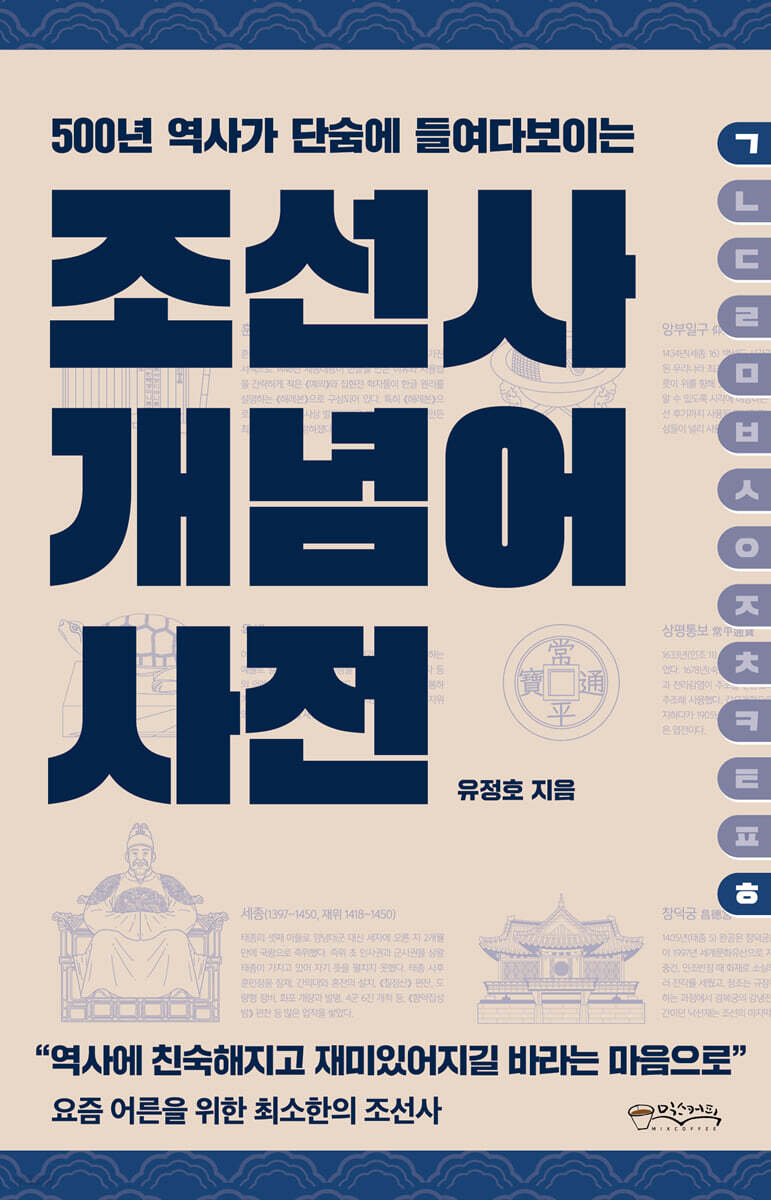
This book, which is advertised as a dictionary, is structured identically to a Korean dictionary.
The terms are arranged in the order of consonants 'ㄱ ㄴ ㄷ ㄹ…', and within the same consonant, the terms are arranged in the order of vowels 'ㅏ ㅑ ㅓ ㅕ…'.
So, if there is a word you want to look up, you can look it up one by one like in a Korean dictionary and read from the necessary section, but even if there is no word you are looking for, if you read from the first word of the first page and read one by one, you may come across a term that catches your eye like a treasure.
Who knows, maybe some time from now I'll find myself writing in the blank spaces of this book a historical term I know that isn't in it?
Admiral Yi Sun-sin's official position was Samdosugun Tongjesa?
Among the ten million Korean films, eight deal with historical events, and three of them, [Roaring Currents], [Masquerade], and [The King and the Clown], are set in the Joseon Dynasty.
The recently popular tvN drama [Wonkyung] is also a historical drama from the Joseon Dynasty, and the main character is Queen Wongyeong, the wife of the third king, King Taejong.
There's no need for any special preparation to enjoy the Joseon Dynasty historical dramas beloved by Koreans, but if you want to enjoy them even more, why not take a look at the "Joseon History Concept Dictionary"?
In [Roaring Currents], General Yi Sun-sin is called the 'Commander of the Three Provinces'. What kind of position is he? In [Masquerade], King Gwanghaegun argues with his subjects about the 'Daedong Law'. What kind of law is it that makes them fight like that? In [The King and the Clown], who is 'Kim Cheo-seon' who helps the main characters, and who are 'Yeonsangun' and 'Jang Nok-su'? In [Wonkyung], the main character, 'Queen Wongyeong', was 'Sejong's' mother and did she really control Joseon together with 'Taejong'?
We realize the joy of learning when unfamiliar terms become understandable, unfamiliar concepts become familiar, and numerous characters and events become established.
Even the characters, events, official positions, books, and government offices that appear in my favorite historical dramas will be covered in this book, and I will never again be distracted by the concepts of Joseon history.
Sometimes like a Korean dictionary, sometimes like a treasure map
From A to H, from A to I
This book, which is advertised as a dictionary, is structured identically to a Korean dictionary.
The terms are arranged in the order of consonants 'ㄱ ㄴ ㄷ ㄹ…', and within the same consonant, the terms are arranged in the order of vowels 'ㅏ ㅑ ㅓ ㅕ…'.
So, if there is a word you want to look up, you can look it up one by one like in a Korean dictionary and read from the necessary section, but even if there is no word you are looking for, if you read from the first word of the first page and read one by one, you may come across a term that catches your eye like a treasure.
Who knows, maybe some time from now I'll find myself writing in the blank spaces of this book a historical term I know that isn't in it?
GOODS SPECIFICS
- Date of issue: February 24, 2025
- Page count, weight, size: 528 pages | 740g | 135*210*30mm
- ISBN13: 9791170436171
- ISBN10: 117043617X
You may also like
카테고리
korean


korean

![GQ KOREA Mark (Monthly): December [2025]](http://librairie.coreenne.fr/cdn/shop/files/8ef265dbbfbf186523ed75ba7319009d.jpg?v=1765340328&width=3840)


