

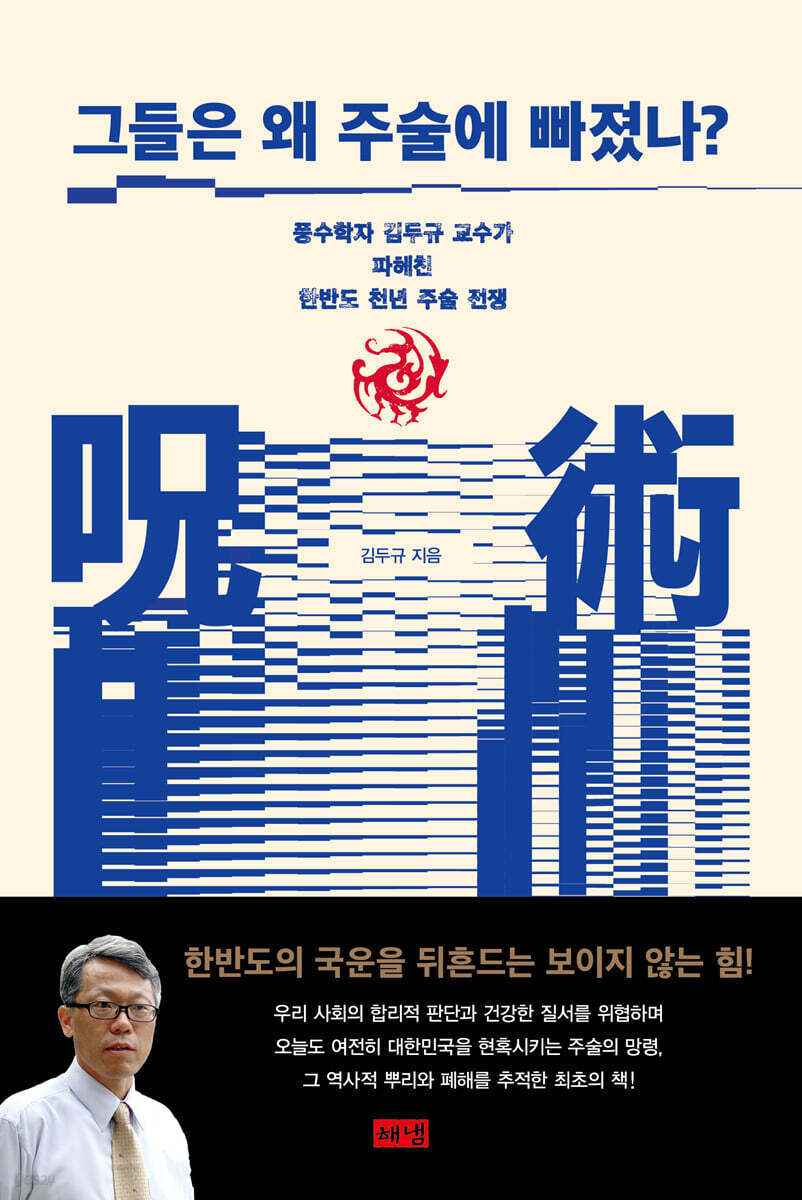
Why did they fall into witchcraft?
 |
Description
Book Introduction
The Republic of Korea trapped in witchcraft!
Shin Don and Yeongui of Goryeo, Jang Sun-myeong and Jinryeong-gun of Joseon, and the Republic of Korea in the 21st century…
How witchcraft can shake the foundations of a nation!
Comparing and analyzing feng shui and divination based on historical and humanistic insights
It exposes the dark shadow of witchcraft that has plagued our society.
The debate over witchcraft has been heated in South Korea in recent years.
It is not a personal problem that involves solving problems in daily life or looking into the future.
There is a controversy over the involvement of irrational and unscientific sorcery in the administration and governance of the ruling class.
The issue that recently brought this awareness to light was the controversy over the relocation of the presidential office that arose immediately after the 20th presidential election.
These suspicions are serious because they can incite chaos in our society and shake rational judgment and order.
In fact, the collusion between political power and sorcery has a long history on the Korean Peninsula.
Accordingly, Professor Kim Du-gyu, a geomancer, published a new book, “Why Did They Fall for Sorcery?” to understand the flow of sorcery that took place on the Korean Peninsula from the Goryeo Dynasty to the Joseon Dynasty and the 21st century, and to examine its harmful effects and dangers.
The author, Professor Kim Du-gyu, is considered a leading feng shui scholar who revived feng shui, a discipline that has been practiced for a thousand years since the Goryeo Dynasty, in the 21st century.
However, its academic starting point is German literature, and in this book in particular, based on the dialectical research method of 'doubt and denial', it analyzes the influence of magic in a three-dimensional way by going back and forth between Eastern and Western studies, past and present.
Shin Don and Yeongui of Goryeo, Jang Sun-myeong and Jinryeong-gun of Joseon, and the Republic of Korea in the 21st century…
How witchcraft can shake the foundations of a nation!
Comparing and analyzing feng shui and divination based on historical and humanistic insights
It exposes the dark shadow of witchcraft that has plagued our society.
The debate over witchcraft has been heated in South Korea in recent years.
It is not a personal problem that involves solving problems in daily life or looking into the future.
There is a controversy over the involvement of irrational and unscientific sorcery in the administration and governance of the ruling class.
The issue that recently brought this awareness to light was the controversy over the relocation of the presidential office that arose immediately after the 20th presidential election.
These suspicions are serious because they can incite chaos in our society and shake rational judgment and order.
In fact, the collusion between political power and sorcery has a long history on the Korean Peninsula.
Accordingly, Professor Kim Du-gyu, a geomancer, published a new book, “Why Did They Fall for Sorcery?” to understand the flow of sorcery that took place on the Korean Peninsula from the Goryeo Dynasty to the Joseon Dynasty and the 21st century, and to examine its harmful effects and dangers.
The author, Professor Kim Du-gyu, is considered a leading feng shui scholar who revived feng shui, a discipline that has been practiced for a thousand years since the Goryeo Dynasty, in the 21st century.
However, its academic starting point is German literature, and in this book in particular, based on the dialectical research method of 'doubt and denial', it analyzes the influence of magic in a three-dimensional way by going back and forth between Eastern and Western studies, past and present.
- You can preview some of the book's contents.
Preview
index
Preface | A Thousand Years of Deceit by the Devil
Chapter 1: Ghosts Still Live and Breathe in This Land
Why was 'he' under a spell?
The exorcism controversy revived in the 21st century
The blind myth that luck and timing can be changed
From Pythagoras to the 'Eighteen-Character Theory': The Magic of Numbers
Build a new building and inscribe it with magical meaning.
Who carved 'King' on that hand?
The day of the selection ceremony is not held on any day.
Chapter 2: The Created God, Doseon, Wanders the Skies of the Korean Peninsula _ The Goryeo Dynasty, Blindly Believing in Sorcery
King Hyeonjong, the 8th king of Goryeo, and the authenticity of the Hunyo Sipjo
The desire for power blinds the eyes to the truth.
Why does a cucumber appear in the story of Dosun's birth?
Secret magic disguised as feng shui
Was Doseon really good at feng shui?
Chapter 3: The Devil's Secret Arts and Their Descendants: Shaking Goryeo's Ruling Ideology
Eliminate disasters and gain blessings through magic.
The fate of the king and the sorcerer who fell into sorcery
A fateful encounter that delves into the incompetent king's anxieties
A horde of zombies from the secret arts that even the reformist monarchs could not avoid
'Jinsa Seonginchul' Bewitches Goryeo and Joseon
Chapter 4: A Record of a Struggle Fueled by Jealousy and Ambition _ Joseon's Transition from Bibosul to Fengshu
How was the founding of Joseon Dynasty and the denial of the secret arts?
A prophecy of the dynasty's downfall that angered the king
The conflict between the secret arts and Neo-Confucianism
The most powerful person obsessed with fortune telling and feng shui
The shaman who spurred Joseon's fortunes
Bibosul and Fengshusu during the Japanese colonial period and after liberation
The last descendant of Doseon
Chapter 5: Capital City Secret Techniques vs. Capital City Feng Shui Techniques - Seoul, Pyongyang, and Yongsan
Where is the best place to make a capital?
The first person to make Seoul the capital
If you want to see the good and bad of a land, look at its three masters.
The Yongsan presidential office is located on top of a cemetery?
Is the Blue House a lucky or lucky place?
Conclusion | Those who rise through sorcery, fall through sorcery / References
Chapter 1: Ghosts Still Live and Breathe in This Land
Why was 'he' under a spell?
The exorcism controversy revived in the 21st century
The blind myth that luck and timing can be changed
From Pythagoras to the 'Eighteen-Character Theory': The Magic of Numbers
Build a new building and inscribe it with magical meaning.
Who carved 'King' on that hand?
The day of the selection ceremony is not held on any day.
Chapter 2: The Created God, Doseon, Wanders the Skies of the Korean Peninsula _ The Goryeo Dynasty, Blindly Believing in Sorcery
King Hyeonjong, the 8th king of Goryeo, and the authenticity of the Hunyo Sipjo
The desire for power blinds the eyes to the truth.
Why does a cucumber appear in the story of Dosun's birth?
Secret magic disguised as feng shui
Was Doseon really good at feng shui?
Chapter 3: The Devil's Secret Arts and Their Descendants: Shaking Goryeo's Ruling Ideology
Eliminate disasters and gain blessings through magic.
The fate of the king and the sorcerer who fell into sorcery
A fateful encounter that delves into the incompetent king's anxieties
A horde of zombies from the secret arts that even the reformist monarchs could not avoid
'Jinsa Seonginchul' Bewitches Goryeo and Joseon
Chapter 4: A Record of a Struggle Fueled by Jealousy and Ambition _ Joseon's Transition from Bibosul to Fengshu
How was the founding of Joseon Dynasty and the denial of the secret arts?
A prophecy of the dynasty's downfall that angered the king
The conflict between the secret arts and Neo-Confucianism
The most powerful person obsessed with fortune telling and feng shui
The shaman who spurred Joseon's fortunes
Bibosul and Fengshusu during the Japanese colonial period and after liberation
The last descendant of Doseon
Chapter 5: Capital City Secret Techniques vs. Capital City Feng Shui Techniques - Seoul, Pyongyang, and Yongsan
Where is the best place to make a capital?
The first person to make Seoul the capital
If you want to see the good and bad of a land, look at its three masters.
The Yongsan presidential office is located on top of a cemetery?
Is the Blue House a lucky or lucky place?
Conclusion | Those who rise through sorcery, fall through sorcery / References
Detailed image
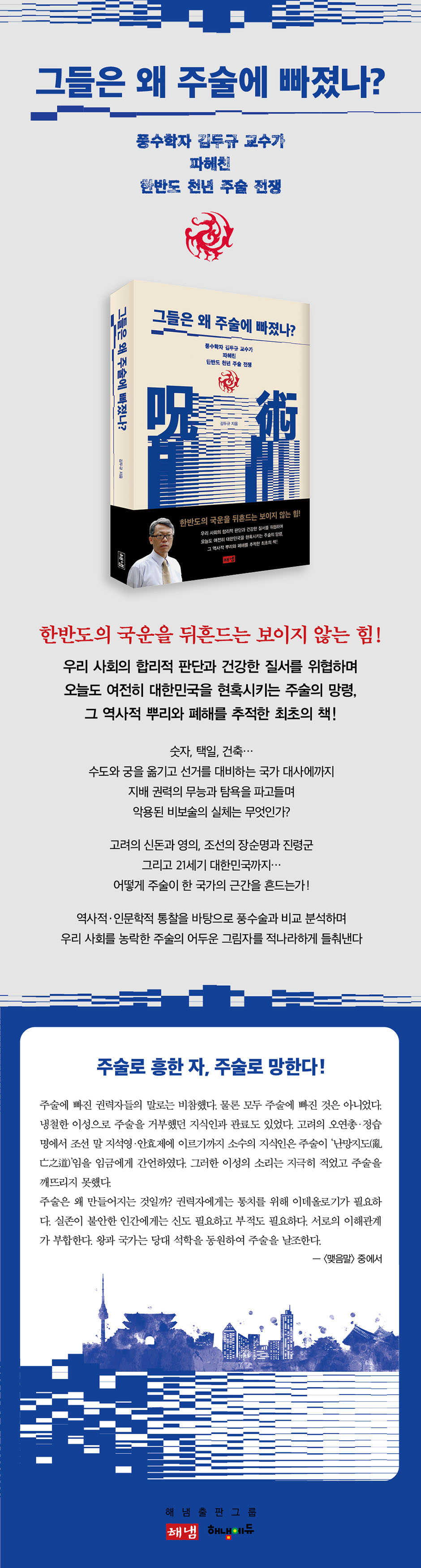
Into the book
"Those who rise by sorcery will perish by sorcery."
In this book, the author attempts to reveal the differences between the art of fortune telling and the art of feng shui from the perspective of a feng shui practitioner.
He also revealed that the secret arts were insubstantial sorcery and deception.
The words of those in power who were addicted to witchcraft were miserable.
There were also intellectuals and bureaucrats who rejected witchcraft with cool reason.
A few intellectuals advised the king that witchcraft was a 'path to ruin.'
But such voices of reason were extremely few and small.
The spell could not be broken.
Why are our society's leaders still so obsessed with fortune telling, physiognomy, and shamanistic rituals? These practices are clearly not "scientifically proven."
I haven't seen any results.
Yet, from the king above to the people below, from the learned to the uneducated, no one was free from sorcery.
Even the media presents it as a part of everyday life without any 'harsh criticism'.
Why are spells created? Those in power need ideologies to rule.
For a human being whose existence is uncertain, both God and amulets are needed.
Our interests are aligned.
The king and the country mobilize the greatest scholars of the time to fabricate sorcery.
---From the “Conclusion”
Numbers, choices, letters, architecture… …
Even the national ambassador who moved the capital and palace and prepared for elections
Unraveling the spectre of witchcraft that has haunted the Korean Peninsula for a thousand years.
Jurgen Habermas, a later philosopher, countered Weber's disenchantment.
He said modern society is “haunted by the specter of religious belief.”
It was said that de-enchantment (disenchantment) and re-enchantment (Wiederverzauberung) were occurring simultaneously.
No, the argument was fundamentally that modern society had not been de-enchanted at all.
Various types of witchcraft are still prevalent.
Freed from the spells of the past, but under the control of new spells.
Witchcraft is a kind of disease.
It is not a disease that invades from outside, but a disease that we create ourselves.
It is clearly an 'unfortunate ritual'.
---From "Chapter 1 - The Ghost Still Lives and Breathes on This Land_Why Was 'He' Bewitched?"
The Goryeo Dynasty's secret surgery was abandoned, and the paradigm shift to fengshu surgery began during the reign of King Taejong.
After that, King Sejong, King Sejo, and King Seongjong all turned their attention to feng shui.
66 years later, in the 16th year of King Seongjong's reign (1485), Bibosul appeared briefly, but was immediately discarded.
This kind of electioneering was spectacularly 'resurrected' in the 2022 South Korean presidential election.
Even the Joseon Dynasty officially denied the practice of choosing a lucky date.
What is the social and historical background?
This is the result of shallow shamans exploiting the gap in the ignorance or disregard for traditional thought (especially the Orientalist attitude) of Korean intellectuals and leaders.
If there are presidential candidates who believe in electoral college, it is because of a lack of self-awareness, a clear sense of calling, and a lack of charismatic insight into the nation and society as a whole.
---From "Chapter 1 - Ghosts Still Live and Breathe in This Land_The Selection of the Day, Not Just Any Day"
Why does the Yoon Seok-yeol administration insist on the number 2,000? Repeating or emphasizing a specific number can lead to brainwashing.
Especially when a country or a person in power repeats this, people become collectively under a spell.
That's what Goryeo did.
It was not just numbers that cast a spell on the Goryeo people.
I also cast a spell with color.
The color corresponding to water in the Five Elements is black.
How did Goryeo utilize black? This happened in the 6th year of King Gongmin's reign (1357).
Woo Pil-heung, a 4th-rank geomancer, submitted a letter to the king.
『Okryonggi』 states, “Our country begins at Baekdu Mountain and ends at Jiri Mountain, and its topography takes water as its root, wood as its trunk, black as its parent, and blue as its body. If customs conform to the land, the country will prosper, but if they disobey, disaster will strike the country.”
Here, customs refer to the clothing, hats, musical instruments, and ritual utensils of the king and his subjects.
From now on, civil and military officials will wear black clothes, monks will wear black hoods, and women will wear black silk.
(From the article on the 7th day of the 9th lunar month in the 6th year of King Gongmin's reign (1357), in the History of Goryeo)
---From "Chapter 1 - Ghosts Still Live and Breathe in This Land_From Pythagoras to the 'Eighteen-Character Theory', the Magic of Numbers"
Already during the Goryeo Dynasty, the forgery of 'Bigyeol' was an issue.
This happened during the reign of King Sukjong, the 15th king of Goryeo.
In the 6th year of King Sukjong's reign (1101), there is a passage that says, "The three monks of Gwangmyeongsa Temple, Son Pil, a 6th-rank official, and Lee Jin-gwang, a Jinsa, were caught forging the Yin-Yang Book, and were beaten with sticks and exiled."
It was a way for poor intellectuals to make a living.
As forgeries impersonating Doseon were proliferating, the 16th king, King Yeongjong, took special measures as soon as he ascended to the throne (1101).
He had about ten people, including Kim In-jon, Kim Yeon, Choi Seon, Lee Jae, Lee Deok-woo, and Park Seung-jung, who were tattooists and feng shui experts, collect books on secrets, feng shui, and secret techniques, compare the similarities and differences, and edit them into a single book by deleting complicated and confusing parts.
The book compiled in this way is ‘Haedongbirok (海東秘錄)’, which means ‘the secret book of the country east of the sea’.
The direct background for the compilation of 『Haedongbirok』 was Kim Wi-je, a sorcerer during the reign of King Sukjong, the father of King Yejong.
One day, Kim Wi-je, a low-ranking official whose name he had never heard of, submitted a long petition advocating for the 'movement of the capital to Nanjing (Hanyang).'
The problem was that Kim Wi-je shook up the world of feng shui by not citing any of the existing official feng shui books, but by citing previously unheard-of 'secrets'.
---From "Chapter 2 - The Created God 'Doseon', Wandering Over the Korean Peninsula - Was Doseon Really Good at Feng Shui?"
As mentioned earlier, the content and method of the esoteric Buddhist method of land tenure and the method of geomancy are different.
Feng Shui is the art of finding the right location for life and action.
Feng Shui is the act of selecting a site according to its purpose and scale, such as a workplace, a market place, a house site, a temple site, a playground, or a battlefield.
In esoteric Buddhism, the places that could become places of practice were the mountains and rivers of the country.
The belief and practice of esoteric Buddhism was that one's fortune would change if one changed the natural environment, either through moving the capital and building palaces, or through building temples, Buddhist statues, pagodas, or planting trees.
Naturally, we had no choice but to respect the mountains and rivers of our country.
Although the esoteric Buddhist land-finding techniques and feng shui ground-finding techniques are similar in that they deal with land, their content and purpose are different.
Esoteric geomancy is divided into three fields: Gwanjisangbeop (observing the appearance of the land), Gwanjijilbeop (observing the quality of the land), and Chijibeop (government of the land).
---From "Chapter 3 - The Devil's Secret Arts and Their Descendants - Eliminating Disasters and Obtaining Blessings with Secret Arts"
Shin Don advised the king to move the capital, saying that Gaegyeong's energy had declined.
Accordingly, the king went to Pyongyang and inspected the land according to these words.
Shin Don, like Myo Cheong during the reign of King Injong, also cited the 『Dosin Bigi』.
The ministers who opposed Shin Don also cited Doseon in their efforts to remove Shin Don.
In the 16th year of King Gongmin's reign (1367), ten people, including Oh In-taek, Gyeong Cheon-heung, Mok In-gil, Kim Won-myeong, An Woo-gyeong, and Jo Hui-go, secretly gathered to discuss eliminating Shin Don.
“Shin Don is cunning, flattering, and cunning, and he likes to slander people.
They are rejecting and expelling the old guard and slaughtering innocent people.
And the Shin Don group is growing bigger day by day.
There is a saying in the 『Dosunmilgi』 that 'Those who are neither monks nor laymen ruin politics and bring ruin to the country.'
This is what I said about this person.
“It will become a great concern for the country in the future, so it should be reported to the king and eliminated as soon as possible.” (From “Shin Don,” “History of Goryeo”)
Shin Don cited the 『Doseonbigi』, and his opponents cited the 『Doseonmilgi』.
The full text of these two books was not known then or now.
At that time, it was already shown that the Doseon was becoming a means of power reorganization or power struggle, like the 'licorice of the pharmacy'.
---From "Chapter 3 - The Devil's Secret Arts and Their Descendants _ 'Jin Sa-seong In-chul', Bewitching Goryeo and Joseon"
The next day, the queen left Janghowon and headed to Hanyang.
The queen, who stayed in Yongin on the 29th, entered Hanyang on August 1st (although it was not the 'August 15th' predicted by the shaman, the August date was correct).
The shaman also entered Hanyang with the queen.
It was a brilliant rise to fame for a shaman who was later crowned Jinryeonggun.
The shaman lived in the palace with the queen.
After that, the queen discussed everything with her.
The shaman who stayed in the palace said that her body spirit (the god who gives spiritual power to the shaman) was General Guan Yu, so she would stay there if a shrine to Guan Yu was built.
Construction began at the end of 1882 and was completed the following year.
On October 21, 1883, Emperor Gojong visited the Bukmyo Shrine to celebrate its completion.
Not only the civil and military officials, but also the crown prince participated.
Emperor Gojong's visit to the Northern Tomb was ostensibly a visit to General Guan Yu, but in reality it was a visit to the Jinling Army.
Because the owner of the northern tomb was Jinryeonggun.
King Gojong and the queen called the owner of the northern tomb 'Shinryeonggun' or 'Jinryeonggun'.
It meant a 'spirit' or 'true spirit' that protected them.
---From "Chapter 4 - A Record of a Struggle Fueled by Jealousy and Ambition - The Shaman Who Hastened the Fate of Goryeo"
'If you want to know the good and bad of a place, look at the three generations of its owners.'
The answer can be found by looking at the Joseon kings who ruled from Gyeongbokgung Palace.
Following Taejong, Sejong also expanded our territory to Mt. Baekdu while working at Gyeongbokgung Palace.
It was also at this time that the Korean Peninsula took its current form.
Also, Hangul was created during the reign of King Sejong.
By creating our own letters, we gave our people a sense of self.
It is a great achievement in the history of our people.
It is no coincidence that the [Statue of King Sejong] was erected in Gwanghwamun Square.
Sejo greatly flourished culture along with establishing royal authority.
Seongjong completed and promulgated the Gyeongguk Daejeon.
This was the golden age of Joseon, and its stage of activity was Gyeongbokgung Palace.
There are even geomancers who say that the Joseon Dynasty fell because of this place, but it is rare in world history for a dynasty to last for 500 years.
The average lifespan of a dynasty is around 100 to 200 years, so it means that he lived more than twice that long.
---From "Chapter 5 - A Record of a Struggle Fueled by Jealousy and Ambition _'If you want to see the good and bad of the land, look at the three masters'"
The current site of the Presidential Office in Yongsan was formerly a public cemetery.
It is an intermediate ridge of the Namsan mountain range that passes through here and connects to the site (can be confirmed on a map drawn up during the Japanese colonial period).
In 1914, the 1st Company of the 9th Regiment of the 9th Division Field Artillery was stationed south of this hill (the current Presidential Office).
In other words, it was not the site of the Japanese Governor-General's Residence or the Japanese military headquarters, but rather the site of a low-level company headquarters (the Governor-General's Residence was moved to the current site of the Blue House in 1939).
This kind of place is called ‘Gwaryong (過龍)’ because it is a place where a dragon passes by.
Feng Shui experts say, “It is a land where you may succeed at first, but you will definitely fail later.”
It is a land of ‘earning first, then losing later’ and ‘quick success, quick defeat’.
What is clear is that the Yongsan Presidential Office is a piece of land that does not conform to the official feng shui books of the Goryeo and Joseon dynasties.
This is a place that was decided by non-physical means, not by geomancy.
In this book, the author attempts to reveal the differences between the art of fortune telling and the art of feng shui from the perspective of a feng shui practitioner.
He also revealed that the secret arts were insubstantial sorcery and deception.
The words of those in power who were addicted to witchcraft were miserable.
There were also intellectuals and bureaucrats who rejected witchcraft with cool reason.
A few intellectuals advised the king that witchcraft was a 'path to ruin.'
But such voices of reason were extremely few and small.
The spell could not be broken.
Why are our society's leaders still so obsessed with fortune telling, physiognomy, and shamanistic rituals? These practices are clearly not "scientifically proven."
I haven't seen any results.
Yet, from the king above to the people below, from the learned to the uneducated, no one was free from sorcery.
Even the media presents it as a part of everyday life without any 'harsh criticism'.
Why are spells created? Those in power need ideologies to rule.
For a human being whose existence is uncertain, both God and amulets are needed.
Our interests are aligned.
The king and the country mobilize the greatest scholars of the time to fabricate sorcery.
---From the “Conclusion”
Numbers, choices, letters, architecture… …
Even the national ambassador who moved the capital and palace and prepared for elections
Unraveling the spectre of witchcraft that has haunted the Korean Peninsula for a thousand years.
Jurgen Habermas, a later philosopher, countered Weber's disenchantment.
He said modern society is “haunted by the specter of religious belief.”
It was said that de-enchantment (disenchantment) and re-enchantment (Wiederverzauberung) were occurring simultaneously.
No, the argument was fundamentally that modern society had not been de-enchanted at all.
Various types of witchcraft are still prevalent.
Freed from the spells of the past, but under the control of new spells.
Witchcraft is a kind of disease.
It is not a disease that invades from outside, but a disease that we create ourselves.
It is clearly an 'unfortunate ritual'.
---From "Chapter 1 - The Ghost Still Lives and Breathes on This Land_Why Was 'He' Bewitched?"
The Goryeo Dynasty's secret surgery was abandoned, and the paradigm shift to fengshu surgery began during the reign of King Taejong.
After that, King Sejong, King Sejo, and King Seongjong all turned their attention to feng shui.
66 years later, in the 16th year of King Seongjong's reign (1485), Bibosul appeared briefly, but was immediately discarded.
This kind of electioneering was spectacularly 'resurrected' in the 2022 South Korean presidential election.
Even the Joseon Dynasty officially denied the practice of choosing a lucky date.
What is the social and historical background?
This is the result of shallow shamans exploiting the gap in the ignorance or disregard for traditional thought (especially the Orientalist attitude) of Korean intellectuals and leaders.
If there are presidential candidates who believe in electoral college, it is because of a lack of self-awareness, a clear sense of calling, and a lack of charismatic insight into the nation and society as a whole.
---From "Chapter 1 - Ghosts Still Live and Breathe in This Land_The Selection of the Day, Not Just Any Day"
Why does the Yoon Seok-yeol administration insist on the number 2,000? Repeating or emphasizing a specific number can lead to brainwashing.
Especially when a country or a person in power repeats this, people become collectively under a spell.
That's what Goryeo did.
It was not just numbers that cast a spell on the Goryeo people.
I also cast a spell with color.
The color corresponding to water in the Five Elements is black.
How did Goryeo utilize black? This happened in the 6th year of King Gongmin's reign (1357).
Woo Pil-heung, a 4th-rank geomancer, submitted a letter to the king.
『Okryonggi』 states, “Our country begins at Baekdu Mountain and ends at Jiri Mountain, and its topography takes water as its root, wood as its trunk, black as its parent, and blue as its body. If customs conform to the land, the country will prosper, but if they disobey, disaster will strike the country.”
Here, customs refer to the clothing, hats, musical instruments, and ritual utensils of the king and his subjects.
From now on, civil and military officials will wear black clothes, monks will wear black hoods, and women will wear black silk.
(From the article on the 7th day of the 9th lunar month in the 6th year of King Gongmin's reign (1357), in the History of Goryeo)
---From "Chapter 1 - Ghosts Still Live and Breathe in This Land_From Pythagoras to the 'Eighteen-Character Theory', the Magic of Numbers"
Already during the Goryeo Dynasty, the forgery of 'Bigyeol' was an issue.
This happened during the reign of King Sukjong, the 15th king of Goryeo.
In the 6th year of King Sukjong's reign (1101), there is a passage that says, "The three monks of Gwangmyeongsa Temple, Son Pil, a 6th-rank official, and Lee Jin-gwang, a Jinsa, were caught forging the Yin-Yang Book, and were beaten with sticks and exiled."
It was a way for poor intellectuals to make a living.
As forgeries impersonating Doseon were proliferating, the 16th king, King Yeongjong, took special measures as soon as he ascended to the throne (1101).
He had about ten people, including Kim In-jon, Kim Yeon, Choi Seon, Lee Jae, Lee Deok-woo, and Park Seung-jung, who were tattooists and feng shui experts, collect books on secrets, feng shui, and secret techniques, compare the similarities and differences, and edit them into a single book by deleting complicated and confusing parts.
The book compiled in this way is ‘Haedongbirok (海東秘錄)’, which means ‘the secret book of the country east of the sea’.
The direct background for the compilation of 『Haedongbirok』 was Kim Wi-je, a sorcerer during the reign of King Sukjong, the father of King Yejong.
One day, Kim Wi-je, a low-ranking official whose name he had never heard of, submitted a long petition advocating for the 'movement of the capital to Nanjing (Hanyang).'
The problem was that Kim Wi-je shook up the world of feng shui by not citing any of the existing official feng shui books, but by citing previously unheard-of 'secrets'.
---From "Chapter 2 - The Created God 'Doseon', Wandering Over the Korean Peninsula - Was Doseon Really Good at Feng Shui?"
As mentioned earlier, the content and method of the esoteric Buddhist method of land tenure and the method of geomancy are different.
Feng Shui is the art of finding the right location for life and action.
Feng Shui is the act of selecting a site according to its purpose and scale, such as a workplace, a market place, a house site, a temple site, a playground, or a battlefield.
In esoteric Buddhism, the places that could become places of practice were the mountains and rivers of the country.
The belief and practice of esoteric Buddhism was that one's fortune would change if one changed the natural environment, either through moving the capital and building palaces, or through building temples, Buddhist statues, pagodas, or planting trees.
Naturally, we had no choice but to respect the mountains and rivers of our country.
Although the esoteric Buddhist land-finding techniques and feng shui ground-finding techniques are similar in that they deal with land, their content and purpose are different.
Esoteric geomancy is divided into three fields: Gwanjisangbeop (observing the appearance of the land), Gwanjijilbeop (observing the quality of the land), and Chijibeop (government of the land).
---From "Chapter 3 - The Devil's Secret Arts and Their Descendants - Eliminating Disasters and Obtaining Blessings with Secret Arts"
Shin Don advised the king to move the capital, saying that Gaegyeong's energy had declined.
Accordingly, the king went to Pyongyang and inspected the land according to these words.
Shin Don, like Myo Cheong during the reign of King Injong, also cited the 『Dosin Bigi』.
The ministers who opposed Shin Don also cited Doseon in their efforts to remove Shin Don.
In the 16th year of King Gongmin's reign (1367), ten people, including Oh In-taek, Gyeong Cheon-heung, Mok In-gil, Kim Won-myeong, An Woo-gyeong, and Jo Hui-go, secretly gathered to discuss eliminating Shin Don.
“Shin Don is cunning, flattering, and cunning, and he likes to slander people.
They are rejecting and expelling the old guard and slaughtering innocent people.
And the Shin Don group is growing bigger day by day.
There is a saying in the 『Dosunmilgi』 that 'Those who are neither monks nor laymen ruin politics and bring ruin to the country.'
This is what I said about this person.
“It will become a great concern for the country in the future, so it should be reported to the king and eliminated as soon as possible.” (From “Shin Don,” “History of Goryeo”)
Shin Don cited the 『Doseonbigi』, and his opponents cited the 『Doseonmilgi』.
The full text of these two books was not known then or now.
At that time, it was already shown that the Doseon was becoming a means of power reorganization or power struggle, like the 'licorice of the pharmacy'.
---From "Chapter 3 - The Devil's Secret Arts and Their Descendants _ 'Jin Sa-seong In-chul', Bewitching Goryeo and Joseon"
The next day, the queen left Janghowon and headed to Hanyang.
The queen, who stayed in Yongin on the 29th, entered Hanyang on August 1st (although it was not the 'August 15th' predicted by the shaman, the August date was correct).
The shaman also entered Hanyang with the queen.
It was a brilliant rise to fame for a shaman who was later crowned Jinryeonggun.
The shaman lived in the palace with the queen.
After that, the queen discussed everything with her.
The shaman who stayed in the palace said that her body spirit (the god who gives spiritual power to the shaman) was General Guan Yu, so she would stay there if a shrine to Guan Yu was built.
Construction began at the end of 1882 and was completed the following year.
On October 21, 1883, Emperor Gojong visited the Bukmyo Shrine to celebrate its completion.
Not only the civil and military officials, but also the crown prince participated.
Emperor Gojong's visit to the Northern Tomb was ostensibly a visit to General Guan Yu, but in reality it was a visit to the Jinling Army.
Because the owner of the northern tomb was Jinryeonggun.
King Gojong and the queen called the owner of the northern tomb 'Shinryeonggun' or 'Jinryeonggun'.
It meant a 'spirit' or 'true spirit' that protected them.
---From "Chapter 4 - A Record of a Struggle Fueled by Jealousy and Ambition - The Shaman Who Hastened the Fate of Goryeo"
'If you want to know the good and bad of a place, look at the three generations of its owners.'
The answer can be found by looking at the Joseon kings who ruled from Gyeongbokgung Palace.
Following Taejong, Sejong also expanded our territory to Mt. Baekdu while working at Gyeongbokgung Palace.
It was also at this time that the Korean Peninsula took its current form.
Also, Hangul was created during the reign of King Sejong.
By creating our own letters, we gave our people a sense of self.
It is a great achievement in the history of our people.
It is no coincidence that the [Statue of King Sejong] was erected in Gwanghwamun Square.
Sejo greatly flourished culture along with establishing royal authority.
Seongjong completed and promulgated the Gyeongguk Daejeon.
This was the golden age of Joseon, and its stage of activity was Gyeongbokgung Palace.
There are even geomancers who say that the Joseon Dynasty fell because of this place, but it is rare in world history for a dynasty to last for 500 years.
The average lifespan of a dynasty is around 100 to 200 years, so it means that he lived more than twice that long.
---From "Chapter 5 - A Record of a Struggle Fueled by Jealousy and Ambition _'If you want to see the good and bad of the land, look at the three masters'"
The current site of the Presidential Office in Yongsan was formerly a public cemetery.
It is an intermediate ridge of the Namsan mountain range that passes through here and connects to the site (can be confirmed on a map drawn up during the Japanese colonial period).
In 1914, the 1st Company of the 9th Regiment of the 9th Division Field Artillery was stationed south of this hill (the current Presidential Office).
In other words, it was not the site of the Japanese Governor-General's Residence or the Japanese military headquarters, but rather the site of a low-level company headquarters (the Governor-General's Residence was moved to the current site of the Blue House in 1939).
This kind of place is called ‘Gwaryong (過龍)’ because it is a place where a dragon passes by.
Feng Shui experts say, “It is a land where you may succeed at first, but you will definitely fail later.”
It is a land of ‘earning first, then losing later’ and ‘quick success, quick defeat’.
What is clear is that the Yongsan Presidential Office is a piece of land that does not conform to the official feng shui books of the Goryeo and Joseon dynasties.
This is a place that was decided by non-physical means, not by geomancy.
---From "Chapter 5 - Capital Site Secret Technique vs. Capital Site Feng Shui Technique _Is the Yongsan Presidential Office on the Site of a Cemetery?"
Publisher's Review
A History of Sorcery: A Compilation of the Practices, Background, and Endings of Sorcery (Bibosul) Practiced on the Korean Peninsula
Where does the collusion between sorcery and power begin?
The author claims that it is based on the late Silla monk Doseon, known as the ancestor of Korean feng shui, and his secret art.
Although they may be confused in that they both deal with land, Bibosul is different from Feng Shui.
Bibosul is an esoteric Buddhist method of land management that uses the topography to determine good or bad fortune, and to control or cure sick land through relocating the capital for magical purposes, building new palaces and pavilions, constructing Bibo pagodas, and performing rituals.
On the other hand, feng shui is a technique of objectively examining the shape and size of land, such as cemeteries, houses, towns, and capital cities, and selecting a place for life and activities that suits the purpose and size.
The author questions the existence of the Dosun and presents various evidence.
The Taoist priest himself was a fictional character born from the desires and needs of those in power, and was later reproduced and expanded by numerous sorcerers who took his name, casting a shadow of sorcery on this land.
The secret art of fortune telling was an act of government to prevent disaster and bring good fortune to the country.
However, during the Goryeo Dynasty, it was mixed with the Taoist ideology of fortune telling and predicting the future, and became an evil sorcery to satisfy the selfish desires of those in power and to allay anxiety.
Of course, when Joseon, which established Confucianism as the state religion at the time of its founding, reached the point where the presence of Taoism and divination in the government seemed to have diminished and flowed into the common people, but King Gwanghaegun was obsessed with fortune telling and gut, and King Gojong and Queen Myeongseong were unable to escape the clutches of the shaman Jinryeonggun.
In this way, the secret technique of fortune telling is disguised as geomancy and “has shown tenacious vitality through Myocheong, Kim Wi-je, Baek Seung-hyeon, Yeongui, Eum Deok-jeon, Bo-u, Woo Pil-heung, Shin Don, Muhak, Choi Ho-won, Yi Ui-sin, Jinryeong-gun, and Choi Tae-min until recently,” and it is claimed that this has led to the theory of a bad omen for the Blue House in 2022.
In addition, it is revealed in detail that the theory of the Blue House being an inauspicious site has no basis in Feng Shui, and that the presidential office relocated to Yongsan was originally a cemetery site, and that this was the result of auspicious techniques, not Feng Shui.
If the words of the presidents of the Republic of Korea were unfortunate, it was the fault and misfortune of individuals who abused their great power, not the problem of the land.
Can we be free from the temptation of witchcraft?
This book, consisting of five chapters, examines the true nature of sorcery, or secret arts, in Chapter 1, and explains the sorcerous background of recent, difficult-to-understand, bizarre acts by those in power, such as the controversy over the character "王" written on the palms of presidential candidates and the proliferation of the number 2000.
Chapter 2 delves into the unclear history and identity of the 'created god' Doseon, and Chapter 3 shows the evils of secret arts that colluded with political power, from Kim Wi-je to Shin Don during the Goryeo Dynasty.
Chapter 4 explains the process of transition from the era of Bibosul to the era of Fengshui in the Joseon Dynasty, a Confucian state, in conflict with Neo-Confucianism.
Chapter 5 explains the differences between geomancy and feng shui surrounding the selection of a capital city site, and in particular, refutes the theory that the Blue House is an inauspicious site, which has sparked much controversy, through various evidence.
This book presents the content of shamanism practiced from the Silla Dynasty to the 21st century in Korea, organized by era, person, and topic, allowing for an overview of the overall flow and clear comparison and analysis.
Additionally, you can verify the author's claims from various angles through various primary sources and encounter historical anecdotes.
Why do we fall prey to witchcraft? Witchcraft subtly exploits the individual's vulnerable self-awareness and the incompetence and lack of leadership of those in power, blinding us to truth and reality.
“Those who rise through sorcery will perish through sorcery.” The author came to this conclusion because the kings of Goryeo and Joseon who fell into sorcery all had similar endings.
This book, through stark examples from our ancestors, raises a renewed awareness of the dangers of witchcraft and makes us realize what truly matters to individuals and political leaders.
Through this, we hope to provide some small help in overcoming the extreme political and social turmoil we have recently faced and in restoring rational values.
Where does the collusion between sorcery and power begin?
The author claims that it is based on the late Silla monk Doseon, known as the ancestor of Korean feng shui, and his secret art.
Although they may be confused in that they both deal with land, Bibosul is different from Feng Shui.
Bibosul is an esoteric Buddhist method of land management that uses the topography to determine good or bad fortune, and to control or cure sick land through relocating the capital for magical purposes, building new palaces and pavilions, constructing Bibo pagodas, and performing rituals.
On the other hand, feng shui is a technique of objectively examining the shape and size of land, such as cemeteries, houses, towns, and capital cities, and selecting a place for life and activities that suits the purpose and size.
The author questions the existence of the Dosun and presents various evidence.
The Taoist priest himself was a fictional character born from the desires and needs of those in power, and was later reproduced and expanded by numerous sorcerers who took his name, casting a shadow of sorcery on this land.
The secret art of fortune telling was an act of government to prevent disaster and bring good fortune to the country.
However, during the Goryeo Dynasty, it was mixed with the Taoist ideology of fortune telling and predicting the future, and became an evil sorcery to satisfy the selfish desires of those in power and to allay anxiety.
Of course, when Joseon, which established Confucianism as the state religion at the time of its founding, reached the point where the presence of Taoism and divination in the government seemed to have diminished and flowed into the common people, but King Gwanghaegun was obsessed with fortune telling and gut, and King Gojong and Queen Myeongseong were unable to escape the clutches of the shaman Jinryeonggun.
In this way, the secret technique of fortune telling is disguised as geomancy and “has shown tenacious vitality through Myocheong, Kim Wi-je, Baek Seung-hyeon, Yeongui, Eum Deok-jeon, Bo-u, Woo Pil-heung, Shin Don, Muhak, Choi Ho-won, Yi Ui-sin, Jinryeong-gun, and Choi Tae-min until recently,” and it is claimed that this has led to the theory of a bad omen for the Blue House in 2022.
In addition, it is revealed in detail that the theory of the Blue House being an inauspicious site has no basis in Feng Shui, and that the presidential office relocated to Yongsan was originally a cemetery site, and that this was the result of auspicious techniques, not Feng Shui.
If the words of the presidents of the Republic of Korea were unfortunate, it was the fault and misfortune of individuals who abused their great power, not the problem of the land.
Can we be free from the temptation of witchcraft?
This book, consisting of five chapters, examines the true nature of sorcery, or secret arts, in Chapter 1, and explains the sorcerous background of recent, difficult-to-understand, bizarre acts by those in power, such as the controversy over the character "王" written on the palms of presidential candidates and the proliferation of the number 2000.
Chapter 2 delves into the unclear history and identity of the 'created god' Doseon, and Chapter 3 shows the evils of secret arts that colluded with political power, from Kim Wi-je to Shin Don during the Goryeo Dynasty.
Chapter 4 explains the process of transition from the era of Bibosul to the era of Fengshui in the Joseon Dynasty, a Confucian state, in conflict with Neo-Confucianism.
Chapter 5 explains the differences between geomancy and feng shui surrounding the selection of a capital city site, and in particular, refutes the theory that the Blue House is an inauspicious site, which has sparked much controversy, through various evidence.
This book presents the content of shamanism practiced from the Silla Dynasty to the 21st century in Korea, organized by era, person, and topic, allowing for an overview of the overall flow and clear comparison and analysis.
Additionally, you can verify the author's claims from various angles through various primary sources and encounter historical anecdotes.
Why do we fall prey to witchcraft? Witchcraft subtly exploits the individual's vulnerable self-awareness and the incompetence and lack of leadership of those in power, blinding us to truth and reality.
“Those who rise through sorcery will perish through sorcery.” The author came to this conclusion because the kings of Goryeo and Joseon who fell into sorcery all had similar endings.
This book, through stark examples from our ancestors, raises a renewed awareness of the dangers of witchcraft and makes us realize what truly matters to individuals and political leaders.
Through this, we hope to provide some small help in overcoming the extreme political and social turmoil we have recently faced and in restoring rational values.
GOODS SPECIFICS
- Date of issue: January 31, 2025
- Page count, weight, size: 356 pages | 564g | 145*217*23mm
- ISBN13: 9791167141064
- ISBN10: 1167141067
You may also like
카테고리
korean


korean

![GQ KOREA Mark (Monthly): December [2025]](http://librairie.coreenne.fr/cdn/shop/files/8ef265dbbfbf186523ed75ba7319009d.jpg?v=1765340328&width=3840)


