

Civilization and War
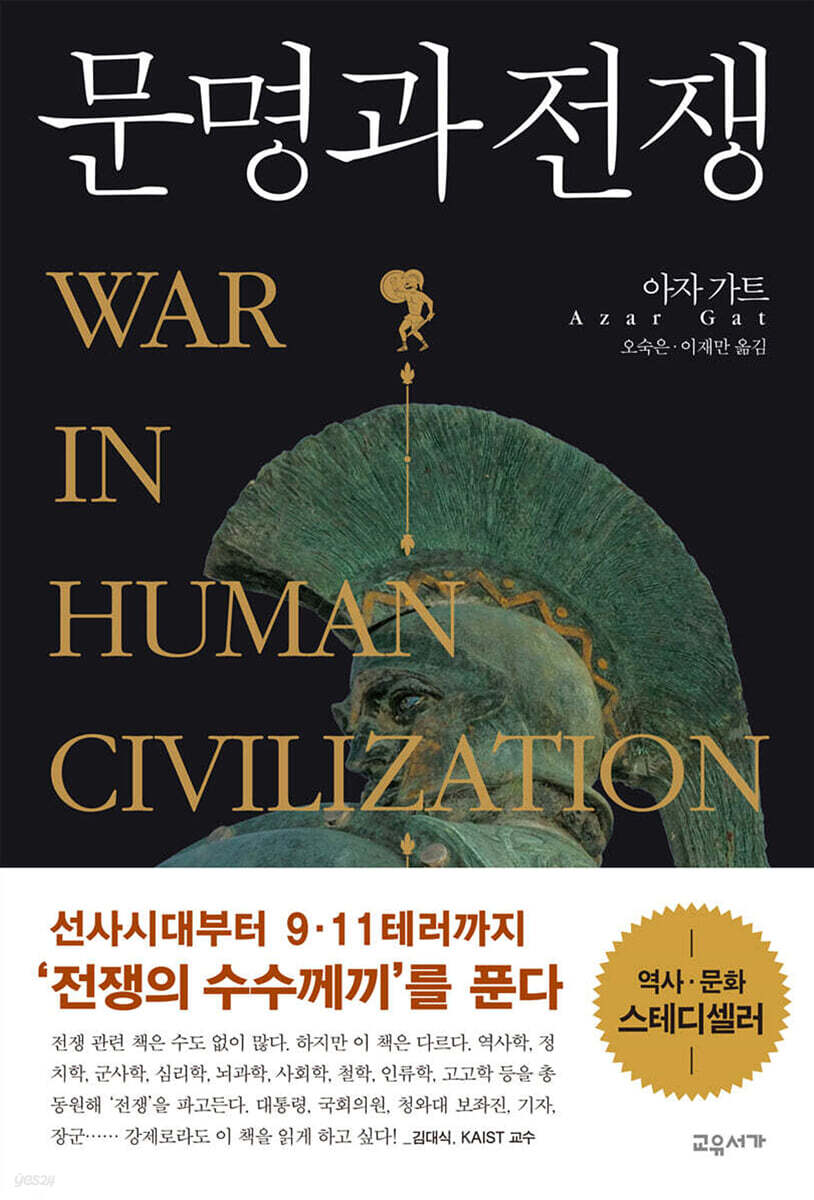 |
Description
Book Introduction
How has civilization evolved in conjunction with war?
Is war rooted in human nature or a cultural invention?
From prehistoric times to 9/11, unraveling the mysteries of war.
'Survival' and 'reproduction' were the fundamental motives for war and violence!
A culmination of cutting-edge research based on evolutionary theory, offering a fascinating insight into human history.
A renowned work covering anthropology, evolutionary biology, psychology, economics, and international relations.
· War is not a cultural invention.
· Human aggression is not an unconditional impulse, but a selective tactic.
· Human biological instincts were formed in hunter-gatherer societies, which account for 99.5 percent of human history.
· Evolution is essential to understanding human struggle.
The enormous task of raising and maintaining a cavalry gave rise to feudalism.
· The rate of violent deaths has decreased under state rule.
· Power has become a universal currency for obtaining anything one desires.
* 2006 Times Literary Supplement Book of the Year
※ Re-publication of 『Civilization and War』(2017)
How Civilization and War Interact and Coevolve
The history of mankind has been a history of war.
This book traces and explains how civilization and war have closely interacted and co-evolved from prehistoric times to the present.
Author Gat argues for the declining trend of violence throughout human history, but warns against the premature illusion of predicting a "triumph of peace."
The history of humanity covered in this book is rather a 'triumph of violence', a process in which strong violence has suppressed and replaced weak violence.
Peace is just a byproduct.
“When the rate of violent deaths within a society declines, it is usually because violence has triumphed, not because of some peaceful agreement.”
In order to address the vast topic of 'the co-evolution of civilization and war,' the author studied not only his specialty, military science, but also various fields such as evolutionary theory, evolutionary psychology, animal behavior, anthropology, archaeology, historical sociology, political science, and international relations, and spent a full nine years writing the book.
This book goes beyond simply reviewing or synthesizing existing knowledge; it challenges numerous existing studies and debates, while also offering a fresh perspective on the relationship between civilization and war.
Is war rooted in human nature or a cultural invention?
From prehistoric times to 9/11, unraveling the mysteries of war.
'Survival' and 'reproduction' were the fundamental motives for war and violence!
A culmination of cutting-edge research based on evolutionary theory, offering a fascinating insight into human history.
A renowned work covering anthropology, evolutionary biology, psychology, economics, and international relations.
· War is not a cultural invention.
· Human aggression is not an unconditional impulse, but a selective tactic.
· Human biological instincts were formed in hunter-gatherer societies, which account for 99.5 percent of human history.
· Evolution is essential to understanding human struggle.
The enormous task of raising and maintaining a cavalry gave rise to feudalism.
· The rate of violent deaths has decreased under state rule.
· Power has become a universal currency for obtaining anything one desires.
* 2006 Times Literary Supplement Book of the Year
※ Re-publication of 『Civilization and War』(2017)
How Civilization and War Interact and Coevolve
The history of mankind has been a history of war.
This book traces and explains how civilization and war have closely interacted and co-evolved from prehistoric times to the present.
Author Gat argues for the declining trend of violence throughout human history, but warns against the premature illusion of predicting a "triumph of peace."
The history of humanity covered in this book is rather a 'triumph of violence', a process in which strong violence has suppressed and replaced weak violence.
Peace is just a byproduct.
“When the rate of violent deaths within a society declines, it is usually because violence has triumphed, not because of some peaceful agreement.”
In order to address the vast topic of 'the co-evolution of civilization and war,' the author studied not only his specialty, military science, but also various fields such as evolutionary theory, evolutionary psychology, animal behavior, anthropology, archaeology, historical sociology, political science, and international relations, and spent a full nine years writing the book.
This book goes beyond simply reviewing or synthesizing existing knowledge; it challenges numerous existing studies and debates, while also offering a fresh perspective on the relationship between civilization and war.
index
Recommendation: Is a human race without war possible?
Preface: The Mystery of War
Part 1: The Last 2 Million Years of War: Environment, Genes, and Culture
Chapter 1 Introduction: "The Natural State of Man"
Chapter 2: Peaceful or Warlike: Did Hunter-Gatherers Fight?
Simple Hunter-Gatherers: Australia's 'Laboratory' / The War Between Complex Hunter-Gatherers
Chapter 3: Why Humans Fight: An Evolutionary Perspective
Innate but selective tactics / evolutionary calculations / larger groups
Chapter 4 Motivation: Food and Sex
Survival Resources: Hunting Area, Water, Shelter, Raw Materials / Breeding / Intermission: Are Men Beasts?
Chapter 5 Motivation: The Web of Desire
Domination: Rank, Status, Prestige, Honor / Revenge: Retaliation for Elimination and Deterrence / Power and the 'Security Dilemma' / Worldview and the Supernatural / Mixed Motives: Cannibalism / Play, Adventure, Sadism, and Ecstasy / Conclusion
Chapter 6: "Primitive Wars": How They Were Waged
Combat, Ambush, Surprise / Asymmetric Preemptive Strike
Chapter 7 Conclusion: Fighting in the Evolutionary State of Nature
Part 2: Agriculture, Civilization, and War
Chapter 8 Introduction: Evolving Cultural Complexity
Chapter 9: Tribal Warfare in Agricultural and Pastoral Societies
The emergence and spread of agriculture / Armed conflict during the spread of agriculture / Tribal society / Tribal warfare / Warfare among pastoral tribes / Primitive equestrian herders / Armed retainers: Wealth and power in the transition from tribes / Chieftaincy
Chapter 10: The Emergence of States and Armed Forces
Rural Small States and War in the Formation of the Nation / The Rise and Fall of City-States and War
Chapter 11: The Vanguard of Eurasia: East, West, and the Steppes
The King's Cavalry: Horses, Infantry, and Political Societies in Time and Space / What is Feudalism? / Semi-Feudal and Centralized-Bureaucrat Armies / State-Organized Infantry and the Decline of Knightly Power / The Rise and Decline of Empires / Mounted Raiders and Steppe Empires / West versus East
Chapter 12 Conclusion: War, Leviathan, and the Pleasures and Pains of Civilization
Coercive Structures and Exponential Growth / Who Benefits: Material Elements / Sex and Harems / Gardens of Delight and Cherubs at the Gates with Flaming Swords / The Pursuit of Power and Glory / Kinship, Culture, Ideology, and Ideals / War: A Serious Matter for a Serious Goal, or a Reckless Thing?
Part 3: Modernity: The Two Faces of Janus
Chapter 13 Introduction: The Explosion of Wealth and Power
Chapter 14: Guns and Markets: Europe's Emerging States and the Global World
The Emergence of the 'Warring States' in Europe / What Constituted the 'Military Revolution' / The State and the Army / Sea Power and the Commercial-Financial Revolution / The Market System and Military Capability / The Printing Press, Nations, and Great Armies / Modern Warfare—Modern Peace
Chapter 15: Prometheus Free and Prometheus Bound: War in the Mechanized Age
The Explosion of Technology and the Infrastructure of Power / Wealth, Technology, and Military Hardware / Wars between Great Powers and Wars between Nations / Wars of Empires / The Challenge of Totalitarianism and Why It Was Defeated / Conclusion
Chapter 16: Affluent Liberal Democracies, the Ultimate Weapon, and the World
Does 'Democratic Peace' Exist? / Resetting 'Democratic Peace' / Other Independent Related Factors / Strategic Policies of Liberal States: Isolationism, Appeasement, Blockade, and Limited War / Is the Advanced World a Zone of Peace? / Regions Where Modernized and Traditional Societies Conflict / Unconventional Terrorism and the New World Disorder / Conclusion
Chapter 17: Conclusion: Unraveling the Mystery of War
Acknowledgments / Notes / Translator's Note / Index / Illustration Sources
Preface: The Mystery of War
Part 1: The Last 2 Million Years of War: Environment, Genes, and Culture
Chapter 1 Introduction: "The Natural State of Man"
Chapter 2: Peaceful or Warlike: Did Hunter-Gatherers Fight?
Simple Hunter-Gatherers: Australia's 'Laboratory' / The War Between Complex Hunter-Gatherers
Chapter 3: Why Humans Fight: An Evolutionary Perspective
Innate but selective tactics / evolutionary calculations / larger groups
Chapter 4 Motivation: Food and Sex
Survival Resources: Hunting Area, Water, Shelter, Raw Materials / Breeding / Intermission: Are Men Beasts?
Chapter 5 Motivation: The Web of Desire
Domination: Rank, Status, Prestige, Honor / Revenge: Retaliation for Elimination and Deterrence / Power and the 'Security Dilemma' / Worldview and the Supernatural / Mixed Motives: Cannibalism / Play, Adventure, Sadism, and Ecstasy / Conclusion
Chapter 6: "Primitive Wars": How They Were Waged
Combat, Ambush, Surprise / Asymmetric Preemptive Strike
Chapter 7 Conclusion: Fighting in the Evolutionary State of Nature
Part 2: Agriculture, Civilization, and War
Chapter 8 Introduction: Evolving Cultural Complexity
Chapter 9: Tribal Warfare in Agricultural and Pastoral Societies
The emergence and spread of agriculture / Armed conflict during the spread of agriculture / Tribal society / Tribal warfare / Warfare among pastoral tribes / Primitive equestrian herders / Armed retainers: Wealth and power in the transition from tribes / Chieftaincy
Chapter 10: The Emergence of States and Armed Forces
Rural Small States and War in the Formation of the Nation / The Rise and Fall of City-States and War
Chapter 11: The Vanguard of Eurasia: East, West, and the Steppes
The King's Cavalry: Horses, Infantry, and Political Societies in Time and Space / What is Feudalism? / Semi-Feudal and Centralized-Bureaucrat Armies / State-Organized Infantry and the Decline of Knightly Power / The Rise and Decline of Empires / Mounted Raiders and Steppe Empires / West versus East
Chapter 12 Conclusion: War, Leviathan, and the Pleasures and Pains of Civilization
Coercive Structures and Exponential Growth / Who Benefits: Material Elements / Sex and Harems / Gardens of Delight and Cherubs at the Gates with Flaming Swords / The Pursuit of Power and Glory / Kinship, Culture, Ideology, and Ideals / War: A Serious Matter for a Serious Goal, or a Reckless Thing?
Part 3: Modernity: The Two Faces of Janus
Chapter 13 Introduction: The Explosion of Wealth and Power
Chapter 14: Guns and Markets: Europe's Emerging States and the Global World
The Emergence of the 'Warring States' in Europe / What Constituted the 'Military Revolution' / The State and the Army / Sea Power and the Commercial-Financial Revolution / The Market System and Military Capability / The Printing Press, Nations, and Great Armies / Modern Warfare—Modern Peace
Chapter 15: Prometheus Free and Prometheus Bound: War in the Mechanized Age
The Explosion of Technology and the Infrastructure of Power / Wealth, Technology, and Military Hardware / Wars between Great Powers and Wars between Nations / Wars of Empires / The Challenge of Totalitarianism and Why It Was Defeated / Conclusion
Chapter 16: Affluent Liberal Democracies, the Ultimate Weapon, and the World
Does 'Democratic Peace' Exist? / Resetting 'Democratic Peace' / Other Independent Related Factors / Strategic Policies of Liberal States: Isolationism, Appeasement, Blockade, and Limited War / Is the Advanced World a Zone of Peace? / Regions Where Modernized and Traditional Societies Conflict / Unconventional Terrorism and the New World Disorder / Conclusion
Chapter 17: Conclusion: Unraveling the Mystery of War
Acknowledgments / Notes / Translator's Note / Index / Illustration Sources
Into the book
This book is an ambitious work.
(…) Why do people engage in destructive, deadly warfare? Is war deeply rooted in human nature, or is it a later cultural invention? Have people always fought, or did it only begin with the emergence of agriculture, states, and civilization? How have agriculture, states, civilization, and subsequent major developments in human history been influenced by war, and how have they in turn influenced it? If war could be eliminated, under what conditions would this be possible, and is it currently declining?
--- p.12
Did humans, who evolved a natural hunter-gatherer lifestyle within an evolving natural environment, also engage in fighting? Was fighting an inherent aspect of their unique adaptive patterns, shaped by millions of years of selective pressure? In other words, did their evolutionary path make war "natural" for humans? Or was fighting something that emerged only later, after the full-blown emergence of culture, and thus "unnatural" for humans?
--- p.22
Tensions and competition between close relatives are common.
Violence among them is strictly forbidden, because evolutionarily speaking, such violence would be a great loss to oneself.
Yet, when one's evolutionary prospects are seriously threatened, hostility may grow within close relatives.
The story of Cain and Abel illustrates both the fierce competition and the strict prohibition of competition associated with such cases.
Violence within families (mostly, but not always, between spouses), and even lethal violence, occurs in all societies.
Except in such cases, no matter how much internal tension or rivalry there may be, clan members tend to support one another, especially when quarrels or disputes arise with other clan members, and this sometimes escalates into fatal attacks.
--- p.78∼79
So why were the cities of that time so easily conquered? The heavy infantry, who fought in dense phalanxes, deserved praise for their unique bravery in embracing and enduring frontal combat.
However, when conditions were equal on a flat plain, they fought like that, but when they were dealing with an enemy force that occupied a high advantageous position compared to the surroundings, they avoided attacking.
It is clear that pure street fighting, where the two sides are not equal, was avoided.
--- p.382
Just as the potential benefits of fighting have lured people into fighting, the potential risks and losses of fighting (as with all animals) have deterred people from fighting.
As a result, fighting has become one of the most polarized human activities, with two conflicting emotional mechanisms—one that turns the fight switch on and one that turns it off.
The death, mutilation, material loss, and poverty that were likely to befall individuals and groups brought about immense suffering, fear, terror, sorrow, agony, helplessness, and despair.
In places where a landslide victory was achieved, there was little question.
But contrary to appearances, decisive victories in history were the exception rather than the rule.
--- p.571
Modern wars were not historically unique in their scale of casualties and physical destruction (relative to population and wealth), in their breaking down the (indeed, modern) distinction between combatants and non-combatants and exposing the civilian population behind the scenes, or in their high levels of manpower mobilization.
Both world wars were uniquely 'total' in the sense that they combined a significant increase in the military expenditure as a percentage of GNP with high mobilization rates.
Most of the increased military spending was invested in industrial mass production of military hardware.
--- p.681
The advent of nuclear weapons marks a turning point in history.
Now, unrestricted war between nuclear powers, whether liberal or democratic, has become a suicide attempt for both sides.
However, the restraint of conflict that nuclear weapons ultimately lead to is based on the arms race, deterrence, and the balance of terror, and the possibility of covert, indirect, low-intensity armed conflict remains.
But on the other hand, it is becoming virtually unthinkable that any kind of violent conflict would break out between affluent liberal democracies, with or without nuclear weapons.
In the relations between these countries, a "positive" peace rooted in shared interests and shared anti-war norms prevails over a "negative peace" based on the deterrence of all-out war.
(…) Why do people engage in destructive, deadly warfare? Is war deeply rooted in human nature, or is it a later cultural invention? Have people always fought, or did it only begin with the emergence of agriculture, states, and civilization? How have agriculture, states, civilization, and subsequent major developments in human history been influenced by war, and how have they in turn influenced it? If war could be eliminated, under what conditions would this be possible, and is it currently declining?
--- p.12
Did humans, who evolved a natural hunter-gatherer lifestyle within an evolving natural environment, also engage in fighting? Was fighting an inherent aspect of their unique adaptive patterns, shaped by millions of years of selective pressure? In other words, did their evolutionary path make war "natural" for humans? Or was fighting something that emerged only later, after the full-blown emergence of culture, and thus "unnatural" for humans?
--- p.22
Tensions and competition between close relatives are common.
Violence among them is strictly forbidden, because evolutionarily speaking, such violence would be a great loss to oneself.
Yet, when one's evolutionary prospects are seriously threatened, hostility may grow within close relatives.
The story of Cain and Abel illustrates both the fierce competition and the strict prohibition of competition associated with such cases.
Violence within families (mostly, but not always, between spouses), and even lethal violence, occurs in all societies.
Except in such cases, no matter how much internal tension or rivalry there may be, clan members tend to support one another, especially when quarrels or disputes arise with other clan members, and this sometimes escalates into fatal attacks.
--- p.78∼79
So why were the cities of that time so easily conquered? The heavy infantry, who fought in dense phalanxes, deserved praise for their unique bravery in embracing and enduring frontal combat.
However, when conditions were equal on a flat plain, they fought like that, but when they were dealing with an enemy force that occupied a high advantageous position compared to the surroundings, they avoided attacking.
It is clear that pure street fighting, where the two sides are not equal, was avoided.
--- p.382
Just as the potential benefits of fighting have lured people into fighting, the potential risks and losses of fighting (as with all animals) have deterred people from fighting.
As a result, fighting has become one of the most polarized human activities, with two conflicting emotional mechanisms—one that turns the fight switch on and one that turns it off.
The death, mutilation, material loss, and poverty that were likely to befall individuals and groups brought about immense suffering, fear, terror, sorrow, agony, helplessness, and despair.
In places where a landslide victory was achieved, there was little question.
But contrary to appearances, decisive victories in history were the exception rather than the rule.
--- p.571
Modern wars were not historically unique in their scale of casualties and physical destruction (relative to population and wealth), in their breaking down the (indeed, modern) distinction between combatants and non-combatants and exposing the civilian population behind the scenes, or in their high levels of manpower mobilization.
Both world wars were uniquely 'total' in the sense that they combined a significant increase in the military expenditure as a percentage of GNP with high mobilization rates.
Most of the increased military spending was invested in industrial mass production of military hardware.
--- p.681
The advent of nuclear weapons marks a turning point in history.
Now, unrestricted war between nuclear powers, whether liberal or democratic, has become a suicide attempt for both sides.
However, the restraint of conflict that nuclear weapons ultimately lead to is based on the arms race, deterrence, and the balance of terror, and the possibility of covert, indirect, low-intensity armed conflict remains.
But on the other hand, it is becoming virtually unthinkable that any kind of violent conflict would break out between affluent liberal democracies, with or without nuclear weapons.
In the relations between these countries, a "positive" peace rooted in shared interests and shared anti-war norms prevails over a "negative peace" based on the deterrence of all-out war.
--- p.785
Publisher's Review
A New Perspective on the Interrelationship Between Civilization and War
This book explores a wide range of topics, from the origins of our species to today's unconventional terrorist threats, from a multidisciplinary perspective that combines multiple disciplines.
It also shows that large-scale violent conflict has always been with us, that the objects of struggle and the objects of human desire have always been the same.
Tracing the course of war across time and space around the world, this book provides rich insights into key stages in human history.
Why do humans engage in deadly conflicts? Is war rooted in human nature, or is it a later cultural invention? What is the relationship between war and major developments in world history, such as the emergence of agriculture, the rise of the state, the birth of civilization, and the rise of modernity and democracy? Is war constantly spreading, or is it declining?
Azha Gat, a leading figure in military thought and strategy
Azar Gat, who is introduced to Korea for the first time through this book, is an Israeli scholar and an authority in the fields of military history, military thought, and military strategy.
After studying at Tel Aviv University and the University of Haifa in Israel, Gat completed his doctoral studies at All Souls College, Oxford University, where he was supervised by the renowned military historian Michael Howard.
Howard criticized the existing view that war was limited to the narrow meaning of armies and military operations, and argued for exploring the complex interaction between the two from the perspective of 'war and society.'
Gart shares Howard's view of war.
The author argues that for 1.99 million years, or 99.5 percent of the 2 million years that the genus Homo evolved, all humans lived as hunter-gatherers in nature, and that human biological evolution took place under the pressure of natural selection during this long period.
The cultural evolution that has been taking place breathlessly over the past 10,000 years, starting with agriculture, is only the tip of the iceberg in the overall evolution of humanity.
Therefore, the author begins by discussing how the human nature and motivations associated with fighting evolved in hunter-gatherer societies and what the patterns of primitive warfare were like, saying that to examine the biological evolution closely related to human fighting, we must look back to the past two million years.
Rousseau vs. Hobbes: 'Noble Savage' or 'War of All Against All'?
Modern people generally see the struggle for survival of animals and the wars of nations as being on entirely different levels.
However, the author argues that hunter-gatherer fights were not much different from those of other animals.
This counterintuitive assertion is the central thesis of Part I: that hunter-gatherers were no exception to nature's universal law of competing for survival and reproduction.
So, it was not Rousseau, who imagined the 'noble savage', but Hobbes, who assumed that people in the state of nature waged a 'war of all against all', who was closer to the truth.
The 'peaceful savage' was a myth, fighting was rife among hunter-gatherer groups, raids and counter-attacks were commonplace, and death in combat was the leading cause of death.
The authors also argue that biological mechanisms that evolved in hunter-gatherer environments continue to drive human behavior with strong emotional stimuli in other artificial and cultural environments.
The natural hostility of humans to be wary and suspicious of outside groups originated in the potential conflict situations of hunter-gatherer life, but it also served as the source of the 'prisoner's dilemma', the 'security dilemma', and the endless arms race in later, very different environments.
The Interaction of Cultural Evolution and War
Part II delves into the interplay between cultural evolution and war.
Beginning about 10,000 years ago, with the adoption of agriculture, human groups expanded and diversified from hunter-gatherer societies to agricultural societies, pastoral and nomadic societies, tribal societies, chieftaincies, small states, city-states, empires, and modern nation-states, each with a different lifestyle and scale.
This was a major shift away from the 'evolutionary state of nature'.
The overall trend of these changes was the accumulation, concentration, and institutionalization of wealth and power, and the resulting stratification of society, and the primary and essential means of acquiring wealth and power was force.
The author vividly demonstrates that in any political system, armed forces are the core of power; that without a solid military base, external attacks and internal usurpations of power cannot be prevented; and that there is a close correlation between the growth of power and armed forces.
In particular, the author analyzes that the state opened a new chapter in war by transforming groups of warriors into armies, raising funds through taxes, and directly training and organizing the military.
The rapid and remarkable mutual transformation of wealth and power in modern times
Part 3 deals with the mutual transformation and effects of the rapid increase in wealth and power in the modern era.
The author cites the mutual transformation of wealth and power as a new phenomenon of the modern era. He argues that while such transformation was unclear until pre-modern times, in the modern era a virtuous cycle mechanism was formed in which wealth creates power and power creates wealth.
In relation to war, wealth was the money for war, and war brought more wealth.
And as technologically advanced military hardware began to determine the outcome of wars, a suitable technological and social foundation was needed to produce and operate military hardware.
Thus, productivity and military power became inseparable, and economically advanced countries emerged as military powers.
The author focuses on the capitalist economies and advanced militaries that developed in the West in the modern era, examining how they destroyed and replaced existing economic and military organizations on a global scale.
Military Revolution, Democratic Peace Theory, and Unconventional Terrorism
This book also delves into the 'military revolution,' democratic peace theory, and unconventional terrorism, which have been hot topics of debate in academic circles.
While the author agrees with the existing thesis that revolutionary changes occurred across the military in modern Europe, such as the rapid increase in the size of armies and the introduction of firearms, which transformed the nature of field warfare and siege warfare, he points out that the military revolution did not stem from some tactical development, but was an element of the modernization process that swept through Europe.
Furthermore, the author synthesizes existing debates on the democratic peace theory, which holds that liberal democratic nations rarely fight among themselves, and argues that democratization and liberalization were not short-term transitions but rather arduous processes; that the standards of democracy and liberalism have steadily risen, and that democratic peace has deepened accordingly; and that economic development is also a major factor in democratic peace.
Finally, the author sees unconventional terrorism as a new modern phenomenon resulting from the combination of weapons of mass destruction and terrorism.
The author points out that the root of the problem is the penetration of weapons of mass destruction technology and materials below the national level, and proposes a global cooperative crackdown as a way to combat unconventional terrorism that is not constrained by mutually assured destruction.
Praise poured in for this book
The best book on this subject! By far the best book I've read on the topic of civilization and war.
The author combines insights from diverse fields, including anthropology, evolutionary biology, psychology, archaeology, economics, history, and international relations, in a refreshingly holistic approach.
This highly objective book relies on data (both qualitative and quantitative) collected from social science disciplines, and the author does not moralize or justify the subject of war.
(…) It is easy to read, interesting, and very thorough.
I've read a lot of social science books, but this one has had the greatest impact on my understanding of human nature and human civilization in a broad sense.
(…) a true masterpiece and recommended to anyone interested in learning about the relationship between human civilization and history and war.
_Amazon Reader Akhilesh Pillalamarri
It's a 5-star rating! A must-read for senior military experts! It's truly a book of shock and awe! You'll be astonished once again by this masterpiece, filled with Azza Gat's pure intellect.
I have always been impressed by Gatt's other books on war.
But as someone who served in active duty for 28 years and has a library of over 1,000 books on various military topics, no book has impressed me as deeply as this one, which comprehensively addresses the "mystery of war" from a multidisciplinary perspective.
(…) I am now convinced that all senior officers should study the broad scope of warfare with this kind of knowledgeable, multidisciplinary approach.
The perspective of this book is by no means a 'just any old' standard view of war.
Any truly open-minded reader will be compelled to read this book and re-evaluate every aspect of the war.
I believe this book is a seminal text that will begin to re-educate and re-evaluate so-called "modern" beliefs, motivations, policies, strategies, operations, and tactics regarding war.
Every high-ranking official in the White House, the Department of Defense, the State Department, the Director of National Intelligence, the National Security Agency, the CIA, and the FBI should be required to read this book.
This book should be required reading in all staff training colleges and military universities.
_Amazon Reader, i-Palikar
The term "thorough" is often overused to describe the breadth and depth of one's knowledge.
But it is no exaggeration to say that this book is thorough in its description.
The scope and level of research across multiple disciplines is truly impressive.
_Amazon Reader, Michael
This book explores a wide range of topics, from the origins of our species to today's unconventional terrorist threats, from a multidisciplinary perspective that combines multiple disciplines.
It also shows that large-scale violent conflict has always been with us, that the objects of struggle and the objects of human desire have always been the same.
Tracing the course of war across time and space around the world, this book provides rich insights into key stages in human history.
Why do humans engage in deadly conflicts? Is war rooted in human nature, or is it a later cultural invention? What is the relationship between war and major developments in world history, such as the emergence of agriculture, the rise of the state, the birth of civilization, and the rise of modernity and democracy? Is war constantly spreading, or is it declining?
Azha Gat, a leading figure in military thought and strategy
Azar Gat, who is introduced to Korea for the first time through this book, is an Israeli scholar and an authority in the fields of military history, military thought, and military strategy.
After studying at Tel Aviv University and the University of Haifa in Israel, Gat completed his doctoral studies at All Souls College, Oxford University, where he was supervised by the renowned military historian Michael Howard.
Howard criticized the existing view that war was limited to the narrow meaning of armies and military operations, and argued for exploring the complex interaction between the two from the perspective of 'war and society.'
Gart shares Howard's view of war.
The author argues that for 1.99 million years, or 99.5 percent of the 2 million years that the genus Homo evolved, all humans lived as hunter-gatherers in nature, and that human biological evolution took place under the pressure of natural selection during this long period.
The cultural evolution that has been taking place breathlessly over the past 10,000 years, starting with agriculture, is only the tip of the iceberg in the overall evolution of humanity.
Therefore, the author begins by discussing how the human nature and motivations associated with fighting evolved in hunter-gatherer societies and what the patterns of primitive warfare were like, saying that to examine the biological evolution closely related to human fighting, we must look back to the past two million years.
Rousseau vs. Hobbes: 'Noble Savage' or 'War of All Against All'?
Modern people generally see the struggle for survival of animals and the wars of nations as being on entirely different levels.
However, the author argues that hunter-gatherer fights were not much different from those of other animals.
This counterintuitive assertion is the central thesis of Part I: that hunter-gatherers were no exception to nature's universal law of competing for survival and reproduction.
So, it was not Rousseau, who imagined the 'noble savage', but Hobbes, who assumed that people in the state of nature waged a 'war of all against all', who was closer to the truth.
The 'peaceful savage' was a myth, fighting was rife among hunter-gatherer groups, raids and counter-attacks were commonplace, and death in combat was the leading cause of death.
The authors also argue that biological mechanisms that evolved in hunter-gatherer environments continue to drive human behavior with strong emotional stimuli in other artificial and cultural environments.
The natural hostility of humans to be wary and suspicious of outside groups originated in the potential conflict situations of hunter-gatherer life, but it also served as the source of the 'prisoner's dilemma', the 'security dilemma', and the endless arms race in later, very different environments.
The Interaction of Cultural Evolution and War
Part II delves into the interplay between cultural evolution and war.
Beginning about 10,000 years ago, with the adoption of agriculture, human groups expanded and diversified from hunter-gatherer societies to agricultural societies, pastoral and nomadic societies, tribal societies, chieftaincies, small states, city-states, empires, and modern nation-states, each with a different lifestyle and scale.
This was a major shift away from the 'evolutionary state of nature'.
The overall trend of these changes was the accumulation, concentration, and institutionalization of wealth and power, and the resulting stratification of society, and the primary and essential means of acquiring wealth and power was force.
The author vividly demonstrates that in any political system, armed forces are the core of power; that without a solid military base, external attacks and internal usurpations of power cannot be prevented; and that there is a close correlation between the growth of power and armed forces.
In particular, the author analyzes that the state opened a new chapter in war by transforming groups of warriors into armies, raising funds through taxes, and directly training and organizing the military.
The rapid and remarkable mutual transformation of wealth and power in modern times
Part 3 deals with the mutual transformation and effects of the rapid increase in wealth and power in the modern era.
The author cites the mutual transformation of wealth and power as a new phenomenon of the modern era. He argues that while such transformation was unclear until pre-modern times, in the modern era a virtuous cycle mechanism was formed in which wealth creates power and power creates wealth.
In relation to war, wealth was the money for war, and war brought more wealth.
And as technologically advanced military hardware began to determine the outcome of wars, a suitable technological and social foundation was needed to produce and operate military hardware.
Thus, productivity and military power became inseparable, and economically advanced countries emerged as military powers.
The author focuses on the capitalist economies and advanced militaries that developed in the West in the modern era, examining how they destroyed and replaced existing economic and military organizations on a global scale.
Military Revolution, Democratic Peace Theory, and Unconventional Terrorism
This book also delves into the 'military revolution,' democratic peace theory, and unconventional terrorism, which have been hot topics of debate in academic circles.
While the author agrees with the existing thesis that revolutionary changes occurred across the military in modern Europe, such as the rapid increase in the size of armies and the introduction of firearms, which transformed the nature of field warfare and siege warfare, he points out that the military revolution did not stem from some tactical development, but was an element of the modernization process that swept through Europe.
Furthermore, the author synthesizes existing debates on the democratic peace theory, which holds that liberal democratic nations rarely fight among themselves, and argues that democratization and liberalization were not short-term transitions but rather arduous processes; that the standards of democracy and liberalism have steadily risen, and that democratic peace has deepened accordingly; and that economic development is also a major factor in democratic peace.
Finally, the author sees unconventional terrorism as a new modern phenomenon resulting from the combination of weapons of mass destruction and terrorism.
The author points out that the root of the problem is the penetration of weapons of mass destruction technology and materials below the national level, and proposes a global cooperative crackdown as a way to combat unconventional terrorism that is not constrained by mutually assured destruction.
Praise poured in for this book
The best book on this subject! By far the best book I've read on the topic of civilization and war.
The author combines insights from diverse fields, including anthropology, evolutionary biology, psychology, archaeology, economics, history, and international relations, in a refreshingly holistic approach.
This highly objective book relies on data (both qualitative and quantitative) collected from social science disciplines, and the author does not moralize or justify the subject of war.
(…) It is easy to read, interesting, and very thorough.
I've read a lot of social science books, but this one has had the greatest impact on my understanding of human nature and human civilization in a broad sense.
(…) a true masterpiece and recommended to anyone interested in learning about the relationship between human civilization and history and war.
_Amazon Reader Akhilesh Pillalamarri
It's a 5-star rating! A must-read for senior military experts! It's truly a book of shock and awe! You'll be astonished once again by this masterpiece, filled with Azza Gat's pure intellect.
I have always been impressed by Gatt's other books on war.
But as someone who served in active duty for 28 years and has a library of over 1,000 books on various military topics, no book has impressed me as deeply as this one, which comprehensively addresses the "mystery of war" from a multidisciplinary perspective.
(…) I am now convinced that all senior officers should study the broad scope of warfare with this kind of knowledgeable, multidisciplinary approach.
The perspective of this book is by no means a 'just any old' standard view of war.
Any truly open-minded reader will be compelled to read this book and re-evaluate every aspect of the war.
I believe this book is a seminal text that will begin to re-educate and re-evaluate so-called "modern" beliefs, motivations, policies, strategies, operations, and tactics regarding war.
Every high-ranking official in the White House, the Department of Defense, the State Department, the Director of National Intelligence, the National Security Agency, the CIA, and the FBI should be required to read this book.
This book should be required reading in all staff training colleges and military universities.
_Amazon Reader, i-Palikar
The term "thorough" is often overused to describe the breadth and depth of one's knowledge.
But it is no exaggeration to say that this book is thorough in its description.
The scope and level of research across multiple disciplines is truly impressive.
_Amazon Reader, Michael
GOODS SPECIFICS
- Date of issue: December 24, 2024
- Format: Hardcover book binding method guide
- Page count, weight, size: 1,064 pages | 153*225*60mm
- ISBN13: 9791193710920
- ISBN10: 1193710928
You may also like
카테고리
korean


korean

![GQ KOREA Mark (Monthly): December [2025]](http://librairie.coreenne.fr/cdn/shop/files/8ef265dbbfbf186523ed75ba7319009d.jpg?v=1765340328&width=3840)


