

The price of downfall
 |
Description
Book Introduction
"It's not just a history book; it shows the power of climate."
Lee Jeong-mo (former director of the National Science Museum in Gwacheon)
In the early 1640s, at the height of the Little Ice Age in China, a lethal combination of climate crisis, pandemic, soaring prices, and inflation brought the Ming Empire to its knees.
Many historians have attributed the fall of the Ming dynasty to Manchu invasions, political factionalism, administrative failures, declining tax revenues, and moral failures such as peasant revolts, but the causes were actually much deeper.
It's a climate problem.
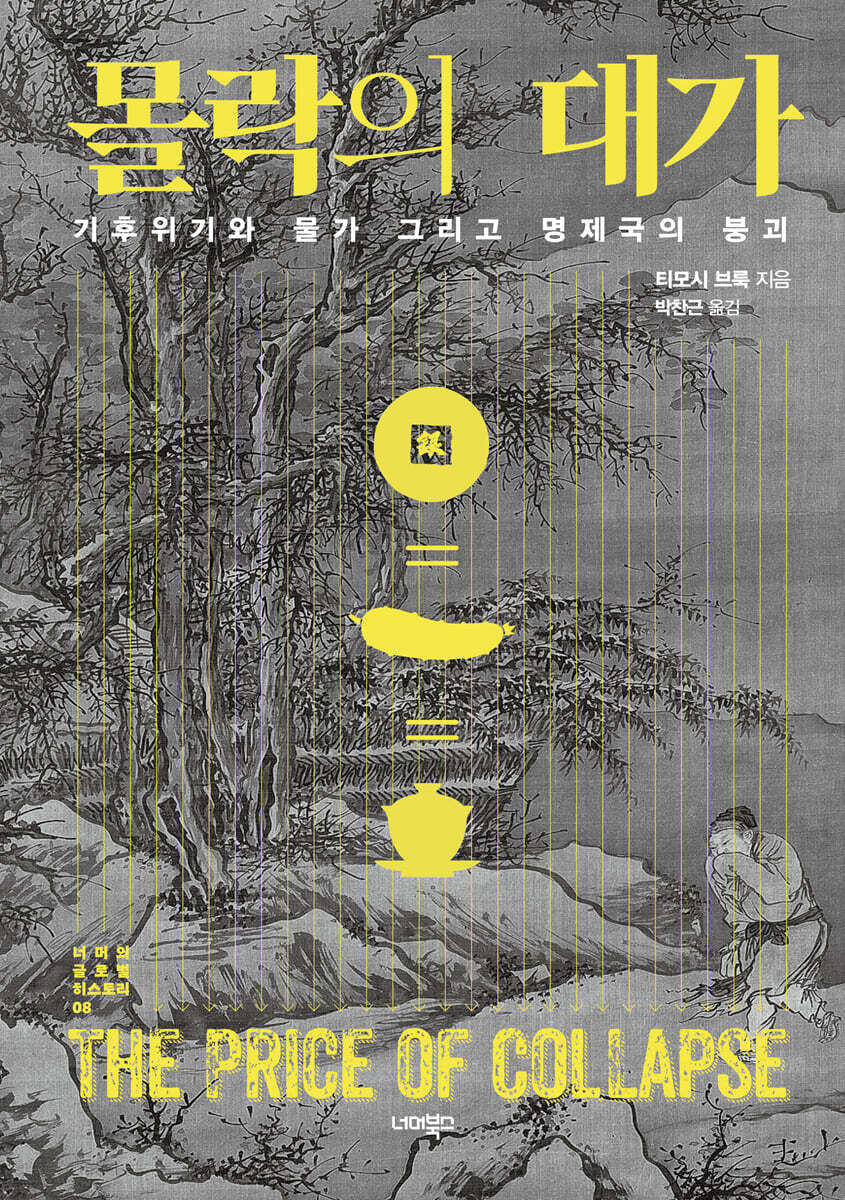
Professor Timothy Brook, a renowned Chinese historian at UBC, has published a new book titled “The Price of Collapse: Climate Crisis, Prices, and the Collapse of the Ming Empire” (original title: The Price of Collapse), which focuses not on the political history of the late Ming Dynasty, but on “price,” a seemingly ordinary piece of data.
The author's insight is that prices are not only a consequence of climate change, but also an indicator of environmental disaster.
By combining climate history and price history like two sides of a coin, it vividly shows why grain prices during famines are important as evidence of environmental history and how short-term environmental shocks can collapse markets and societies.
The book reconstructs the experiences of ordinary people as the climate crisis spirals toward catastrophe and as grain prices soar to unsustainable levels.
Drawing on information gleaned from scattered contemporary records, the author vividly portrays the cost of basic necessities in Chinese society four centuries ago, how common people struggled to afford them, and what happened when climate change destroyed crops and drove up prices.
It also refutes the conventional wisdom that the extreme prices of the late Ming Dynasty were due to the influx of silver and the money supply, and clearly shows that it was not due to global trade but to an environmental disaster.
While he praised Ming Dynasty China for its resilience in responding to crises, acknowledging that it had the most advanced political, economic, social, and population-supporting systems in the world at the time, he said that it was helpless in the face of external environmental disasters such as those in the 1640s.
It was 'nature' that set the limits of what was possible and impossible to survive.
The book's story of the climate crisis, pandemics, and soaring prices ruining the lives of ordinary people is no different from the problems of our time.
Professor Timothy Brooke, in his preface to the Korean edition, sympathizes with Korean readers' concerns about climate issues, saying, "Living on a peninsula vulnerable to climate change, surrounded by the turbulent environment of the Pacific Ocean and nestled beneath the vast Siberian plain, means that climate disaster is always lurking nearby."
Professor Lee Jeong-mo (former director of the National Science Museum in Gwacheon) said, “It is not a simple history book.
I recommend this book, saying, “It shows the power of climate.”
Lee Jeong-mo (former director of the National Science Museum in Gwacheon)
In the early 1640s, at the height of the Little Ice Age in China, a lethal combination of climate crisis, pandemic, soaring prices, and inflation brought the Ming Empire to its knees.
Many historians have attributed the fall of the Ming dynasty to Manchu invasions, political factionalism, administrative failures, declining tax revenues, and moral failures such as peasant revolts, but the causes were actually much deeper.
It's a climate problem.
Professor Timothy Brook, a renowned Chinese historian at UBC, has published a new book titled “The Price of Collapse: Climate Crisis, Prices, and the Collapse of the Ming Empire” (original title: The Price of Collapse), which focuses not on the political history of the late Ming Dynasty, but on “price,” a seemingly ordinary piece of data.
The author's insight is that prices are not only a consequence of climate change, but also an indicator of environmental disaster.
By combining climate history and price history like two sides of a coin, it vividly shows why grain prices during famines are important as evidence of environmental history and how short-term environmental shocks can collapse markets and societies.
The book reconstructs the experiences of ordinary people as the climate crisis spirals toward catastrophe and as grain prices soar to unsustainable levels.
Drawing on information gleaned from scattered contemporary records, the author vividly portrays the cost of basic necessities in Chinese society four centuries ago, how common people struggled to afford them, and what happened when climate change destroyed crops and drove up prices.
It also refutes the conventional wisdom that the extreme prices of the late Ming Dynasty were due to the influx of silver and the money supply, and clearly shows that it was not due to global trade but to an environmental disaster.
While he praised Ming Dynasty China for its resilience in responding to crises, acknowledging that it had the most advanced political, economic, social, and population-supporting systems in the world at the time, he said that it was helpless in the face of external environmental disasters such as those in the 1640s.
It was 'nature' that set the limits of what was possible and impossible to survive.
The book's story of the climate crisis, pandemics, and soaring prices ruining the lives of ordinary people is no different from the problems of our time.
Professor Timothy Brooke, in his preface to the Korean edition, sympathizes with Korean readers' concerns about climate issues, saying, "Living on a peninsula vulnerable to climate change, surrounded by the turbulent environment of the Pacific Ocean and nestled beneath the vast Siberian plain, means that climate disaster is always lurking nearby."
Professor Lee Jeong-mo (former director of the National Science Museum in Gwacheon) said, “It is not a simple history book.
I recommend this book, saying, “It shows the power of climate.”
- You can preview some of the book's contents.
Preview
index
Preface to the Korean edition
Introduction_My History as a Researcher of Price History
Chapter 1: The Story of Cheonchi-de
Understanding prices in the Ming Dynasty
The existence of a state
Price as data
The limits of what is possible
Disaster prices as an indicator of climate change
Chapter 2: Peaceful Days? The Price System of the Wanli Period
Bookkeeping
Two main characters
The value of 1 nyang, 1 don, and 1 pun
Spanish people in Guangzhou
local officials of the North China Plain
Cost of living under the Wanli price system
earnings
Prices among the wealthy
Prices in the luxury economy
Chapter 3: Silver, Prices, and Maritime Trade
foreign trade
Tribute and Trade
South China Sea prices
Prices of the porcelain trade
The impact of foreign trade on prices
Support for trade
Magellan's Exchange?
Chapter 4 Grain Prices During the Famine
Grain prices
Grain prices during the famine recorded in local newspapers
Distribution of famine prices
Sky, Climate, and Famine
Six crises
Pressure from rising prices
Chapter 5: Price Rise During the Chongzhen Period
Long-term price fluctuations during the Ming Dynasty
Short-term price fluctuations during the Wanli period
Price stabilization after the Chongzhen era
Price surge during the Chongzhen era
The Fall of the Ming Dynasty, Famine Prices, and the Role of Climate
Postscript_ Climate and History
Translator's Note
supplement
References
Search
Introduction_My History as a Researcher of Price History
Chapter 1: The Story of Cheonchi-de
Understanding prices in the Ming Dynasty
The existence of a state
Price as data
The limits of what is possible
Disaster prices as an indicator of climate change
Chapter 2: Peaceful Days? The Price System of the Wanli Period
Bookkeeping
Two main characters
The value of 1 nyang, 1 don, and 1 pun
Spanish people in Guangzhou
local officials of the North China Plain
Cost of living under the Wanli price system
earnings
Prices among the wealthy
Prices in the luxury economy
Chapter 3: Silver, Prices, and Maritime Trade
foreign trade
Tribute and Trade
South China Sea prices
Prices of the porcelain trade
The impact of foreign trade on prices
Support for trade
Magellan's Exchange?
Chapter 4 Grain Prices During the Famine
Grain prices
Grain prices during the famine recorded in local newspapers
Distribution of famine prices
Sky, Climate, and Famine
Six crises
Pressure from rising prices
Chapter 5: Price Rise During the Chongzhen Period
Long-term price fluctuations during the Ming Dynasty
Short-term price fluctuations during the Wanli period
Price stabilization after the Chongzhen era
Price surge during the Chongzhen era
The Fall of the Ming Dynasty, Famine Prices, and the Role of Climate
Postscript_ Climate and History
Translator's Note
supplement
References
Search
Detailed image

Into the book
The only food so cheap that it couldn't be priced in silver was the soybeans used to make tofu.
The price of these beans was determined by the use of thin coins with a hole in the center, which were used for small transactions.
This coin was called 'Wen', meaning 'letter', referring to the emperor's reign title engraved on the front of the coin.
Portuguese merchants called these coins 'caixa' after the Malay word, or 'caxa' in Spanish, from which the English word 'cash' is derived.
Since 'cash' has a different meaning in English, this book uses the old English expression 'copper', meaning a low-value coin, as a translation for 'mun', a unit for counting coins.
1,000 mun was set at the nominal equivalent of 1 nyang of silver in the early Ming Dynasty, but the coin soon appreciated in value against silver, stabilizing at an exchange rate of about 700 mun coins per 1 nyang of silver.
Therefore, seven coins were worth the same as one silver penny.
A single coin was not worth much.
You could buy a block of tofu, a sheet of plain paper, two pairs of chopsticks, or a pound of charcoal.
For two coins, you could buy a cheap brush, incense made from sandalwood, or rice cakes.
The poorest people treasured coins, and the rich did not stoop to pick up a single coin.
--- p.31
[Table 2.2] shows the items that can be purchased with 1 silver coin.
This was a price most people could afford.
A pun was the almost universal price for a geun (1 1/3 pounds or 600 grams) of vegetables such as cucumbers, plums, etc., but it was too high a price for basic cooking ingredients such as green onions and ginger, which cost one-fifth of a pun or less, that is, one or two mon.
One silver pun was enough for Hairui to buy one geun of liquor, but liquor was available at a wide range of prices (Seonbang offered prices ranging from 4 to 20 silver pun per bottle).
Since the standard price of meat was two silver pennies per geun, one silver pennies could only buy half a geun (300 grams or two-thirds of a pound).
However, live animals were half the price of slaughtered meat.
Fresh or pickled fish usually sold for the same price as meat, but in a 1602 letter, Jesuit missionary Diego Pantoja wrote that a pound of trout could be bought in Beijing for a silver penny.
--- p.87
Could the silver that flowed into the Ming Dynasty have expanded the money supply in the Chinese economy of approximately 100 million people, leading to inflation? Many historians have concluded this based on relatively scattered and unreliable price data, but most economic historians have now abandoned that hypothesis.
This chapter will challenge this claim and propose an alternative interpretation, along with the latter group.
We will turn our gaze around and approach the international silver issue of the time from the perspective of the British, who attempted to ride the silver wave and participate in the Chinese trade in the late Ming Dynasty.
To examine the impact of prices on the economy, we will first examine the period of the tribute system in the first half of the Ming dynasty, and then examine all the relatively reliable cost records left by Spanish, British, and Dutch merchants who traded goods and silver during the last half century of the Ming dynasty.
This chapter will conclude with a brief examination of some Ming Dynasty figures' views on the beneficial economic effects of silver trade.
--- p.140~141
After Emperor Cheonji died in 1627, his 16-year-old younger brother, Emperor Chongzhen, became the emperor, but at this time the climate began to deteriorate again.
From the beginning, the highest price has been updated every year.
During the 'Wanli II' era, Gu Chi-won and Wu Ying-ji could have hoped that grain prices would return to normal.
However, when Wu Yingzhi wrote about the disasters of the Chongzhen era, the price of 'Wanli II' was reasonable compared to what would happen later.
“In 1640, 1641, and 1642, it reached 3.6 nyang of silver, and the price continued to rise.
“The situation was even more dire in the surrounding counties.” Looking back on the period of the Chongzhen Crisis (1638-1644), Wu Yingzhi regarded it as a time when, although Wanli II suffered from high prices, it was expected that prices would soon fall to normal levels.
At that time, he said, “City dwellers had even forgotten what buckwheat or barley was.
Now these grains are being sold for 5,000 coins per se.
However, in Shandong and Henan, the price of millet reaches 10,000 mu per du (not 1 seok, but 1 du!),” he observed.
It was 12 times more expensive than Beijing.
While Nanjing's prices are horrendous, living in Beijing is "like living in heaven by comparison," said Wu Yingzhi.
This is an example of how expectations can change.
The price of these beans was determined by the use of thin coins with a hole in the center, which were used for small transactions.
This coin was called 'Wen', meaning 'letter', referring to the emperor's reign title engraved on the front of the coin.
Portuguese merchants called these coins 'caixa' after the Malay word, or 'caxa' in Spanish, from which the English word 'cash' is derived.
Since 'cash' has a different meaning in English, this book uses the old English expression 'copper', meaning a low-value coin, as a translation for 'mun', a unit for counting coins.
1,000 mun was set at the nominal equivalent of 1 nyang of silver in the early Ming Dynasty, but the coin soon appreciated in value against silver, stabilizing at an exchange rate of about 700 mun coins per 1 nyang of silver.
Therefore, seven coins were worth the same as one silver penny.
A single coin was not worth much.
You could buy a block of tofu, a sheet of plain paper, two pairs of chopsticks, or a pound of charcoal.
For two coins, you could buy a cheap brush, incense made from sandalwood, or rice cakes.
The poorest people treasured coins, and the rich did not stoop to pick up a single coin.
--- p.31
[Table 2.2] shows the items that can be purchased with 1 silver coin.
This was a price most people could afford.
A pun was the almost universal price for a geun (1 1/3 pounds or 600 grams) of vegetables such as cucumbers, plums, etc., but it was too high a price for basic cooking ingredients such as green onions and ginger, which cost one-fifth of a pun or less, that is, one or two mon.
One silver pun was enough for Hairui to buy one geun of liquor, but liquor was available at a wide range of prices (Seonbang offered prices ranging from 4 to 20 silver pun per bottle).
Since the standard price of meat was two silver pennies per geun, one silver pennies could only buy half a geun (300 grams or two-thirds of a pound).
However, live animals were half the price of slaughtered meat.
Fresh or pickled fish usually sold for the same price as meat, but in a 1602 letter, Jesuit missionary Diego Pantoja wrote that a pound of trout could be bought in Beijing for a silver penny.
--- p.87
Could the silver that flowed into the Ming Dynasty have expanded the money supply in the Chinese economy of approximately 100 million people, leading to inflation? Many historians have concluded this based on relatively scattered and unreliable price data, but most economic historians have now abandoned that hypothesis.
This chapter will challenge this claim and propose an alternative interpretation, along with the latter group.
We will turn our gaze around and approach the international silver issue of the time from the perspective of the British, who attempted to ride the silver wave and participate in the Chinese trade in the late Ming Dynasty.
To examine the impact of prices on the economy, we will first examine the period of the tribute system in the first half of the Ming dynasty, and then examine all the relatively reliable cost records left by Spanish, British, and Dutch merchants who traded goods and silver during the last half century of the Ming dynasty.
This chapter will conclude with a brief examination of some Ming Dynasty figures' views on the beneficial economic effects of silver trade.
--- p.140~141
After Emperor Cheonji died in 1627, his 16-year-old younger brother, Emperor Chongzhen, became the emperor, but at this time the climate began to deteriorate again.
From the beginning, the highest price has been updated every year.
During the 'Wanli II' era, Gu Chi-won and Wu Ying-ji could have hoped that grain prices would return to normal.
However, when Wu Yingzhi wrote about the disasters of the Chongzhen era, the price of 'Wanli II' was reasonable compared to what would happen later.
“In 1640, 1641, and 1642, it reached 3.6 nyang of silver, and the price continued to rise.
“The situation was even more dire in the surrounding counties.” Looking back on the period of the Chongzhen Crisis (1638-1644), Wu Yingzhi regarded it as a time when, although Wanli II suffered from high prices, it was expected that prices would soon fall to normal levels.
At that time, he said, “City dwellers had even forgotten what buckwheat or barley was.
Now these grains are being sold for 5,000 coins per se.
However, in Shandong and Henan, the price of millet reaches 10,000 mu per du (not 1 seok, but 1 du!),” he observed.
It was 12 times more expensive than Beijing.
While Nanjing's prices are horrendous, living in Beijing is "like living in heaven by comparison," said Wu Yingzhi.
This is an example of how expectations can change.
--- p.232~233
Publisher's Review
"Grain prices during famine are an indicator of climate change and the best evidence of climate (environmental) history. Climate history cannot be described without price history, and price history cannot be described without climate history."
During the late Ming Dynasty's Chongzhen Crisis (1638–1644), China was hit by an unprecedented combination of severe cold waves, droughts, epidemics, gales, earthquakes, and locust swarms, driving millions of people across the country to their deaths.
It was the 'seven most severe years in a thousand years', and 1642 was the worst of them all.
Tian Zhide, a scholar-official from Tongxiang County near the Yangtze River Delta, wrote:
“At this time, there was no rice available for purchase in the market.
Even if there was a merchant with grain, people passed by without asking the price.
The rich searched for beans and wheat, while the poor searched for chaff and rotten food.
It was a joy to be able to obtain a few chaff or bark.” The Ming Empire collapsed two years later.
Given the nature of Chinese rice farming, the combination of cold waves and drought was far more dangerous than cold waves and heavy rainfall.
Adding to this the pandemic, prices soared, inflation destroyed the nominal economy and social system, and the political system collapsed as well.
Professor Timothy Brooke asserts that the only factor that could explain the extreme grain prices and inflation that brought down the Ming Empire was 'climate'.
After collecting hundreds of price data points, we prove that the period coincides with the Little Ice Age climate change.
What has caught China is not political failure, but climate failure.
But why does the author focus on prices? Why does he link grain prices during the famine to climate (environmental) history? While scientists track climate change through physical indicators, no climate simulation can accurately capture the moment in the 1640s when the price disaster "completely exhausted people."
This is why the history of climate in the Ming Dynasty cannot be described without the history of water, and the history of water cannot be described without the history of climate.
When crops were damaged by cold waves or droughts, the impact was not only that people suffered famine, but also that they created famine prices for grain.
Timothy Brooke's insightful explanation is that grain prices during famines are a barometer of climate change, and that they represent the best environmental historical evidence we have.
This book expands on the story by using the disaster situation and price data from 1640 to 1642 recorded by Cheon Chi-de ("Records of Disaster and Waste") as a tool for understanding Ming Dynasty history.
"For a common household, it takes 14 nyang of silver to survive a year, while for a middle-class household, it takes at least 23 nyang."
The author collected approximately 3,000 volumes of local newspapers, essays, diaries, memoirs, and even the ledgers of the British East India Company from the Ming, Qing, and Republic of China dynasties.
We extracted 777 large-scale famine-era grain price data sets and compared prices extensively for grains such as rice, barley, wheat, and soybeans, along with 72 other commodities.
Rather than viewing prices solely as a consequence of climate change, the correlation between price fluctuations and climate change was traced by adopting a strategy of changing the relationship and utilizing Ming Dynasty prices as a proxy indicator for detecting climate change.
For prices to function as a proxy for climate change here, there should be no noticeable fluctuations in prices in the absence of climate change shocks.
Thus, in Chapter 2 of this book, the author proves that prices in the Ming Dynasty were situated within a 'price system' in which equalizing pressure operated within a certain price range unless there was an external shock (the author estimates the average annual inflation rate in the Ming Dynasty to be 0.3 percent) and that the concept of a 'fair price' was in operation.
In particular, Timothy Brook's outstanding scholarly contribution in this book is his estimation of the annual living expenses and earnings of common households in the Ming Dynasty to support themselves and raise their children.
The poorest families, including laborers, soldiers, self-employed people, artisans, and fishermen, needed a little more than 14 nyang of silver to survive a year, while the living expenses of the middle class were more than 23 nyang.
The common people's annual wages ranged from 5 to 12 nyang of silver, and the shortfall was made up by growing food in their gardens.
The middle class's wages ranged from 14 to 22 nyang, and they also had some additional income, such as from gardening.
The author also reconstructed the price system of the Ming Dynasty, presenting 25 items that could be purchased for 1 silver pun, 1 don, and 1 nyang, which is very detailed and interesting.
It shows that history is not just about great rulers or powerful armies, but about the conditions under which people had to survive.
The extreme inflation of the late Ming Dynasty was due to climate change, not global silver trade.
Timothy Brooke challenges the argument of some historians that the record inflation of the late Ming Dynasty was caused by the money supply.
There is no doubt that the global circulation of silver played a major role in making Chinese history a part of world history.
The problem is that silver had already flowed into China before the price spike, and there is no evidence that grain prices were affected by silver movements during the Chongzhen Crisis.
Moreover, the Ming Empire's economy was large enough, comparable in size to that of the entire European economy, to integrate the inflow of silver into the commercial exchange system, preventing it from becoming unstable.
This paper refutes point by point the view that the crisis was caused by the influx of silver, distinguishes between fluctuations in the prices of luxury goods and grain, and reexamines how market prices in China were formed and fluctuated at the time.
In China's agricultural society, grain prices were the most reliable measure of agricultural prosperity, human survival, and political stability.
It was not the money supply that broke down that boundary, but the deterioration of the natural conditions for agricultural production during the Little Ice Age.
Grain prices are a mediating mechanism between solar energy and human demand.
When an economy relies on solar radiation as its energy source, it emphasizes the need to recognize that 'nature' is a factor that determines the viability of a society or nation.
In short, the author's argument is that it was not global trade, but global climate that drove grain prices in the Ming Dynasty to catastrophic levels.
Six climate crises: between long-term resilience and momentary collapse.
By synthesizing the Ming Dynasty's pricing system and grain prices during famine periods, the author identifies a period of great famine in the three-century history of the Ming Empire, a time when soaring prices coincided with environmental disasters.
The six 'crises' introduced by the author in his previous work, 'Harvard Chinese History: Yuanming: Empires in Trouble', are the Yongle Crisis (1403-1406), Jingtai Crisis (1450-1456), Jiajing Crisis (1544-1545), Wanli Crisis 1 (1586-1589), Wanli Crisis 2 (1615-1620), and Chongzhen Crisis (1638-1644).
During most of the Ming Dynasty, the normal price of a head of rice was 3-4 silver pennies, and during the Wanli period and thereafter, it was around 4-5 silver pennies. However, during the famine caused by the environmental crisis, the price jumped to between 10 and 30 silver pennies.
Especially during the Chongzheng crisis, the price per head ranged from 1 to 2 nyang, and in some regions it reached 4 nyang.
Of the 777 records of grain prices during famine in local newspapers, 32 percent were concentrated in the seven years of the Chongzhen Crisis, from 1638 to 1644.
Although there were several climate changes during the Ming Dynasty, the price fluctuations did not exceed a certain level during the crises before the Chongzhen era.
Some 'crises' ended in political disaster, such as the palace coup against Emperor Gyeongtae in the winter of 1456, but most showed 'resilience' and moved back towards stability.
So how can we explain the resilience demonstrated during the five previous crises and the collapse of the 1640s? Was the "Chongjeong Crisis" the result of the gradual accumulation of multiple environmental crises? Here, Timothy Brook argues that it is necessary to distinguish between long-term and short-term climate disruptions—that is, climate change and weather.
The Ming Chinese demonstrated remarkable resilience to environmental pressures.
Innovations such as building infrastructure like irrigation and drainage, crop variations like early-maturing rice, developing institutions like granaries and grain markets, devising technologies like water pumps, and controlling population to alleviate pressure on food supply did not happen overnight.
Prolonged chaos has forced humans to adapt to new circumstances.
However, the 'Chongjeong Crisis' was a different scale of environmental disaster.
When it is sudden and severe, it tends to overwhelm rather than promote adaptation.
The author notes that historical sources for extreme disasters like the Chongzhen crisis do not describe adaptation, but simply state that there was a large-scale famine and that there was nothing anyone could do.
Four centuries ago they were overwhelmed.
The strain on grain production caused by cold spells and droughts during the worst of China's Little Ice Age was not felt again until the 1850s.
The Qing people adapted to the post-Chongzhen price system and transitioned to a new price system in the 18th century, but climate change at the end of the Little Ice Age in the mid-19th century led to famine, civil war, and the subsequent collapse of the dynasty.
Despite warnings of the climate crisis for decades, haven't we ignored or largely ignored the environmental pressures and their scale until recently? Doesn't the recent surge in food prices demand proactive, fundamental solutions and action? This is why you should open this book and read it now.
Author's note?
I know that most Koreans are sensitive to climate issues, as Korea is vulnerable to climate change.
We also recognize that Korean historians were among the first to consider climate in their analysis of historical change in East Asia.
For these two reasons, I believe the Korean translation of this book will reach readers who are interested in and understand my findings.
I'm particularly looking forward to hearing from Korean readers about how they view the link between grain prices and climate change.
This connection had enormous political implications for Joseon, which was experiencing difficulties similar to those experienced by the Ming Dynasty.
Translator's Note
I would like to add a word about the title of this book.
The late Ming situation described in this book was one of widespread socioeconomic and environmental change.
At that time, people experienced a comprehensive downfall that went beyond the collapse of the dynasty, including the collapse of the price system and the collapse of livelihood conditions due to climate change, and people had to pay the price in extreme hardship and death.
The title 'The Price of Fall' can be said to well capture the multi-layered content of this book.
During the late Ming Dynasty's Chongzhen Crisis (1638–1644), China was hit by an unprecedented combination of severe cold waves, droughts, epidemics, gales, earthquakes, and locust swarms, driving millions of people across the country to their deaths.
It was the 'seven most severe years in a thousand years', and 1642 was the worst of them all.
Tian Zhide, a scholar-official from Tongxiang County near the Yangtze River Delta, wrote:
“At this time, there was no rice available for purchase in the market.
Even if there was a merchant with grain, people passed by without asking the price.
The rich searched for beans and wheat, while the poor searched for chaff and rotten food.
It was a joy to be able to obtain a few chaff or bark.” The Ming Empire collapsed two years later.
Given the nature of Chinese rice farming, the combination of cold waves and drought was far more dangerous than cold waves and heavy rainfall.
Adding to this the pandemic, prices soared, inflation destroyed the nominal economy and social system, and the political system collapsed as well.
Professor Timothy Brooke asserts that the only factor that could explain the extreme grain prices and inflation that brought down the Ming Empire was 'climate'.
After collecting hundreds of price data points, we prove that the period coincides with the Little Ice Age climate change.
What has caught China is not political failure, but climate failure.
But why does the author focus on prices? Why does he link grain prices during the famine to climate (environmental) history? While scientists track climate change through physical indicators, no climate simulation can accurately capture the moment in the 1640s when the price disaster "completely exhausted people."
This is why the history of climate in the Ming Dynasty cannot be described without the history of water, and the history of water cannot be described without the history of climate.
When crops were damaged by cold waves or droughts, the impact was not only that people suffered famine, but also that they created famine prices for grain.
Timothy Brooke's insightful explanation is that grain prices during famines are a barometer of climate change, and that they represent the best environmental historical evidence we have.
This book expands on the story by using the disaster situation and price data from 1640 to 1642 recorded by Cheon Chi-de ("Records of Disaster and Waste") as a tool for understanding Ming Dynasty history.
"For a common household, it takes 14 nyang of silver to survive a year, while for a middle-class household, it takes at least 23 nyang."
The author collected approximately 3,000 volumes of local newspapers, essays, diaries, memoirs, and even the ledgers of the British East India Company from the Ming, Qing, and Republic of China dynasties.
We extracted 777 large-scale famine-era grain price data sets and compared prices extensively for grains such as rice, barley, wheat, and soybeans, along with 72 other commodities.
Rather than viewing prices solely as a consequence of climate change, the correlation between price fluctuations and climate change was traced by adopting a strategy of changing the relationship and utilizing Ming Dynasty prices as a proxy indicator for detecting climate change.
For prices to function as a proxy for climate change here, there should be no noticeable fluctuations in prices in the absence of climate change shocks.
Thus, in Chapter 2 of this book, the author proves that prices in the Ming Dynasty were situated within a 'price system' in which equalizing pressure operated within a certain price range unless there was an external shock (the author estimates the average annual inflation rate in the Ming Dynasty to be 0.3 percent) and that the concept of a 'fair price' was in operation.
In particular, Timothy Brook's outstanding scholarly contribution in this book is his estimation of the annual living expenses and earnings of common households in the Ming Dynasty to support themselves and raise their children.
The poorest families, including laborers, soldiers, self-employed people, artisans, and fishermen, needed a little more than 14 nyang of silver to survive a year, while the living expenses of the middle class were more than 23 nyang.
The common people's annual wages ranged from 5 to 12 nyang of silver, and the shortfall was made up by growing food in their gardens.
The middle class's wages ranged from 14 to 22 nyang, and they also had some additional income, such as from gardening.
The author also reconstructed the price system of the Ming Dynasty, presenting 25 items that could be purchased for 1 silver pun, 1 don, and 1 nyang, which is very detailed and interesting.
It shows that history is not just about great rulers or powerful armies, but about the conditions under which people had to survive.
The extreme inflation of the late Ming Dynasty was due to climate change, not global silver trade.
Timothy Brooke challenges the argument of some historians that the record inflation of the late Ming Dynasty was caused by the money supply.
There is no doubt that the global circulation of silver played a major role in making Chinese history a part of world history.
The problem is that silver had already flowed into China before the price spike, and there is no evidence that grain prices were affected by silver movements during the Chongzhen Crisis.
Moreover, the Ming Empire's economy was large enough, comparable in size to that of the entire European economy, to integrate the inflow of silver into the commercial exchange system, preventing it from becoming unstable.
This paper refutes point by point the view that the crisis was caused by the influx of silver, distinguishes between fluctuations in the prices of luxury goods and grain, and reexamines how market prices in China were formed and fluctuated at the time.
In China's agricultural society, grain prices were the most reliable measure of agricultural prosperity, human survival, and political stability.
It was not the money supply that broke down that boundary, but the deterioration of the natural conditions for agricultural production during the Little Ice Age.
Grain prices are a mediating mechanism between solar energy and human demand.
When an economy relies on solar radiation as its energy source, it emphasizes the need to recognize that 'nature' is a factor that determines the viability of a society or nation.
In short, the author's argument is that it was not global trade, but global climate that drove grain prices in the Ming Dynasty to catastrophic levels.
Six climate crises: between long-term resilience and momentary collapse.
By synthesizing the Ming Dynasty's pricing system and grain prices during famine periods, the author identifies a period of great famine in the three-century history of the Ming Empire, a time when soaring prices coincided with environmental disasters.
The six 'crises' introduced by the author in his previous work, 'Harvard Chinese History: Yuanming: Empires in Trouble', are the Yongle Crisis (1403-1406), Jingtai Crisis (1450-1456), Jiajing Crisis (1544-1545), Wanli Crisis 1 (1586-1589), Wanli Crisis 2 (1615-1620), and Chongzhen Crisis (1638-1644).
During most of the Ming Dynasty, the normal price of a head of rice was 3-4 silver pennies, and during the Wanli period and thereafter, it was around 4-5 silver pennies. However, during the famine caused by the environmental crisis, the price jumped to between 10 and 30 silver pennies.
Especially during the Chongzheng crisis, the price per head ranged from 1 to 2 nyang, and in some regions it reached 4 nyang.
Of the 777 records of grain prices during famine in local newspapers, 32 percent were concentrated in the seven years of the Chongzhen Crisis, from 1638 to 1644.
Although there were several climate changes during the Ming Dynasty, the price fluctuations did not exceed a certain level during the crises before the Chongzhen era.
Some 'crises' ended in political disaster, such as the palace coup against Emperor Gyeongtae in the winter of 1456, but most showed 'resilience' and moved back towards stability.
So how can we explain the resilience demonstrated during the five previous crises and the collapse of the 1640s? Was the "Chongjeong Crisis" the result of the gradual accumulation of multiple environmental crises? Here, Timothy Brook argues that it is necessary to distinguish between long-term and short-term climate disruptions—that is, climate change and weather.
The Ming Chinese demonstrated remarkable resilience to environmental pressures.
Innovations such as building infrastructure like irrigation and drainage, crop variations like early-maturing rice, developing institutions like granaries and grain markets, devising technologies like water pumps, and controlling population to alleviate pressure on food supply did not happen overnight.
Prolonged chaos has forced humans to adapt to new circumstances.
However, the 'Chongjeong Crisis' was a different scale of environmental disaster.
When it is sudden and severe, it tends to overwhelm rather than promote adaptation.
The author notes that historical sources for extreme disasters like the Chongzhen crisis do not describe adaptation, but simply state that there was a large-scale famine and that there was nothing anyone could do.
Four centuries ago they were overwhelmed.
The strain on grain production caused by cold spells and droughts during the worst of China's Little Ice Age was not felt again until the 1850s.
The Qing people adapted to the post-Chongzhen price system and transitioned to a new price system in the 18th century, but climate change at the end of the Little Ice Age in the mid-19th century led to famine, civil war, and the subsequent collapse of the dynasty.
Despite warnings of the climate crisis for decades, haven't we ignored or largely ignored the environmental pressures and their scale until recently? Doesn't the recent surge in food prices demand proactive, fundamental solutions and action? This is why you should open this book and read it now.
Author's note?
I know that most Koreans are sensitive to climate issues, as Korea is vulnerable to climate change.
We also recognize that Korean historians were among the first to consider climate in their analysis of historical change in East Asia.
For these two reasons, I believe the Korean translation of this book will reach readers who are interested in and understand my findings.
I'm particularly looking forward to hearing from Korean readers about how they view the link between grain prices and climate change.
This connection had enormous political implications for Joseon, which was experiencing difficulties similar to those experienced by the Ming Dynasty.
Translator's Note
I would like to add a word about the title of this book.
The late Ming situation described in this book was one of widespread socioeconomic and environmental change.
At that time, people experienced a comprehensive downfall that went beyond the collapse of the dynasty, including the collapse of the price system and the collapse of livelihood conditions due to climate change, and people had to pay the price in extreme hardship and death.
The title 'The Price of Fall' can be said to well capture the multi-layered content of this book.
GOODS SPECIFICS
- Date of issue: November 27, 2024
- Page count, weight, size: 336 pages | 406g | 148*210*19mm
- ISBN13: 9788994606958
- ISBN10: 8994606955
You may also like
카테고리
korean


korean

![GQ KOREA Mark (Monthly): December [2025]](http://librairie.coreenne.fr/cdn/shop/files/8ef265dbbfbf186523ed75ba7319009d.jpg?v=1765340328&width=3840)


