

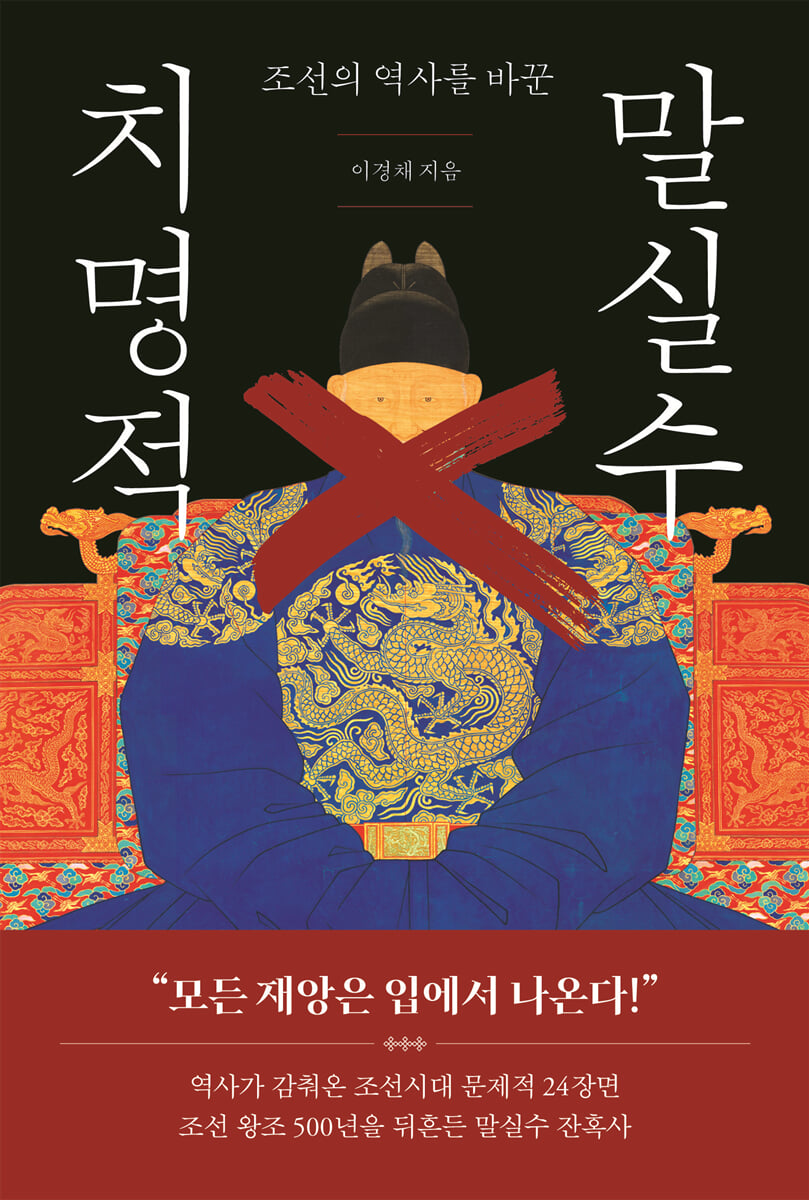
A fatal slip of the tongue that changed Joseon's history
 |
Description
Book Introduction
“All disasters come from the mouth!” 24 Problematic Scenes from the Joseon Dynasty Hidden by History The brutal history of slips of the tongue that shook the Joseon Dynasty for 500 years A fatal fire caused by a three-tongue 24 Scenes from the Tales of Joseon Dynasty Leaders There is a saying in the Dhammapada that “an unfortunate fate begins with one’s own mouth.” A book titled “Fatal Slips of the tongue that changed Joseon’s history” (revised edition) has been published to raise awareness about words through the stories of people who brought disaster upon themselves with a single word and disappeared into the back alleys of history. The lives of seven Joseon Dynasty figures who were influential in their time but lost everything due to a slip of the tongue are reconstructed and introduced in 24 episodes. Jeong Do-jeon, who founded the Joseon Dynasty with his brilliant strategy, but met a miserable end due to his repeated self-righteous and arrogant words and actions; the four brothers of Min Mu-gu, the king's brothers-in-law, who brought about their own deaths with their arrogant and insolent attitude that could not distinguish between public and private matters; General Nam I, who died young at the execution grounds due to his overconfidence and outspokenness; Shin Jeong, the son of Shin Suk-ju, who took advantage of his father's chances and lied and abused his power, and was poisoned; Shin Su-geun, the brother-in-law of King Yeonsangun, who failed to face reality and made the wrong choice, leading to the destruction of his family; Sim Ui-gyeom, who caused the East and West factions to split due to a slip of the tongue stemming from a minor misunderstanding; and Na Gyeong-eon, who exposed the misdeeds of Crown Prince Sado at the instigation of the Noron faction and was then executed for treason. Author Lee Gyeong-chae describes their scandalous tales in an exciting way, as if watching a historical drama or novel, based on historical materials such as the Annals of the Joseon Dynasty and the Records of the Joseon Dynasty. |
- You can preview some of the book's contents.
Preview
index
Author's Note
Part 1: Jeong Do-jeon's fatal speech and slips of the tongue
S#01 A Straightforward Word
S#02 Private, too private
S#03 Petition and Counterpetition: A Battle of Words
S#04 Embrace is Far, Revenge is Near
S#05 Words are the seeds of misfortune
S#06 Political Judgment and a Critical Slip of the tongue
Part 2: The Deaths of the Four Minmugu Brothers, Caused by Carelessly Shot Arrows
S#07 Taejong's Shadow, Zhu Yuanzhang
S#08 The Prince's Wedding Incident
S#09 The King's Brothers-in-Law Who Speak and Act Recklessly
S#10 Four brothers who brought death upon themselves with their arrogant words and actions
Part 3: A Case of Excessive Passion Becoming Poisonous: General Nam
S#11 The Birth of Giraffe Nam-i
S#12 A Bloody History Caused by Careless Words
S#13 The Fortune Teller's Prophecy
Part 4: Shin Jeong, the epitome of lies and abuse of power
S#14 Shin Jeong, the son of Shin Suk-ju, who enjoyed his father's chance
S#15 The Prime Minister's Son Who Committed Misconduct
S#16 Words of Lies and Hypocrisy
Part 5: Shin Soo-geun's clan was destroyed because he couldn't see the future.
S#17 Kim Jong-jik, who was subjected to a state examination for his "condolence message"
S#18 King Yeonsangun is deceived by Shin Su-geun's sweet talk and his maternal relatives.
S#19 Will you save your sister or your daughter?
Part 6: The East-West Factions Born from Minor Misunderstandings
S#20 Sarim, the victim of false accusations and a secret struggle
S#21 A Minor Misunderstanding Leads to the East-West Factions
Part 7: Na Kyung-eon's revelations about the murder of Crown Prince Sado
S#22 Strict Father, Precious Son
S#23 The Isolated and Helpless Crown Prince
S#24 The Whistleblower, Na Kyung-eon
Part 1: Jeong Do-jeon's fatal speech and slips of the tongue
S#01 A Straightforward Word
S#02 Private, too private
S#03 Petition and Counterpetition: A Battle of Words
S#04 Embrace is Far, Revenge is Near
S#05 Words are the seeds of misfortune
S#06 Political Judgment and a Critical Slip of the tongue
Part 2: The Deaths of the Four Minmugu Brothers, Caused by Carelessly Shot Arrows
S#07 Taejong's Shadow, Zhu Yuanzhang
S#08 The Prince's Wedding Incident
S#09 The King's Brothers-in-Law Who Speak and Act Recklessly
S#10 Four brothers who brought death upon themselves with their arrogant words and actions
Part 3: A Case of Excessive Passion Becoming Poisonous: General Nam
S#11 The Birth of Giraffe Nam-i
S#12 A Bloody History Caused by Careless Words
S#13 The Fortune Teller's Prophecy
Part 4: Shin Jeong, the epitome of lies and abuse of power
S#14 Shin Jeong, the son of Shin Suk-ju, who enjoyed his father's chance
S#15 The Prime Minister's Son Who Committed Misconduct
S#16 Words of Lies and Hypocrisy
Part 5: Shin Soo-geun's clan was destroyed because he couldn't see the future.
S#17 Kim Jong-jik, who was subjected to a state examination for his "condolence message"
S#18 King Yeonsangun is deceived by Shin Su-geun's sweet talk and his maternal relatives.
S#19 Will you save your sister or your daughter?
Part 6: The East-West Factions Born from Minor Misunderstandings
S#20 Sarim, the victim of false accusations and a secret struggle
S#21 A Minor Misunderstanding Leads to the East-West Factions
Part 7: Na Kyung-eon's revelations about the murder of Crown Prince Sado
S#22 Strict Father, Precious Son
S#23 The Isolated and Helpless Crown Prince
S#24 The Whistleblower, Na Kyung-eon
Detailed image
.jpg)
Into the book
At that time, King Taejo trusted Jeong Do-jeon so much that he would have believed him even if he had said that he made meju with red beans.
Taejo, who was a military man, was practically an outsider when it came to running a country, so it would not be an exaggeration to say that Jeong Do-jeon was in charge of actually running the government.
Because this was the case, Jeong Do-jeon would boast and boast about his achievements whenever he had a drink with his close acquaintances.
“It was not Gaozu of Han who wrote Zhang Zifang, but Zhang Zifang who wrote Gaozu of Han.”
This meant that Jeong Do-jeon used King Taejo Lee Seong-gye to overthrow Goryeo and establish Joseon.
If someone else had said this, it would have been an extremely dangerous statement that would have killed anyone even if they had ten necks.
--- p.45~50
The next day, when Min Mu-gu entered Daejeon, Taejong asked.
“Why didn’t you come to Taepyeonggwan yesterday?”
Minmu-gu frowned and answered curtly.
"Your Majesty dislikes me, so I deliberately avoided going." "What are you talking about? When have I ever disliked you?" "Doesn't Your Majesty usually turn away when he meets me? That's why I deliberately avoided going, fearing that something like that might happen at your joyful banquet."
In this way, Min Mu-gu treated Taejong the same way he did when he was Prince Jeongan.
Taejong was displeased with Min Mu-gu's behavior, which was unable to escape the days of being his brother-in-law.
--- p.103
Three days later, Nam-i and Kang-sun's older brothers were executed.
At that time, anyone who committed treason, regardless of their social status, was subject to the punishment of being burned to death by having their limbs torn off.
As the executioners approached with ropes to tie his legs together, Nam-i slowly closed his eyes.
Suddenly, I remembered King Sejo praising my bold words and actions as worthy of a great man.
On the other hand, I regret the past when I was unable to be humble and acted rashly with overconfidence even after rising to the position of high-ranking official.
Kang Soon, sitting next to me, groaned and muttered softly.
“I am suffering like this because I was close to a young child.
“I resent the heavens.”
--- p.131
Seongjong summoned Shin Jeong and said.
“I feel very sorry for you, the son of Shin Suk-ju, who was like my benefactor, for committing a mortal sin.
If you confess your sins and repent of your transgressions, I will release you and repay the kindness shown to your father.
It's clear to me that you forged the tea leaflet.
But why don't you tell the truth?"
Shin Jeong thought that Seongjong would never kill him.
I had held out all this time, so confessing now would only make things more ridiculous.
So, Shin Jeong spoke to Seongjong without any sign of remorse.
“Your Majesty, I never forged a secret document.”
--- p.176
I'd expected a rebellion, but I never thought it would come so quickly! Shin Soo-geun sat on the table with a feigned calm expression.
Shin Yun-mu approached and said.
“Why did you make that decision?” “A dog that follows its master can’t bite him, can it? I have nothing more to say, so do as you wish.” “Do you have nothing more to say?” “I have lived in luxury thanks to my master, so what regrets can I have?
“I just feel sorry for my daughter.” “Then go.” Shin Yun-mu raised his sword and cut off Shin Su-geun’s neck.
--- p.220
“Kim Hyo-won’s words came from a heart that cared for the country, but it is very wrong for Sim Ui-gyeom to reject such a great scholar for personal reasons.” Those who sided with Sim Ui-gyeom also raised their voices.
“Sim Ui-gyeom’s words are not made up, but are simply what he has seen with his own eyes and heard with his own ears.
However, Kim Hyo-won is opposing the appointment of Sim Chung-gyeom, saying that he is a relative of the royal family due to a grudge he held in the past. This is the kind of behavior that only petty people would do.”
After this incident, they split into two factions and began to reject each other, and from this time on, the terms Dong-in and Seo-in came into being.
This is because Kim Hyo-won's house was in Geoncheon-dong, east of the city, and Sim Ui-gyeom's house was in Jeongneung-dong, west of the city.
--- p.238
Yeongjo scolded the crown prince with a vengeance.
"You beat and killed the royal family's mother, brought a nun into the palace, traveled to Pyongyang without my permission, and ransacked Bukhansanseong Fortress at will. How can this be the conduct of a crown prince? And do you expect to survive?"
“Your Majesty, I feel wronged.
After listening to the video, I found out that there were many exaggerations in that article.
“Please let that sinner and the child face each other!” The prince, unable to control his anger, demanded a face-to-face examination with Na Gyeong-eon.
However, Yeongjo refused outright.
“You are the crown prince who rules this country in my stead.
"But why demand a confrontation with a lowly criminal? I don't like seeing you, so get out of here!"
Taejo, who was a military man, was practically an outsider when it came to running a country, so it would not be an exaggeration to say that Jeong Do-jeon was in charge of actually running the government.
Because this was the case, Jeong Do-jeon would boast and boast about his achievements whenever he had a drink with his close acquaintances.
“It was not Gaozu of Han who wrote Zhang Zifang, but Zhang Zifang who wrote Gaozu of Han.”
This meant that Jeong Do-jeon used King Taejo Lee Seong-gye to overthrow Goryeo and establish Joseon.
If someone else had said this, it would have been an extremely dangerous statement that would have killed anyone even if they had ten necks.
--- p.45~50
The next day, when Min Mu-gu entered Daejeon, Taejong asked.
“Why didn’t you come to Taepyeonggwan yesterday?”
Minmu-gu frowned and answered curtly.
"Your Majesty dislikes me, so I deliberately avoided going." "What are you talking about? When have I ever disliked you?" "Doesn't Your Majesty usually turn away when he meets me? That's why I deliberately avoided going, fearing that something like that might happen at your joyful banquet."
In this way, Min Mu-gu treated Taejong the same way he did when he was Prince Jeongan.
Taejong was displeased with Min Mu-gu's behavior, which was unable to escape the days of being his brother-in-law.
--- p.103
Three days later, Nam-i and Kang-sun's older brothers were executed.
At that time, anyone who committed treason, regardless of their social status, was subject to the punishment of being burned to death by having their limbs torn off.
As the executioners approached with ropes to tie his legs together, Nam-i slowly closed his eyes.
Suddenly, I remembered King Sejo praising my bold words and actions as worthy of a great man.
On the other hand, I regret the past when I was unable to be humble and acted rashly with overconfidence even after rising to the position of high-ranking official.
Kang Soon, sitting next to me, groaned and muttered softly.
“I am suffering like this because I was close to a young child.
“I resent the heavens.”
--- p.131
Seongjong summoned Shin Jeong and said.
“I feel very sorry for you, the son of Shin Suk-ju, who was like my benefactor, for committing a mortal sin.
If you confess your sins and repent of your transgressions, I will release you and repay the kindness shown to your father.
It's clear to me that you forged the tea leaflet.
But why don't you tell the truth?"
Shin Jeong thought that Seongjong would never kill him.
I had held out all this time, so confessing now would only make things more ridiculous.
So, Shin Jeong spoke to Seongjong without any sign of remorse.
“Your Majesty, I never forged a secret document.”
--- p.176
I'd expected a rebellion, but I never thought it would come so quickly! Shin Soo-geun sat on the table with a feigned calm expression.
Shin Yun-mu approached and said.
“Why did you make that decision?” “A dog that follows its master can’t bite him, can it? I have nothing more to say, so do as you wish.” “Do you have nothing more to say?” “I have lived in luxury thanks to my master, so what regrets can I have?
“I just feel sorry for my daughter.” “Then go.” Shin Yun-mu raised his sword and cut off Shin Su-geun’s neck.
--- p.220
“Kim Hyo-won’s words came from a heart that cared for the country, but it is very wrong for Sim Ui-gyeom to reject such a great scholar for personal reasons.” Those who sided with Sim Ui-gyeom also raised their voices.
“Sim Ui-gyeom’s words are not made up, but are simply what he has seen with his own eyes and heard with his own ears.
However, Kim Hyo-won is opposing the appointment of Sim Chung-gyeom, saying that he is a relative of the royal family due to a grudge he held in the past. This is the kind of behavior that only petty people would do.”
After this incident, they split into two factions and began to reject each other, and from this time on, the terms Dong-in and Seo-in came into being.
This is because Kim Hyo-won's house was in Geoncheon-dong, east of the city, and Sim Ui-gyeom's house was in Jeongneung-dong, west of the city.
--- p.238
Yeongjo scolded the crown prince with a vengeance.
"You beat and killed the royal family's mother, brought a nun into the palace, traveled to Pyongyang without my permission, and ransacked Bukhansanseong Fortress at will. How can this be the conduct of a crown prince? And do you expect to survive?"
“Your Majesty, I feel wronged.
After listening to the video, I found out that there were many exaggerations in that article.
“Please let that sinner and the child face each other!” The prince, unable to control his anger, demanded a face-to-face examination with Na Gyeong-eon.
However, Yeongjo refused outright.
“You are the crown prince who rules this country in my stead.
"But why demand a confrontation with a lowly criminal? I don't like seeing you, so get out of here!"
--- p.280
Publisher's Review
Through people who disappeared into the back alleys of history due to a slip of the tongue
A book that teaches you about history and even the art of living in the future.
The first person the author noticed was Jeong Do-jeon, a founding father of Joseon.
Jeong Do-jeon left behind achievements that laid the foundation for the dynasty with his outstanding experience, but he is also criticized for hastening his own downfall with his narrow-minded personality and harsh words.
His beating to death with a stick the three sons of Woo Hyeon-bo, who had persistently attacked him by pointing out his past weaknesses in bloodlines, and his driving to death his teacher Lee Saek and his son, who had always taken an opposing stance, were recorded as major stains on his political life.
He also openly showed off his superiority over King Taejo, Lee Seong-gye, by saying, “It was not Gaozu of Han, Liu Bang, who wrote Jang Ja-bang, but Jang Ja-bang who wrote Gaozu of Han.”
The fatal mistake was what he said to the fortune teller.
While Jeong Do-jeon was planning an operation to eliminate the five princes born to King Taejo's wife, Queen Sinui, he had a fortune teller write down the horoscopes of the seven princes and read their fortunes to kill time.
When the fortune teller said that the second son, Bang-gwa, and the fifth son, Bang-won, would ascend to the throne, Jeong Do-jeon said, “The method to prevent those two from ascending to the throne is simple.
All you have to do is kill them.
“They will die soon, so it seems your fortune telling is wrong today,” he said, and chased the fortune teller away.
These words soon reached Yi Bang-won's ears, and this changed the course of history.
The 'First Prince's Rebellion', which played a decisive role in Yi Bang-won's ascension to the throne, could be said to be a well-written scenario that arose from Jeong Do-jeon's usual speech patterns and slips of the tongue when he spoke to a fortune teller.
Although it was written during the reign of King Taejong, who had removed Jeong Do-jeon, this short comment is included in the ‘Jeong Do-jeon’s Diary’ of the Annals of King Taejo.
“He is narrow-minded and jealous, and he always tries to get revenge on old feelings.”
General Nam I of the Seongjong era is also one of those who suffered from reckless words and actions stemming from excessive confidence.
Nam I, who passed the military service examination with the highest score at the young age of 18, was favored by King Sejo and rose to the rank of high-ranking official in his early twenties. After suppressing the Yi Si-ae Rebellion, he was revered as a hero by the people and enjoyed a successful career.
After Sejo died, King Yejong, who ascended to the throne, did not promote Nam I.
As a crown prince, King Yeongjong was always compared to others and felt intimidated, so he was more wary of him than anyone else because of his confident and bold speech.
However, even though he was in a low-ranking position, Nam-i continued to speak with confidence without being intimidated. One night, after seeing a comet appearing in the sky, he carelessly said something that brought about a storm of blood.
“I heard that the sun is a sign that the ‘old’ is being removed and the ‘new’ is being revealed.”
Depending on how you interpret it, this was a statement with a high level of risk.
Yu Ja-gwang, the greatest copyist of the time, saw this as a golden opportunity and reported to King Yeongjong that the new power was plotting a rebellion, and even presented a poem written by Nam I as evidence.
This was a poem written by Nam I on his way back from suppressing Yi Si-ae's rebellion, "The stones of Baekdu Mountain were sharpened and completely destroyed / The waters of the Duman River were used to feed horses / If a man cannot pacify the country at the age of twenty / Who in the future will call him a great man?" After reading the poem, King Yeongjong immediately arrested Nam I and those around him on charges of treason.
Because it was an absurd accusation, Nam-i pleaded his innocence, but no one came forward to defend him.
Only then did Nam-i regret the past.
He considered his own bold words and actions to be worthy of a man, and although he held a high office at a young age, he was not humble and acted rashly, so he was sentenced to death by dismemberment for treason.
There are countless people who get caught up in rumors because they talk carelessly.
This is why there is a saying that if you just reduce your slips of the tongue, you are halfway to success in life.
"The Fatal Slip of the Whisper That Changed Joseon's History" reconstructs the lives of historical figures from the perspective that "yesterday is today's lesson, and today is tomorrow's history."
The stories of people who brought trouble upon themselves through their wrong words and actions throughout turbulent history remind us of the importance of words and provide an opportunity for us to reflect on our own words and actions.
This book allows you to build knowledge and understanding of history while also learning the art of living for the future.
A book that teaches you about history and even the art of living in the future.
The first person the author noticed was Jeong Do-jeon, a founding father of Joseon.
Jeong Do-jeon left behind achievements that laid the foundation for the dynasty with his outstanding experience, but he is also criticized for hastening his own downfall with his narrow-minded personality and harsh words.
His beating to death with a stick the three sons of Woo Hyeon-bo, who had persistently attacked him by pointing out his past weaknesses in bloodlines, and his driving to death his teacher Lee Saek and his son, who had always taken an opposing stance, were recorded as major stains on his political life.
He also openly showed off his superiority over King Taejo, Lee Seong-gye, by saying, “It was not Gaozu of Han, Liu Bang, who wrote Jang Ja-bang, but Jang Ja-bang who wrote Gaozu of Han.”
The fatal mistake was what he said to the fortune teller.
While Jeong Do-jeon was planning an operation to eliminate the five princes born to King Taejo's wife, Queen Sinui, he had a fortune teller write down the horoscopes of the seven princes and read their fortunes to kill time.
When the fortune teller said that the second son, Bang-gwa, and the fifth son, Bang-won, would ascend to the throne, Jeong Do-jeon said, “The method to prevent those two from ascending to the throne is simple.
All you have to do is kill them.
“They will die soon, so it seems your fortune telling is wrong today,” he said, and chased the fortune teller away.
These words soon reached Yi Bang-won's ears, and this changed the course of history.
The 'First Prince's Rebellion', which played a decisive role in Yi Bang-won's ascension to the throne, could be said to be a well-written scenario that arose from Jeong Do-jeon's usual speech patterns and slips of the tongue when he spoke to a fortune teller.
Although it was written during the reign of King Taejong, who had removed Jeong Do-jeon, this short comment is included in the ‘Jeong Do-jeon’s Diary’ of the Annals of King Taejo.
“He is narrow-minded and jealous, and he always tries to get revenge on old feelings.”
General Nam I of the Seongjong era is also one of those who suffered from reckless words and actions stemming from excessive confidence.
Nam I, who passed the military service examination with the highest score at the young age of 18, was favored by King Sejo and rose to the rank of high-ranking official in his early twenties. After suppressing the Yi Si-ae Rebellion, he was revered as a hero by the people and enjoyed a successful career.
After Sejo died, King Yejong, who ascended to the throne, did not promote Nam I.
As a crown prince, King Yeongjong was always compared to others and felt intimidated, so he was more wary of him than anyone else because of his confident and bold speech.
However, even though he was in a low-ranking position, Nam-i continued to speak with confidence without being intimidated. One night, after seeing a comet appearing in the sky, he carelessly said something that brought about a storm of blood.
“I heard that the sun is a sign that the ‘old’ is being removed and the ‘new’ is being revealed.”
Depending on how you interpret it, this was a statement with a high level of risk.
Yu Ja-gwang, the greatest copyist of the time, saw this as a golden opportunity and reported to King Yeongjong that the new power was plotting a rebellion, and even presented a poem written by Nam I as evidence.
This was a poem written by Nam I on his way back from suppressing Yi Si-ae's rebellion, "The stones of Baekdu Mountain were sharpened and completely destroyed / The waters of the Duman River were used to feed horses / If a man cannot pacify the country at the age of twenty / Who in the future will call him a great man?" After reading the poem, King Yeongjong immediately arrested Nam I and those around him on charges of treason.
Because it was an absurd accusation, Nam-i pleaded his innocence, but no one came forward to defend him.
Only then did Nam-i regret the past.
He considered his own bold words and actions to be worthy of a man, and although he held a high office at a young age, he was not humble and acted rashly, so he was sentenced to death by dismemberment for treason.
There are countless people who get caught up in rumors because they talk carelessly.
This is why there is a saying that if you just reduce your slips of the tongue, you are halfway to success in life.
"The Fatal Slip of the Whisper That Changed Joseon's History" reconstructs the lives of historical figures from the perspective that "yesterday is today's lesson, and today is tomorrow's history."
The stories of people who brought trouble upon themselves through their wrong words and actions throughout turbulent history remind us of the importance of words and provide an opportunity for us to reflect on our own words and actions.
This book allows you to build knowledge and understanding of history while also learning the art of living for the future.
GOODS SPECIFICS
- Date of issue: November 12, 2024
- Page count, weight, size: 288 pages | 350g | 135*200*18mm
- ISBN13: 9791161571997
You may also like
카테고리
korean


korean

![GQ KOREA Mark (Monthly): December [2025]](http://librairie.coreenne.fr/cdn/shop/files/8ef265dbbfbf186523ed75ba7319009d.jpg?v=1765340328&width=3840)


