

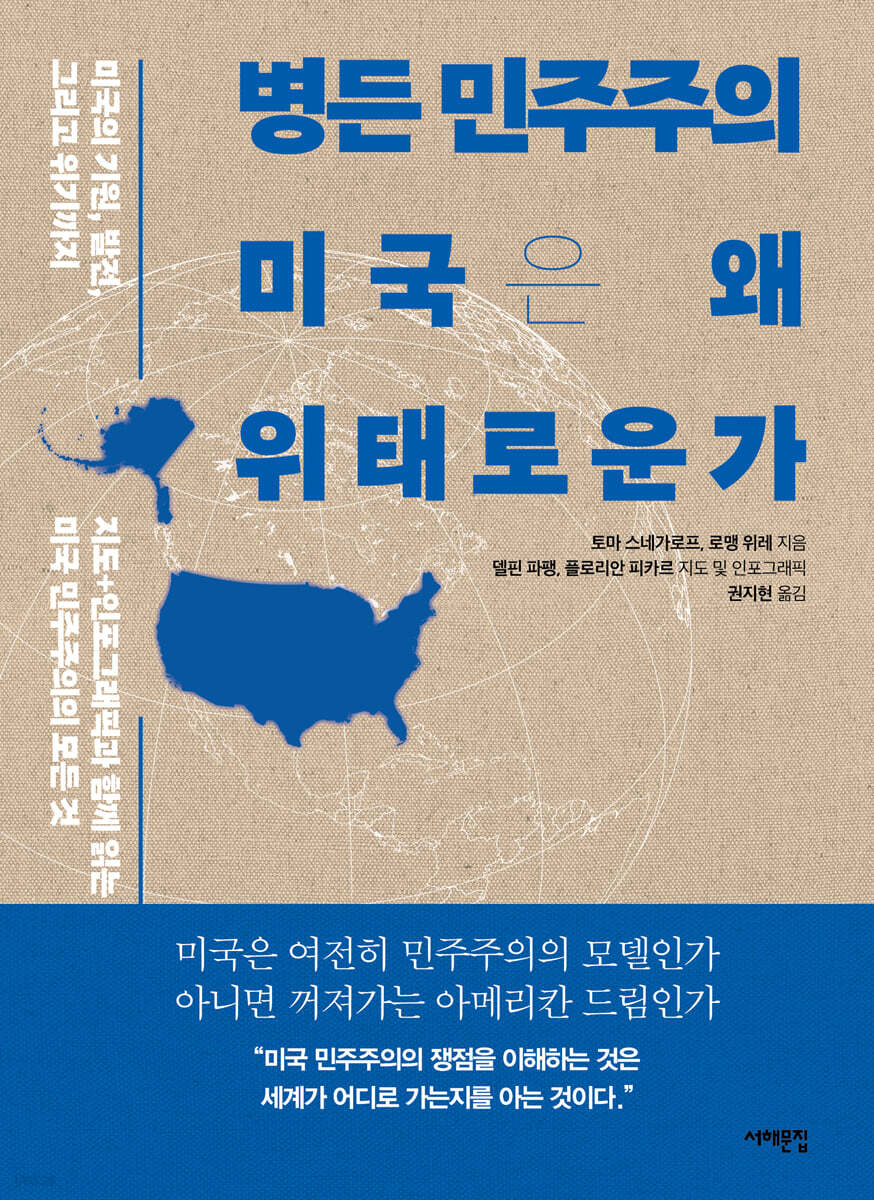
A Sick Democracy: Why America is at Risk
 |
Description
Book Introduction
★Dramatic narrative, concise and insightful narration!
★ Maps and infographics that perfectly visualize American history and political landscape!
★ Includes a wealth of reference material, including historically significant speeches and documents!
Is America still a model of democracy, or is the American Dream fading away? American democracy is more fragile today than ever.
Over the past 20 years, the results of every US presidential election have sparked fierce debate.
Each camp denounces the other as an “enemy of democracy,” and some even try to seize control of the Capitol or assassinate candidates.
American democracy, exploited by all manner of agitators, faces unprecedented challenges.
Will American democracy collapse? If so, what will it leave behind? Or can it be rebuilt?
This book, which can be called 'The Complete Guide to American Democracy,' clearly divides the history of American democracy into six defining moments.
From the visions of the Founding Fathers to the Vietnam War era, the 9/11 terrorist attacks, and the shocking storming of the Capitol in January 2021, this book dramatically illustrates the complex path of American democracy's origins, development, and crisis through a compelling narrative, concise text, and rich, insightful maps and infographics.
This book will reveal why American democracy is so unstable today and how significant its global implications are.
America's ailing democracy is something we should be concerned about.
Because in that sight we will see doubts and fears about our democracy.
In that sense, America is a close yet distant country.
★ Maps and infographics that perfectly visualize American history and political landscape!
★ Includes a wealth of reference material, including historically significant speeches and documents!
Is America still a model of democracy, or is the American Dream fading away? American democracy is more fragile today than ever.
Over the past 20 years, the results of every US presidential election have sparked fierce debate.
Each camp denounces the other as an “enemy of democracy,” and some even try to seize control of the Capitol or assassinate candidates.
American democracy, exploited by all manner of agitators, faces unprecedented challenges.
Will American democracy collapse? If so, what will it leave behind? Or can it be rebuilt?
This book, which can be called 'The Complete Guide to American Democracy,' clearly divides the history of American democracy into six defining moments.
From the visions of the Founding Fathers to the Vietnam War era, the 9/11 terrorist attacks, and the shocking storming of the Capitol in January 2021, this book dramatically illustrates the complex path of American democracy's origins, development, and crisis through a compelling narrative, concise text, and rich, insightful maps and infographics.
This book will reveal why American democracy is so unstable today and how significant its global implications are.
America's ailing democracy is something we should be concerned about.
Because in that sight we will see doubts and fears about our democracy.
In that sense, America is a close yet distant country.
- You can preview some of the book's contents.
Preview
index
preface
1776 Fear of Democracy
1898 The Temptation of Empire
1941 Goodbye Isolationism
The 1968 Culture Wars in America
Democracy under attack in 2001
2021 Occupation of the US Capitol
Epilogue
Search
1776 Fear of Democracy
1898 The Temptation of Empire
1941 Goodbye Isolationism
The 1968 Culture Wars in America
Democracy under attack in 2001
2021 Occupation of the US Capitol
Epilogue
Search
Detailed image

Into the book
“Government of the people, by the people, for the people.” On November 19, 1863, Abraham Lincoln defined democracy in these simple yet profound words at Gettysburg.
(…) The fratricidal Civil War arose from the fundamental dilemma of democracy: how to reconcile the South's slave system with the ideal of equality.
The Confederacy, which supported slavery, believed that it did not violate equality, while Northern abolitionists could not accept slavery for moral reasons.
Lincoln's famous Gettysburg Address remains as haunting to American democracy as the specter of the Civil War that started it.
--- p.6
“Democracy has never lasted long.
Democracy is wasteful, exhausting and disappearing.
There has never been a democratic country that has not self-destructed.
It is meaningless to say that democracy is less fleeting, less arrogant, less selfish, less ambitious, or less stingy than aristocracy or monarchy.
That is not true, and it has never been true in history.
“Whatever form of government is taken, men have the same passions, and if these passions are not controlled, they produce the same results in fraud, violence, and cruelty.” (John Adams)
--- p.17
America thought of itself as a republic ruled by elites.
The victory over the British monarchy in the Revolutionary War ignited strong nationalist sentiments in the United States, giving it a sense of itself as a special political system and nation.
In a world ruled by kings, the American Republic hoped to be a universal model.
The Founding Fathers believed they had created a special and universal political system, even though it excluded many from the "public good."
The existence of slavery, of course, made them uncomfortable.
(…) In this way, the coexistence of the ideals of the republic and the institution of slavery created a fundamental contradiction.
How could they not grant citizenship to people they knew and encountered every day on the plantation?
--- p.20
Meanwhile, many Northerners settled in the South after the war and tried to teach the local population how to change their economy and society.
The South experienced a period of "Reconstruction" that lasted until 1877 as a period of extreme humiliation and "occupation" by the North.
Confederate supporters created the myth of the Confederacy as a "Lost Cause."
It means that although they lost the war, they pursued a just cause.
The world before the war was a golden age for them.
In their view, slaves could live happily in the South, even with a low legal status, and perhaps even be 'freed'.
Ultimately, the Confederate flag came to symbolize pride in belonging to a South that was perpetually dominated by whites.
--- p.22
But looking back, American universalism at the time is encapsulated in the image that Puritan Governor John Winthrop drew from the Gospel of Matthew.
It is 'A City upon a Hill' that is visible to everyone.
Before the rest of the world could emulate America's political model and republican values, America had to first build a perfect society at home.
--- p.41
Many historians believe that the Spanish-American War of 1898 gave rise to American expansionism.
(…) Whenever there was foreign intervention, leaders promoted the logic of a “just war” created from the war in Cuba.
It was acceptable to use force and violence as long as it could expand democracy throughout the world.
When the United States entered World War I in 1917, President Thomas Woodrow Wilson declared that this would be the last war that would permanently establish democracy in Europe and bring an end to all authoritarian empires.
The exact same logic was used when the United States entered World War II in 1941 and when it intervened in Vietnam and the Middle East.
--- p.46
[Many historians] point to the widespread belief in 'American exceptionalism' and the 'civilizing' mission in American society at the time as the cause.
Indeed, the weight of religion in the American public and political sphere should not be underestimated.
The United States is not a country that claims to be religiously neutral, nor has it transferred the functions of the church to the private sector.
Even today, the President of the United States takes his oath with his hand on the Bible, and ends every speech with the official motto, "In God we trust."
Throughout the 20th century, the majority of American political, union, and corporate leaders sincerely believed that America was called to play a messianic role in the world.
(…) Public opinion was the same.
Many Americans who believed that communism was an anti-Christian evil initially believed that sending American troops to Vietnam to defeat this "absolute evil" was justified.
--- p.49
'America First' can be interpreted in two complementary ways.
First of all, from a historical perspective, the choice of this slogan is not accidental.
This slogan is reminiscent of the conservative and isolationist movements that existed between the two world wars.
(…) Moreover, ‘America First’ is an expression that shows Trump’s geopolitical choice, but it is a strategy that Obama had already conceived.
Both presidents, each in his own way, wanted to break with the belligerent United States after 9/11.
(…) However, their neo-isolationism took on conflicting forms.
--- p.71
President Nixon, who valued hierarchy and fervently opposed communism, disliked this new side of America.
He campaigned in 1968 on the platform of the "silent majority."
In fact, the silent majority is larger than the "leftist" youth we often see on the streets and in the media, burning flags, denouncing the Vietnam War, and ripping their bras.
--- p.84
In 1968, many college students died during protests against the Vietnam War, capitalism, and Nixon's candidacy.
In college, the very meaning of "American exceptionalism" has completely changed.
Contrary to what Presidents Wilson and Roosevelt said, the United States was not much different from the rest of the world as a democracy.
The difference was that extreme violence, domination, and oppression were perpetrated continuously.
College students and some historians have argued that American history can be summarized as a chain of unending violence that began with the massacre of Native Americans upon their arrival in the colonies.
The phenomenon of rereading American history "backwards" in the 1970s was further strengthened by the discovery of the Pentagon Papers.
--- p.87
American society is in great turmoil.
Americans realized that the very system they believed to be perfect could be used for purposes contrary to the ideals of democracy.
Even the constitution enacted by the founding fathers could not prevent corruption and collusion among the ruling class.
(…) President Jimmy Carter symbolized this hope for innovation.
However, the Carter administration soon faced numerous economic challenges.
The United States, hit hard by two oil crises in 1973 and 1979, experienced its greatest economic crisis since the 1930s.
(…) With so much tension, President Carter lost his way, and on July 15, 1979, he gave a disastrous televised speech that was called the “anxiety speech.”
--- p.92
Like many presidential candidates, Reagan pledged that if elected, he would restore the "real" America that the Founding Fathers envisioned.
(…) As an actor, he has a knack for re-expressing America's "timeless" principles with a simple yet sophisticated quality.
For example, he called the Soviet Union the "evil empire," inspired by the Star Wars series.
(…) In 1984, Americans saw an ad that said, “It’s Morning Again in America,” and elected Reagan as president again.
During his presidency, Reagan rolled back welfare policies in the name of democracy and the federalism established by the Founding Fathers.
(…) He had already announced his course in his inaugural speech in January 1981.
“In this current crisis, the federal government is not the solution to our problems.
“The federal government itself is the problem.”
--- p.93
George W., who was shocked when he heard the news that the World Trade Center had been attacked.
Bush's appearance is well known.
But he was transformed into a war commander the very next day.
(…) Like many other conservatives, he interpreted the 9/11 attacks in messianic terms.
President Bush believed that the 9/11 attacks were not only an attack on American democracy, but also an attack by Islamic terrorists targeting Christians.
And the United States, the "civilization of good," claimed that it had a mission to fully establish democracy on other continents.
Like the Reagan years, the Bush administration's geopolitical perspective was expressed in dichotomous, religiously charged terms.
--- p.110
It is also important to consider the "boomerang effect" that wars waged abroad have on democracy.
Since December 7, 1941, the United States has continued its overseas campaigns, mobilizing millions of conscripts and professional soldiers.
Like Europe between the two world wars, American society and politics have been, one might even say, "barbarized" over the past two decades by the return of soldiers from Afghanistan and Iraq.
There are currently 2 million active-duty and reserve military personnel and 16 million retired military personnel living in the United States.
These 18 million soldiers who served or completed their service for their country were reintegrated into their families and economic networks.
They have also made significant inroads into the public sphere.
This has also affected democracy, with American politics experiencing a period of extraordinary violence over the past two decades.
--- p.116
Since the early 21st century, many Americans have viewed the United States as a nation at war.
Many people believe that the war is happening not only outside our borders but also on American soil.
(…) The impact of this militarization was particularly great in the South, Midwest, and West, where the military and military economy were established.
Montana, which has many military bases, is a representative example.
The population is predominantly white, and for the past two decades, political debate has been polarized by fears of immigration, Islam, and the end of the world.
Veterans from Montana have contributed significantly to this shift in political debate.
Because their only foreign experience is confined to the battlefields of Afghanistan, Iraq, and Syria, they return home believing the world outside the United States is marked by extreme violence and a fundamental hostility to American democratic values.
So it's not surprising that Montana voters in 2016 supported Trump's neo-isolationist policies.
(…) The fratricidal Civil War arose from the fundamental dilemma of democracy: how to reconcile the South's slave system with the ideal of equality.
The Confederacy, which supported slavery, believed that it did not violate equality, while Northern abolitionists could not accept slavery for moral reasons.
Lincoln's famous Gettysburg Address remains as haunting to American democracy as the specter of the Civil War that started it.
--- p.6
“Democracy has never lasted long.
Democracy is wasteful, exhausting and disappearing.
There has never been a democratic country that has not self-destructed.
It is meaningless to say that democracy is less fleeting, less arrogant, less selfish, less ambitious, or less stingy than aristocracy or monarchy.
That is not true, and it has never been true in history.
“Whatever form of government is taken, men have the same passions, and if these passions are not controlled, they produce the same results in fraud, violence, and cruelty.” (John Adams)
--- p.17
America thought of itself as a republic ruled by elites.
The victory over the British monarchy in the Revolutionary War ignited strong nationalist sentiments in the United States, giving it a sense of itself as a special political system and nation.
In a world ruled by kings, the American Republic hoped to be a universal model.
The Founding Fathers believed they had created a special and universal political system, even though it excluded many from the "public good."
The existence of slavery, of course, made them uncomfortable.
(…) In this way, the coexistence of the ideals of the republic and the institution of slavery created a fundamental contradiction.
How could they not grant citizenship to people they knew and encountered every day on the plantation?
--- p.20
Meanwhile, many Northerners settled in the South after the war and tried to teach the local population how to change their economy and society.
The South experienced a period of "Reconstruction" that lasted until 1877 as a period of extreme humiliation and "occupation" by the North.
Confederate supporters created the myth of the Confederacy as a "Lost Cause."
It means that although they lost the war, they pursued a just cause.
The world before the war was a golden age for them.
In their view, slaves could live happily in the South, even with a low legal status, and perhaps even be 'freed'.
Ultimately, the Confederate flag came to symbolize pride in belonging to a South that was perpetually dominated by whites.
--- p.22
But looking back, American universalism at the time is encapsulated in the image that Puritan Governor John Winthrop drew from the Gospel of Matthew.
It is 'A City upon a Hill' that is visible to everyone.
Before the rest of the world could emulate America's political model and republican values, America had to first build a perfect society at home.
--- p.41
Many historians believe that the Spanish-American War of 1898 gave rise to American expansionism.
(…) Whenever there was foreign intervention, leaders promoted the logic of a “just war” created from the war in Cuba.
It was acceptable to use force and violence as long as it could expand democracy throughout the world.
When the United States entered World War I in 1917, President Thomas Woodrow Wilson declared that this would be the last war that would permanently establish democracy in Europe and bring an end to all authoritarian empires.
The exact same logic was used when the United States entered World War II in 1941 and when it intervened in Vietnam and the Middle East.
--- p.46
[Many historians] point to the widespread belief in 'American exceptionalism' and the 'civilizing' mission in American society at the time as the cause.
Indeed, the weight of religion in the American public and political sphere should not be underestimated.
The United States is not a country that claims to be religiously neutral, nor has it transferred the functions of the church to the private sector.
Even today, the President of the United States takes his oath with his hand on the Bible, and ends every speech with the official motto, "In God we trust."
Throughout the 20th century, the majority of American political, union, and corporate leaders sincerely believed that America was called to play a messianic role in the world.
(…) Public opinion was the same.
Many Americans who believed that communism was an anti-Christian evil initially believed that sending American troops to Vietnam to defeat this "absolute evil" was justified.
--- p.49
'America First' can be interpreted in two complementary ways.
First of all, from a historical perspective, the choice of this slogan is not accidental.
This slogan is reminiscent of the conservative and isolationist movements that existed between the two world wars.
(…) Moreover, ‘America First’ is an expression that shows Trump’s geopolitical choice, but it is a strategy that Obama had already conceived.
Both presidents, each in his own way, wanted to break with the belligerent United States after 9/11.
(…) However, their neo-isolationism took on conflicting forms.
--- p.71
President Nixon, who valued hierarchy and fervently opposed communism, disliked this new side of America.
He campaigned in 1968 on the platform of the "silent majority."
In fact, the silent majority is larger than the "leftist" youth we often see on the streets and in the media, burning flags, denouncing the Vietnam War, and ripping their bras.
--- p.84
In 1968, many college students died during protests against the Vietnam War, capitalism, and Nixon's candidacy.
In college, the very meaning of "American exceptionalism" has completely changed.
Contrary to what Presidents Wilson and Roosevelt said, the United States was not much different from the rest of the world as a democracy.
The difference was that extreme violence, domination, and oppression were perpetrated continuously.
College students and some historians have argued that American history can be summarized as a chain of unending violence that began with the massacre of Native Americans upon their arrival in the colonies.
The phenomenon of rereading American history "backwards" in the 1970s was further strengthened by the discovery of the Pentagon Papers.
--- p.87
American society is in great turmoil.
Americans realized that the very system they believed to be perfect could be used for purposes contrary to the ideals of democracy.
Even the constitution enacted by the founding fathers could not prevent corruption and collusion among the ruling class.
(…) President Jimmy Carter symbolized this hope for innovation.
However, the Carter administration soon faced numerous economic challenges.
The United States, hit hard by two oil crises in 1973 and 1979, experienced its greatest economic crisis since the 1930s.
(…) With so much tension, President Carter lost his way, and on July 15, 1979, he gave a disastrous televised speech that was called the “anxiety speech.”
--- p.92
Like many presidential candidates, Reagan pledged that if elected, he would restore the "real" America that the Founding Fathers envisioned.
(…) As an actor, he has a knack for re-expressing America's "timeless" principles with a simple yet sophisticated quality.
For example, he called the Soviet Union the "evil empire," inspired by the Star Wars series.
(…) In 1984, Americans saw an ad that said, “It’s Morning Again in America,” and elected Reagan as president again.
During his presidency, Reagan rolled back welfare policies in the name of democracy and the federalism established by the Founding Fathers.
(…) He had already announced his course in his inaugural speech in January 1981.
“In this current crisis, the federal government is not the solution to our problems.
“The federal government itself is the problem.”
--- p.93
George W., who was shocked when he heard the news that the World Trade Center had been attacked.
Bush's appearance is well known.
But he was transformed into a war commander the very next day.
(…) Like many other conservatives, he interpreted the 9/11 attacks in messianic terms.
President Bush believed that the 9/11 attacks were not only an attack on American democracy, but also an attack by Islamic terrorists targeting Christians.
And the United States, the "civilization of good," claimed that it had a mission to fully establish democracy on other continents.
Like the Reagan years, the Bush administration's geopolitical perspective was expressed in dichotomous, religiously charged terms.
--- p.110
It is also important to consider the "boomerang effect" that wars waged abroad have on democracy.
Since December 7, 1941, the United States has continued its overseas campaigns, mobilizing millions of conscripts and professional soldiers.
Like Europe between the two world wars, American society and politics have been, one might even say, "barbarized" over the past two decades by the return of soldiers from Afghanistan and Iraq.
There are currently 2 million active-duty and reserve military personnel and 16 million retired military personnel living in the United States.
These 18 million soldiers who served or completed their service for their country were reintegrated into their families and economic networks.
They have also made significant inroads into the public sphere.
This has also affected democracy, with American politics experiencing a period of extraordinary violence over the past two decades.
--- p.116
Since the early 21st century, many Americans have viewed the United States as a nation at war.
Many people believe that the war is happening not only outside our borders but also on American soil.
(…) The impact of this militarization was particularly great in the South, Midwest, and West, where the military and military economy were established.
Montana, which has many military bases, is a representative example.
The population is predominantly white, and for the past two decades, political debate has been polarized by fears of immigration, Islam, and the end of the world.
Veterans from Montana have contributed significantly to this shift in political debate.
Because their only foreign experience is confined to the battlefields of Afghanistan, Iraq, and Syria, they return home believing the world outside the United States is marked by extreme violence and a fundamental hostility to American democratic values.
So it's not surprising that Montana voters in 2016 supported Trump's neo-isolationist policies.
--- p.119
Publisher's Review
Is America Still a Model of Democracy?
Or is it the fading American dream?
“To understand the issues of American democracy is to understand where the world is going.”
The perfect answer to the question, "Where did America come from, and where is it going?" _Le Parisien
The crisis of today's America and its shaky democracy
The only book that explains it clearly!
Today, American democracy is more disintegrating than ever before, driven by conflict, division, and dissension.
For the past 20 years, American voters have been questioning the results of every election.
In 2000, after a lengthy recount lawsuit that went all the way to the Supreme Court, George W.
Bush defeated Al Gore and was elected president.
Eight years later, when Barack Obama was elected, his opponents even brought up his birth certificate to suggest that he might not be American.
In 2016, Donald Trump was elected president with 3 million fewer votes than Hillary Clinton, causing enormous shock and repercussions.
In January 2021, supporters of Trump, who had lost his re-election bid, stormed the Capitol building, refusing to accept the democratic transfer of power.
American democracy resembles a battlefield straight out of a Hollywood blockbuster, and election campaigns increasingly resemble a bloodbath.
So where did this crisis of democracy originate? How can the United States win elections with fewer votes? American democracy is based on a system of checks and balances, based on the separation of powers—legislative, executive, and judicial—and particularly on the strict division of power between the states and the federal government.
Each state elects two senators, regardless of the number of people living in the state.
So, the vote of one voter in Wyoming (584,000 residents) is worth 66 times more than the vote of one voter in California (39 million residents).
This complex electoral system has eroded voters' trust in the system, and the potential for American division, a fear our Founding Fathers had 250 years ago, is now resurfacing in states like California and Texas.
The principle of separation of powers is also at risk of being seriously violated given the recent politicization of the U.S. Supreme Court.
What happened in America after the Revolutionary War of 1776?
This book answers this question, which is of crucial importance to the United States and beyond, to the rest of the world.
And we take a historical look at the flaws in the American democratic experiment, long held up as a model by the world.
Those who support American democracy take pride in its stable institutions, strong middle class, and dynamic economy.
On the other hand, opponents emphasize the limitations, contradictions, injustice, and violence of the so-called model American democracy.
Through this book, readers will be able to hear both sides of the argument and make their own judgments.
All About American Democracy!
With the world-renowned Le Monde infographics team
A masterpiece created through the collaboration of leading American history experts!
This book presents a concise overview of the history of American democracy, divided into six defining moments.
From the visions of the Founding Fathers to the Vietnam War era, 9/11, and the shocking storming of the Capitol in January 2021, this book dramatically illustrates the complex path of American democracy's origins, development, and crisis through a compelling narrative, concise text, and rich, insightful maps and infographics.
This book will reveal why American democracy is so unstable today and how significant its global implications are.
The history of American democracy is not linear.
In particular, it is best not to imagine the perfect democracy envisioned by the "Founding Fathers" and the delegates who gathered to draft the U.S. Constitution in 1787.
Rather, it speaks volumes about how much they distrusted democracy (in fact, they preferred a republican model ruled by a small elite), and how the word "democracy" does not appear even once in the Constitution.
But don't imagine a democracy that has deteriorated over time because of incompetent leaders.
In other words, American democracy did not go off the rails because of Richard Nixon's resignation or Donald Trump's brash behavior.
This book identifies 31 key questions that can help us understand this complex path of democracy, and offers insightful answers from leading experts in American history.
It also provides a wealth of reference material, including historically significant speeches and documents, to help readers gain a deeper understanding of the American psyche and the American people today.
For example, John Winthrop's "City upon a Hill" (1630), which well illustrates American universalism in the early days of the republic, Charles Lindbergh's Des Moines Speech (1941), which represents the "isolationist" line, the historic trial decision that put the brakes on racial segregation (1954), President Nixon's resignation speech (1974) after the Watergate scandal, President Jimmy Carter's "anxiety-inducing speech" (1979) during the global oil crisis, and George W.
President Bush's New York speech (2001), Donald Trump's Washington speech inciting the storming of the Capitol in January 2021, etc.
Additionally, the maps and infographics produced by the world-renowned Le Monde infographics team perfectly visualize America's history and political landscape, helping readers intuitively understand the core of American democracy at a glance.
Or is it the fading American dream?
“To understand the issues of American democracy is to understand where the world is going.”
The perfect answer to the question, "Where did America come from, and where is it going?" _Le Parisien
The crisis of today's America and its shaky democracy
The only book that explains it clearly!
Today, American democracy is more disintegrating than ever before, driven by conflict, division, and dissension.
For the past 20 years, American voters have been questioning the results of every election.
In 2000, after a lengthy recount lawsuit that went all the way to the Supreme Court, George W.
Bush defeated Al Gore and was elected president.
Eight years later, when Barack Obama was elected, his opponents even brought up his birth certificate to suggest that he might not be American.
In 2016, Donald Trump was elected president with 3 million fewer votes than Hillary Clinton, causing enormous shock and repercussions.
In January 2021, supporters of Trump, who had lost his re-election bid, stormed the Capitol building, refusing to accept the democratic transfer of power.
American democracy resembles a battlefield straight out of a Hollywood blockbuster, and election campaigns increasingly resemble a bloodbath.
So where did this crisis of democracy originate? How can the United States win elections with fewer votes? American democracy is based on a system of checks and balances, based on the separation of powers—legislative, executive, and judicial—and particularly on the strict division of power between the states and the federal government.
Each state elects two senators, regardless of the number of people living in the state.
So, the vote of one voter in Wyoming (584,000 residents) is worth 66 times more than the vote of one voter in California (39 million residents).
This complex electoral system has eroded voters' trust in the system, and the potential for American division, a fear our Founding Fathers had 250 years ago, is now resurfacing in states like California and Texas.
The principle of separation of powers is also at risk of being seriously violated given the recent politicization of the U.S. Supreme Court.
What happened in America after the Revolutionary War of 1776?
This book answers this question, which is of crucial importance to the United States and beyond, to the rest of the world.
And we take a historical look at the flaws in the American democratic experiment, long held up as a model by the world.
Those who support American democracy take pride in its stable institutions, strong middle class, and dynamic economy.
On the other hand, opponents emphasize the limitations, contradictions, injustice, and violence of the so-called model American democracy.
Through this book, readers will be able to hear both sides of the argument and make their own judgments.
All About American Democracy!
With the world-renowned Le Monde infographics team
A masterpiece created through the collaboration of leading American history experts!
This book presents a concise overview of the history of American democracy, divided into six defining moments.
From the visions of the Founding Fathers to the Vietnam War era, 9/11, and the shocking storming of the Capitol in January 2021, this book dramatically illustrates the complex path of American democracy's origins, development, and crisis through a compelling narrative, concise text, and rich, insightful maps and infographics.
This book will reveal why American democracy is so unstable today and how significant its global implications are.
The history of American democracy is not linear.
In particular, it is best not to imagine the perfect democracy envisioned by the "Founding Fathers" and the delegates who gathered to draft the U.S. Constitution in 1787.
Rather, it speaks volumes about how much they distrusted democracy (in fact, they preferred a republican model ruled by a small elite), and how the word "democracy" does not appear even once in the Constitution.
But don't imagine a democracy that has deteriorated over time because of incompetent leaders.
In other words, American democracy did not go off the rails because of Richard Nixon's resignation or Donald Trump's brash behavior.
This book identifies 31 key questions that can help us understand this complex path of democracy, and offers insightful answers from leading experts in American history.
It also provides a wealth of reference material, including historically significant speeches and documents, to help readers gain a deeper understanding of the American psyche and the American people today.
For example, John Winthrop's "City upon a Hill" (1630), which well illustrates American universalism in the early days of the republic, Charles Lindbergh's Des Moines Speech (1941), which represents the "isolationist" line, the historic trial decision that put the brakes on racial segregation (1954), President Nixon's resignation speech (1974) after the Watergate scandal, President Jimmy Carter's "anxiety-inducing speech" (1979) during the global oil crisis, and George W.
President Bush's New York speech (2001), Donald Trump's Washington speech inciting the storming of the Capitol in January 2021, etc.
Additionally, the maps and infographics produced by the world-renowned Le Monde infographics team perfectly visualize America's history and political landscape, helping readers intuitively understand the core of American democracy at a glance.
GOODS SPECIFICS
- Date of issue: November 5, 2024
- Page count, weight, size: 160 pages | 153*210*12mm
- ISBN13: 9791192988955
You may also like
카테고리
korean


korean

![GQ KOREA Mark (Monthly): December [2025]](http://librairie.coreenne.fr/cdn/shop/files/8ef265dbbfbf186523ed75ba7319009d.jpg?v=1765340328&width=3840)


