

Criticism of the New Right
 |
Description
Book Introduction
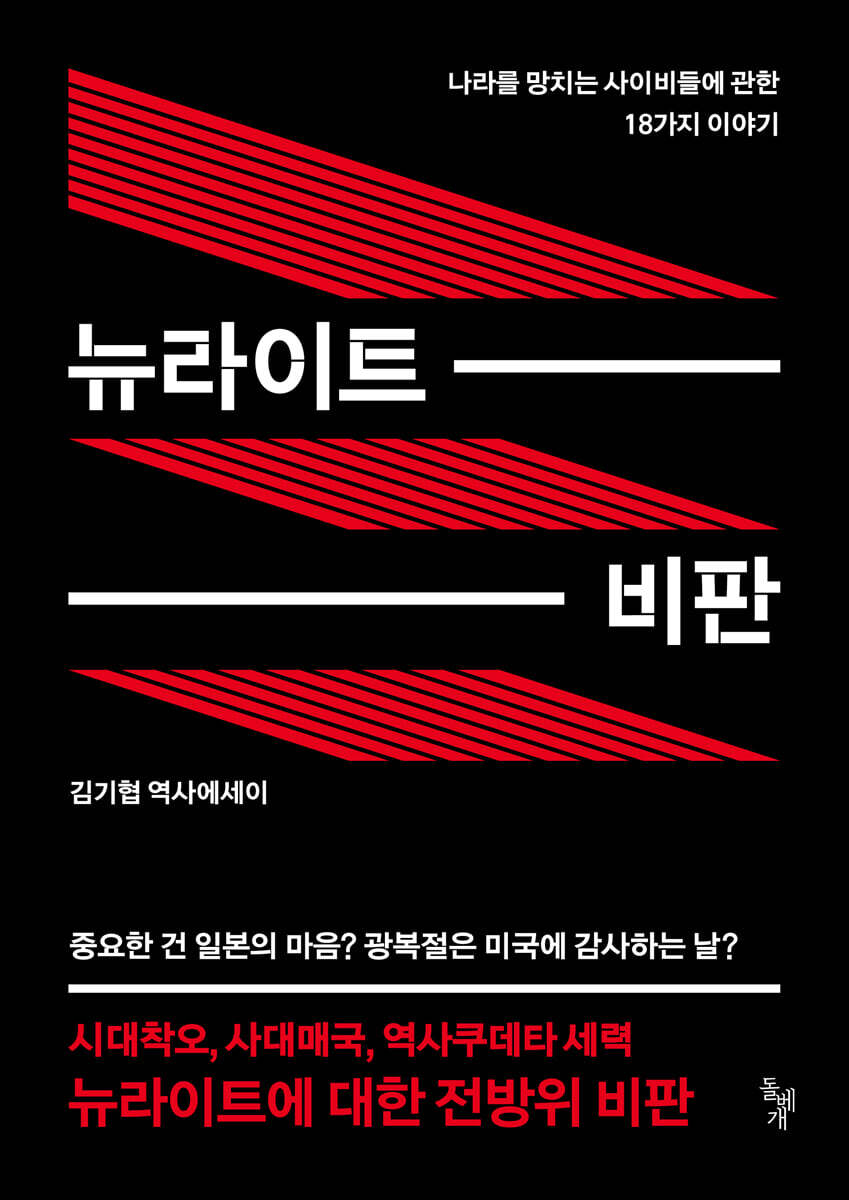
Is it evil or stupid? A comprehensive critique of the "pseudo-religious" groups who are ruining the country, blinded by the ashes. These days, with absurd statements like “What’s important is Japan’s heart” and “Liberation Day is a day to thank the United States” pouring out almost daily from key figures and heads of the current government and institutions, there is a growing demand from readers to understand more precisely what the so-called “New Right” is and how their worldview is structured, and to strongly criticize it. In 2008, when the New Right first emerged, historical essayist Kim Ki-hyeop meticulously dissected and criticized their ideology from all angles under 18 headings. His comprehensive analysis, based on common sense, a sense of balance, a view of history, and a view of humanity, shines even brighter in these times when 'New Right or Pseudo Season 2' is on the rise. Because 16 years have proven that his critical views were correct. Published with a new cover, a new preface, and a new text design, the revised and re-covered edition of "New Right Criticism" will once again provide welcome and sound intellectual nourishment to the many readers who wish to clearly understand the true nature of the "pseudo-religious people who are ruining the country, blinded by the ashes." |
- You can preview some of the book's contents.
Preview
index
Preface to the Revised Edition 005
First Edition Preface 010
01 New Right's View of Humanity: Are Humans Simply Selfish? 023
Politics or Strategy? History is the study of humanity. Humans unite and coexist. Language creates the 'social animal.' Those who betray their own society.
02 New Right's View of the Nation: What Does the Republic of Korea Mean to Them? 032
The National Foundation Day Controversy│What does the Republic of Korea mean to me│A Perspective on the Division of the Korean Peninsula│Let's Look Straight at Syngman Rhee│The Claim that National Foundation Day Sows Discord Between the Nation and the People
03 New Right's Colonial Modernization Theory: What is "Colonial Modernization"? 041
A perspective that follows Japan's far right │ The trap of '3.6% annual high growth' │ If you want to expropriate eggs, feed the chickens │ The purpose of colonial rule is subjugation │ The reason colonial rule is glorified
04 The New Right's Ideology: What Kind of "Liberalism" Is It? 051
Liberalism renamed as 'neoliberalism'│Liberalism, a gift of the industrial revolution│Economic liberalism and social liberalism│Approaching liberalism that alleviated the contradictions of capitalism│The efficiency and dangers of neoliberalism│Serving the winners and chasing the strong
05 New Right's View of Civilization: What Kind of "New Korea" Do They See? 062
The New Right, which sees capitalism as the only civilization│Marx, who sees capitalism as a historical phenomenon│The fantastic combination of the Industrial Revolution and capitalism│Humanity as the Earth's true ally│Capitalism facing a resource wall│Neoliberalism, which sees a new class society
06 New Right's Nationalism: Why Do They Hate Nationalism? 072
Reflections on Hypernationalism│The New Right Confuses Nationalism with Ethnocentrism│Will a Nation Disappear Just Because It's Existing?│The "Dissolution of National History" Call: Trying to Avoid the Fox but Encountering the Tiger│What Colors Does Nationalism Have?│The Strange Far-Right Fighting Nationalism
07 New Right's View of the United States: Why Can't I Live Without America? 084
From a world of distant and near-distant perspectives to a world of near-distant perspectives│A world where absolutes are disappearing│America's new product, the founding of the Republic of Korea│A boss who no longer needs a junior staff│The 'old' right, not the 'new' right│America, a country maladapted to the new world│Catch-up theory that ignores resource limitations
08 New Right's Economic Policy: Advancement, Where? 096
Privatization Disguised as "Advanced Development" | The Problem of Natural Monopolies | The Unrealisticness of Catch-Up Theory | An Extraordinary Means for an Extraordinary Goal | The Public Security Politics of Rapid Growth
09 New Right's View of Capital: Does "Capital" Mean Only Money? 106
Not 'moral decay' but 'moral bankruptcy'│The New Right, which doesn't even understand capitalism│Mansu, Cheongsu, and the prisoner's dilemma│Two types of organizational power: bonding and bridging│The Park Chung-hee regime that blocked the growth of social capital│The 'Myungbak Mountain Fortress' that blocked bridging organizational power
10 New Right and Pro-Japanese Collaborators: Are They Following in Michio Amano's Footsteps? 118
Michio Amano, the Prophet of the New Right│The Cry of the Naisen-Island Assembled Theory│The Logic of the Naisen-Island Assembled Theory│The Passion of the Convert│Is the Assembled Theory a Resurgence│The Diverse Spectrum of Pro-Japanese Collaborators
11 New Right and 'Pro-American Nationalism': Do They Dream of 'Pro-American Nationalism'? 130
A Re-Recognition of 『Re-Recognition of the History Before and After Liberation』│A Product of Weak Vision and Excessive Politics│Do Not Distort Cho Kwan-ja's Thesis│The Unfortunate Thesis Published in 『Re-Recognition of the History Before and After Liberation』│Cho Kwan-ja's Lee Gwang-su and Lee Young-hoon's Lee Gwang-su│The Editor's Responsibility, Authority, and Conscience
12 The New Right and Mainstream Historiography: We Can Learn from the New Right 142
The Untreated Trauma of a Nation│Beyond the Theory of Exploitation and Modernization│The Excessive View of History of the Nation That Gave the New Right a Pretext│An Analysis of Carter Eckert, Free from Nationalism│Authoritarian Regimes: A Legacy of the Colonial Era│In the Eyes of the Far Right, Everyone Is Left
13 The New Right's View on North Korea: Evil or Foolish? 155
Who are the evil and foolish ones? │The forces that wish for North Korea's downfall │The loopholes of the Velvet Revolution │Are we really going back to the way things were 20 years ago? │Please, at least inter-Korean relations...
14 New Right and 'Alternative Textbooks': Do They See History as 'Science'? 165
No "patents" for academia? │ Textbook writing without academic responsibility │ What's the difference between social scientists and historians │ Private history of the Republic of Korea presented as an alternative to people's history │ A political tactic, not an academic challenge
15 New Right Triumphalism: Is "Victory" Equal to "Success"? 175
Is the meaning of history limited to 'success'? Is competition always desirable? The neoliberal path that exacerbated the catastrophe. The New Right's historical view of capitalism's confession of faith. The obsession with viewing North Korea as a failed state. Learn from the history of 'failure.'
16 New Right and the History Textbook Controversy: Do You Think "Textbooks" Are Tinder? 187
Textbooks are inherently inflexible. │History education is a double-edged sword. │The textbook approval system, the fruit of democratization. │The New Right's isolation is more problematic than the historical academia's isolation. │Procedure is crucial.
17 New Right and Conservatism: Are They Trying to Kill Conservatism in This Land? 198
The Desire for Rational Conservatism│Conservatism Without a Sense of History Is Not Conservatism│The Narrow-mindedness and Dogmatism of Capitalist Beliefs│The Weaknesses of Korean Democracy│“Is Rational Conservatism Dead in This Land?”
18 Dealing with the New Right: How to Respond to Their Threats? 209
A time machine from 200 years ago│A forced view of history and unreasonable policy directions│Candlelight as a demonstration of political progress│Crisis as an opportunity│Human values that must be revived
Appendix: "Alternative Textbook: Modern and Contemporary Korean History" Review: History Book? Well, Textbook? No. 220
First Edition Review 229
First Edition Preface 010
01 New Right's View of Humanity: Are Humans Simply Selfish? 023
Politics or Strategy? History is the study of humanity. Humans unite and coexist. Language creates the 'social animal.' Those who betray their own society.
02 New Right's View of the Nation: What Does the Republic of Korea Mean to Them? 032
The National Foundation Day Controversy│What does the Republic of Korea mean to me│A Perspective on the Division of the Korean Peninsula│Let's Look Straight at Syngman Rhee│The Claim that National Foundation Day Sows Discord Between the Nation and the People
03 New Right's Colonial Modernization Theory: What is "Colonial Modernization"? 041
A perspective that follows Japan's far right │ The trap of '3.6% annual high growth' │ If you want to expropriate eggs, feed the chickens │ The purpose of colonial rule is subjugation │ The reason colonial rule is glorified
04 The New Right's Ideology: What Kind of "Liberalism" Is It? 051
Liberalism renamed as 'neoliberalism'│Liberalism, a gift of the industrial revolution│Economic liberalism and social liberalism│Approaching liberalism that alleviated the contradictions of capitalism│The efficiency and dangers of neoliberalism│Serving the winners and chasing the strong
05 New Right's View of Civilization: What Kind of "New Korea" Do They See? 062
The New Right, which sees capitalism as the only civilization│Marx, who sees capitalism as a historical phenomenon│The fantastic combination of the Industrial Revolution and capitalism│Humanity as the Earth's true ally│Capitalism facing a resource wall│Neoliberalism, which sees a new class society
06 New Right's Nationalism: Why Do They Hate Nationalism? 072
Reflections on Hypernationalism│The New Right Confuses Nationalism with Ethnocentrism│Will a Nation Disappear Just Because It's Existing?│The "Dissolution of National History" Call: Trying to Avoid the Fox but Encountering the Tiger│What Colors Does Nationalism Have?│The Strange Far-Right Fighting Nationalism
07 New Right's View of the United States: Why Can't I Live Without America? 084
From a world of distant and near-distant perspectives to a world of near-distant perspectives│A world where absolutes are disappearing│America's new product, the founding of the Republic of Korea│A boss who no longer needs a junior staff│The 'old' right, not the 'new' right│America, a country maladapted to the new world│Catch-up theory that ignores resource limitations
08 New Right's Economic Policy: Advancement, Where? 096
Privatization Disguised as "Advanced Development" | The Problem of Natural Monopolies | The Unrealisticness of Catch-Up Theory | An Extraordinary Means for an Extraordinary Goal | The Public Security Politics of Rapid Growth
09 New Right's View of Capital: Does "Capital" Mean Only Money? 106
Not 'moral decay' but 'moral bankruptcy'│The New Right, which doesn't even understand capitalism│Mansu, Cheongsu, and the prisoner's dilemma│Two types of organizational power: bonding and bridging│The Park Chung-hee regime that blocked the growth of social capital│The 'Myungbak Mountain Fortress' that blocked bridging organizational power
10 New Right and Pro-Japanese Collaborators: Are They Following in Michio Amano's Footsteps? 118
Michio Amano, the Prophet of the New Right│The Cry of the Naisen-Island Assembled Theory│The Logic of the Naisen-Island Assembled Theory│The Passion of the Convert│Is the Assembled Theory a Resurgence│The Diverse Spectrum of Pro-Japanese Collaborators
11 New Right and 'Pro-American Nationalism': Do They Dream of 'Pro-American Nationalism'? 130
A Re-Recognition of 『Re-Recognition of the History Before and After Liberation』│A Product of Weak Vision and Excessive Politics│Do Not Distort Cho Kwan-ja's Thesis│The Unfortunate Thesis Published in 『Re-Recognition of the History Before and After Liberation』│Cho Kwan-ja's Lee Gwang-su and Lee Young-hoon's Lee Gwang-su│The Editor's Responsibility, Authority, and Conscience
12 The New Right and Mainstream Historiography: We Can Learn from the New Right 142
The Untreated Trauma of a Nation│Beyond the Theory of Exploitation and Modernization│The Excessive View of History of the Nation That Gave the New Right a Pretext│An Analysis of Carter Eckert, Free from Nationalism│Authoritarian Regimes: A Legacy of the Colonial Era│In the Eyes of the Far Right, Everyone Is Left
13 The New Right's View on North Korea: Evil or Foolish? 155
Who are the evil and foolish ones? │The forces that wish for North Korea's downfall │The loopholes of the Velvet Revolution │Are we really going back to the way things were 20 years ago? │Please, at least inter-Korean relations...
14 New Right and 'Alternative Textbooks': Do They See History as 'Science'? 165
No "patents" for academia? │ Textbook writing without academic responsibility │ What's the difference between social scientists and historians │ Private history of the Republic of Korea presented as an alternative to people's history │ A political tactic, not an academic challenge
15 New Right Triumphalism: Is "Victory" Equal to "Success"? 175
Is the meaning of history limited to 'success'? Is competition always desirable? The neoliberal path that exacerbated the catastrophe. The New Right's historical view of capitalism's confession of faith. The obsession with viewing North Korea as a failed state. Learn from the history of 'failure.'
16 New Right and the History Textbook Controversy: Do You Think "Textbooks" Are Tinder? 187
Textbooks are inherently inflexible. │History education is a double-edged sword. │The textbook approval system, the fruit of democratization. │The New Right's isolation is more problematic than the historical academia's isolation. │Procedure is crucial.
17 New Right and Conservatism: Are They Trying to Kill Conservatism in This Land? 198
The Desire for Rational Conservatism│Conservatism Without a Sense of History Is Not Conservatism│The Narrow-mindedness and Dogmatism of Capitalist Beliefs│The Weaknesses of Korean Democracy│“Is Rational Conservatism Dead in This Land?”
18 Dealing with the New Right: How to Respond to Their Threats? 209
A time machine from 200 years ago│A forced view of history and unreasonable policy directions│Candlelight as a demonstration of political progress│Crisis as an opportunity│Human values that must be revived
Appendix: "Alternative Textbook: Modern and Contemporary Korean History" Review: History Book? Well, Textbook? No. 220
First Edition Review 229
Detailed image
Into the book
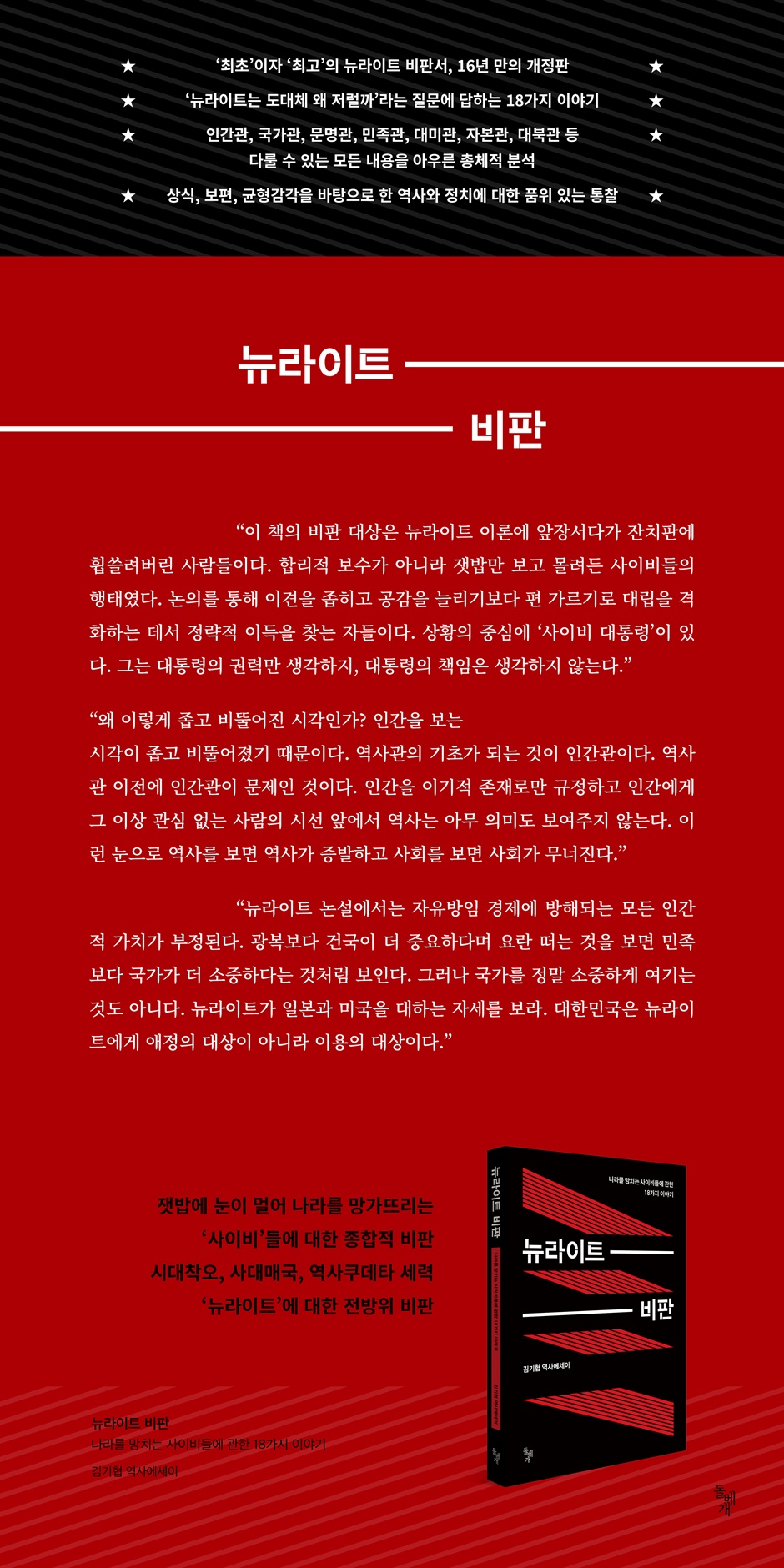
The reason why “New Right” became a bad word in this society was because of the New Right’s chaotic behavior when they were excited about victory.
Strictly speaking, it was not the behavior of true New Rightists who pursue rational conservatism, but rather the behavior of pseudo-rightists who flocked to the party only to see the ashes.
The party was so exciting that even those who had started the New Right movement were swept away, and a very small number of serious people even left the ranks.
The book's target of criticism is those who were at the forefront of the New Right theory and then got swept up in the party.
It is a great joy for a student to see what he has studied reflected in reality.
However, if you get drunk on joy and try to fit your studies into reality, your studies will be ruined and your attitude as a student will collapse.
This article was written to seek lessons from New Right.
--- p.5~6
Pseudo-scams thrive when there is a profit to be made.
What benefits do they see now? The problem lies in the fact that confrontation and division are more advantageous than harmony and cooperation.
At the center of this situation is a ‘pseudo-president.’
A person who was not prepared to become president suddenly became president.
He only thinks about the power of the president, not the responsibility of the president.
People who work in politics, regardless of their level, set their own goals and make consistent efforts to achieve them.
People who 'accidentally' took over a position during a dispute do not have that kind of professional consciousness.
They only look for 'victory' through a stroke of luck, not 'success' through consistent effort.
People who fit the tastes of the person with the power to appoint are appointed.
The purpose of selecting people with anti-media leanings for key positions in media relations and people with anti-history leanings for key positions in history relations is to incite conflict.
People who take responsibility for their positions and try to resolve disputes do not fit the 'code'.
--- p.7~8
The fundamental problem with the New Right's view of history lies, above all, in its view of humans as merely 'selfish beings.'
It is true that humans are selfish beings.
But that's not all.
Although humans have a certain degree of selfish tendencies, their actions are also influenced by other factors.
If we view humans only as selfish beings without considering other factors, we cannot help but view society as a jungle where the strong prey on the weak.
If you look at it that way, laissez-faire neoliberalism is the right path.
It should be centered on those who have the power and control over exchange rate policy, tax policy, and economic management.
The discontent of the less fortunate and the poor can be suppressed through public security legislation and the unrestrained exercise of public power.
The New Right wants to create a society where the strong reign.
--- p.14
However, no matter how much one supports capitalism, there is a problem with giving credit for Korea's capitalism to Japanese colonial rule and the Syngman Rhee regime.
Both regimes made Korea a victim of capitalism, not a subject of capitalism.
The fact that Korea has achieved this level of economic development so far is not due to the two administrations, but to the power of the people who have struggled to escape the pit they have fallen into.
--- p.38~39
When pointing out the minor issues of exploitation theory, where does the so-called "rationality" that is so revered go when emphasizing Japan's contribution to modernization and the goodwill that supported that contribution?
The call to view colonial rulers as rational human beings as possible seems more urgent for New Right modernizers than for some exploitatives.
Why did the great powers strive to secure colonies? There is a well-established, common-sense understanding of the nature of imperialism.
New Right ignores this common sense.
Some even say that Japan's colonization of Korea was not due to ambition, but rather for self-defense.
During the Greater East Asia War, the Japanese military leader claimed to “secure space for national activities.”
It is surprising to see so-called 'historians' in 21st century Korea still listening to the propaganda of the chairmen.
--- p.49
Even in Korea, which was under Japanese rule, the basic policy of the United States was to revive the Japanese ruling system as much as possible.
It was Syngman Rhee who took on the role of responding to this policy.
At the time of liberation, Syngman Rhee was an old man with little respect among independence activists and no followers.
Having lived in the United States for over 30 years, his only asset was that he knew America better than any other Korean, and that asset made him a victor in the liberated South Korea.
Even before McCarthyism swept through Korea and the US military government in the midst of the Cold War system established a hard-line anti-communist line, Syngman Rhee focused on anti-communism.
Because it was the only way for him to seize power.
Embracing pro-Japanese collaborators was like two sides of the same coin as anti-communism.
--- p.87
There are thousands of researchers in the field of history, and hundreds of researchers in the field of modern and contemporary Korean history alone.
New Right says that among them there are people who are friendly to them.
However, the reason why no one has agreed with the history textbook is because the way the work is being done and the content of the resulting 'alternative textbook' are problematic beyond common sense.
The problem is the closed nature of New Right.
--- p.194
Why is this perspective so narrow and distorted? It's because our perspective on humanity is narrow and distorted.
The foundation of a view of history is a view of humanity.
History becomes meaningful and comprehensible when we look at it with a mind that explores what it means to be human.
History holds no meaning in the eyes of those who define humans as selfish beings and have no interest in them beyond that.
That person is stuck in his own perspective and learns nothing from history.
Strictly speaking, it was not the behavior of true New Rightists who pursue rational conservatism, but rather the behavior of pseudo-rightists who flocked to the party only to see the ashes.
The party was so exciting that even those who had started the New Right movement were swept away, and a very small number of serious people even left the ranks.
The book's target of criticism is those who were at the forefront of the New Right theory and then got swept up in the party.
It is a great joy for a student to see what he has studied reflected in reality.
However, if you get drunk on joy and try to fit your studies into reality, your studies will be ruined and your attitude as a student will collapse.
This article was written to seek lessons from New Right.
--- p.5~6
Pseudo-scams thrive when there is a profit to be made.
What benefits do they see now? The problem lies in the fact that confrontation and division are more advantageous than harmony and cooperation.
At the center of this situation is a ‘pseudo-president.’
A person who was not prepared to become president suddenly became president.
He only thinks about the power of the president, not the responsibility of the president.
People who work in politics, regardless of their level, set their own goals and make consistent efforts to achieve them.
People who 'accidentally' took over a position during a dispute do not have that kind of professional consciousness.
They only look for 'victory' through a stroke of luck, not 'success' through consistent effort.
People who fit the tastes of the person with the power to appoint are appointed.
The purpose of selecting people with anti-media leanings for key positions in media relations and people with anti-history leanings for key positions in history relations is to incite conflict.
People who take responsibility for their positions and try to resolve disputes do not fit the 'code'.
--- p.7~8
The fundamental problem with the New Right's view of history lies, above all, in its view of humans as merely 'selfish beings.'
It is true that humans are selfish beings.
But that's not all.
Although humans have a certain degree of selfish tendencies, their actions are also influenced by other factors.
If we view humans only as selfish beings without considering other factors, we cannot help but view society as a jungle where the strong prey on the weak.
If you look at it that way, laissez-faire neoliberalism is the right path.
It should be centered on those who have the power and control over exchange rate policy, tax policy, and economic management.
The discontent of the less fortunate and the poor can be suppressed through public security legislation and the unrestrained exercise of public power.
The New Right wants to create a society where the strong reign.
--- p.14
However, no matter how much one supports capitalism, there is a problem with giving credit for Korea's capitalism to Japanese colonial rule and the Syngman Rhee regime.
Both regimes made Korea a victim of capitalism, not a subject of capitalism.
The fact that Korea has achieved this level of economic development so far is not due to the two administrations, but to the power of the people who have struggled to escape the pit they have fallen into.
--- p.38~39
When pointing out the minor issues of exploitation theory, where does the so-called "rationality" that is so revered go when emphasizing Japan's contribution to modernization and the goodwill that supported that contribution?
The call to view colonial rulers as rational human beings as possible seems more urgent for New Right modernizers than for some exploitatives.
Why did the great powers strive to secure colonies? There is a well-established, common-sense understanding of the nature of imperialism.
New Right ignores this common sense.
Some even say that Japan's colonization of Korea was not due to ambition, but rather for self-defense.
During the Greater East Asia War, the Japanese military leader claimed to “secure space for national activities.”
It is surprising to see so-called 'historians' in 21st century Korea still listening to the propaganda of the chairmen.
--- p.49
Even in Korea, which was under Japanese rule, the basic policy of the United States was to revive the Japanese ruling system as much as possible.
It was Syngman Rhee who took on the role of responding to this policy.
At the time of liberation, Syngman Rhee was an old man with little respect among independence activists and no followers.
Having lived in the United States for over 30 years, his only asset was that he knew America better than any other Korean, and that asset made him a victor in the liberated South Korea.
Even before McCarthyism swept through Korea and the US military government in the midst of the Cold War system established a hard-line anti-communist line, Syngman Rhee focused on anti-communism.
Because it was the only way for him to seize power.
Embracing pro-Japanese collaborators was like two sides of the same coin as anti-communism.
--- p.87
There are thousands of researchers in the field of history, and hundreds of researchers in the field of modern and contemporary Korean history alone.
New Right says that among them there are people who are friendly to them.
However, the reason why no one has agreed with the history textbook is because the way the work is being done and the content of the resulting 'alternative textbook' are problematic beyond common sense.
The problem is the closed nature of New Right.
--- p.194
Why is this perspective so narrow and distorted? It's because our perspective on humanity is narrow and distorted.
The foundation of a view of history is a view of humanity.
History becomes meaningful and comprehensible when we look at it with a mind that explores what it means to be human.
History holds no meaning in the eyes of those who define humans as selfish beings and have no interest in them beyond that.
That person is stuck in his own perspective and learns nothing from history.
--- p.202
Publisher's Review
The Return of the New Right Critique
The New Right, which emerged and proliferated in 2008 and was thought to have subsided after the candlelight protests of 2016, reappeared at the center of politics and society in 2024.
Still old-fashioned and anachronistic.
So, 『New Right Criticism』 also came back.
Unlike them, with a new cover and a new preface for the 2024 edition.
The publication of a revised edition of the “first” and “best” New Right critique book, which was praised at the time of its publication as “a good guide and a book that provides clues” (Han Hong-gu, Professor at Sungkonghoe University) with “persuasive power based on extensive knowledge and rationality” (Seo Jung-seok, Professor Emeritus at Sungkyunkwan University), is very welcome news to those who hope for an early end to the New Right’s melodrama.
This book, which covers all the topics that can be covered, including their views on humanity, the state, ideology, civilization, ethnicity, the United States, capital, and North Korea, through 18 stories under the theme of "Why on earth is the New Right like that?", allows us to thoroughly understand the New Right's true nature, worldview, and dangers (which recent reality reveals like a "textbook").
Although it was written 16 years ago, it still applies to today's reality.
That much they haven't changed.
In some ways, it seems to have become more regressive and malignant.
Those charlatans blinded by ashes,
The president at the center of it all
'New Right' is not 'New Right'.
The entity that is perhaps furthest from the 'new effort for genuine rational conservatism' (which is also in line with the direction the author is most striving for), which seems to have never been properly established in Korea, is the 'New Right'.
“Those who seek political gain by escalating conflict through division rather than narrowing differences and increasing empathy through discussion,” and those who do not have genuine concerns about humanity, society, the nation, and the people, but only seek “profit” and “victory, not success,” are the current “New Right.”
So the author calls those who are blinded by ashes “pseudo-people.”
They are now “wearing away at the state system and accelerating its collapse,” “evaporating history,” and “destroying society.”
Above all, the author points out that the “pseudo-president” who “honestly doesn’t know what the New Right is” is at the center of the situation.
The behavior of “thinking only of power, not of responsibility” and the perspective of “seeing victory not through hard work but through a sudden stroke of luck” have led to the appointment of “anti-media” and “anti-historical” figures.
The conflict continues to deepen as extreme language such as 'anti-state forces' is used.
The outcome of this conflict is bound to be catastrophic, and it is particularly devastating to the Korean 'conservatives'.
Is a pro-Japanese, pro-American, anti-communist dictatorship really that good?
New Right's worldview is consistently poor.
After defining humans solely as a 'selfish form', they 'understand capitalism in a rigid form', deny all values other than 'liberal (laissez-faire)', and subordinate everything to 'material things'.
This is why we praise pro-Japanese, pro-American, anti-communist dictatorship, and neoliberal capitalism.
The Japanese colonial period became a time of blessing for modernization, American hegemony became a global blessing, and Syngman Rhee and Park Chung-hee were praised as the greatest leaders, not dictators.
North Korea is the eternal enemy and a target of war and absorption unification.
(Recently, they have been putting a lot of effort into ‘improving relations’ with Japan and promoting the Korea-US-Japan alliance.
(This is an inevitable result of the New Right worldview.) To them, progressive values such as independence, anti-war peace, historical justice, democracy, multipolar system, and anti-discrimination are nothing but targets of hostility.
They try to interpret everything by fitting it into their own unique values, while history, humanity, the combination and balance of various values, change and development, etc., all disappear from their sight.
Such a worldview is ultimately humanly evil in that it regards the freedom and happiness of the strong as the absolute good, and historically foolish in that the Japanese colonial period, neoliberalism, and American hegemony that they worship as if they were gods have either collapsed or entered a period of great transformation.
It can never guarantee the healthy development of humanity and society.
Based on common sense, universality, and a sense of balance
Insights into history and politics
This book not only critiques the New Right, but also actively weaves together historical and current events from all over the world.
The author's insight, taking into account the vast historical context, provides readers with a wealth of knowledge and enjoyment.
Moreover, the author presents a cool-headed perspective rather than appealing to nationalistic sentiment (the author acknowledges certain national values, but is very wary of "hypernationalism"), and attempts a comprehensive critique that any reader with rational logic and common sense, regardless of political affiliation, can empathize with.
A cool-headed evaluation of colonialism, pro-Japanese collaborators, exploitation, and modernization was conducted on this basis.
This book, accessible to anyone with common sense, builds on the obvious premise that history is inseparable from politics. It offers those seeking to better and more systematically express their political discontent the ability to observe vivid and concrete criteria, and through these, the insight into human values and social prospects.
The New Right, which emerged and proliferated in 2008 and was thought to have subsided after the candlelight protests of 2016, reappeared at the center of politics and society in 2024.
Still old-fashioned and anachronistic.
So, 『New Right Criticism』 also came back.
Unlike them, with a new cover and a new preface for the 2024 edition.
The publication of a revised edition of the “first” and “best” New Right critique book, which was praised at the time of its publication as “a good guide and a book that provides clues” (Han Hong-gu, Professor at Sungkonghoe University) with “persuasive power based on extensive knowledge and rationality” (Seo Jung-seok, Professor Emeritus at Sungkyunkwan University), is very welcome news to those who hope for an early end to the New Right’s melodrama.
This book, which covers all the topics that can be covered, including their views on humanity, the state, ideology, civilization, ethnicity, the United States, capital, and North Korea, through 18 stories under the theme of "Why on earth is the New Right like that?", allows us to thoroughly understand the New Right's true nature, worldview, and dangers (which recent reality reveals like a "textbook").
Although it was written 16 years ago, it still applies to today's reality.
That much they haven't changed.
In some ways, it seems to have become more regressive and malignant.
Those charlatans blinded by ashes,
The president at the center of it all
'New Right' is not 'New Right'.
The entity that is perhaps furthest from the 'new effort for genuine rational conservatism' (which is also in line with the direction the author is most striving for), which seems to have never been properly established in Korea, is the 'New Right'.
“Those who seek political gain by escalating conflict through division rather than narrowing differences and increasing empathy through discussion,” and those who do not have genuine concerns about humanity, society, the nation, and the people, but only seek “profit” and “victory, not success,” are the current “New Right.”
So the author calls those who are blinded by ashes “pseudo-people.”
They are now “wearing away at the state system and accelerating its collapse,” “evaporating history,” and “destroying society.”
Above all, the author points out that the “pseudo-president” who “honestly doesn’t know what the New Right is” is at the center of the situation.
The behavior of “thinking only of power, not of responsibility” and the perspective of “seeing victory not through hard work but through a sudden stroke of luck” have led to the appointment of “anti-media” and “anti-historical” figures.
The conflict continues to deepen as extreme language such as 'anti-state forces' is used.
The outcome of this conflict is bound to be catastrophic, and it is particularly devastating to the Korean 'conservatives'.
Is a pro-Japanese, pro-American, anti-communist dictatorship really that good?
New Right's worldview is consistently poor.
After defining humans solely as a 'selfish form', they 'understand capitalism in a rigid form', deny all values other than 'liberal (laissez-faire)', and subordinate everything to 'material things'.
This is why we praise pro-Japanese, pro-American, anti-communist dictatorship, and neoliberal capitalism.
The Japanese colonial period became a time of blessing for modernization, American hegemony became a global blessing, and Syngman Rhee and Park Chung-hee were praised as the greatest leaders, not dictators.
North Korea is the eternal enemy and a target of war and absorption unification.
(Recently, they have been putting a lot of effort into ‘improving relations’ with Japan and promoting the Korea-US-Japan alliance.
(This is an inevitable result of the New Right worldview.) To them, progressive values such as independence, anti-war peace, historical justice, democracy, multipolar system, and anti-discrimination are nothing but targets of hostility.
They try to interpret everything by fitting it into their own unique values, while history, humanity, the combination and balance of various values, change and development, etc., all disappear from their sight.
Such a worldview is ultimately humanly evil in that it regards the freedom and happiness of the strong as the absolute good, and historically foolish in that the Japanese colonial period, neoliberalism, and American hegemony that they worship as if they were gods have either collapsed or entered a period of great transformation.
It can never guarantee the healthy development of humanity and society.
Based on common sense, universality, and a sense of balance
Insights into history and politics
This book not only critiques the New Right, but also actively weaves together historical and current events from all over the world.
The author's insight, taking into account the vast historical context, provides readers with a wealth of knowledge and enjoyment.
Moreover, the author presents a cool-headed perspective rather than appealing to nationalistic sentiment (the author acknowledges certain national values, but is very wary of "hypernationalism"), and attempts a comprehensive critique that any reader with rational logic and common sense, regardless of political affiliation, can empathize with.
A cool-headed evaluation of colonialism, pro-Japanese collaborators, exploitation, and modernization was conducted on this basis.
This book, accessible to anyone with common sense, builds on the obvious premise that history is inseparable from politics. It offers those seeking to better and more systematically express their political discontent the ability to observe vivid and concrete criteria, and through these, the insight into human values and social prospects.
GOODS SPECIFICS
- Date of issue: November 1, 2024
- Page count, weight, size: 232 pages | 145*205*20mm
- ISBN13: 9791192836959
- ISBN10: 1192836952
You may also like
카테고리
korean


korean

![GQ KOREA Mark (Monthly): December [2025]](http://librairie.coreenne.fr/cdn/shop/files/8ef265dbbfbf186523ed75ba7319009d.jpg?v=1765340328&width=3840)


