

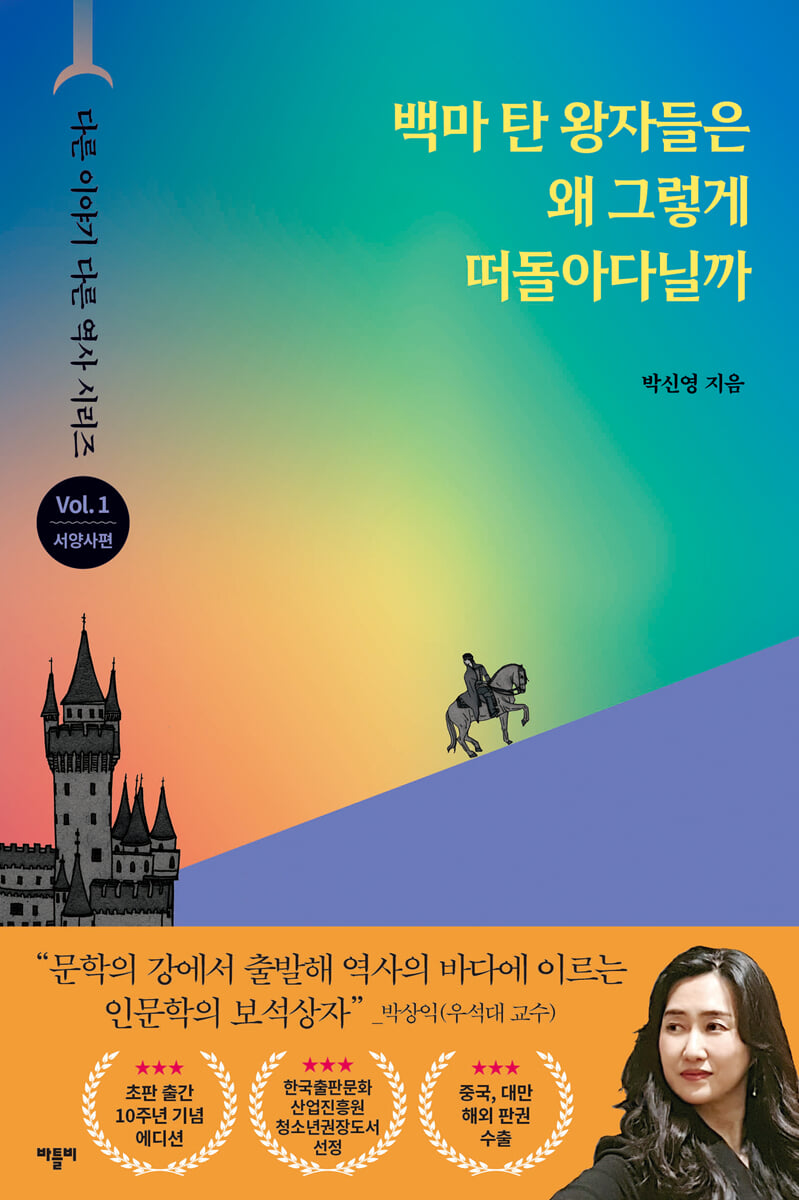
Why Do Princes on White Horses Wander So Much? (10th Anniversary Recover Edition)
 |
Description
Book Introduction
*10th Anniversary Recover Edition
*Published overseas in China and Taiwan!
*The choice of 100,000 readers in Korea, China, and Taiwan!
*Selected as a recommended book for youth by the Korea Publication Industry Promotion Agency
World history, where context and flow become apparent as you follow the protagonists of masterpieces.
The Western history book, "Why Do Princes on White Horses Wander So Much?" and its in-depth edition, "Why Did the Cat Wear Puss in Boots?", have been consistently loved by readers since their publication in 2013 and have become steady sellers.
To celebrate the 10th anniversary of the first edition, it is being compiled into a 'Different Stories, Different Histories' series and released as a reissue edition.
This series, which uncovers the hidden stories behind masterpieces with rich imagination and keen insight, guides readers through exciting history and is expected to continue with Oriental history, Korean history, and women's history.
"Why Do Princes on White Horses Wander So Much?" has been translated and published in China and Taiwan, and is currently receiving favorable reviews from readers.
Over the past 10 years, 100,000 readers in Korea, China, and Taiwan have chosen this book, and it was also selected as a recommended book for youth by the Korea Publication Industry Promotion Agency.
Volume 2, “Why Did the Cat Wear Boots?” was selected as an excellent publication content for small and medium-sized publishers by the Korea Creative Content Agency.
The author is working hard on writing the third volume of the series, Oriental History, with the goal of publication in the first half of next year.
The author, who conveys world history in a delightful way with his uniquely savory storytelling, calls upon familiar characters from classic fairy tales such as Snow White, Anne of Green Gables, Little Princess, Zeze, and Marco to lower the barrier to entry to world history.
In a world filled with dignified heroes, kings, and wars, we uncover the stories of boys and girls, villains, supporting characters, witches, and strange heroes, and even uncover the hidden backstories of world history.
From the story of how princes on white horses ended up wandering around a country other than their own, to the reason Marco had to travel 30,000 miles to find his mother, to the inside story of why Anne of Green Gables was so enraged by being teased as a "carrot," we delve into the historical background of these classic fairy tales one by one, guiding you through a world of astonishing twists and turns to grasp the context and flow of history.
*Published overseas in China and Taiwan!
*The choice of 100,000 readers in Korea, China, and Taiwan!
*Selected as a recommended book for youth by the Korea Publication Industry Promotion Agency
World history, where context and flow become apparent as you follow the protagonists of masterpieces.
The Western history book, "Why Do Princes on White Horses Wander So Much?" and its in-depth edition, "Why Did the Cat Wear Puss in Boots?", have been consistently loved by readers since their publication in 2013 and have become steady sellers.
To celebrate the 10th anniversary of the first edition, it is being compiled into a 'Different Stories, Different Histories' series and released as a reissue edition.
This series, which uncovers the hidden stories behind masterpieces with rich imagination and keen insight, guides readers through exciting history and is expected to continue with Oriental history, Korean history, and women's history.
"Why Do Princes on White Horses Wander So Much?" has been translated and published in China and Taiwan, and is currently receiving favorable reviews from readers.
Over the past 10 years, 100,000 readers in Korea, China, and Taiwan have chosen this book, and it was also selected as a recommended book for youth by the Korea Publication Industry Promotion Agency.
Volume 2, “Why Did the Cat Wear Boots?” was selected as an excellent publication content for small and medium-sized publishers by the Korea Creative Content Agency.
The author is working hard on writing the third volume of the series, Oriental History, with the goal of publication in the first half of next year.
The author, who conveys world history in a delightful way with his uniquely savory storytelling, calls upon familiar characters from classic fairy tales such as Snow White, Anne of Green Gables, Little Princess, Zeze, and Marco to lower the barrier to entry to world history.
In a world filled with dignified heroes, kings, and wars, we uncover the stories of boys and girls, villains, supporting characters, witches, and strange heroes, and even uncover the hidden backstories of world history.
From the story of how princes on white horses ended up wandering around a country other than their own, to the reason Marco had to travel 30,000 miles to find his mother, to the inside story of why Anne of Green Gables was so enraged by being teased as a "carrot," we delve into the historical background of these classic fairy tales one by one, guiding you through a world of astonishing twists and turns to grasp the context and flow of history.
- You can preview some of the book's contents.
Preview
index
Preface to the Revised and Expanded Edition
Preface to the first edition
Preface to the series publication
Part 1: Villains, Supporting Characters, and Witches in World History _014
Why do princes on white horses wander around like that?
Why do you encounter monsters when you get lost in the forest?
Where did the Pied Piper go?
Why are redheads discriminated against?
Apology for the Witch Queen
Shylock, the financier who turns out to be wronged
Part 2: The Great Hero, the Wrongful Hero, the Strange Hero _082
Who is Robin Hood's enemy?
It's always love that changes the world
What Quasimodo threw from the railing
Burned at the stake for saving his country
Romania's hero, Dracula
Is Don Quixote a stupid knight?
The gloves are thrown down, take up the sword.
The Alchemy of Raising Children into Adults
Part 3: A History Called Desire _174
Why did the girl desire red shoes?
Oh, my prince and my beggar
A showdown between British and American capitalists
A true princess who overcame hardship
The smell of revolution in the sewers of Paris
The heart of unified Italy is burning hot
Part 4 History Repeats Itself in Similar Rhymes _241
Every mother tongue is the most beautiful
The Land of Honest Seeds, a History We Want to Erase
Marco still looking for his mother
What country is the Flanders dog from?
Paper has more patience than people.
There is no one who should not have been born, Jeje!
The right to meet other Cinderellas
Preface to the first edition
Preface to the series publication
Part 1: Villains, Supporting Characters, and Witches in World History _014
Why do princes on white horses wander around like that?
Why do you encounter monsters when you get lost in the forest?
Where did the Pied Piper go?
Why are redheads discriminated against?
Apology for the Witch Queen
Shylock, the financier who turns out to be wronged
Part 2: The Great Hero, the Wrongful Hero, the Strange Hero _082
Who is Robin Hood's enemy?
It's always love that changes the world
What Quasimodo threw from the railing
Burned at the stake for saving his country
Romania's hero, Dracula
Is Don Quixote a stupid knight?
The gloves are thrown down, take up the sword.
The Alchemy of Raising Children into Adults
Part 3: A History Called Desire _174
Why did the girl desire red shoes?
Oh, my prince and my beggar
A showdown between British and American capitalists
A true princess who overcame hardship
The smell of revolution in the sewers of Paris
The heart of unified Italy is burning hot
Part 4 History Repeats Itself in Similar Rhymes _241
Every mother tongue is the most beautiful
The Land of Honest Seeds, a History We Want to Erase
Marco still looking for his mother
What country is the Flanders dog from?
Paper has more patience than people.
There is no one who should not have been born, Jeje!
The right to meet other Cinderellas
Detailed image

Into the book
Many of the wandering princes in fairy tales were actually wandering young knights who were driven out of their homeland with the words, “Try your luck.”
With little inheritance to inherit and unemployed, the best way for them to survive was to marry the only daughter of a neighboring country's princess and inherit her family's kingdom, thereby becoming joint kings.
So, the princes had to train themselves to be eloquent, have good etiquette, and have chivalry so that the princess would fall in love with them at first sight.
Even if Snow White in the glass case wasn't his type of woman, and even if Sleeping Beauty, who was about 100 years older than him, had bad breath because he hadn't brushed his teeth for 100 years, he had to endure it and pretend to fall in love with her at first sight and kiss her.
It turns out he's a white man riding a white horse.
Ah, sadly, this was the true identity of Prince Charming, the prince on a white horse.
--- p.22
Because I could not dare to express my resentment towards the Christian God, who is an absolute being.
Instead, the cause was sought in other beings of the universe, such as witches and werewolves.
Because people who are driven out into the forest outside the village can easily become targets of resentment.
But if these scapegoats and public enemies were simply criminals who were chased away in wolf skins, or grandmothers whose noses were slightly burned while boiling herbs, wouldn't their existence be too insignificant compared to the magnitude of the sins they are believed to have committed?
So, medieval people imagined them as monsters that turned into wolves and harmed people when the full moon rose, and as witches who made a pact with the devil and ate children.
--- p.33
Westerners were not very negative about the color red itself.
The problem was the red color that came from the body of the living creature.
Medieval Christians believed that the red blood of living creatures stimulated excessive sexual desire.
This is where the idea that during Lent, when meat consumption is prohibited, 'red' meat such as beef and pork cannot be eaten, but eating white fish is permitted.
There is also a reason why it is believed that fish do not induce sexual desire because they do not mate by direct physical contact between male and female.
In this context, a person with a red beard or red hair, which seemed to be filled with red blood, was considered to have excessive sexual energy.
--- p.48
The blonde hair that the Germanic peoples idealized was seen as beautiful and normal, while the red hair common among the Celts they drove out was seen as ugly and abnormal.
That it reflects the history of discrimination against the Irish and Scottish, who served as internal colonies of Britain for a long time.
That is, the hatred for redheads is based on the persecution of a minority by the majority.
In northwestern Europe, redheads are considered witches, but in southern Europe, where black hair and brown eyes are common, blue-eyed women are often accused of being witches, which clearly shows the persecution of this minority.
--- p.52
The queen must have had circumstances that forced her to look in the mirror frequently.
Usually, a country's queen is a foreign princess who was sacrificed in a political marriage.
The only person a queen could rely on when she married into a foreign country and was in a desperate situation was her husband, the king.
In a time when a woman's worth was judged by her appearance, a queen had to be more beautiful than anyone else to win the king's love.
So she may have become obsessed with her appearance, looking in the mirror often.
She looked at the mirror she had brought from her parents' house as a dowry, and because she felt miserable about her situation and missed her parents, she muttered a few words in her native language. But didn't the people around her, who didn't know foreign languages, think that she was casting a strange spell while looking at the mirror?
--- p.58~59
Jewish financiers were discriminated against, yet they were essential to society.
When feudal lords in medieval Europe needed money urgently, for example, for war or for their children's political marriages, they sought loans from wealthy Jewish financiers.
Then, in order to repay the money, he would exploit the peasants living in his territory and collect taxes harshly.
Instead of criticizing the problems of the feudal system, the people took out their anger on the easy Jews.
--- p.72
Charlemagne's descendants became obsessed with the idea that they had to march into Italy and take Rome to become true emperors who could rule the world.
This was because of the general perception that ‘Rome was naturally the center of the Roman Empire.’
However, the home base of Charles and his successors was not the Italian peninsula, but north of the Alps.
Nevertheless, the reason they tried to intervene politically and militarily in Italian affairs was precisely because of the medieval imperial concept that the Western European kings had.
On the other hand, the Pope was also a religious leader and a feudal lord with territories in central Italy.
The Pope was always wary of the Emperor's ambitions for Italy.
The conflict between the Pope and the Emperor over secular power, such as the right to appoint clergy, continued unabated.
--- p.96
In 1492, the long-awaited unification was achieved, but the many Spanish knights suddenly became unemployed.
This means that armed social discontent forces were always ready and waiting to use violence.
So Fernando and Isabella sent them to Africa and South America to establish colonies.
So to speak, the king and queen exported violence, and the knights became industrial warriors for foreign currency acquisition.
--- p.146
The arduous struggles of the heroes in mythology tell us, in turn, about the process of resolving the problems that ordinary people like us face in life.
The near-death experience they have signifies a moment of spiritual awakening where we can discard our past, flawed selves, be reborn, and become complete human beings.
--- p.168
When you feel like you're in the most difficult and lonely situation in the world and want to give up everything, read a history book and you'll learn that there were people who bravely overcame even greater hardships.
As the context surrounding the incident begins to become apparent, we begin to break free from pessimism and think about how to deal with it wisely.
--- p.214
Italy has the third largest number of overseas Koreans, after the Chinese and the Jews of Israel.
The majority come from rural areas in the south.
The spirit of mutual assistance among these Italians who left their homeland is famous for its strong bond.
This is because they went through such difficult times as migrant workers that they had to unite and help each other to survive.
With little inheritance to inherit and unemployed, the best way for them to survive was to marry the only daughter of a neighboring country's princess and inherit her family's kingdom, thereby becoming joint kings.
So, the princes had to train themselves to be eloquent, have good etiquette, and have chivalry so that the princess would fall in love with them at first sight.
Even if Snow White in the glass case wasn't his type of woman, and even if Sleeping Beauty, who was about 100 years older than him, had bad breath because he hadn't brushed his teeth for 100 years, he had to endure it and pretend to fall in love with her at first sight and kiss her.
It turns out he's a white man riding a white horse.
Ah, sadly, this was the true identity of Prince Charming, the prince on a white horse.
--- p.22
Because I could not dare to express my resentment towards the Christian God, who is an absolute being.
Instead, the cause was sought in other beings of the universe, such as witches and werewolves.
Because people who are driven out into the forest outside the village can easily become targets of resentment.
But if these scapegoats and public enemies were simply criminals who were chased away in wolf skins, or grandmothers whose noses were slightly burned while boiling herbs, wouldn't their existence be too insignificant compared to the magnitude of the sins they are believed to have committed?
So, medieval people imagined them as monsters that turned into wolves and harmed people when the full moon rose, and as witches who made a pact with the devil and ate children.
--- p.33
Westerners were not very negative about the color red itself.
The problem was the red color that came from the body of the living creature.
Medieval Christians believed that the red blood of living creatures stimulated excessive sexual desire.
This is where the idea that during Lent, when meat consumption is prohibited, 'red' meat such as beef and pork cannot be eaten, but eating white fish is permitted.
There is also a reason why it is believed that fish do not induce sexual desire because they do not mate by direct physical contact between male and female.
In this context, a person with a red beard or red hair, which seemed to be filled with red blood, was considered to have excessive sexual energy.
--- p.48
The blonde hair that the Germanic peoples idealized was seen as beautiful and normal, while the red hair common among the Celts they drove out was seen as ugly and abnormal.
That it reflects the history of discrimination against the Irish and Scottish, who served as internal colonies of Britain for a long time.
That is, the hatred for redheads is based on the persecution of a minority by the majority.
In northwestern Europe, redheads are considered witches, but in southern Europe, where black hair and brown eyes are common, blue-eyed women are often accused of being witches, which clearly shows the persecution of this minority.
--- p.52
The queen must have had circumstances that forced her to look in the mirror frequently.
Usually, a country's queen is a foreign princess who was sacrificed in a political marriage.
The only person a queen could rely on when she married into a foreign country and was in a desperate situation was her husband, the king.
In a time when a woman's worth was judged by her appearance, a queen had to be more beautiful than anyone else to win the king's love.
So she may have become obsessed with her appearance, looking in the mirror often.
She looked at the mirror she had brought from her parents' house as a dowry, and because she felt miserable about her situation and missed her parents, she muttered a few words in her native language. But didn't the people around her, who didn't know foreign languages, think that she was casting a strange spell while looking at the mirror?
--- p.58~59
Jewish financiers were discriminated against, yet they were essential to society.
When feudal lords in medieval Europe needed money urgently, for example, for war or for their children's political marriages, they sought loans from wealthy Jewish financiers.
Then, in order to repay the money, he would exploit the peasants living in his territory and collect taxes harshly.
Instead of criticizing the problems of the feudal system, the people took out their anger on the easy Jews.
--- p.72
Charlemagne's descendants became obsessed with the idea that they had to march into Italy and take Rome to become true emperors who could rule the world.
This was because of the general perception that ‘Rome was naturally the center of the Roman Empire.’
However, the home base of Charles and his successors was not the Italian peninsula, but north of the Alps.
Nevertheless, the reason they tried to intervene politically and militarily in Italian affairs was precisely because of the medieval imperial concept that the Western European kings had.
On the other hand, the Pope was also a religious leader and a feudal lord with territories in central Italy.
The Pope was always wary of the Emperor's ambitions for Italy.
The conflict between the Pope and the Emperor over secular power, such as the right to appoint clergy, continued unabated.
--- p.96
In 1492, the long-awaited unification was achieved, but the many Spanish knights suddenly became unemployed.
This means that armed social discontent forces were always ready and waiting to use violence.
So Fernando and Isabella sent them to Africa and South America to establish colonies.
So to speak, the king and queen exported violence, and the knights became industrial warriors for foreign currency acquisition.
--- p.146
The arduous struggles of the heroes in mythology tell us, in turn, about the process of resolving the problems that ordinary people like us face in life.
The near-death experience they have signifies a moment of spiritual awakening where we can discard our past, flawed selves, be reborn, and become complete human beings.
--- p.168
When you feel like you're in the most difficult and lonely situation in the world and want to give up everything, read a history book and you'll learn that there were people who bravely overcame even greater hardships.
As the context surrounding the incident begins to become apparent, we begin to break free from pessimism and think about how to deal with it wisely.
--- p.214
Italy has the third largest number of overseas Koreans, after the Chinese and the Jews of Israel.
The majority come from rural areas in the south.
The spirit of mutual assistance among these Italians who left their homeland is famous for its strong bond.
This is because they went through such difficult times as migrant workers that they had to unite and help each other to survive.
--- p.268
Publisher's Review
★10th Anniversary Recover Edition
“Different Stories, Different Histories” series
A world history textbook that helps you understand the context and flow of a fairy tale by following its protagonist.
For modern people living in an interdependent world, world history is the best tool for understanding today's world on a macroscopic and fundamental level.
However, I only have a vague idea of the short knowledge I learned in history class floating around in my head, and I have no idea where or how to start studying.
I take out a book to study world history, but it's full of stiff historical terms, names of people, and places, and I can't figure out how it relates to me, so I lose interest right away.
The popular books 『Why Do Princes on White Horses Wander So Much?』(Seoyangsa) and 『Why Did the Cat Wear Puss in Boots?』(Seoyangsa, Advanced Edition), which allow readers to easily approach the vast world history, are now available in a recovered edition to commemorate the 10th anniversary of their first publication.
With rich imagination and keen insight, he delves into the historical background of classic fairy tales, guiding us through a world of exciting twists and turns.
By following the main characters in masterpieces, you can grasp the context and flow of world history.
Little Princess Sarah, Little Red Riding Hood, Zeze, Patrasche…
Fairytale characters become protagonists of world history.
Can't we begin world history lightly? "Why Do Princes on White Horses Wander So Much?" brings the characters from classic fairy tales that accompanies our childhoods onto the stage of world history.
As a result, this book is far from the solemnity and authority of existing history books.
Instead, there is fun, humor, and reflection that the story and characters bring.
Humans love stories.
They are highly social animals, sensitive to characters and plot.
Similar plots, characters, and stories are created all over the world, and children hear these stories from adults, learning how the world works and how people behave.
Stories are the result of collective memory, and they contain the social and historical structure and background of an era, as well as the worldview and values of the people of that time.
Have you ever felt lost, unsure of where or how to begin your exploration of world history? Then let's welcome back the heroes of these masterpieces with open arms.
The plot and characters will take you on an exciting journey through history.
"Ah, so this is how it's connected!" You'll be surprised to discover the historical facts hidden in classic fairy tales you've read and passed over without a second thought.
Now that I know, it can't get any more unfair than this.
A world history of incredible twists and turns!
“My illusions are shattered!” you might find yourself muttering this after reading this book.
"Why Do Princes on White Horses Wander So Much?" is a book that focuses on the gaps and inconsistencies in sacred heroes, great kings, and solemn history.
The author emphasizes that history is created and uncovers the hidden stories of world history.
The prince on a white horse that girls once dreamed of was actually a 'white horse' riding a white horse (p. 22), the musketeers in 'The Three Musketeers' were closer to 'gangsters' who rebelled against the absolute monarchy (p. 158), and 'The Last Lesson' was a historical distortion novel that pretended that France was the victim (p. 241).
On the other hand, the werewolf who ate Little Red Riding Hood was a criminal who was driven out of the village wearing a wolf skin, the witch who tried to eat Hansel was an old woman who brewed herbs (p. 32), and the queen who was branded a witch for saying to herself, “Mirror, mirror on the wall, who is the fairest of them all?” was a lonely foreign princess who had married into a strange land (p. 59).
Shylock, the cruel Jewish moneylender who had no blood or tears, was a proper financier (p. 72), and Sarah in A Little Princess was not a princess with princess syndrome, but a true princess (p. 217).
Romeo and Juliet was not a love story between naive, reckless teenagers, but a story of revolutionary heroes made possible by the fact that they were teenagers who did not listen to their parents (p. 101).
"Why Do Princes on White Horses Wander So Much?" vividly reconstructs a world history of twists and turns with historical facts, rich imagination, and sharp insight.
It transcends the dichotomy of good and evil and brings to life the characters of the time as extremely friendly and rational human beings.
'Why is that?', 'Is that really so?' The Virtue of the Mind
The magic of history that makes you want to keep talking
Since 2013, author Park Shin-young has been writing books and giving lectures online and offline for the general public under the motto, “History is a story.”
He is a natural born history nerd.
While watching a movie, reading a book, or reading a newspaper, you may suddenly become curious about the historical origins and wonder, "Is that really true?" or "Why is that true?"
It's frustrating to have to read dozens of related books and materials and check everything out for yourself.
When we discover a new fact, we rejoice and say, "How did I not know this yet?" or "I almost lived without knowing such an interesting fact!" We enjoy history because it answers one question and then leads to another.
Sharing newly acquired knowledge freely through lectures and social media is also one of the greatest joys.
The author's strengths shine even brighter in this book.
"Why Do Princes on White Horses Wander So Much?" captures the author's signature honest, candid, and humorous storytelling.
It's as if a close older sister or older sister is telling me an interesting story.
It also shows us how history can provide hope and new ideas for our lives through the characters of older sisters and brothers who never lose their strength or humor even in difficult times.
If you're someone who's always faced with the barriers of world history, try overcoming them easily with this book.
“Different Stories, Different Histories” series
A world history textbook that helps you understand the context and flow of a fairy tale by following its protagonist.
For modern people living in an interdependent world, world history is the best tool for understanding today's world on a macroscopic and fundamental level.
However, I only have a vague idea of the short knowledge I learned in history class floating around in my head, and I have no idea where or how to start studying.
I take out a book to study world history, but it's full of stiff historical terms, names of people, and places, and I can't figure out how it relates to me, so I lose interest right away.
The popular books 『Why Do Princes on White Horses Wander So Much?』(Seoyangsa) and 『Why Did the Cat Wear Puss in Boots?』(Seoyangsa, Advanced Edition), which allow readers to easily approach the vast world history, are now available in a recovered edition to commemorate the 10th anniversary of their first publication.
With rich imagination and keen insight, he delves into the historical background of classic fairy tales, guiding us through a world of exciting twists and turns.
By following the main characters in masterpieces, you can grasp the context and flow of world history.
Little Princess Sarah, Little Red Riding Hood, Zeze, Patrasche…
Fairytale characters become protagonists of world history.
Can't we begin world history lightly? "Why Do Princes on White Horses Wander So Much?" brings the characters from classic fairy tales that accompanies our childhoods onto the stage of world history.
As a result, this book is far from the solemnity and authority of existing history books.
Instead, there is fun, humor, and reflection that the story and characters bring.
Humans love stories.
They are highly social animals, sensitive to characters and plot.
Similar plots, characters, and stories are created all over the world, and children hear these stories from adults, learning how the world works and how people behave.
Stories are the result of collective memory, and they contain the social and historical structure and background of an era, as well as the worldview and values of the people of that time.
Have you ever felt lost, unsure of where or how to begin your exploration of world history? Then let's welcome back the heroes of these masterpieces with open arms.
The plot and characters will take you on an exciting journey through history.
"Ah, so this is how it's connected!" You'll be surprised to discover the historical facts hidden in classic fairy tales you've read and passed over without a second thought.
Now that I know, it can't get any more unfair than this.
A world history of incredible twists and turns!
“My illusions are shattered!” you might find yourself muttering this after reading this book.
"Why Do Princes on White Horses Wander So Much?" is a book that focuses on the gaps and inconsistencies in sacred heroes, great kings, and solemn history.
The author emphasizes that history is created and uncovers the hidden stories of world history.
The prince on a white horse that girls once dreamed of was actually a 'white horse' riding a white horse (p. 22), the musketeers in 'The Three Musketeers' were closer to 'gangsters' who rebelled against the absolute monarchy (p. 158), and 'The Last Lesson' was a historical distortion novel that pretended that France was the victim (p. 241).
On the other hand, the werewolf who ate Little Red Riding Hood was a criminal who was driven out of the village wearing a wolf skin, the witch who tried to eat Hansel was an old woman who brewed herbs (p. 32), and the queen who was branded a witch for saying to herself, “Mirror, mirror on the wall, who is the fairest of them all?” was a lonely foreign princess who had married into a strange land (p. 59).
Shylock, the cruel Jewish moneylender who had no blood or tears, was a proper financier (p. 72), and Sarah in A Little Princess was not a princess with princess syndrome, but a true princess (p. 217).
Romeo and Juliet was not a love story between naive, reckless teenagers, but a story of revolutionary heroes made possible by the fact that they were teenagers who did not listen to their parents (p. 101).
"Why Do Princes on White Horses Wander So Much?" vividly reconstructs a world history of twists and turns with historical facts, rich imagination, and sharp insight.
It transcends the dichotomy of good and evil and brings to life the characters of the time as extremely friendly and rational human beings.
'Why is that?', 'Is that really so?' The Virtue of the Mind
The magic of history that makes you want to keep talking
Since 2013, author Park Shin-young has been writing books and giving lectures online and offline for the general public under the motto, “History is a story.”
He is a natural born history nerd.
While watching a movie, reading a book, or reading a newspaper, you may suddenly become curious about the historical origins and wonder, "Is that really true?" or "Why is that true?"
It's frustrating to have to read dozens of related books and materials and check everything out for yourself.
When we discover a new fact, we rejoice and say, "How did I not know this yet?" or "I almost lived without knowing such an interesting fact!" We enjoy history because it answers one question and then leads to another.
Sharing newly acquired knowledge freely through lectures and social media is also one of the greatest joys.
The author's strengths shine even brighter in this book.
"Why Do Princes on White Horses Wander So Much?" captures the author's signature honest, candid, and humorous storytelling.
It's as if a close older sister or older sister is telling me an interesting story.
It also shows us how history can provide hope and new ideas for our lives through the characters of older sisters and brothers who never lose their strength or humor even in difficult times.
If you're someone who's always faced with the barriers of world history, try overcoming them easily with this book.
GOODS SPECIFICS
- Date of issue: October 25, 2024
- Page count, weight, size: 328 pages | 446g | 140*210*30mm
- ISBN13: 9791191959369
- ISBN10: 1191959368
You may also like
카테고리
korean


korean

![GQ KOREA Mark (Monthly): December [2025]](http://librairie.coreenne.fr/cdn/shop/files/8ef265dbbfbf186523ed75ba7319009d.jpg?v=1765340328&width=3840)


