

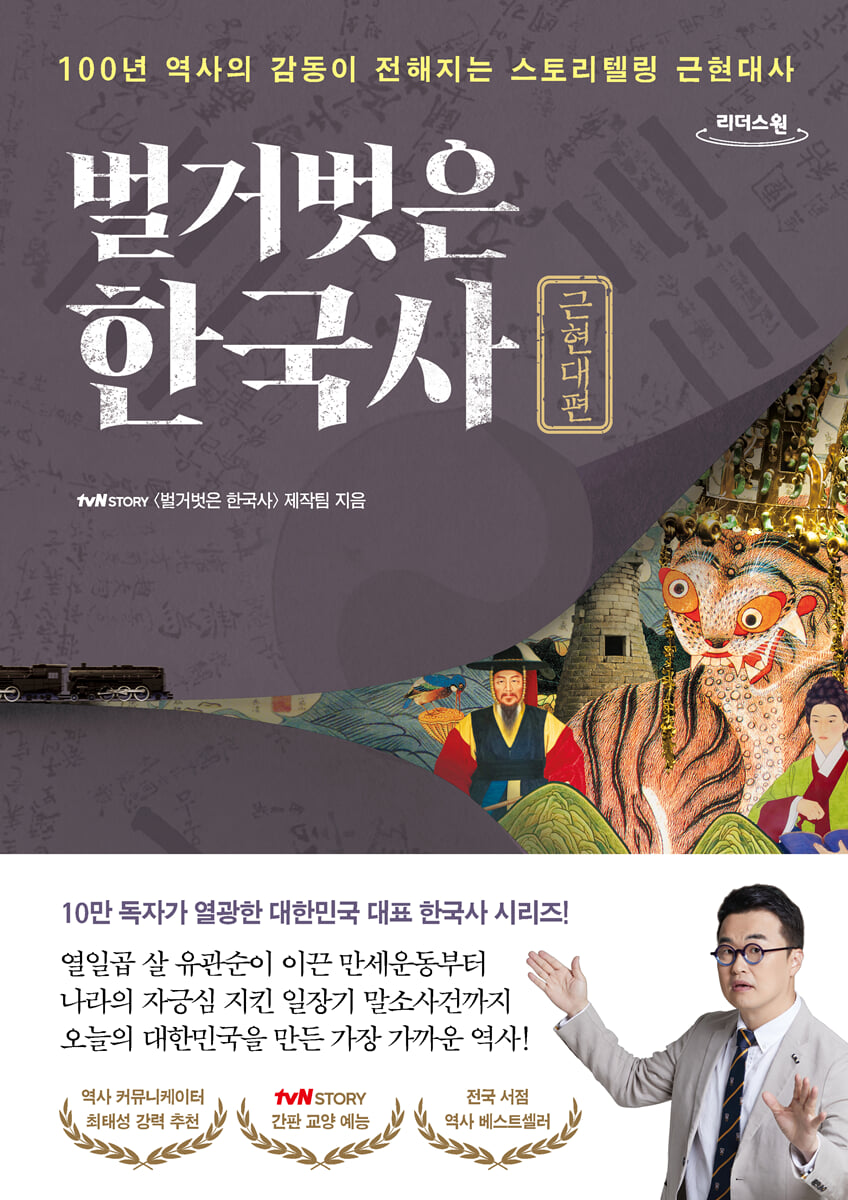
Naked Korean History: Modern and Contemporary History (Large Print Book)
 |
Description
Book Introduction
The complete edition of 『Naked Korean History』, which has captivated 100,000 readers, has been published!
The final story: A moving glimpse into the modern and contemporary history of South Korea.
“The darkest era in the history of the Republic of Korea,
“A bold and noble journey that illuminates the light of hope!”
The representative Korean history series, "Naked Korean History," which has solidified its position as a bestseller for 98 consecutive weeks, concludes its "period" series with a story of modern and contemporary history.
This time, we carefully selected and took a three-dimensional look at the events and people representing the 100 years of moving modern history from among the stories introduced in tvN STORY's signature educational entertainment show, "Naked Korean History."
Modern and contemporary history is recent history that intersects with our lives today, and without knowledge of modern and contemporary history, it is difficult to properly understand what is happening in our country today.
As the division between South and North Korea continues after liberation and attempts to distort history continue both within and outside the country, learning about Korea's past has become a necessity, not an option, to find the right path forward for Korea.
The modern and contemporary history of the Republic of Korea has been a series of upheavals, from Japanese invasion and occupation, independence movements at home and abroad, liberation, and division.
"Naked Korean History: Modern and Contemporary History" focuses on those who, even amidst these turbulent times, risked everything to pursue their dreams.
From Yu Gwan-sun, who led the independence movement even in prison, to Na Hye-seok, a new woman who defied the limitations of her time, to Yun Dong-ju, who continued to write poetry in Korean despite feeling ashamed of not being able to actively oppose Japanese colonial rule, we encounter the hardships and glories our country has endured over the past 100 years through the stories of those who shouldered their own destinies.
Through this book, readers will be moved by the stories behind familiar figures and events, while also understanding the context and lessons of modern and contemporary history.
In it, you will find a clue to solving the current problem and establish yourself as the subject of life and history.
Let us now embark on a journey into the history of hope that burned brightly, never extinguished, even in dark times.
[Introduction to large-print books]
Leaders One's large-print books are books with 'font size' and 'line spacing' enlarged by '120% to 150%' compared to regular paperbacks to provide a comfortable reading environment for all those who have difficulty reading due to small print.
We want to bring back the joy of reading to those who have poor eyesight or find small print frustrating.
The final story: A moving glimpse into the modern and contemporary history of South Korea.
“The darkest era in the history of the Republic of Korea,
“A bold and noble journey that illuminates the light of hope!”
The representative Korean history series, "Naked Korean History," which has solidified its position as a bestseller for 98 consecutive weeks, concludes its "period" series with a story of modern and contemporary history.
This time, we carefully selected and took a three-dimensional look at the events and people representing the 100 years of moving modern history from among the stories introduced in tvN STORY's signature educational entertainment show, "Naked Korean History."
Modern and contemporary history is recent history that intersects with our lives today, and without knowledge of modern and contemporary history, it is difficult to properly understand what is happening in our country today.
As the division between South and North Korea continues after liberation and attempts to distort history continue both within and outside the country, learning about Korea's past has become a necessity, not an option, to find the right path forward for Korea.
The modern and contemporary history of the Republic of Korea has been a series of upheavals, from Japanese invasion and occupation, independence movements at home and abroad, liberation, and division.
"Naked Korean History: Modern and Contemporary History" focuses on those who, even amidst these turbulent times, risked everything to pursue their dreams.
From Yu Gwan-sun, who led the independence movement even in prison, to Na Hye-seok, a new woman who defied the limitations of her time, to Yun Dong-ju, who continued to write poetry in Korean despite feeling ashamed of not being able to actively oppose Japanese colonial rule, we encounter the hardships and glories our country has endured over the past 100 years through the stories of those who shouldered their own destinies.
Through this book, readers will be moved by the stories behind familiar figures and events, while also understanding the context and lessons of modern and contemporary history.
In it, you will find a clue to solving the current problem and establish yourself as the subject of life and history.
Let us now embark on a journey into the history of hope that burned brightly, never extinguished, even in dark times.
[Introduction to large-print books]
Leaders One's large-print books are books with 'font size' and 'line spacing' enlarged by '120% to 150%' compared to regular paperbacks to provide a comfortable reading environment for all those who have difficulty reading due to small print.
We want to bring back the joy of reading to those who have poor eyesight or find small print frustrating.
index
Introduction: Let's go on a special journey together.
Recommended Reading: A Look into Modern and Contemporary History: Transforming Suffering into Glory --- Choi Tae-seong
Chapter 1: Naked Japanese Invasion
: Japan's elaborate plan to overthrow the 500-year-old Joseon Dynasty --- Hong Mun-gi
Chapter 2: The Naked March 1st Movement
How Seventeen-Year-Old Yu Gwan-sun Painted the Streets with the Taegeukgi --- Shim Ok-ju
Chapter 3 The Naked Anarchist
Why did Japan fear the Korean villain Park Yeol? --- Shin Joo-baek
Chapter 4: The Naked Last Princess
: The reason why Princess Deokhye, the youngest daughter of Emperor Gojong, was found in a mental hospital --- Hong Mun-gi
Chapter 5: The Birth of the Naked New Woman
How the genius artist Na Hye-seok defied the limitations of her time --- So Hyun-sook
Chapter 6: The Naked Resistance Poet
: How Yun Dong-ju's Poetry Resonated with the Hearts of Even the Japanese --- Shin Ju-baek
Chapter 7: The Bare Japanese Flag Eradication Incident
: Why did Son Ki-jeong wear the Taegeuk mark only at the age of 76? --- Hong Moon-ki
Recommended Reading: A Look into Modern and Contemporary History: Transforming Suffering into Glory --- Choi Tae-seong
Chapter 1: Naked Japanese Invasion
: Japan's elaborate plan to overthrow the 500-year-old Joseon Dynasty --- Hong Mun-gi
Chapter 2: The Naked March 1st Movement
How Seventeen-Year-Old Yu Gwan-sun Painted the Streets with the Taegeukgi --- Shim Ok-ju
Chapter 3 The Naked Anarchist
Why did Japan fear the Korean villain Park Yeol? --- Shin Joo-baek
Chapter 4: The Naked Last Princess
: The reason why Princess Deokhye, the youngest daughter of Emperor Gojong, was found in a mental hospital --- Hong Mun-gi
Chapter 5: The Birth of the Naked New Woman
How the genius artist Na Hye-seok defied the limitations of her time --- So Hyun-sook
Chapter 6: The Naked Resistance Poet
: How Yun Dong-ju's Poetry Resonated with the Hearts of Even the Japanese --- Shin Ju-baek
Chapter 7: The Bare Japanese Flag Eradication Incident
: Why did Son Ki-jeong wear the Taegeuk mark only at the age of 76? --- Hong Moon-ki
Into the book
So, Japan accepted Joseon's strong opposition and erased "His Majesty the Emperor of Japan" from the preamble of the treaty, changing it to "Great Japan" and "His Majesty the King of Joseon" to "Great Joseon."
Since Japan respected Joseon's wishes to this extent, Joseon thought, "Japan is a partner with whom we can sufficiently negotiate," and thought that they would mutually agree to sign a treaty for trade.
Therefore, it is more accurate to view the Japan-Korea Treaty of Amity and Commerce as a treaty that was “completely fooled by Japan’s trickery” rather than a “treaty that was forced upon us by Japan.”
Unfortunately, at the time, Joseon did not believe that the Japan-Korea Treaty of Amity and Commerce was an unfair treaty.
King Gojong of Joseon even praised this event as a treaty that "overcame a great national crisis and preserved the nation's prestige."
After the signing of the Treaty of Amity and Commerce between Japan and Korea, Japan's influence in Korea gradually increased, like clothes getting wet in a drizzle, without even the Korean government noticing.
--- p.21~22, from “Chapter 1: Naked Japanese Invasion _ Japan’s elaborate plan to overthrow the 500-year Joseon Dynasty”
Then one day, a strange tension began to hang over Cell No. 8, making even the air chilly.
And soon after, Yu Gwan-sun and the prisoners exchanged solemn glances, raised their arms high, and began shouting at the top of their lungs.
“Long live Korean independence! Long live Korean independence!”
Why did they shout so loudly in unison? It was March 1, 1920! It was the exact first anniversary of the March 1st Movement.
Yu Gwan-sun and the prisoners in Cell No. 8 boldly and courageously held a demonstration to commemorate the first anniversary of the March 1st Movement inside the prison.
Yu Gwan-sun must have wanted to say, "Our independence movement is not over yet, and it is only natural to fight for independence to reclaim our country."
--- p.82~83, from “Chapter 2: The Naked March 1st Movement - How did seventeen-year-old Yu Gwan-sun paint the streets with the Taegeukgi?”
“I stand before the court on behalf of the Korean people to condemn Japan’s actions of plundering Korea.
So, let me tell you the meaning with my own mouth.”
The third requirement was that he defend himself in Korean, not Japanese.
Even though he was a criminal, he confidently asked for an interpreter to be prepared.
The fourth condition, which requires that the judge's seat be at eye level, is also significant.
Usually, the judge sits on a high platform, and the defendant sits below.
Park Yeol couldn't stand to see this.
He said that he was not a criminal and that he was standing in court representing Joseon, so he wanted to judge right and wrong on an equal footing with the judge representing Japan.
It was like saying that Japan had no right to look down on me.
--- p.119, from “Chapter 3 Naked Anarchist _ Why did Japan fear the rogue Korean Park Yeol?”
Why did Princess Deokhye's return to Korea become such a hot topic? Because she returned to her homeland after a whopping 37 years.
Unfortunately, Princess Deokhye was forcibly separated from her family at the age of fourteen and had to go to Japan.
I was taken away as a hostage by the Japanese imperialists' cunning scheme and lived a life like a puppet.
The place where she was discovered after so many years shocked many people.
Because it was a mental hospital in Tokyo, Japan.
Why was Princess Deokhye, the daughter of Emperor Gojong and the last princess of our country, found in a shabby state in a mental hospital?
--- p.136, from “Chapter 4 The Last Naked Princess - The Reason Why Princess Deokhye, the Youngest Daughter of Emperor Gojong, Was Found in a Mental Hospital”
After her divorce, Na Hye-seok, now in a miserable state, once again published a groundbreaking piece that turned the world upside down.
“The Joseon men’s evaluation is strange.
“He has no sense of chastity, yet he demands chastity from his wife and other women, and he also tries to take away the chastity of others.”
Divorce Confession
"It's strange that Joseon men, who lack a sense of chastity themselves, demand chastity only from their wives and other women." Doesn't this seem like a statement aimed at someone? It is.
It was Kim Woo-young.
It was a direct criticism of her ex-husband's shamelessness in blaming Na Hye-seok even though he had committed the same affair.
Furthermore, it strongly criticized Joseon society, which forced chastity only on women.
--- p.199~200, from “Chapter 5: The Birth of the Naked New Woman _ How did the genius artist Na Hye-seok confront the limitations of the times”
In fact, the conversation between Yun Dong-ju and Song Mong-gyu was an issue that would have been passed over so simply that even school disciplinary action would have been excessive in the past.
However, the 'New Public Security Preservation Law' revised by the Japanese in 1941 caught the two people by the ankles.
At that time, the Japanese government revised the Public Security Preservation Act, which originally had 7 articles, to a whopping 65 articles.
The two men were charged with the crime of "writing poetry in Korean, not Japanese," and "striving to maintain and improve Korean culture," according to the new Public Security Preservation Act.
--- p.238~239, from “Chapter 6: The Naked Resistance Poet - How Did Yun Dong-ju’s Poetry Resonate Even with the Hearts of the Japanese?”
On August 25, two months before his return to Korea, the Dong-A Ilbo published a photo of Son Ki-chung with the article, “Our honorable Son holds a laurel wreath on his head and a pot of laurel in both hands.”
But the Japanese took issue with this.
Originally, Son Ki-jeong's uniform had the Japanese flag on it.
However, the Dong-A Ilbo, which did not want to publish this, erased the Japanese flag and reported it.
This incident is called the 'Rising Sun Flag Deletion Incident'.
The enraged Japanese Government-General of Korea arrested those involved in erasing the Japanese flag and banned the publication of the Dong-A Ilbo for 10 months.
Since Japan respected Joseon's wishes to this extent, Joseon thought, "Japan is a partner with whom we can sufficiently negotiate," and thought that they would mutually agree to sign a treaty for trade.
Therefore, it is more accurate to view the Japan-Korea Treaty of Amity and Commerce as a treaty that was “completely fooled by Japan’s trickery” rather than a “treaty that was forced upon us by Japan.”
Unfortunately, at the time, Joseon did not believe that the Japan-Korea Treaty of Amity and Commerce was an unfair treaty.
King Gojong of Joseon even praised this event as a treaty that "overcame a great national crisis and preserved the nation's prestige."
After the signing of the Treaty of Amity and Commerce between Japan and Korea, Japan's influence in Korea gradually increased, like clothes getting wet in a drizzle, without even the Korean government noticing.
--- p.21~22, from “Chapter 1: Naked Japanese Invasion _ Japan’s elaborate plan to overthrow the 500-year Joseon Dynasty”
Then one day, a strange tension began to hang over Cell No. 8, making even the air chilly.
And soon after, Yu Gwan-sun and the prisoners exchanged solemn glances, raised their arms high, and began shouting at the top of their lungs.
“Long live Korean independence! Long live Korean independence!”
Why did they shout so loudly in unison? It was March 1, 1920! It was the exact first anniversary of the March 1st Movement.
Yu Gwan-sun and the prisoners in Cell No. 8 boldly and courageously held a demonstration to commemorate the first anniversary of the March 1st Movement inside the prison.
Yu Gwan-sun must have wanted to say, "Our independence movement is not over yet, and it is only natural to fight for independence to reclaim our country."
--- p.82~83, from “Chapter 2: The Naked March 1st Movement - How did seventeen-year-old Yu Gwan-sun paint the streets with the Taegeukgi?”
“I stand before the court on behalf of the Korean people to condemn Japan’s actions of plundering Korea.
So, let me tell you the meaning with my own mouth.”
The third requirement was that he defend himself in Korean, not Japanese.
Even though he was a criminal, he confidently asked for an interpreter to be prepared.
The fourth condition, which requires that the judge's seat be at eye level, is also significant.
Usually, the judge sits on a high platform, and the defendant sits below.
Park Yeol couldn't stand to see this.
He said that he was not a criminal and that he was standing in court representing Joseon, so he wanted to judge right and wrong on an equal footing with the judge representing Japan.
It was like saying that Japan had no right to look down on me.
--- p.119, from “Chapter 3 Naked Anarchist _ Why did Japan fear the rogue Korean Park Yeol?”
Why did Princess Deokhye's return to Korea become such a hot topic? Because she returned to her homeland after a whopping 37 years.
Unfortunately, Princess Deokhye was forcibly separated from her family at the age of fourteen and had to go to Japan.
I was taken away as a hostage by the Japanese imperialists' cunning scheme and lived a life like a puppet.
The place where she was discovered after so many years shocked many people.
Because it was a mental hospital in Tokyo, Japan.
Why was Princess Deokhye, the daughter of Emperor Gojong and the last princess of our country, found in a shabby state in a mental hospital?
--- p.136, from “Chapter 4 The Last Naked Princess - The Reason Why Princess Deokhye, the Youngest Daughter of Emperor Gojong, Was Found in a Mental Hospital”
After her divorce, Na Hye-seok, now in a miserable state, once again published a groundbreaking piece that turned the world upside down.
“The Joseon men’s evaluation is strange.
“He has no sense of chastity, yet he demands chastity from his wife and other women, and he also tries to take away the chastity of others.”
Divorce Confession
"It's strange that Joseon men, who lack a sense of chastity themselves, demand chastity only from their wives and other women." Doesn't this seem like a statement aimed at someone? It is.
It was Kim Woo-young.
It was a direct criticism of her ex-husband's shamelessness in blaming Na Hye-seok even though he had committed the same affair.
Furthermore, it strongly criticized Joseon society, which forced chastity only on women.
--- p.199~200, from “Chapter 5: The Birth of the Naked New Woman _ How did the genius artist Na Hye-seok confront the limitations of the times”
In fact, the conversation between Yun Dong-ju and Song Mong-gyu was an issue that would have been passed over so simply that even school disciplinary action would have been excessive in the past.
However, the 'New Public Security Preservation Law' revised by the Japanese in 1941 caught the two people by the ankles.
At that time, the Japanese government revised the Public Security Preservation Act, which originally had 7 articles, to a whopping 65 articles.
The two men were charged with the crime of "writing poetry in Korean, not Japanese," and "striving to maintain and improve Korean culture," according to the new Public Security Preservation Act.
--- p.238~239, from “Chapter 6: The Naked Resistance Poet - How Did Yun Dong-ju’s Poetry Resonate Even with the Hearts of the Japanese?”
On August 25, two months before his return to Korea, the Dong-A Ilbo published a photo of Son Ki-chung with the article, “Our honorable Son holds a laurel wreath on his head and a pot of laurel in both hands.”
But the Japanese took issue with this.
Originally, Son Ki-jeong's uniform had the Japanese flag on it.
However, the Dong-A Ilbo, which did not want to publish this, erased the Japanese flag and reported it.
This incident is called the 'Rising Sun Flag Deletion Incident'.
The enraged Japanese Government-General of Korea arrested those involved in erasing the Japanese flag and banned the publication of the Dong-A Ilbo for 10 months.
--- p.268, from “Chapter 7: The Naked Japanese Flag Deletion Incident _ Why did Son Ki-jeong wear the Taegeuk mark only when he was 76 years old?”
Publisher's Review
In order to avoid repeating the painful history, we must remember
The closest history that created today's Republic of Korea!
Although modern and contemporary history has had a significant impact on the history of the Republic of Korea, perhaps because it is so close to the present, it is often less considered a history worth learning and mastering compared to other periods.
One of the reasons is that I don't feel like looking into it deeply because I have to look back on the painful history of losing my country.
However, modern and contemporary history is an important history full of decisive events that formed the foundation of the Republic of Korea and must be remembered.
As Japan and China continue to distort history and attempts to glorify Japan's colonial rule persist, the only weapon we have to counter this is a proper understanding of modern and contemporary history.
This book summarizes the process by which the once-solid Joseon Dynasty, which lasted for 518 years, collapsed miserably in just 40 years, in six events.
We delve into the hidden stories of well-known independence activists like Yu Gwan-sun and Yun Dong-ju, and take a close look at the true story of Park Yeol and Princess Deokhye, whose events were so turbulent that they were made into movies.
Specially added photographs, old books, and supplementary content reviewed by historical experts not only allow us to properly examine the heartbreaking history of the erosion of national sovereignty, which we had only vaguely known, but also remind us that invading other countries and eroding national sovereignty can never be justified under any circumstances.
This will be a satisfying historical textbook for readers who want to clearly understand a period of contentious issues and develop a correct understanding of history.
『Naked Korean History: Modern and Contemporary History』 covers history from 1876 to the present day.
By examining the most recent history that shaped today's Republic of Korea, we can understand and reflect on past history, reflect on our achievements, and lay the foundation for greater advancement.
There is a saying that 'the past is an old future'.
It is time to reflect on what we have lost, what we have gained, and what we will achieve in the future, and to realize once again the important fact that the modern history of the Republic of Korea is still being written.
From the prison independence movement of seventeen-year-old Yu Gwan-sun, who risked her life to fight
Even the incident of erasing the Japanese flag, which protected the nation's pride against the limitations of colonial Joseon...
Representative scenes from modern and contemporary history that transformed suffering into glory.
- How did the Joseon Dynasty, which lasted for 500 years, collapse under Japanese rule in just 40 years?
- How did the seventeen-year-old girl Yu Gwan-sun become a symbol of the March 1st Movement and a national independence fighter?
- How did Park Yeol, an independence activist who advocated anarchism, make the Japanese tremble in fear?
- Why did Princess Deokhye, the famous daughter of King Gojong, return to her homeland after 37 years?
- What is the truth about Na Hye-seok, a new woman who defied the limitations of her time by revealing the details of her divorce?
- How did Yun Dong-ju's resistance poems written in Korean during the Japanese colonial period resonate with the hearts of the Japanese?
- Why did Son Ki-chung, Korea's first Olympic gold medalist, cover his eyes on the podium?
This book tells the fascinating, hidden stories of the people and events that shaped the Republic of Korea over the past 100 years.
Choi Tae-seong, the guide for the "Naked Korean History" tour, says that if we follow the journey of those who managed to create hope in the darkest of times, we will realize that the Japanese colonial period was not a time filled with despair, but rather a time filled with dreams and hope.
That noble journey includes the independence movement led by the young Yu Gwan-sun within the country, and the fiery independence movement carried out by the young Park Yeol in Japan.
And that's not all.
The struggle and resistance to reclaim the country were carried out by many ordinary people in various fields.
In the literary world, Yun Dong-ju wrote resistance poetry to represent the hearts of Koreans, and in the sports world, Olympic hero Son Kee-chung resisted by covering the Japanese flag on his uniform on the podium.
In response, the media also stood up to the Japanese by reporting the news of Son Ki-chung's victory along with a photo of the Japanese flag erased.
It was one of the darkest times in Korean history, but the stories of those who fought and struggled to achieve success are heartwarming.
It is our role to know history to prove that their bold efforts were not in vain.
Frank Schofield, a British missionary who made the world aware of the atrocities of the Japanese colonial rule, said, “Koreans, do not forget the great debt you owe to the people of 1919.”
I hope that we will remember their courage and sacrifice and pledge to live proudly before history.
The closest history that created today's Republic of Korea!
Although modern and contemporary history has had a significant impact on the history of the Republic of Korea, perhaps because it is so close to the present, it is often less considered a history worth learning and mastering compared to other periods.
One of the reasons is that I don't feel like looking into it deeply because I have to look back on the painful history of losing my country.
However, modern and contemporary history is an important history full of decisive events that formed the foundation of the Republic of Korea and must be remembered.
As Japan and China continue to distort history and attempts to glorify Japan's colonial rule persist, the only weapon we have to counter this is a proper understanding of modern and contemporary history.
This book summarizes the process by which the once-solid Joseon Dynasty, which lasted for 518 years, collapsed miserably in just 40 years, in six events.
We delve into the hidden stories of well-known independence activists like Yu Gwan-sun and Yun Dong-ju, and take a close look at the true story of Park Yeol and Princess Deokhye, whose events were so turbulent that they were made into movies.
Specially added photographs, old books, and supplementary content reviewed by historical experts not only allow us to properly examine the heartbreaking history of the erosion of national sovereignty, which we had only vaguely known, but also remind us that invading other countries and eroding national sovereignty can never be justified under any circumstances.
This will be a satisfying historical textbook for readers who want to clearly understand a period of contentious issues and develop a correct understanding of history.
『Naked Korean History: Modern and Contemporary History』 covers history from 1876 to the present day.
By examining the most recent history that shaped today's Republic of Korea, we can understand and reflect on past history, reflect on our achievements, and lay the foundation for greater advancement.
There is a saying that 'the past is an old future'.
It is time to reflect on what we have lost, what we have gained, and what we will achieve in the future, and to realize once again the important fact that the modern history of the Republic of Korea is still being written.
From the prison independence movement of seventeen-year-old Yu Gwan-sun, who risked her life to fight
Even the incident of erasing the Japanese flag, which protected the nation's pride against the limitations of colonial Joseon...
Representative scenes from modern and contemporary history that transformed suffering into glory.
- How did the Joseon Dynasty, which lasted for 500 years, collapse under Japanese rule in just 40 years?
- How did the seventeen-year-old girl Yu Gwan-sun become a symbol of the March 1st Movement and a national independence fighter?
- How did Park Yeol, an independence activist who advocated anarchism, make the Japanese tremble in fear?
- Why did Princess Deokhye, the famous daughter of King Gojong, return to her homeland after 37 years?
- What is the truth about Na Hye-seok, a new woman who defied the limitations of her time by revealing the details of her divorce?
- How did Yun Dong-ju's resistance poems written in Korean during the Japanese colonial period resonate with the hearts of the Japanese?
- Why did Son Ki-chung, Korea's first Olympic gold medalist, cover his eyes on the podium?
This book tells the fascinating, hidden stories of the people and events that shaped the Republic of Korea over the past 100 years.
Choi Tae-seong, the guide for the "Naked Korean History" tour, says that if we follow the journey of those who managed to create hope in the darkest of times, we will realize that the Japanese colonial period was not a time filled with despair, but rather a time filled with dreams and hope.
That noble journey includes the independence movement led by the young Yu Gwan-sun within the country, and the fiery independence movement carried out by the young Park Yeol in Japan.
And that's not all.
The struggle and resistance to reclaim the country were carried out by many ordinary people in various fields.
In the literary world, Yun Dong-ju wrote resistance poetry to represent the hearts of Koreans, and in the sports world, Olympic hero Son Kee-chung resisted by covering the Japanese flag on his uniform on the podium.
In response, the media also stood up to the Japanese by reporting the news of Son Ki-chung's victory along with a photo of the Japanese flag erased.
It was one of the darkest times in Korean history, but the stories of those who fought and struggled to achieve success are heartwarming.
It is our role to know history to prove that their bold efforts were not in vain.
Frank Schofield, a British missionary who made the world aware of the atrocities of the Japanese colonial rule, said, “Koreans, do not forget the great debt you owe to the people of 1919.”
I hope that we will remember their courage and sacrifice and pledge to live proudly before history.
GOODS SPECIFICS
- Date of issue: September 30, 2024
- Page count, weight, size: 288 pages | 205*290*20mm
- ISBN13: 9791193401248
- ISBN10: 1193401240
You may also like
카테고리
korean


korean

![GQ KOREA Mark (Monthly): December [2025]](http://librairie.coreenne.fr/cdn/shop/files/8ef265dbbfbf186523ed75ba7319009d.jpg?v=1765340328&width=3840)


