

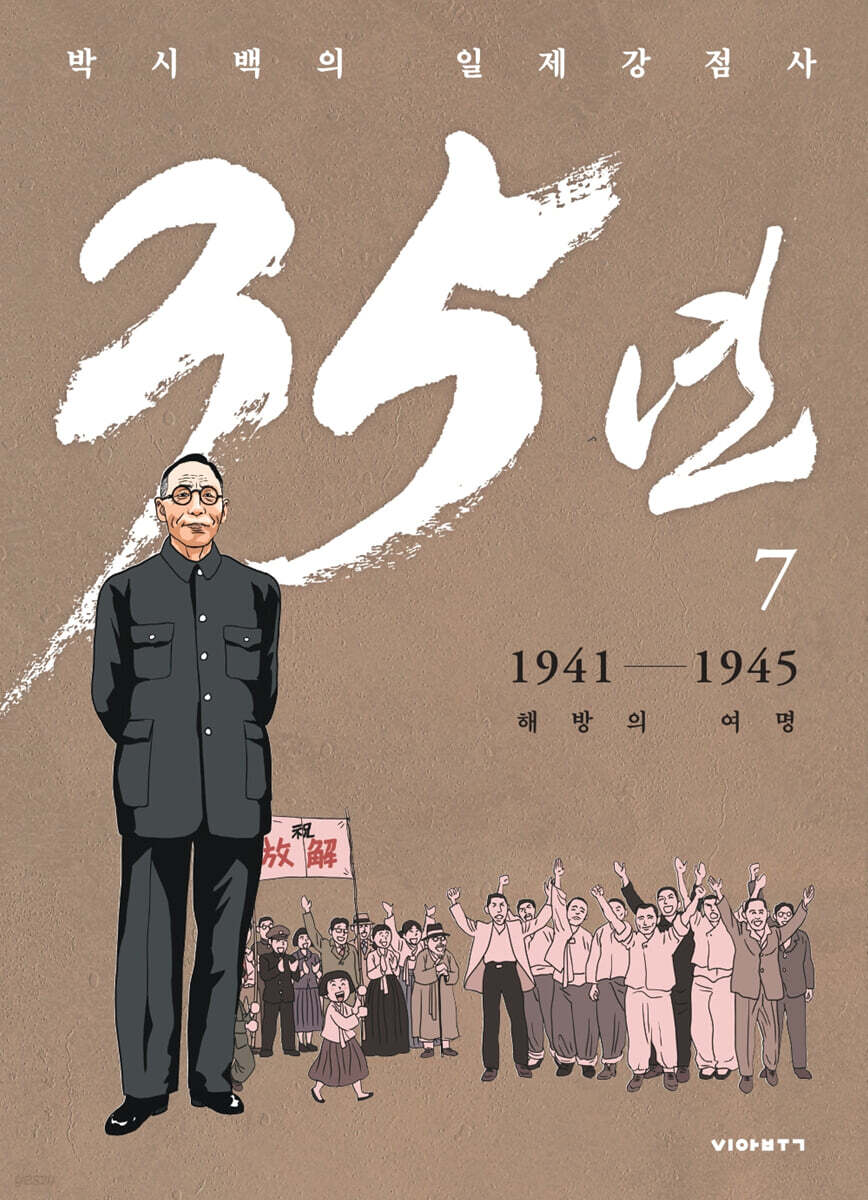
35 Years 7 (Independence Activist Yangjang Edition)
 |
Description
Book Introduction
A masterpiece depicting the 35 years of Japanese colonial history in comics.
Park Si-baek's 35 Years of Japanese Colonial History
Independence Activist Yangjang Edition published!
From the forced annexation by Japan in 1910 to the liberation in 1945, the unique book "Park Si-baek's 35 Years of Japanese Colonial History" depicts our history under Japanese colonial rule in the form of comics. Since the first volume was published in 2018, it has been widely loved and established as a must-read for the nation.
A massive volume featuring approximately 1,000 characters, reconstructed from solid research, the vivid scenes unfold over seven volumes.
To commemorate the 79th anniversary of liberation, we are republishing this book as a 'Independence Activist Hardcover Edition' with corrections to errors in the illustrations and content and a redesigned cover so that it can be kept for a long time.
The cover concept for this edition of the Independence Activist Hardcover Edition of “Park Si-baek’s 35 Years of Japanese Colonial History” is “Memory and Record.”
The author's intention was to bring back the names of forgotten independence activists one by one and to remember without exception even the pro-Japanese traitors who betrayed our people.
The front cover depicts independence activists and representative events that symbolize each period, and the back cover records pro-Japanese and anti-nationalist collaborators who we must remember.
Furthermore, to show that the past 35 years have been a history of proud struggle, not a history of submission, the title written in the dynamic and powerful calligraphy of Tanjeong Lee Jin-hyeok was placed at the front.
In these times, as remarks that undermine the significance of Japanese colonial rule in our history and denigrate independence activists become increasingly inflammatory, I hope that "Park Si-baek's 35 Years of Japanese Colonialism" will help restore the balance in historical perception.
Park Si-baek's 35 Years of Japanese Colonial History
Independence Activist Yangjang Edition published!
From the forced annexation by Japan in 1910 to the liberation in 1945, the unique book "Park Si-baek's 35 Years of Japanese Colonial History" depicts our history under Japanese colonial rule in the form of comics. Since the first volume was published in 2018, it has been widely loved and established as a must-read for the nation.
A massive volume featuring approximately 1,000 characters, reconstructed from solid research, the vivid scenes unfold over seven volumes.
To commemorate the 79th anniversary of liberation, we are republishing this book as a 'Independence Activist Hardcover Edition' with corrections to errors in the illustrations and content and a redesigned cover so that it can be kept for a long time.
The cover concept for this edition of the Independence Activist Hardcover Edition of “Park Si-baek’s 35 Years of Japanese Colonial History” is “Memory and Record.”
The author's intention was to bring back the names of forgotten independence activists one by one and to remember without exception even the pro-Japanese traitors who betrayed our people.
The front cover depicts independence activists and representative events that symbolize each period, and the back cover records pro-Japanese and anti-nationalist collaborators who we must remember.
Furthermore, to show that the past 35 years have been a history of proud struggle, not a history of submission, the title written in the dynamic and powerful calligraphy of Tanjeong Lee Jin-hyeok was placed at the front.
In these times, as remarks that undermine the significance of Japanese colonial rule in our history and denigrate independence activists become increasingly inflammatory, I hope that "Park Si-baek's 35 Years of Japanese Colonialism" will help restore the balance in historical perception.
- You can preview some of the book's contents.
Preview
index
[Volume 7] 1941-1945: The Dawn of Liberation
|Prologue| In the early 1940s, the world
Chapter 1: The Empire in Frenzy
Into an all-out war system
Exhibition economy, exhibition life
Conscription system, student conscription system
Forced conscription, comfort women
Chapter 2: Pro-Japanese Chorus 1
Perceptions of pro-Japanese collaborators and major pro-Japanese organizations
nobles
managers
Graduates of the Japanese Military Academy
Graduates of the Manchukuo Military Academy and pro-Japanese collaborators in Manchuria
Chapter 3: Pro-Japanese Chorus 2
The prestigious ones
writers
theater, film, and dance worlds
art world
music industry
Women's, education, and media circles
Religion and religious people
Business world, etc.
Chapter 4: Resistance in the Face of Tyranny
Workers and peasants' resistance
Resistance of young students
The struggle to escape from the Japanese military
The Korean Language Society incident, and…
Chapter 5: The Last Resistance and Preparations for the Founding of the Nation
Provisional Government and Korean Liberation Army
Korean Volunteer Army
Kim Il-sung Group
Syngman Rhee and Korean-American forces
National Foundation Alliance, a domestic communist group
Efforts by each force to form a united front
Nationalist movement in Japan
Chapter 6: The Fall of Japan and Liberation
liberation?
The road back home
Without seeing liberation
Japan after defeat
|Appendix|
Volume 7 Chronology
7-volume biographical dictionary
Reading the feed
References
|Prologue| In the early 1940s, the world
Chapter 1: The Empire in Frenzy
Into an all-out war system
Exhibition economy, exhibition life
Conscription system, student conscription system
Forced conscription, comfort women
Chapter 2: Pro-Japanese Chorus 1
Perceptions of pro-Japanese collaborators and major pro-Japanese organizations
nobles
managers
Graduates of the Japanese Military Academy
Graduates of the Manchukuo Military Academy and pro-Japanese collaborators in Manchuria
Chapter 3: Pro-Japanese Chorus 2
The prestigious ones
writers
theater, film, and dance worlds
art world
music industry
Women's, education, and media circles
Religion and religious people
Business world, etc.
Chapter 4: Resistance in the Face of Tyranny
Workers and peasants' resistance
Resistance of young students
The struggle to escape from the Japanese military
The Korean Language Society incident, and…
Chapter 5: The Last Resistance and Preparations for the Founding of the Nation
Provisional Government and Korean Liberation Army
Korean Volunteer Army
Kim Il-sung Group
Syngman Rhee and Korean-American forces
National Foundation Alliance, a domestic communist group
Efforts by each force to form a united front
Nationalist movement in Japan
Chapter 6: The Fall of Japan and Liberation
liberation?
The road back home
Without seeing liberation
Japan after defeat
|Appendix|
Volume 7 Chronology
7-volume biographical dictionary
Reading the feed
References
Detailed image

Publisher's Review
Culture, fun, meaning… the pinnacle of Park Si-baek’s historical comics!
Digging into the tight crevices of history with a pen
History is a continuum between past and present.
While working on his previous work, “Park Si-baek’s Annals of the Joseon Dynasty,” the author focused on the history after the period when the writing of “Annals of the Joseon Dynasty” was forcibly halted.
Because the shameful history of colonial life is directly connected to our ‘present.’
As soon as I finished working on “Park Si-baek’s Annals of the Joseon Dynasty,” I traveled to the sites of the independence movement, both domestically and internationally, and after five years of devoted study and collection of various materials, I published the first volume of “Park Si-baek’s 35 Years of Japanese Colonial History.”
Since I did not hire any assistants to help me with my work, and took charge of all the processes myself, including researching and organizing materials, storyboards and sketches, pen work, and coloring, the work was slow, but the quality of the work was high.
We can confirm that the '35 years' that gave birth to the democratic republic we enjoy today are a proud part of our history, not only as a history of pro-Japanese collaborators but also as a history of fierce anti-Japanese struggle.
The power of a single, precise cut,
35 years of vivid facts and details
In his previous work, “Park Si-baek’s Annals of the Joseon Dynasty,” artist Park described Yi Seong-gye’s childhood with a pigtail, giving readers a concise explanation of the times in just one cut.
This kind of sophisticated directing is also prominent in “Park Si-baek’s 35 Years of Japanese Colonial History.”
In the Hongkou Park incident scene in Volume 4, Dr. Yun Bong-gil throws a water bottle bomb at the Japanese commander on the platform.
We have known it as a 'lunchbox bomb' for a long time, but recent research shows that Dr. Yun Bong-gil prepared two bombs, a 'lunchbox bomb' and a 'water bottle bomb', and used the 'water bottle bomb' during the uprising.
The author vividly recreates this with just one picture.
Meanwhile, the single picture in Volume 1 depicting the 60 or so members of Lee Hoe-young's family selling their property and going into exile brings a feeling of emotion that cannot be expressed in words.
Expressing multiple explanations in a single picture is a unique charm of comics.
From female independence activists to pro-Japanese collaborators such as spies,
35 years of living, breathing characters and events
《Park Si-baek's 35 Years of Japanese Colonial History》 puts a lot of effort into introducing the Japanese Government-General of Korea and the police who engulfed Joseon with harsh oppression, the pro-Japanese collaborators who sold out their country and compatriots for their own wealth and fame, the moments of the March 1st Revolution when the people's boiling resistance exploded and the mass movements that followed, the establishment and division of the Provisional Government of the Republic of Korea, those who escaped colonial Gyeongseong and traveled overseas to Gando, the Maritime Province, Shanghai, and Hawaii to explore the possibility of independence, the independence fighters who burned their will for independence with armed struggle and righteous struggle, and female independence activists such as Kim Alexandra, Yun Hee-soon, and Nam Ja-hyeon, who were somewhat unfamiliar to us.
As the author stated in the preface, with a sense of mission to make as many independence activists and pro-Japanese collaborators known as possible, approximately 1,000 characters appear in volumes 1-7.
The complex relationship between socialists and nationalists, sometimes in conflict and sometimes in cooperation, is depicted three-dimensionally, intersecting like warp and weft.
As befitting a cartoonist, Park reinterprets contemporary events and figures from a present-day perspective and vividly expresses them with a sharp wit.
Additionally, a chronological table by period is included at the end of the text to provide an easy-to-understand overview of major domestic and global events by year.
The appendix, “Biographical Dictionary,” provides a detailed summary of the lives and historical evaluations of independence activists and pro-Japanese collaborators.
In particular, Volume 7 describes in detail the process and actions of many communists and nationalists who turned to pro-Japanese forces during the victorious period of the Manchurian invasion, the Second Sino-Japanese War, and the Pacific War.
Pro-Japanese collaborators, mainly from the upper echelons of society, including the nobility, government officials, military personnel, artists, religious figures, and businessmen, actively promoted cooperation in the war and the unity of Japan and Korea.
Even after liberation, they continued to be active in various areas of society and established themselves as leaders of our society.
Let's understand the story through comics, and meet living, breathing historical figures and events by summarizing the content once again through the appendix.
From Joseon people to modern people,
35 years of confirming the prototype of Korean society
During the 35 years of Japanese colonial rule, Koreans transformed into modern people.
The Korean people, as colonists who experienced internal conflict under Japan's oppressive rule, as a generation that experienced the modernized class and land system, and above all, as revolutionaries who continued the ceaseless struggle for independence.
They are the closest prototype to the way we live in Korean society today.
Park Si-baek's "35 Years of Japanese Colonial History" vividly restores this original time, this unresolved past history.
History is not simply a display and listing of stuffed information, but rather a communication that breathes with our social reality.
Comparing history as a prototype with our present self in this way leads to the fundamental question, "Why do we learn history?"
Author Park Si-baek says this:
“Why do we learn history?
The common answer is to learn from the past and not repeat past mistakes.
But for us ordinary people who are not in charge of government affairs, this is a somewhat abstract answer.
Some say that we gain wisdom to live from history.
However, the path of anti-Japanese struggle was a path of hardship and death, while the path of collaboration with Japan was a path of comfort and glory.
“If living like the latter becomes the wisdom we gain from history, then learning history becomes a very miserable thing.”
35 Years Seen anew in a World Historical Context
- Appendix "35 Years of the World, Us" provided
Another characteristic of “Park Si-baek’s 35 Years of Japanese Colonial History” is that it breaks away from the nationalistic and state-based perspective on history and considers the global historical context.
The 35 years of Japanese colonial history were not a dichotomous one of Japanese oppression and our resistance, but rather a global, organic situation that unfolded through the colonial exploitation of imperialist powers and two world wars.
For example, when the Russian Revolution occurred in 1917 and the Bolshevik regime came to power, Lee Dong-hui organized the Korean Socialist Party in the independence movement camp in step with this.
Wilson's principle of national self-determination, advocated after World War I, despite its inherent limitations, had a significant impact on the people who longed for independence from colonial countries. Yeo Un-hyeong, keeping a close eye on the rapidly changing situation, organized the New Korea Youth Party and prepared for a large-scale independence movement.
In this way, the prologue of each volume of “Park Si-baek’s 35 Years of Japanese Colonial History” introduces the prehistory that allows us to understand the flow of world history, allowing us to view our Japanese colonial period from a different perspective.
The box set includes the prologues of all seven volumes and the synopsis of "Park Si-baek's 35 Years of Japanese Colonial History" compiled into one book and provided as an appendix.
This will be a useful resource that provides a glimpse into the 35 years of unprecedented times humanity has faced, including World War I and II, the Great Depression, and mass genocide.
Through thorough research and verification
35 years of balanced perspectives and views
It is clear that 'you see as much as you know', but to achieve this, an active attitude to understand 'visible knowledge' without distorting it must come first.
Artist Park Si-baek, who presented the hidden joys of the history of the Joseon Dynasty based on thorough research and verification in his previous work, “Park Si-baek’s Annals of the Joseon Dynasty,” continues that trend once again with “Park Si-baek’s 35 Years of Japanese Colonial History.”
The author refuses to be mechanically neutral from the position of an “active historian,” without becoming mired in the age-old debate about the left-right confrontation in the history of the Japanese colonial period.
This is because only an undistorted view of history, an unwavering perspective, and a faithful interpretation of history, free from the attitude of observation, can provide us with a balanced perspective.
《Park Si-baek's 35 Years of Japanese Colonial History》 is based on the 《History of the Korean Independence Movement》 published by the Independence Movement History Compilation Committee and the 《Dictionary of Pro-Japanese Figures》 by the Dictionary of Pro-Japanese Figures Compilation Committee, and it took about four years just to study and organize the story by referring to research materials from the Encyclopedia of Korean Culture, the National Institute of Korean History, and around 100 volumes of books.
Additionally, nine current history teachers participated in the editing process to correct historical facts and devoted themselves to proofreading and organizing to deliver a rich work to readers.
Through rich visual materials
35 years of easy-to-understand various issues
The Japanese colonial period was often remembered with a focus on only a few heroic figures and events, such as Yu Gwan-sun's March 1st Movement, Yun Bong-gil's righteous deed, and Kim Jwa-jin's Battle of Cheongsan-ri.
However, the legacy left behind by the countless people who lived in the colony and struggled for independence is much broader.
"Park Si-baek's 35 Years of Japanese Colonial History" organizes complex and difficult issues that have been neglected, such as the activities and division of the Provisional Government, the division of the socialist movement, and the conflict and integration between nationalist and socialist forces, into a book that anyone can easily understand through visual aids such as pictures, photographs, and tables.
At the beginning of each chapter, representative events or people are introduced in infographics along with a map.
Photographic materials and brief summaries presented with geographical information allow readers to grasp information at a glance that cannot be understood through text alone.
In this way, the combination of comics and textbooks (history books) allows for practical connection and utilization in educational settings for not only adults but also youth, and is also excellent as a supplementary teaching material that supplements issues that cannot be covered in detail through classes.
Recording history through comics
History is always three-dimensional.
The way we understand history has always been through one-dimensional texts, but those who ran around colonial Korea and shouted "Manse" were clearly people who breathed in the same time and space as us.
Comics are the closest thing to that kind of real-world time and space, and they are an effective medium for vividly recording the lives they lived.
Unlike the recent trend of producing comics through a division of labor system, artist Park Si-baek is in charge of the entire process, from storyboarding to drawing and coloring.
Although the work schedule is slow, it presents a high-quality educational comic in which information and pictures are organically combined rather than being separated like regular educational comics.
Additionally, the lines of the characters in the cartoon were drawn directly by the author in his own handwriting, enhancing the power of communication between the text and the pictures.
In the author's note, the author states, "The 35 years of Japanese colonial rule are a history of continuous and fierce anti-Japanese struggle."
He also stated that he published this book with a “sense of mission to make as many independence activists and pro-Japanese collaborators known as possible.”
Of course, many books dealing with the Japanese colonial period have a similar weight, but what is important is that "Park Si-baek's 35 Years of Japanese Colonial History" is a comic book.
Recording the history of the Japanese colonial period in comics involves transforming the rigidity of historical text into soft lines, expressing the boiling cries of independence activists through the gaps between cuts, and coloring them with the blood they shed.
Digging into the tight crevices of history with a pen
History is a continuum between past and present.
While working on his previous work, “Park Si-baek’s Annals of the Joseon Dynasty,” the author focused on the history after the period when the writing of “Annals of the Joseon Dynasty” was forcibly halted.
Because the shameful history of colonial life is directly connected to our ‘present.’
As soon as I finished working on “Park Si-baek’s Annals of the Joseon Dynasty,” I traveled to the sites of the independence movement, both domestically and internationally, and after five years of devoted study and collection of various materials, I published the first volume of “Park Si-baek’s 35 Years of Japanese Colonial History.”
Since I did not hire any assistants to help me with my work, and took charge of all the processes myself, including researching and organizing materials, storyboards and sketches, pen work, and coloring, the work was slow, but the quality of the work was high.
We can confirm that the '35 years' that gave birth to the democratic republic we enjoy today are a proud part of our history, not only as a history of pro-Japanese collaborators but also as a history of fierce anti-Japanese struggle.
The power of a single, precise cut,
35 years of vivid facts and details
In his previous work, “Park Si-baek’s Annals of the Joseon Dynasty,” artist Park described Yi Seong-gye’s childhood with a pigtail, giving readers a concise explanation of the times in just one cut.
This kind of sophisticated directing is also prominent in “Park Si-baek’s 35 Years of Japanese Colonial History.”
In the Hongkou Park incident scene in Volume 4, Dr. Yun Bong-gil throws a water bottle bomb at the Japanese commander on the platform.
We have known it as a 'lunchbox bomb' for a long time, but recent research shows that Dr. Yun Bong-gil prepared two bombs, a 'lunchbox bomb' and a 'water bottle bomb', and used the 'water bottle bomb' during the uprising.
The author vividly recreates this with just one picture.
Meanwhile, the single picture in Volume 1 depicting the 60 or so members of Lee Hoe-young's family selling their property and going into exile brings a feeling of emotion that cannot be expressed in words.
Expressing multiple explanations in a single picture is a unique charm of comics.
From female independence activists to pro-Japanese collaborators such as spies,
35 years of living, breathing characters and events
《Park Si-baek's 35 Years of Japanese Colonial History》 puts a lot of effort into introducing the Japanese Government-General of Korea and the police who engulfed Joseon with harsh oppression, the pro-Japanese collaborators who sold out their country and compatriots for their own wealth and fame, the moments of the March 1st Revolution when the people's boiling resistance exploded and the mass movements that followed, the establishment and division of the Provisional Government of the Republic of Korea, those who escaped colonial Gyeongseong and traveled overseas to Gando, the Maritime Province, Shanghai, and Hawaii to explore the possibility of independence, the independence fighters who burned their will for independence with armed struggle and righteous struggle, and female independence activists such as Kim Alexandra, Yun Hee-soon, and Nam Ja-hyeon, who were somewhat unfamiliar to us.
As the author stated in the preface, with a sense of mission to make as many independence activists and pro-Japanese collaborators known as possible, approximately 1,000 characters appear in volumes 1-7.
The complex relationship between socialists and nationalists, sometimes in conflict and sometimes in cooperation, is depicted three-dimensionally, intersecting like warp and weft.
As befitting a cartoonist, Park reinterprets contemporary events and figures from a present-day perspective and vividly expresses them with a sharp wit.
Additionally, a chronological table by period is included at the end of the text to provide an easy-to-understand overview of major domestic and global events by year.
The appendix, “Biographical Dictionary,” provides a detailed summary of the lives and historical evaluations of independence activists and pro-Japanese collaborators.
In particular, Volume 7 describes in detail the process and actions of many communists and nationalists who turned to pro-Japanese forces during the victorious period of the Manchurian invasion, the Second Sino-Japanese War, and the Pacific War.
Pro-Japanese collaborators, mainly from the upper echelons of society, including the nobility, government officials, military personnel, artists, religious figures, and businessmen, actively promoted cooperation in the war and the unity of Japan and Korea.
Even after liberation, they continued to be active in various areas of society and established themselves as leaders of our society.
Let's understand the story through comics, and meet living, breathing historical figures and events by summarizing the content once again through the appendix.
From Joseon people to modern people,
35 years of confirming the prototype of Korean society
During the 35 years of Japanese colonial rule, Koreans transformed into modern people.
The Korean people, as colonists who experienced internal conflict under Japan's oppressive rule, as a generation that experienced the modernized class and land system, and above all, as revolutionaries who continued the ceaseless struggle for independence.
They are the closest prototype to the way we live in Korean society today.
Park Si-baek's "35 Years of Japanese Colonial History" vividly restores this original time, this unresolved past history.
History is not simply a display and listing of stuffed information, but rather a communication that breathes with our social reality.
Comparing history as a prototype with our present self in this way leads to the fundamental question, "Why do we learn history?"
Author Park Si-baek says this:
“Why do we learn history?
The common answer is to learn from the past and not repeat past mistakes.
But for us ordinary people who are not in charge of government affairs, this is a somewhat abstract answer.
Some say that we gain wisdom to live from history.
However, the path of anti-Japanese struggle was a path of hardship and death, while the path of collaboration with Japan was a path of comfort and glory.
“If living like the latter becomes the wisdom we gain from history, then learning history becomes a very miserable thing.”
35 Years Seen anew in a World Historical Context
- Appendix "35 Years of the World, Us" provided
Another characteristic of “Park Si-baek’s 35 Years of Japanese Colonial History” is that it breaks away from the nationalistic and state-based perspective on history and considers the global historical context.
The 35 years of Japanese colonial history were not a dichotomous one of Japanese oppression and our resistance, but rather a global, organic situation that unfolded through the colonial exploitation of imperialist powers and two world wars.
For example, when the Russian Revolution occurred in 1917 and the Bolshevik regime came to power, Lee Dong-hui organized the Korean Socialist Party in the independence movement camp in step with this.
Wilson's principle of national self-determination, advocated after World War I, despite its inherent limitations, had a significant impact on the people who longed for independence from colonial countries. Yeo Un-hyeong, keeping a close eye on the rapidly changing situation, organized the New Korea Youth Party and prepared for a large-scale independence movement.
In this way, the prologue of each volume of “Park Si-baek’s 35 Years of Japanese Colonial History” introduces the prehistory that allows us to understand the flow of world history, allowing us to view our Japanese colonial period from a different perspective.
The box set includes the prologues of all seven volumes and the synopsis of "Park Si-baek's 35 Years of Japanese Colonial History" compiled into one book and provided as an appendix.
This will be a useful resource that provides a glimpse into the 35 years of unprecedented times humanity has faced, including World War I and II, the Great Depression, and mass genocide.
Through thorough research and verification
35 years of balanced perspectives and views
It is clear that 'you see as much as you know', but to achieve this, an active attitude to understand 'visible knowledge' without distorting it must come first.
Artist Park Si-baek, who presented the hidden joys of the history of the Joseon Dynasty based on thorough research and verification in his previous work, “Park Si-baek’s Annals of the Joseon Dynasty,” continues that trend once again with “Park Si-baek’s 35 Years of Japanese Colonial History.”
The author refuses to be mechanically neutral from the position of an “active historian,” without becoming mired in the age-old debate about the left-right confrontation in the history of the Japanese colonial period.
This is because only an undistorted view of history, an unwavering perspective, and a faithful interpretation of history, free from the attitude of observation, can provide us with a balanced perspective.
《Park Si-baek's 35 Years of Japanese Colonial History》 is based on the 《History of the Korean Independence Movement》 published by the Independence Movement History Compilation Committee and the 《Dictionary of Pro-Japanese Figures》 by the Dictionary of Pro-Japanese Figures Compilation Committee, and it took about four years just to study and organize the story by referring to research materials from the Encyclopedia of Korean Culture, the National Institute of Korean History, and around 100 volumes of books.
Additionally, nine current history teachers participated in the editing process to correct historical facts and devoted themselves to proofreading and organizing to deliver a rich work to readers.
Through rich visual materials
35 years of easy-to-understand various issues
The Japanese colonial period was often remembered with a focus on only a few heroic figures and events, such as Yu Gwan-sun's March 1st Movement, Yun Bong-gil's righteous deed, and Kim Jwa-jin's Battle of Cheongsan-ri.
However, the legacy left behind by the countless people who lived in the colony and struggled for independence is much broader.
"Park Si-baek's 35 Years of Japanese Colonial History" organizes complex and difficult issues that have been neglected, such as the activities and division of the Provisional Government, the division of the socialist movement, and the conflict and integration between nationalist and socialist forces, into a book that anyone can easily understand through visual aids such as pictures, photographs, and tables.
At the beginning of each chapter, representative events or people are introduced in infographics along with a map.
Photographic materials and brief summaries presented with geographical information allow readers to grasp information at a glance that cannot be understood through text alone.
In this way, the combination of comics and textbooks (history books) allows for practical connection and utilization in educational settings for not only adults but also youth, and is also excellent as a supplementary teaching material that supplements issues that cannot be covered in detail through classes.
Recording history through comics
History is always three-dimensional.
The way we understand history has always been through one-dimensional texts, but those who ran around colonial Korea and shouted "Manse" were clearly people who breathed in the same time and space as us.
Comics are the closest thing to that kind of real-world time and space, and they are an effective medium for vividly recording the lives they lived.
Unlike the recent trend of producing comics through a division of labor system, artist Park Si-baek is in charge of the entire process, from storyboarding to drawing and coloring.
Although the work schedule is slow, it presents a high-quality educational comic in which information and pictures are organically combined rather than being separated like regular educational comics.
Additionally, the lines of the characters in the cartoon were drawn directly by the author in his own handwriting, enhancing the power of communication between the text and the pictures.
In the author's note, the author states, "The 35 years of Japanese colonial rule are a history of continuous and fierce anti-Japanese struggle."
He also stated that he published this book with a “sense of mission to make as many independence activists and pro-Japanese collaborators known as possible.”
Of course, many books dealing with the Japanese colonial period have a similar weight, but what is important is that "Park Si-baek's 35 Years of Japanese Colonial History" is a comic book.
Recording the history of the Japanese colonial period in comics involves transforming the rigidity of historical text into soft lines, expressing the boiling cries of independence activists through the gaps between cuts, and coloring them with the blood they shed.
GOODS SPECIFICS
- Date of issue: October 7, 2024
- Format: Hardcover book binding method guide
- Page count, weight, size: 384 pages | 780g | 173*243*30mm
- ISBN13: 9791192904986
- ISBN10: 1192904982
You may also like
카테고리
korean


korean

![GQ KOREA Mark (Monthly): December [2025]](http://librairie.coreenne.fr/cdn/shop/files/8ef265dbbfbf186523ed75ba7319009d.jpg?v=1765340328&width=3840)


