

Daegu Independence Movement Sites Tour 3
 |
Description
Book Introduction
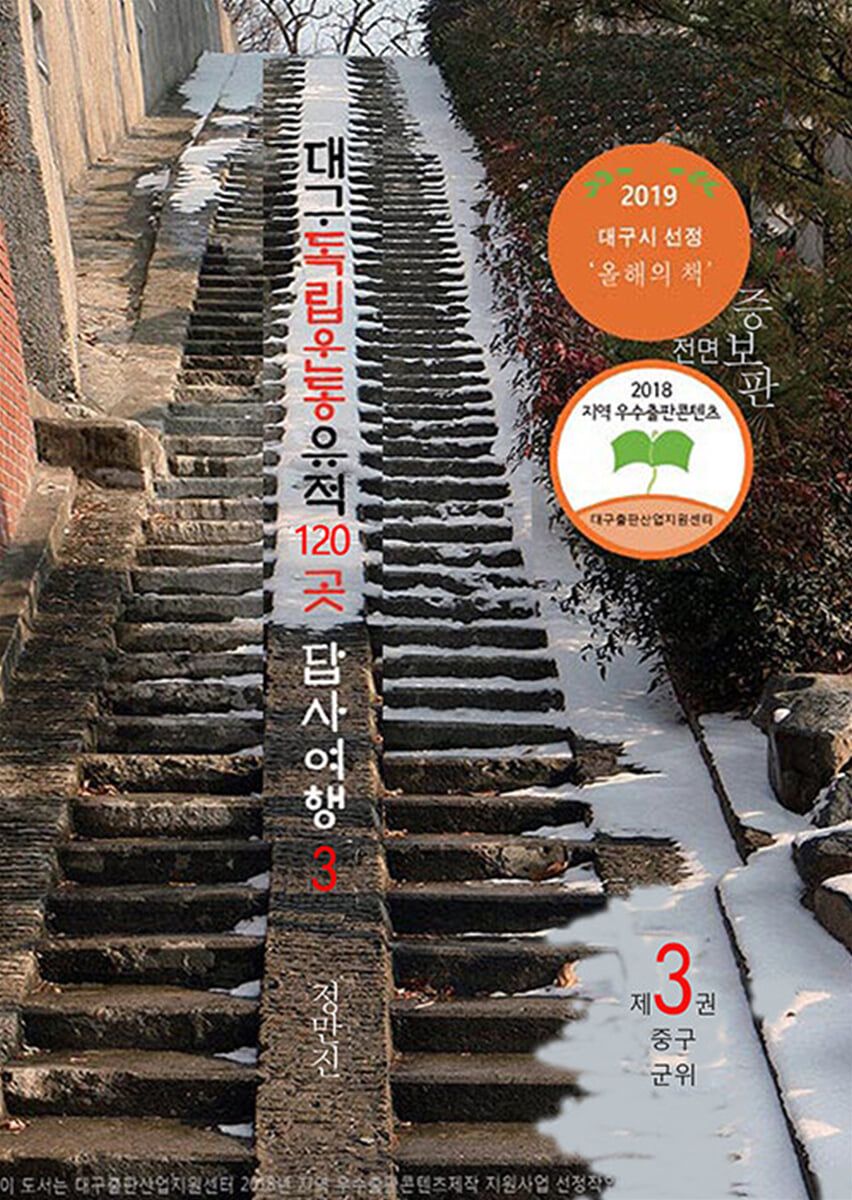
This is a fully expanded edition of [A Field Trip to 100 Sites of the Daegu Independence Movement], the 2019 Daegu City Book of the Year.
As Gunwi County was incorporated into Daegu City, and new and lost relics were discovered within the city, the need arose to supplement and refine the existing manuscript, so a comprehensive expansion was made. However, the book became so thick that it was inevitably divided into three volumes.
Volume 1 covers Dalseo-gu and Nam-gu, Volume 2 covers Dong-gu, Buk-gu, Suseong-gu, and Dalseong-gun, and Volume 3 covers Jung-gu and Gunwi-gun.
As Gunwi County was incorporated into Daegu City, and new and lost relics were discovered within the city, the need arose to supplement and refine the existing manuscript, so a comprehensive expansion was made. However, the book became so thick that it was inevitably divided into three volumes.
Volume 1 covers Dalseo-gu and Nam-gu, Volume 2 covers Dong-gu, Buk-gu, Suseong-gu, and Dalseong-gun, and Volume 3 covers Jung-gu and Gunwi-gun.
- You can preview some of the book's contents.
Preview
index
[Poem] Good Pan: Choi Young * 11
01.
Daegu Prison Site * 11
02.
Daegu Normal School Dahyeokdang Struggle Site * 20
03.
Daegu High School Alliance Strike Site * 27
04.
Daegu Commercial School Taegeuk Team Struggle Site * 29
05.
Taegeukdan leader Lee Sang-ho's birthplace * 31
06.
Taegeukdan Kim Sang-gil's birthplace * 31
07.
Taegeukdan leader Seo Sang-gyo's birthplace * 31
08.
House related to Lee Jong-am, the leader of the Uiyeoldan * 33
09.
Lee Yuk-sa Memorial Hall * 41
10.
Namsan Church * 46
11.
Donghwasa Temple Monk's Righteous Deed at Bohyeonsa Temple * 52
12.
Deoksanjeong Market * 52
13.
March 10, 1919, Yeommae Market * 54
14.
Kim Jin-man and Kim Jin-woo brothers' house site * 55
15.
Choi Je-woo's execution site * 57
16.
Daegu Pistol Incident Site * 58
17.
The Wives of the National Debt Redemption Movement in Jingolmok * 60
18.
Gyo-nam YMCA * 61
19.
Site of Governor Seo Sang-han's house * 65
20.
The Nihilistic Declaration of Independence * 66
21.
Sanghwa House * 69
22.
Choi Hae-cheong's house site * 71
23.
Seo Sang-don's House * 72
24.
Lee Sang-jeong's House * 74 - Hyun Jin-geon's Information Board * 76
[Poem] I am Hyun Jin-geon: Choi Young * 80
25.
90 steps * 82
26.
Shinmyeong School Memorial Tower? Blair Missionary House * 82
27.
Gyeseong School * 84
28.
The starting point of the Daegu Independence Movement in 1919 * 87
29.
Governor Lee Jong-am's Independence Movement Fund Raising Site * 89
30.
Lee Il-woo's House * 102
31.
Lee Sang-hwa's Birthplace * 104
32.
Uhyeonseoru site * 104
33.
Emperor Sunjong visits Dalseong Toseong * 116
34.
Choi Je-woo Statue * 118
35.
Seo Dong-gyun Art Fee * 120
36.
Sanghwa Sibi * 120
37.
Lee Sang-ryong's National Salvation Monument * 121
38.
False monument to the martyrs * 123
39.
Formation of the G Party * 125
40.
Founding of the Liberation Association * 126
41.
Site of the statue of King Sunjong * 151 ? Site of the Joyang Hall * 155
42.
Gwangmunsa Temple Site * 157
43.
Bukseong-ro * 158
44.
1919 Manse Movement Road * 163
45.
Daegu Police Station site * 165
46.
Jongno Elementary School, Choi Je-woo Tree * 167
47.
Hope's 'Comfort Women' History * 168
48.
Kim Seok-hyung's house site * 171
49.
Bukhujeong site * 172
50.
Dr. Jang Jin-hong's Historic Site * 173
51.
Oriental Development Company site * 178
52.
National Debt Redemption Movement Memorial Hall, National Debt Redemption Park * 179
53.
The Last Scene on March 8, 1919 * 166
It is efficient to conduct the survey in the above order.
54.
Dr. Heo Seok's Miracle Monument * 183
55.
Gunwi Holiness Church * 185
56.
Governor Lee Yong-moon's house site * 186
57.
Governor Park Mu-jo's Monument * 187
58.
The Manse Movement site, Ubo Market * 188
59.
Kim Harak's volunteer army base * 189
60.
The site of the house of Governor Lee Hyeon-seop, who died at midnight * 190
61.
The Shinganhoe Gwaehwadong branch and the Gachang massacre * 191
62.
Tomb of Uiyeoldan member and patriot Ryu Si-tae * 210
01.
Daegu Prison Site * 11
02.
Daegu Normal School Dahyeokdang Struggle Site * 20
03.
Daegu High School Alliance Strike Site * 27
04.
Daegu Commercial School Taegeuk Team Struggle Site * 29
05.
Taegeukdan leader Lee Sang-ho's birthplace * 31
06.
Taegeukdan Kim Sang-gil's birthplace * 31
07.
Taegeukdan leader Seo Sang-gyo's birthplace * 31
08.
House related to Lee Jong-am, the leader of the Uiyeoldan * 33
09.
Lee Yuk-sa Memorial Hall * 41
10.
Namsan Church * 46
11.
Donghwasa Temple Monk's Righteous Deed at Bohyeonsa Temple * 52
12.
Deoksanjeong Market * 52
13.
March 10, 1919, Yeommae Market * 54
14.
Kim Jin-man and Kim Jin-woo brothers' house site * 55
15.
Choi Je-woo's execution site * 57
16.
Daegu Pistol Incident Site * 58
17.
The Wives of the National Debt Redemption Movement in Jingolmok * 60
18.
Gyo-nam YMCA * 61
19.
Site of Governor Seo Sang-han's house * 65
20.
The Nihilistic Declaration of Independence * 66
21.
Sanghwa House * 69
22.
Choi Hae-cheong's house site * 71
23.
Seo Sang-don's House * 72
24.
Lee Sang-jeong's House * 74 - Hyun Jin-geon's Information Board * 76
[Poem] I am Hyun Jin-geon: Choi Young * 80
25.
90 steps * 82
26.
Shinmyeong School Memorial Tower? Blair Missionary House * 82
27.
Gyeseong School * 84
28.
The starting point of the Daegu Independence Movement in 1919 * 87
29.
Governor Lee Jong-am's Independence Movement Fund Raising Site * 89
30.
Lee Il-woo's House * 102
31.
Lee Sang-hwa's Birthplace * 104
32.
Uhyeonseoru site * 104
33.
Emperor Sunjong visits Dalseong Toseong * 116
34.
Choi Je-woo Statue * 118
35.
Seo Dong-gyun Art Fee * 120
36.
Sanghwa Sibi * 120
37.
Lee Sang-ryong's National Salvation Monument * 121
38.
False monument to the martyrs * 123
39.
Formation of the G Party * 125
40.
Founding of the Liberation Association * 126
41.
Site of the statue of King Sunjong * 151 ? Site of the Joyang Hall * 155
42.
Gwangmunsa Temple Site * 157
43.
Bukseong-ro * 158
44.
1919 Manse Movement Road * 163
45.
Daegu Police Station site * 165
46.
Jongno Elementary School, Choi Je-woo Tree * 167
47.
Hope's 'Comfort Women' History * 168
48.
Kim Seok-hyung's house site * 171
49.
Bukhujeong site * 172
50.
Dr. Jang Jin-hong's Historic Site * 173
51.
Oriental Development Company site * 178
52.
National Debt Redemption Movement Memorial Hall, National Debt Redemption Park * 179
53.
The Last Scene on March 8, 1919 * 166
It is efficient to conduct the survey in the above order.
54.
Dr. Heo Seok's Miracle Monument * 183
55.
Gunwi Holiness Church * 185
56.
Governor Lee Yong-moon's house site * 186
57.
Governor Park Mu-jo's Monument * 187
58.
The Manse Movement site, Ubo Market * 188
59.
Kim Harak's volunteer army base * 189
60.
The site of the house of Governor Lee Hyeon-seop, who died at midnight * 190
61.
The Shinganhoe Gwaehwadong branch and the Gachang massacre * 191
62.
Tomb of Uiyeoldan member and patriot Ryu Si-tae * 210
Into the book
During the Japanese colonial period, there was a reputation that said, “When it comes to photography, it’s Choi Gye-bok from Daegu and Jeong Do-seon from Hoeryeong.”
A photo book commemorating the 100th anniversary of the birth of Choi Gye-bok, a famous photographer, was published on October 28, 2009.
The cover of the photo album is decorated with his first work, ‘Spring at Yeongseon Pond.’
In the 1933 work, “Spring at Yeongseon Pond,” well-dressed women and grown men in suits and bowler hats are enjoying a cruise on a cruise ship.
That means Yeongseon Pond was that big.
In the 1970s, Daegu had many large lakes.
The Yeongseon Pond that appears in Choi Gye-bok's photo album was located in front of Daegu National University of Education, and the Baeja Pond was located beyond the north gate of Kyungpook National University.
There was a large lake in Gamsam-dong before Baejamot was 'destined' to die.
But they all filled it up to build apartments.
Even before that, the area around the current Seomun Market was also a large lake.
The Japanese reclaimed what was originally a swamp and turned it into a market.
This indicates that the site of the Daegu Independence Movement on March 8, 1919 was not the current Seomun Market.
The Japanese were displeased with the fact that the people of Daegu gathered at Seomun Market and kept repeating the independence movement because it was the site of the independence movement.
So, it was forcibly moved to its current location on April 1, 1923.
The Academy of Korean Studies' "Encyclopedia of Korean Culture" states, "The Seomun Market, which was once famous, was (relocated) by the Daegu government as part of its colonial policy, citing the reason that the space was too small.
The March 1st Movement in Daegu in 1919 was led by white-clad merchants at Seomun Market, and the colonialists were terrified of the white-clad crowds loitering around the city.
The current site of Seomun Market was originally a swamp called “Seonghwangdang (Cheonhwangdang) Pond.”
In order to clear the lowlands, a lot of guest soil was needed, and it was filled in by transporting the earth from the ancient tombs in the highlands of Naedang-dong and Bisan-dong today.'
In this way, the Japanese destroyed the Seomun Market, the site of the Daegu Independence Movement.
To build the site of the current Seomun Market, all the ancient tombs in the Naedang-dong and Bisan-dong areas were destroyed.
The soil was moved and used to fill in the swamp.
(Daegu City held the 'Seomun Market 100th Anniversary Celebration' to commemorate it in 2023.
Are you in your right mind?)
As can be guessed from the fact that the Seomun Market in 1919 was located in front of the West Gate of Daegu Eupseong (Dalseomun, 52-5 Seoseong-ro 1-ga, Jung-gu), it was the area around 12 Gukchaebosang-ro 99-gil (15-30 Dongsan-dong), commonly known as the 'Motorcycle Alley'.
At the entrance to the alley, a signpost stands, declaring the ‘Birthplace of the Daegu March 1st Independence Movement.’
Seomun Market was often called 'Big Market' because, along with Pyeongyang Market and Ganggyeong Market, it was one of the three largest markets during the Joseon Dynasty.
March 8, 1919 was the Daegu Big Market day, and as a result, it was a perfect time and place for a independence movement as many people gathered there.
A photo book commemorating the 100th anniversary of the birth of Choi Gye-bok, a famous photographer, was published on October 28, 2009.
The cover of the photo album is decorated with his first work, ‘Spring at Yeongseon Pond.’
In the 1933 work, “Spring at Yeongseon Pond,” well-dressed women and grown men in suits and bowler hats are enjoying a cruise on a cruise ship.
That means Yeongseon Pond was that big.
In the 1970s, Daegu had many large lakes.
The Yeongseon Pond that appears in Choi Gye-bok's photo album was located in front of Daegu National University of Education, and the Baeja Pond was located beyond the north gate of Kyungpook National University.
There was a large lake in Gamsam-dong before Baejamot was 'destined' to die.
But they all filled it up to build apartments.
Even before that, the area around the current Seomun Market was also a large lake.
The Japanese reclaimed what was originally a swamp and turned it into a market.
This indicates that the site of the Daegu Independence Movement on March 8, 1919 was not the current Seomun Market.
The Japanese were displeased with the fact that the people of Daegu gathered at Seomun Market and kept repeating the independence movement because it was the site of the independence movement.
So, it was forcibly moved to its current location on April 1, 1923.
The Academy of Korean Studies' "Encyclopedia of Korean Culture" states, "The Seomun Market, which was once famous, was (relocated) by the Daegu government as part of its colonial policy, citing the reason that the space was too small.
The March 1st Movement in Daegu in 1919 was led by white-clad merchants at Seomun Market, and the colonialists were terrified of the white-clad crowds loitering around the city.
The current site of Seomun Market was originally a swamp called “Seonghwangdang (Cheonhwangdang) Pond.”
In order to clear the lowlands, a lot of guest soil was needed, and it was filled in by transporting the earth from the ancient tombs in the highlands of Naedang-dong and Bisan-dong today.'
In this way, the Japanese destroyed the Seomun Market, the site of the Daegu Independence Movement.
To build the site of the current Seomun Market, all the ancient tombs in the Naedang-dong and Bisan-dong areas were destroyed.
The soil was moved and used to fill in the swamp.
(Daegu City held the 'Seomun Market 100th Anniversary Celebration' to commemorate it in 2023.
Are you in your right mind?)
As can be guessed from the fact that the Seomun Market in 1919 was located in front of the West Gate of Daegu Eupseong (Dalseomun, 52-5 Seoseong-ro 1-ga, Jung-gu), it was the area around 12 Gukchaebosang-ro 99-gil (15-30 Dongsan-dong), commonly known as the 'Motorcycle Alley'.
At the entrance to the alley, a signpost stands, declaring the ‘Birthplace of the Daegu March 1st Independence Movement.’
Seomun Market was often called 'Big Market' because, along with Pyeongyang Market and Ganggyeong Market, it was one of the three largest markets during the Joseon Dynasty.
March 8, 1919 was the Daegu Big Market day, and as a result, it was a perfect time and place for a independence movement as many people gathered there.
--- From the text
GOODS SPECIFICS
- Date of issue: September 2, 2024
- Page count, weight, size: 216 pages | 500g | 148*216*10mm
- ISBN13: 9791188701582
- ISBN10: 1188701584
You may also like
카테고리
korean


korean

![GQ KOREA Mark (Monthly): December [2025]](http://librairie.coreenne.fr/cdn/shop/files/8ef265dbbfbf186523ed75ba7319009d.jpg?v=1765340328&width=3840)


