

Daegu Independence Movement Sites Tour 2
 |
Description
Book Introduction
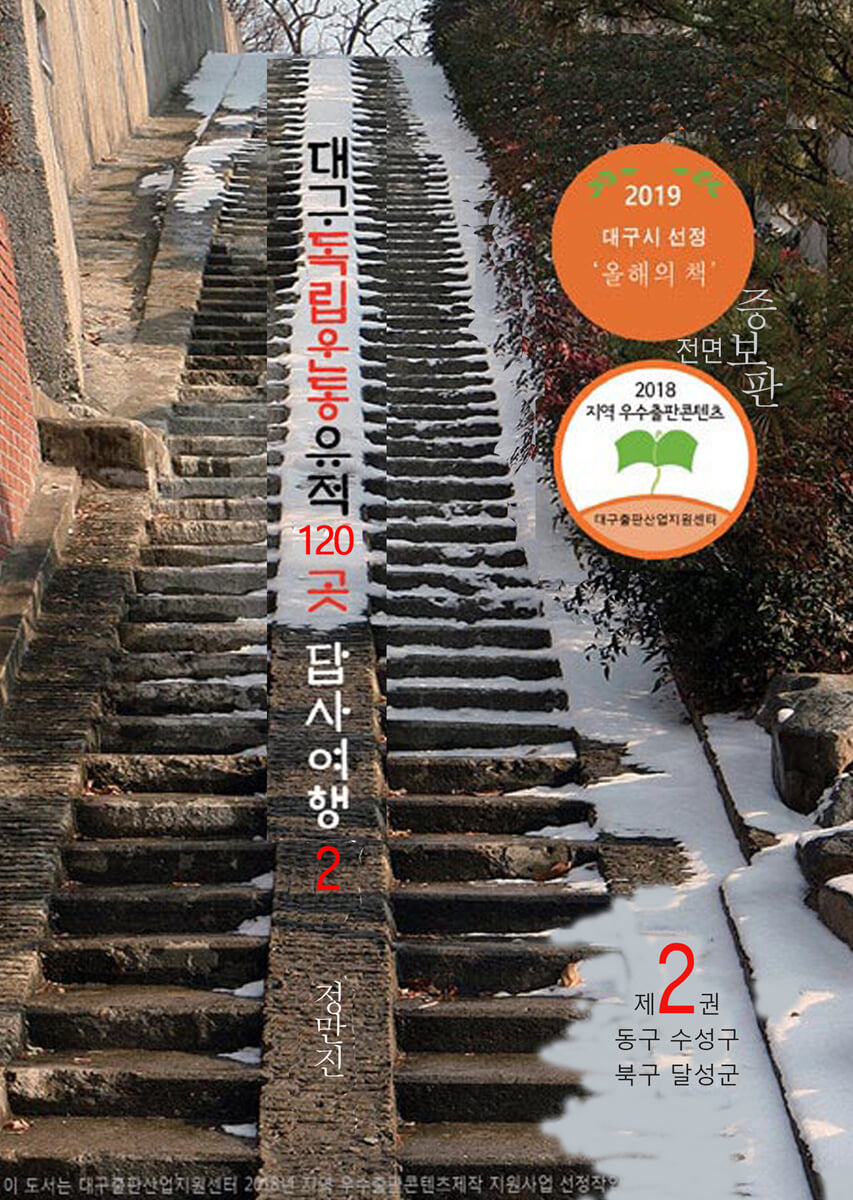
This is a fully expanded edition of [A Field Trip to 100 Sites of the Daegu Independence Movement], the 2019 Daegu City Book of the Year.
As Gunwi County was incorporated into Daegu City, and new and lost relics were discovered within the city, the need arose to supplement and refine the existing manuscript, so a comprehensive expansion was made. However, the book became so thick that it was inevitably divided into three volumes.
Volume 1 covers Dalseo-gu and Nam-gu, Volume 2 covers Dong-gu, Buk-gu, Suseong-gu, and Dalseong-gun, and Volume 3 covers Jung-gu and Gunwi-gun.
As Gunwi County was incorporated into Daegu City, and new and lost relics were discovered within the city, the need arose to supplement and refine the existing manuscript, so a comprehensive expansion was made. However, the book became so thick that it was inevitably divided into three volumes.
Volume 1 covers Dalseo-gu and Nam-gu, Volume 2 covers Dong-gu, Buk-gu, Suseong-gu, and Dalseong-gun, and Volume 3 covers Jung-gu and Gunwi-gun.
- You can preview some of the book's contents.
Preview
index
01.
Liberation Pine Tree * 08
02.
Bongmu-dong Japanese Military Cave * 13
03.
Dodong Cypress Forest Japanese Military Cave * 18
04.
Simgeomdang, the site of the student monk independence resolution * 19
05.
The final guerrilla battle of the Sannam Army, Dongwha Temple * 24
06.
Daegu's only village-level independence movement site, Mt. Yeobong * 34
07.
Governor Chae Chung-sik's house site * 37
08.
Governor Son Yang-yoon's birthplace * 41
09.
Birthplace of Governor Gu Chan-hoe * 43
10.
Monument to Governor Cho Hyun-wook's Martyrdom * 47
11.
Traitor Park Jung-yang's Historic Site * 49
12.
Memorial to Governor Chae Gi-jung * 56
13.
Monument to Governor Jang Yoon-deok's Martyrdom * 73
14.
Shinam Seonyeol Park * 79
15.
Geumjeongotaek * 101
16.
Andong Agricultural and Forestry Student Homestead * 106
17.
Estimated sites of 'comfort women' detention * 106
18.
Joyang Hall * 107
19.
Governor Lee Kyung-hee's public service monument * 114
20.
Woo Kang Song Jong-ik's statue * 121
21.
350-year-old Zelkova tree * 127
22.
Seo Sang-don's Tomb * 128
23.
Sugi Im Tae-rang and Myo * 132
24.
Idealization controversy * 136
25.
Remains of the Tenancy Dispute on Yangdo-il * 158
26.
Lee Gyeong-man's Provisional Government Organization Member Remains * 159
27.
Seoboin Bocheon Bridge Relics * 160
28.
Seo Geon-su Paris Jang-seo Relics * 161
29.
Jo Eun-seok's Daegu High School Struggle Site * 163
30.
Governor Jeonghak's statue * 164
31.
Governor Moon Young-bak's Relics * 167
32.
Lee Hyun-soo's father and son's remains * 169
33.
Birthplace of Governor Moon Seok-bong * 171
34.
Governor Jo Gi-hong's weapons cache in Bisulsan * 174
35.
Governor Park Yong-gyu's remains * 175
36.
Lee Yun-jae, a Korean language scholar, grave site * 176
Appendix: Hyun Jin-geon's novel [Equator], etc. * 181
Liberation Pine Tree * 08
02.
Bongmu-dong Japanese Military Cave * 13
03.
Dodong Cypress Forest Japanese Military Cave * 18
04.
Simgeomdang, the site of the student monk independence resolution * 19
05.
The final guerrilla battle of the Sannam Army, Dongwha Temple * 24
06.
Daegu's only village-level independence movement site, Mt. Yeobong * 34
07.
Governor Chae Chung-sik's house site * 37
08.
Governor Son Yang-yoon's birthplace * 41
09.
Birthplace of Governor Gu Chan-hoe * 43
10.
Monument to Governor Cho Hyun-wook's Martyrdom * 47
11.
Traitor Park Jung-yang's Historic Site * 49
12.
Memorial to Governor Chae Gi-jung * 56
13.
Monument to Governor Jang Yoon-deok's Martyrdom * 73
14.
Shinam Seonyeol Park * 79
15.
Geumjeongotaek * 101
16.
Andong Agricultural and Forestry Student Homestead * 106
17.
Estimated sites of 'comfort women' detention * 106
18.
Joyang Hall * 107
19.
Governor Lee Kyung-hee's public service monument * 114
20.
Woo Kang Song Jong-ik's statue * 121
21.
350-year-old Zelkova tree * 127
22.
Seo Sang-don's Tomb * 128
23.
Sugi Im Tae-rang and Myo * 132
24.
Idealization controversy * 136
25.
Remains of the Tenancy Dispute on Yangdo-il * 158
26.
Lee Gyeong-man's Provisional Government Organization Member Remains * 159
27.
Seoboin Bocheon Bridge Relics * 160
28.
Seo Geon-su Paris Jang-seo Relics * 161
29.
Jo Eun-seok's Daegu High School Struggle Site * 163
30.
Governor Jeonghak's statue * 164
31.
Governor Moon Young-bak's Relics * 167
32.
Lee Hyun-soo's father and son's remains * 169
33.
Birthplace of Governor Moon Seok-bong * 171
34.
Governor Jo Gi-hong's weapons cache in Bisulsan * 174
35.
Governor Park Yong-gyu's remains * 175
36.
Lee Yun-jae, a Korean language scholar, grave site * 176
Appendix: Hyun Jin-geon's novel [Equator], etc. * 181
Into the book
Large temples often have a house with a signboard that says "Simgeomdang" next to the main hall.
The Simgeom is a sword that searches for wisdom.
Since Daeungjeon is the temple where Sakyamuni is enshrined, it is natural that monks built Simgeomdang right next to it and pray for wisdom day and night.
There is also a Simgeomdang next to the Daeungjeon Hall of Donghwasa Temple.
Donghwasa Simgeomdang is like any other temple in that it is a place of retreat where monks seek wisdom, but it has a very different identity.
Donghwasa Simgeomdang is a historical site of the independence movement.
On March 28, 1919, students from Donghwasa Temple's local Buddhist university gathered here and resolved to participate in the independence movement.
At that time, the head priest of Donghwasa Temple was Kim Nam-pa.
Kim Nam-pa was a leading pro-Japanese figure who petitioned the Japanese Government-General of Korea to close Daegeonsa Temple in 1917, claiming that "the terrain of Mt. Bisul and Daegeonsa Temple would dampen Japan's spirit."
However, the students of Dongwha Academy took the lead in the anti-Japanese movement, which was in direct contrast to the pro-Japanese activities of their abbot.
The student monks were not the current head monks, but rather followed the majestic spirit of Master Samyeong, who stayed at Donghwasa Temple during the Imjin War and commanded the monk soldiers of Yeongnam.
Yoon Hak-jo (25 years old), a student at Jungang Academy from Jinin-dong, Gongsan-myeon, Dalseong-gun, came down to Daegu on March 23 and ignited the independence movement among students at Donghwasa Academy.
(During the March 1st Movement in 1919, two Buddhist monks, Han Yong-un and Baek Yong-seong, who were lecturers at the Central Academy, were active as 33 national representatives.
(The students of Joongang Hakrim, who were inspired by the participation of the two monks in the March 1st Movement, distributed the Declaration of Independence throughout the country and visited temples they had connections with to urge them to join the independence demonstration.) Yun Hak-jo met with his juniors, Kwon Cheong-hak and Kim Mun-ok, and other students of Donghwasa Temple, to inform them of the independence movement unfolding in the Buddhist community in Seoul, and encouraged them to rise up in Daegu as well.
(Omitted) At around 2:00 PM on the 30th, the shouts of hurrah from 3,000 people resonated loudly at Deoksan Market.
It was the largest protest in Daegu.
On market day, ordinary people and merchants who visited the market participated in large numbers and shouted “Long live Korean independence” at the top of their lungs.
The Taegeukgi fluttering vigorously on a long pole and in people's hands.
It was obvious that the Japanese police had to be dispatched in an emergency.
The Japanese police dispersed the crowd with guns and swords, and arrested about 10 of the ringleaders.
The ten people, including Yoon Hak-jo, Heo Seon-il, Kwon Cheong-hak, Kim Jong-man, Lee Ki-yoon, Kim Moon-ok, Kim Yun-seop, Lee Bo-sik, Lee Seong-geun, and Park Chang-ho, were all sentenced to 10 months in prison and served their sentences in Daegu Prison.
The Simgeom is a sword that searches for wisdom.
Since Daeungjeon is the temple where Sakyamuni is enshrined, it is natural that monks built Simgeomdang right next to it and pray for wisdom day and night.
There is also a Simgeomdang next to the Daeungjeon Hall of Donghwasa Temple.
Donghwasa Simgeomdang is like any other temple in that it is a place of retreat where monks seek wisdom, but it has a very different identity.
Donghwasa Simgeomdang is a historical site of the independence movement.
On March 28, 1919, students from Donghwasa Temple's local Buddhist university gathered here and resolved to participate in the independence movement.
At that time, the head priest of Donghwasa Temple was Kim Nam-pa.
Kim Nam-pa was a leading pro-Japanese figure who petitioned the Japanese Government-General of Korea to close Daegeonsa Temple in 1917, claiming that "the terrain of Mt. Bisul and Daegeonsa Temple would dampen Japan's spirit."
However, the students of Dongwha Academy took the lead in the anti-Japanese movement, which was in direct contrast to the pro-Japanese activities of their abbot.
The student monks were not the current head monks, but rather followed the majestic spirit of Master Samyeong, who stayed at Donghwasa Temple during the Imjin War and commanded the monk soldiers of Yeongnam.
Yoon Hak-jo (25 years old), a student at Jungang Academy from Jinin-dong, Gongsan-myeon, Dalseong-gun, came down to Daegu on March 23 and ignited the independence movement among students at Donghwasa Academy.
(During the March 1st Movement in 1919, two Buddhist monks, Han Yong-un and Baek Yong-seong, who were lecturers at the Central Academy, were active as 33 national representatives.
(The students of Joongang Hakrim, who were inspired by the participation of the two monks in the March 1st Movement, distributed the Declaration of Independence throughout the country and visited temples they had connections with to urge them to join the independence demonstration.) Yun Hak-jo met with his juniors, Kwon Cheong-hak and Kim Mun-ok, and other students of Donghwasa Temple, to inform them of the independence movement unfolding in the Buddhist community in Seoul, and encouraged them to rise up in Daegu as well.
(Omitted) At around 2:00 PM on the 30th, the shouts of hurrah from 3,000 people resonated loudly at Deoksan Market.
It was the largest protest in Daegu.
On market day, ordinary people and merchants who visited the market participated in large numbers and shouted “Long live Korean independence” at the top of their lungs.
The Taegeukgi fluttering vigorously on a long pole and in people's hands.
It was obvious that the Japanese police had to be dispatched in an emergency.
The Japanese police dispersed the crowd with guns and swords, and arrested about 10 of the ringleaders.
The ten people, including Yoon Hak-jo, Heo Seon-il, Kwon Cheong-hak, Kim Jong-man, Lee Ki-yoon, Kim Moon-ok, Kim Yun-seop, Lee Bo-sik, Lee Seong-geun, and Park Chang-ho, were all sentenced to 10 months in prison and served their sentences in Daegu Prison.
--- From the text
GOODS SPECIFICS
- Date of issue: September 2, 2024
- Page count, weight, size: 208 pages | 500g | 148*216*10mm
- ISBN13: 9791188701551
- ISBN10: 118870155X
You may also like
카테고리
korean


korean

![GQ KOREA Mark (Monthly): December [2025]](http://librairie.coreenne.fr/cdn/shop/files/8ef265dbbfbf186523ed75ba7319009d.jpg?v=1765340328&width=3840)


