

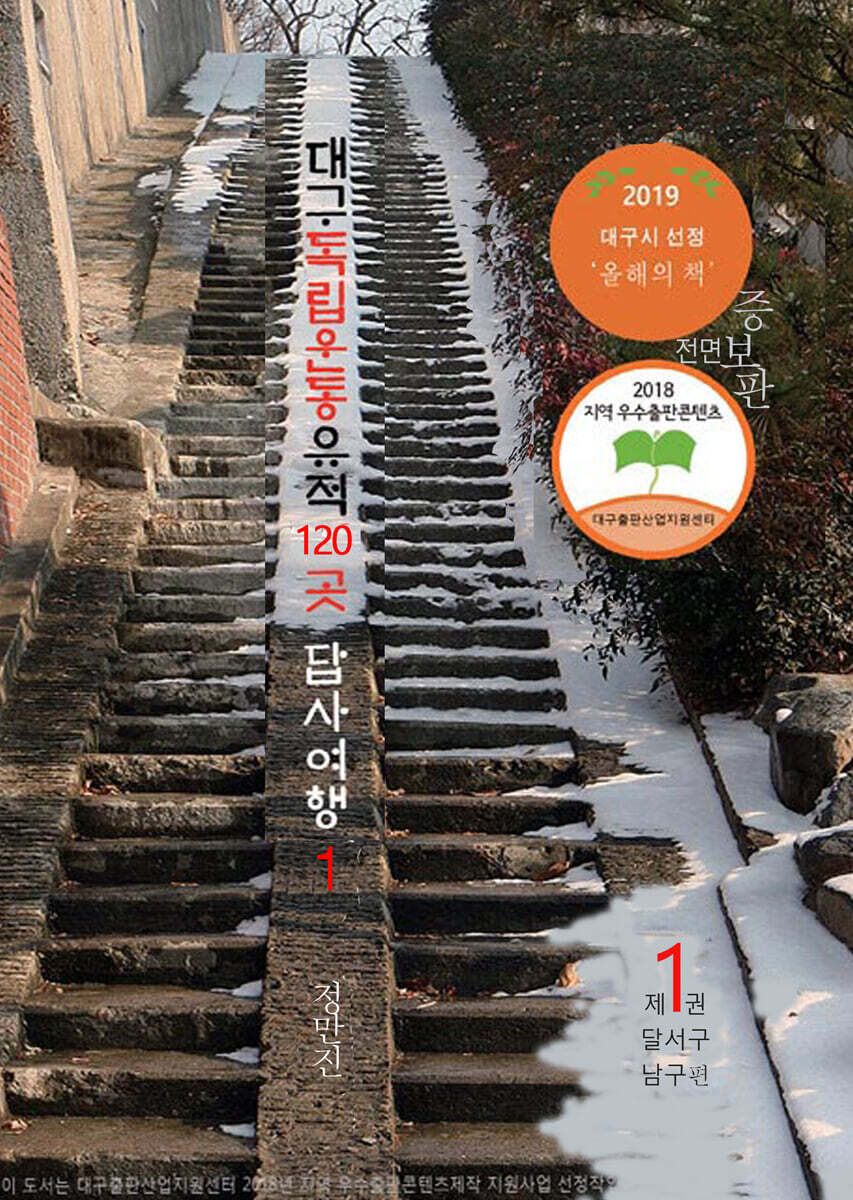
Daegu Independence Movement Sites Tour 1
 |
Description
Book Introduction
This is a fully expanded edition of [A Field Trip to 100 Sites of the Daegu Independence Movement], the 2019 Daegu City Book of the Year.
As Gunwi County was incorporated into Daegu City, and new and lost relics were discovered within the city, the need arose to supplement and refine the existing manuscript, so a comprehensive expansion was made. However, the book became so thick that it was inevitably divided into three volumes.
Volume 1 covers Dalseo-gu and Nam-gu, Volume 2 covers Dong-gu, Buk-gu, Suseong-gu, and Dalseong-gun, and Volume 3 covers Jung-gu and Gunwi-gun.
As Gunwi County was incorporated into Daegu City, and new and lost relics were discovered within the city, the need arose to supplement and refine the existing manuscript, so a comprehensive expansion was made. However, the book became so thick that it was inevitably divided into three volumes.
Volume 1 covers Dalseo-gu and Nam-gu, Volume 2 covers Dong-gu, Buk-gu, Suseong-gu, and Dalseong-gun, and Volume 3 covers Jung-gu and Gunwi-gun.
- You can preview some of the book's contents.
Preview
index
1-9.
Duryu Park Portrait Park (Layout * 58)
1.
Daegu Normal School Student Independence Movement Memorial Tower * 09
2.
Park Hee-kwang bust, monument * 18
3.
Woo Jae-ryong bust, monument to his achievements * 22
Gwangbokhoe, a representative independence movement organization in the 1910s * 24
4.
Jo Gi-hong bust, monument * 29
5.
Hyun Jin-geon Literature Monument * 31
The Japanese flag erasure incident and the Hyun Jin-geon incident * 34
The Relationship Between the Families of Hyun Kyung-woon and Lee Il-woo * 37
Hyun Jin-geon and Lee Sang-hwa's song "Friend" * 41
Reading Hyun Jin-geon's novel * 164
Hometown * 165
Lucky Day * 174
A society that encourages drinking * 192
6.
Idealized left statue, stele * 43
The Stolen Homeland and Yun Bong-gil * 47
7.
Lee Jang-hee's Stele * 53
8.
Baek Ki-man's Sibi * 55
9.
Choi Yang-hae bust, Hansi Monument * 56
10.
Baek Nam-chae's Tombstone: A Key Figure in the Daegu Independence Movement in 1919 * 59
11.
Seo Sang-il, the 'Daegu figure' who built the Jo Yang Hall * 64
12.
Taegeukdan Monument: Students at Daegu Commercial School Dream of Independence * 71
13.
The remains of Yun Sang-tae, the president of the Cheomunjae Joseon National Restoration Corps * 78
14-16.
Wolgok Historical Park: The Woo Clan, a Key Figure in the Daegu Independence Movement * 84
14.
Paris Jangseobi * 85
15.
Uhagyo Rain * 86
16.
Woo Byeong-gi Rain * 91
17.
From the Ijangga Cultural Center and Sanghwa Memorial Hall to the "Stolen Fields" * 98
Establishment of Woohyunseoru * 99
The flow of the national sovereignty restoration movement in the late Joseon Dynasty * 109
Lee Il-woo, Lee Sang-jeong, Lee Sang-hwa * 117
18.
Kim Byeong-uk, Song Deok-bi: Students Who Dreamed of a World Without Worries * 129
19-21.
Front Mountain Big Valley * 19.
Lee Si-young Memorial Tower * 131
20.
Im Yong-sang bust * 132
21.
Bust of Song Doo-hwan * 136
22.
Anilsa Temple in Apsan, the founding site of the Joseon National Restoration Corps * 138
Formation of the Joseon National Restoration Corps * 139
Daegu Pistol Incident * 146
23.
Japanese Infantry 80th Regiment Garrison * 150
24.
Yeongseon Market, Hyun Jeong-geon and Hyun Gye-ok's secret meeting location * 154
Duryu Park Portrait Park (Layout * 58)
1.
Daegu Normal School Student Independence Movement Memorial Tower * 09
2.
Park Hee-kwang bust, monument * 18
3.
Woo Jae-ryong bust, monument to his achievements * 22
Gwangbokhoe, a representative independence movement organization in the 1910s * 24
4.
Jo Gi-hong bust, monument * 29
5.
Hyun Jin-geon Literature Monument * 31
The Japanese flag erasure incident and the Hyun Jin-geon incident * 34
The Relationship Between the Families of Hyun Kyung-woon and Lee Il-woo * 37
Hyun Jin-geon and Lee Sang-hwa's song "Friend" * 41
Reading Hyun Jin-geon's novel * 164
Hometown * 165
Lucky Day * 174
A society that encourages drinking * 192
6.
Idealized left statue, stele * 43
The Stolen Homeland and Yun Bong-gil * 47
7.
Lee Jang-hee's Stele * 53
8.
Baek Ki-man's Sibi * 55
9.
Choi Yang-hae bust, Hansi Monument * 56
10.
Baek Nam-chae's Tombstone: A Key Figure in the Daegu Independence Movement in 1919 * 59
11.
Seo Sang-il, the 'Daegu figure' who built the Jo Yang Hall * 64
12.
Taegeukdan Monument: Students at Daegu Commercial School Dream of Independence * 71
13.
The remains of Yun Sang-tae, the president of the Cheomunjae Joseon National Restoration Corps * 78
14-16.
Wolgok Historical Park: The Woo Clan, a Key Figure in the Daegu Independence Movement * 84
14.
Paris Jangseobi * 85
15.
Uhagyo Rain * 86
16.
Woo Byeong-gi Rain * 91
17.
From the Ijangga Cultural Center and Sanghwa Memorial Hall to the "Stolen Fields" * 98
Establishment of Woohyunseoru * 99
The flow of the national sovereignty restoration movement in the late Joseon Dynasty * 109
Lee Il-woo, Lee Sang-jeong, Lee Sang-hwa * 117
18.
Kim Byeong-uk, Song Deok-bi: Students Who Dreamed of a World Without Worries * 129
19-21.
Front Mountain Big Valley * 19.
Lee Si-young Memorial Tower * 131
20.
Im Yong-sang bust * 132
21.
Bust of Song Doo-hwan * 136
22.
Anilsa Temple in Apsan, the founding site of the Joseon National Restoration Corps * 138
Formation of the Joseon National Restoration Corps * 139
Daegu Pistol Incident * 146
23.
Japanese Infantry 80th Regiment Garrison * 150
24.
Yeongseon Market, Hyun Jeong-geon and Hyun Gye-ok's secret meeting location * 154
Into the book
In front left of the 'Daegu Normal School Students Independence Movement Monument' in Duryu Park, there is a bust and monument of Governor Park Hee-kwang.
Governor Park Hee-gwang (1901-1970) was born on February 15, 1901 in Bonggok-ri, Sanggo-myeon, Seonsan-gun, Gyeongsangbuk-do.
At the age of 12, he decided to devote himself to the independence movement and went into exile across the Yalu River.
The governor attempted to assassinate Choi Jeong-gyu, the first president of the Bominhoe, in 1924, but was unsuccessful.
The assassination attempt on Choi Jeong-gyu was a representative anti-Japanese struggle that took place in the Lushun area at the time, and it was an event that gave great inspiration and encouragement to our independence fighters and instilled great fear in pro-Japanese collaborators.
The founding of the Bominhoe in Manchuria in 1920 was a revival of the Manchurian branch of the Iljinhoe (1904-1910), a pro-Japanese organization that had actively spearheaded Japan's annexation of Korea in the final years of the Korean Empire.
The Bominhoe was organized around the remnants of the Iljinhoe Jewoo religion, and the fact that Choi Jeong-gyu was selected as chairman was clearly stated in a Japanese Ministry of Foreign Affairs document as being because he was a member of the pro-Japanese new religion Jewoo religion affiliated with Cheondogyo and a remnant of the Iljinhoe that actively promoted the annexation of Korea by Japan.
The Bominhoe moved under the direction of the Japanese Kwantung Army.
The people who instigated the establishment of the Bominhoe were Aiba Sanji of the Police Bureau of the Government-General and Bae Jeong-ja, a spy at the Japanese Consulate in Harbin (see page 162).
Governor Park Hee-gwang (1901-1970) was born on February 15, 1901 in Bonggok-ri, Sanggo-myeon, Seonsan-gun, Gyeongsangbuk-do.
At the age of 12, he decided to devote himself to the independence movement and went into exile across the Yalu River.
The governor attempted to assassinate Choi Jeong-gyu, the first president of the Bominhoe, in 1924, but was unsuccessful.
The assassination attempt on Choi Jeong-gyu was a representative anti-Japanese struggle that took place in the Lushun area at the time, and it was an event that gave great inspiration and encouragement to our independence fighters and instilled great fear in pro-Japanese collaborators.
The founding of the Bominhoe in Manchuria in 1920 was a revival of the Manchurian branch of the Iljinhoe (1904-1910), a pro-Japanese organization that had actively spearheaded Japan's annexation of Korea in the final years of the Korean Empire.
The Bominhoe was organized around the remnants of the Iljinhoe Jewoo religion, and the fact that Choi Jeong-gyu was selected as chairman was clearly stated in a Japanese Ministry of Foreign Affairs document as being because he was a member of the pro-Japanese new religion Jewoo religion affiliated with Cheondogyo and a remnant of the Iljinhoe that actively promoted the annexation of Korea by Japan.
The Bominhoe moved under the direction of the Japanese Kwantung Army.
The people who instigated the establishment of the Bominhoe were Aiba Sanji of the Police Bureau of the Government-General and Bae Jeong-ja, a spy at the Japanese Consulate in Harbin (see page 162).
--- From the text
GOODS SPECIFICS
- Date of issue: September 2, 2024
- Pages, weight, size: 208 pages | 500g | 148*210*10mm
- ISBN13: 9791188701568
- ISBN10: 1188701568
You may also like
카테고리
korean


korean

![GQ KOREA Mark (Monthly): December [2025]](http://librairie.coreenne.fr/cdn/shop/files/8ef265dbbfbf186523ed75ba7319009d.jpg?v=1765340328&width=3840)


