

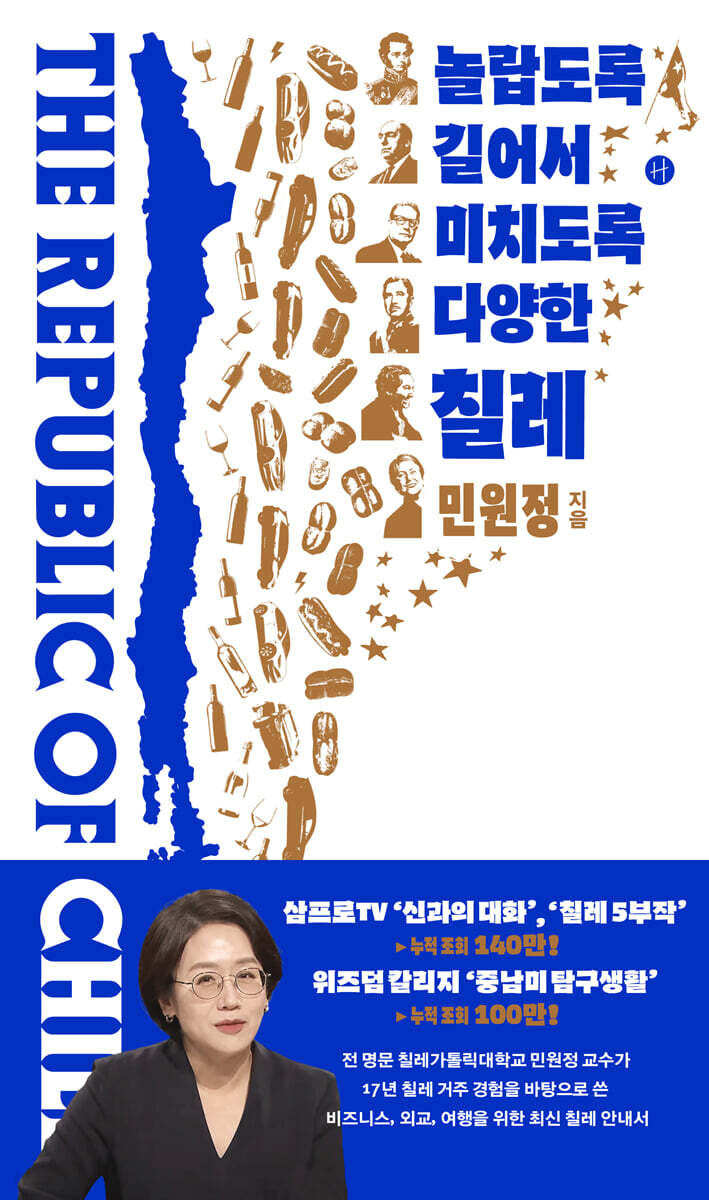
Chile is surprisingly long and crazy diverse
 |
Description
Book Introduction
The first step toward truly encountering and understanding the unfamiliar country of Chile. ―The first introductory book on Chile in Korea, encompassing politics, economics, history, society, and culture. ―A vivid and up-to-date story about Chile, inspired by the author's 17 years of experience living in Chile. To Koreans, Chile is a distant and unfamiliar country, both geographically and psychologically. When people think of 'Chile', only fragments of things like wine, the Korea-Chile Free Trade Agreement (FTA), Allende's Popular Unity government and Pinochet's military regime, and these days, resources like lithium come to mind, but few people really know what kind of country Chile is. Moreover, there are misunderstandings and prejudices because it is located in South America. Is that all? It is true that it is difficult to properly understand the country of Chile due to geographical variables such as earthquakes, as well as social variables such as extreme neoliberal economic policies and large-scale protests that are difficult to see and understand from the outside. However, as lithium, a secondary battery raw material, has recently been in the spotlight, interest in South America, especially Chile, which is a lithium producing region and resource treasure trove, is increasing. Additionally, with the Korean Wave trending globally, Chile is taking up a large portion of the Central and South American Korean Wave market, to the point that it can be said to be the driving force behind the Korean Wave in Central and South America. With such high potential for expanding diplomatic relations, business expansion and investment, and cultural exchange, Chile could become a "land of opportunity" for us. This book is a Chile guidebook written by Professor Min Won-jeong, who has lived in Chile for 17 years since 2004 and taught Korean studies at the prestigious University of Chile, based on her own experiences for Koreans who are curious about Chile. Covering all areas, from history to politics and society, diplomacy and resource policy, and even society and culture, this book provides a true picture of Chile and provides a clue to understanding Chilean society. This is a historical and cultural introductory book focused solely on Chile, almost the first of its kind in Korea. It will be a welcome addition to readers who want to see Chile in detail, beyond the obvious tourist attractions, understand the potential of Chile, a country renowned for its resource wealth, and learn about the true feelings of the Chilean people that were previously unknown. When I said I was from Chile, some people would inexplicably mention Peruvian President Fujimori, the 386 generation would think of Allende and Pinochet, and others would each bring up their own images of salsa, tango, wine, pork, and fermented skate. So naturally, I wasn't someone who had been a professor at one of the most prestigious universities in Central or South America, but rather a somewhat odd woman who had lived alone in a third-world country in South America for a long time. But then, suddenly, Chile became a hot topic as the country with the largest lithium reserves. Central and South America are beginning to receive significant attention as a place that, despite its distance, must be approached. …I wanted to dare to properly introduce Chile and break down prejudices about Chile and other Central and South American countries. … Living as a salaried worker, I gained a deep understanding of Chilean society, and in particular, experienced Chile's elite society, a fact unknown to many Koreans. Having experienced this rare experience, I felt a burning desire to share my story with more detail, accuracy, and vividness than anyone else. ―From the Preface |
- You can preview some of the book's contents.
Preview
index
preface
Entering
Chapter 1: Bakedano Square and the 30 won subway fare
#History, Politics, and Economy
1 After the long military dictatorship ended
· Villa Grimaldi
2 Falling into the swamp of neoliberalism
3. The gap between rich and poor that cannot be overcome
4 The high wall of Chile's elite
Santiago
Chapter 2 Between Europe and South America
#Identity·Class
1 Natives and Conquistadors
· Temuco
2. A space of cross-cultural and hybrid cultures within a multicultural society
· Easter Island
3 Chile is not South America
· Valparaiso Historic District
4. 'Yankee' culture that delves into Eurocentrism
· Puerto Varas
Chapter 3: Neighbors Close Yet Far Away
#Diplomacy/Resources
1. Who owns the land of abundant resources?
2 Peru, the lingering hostility
3 Bolivia: Competition over Resources
· Atacama Desert
4 'Good Neighbors' Argentina
Torres del Paine National Park
5 Drug cartels reaching out to Chile
Chapter 4: Chilean daily life
#Society/Culture
1 Chile is coffee? Chile is wine!
· Vendimia Festival
2 South American countries without tacos
3 A mother who must stand alone
· La Serena
4 Abortions that are neither possible nor impossible
5 Affectionate Machoism
6. Asian hate on the rise
Chapter 5: Chile's Future
#new generation
1. Internet Generation Meets the World
2 Origin over ability?
3 Civil union instead of marriage
4. The Korean Wave Shaking Up Chilean Society
Notes in the text
Image source
Entering
Chapter 1: Bakedano Square and the 30 won subway fare
#History, Politics, and Economy
1 After the long military dictatorship ended
· Villa Grimaldi
2 Falling into the swamp of neoliberalism
3. The gap between rich and poor that cannot be overcome
4 The high wall of Chile's elite
Santiago
Chapter 2 Between Europe and South America
#Identity·Class
1 Natives and Conquistadors
· Temuco
2. A space of cross-cultural and hybrid cultures within a multicultural society
· Easter Island
3 Chile is not South America
· Valparaiso Historic District
4. 'Yankee' culture that delves into Eurocentrism
· Puerto Varas
Chapter 3: Neighbors Close Yet Far Away
#Diplomacy/Resources
1. Who owns the land of abundant resources?
2 Peru, the lingering hostility
3 Bolivia: Competition over Resources
· Atacama Desert
4 'Good Neighbors' Argentina
Torres del Paine National Park
5 Drug cartels reaching out to Chile
Chapter 4: Chilean daily life
#Society/Culture
1 Chile is coffee? Chile is wine!
· Vendimia Festival
2 South American countries without tacos
3 A mother who must stand alone
· La Serena
4 Abortions that are neither possible nor impossible
5 Affectionate Machoism
6. Asian hate on the rise
Chapter 5: Chile's Future
#new generation
1. Internet Generation Meets the World
2 Origin over ability?
3 Civil union instead of marriage
4. The Korean Wave Shaking Up Chilean Society
Notes in the text
Image source
Detailed image

Publisher's Review
A distant and unfamiliar country at the southernmost tip of the earth
Why do we need to meet Chile now?
Wine, lithium, FTAs, the Andes, Pinochet… This isn't the Chile we knew!
Covering everything from history to politics, economy, diplomacy, resources, society, and culture
We're talking about Chile, a country of crazy geography and crazy diversity!
Sampro TV's 'Conversation with God' and 'Chile 5-part series' have accumulated 1.4 million views.
Wisdom College's "Latin American Exploration" Reaches 1 Million Cumulative Views
Former professor Min Won-jeong of the prestigious Catholic University of Chile
Written based on 17 years of experience living in Chile
Korea's first introductory book on Chile and the most up-to-date guide to Chile for business, diplomacy, and travel.
A country of crazy geography and crazy diversity
―Diverse resources and cultures created by diverse geographical environments
―Guide to Chile's famous attractions based on my long-term experience living there.
When talking about Chile, you can't leave out geography.
Chile has such unique geographical conditions that the Chilean writer Benjamin Subercasos called it a country of “crazy geography.”
Chile is the longest and narrowest country in the world, measuring 4,300 kilometers from north to south and averaging just 117 kilometers wide.
From the Atacama Desert in the north, home to the world's largest copper and lithium deposits, to the southern tip of Cape Horn and the Antarctic ice sheet, you can experience every climate on earth.
To the east are the high and majestic Andes Mountains, and to the west are the mysterious islands of Easter Island in the South Pacific.
Thanks to these geographical conditions, the landscape and climate are diverse, as are the lifestyles and resources of the people living there.
The fact that the Carménère grape, which disappeared in France, became the greatest source of pride for Chilean wine, that sweet Chilean fruit can be enjoyed on the other side of the globe in Korea, and that Chile's major exports are diverse, ranging from mineral resources to agricultural, fishery, and forestry products, are all thanks to its geography, which is surrounded by deserts, the Andes, Antarctica, and the Pacific Ocean.
However, because of this, natural disasters such as earthquakes and tsunamis continue, as well as tensions with neighboring countries such as Peru and Bolivia over resources.
Chile's geographical environment is a fundamental element in understanding Chile, as it influences not only Chilean politics, economy, and diplomacy, but also the lives of Chileans in general.
This book provides a detailed introduction to the landscape, resources, culture, and daily life of Chile, created through "crazy geography." At the same time, the author, who has lived there for a long time, provides a separate column in which he kindly guides travelers to places worth visiting, allowing readers to feel as if they are traveling to Chile on the other side of the world while reading.
Wineries are concentrated in central Chile, centered around Santiago.
Several grape varieties are grown in Chile's central valleys over 8,800 hectares.
Among them, Chile's largest cultivated variety and greatest pride is Carmenere.
This variety originated in the Bordeaux region of France, but disappeared from France in the 19th century due to the phylloxera epidemic.
Chile has a natural environment ideal for growing grapes.
The reason Carmenere survived in Chile is also because of the country's geography, which is surrounded by the Andes and the Pacific Ocean, and its dry and hot climate.
―From “Chile is Coffee? Chile is Wine!”
Chile plans to increase its national wealth by leveraging lithium as a key industrial development axis that will link the national economy with the transition to a global green economy.
However, behind the development lies the variable of destruction of the natural environment. ... Lithium producing countries, including Chile, have only recently begun to pay attention to this problem.
The challenge and effort of balancing water access, community benefits, sustainability, and profitable operations is a challenge not only for the lithium industry, but also for the entire Chilean mining industry, including copper and gold.
…what is the way to live well?
Unfortunately, the choice has long since been out of the hands of the people who live on that land.
―From “Land of Overflowing Resources, Who Owns It?”
We are not South America, we are Europe!
―Chile as seen when you know the origins of Chile and the identity of Chileans
To truly understand Chile, you must know its history.
Although Chile is located on the South American continent, it was ruled by Spanish conquerors who discovered the 'New World', and even after independence in 1810, white Criollos, descendants of the conquerors, firmly established themselves as the elite and led Chilean society.
After independence, Chile pursued the goal of becoming a "white nation" and actively accepted European immigrants, leading to an increase in mestizos, descendants of white and Indian immigrants, and now mestizos, descendants of criollos and European immigrants, account for more than 95% of the Chilean population.
They pride themselves on calling Chile 'Europe, not South America'.
Their homeland is not South America or Chile, but Europe, the homeland of their ancestors.
Chile's Eurocentrism, racism that prioritizes white supremacy, and elitism that draws class lines, stemming from a history of conquest and colonialism, still have a significant impact on Chilean society.
There are also social and economic inequalities resulting from this.
This book does not hide the true face of Chile, but also conveys the yearning and hope for change felt by many Chileans, including the indigenous people.
There's a joke that Chileans drink German beer, enjoy English tea, eat Italian ice cream, and make French wine.
But this is true.
Every October, the Oktoberfest beer festival is held, tea time called Onse is enjoyed, and Carménère, which disappeared from France, has become the representative grape of Chilean wine.
Traces of Europe abound throughout Chile, to the point where it could almost be called a 'fake Europe'.
…Europe dominates Chilean life in politics, economics, society, and culture.
Europe is the root of Chileans, but it also serves as a dilemma that makes it difficult for Chilean society to integrate.
―From “Chile is not South America”
Chile, and especially Santiago, has clear class differences across districts.
Centered around Plaza Baquedano, which runs through the center of Santiago, the northeastern part of the city is affluent, while the southwestern part is poorer.
…Chile, like other Latin American countries, has a high concentration of wealth among the very wealthy, with the richest nine people owning 49.6% of the country's wealth.
Socioeconomic inequality is evident not only in terms of income and wealth, but also in education and health.
In addition to where one lives, knowing the elementary, middle, and high schools a person attended can reveal their socioeconomic class.
―From “The Unbridgeable Gap Between Rich and Poor”
The mass protests that took place in Chile in October 2019 were not simply a protest against the neoliberal system, but fundamentally a resistance against the entrenched elite that had endured since colonial times.
Protesters climbed on the statue of General Baquedano in Santiago's Plaza Baquedano and planted flags on it.
Manuel Jesús Baquedano González was a Chilean soldier and politician who contributed significantly to the conquest of Mapuche Indian territory in the Araucania region and to Chile's victory over the Peruvian-Bolivian alliance in the War of the Pacific.
Protesters, who were protesting against long-standing inequalities, classism and neoliberalism, insisted that the square should be called "Plaza de Dignidad" (Dignity Square).
―From “The High Wall of Chile’s Elites”
Essential Issues to Understand Today's Chile
From neoliberalism to love and marriage, to the Korean Wave
As this book is based on the author's experiences of meeting Chileans from various social classes and experiencing changes in Chilean society firsthand during his 17 years of living in Chile, you can see the latest aspects of Chilean society, such as the food culture, love, marriage, study, employment, and retirement of the Chilean people.
We take a look at the daily lives of Chileans these days, a South American country without tacos, where people have civil unions instead of marriages, where they rebel against affectionate machismo, and where Asian hatred rages despite the need for the Asian market. We take a look at the daily lives of Chileans these days, which Koreans cannot fully understand.
We also examine the detrimental effects of extreme neoliberal policies, which sparked massive protests in Santiago, Chile, in 2019, and the rise of a new generation actively engaging with the world beyond Chile through the internet and the Korean Wave, seeking to escape the discrimination and inequality they face.
This book, which details the most recent changes in Chilean society, is a true guide to Chile that will help readers who wish to encounter Chile for business, travel, diplomacy, or research understand the hearts and minds of the Chilean people.
Chile is the only country in the world that treats water as a private property under its constitution, which was enacted during the Pinochet military dictatorship in 1980.
… Internet is a personal choice, but tap water must be provided by a company contracted in the area where I live.
… Enel, which supplies electricity to almost all of Chile, is also a private power company.
Although public transportation is a public service, it is also operated by private companies.
…Privatization of the public sector began with the introduction of neoliberalism during the Pinochet dictatorship and has continued regardless of subsequent administrations.
In October 2019, the streets of Chile were filled with chants of “It’s not 30 pesos, it’s 30 years.”
The 30-peso subway fare hike, which sparked the largest protests in years in just two weeks, is a metaphor for the 30 years since neoliberalism took hold.
―From “Falling into the Swamp of Neoliberalism”
In Chile, couples of both the opposite sex and the same sex can enter into formal marriage, civil union, or cohabitation.
Although civil unions and cohabitation are limited, they are legally protected.
…there are still more people who want civil unions or cohabitation than marriage.
A Chilean friend of mine half-jokingly said that these days only gay people are getting married.
The reasons vary, including those who want to avoid the financial burden of divorce, those who choose to remain separated because of the hassle, and those who believe that formalities are not important in love.
―From “Civil Union, Not Marriage”
Most of the visible K-pop fans were middle- and lower-class girls from poor families, and were considered outsiders who could not fit into the mainstream, and male fans who liked K-pop were sometimes mistaken for gay.
This is due to the Eurocentrism and male chauvinism of Chilean and Latin American societies, as well as Chinoism, which discriminates against all Asians by labeling them as Chinese.
…Since the introduction of neoliberalism, the gap between rich and poor has widened, but paradoxically, neoliberalism has also provided Chile's socially, economically, and culturally disadvantaged with a glimpse into another world through the Internet.
… Marginalization actually allowed fans to use social media to form a stronger bond, and this bond even led to the cover dance protests by K-pop fans during the 2019 protests.
―From “The Korean Wave Shaking Chilean Society”
Why do we need to meet Chile now?
Wine, lithium, FTAs, the Andes, Pinochet… This isn't the Chile we knew!
Covering everything from history to politics, economy, diplomacy, resources, society, and culture
We're talking about Chile, a country of crazy geography and crazy diversity!
Sampro TV's 'Conversation with God' and 'Chile 5-part series' have accumulated 1.4 million views.
Wisdom College's "Latin American Exploration" Reaches 1 Million Cumulative Views
Former professor Min Won-jeong of the prestigious Catholic University of Chile
Written based on 17 years of experience living in Chile
Korea's first introductory book on Chile and the most up-to-date guide to Chile for business, diplomacy, and travel.
A country of crazy geography and crazy diversity
―Diverse resources and cultures created by diverse geographical environments
―Guide to Chile's famous attractions based on my long-term experience living there.
When talking about Chile, you can't leave out geography.
Chile has such unique geographical conditions that the Chilean writer Benjamin Subercasos called it a country of “crazy geography.”
Chile is the longest and narrowest country in the world, measuring 4,300 kilometers from north to south and averaging just 117 kilometers wide.
From the Atacama Desert in the north, home to the world's largest copper and lithium deposits, to the southern tip of Cape Horn and the Antarctic ice sheet, you can experience every climate on earth.
To the east are the high and majestic Andes Mountains, and to the west are the mysterious islands of Easter Island in the South Pacific.
Thanks to these geographical conditions, the landscape and climate are diverse, as are the lifestyles and resources of the people living there.
The fact that the Carménère grape, which disappeared in France, became the greatest source of pride for Chilean wine, that sweet Chilean fruit can be enjoyed on the other side of the globe in Korea, and that Chile's major exports are diverse, ranging from mineral resources to agricultural, fishery, and forestry products, are all thanks to its geography, which is surrounded by deserts, the Andes, Antarctica, and the Pacific Ocean.
However, because of this, natural disasters such as earthquakes and tsunamis continue, as well as tensions with neighboring countries such as Peru and Bolivia over resources.
Chile's geographical environment is a fundamental element in understanding Chile, as it influences not only Chilean politics, economy, and diplomacy, but also the lives of Chileans in general.
This book provides a detailed introduction to the landscape, resources, culture, and daily life of Chile, created through "crazy geography." At the same time, the author, who has lived there for a long time, provides a separate column in which he kindly guides travelers to places worth visiting, allowing readers to feel as if they are traveling to Chile on the other side of the world while reading.
Wineries are concentrated in central Chile, centered around Santiago.
Several grape varieties are grown in Chile's central valleys over 8,800 hectares.
Among them, Chile's largest cultivated variety and greatest pride is Carmenere.
This variety originated in the Bordeaux region of France, but disappeared from France in the 19th century due to the phylloxera epidemic.
Chile has a natural environment ideal for growing grapes.
The reason Carmenere survived in Chile is also because of the country's geography, which is surrounded by the Andes and the Pacific Ocean, and its dry and hot climate.
―From “Chile is Coffee? Chile is Wine!”
Chile plans to increase its national wealth by leveraging lithium as a key industrial development axis that will link the national economy with the transition to a global green economy.
However, behind the development lies the variable of destruction of the natural environment. ... Lithium producing countries, including Chile, have only recently begun to pay attention to this problem.
The challenge and effort of balancing water access, community benefits, sustainability, and profitable operations is a challenge not only for the lithium industry, but also for the entire Chilean mining industry, including copper and gold.
…what is the way to live well?
Unfortunately, the choice has long since been out of the hands of the people who live on that land.
―From “Land of Overflowing Resources, Who Owns It?”
We are not South America, we are Europe!
―Chile as seen when you know the origins of Chile and the identity of Chileans
To truly understand Chile, you must know its history.
Although Chile is located on the South American continent, it was ruled by Spanish conquerors who discovered the 'New World', and even after independence in 1810, white Criollos, descendants of the conquerors, firmly established themselves as the elite and led Chilean society.
After independence, Chile pursued the goal of becoming a "white nation" and actively accepted European immigrants, leading to an increase in mestizos, descendants of white and Indian immigrants, and now mestizos, descendants of criollos and European immigrants, account for more than 95% of the Chilean population.
They pride themselves on calling Chile 'Europe, not South America'.
Their homeland is not South America or Chile, but Europe, the homeland of their ancestors.
Chile's Eurocentrism, racism that prioritizes white supremacy, and elitism that draws class lines, stemming from a history of conquest and colonialism, still have a significant impact on Chilean society.
There are also social and economic inequalities resulting from this.
This book does not hide the true face of Chile, but also conveys the yearning and hope for change felt by many Chileans, including the indigenous people.
There's a joke that Chileans drink German beer, enjoy English tea, eat Italian ice cream, and make French wine.
But this is true.
Every October, the Oktoberfest beer festival is held, tea time called Onse is enjoyed, and Carménère, which disappeared from France, has become the representative grape of Chilean wine.
Traces of Europe abound throughout Chile, to the point where it could almost be called a 'fake Europe'.
…Europe dominates Chilean life in politics, economics, society, and culture.
Europe is the root of Chileans, but it also serves as a dilemma that makes it difficult for Chilean society to integrate.
―From “Chile is not South America”
Chile, and especially Santiago, has clear class differences across districts.
Centered around Plaza Baquedano, which runs through the center of Santiago, the northeastern part of the city is affluent, while the southwestern part is poorer.
…Chile, like other Latin American countries, has a high concentration of wealth among the very wealthy, with the richest nine people owning 49.6% of the country's wealth.
Socioeconomic inequality is evident not only in terms of income and wealth, but also in education and health.
In addition to where one lives, knowing the elementary, middle, and high schools a person attended can reveal their socioeconomic class.
―From “The Unbridgeable Gap Between Rich and Poor”
The mass protests that took place in Chile in October 2019 were not simply a protest against the neoliberal system, but fundamentally a resistance against the entrenched elite that had endured since colonial times.
Protesters climbed on the statue of General Baquedano in Santiago's Plaza Baquedano and planted flags on it.
Manuel Jesús Baquedano González was a Chilean soldier and politician who contributed significantly to the conquest of Mapuche Indian territory in the Araucania region and to Chile's victory over the Peruvian-Bolivian alliance in the War of the Pacific.
Protesters, who were protesting against long-standing inequalities, classism and neoliberalism, insisted that the square should be called "Plaza de Dignidad" (Dignity Square).
―From “The High Wall of Chile’s Elites”
Essential Issues to Understand Today's Chile
From neoliberalism to love and marriage, to the Korean Wave
As this book is based on the author's experiences of meeting Chileans from various social classes and experiencing changes in Chilean society firsthand during his 17 years of living in Chile, you can see the latest aspects of Chilean society, such as the food culture, love, marriage, study, employment, and retirement of the Chilean people.
We take a look at the daily lives of Chileans these days, a South American country without tacos, where people have civil unions instead of marriages, where they rebel against affectionate machismo, and where Asian hatred rages despite the need for the Asian market. We take a look at the daily lives of Chileans these days, which Koreans cannot fully understand.
We also examine the detrimental effects of extreme neoliberal policies, which sparked massive protests in Santiago, Chile, in 2019, and the rise of a new generation actively engaging with the world beyond Chile through the internet and the Korean Wave, seeking to escape the discrimination and inequality they face.
This book, which details the most recent changes in Chilean society, is a true guide to Chile that will help readers who wish to encounter Chile for business, travel, diplomacy, or research understand the hearts and minds of the Chilean people.
Chile is the only country in the world that treats water as a private property under its constitution, which was enacted during the Pinochet military dictatorship in 1980.
… Internet is a personal choice, but tap water must be provided by a company contracted in the area where I live.
… Enel, which supplies electricity to almost all of Chile, is also a private power company.
Although public transportation is a public service, it is also operated by private companies.
…Privatization of the public sector began with the introduction of neoliberalism during the Pinochet dictatorship and has continued regardless of subsequent administrations.
In October 2019, the streets of Chile were filled with chants of “It’s not 30 pesos, it’s 30 years.”
The 30-peso subway fare hike, which sparked the largest protests in years in just two weeks, is a metaphor for the 30 years since neoliberalism took hold.
―From “Falling into the Swamp of Neoliberalism”
In Chile, couples of both the opposite sex and the same sex can enter into formal marriage, civil union, or cohabitation.
Although civil unions and cohabitation are limited, they are legally protected.
…there are still more people who want civil unions or cohabitation than marriage.
A Chilean friend of mine half-jokingly said that these days only gay people are getting married.
The reasons vary, including those who want to avoid the financial burden of divorce, those who choose to remain separated because of the hassle, and those who believe that formalities are not important in love.
―From “Civil Union, Not Marriage”
Most of the visible K-pop fans were middle- and lower-class girls from poor families, and were considered outsiders who could not fit into the mainstream, and male fans who liked K-pop were sometimes mistaken for gay.
This is due to the Eurocentrism and male chauvinism of Chilean and Latin American societies, as well as Chinoism, which discriminates against all Asians by labeling them as Chinese.
…Since the introduction of neoliberalism, the gap between rich and poor has widened, but paradoxically, neoliberalism has also provided Chile's socially, economically, and culturally disadvantaged with a glimpse into another world through the Internet.
… Marginalization actually allowed fans to use social media to form a stronger bond, and this bond even led to the cover dance protests by K-pop fans during the 2019 protests.
―From “The Korean Wave Shaking Chilean Society”
GOODS SPECIFICS
- Date of issue: August 19, 2024
- Page count, weight, size: 240 pages | 324g | 130*220*15mm
- ISBN13: 9791170872351
- ISBN10: 1170872352
You may also like
카테고리
korean


korean

![GQ KOREA Mark (Monthly): December [2025]](http://librairie.coreenne.fr/cdn/shop/files/8ef265dbbfbf186523ed75ba7319009d.jpg?v=1765340328&width=3840)


