

Blood and iron
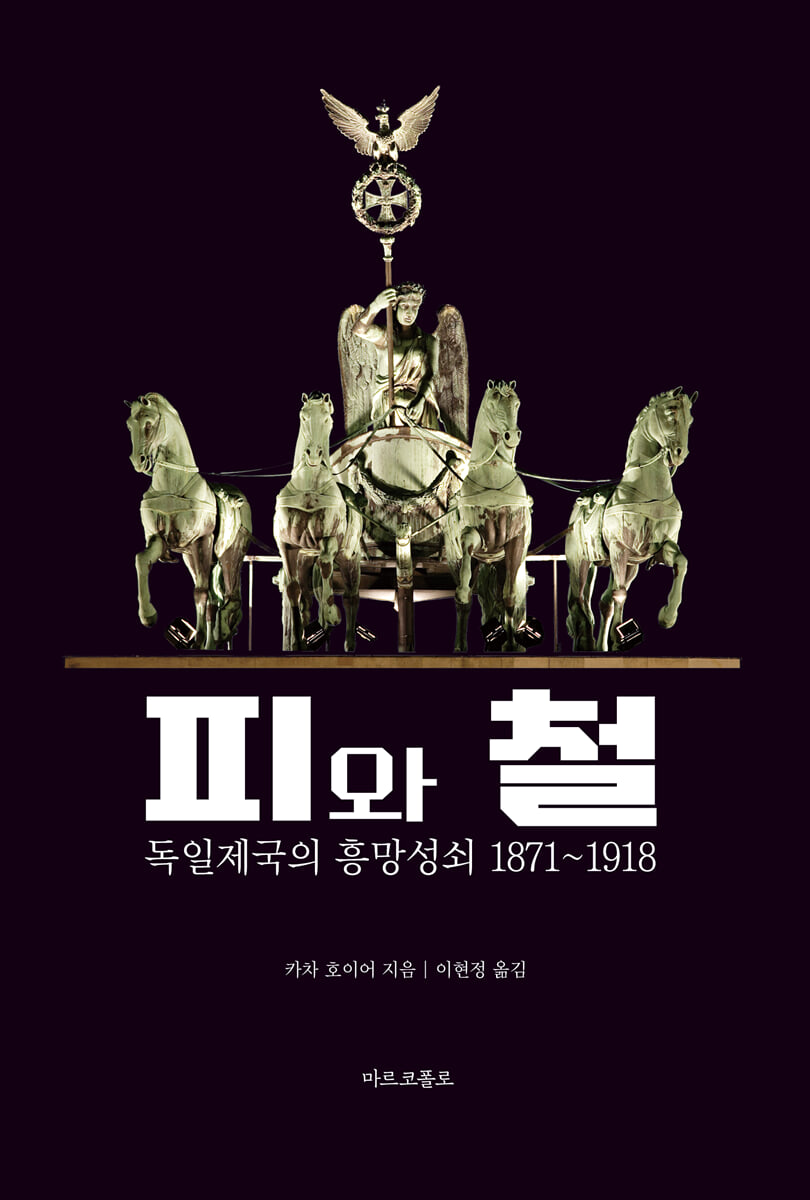 |
Description
Book Introduction
The best book that tells the history of the German Empire from the late 19th to early 20th centuries in an easy and fun way!
Washington Post Book of the Year
The Times Book of the Year
Publisher's Weekly Book of the Year
National Review Book of the Year
Daily Telegraph Recommended Books
The Sunday Times Recommended Books
Kirkus Recommended Books
On September 30, 1862, Prussian Chancellor Otto von Bismarck made the following speech:
“With that power.
...
The crucial issues of today are not decided by speeches and majority votes...
It will be decided by iron and blood.”
About nine years later, after victorious wars of unification against Denmark (1864), Austria-Hungary (1866), and France (1870–71), Bismarck proclaimed the first German nation-state at the Palace of Versailles outside Paris.
He would serve as prime minister of Europe's most populous and increasingly wealthy nation for the next 19 years.
Katja Heuer presents us with a very compelling work on the subject of the German Empire that was born as a result.
It contains the rise and fall of the Second German Empire for more than half a century in a volume of about 250 pages.
Washington Post Book of the Year
The Times Book of the Year
Publisher's Weekly Book of the Year
National Review Book of the Year
Daily Telegraph Recommended Books
The Sunday Times Recommended Books
Kirkus Recommended Books
On September 30, 1862, Prussian Chancellor Otto von Bismarck made the following speech:
“With that power.
...
The crucial issues of today are not decided by speeches and majority votes...
It will be decided by iron and blood.”
About nine years later, after victorious wars of unification against Denmark (1864), Austria-Hungary (1866), and France (1870–71), Bismarck proclaimed the first German nation-state at the Palace of Versailles outside Paris.
He would serve as prime minister of Europe's most populous and increasingly wealthy nation for the next 19 years.
Katja Heuer presents us with a very compelling work on the subject of the German Empire that was born as a result.
It contains the rise and fall of the Second German Empire for more than half a century in a volume of about 250 pages.
index
Preface / 9p.
Chapter 1: The Founding Era 1815-1871 / 18p.
Chapter 2 Bismarck's Empire 1871-1888 / 80p.
Chapter 3 Three Emperors and Prime Ministers 1888-1890 / 156p.
Chapter 4: Wilhelm's Empire 1890-1914 / 170p.
Chapter 5: The Catastrophe 1914-1918 / 250p.
Conclusion: What is the end? / 311p.
References/ 317p.
Chapter 1: The Founding Era 1815-1871 / 18p.
Chapter 2 Bismarck's Empire 1871-1888 / 80p.
Chapter 3 Three Emperors and Prime Ministers 1888-1890 / 156p.
Chapter 4: Wilhelm's Empire 1890-1914 / 170p.
Chapter 5: The Catastrophe 1914-1918 / 250p.
Conclusion: What is the end? / 311p.
References/ 317p.
Detailed image

Publisher's Review
On September 30, 1862, Prussian Chancellor Otto von Bismarck made the following speech:
“With that power.
...
The crucial issues of today are not decided by speeches and majority votes...
It will be decided by iron and blood.”
About nine years later, after victorious wars of unification against Denmark (1864), Austria-Hungary (1866), and France (1870–71), Bismarck proclaimed the first German nation-state at the Palace of Versailles outside Paris.
He would serve as prime minister of Europe's most populous and increasingly wealthy nation for the next 19 years.
Katja Heuer presents us with a very compelling work on the subject of the German Empire that was born as a result.
It contains the rise and fall of the Second German Empire for more than half a century in a volume of about 250 pages.
A British woman of German descent, she never forgot where her umbilical cord was buried and blew our minds with her concise, fast-paced prose.
What is even more remarkable is that she implemented her original ideas using only previously published material, without relying on new material.
In that respect, it is quite effective to explain the German psychological analysis of discipline and obedience as a political narrative through a fascinating cultural illustration such as the Brothers Grimm's fairy tale (Little Red Riding Hood).
Three years ago, January 18th marked the 150th anniversary of the founding of the German Empire, but many Germans do not remember it as a glorious day.
On this very day, January 18, 1871, the German Empire was officially established at Versailles.
So the Germans got on the elevator to destruction.
No wonder Der Spiegel declared it the most unfortunate year in German history. However, the author of this book subtly twists this traditional notion.
In this way, the historical land she looked at illuminates German history from a new angle.
Before 1871, Germany was not yet a nation, but merely an idea.
Bismarck, the founder of the empire, had a huge task ahead of him.
How did he unite 39 small, grain-of-sand states under the Kaiser's banner? How did he persuade the Prussians, Bavarians, and Rhinelanders to become true Germans? As Voltaire said, the Holy Roman Empire was neither holy, nor Roman, nor an empire.
This book is a serious exploration of how the German Empire began and how it fell apart.
“With that power.
...
The crucial issues of today are not decided by speeches and majority votes...
It will be decided by iron and blood.”
About nine years later, after victorious wars of unification against Denmark (1864), Austria-Hungary (1866), and France (1870–71), Bismarck proclaimed the first German nation-state at the Palace of Versailles outside Paris.
He would serve as prime minister of Europe's most populous and increasingly wealthy nation for the next 19 years.
Katja Heuer presents us with a very compelling work on the subject of the German Empire that was born as a result.
It contains the rise and fall of the Second German Empire for more than half a century in a volume of about 250 pages.
A British woman of German descent, she never forgot where her umbilical cord was buried and blew our minds with her concise, fast-paced prose.
What is even more remarkable is that she implemented her original ideas using only previously published material, without relying on new material.
In that respect, it is quite effective to explain the German psychological analysis of discipline and obedience as a political narrative through a fascinating cultural illustration such as the Brothers Grimm's fairy tale (Little Red Riding Hood).
Three years ago, January 18th marked the 150th anniversary of the founding of the German Empire, but many Germans do not remember it as a glorious day.
On this very day, January 18, 1871, the German Empire was officially established at Versailles.
So the Germans got on the elevator to destruction.
No wonder Der Spiegel declared it the most unfortunate year in German history. However, the author of this book subtly twists this traditional notion.
In this way, the historical land she looked at illuminates German history from a new angle.
Before 1871, Germany was not yet a nation, but merely an idea.
Bismarck, the founder of the empire, had a huge task ahead of him.
How did he unite 39 small, grain-of-sand states under the Kaiser's banner? How did he persuade the Prussians, Bavarians, and Rhinelanders to become true Germans? As Voltaire said, the Holy Roman Empire was neither holy, nor Roman, nor an empire.
This book is a serious exploration of how the German Empire began and how it fell apart.
GOODS SPECIFICS
- Date of issue: July 31, 2024
- Page count, weight, size: 328 pages | 526g | 148*210*20mm
- ISBN13: 9791192667522
- ISBN10: 1192667522
You may also like
카테고리
korean


korean

![GQ KOREA Mark (Monthly): December [2025]](http://librairie.coreenne.fr/cdn/shop/files/8ef265dbbfbf186523ed75ba7319009d.jpg?v=1765340328&width=3840)


