

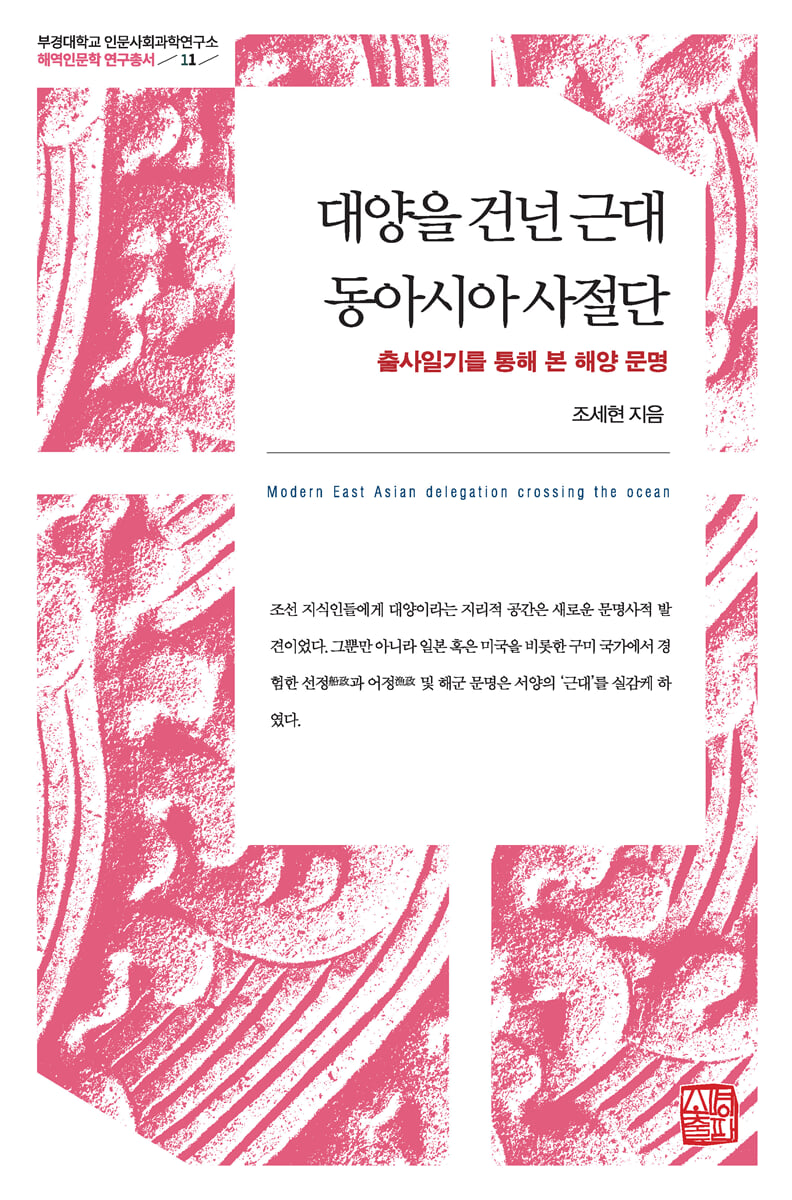
Modern East Asian missions that crossed the ocean
 |
Description
Book Introduction
This book analyzes the diaries of modern East Asian diplomatic missions from the perspective of maritime history to explore their view of maritime civilization.
By comparing and analyzing the experiences of overseas missions dispatched from China, Japan, and Joseon, we can understand the modernization process and perception of maritime civilization in each country.
Through this, we can examine the process of dismantling the traditional Sino-centric world order and building a modern nation-state.
By comparing and analyzing the experiences of overseas missions dispatched from China, Japan, and Joseon, we can understand the modernization process and perception of maritime civilization in each country.
Through this, we can examine the process of dismantling the traditional Sino-centric world order and building a modern nation-state.
- You can preview some of the book's contents.
Preview
index
Preface
greetings
Preface_The Korean, Chinese, and Japanese Delegations Across the Ocean
Part 1: The Burlingame and Iwakura Delegations' World Tour
Chapter 1: The Ocean Routes of the Burlingame and Iwakura Missions
1.
The process of the Qing and Japanese delegations' departure
2.
Pacific
3.
Atlantic Ocean
4.
Mediterranean
Chapter 2: American and British Maritime Civilizations as Experienced by the Qing and Japanese Delegations
1.
Main activities in the United States and the United Kingdom
2.
US and UK naval systems
3.
American and British maritime cultures
Chapter 3: Maritime Civilizations of Europe and Asia as Inspected by the Delegations of Both Countries
1.
Maritime civilizations of the European continent
2.
Asia's maritime port city
3.
East-West Cultural Center of the Two Delegations
Sintering I China and the world are different
Part 2: The Ocean Voyages of the Joseon Delegation and Maritime Civilization
Chapter 4: Japan, the Maritime State Visited by the Envoy and the Investigative Delegation
1.
Japanese route of the receiver and inspection team
2.
Maritime civilization experienced in Japan
Chapter 5: Pacific Routes Experienced by the American Mission to Joseon During the Opening of Ports
1.
The Pacific crossing of Bobingsa and his entourage and Ambassador to the United States Park Jeong-yang
2.
Impressions of American port cities
3.
Min Yeong-ik and his party's transatlantic journey and return home via the imperial route
Chapter 6: Min Yeong-hwan's World Tour and Ocean Voyage
1.
Ocean routes to Russia
2.
A modern navy inspected in Russia
3.
Two routes back home
Chapter 7: Imperial Routes Experienced by European Envoys during the Korean Empire
1.
Three types of travel diaries from around 1900
2.
Traveling back and forth on the imperial route
3.
Maritime civilization seen in Europe
Sintering II The East of the East is the West of the West
Conclusion_Maritime Civilization Experienced by the Minister of Foreign Affairs
References
Search
greetings
Preface_The Korean, Chinese, and Japanese Delegations Across the Ocean
Part 1: The Burlingame and Iwakura Delegations' World Tour
Chapter 1: The Ocean Routes of the Burlingame and Iwakura Missions
1.
The process of the Qing and Japanese delegations' departure
2.
Pacific
3.
Atlantic Ocean
4.
Mediterranean
Chapter 2: American and British Maritime Civilizations as Experienced by the Qing and Japanese Delegations
1.
Main activities in the United States and the United Kingdom
2.
US and UK naval systems
3.
American and British maritime cultures
Chapter 3: Maritime Civilizations of Europe and Asia as Inspected by the Delegations of Both Countries
1.
Maritime civilizations of the European continent
2.
Asia's maritime port city
3.
East-West Cultural Center of the Two Delegations
Sintering I China and the world are different
Part 2: The Ocean Voyages of the Joseon Delegation and Maritime Civilization
Chapter 4: Japan, the Maritime State Visited by the Envoy and the Investigative Delegation
1.
Japanese route of the receiver and inspection team
2.
Maritime civilization experienced in Japan
Chapter 5: Pacific Routes Experienced by the American Mission to Joseon During the Opening of Ports
1.
The Pacific crossing of Bobingsa and his entourage and Ambassador to the United States Park Jeong-yang
2.
Impressions of American port cities
3.
Min Yeong-ik and his party's transatlantic journey and return home via the imperial route
Chapter 6: Min Yeong-hwan's World Tour and Ocean Voyage
1.
Ocean routes to Russia
2.
A modern navy inspected in Russia
3.
Two routes back home
Chapter 7: Imperial Routes Experienced by European Envoys during the Korean Empire
1.
Three types of travel diaries from around 1900
2.
Traveling back and forth on the imperial route
3.
Maritime civilization seen in Europe
Sintering II The East of the East is the West of the West
Conclusion_Maritime Civilization Experienced by the Minister of Foreign Affairs
References
Search
Publisher's Review
Diary of a Modern East Asian Mission
Overseas travelogues have been studied to some extent in academia.
There are many writings by Western explorers and missionaries that look at 19th-century East Asian society from the perspectives of civilization and barbarism, and conversely, there are also quite a few writings by East Asians that deal with Western civilization from the perspectives of conflicts in foreign relations, cultural exchanges between China and the West, and travel literature.
However, despite the numerous studies on the West in Korea, China, and Japan during the modern period, studies on maritime civilizations are surprisingly difficult to find.
Perhaps this is because researchers focus only on individual travel experiences and diplomatic activities, rather than on diplomatic missions or missions.
But they are the ones who have most vividly experienced maritime civilization.
Based on these facts, this book analyzes the travel diaries of various overseas diplomatic missions dispatched by China, Japan, and Joseon during the modern period from the perspective of maritime history to explore their view of maritime civilization.
Comparing and analyzing the experiences of the Korean, Chinese, and Japanese delegations can help us understand aspects of the modernization process in both countries.
The process of their awakening to maritime civilization is significant because it simultaneously demonstrates the disintegration of the traditional Chinese world order and hints at the construction of a modern nation-state.
Burlingame and Iwakura delegations
The Burlingame and Iwakura missions were overseas missions representing China and Japan in the late 19th century that traveled around the world.
During the voyage, they crossed vast oceans such as the Pacific, Atlantic, and Indian Oceans, as well as the Mediterranean and the China Sea.
The process of changing the name from the Great East to the Pacific around the time they traveled was accompanied by the surprise of East Asians experiencing a new geographical space called the ocean.
An interesting passage in the records of the two countries' diplomatic missions is that while the travelogues of the Chinese Zhi Gang and Zhang De Yi are rich in memories of ocean voyages, such as steamships, steam engines, storms, and seasickness, the travelogue of the Japanese Kume Kunitake omits such details.
Perhaps the shock of the Iwakura mission was mitigated because they had already indirectly experienced what ocean voyages were like through the abundant records of overseas missions at the end of the Edo period, or because the party included people who had studied abroad.
But what's interesting is that at the time, Japan frequently used the term "maritime nation," while China also used this term occasionally.
Joseon almost never uses the term "maritime nation."
Perhaps this simple fact clearly shows the level of awareness of the maritime civilization of the three modern East Asian countries.
China and the world are different
Crossing the Pacific Ocean, the world's largest ocean, on a steamship, a remarkable invention of the Industrial Revolution, I saw with my own eyes that the Earth is round and that the ocean surrounds the land.
And during the ocean voyage, we were able to recognize the modern concept of time, that day and night and the four seasons are created by the rotation and revolution of the Earth.
Understanding the International Date Line, or the awareness of the problem of time difference—that "traveling in the opposite direction of the sun gives you an extra day"—led to the acceptance of modern concepts of time and distance.
If we accept this modern scientific global theory and view of geography, it will inevitably lead to decentralization, where no region of the world can be the center, and this will inevitably cause a rift in the traditional Sino-centric world order.
For example, in the writings that Ji Kang wrote on his way back home, when asked by a foreigner about the name "China," he could only explain that China was no longer a geographical center, but rather a country of the Middle Way in the context of the Tao.
Because through my travels, it became clear that the South and North Poles of China were different from the South and North Poles of the world, and I could not help but acknowledge the fact that China and the world were different from each other in terms of geography.
Two routes around the world
After the opening of the country, most of the travels of Koreans to the West were carried out by diplomatic missions.
The Koreans' world tour, like that of China and Japan, took two routes.
The first course starts from Shanghai, China (or Yokohama, Japan) and passes through the Pacific Ocean, the American continent, the Atlantic Ocean, England, Europe, the Mediterranean Sea, the Red Sea, the Indian Ocean, and the South China Sea to arrive in Shanghai (Yokohama).
It is an easterly direction that crosses the Pacific Ocean, the American continent, and then the Atlantic Ocean again.
The second course starts from Shanghai (or Yokohama, Japan) and goes through the East China Sea, Singapore, the Indian Ocean, the Suez Canal, the Mediterranean Sea, Europe and the United Kingdom, and then returns to Shanghai (Yokohama) via the Mediterranean Sea, the Suez Canal, the Indian Ocean, Singapore and the East China Sea.
The so-called imperial route is the route pioneered by Britain during its expansion into India and China. From the perspective of East Asians, it is a westward route that can be called the European route.
Of course, the round-trip route for each delegation was slightly different, and in the case of Joseon, they went to Shanghai and Yokohama and used international routes.
Maritime civilization as seen in the travel diary
This book is a companion volume to 『Modern Chinese Exploration of Maritime Countries』 (Somyeong Publishing, 2022), published two years ago.
While the previous book dealt with the maritime civilizations of Europe and Japan as seen through the diaries of envoys to the late Qing Dynasty, this book explores the maritime civilizations revealed in the diaries of East Asian envoys, including not only Chinese but also Japanese and Koreans.
This is a bit more of an expansion of the category.
While Part 1 of the text compares and analyzes the world tours of the Burlingame delegation of the Qing Dynasty and the Iwakura delegation of Japan, Part 2 deals with the travelogues of overseas delegations from modern Joseon (including the Korean Empire).
It is meaningful to compare and analyze the maritime civilizations of the Burlingame delegation of the Qing Dynasty, the Iwakura delegation of Japan, and the Joseon delegation.
This is because exploring the maritime civilization experiences of modern East Asians is a topic that can attract attention in a wide range of fields, from the study of foreign relations of modern East Asian countries to the study of maritime conflicts in Northeast Asia, such as island disputes today.
Overseas travelogues have been studied to some extent in academia.
There are many writings by Western explorers and missionaries that look at 19th-century East Asian society from the perspectives of civilization and barbarism, and conversely, there are also quite a few writings by East Asians that deal with Western civilization from the perspectives of conflicts in foreign relations, cultural exchanges between China and the West, and travel literature.
However, despite the numerous studies on the West in Korea, China, and Japan during the modern period, studies on maritime civilizations are surprisingly difficult to find.
Perhaps this is because researchers focus only on individual travel experiences and diplomatic activities, rather than on diplomatic missions or missions.
But they are the ones who have most vividly experienced maritime civilization.
Based on these facts, this book analyzes the travel diaries of various overseas diplomatic missions dispatched by China, Japan, and Joseon during the modern period from the perspective of maritime history to explore their view of maritime civilization.
Comparing and analyzing the experiences of the Korean, Chinese, and Japanese delegations can help us understand aspects of the modernization process in both countries.
The process of their awakening to maritime civilization is significant because it simultaneously demonstrates the disintegration of the traditional Chinese world order and hints at the construction of a modern nation-state.
Burlingame and Iwakura delegations
The Burlingame and Iwakura missions were overseas missions representing China and Japan in the late 19th century that traveled around the world.
During the voyage, they crossed vast oceans such as the Pacific, Atlantic, and Indian Oceans, as well as the Mediterranean and the China Sea.
The process of changing the name from the Great East to the Pacific around the time they traveled was accompanied by the surprise of East Asians experiencing a new geographical space called the ocean.
An interesting passage in the records of the two countries' diplomatic missions is that while the travelogues of the Chinese Zhi Gang and Zhang De Yi are rich in memories of ocean voyages, such as steamships, steam engines, storms, and seasickness, the travelogue of the Japanese Kume Kunitake omits such details.
Perhaps the shock of the Iwakura mission was mitigated because they had already indirectly experienced what ocean voyages were like through the abundant records of overseas missions at the end of the Edo period, or because the party included people who had studied abroad.
But what's interesting is that at the time, Japan frequently used the term "maritime nation," while China also used this term occasionally.
Joseon almost never uses the term "maritime nation."
Perhaps this simple fact clearly shows the level of awareness of the maritime civilization of the three modern East Asian countries.
China and the world are different
Crossing the Pacific Ocean, the world's largest ocean, on a steamship, a remarkable invention of the Industrial Revolution, I saw with my own eyes that the Earth is round and that the ocean surrounds the land.
And during the ocean voyage, we were able to recognize the modern concept of time, that day and night and the four seasons are created by the rotation and revolution of the Earth.
Understanding the International Date Line, or the awareness of the problem of time difference—that "traveling in the opposite direction of the sun gives you an extra day"—led to the acceptance of modern concepts of time and distance.
If we accept this modern scientific global theory and view of geography, it will inevitably lead to decentralization, where no region of the world can be the center, and this will inevitably cause a rift in the traditional Sino-centric world order.
For example, in the writings that Ji Kang wrote on his way back home, when asked by a foreigner about the name "China," he could only explain that China was no longer a geographical center, but rather a country of the Middle Way in the context of the Tao.
Because through my travels, it became clear that the South and North Poles of China were different from the South and North Poles of the world, and I could not help but acknowledge the fact that China and the world were different from each other in terms of geography.
Two routes around the world
After the opening of the country, most of the travels of Koreans to the West were carried out by diplomatic missions.
The Koreans' world tour, like that of China and Japan, took two routes.
The first course starts from Shanghai, China (or Yokohama, Japan) and passes through the Pacific Ocean, the American continent, the Atlantic Ocean, England, Europe, the Mediterranean Sea, the Red Sea, the Indian Ocean, and the South China Sea to arrive in Shanghai (Yokohama).
It is an easterly direction that crosses the Pacific Ocean, the American continent, and then the Atlantic Ocean again.
The second course starts from Shanghai (or Yokohama, Japan) and goes through the East China Sea, Singapore, the Indian Ocean, the Suez Canal, the Mediterranean Sea, Europe and the United Kingdom, and then returns to Shanghai (Yokohama) via the Mediterranean Sea, the Suez Canal, the Indian Ocean, Singapore and the East China Sea.
The so-called imperial route is the route pioneered by Britain during its expansion into India and China. From the perspective of East Asians, it is a westward route that can be called the European route.
Of course, the round-trip route for each delegation was slightly different, and in the case of Joseon, they went to Shanghai and Yokohama and used international routes.
Maritime civilization as seen in the travel diary
This book is a companion volume to 『Modern Chinese Exploration of Maritime Countries』 (Somyeong Publishing, 2022), published two years ago.
While the previous book dealt with the maritime civilizations of Europe and Japan as seen through the diaries of envoys to the late Qing Dynasty, this book explores the maritime civilizations revealed in the diaries of East Asian envoys, including not only Chinese but also Japanese and Koreans.
This is a bit more of an expansion of the category.
While Part 1 of the text compares and analyzes the world tours of the Burlingame delegation of the Qing Dynasty and the Iwakura delegation of Japan, Part 2 deals with the travelogues of overseas delegations from modern Joseon (including the Korean Empire).
It is meaningful to compare and analyze the maritime civilizations of the Burlingame delegation of the Qing Dynasty, the Iwakura delegation of Japan, and the Joseon delegation.
This is because exploring the maritime civilization experiences of modern East Asians is a topic that can attract attention in a wide range of fields, from the study of foreign relations of modern East Asian countries to the study of maritime conflicts in Northeast Asia, such as island disputes today.
GOODS SPECIFICS
- Date of issue: July 20, 2024
- Page count, weight, size: 420 pages | 152*223*26mm
- ISBN13: 9791159059315
You may also like
카테고리
korean


korean

![GQ KOREA Mark (Monthly): December [2025]](http://librairie.coreenne.fr/cdn/shop/files/8ef265dbbfbf186523ed75ba7319009d.jpg?v=1765340328&width=3840)


