

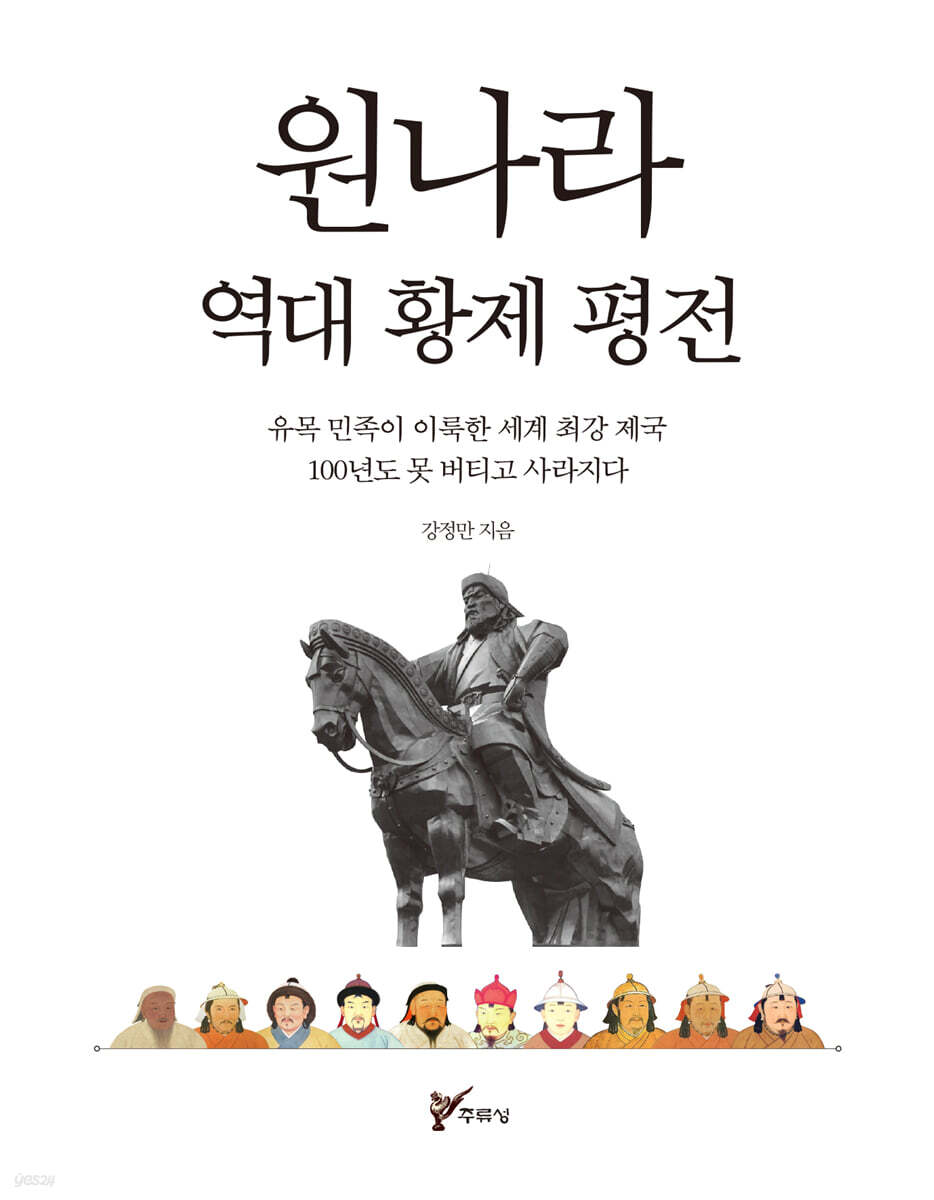
Biographies of the Yuan Dynasty Emperors
 |
Description
Book Introduction
Although it has practical and quick practical prairie laws,
It failed to overcome the Han Chinese cultural system that had long been rooted in Confucianism.
Genghis Khan and his descendants, who were nomads on the northeastern border of Mongolia, built an empire unprecedented in world history with a population smaller than the number of livestock they raised.
They held accurate judgment and quick decisions as their golden rule, and they revered substance and rejected formality.
And thanks to the nomadic lifestyle of frequent movement, an open social atmosphere was created and trade was valued.
Anyone could travel and trade freely as long as they paid a certain amount of taxes.
Furthermore, the Yuan Dynasty's recognition of religious diversity and its refusal to oppress religious figures also served as a driving force for it to become the center of the world in the 13th and 14th centuries.
It failed to overcome the Han Chinese cultural system that had long been rooted in Confucianism.
Genghis Khan and his descendants, who were nomads on the northeastern border of Mongolia, built an empire unprecedented in world history with a population smaller than the number of livestock they raised.
They held accurate judgment and quick decisions as their golden rule, and they revered substance and rejected formality.
And thanks to the nomadic lifestyle of frequent movement, an open social atmosphere was created and trade was valued.
Anyone could travel and trade freely as long as they paid a certain amount of taxes.
Furthermore, the Yuan Dynasty's recognition of religious diversity and its refusal to oppress religious figures also served as a driving force for it to become the center of the world in the 13th and 14th centuries.
- You can preview some of the book's contents.
Preview
index
preface
Chapter 1.
Genghis Khan, founder of the Yuan Dynasty
1.
Born the son of a Kiyat leader, he lived a difficult life.
2.
He broke free from Jamukha's rule and became independent as the Khan of Kyatbu.
3.
Defeated by Jamuka at the Battle of Dalan Baljut
4.
Defeated the Tatars and received an official position in the Jin Dynasty
5.
Allied with Ong Khan and defeated Jamukha's coalition forces
6.
Battle of Dalan Nemurges: Destroying the Tatars
7.
Repelling the attack of Ong Khan and his son
8.
Subdue the Tayang Khan forces and unify the Mongolian steppe.
9.
Laying the foundation of the empire by establishing various systems
10.
Subjugate surrounding tribes and nations and embark on an expedition to the Jin Dynasty.
11.
Died on his way back from a western expedition
12.
Genghis Khan: A Hero or a Butcher of the Ages?
Chapter 2.
Yuan Taizong Uguday
1.
Growth Process and Succession to the Great Khan
2.
Laying the foundation of the nation under Yalul Chojae
3.
Destroy the Jin Dynasty and conquer the Southern Song Dynasty
4.
Goryeo invasion and western expedition
5.
die of alcoholism
Chapter 3.
Won Jeongjong Guiwuk
1.
The sixth katun of Ogedei Khan, with Töregene as regent
2.
Töregene appoints his son Guyuk as Great Khan
3.
Eliminate the power of Queen Toregene and strengthen the power of the Great Khan.
4.
The Tibetan Kingdom surrenders to the Mongol Empire through the Yangzhou Conference.
5.
He died suddenly on his way to conquer Batu of the Golden Horde.
Chapter 4.
Won Heonjong Mongke
1.
Born as the eldest son of Tolui, he grew into a young man with both literary and martial skills.
2.
Return to Mongolia after participating in foreign wars
3.
After the death of Guiyuk Khan, Ogul Kamish Khatun assumed the regency.
4.
After becoming the Great Khan with Batu's support, he eliminated his political opponents.
5.
Reorganize the administrative structure and adopt a tolerant attitude toward religion.
6.
Embark on foreign expeditions to expand territory and influence
Chapter 5.
Kublai Khan, the founder of the Yuan Dynasty
1.
Background and upbringing
2.
Learn the way of governing a country from the world's most talented people.
3.
governing the Han Chinese settlements south of the Gobi Desert
4.
He converted to Tibetan Buddhism and set out to conquer the Dali Kingdom.
5.
He was in danger of losing power after being suspected by Mongke Khan.
6.
He heard news of Mongke Khan's death during the conquest of the Southern Song Dynasty and headed north.
7.
After ascending to the throne as Great Khan, he fought for power with Ariq Böke.
8.
Putting down the heretical rebellion
9.
Accepting Han Chinese institutions and founding the Yuan Dynasty
10.
Destroy the Southern Song Dynasty and unify China
11.
Promote the Paspa alphabet and issue banknotes
12.
Suppressing the rebellion of Genghis Khan's descendants
13.
Subjugate Goryeo and launch a war of conquest
14.
Marco Polo's travels to the Yuan Dynasty fostered exchanges between Eastern and Western civilizations.
Chapter 6.
Emperor Shengzong Temur of Yuan
1.
Crown Prince Chin Kim dies before he can fulfill his ambitions.
2.
Growth Process and Succession to the Throne
3.
Squander the national treasury by giving away money without reservation
4.
Corruption is rampant due to excessive virtuous governance.
5.
Put down the rebellion of the kings and achieve peace
Chapter 7.
Yuan Mujong Kaishan
1.
Growth Process and Succession to the Throne
2.
Ayurbarwada was appointed crown prince
3.
The Emperor, the Crown Prince, and the Empress Dowager share power.
4.
His indecisive personality threw state affairs into chaos.
5.
An attempt to overcome financial difficulties by establishing a Ministry of Finance failed.
Chapter 8.
Ayurveda, the original race
1.
Remove the old ministers and attempt currency reform
2.
Hire scholars and promote innovation
3.
Confucianism reveres sages and revives education and the civil service examination system.
4.
Conflict with Empress Dowager Mohu Daqi
Chapter 9.
Won Yeongjong City Devala
1.
Growth Process and Succession to the Throne
2.
Engage in a power struggle with the Grand Empress Dowager's forces
3.
Heed the advice of loyalists and pursue new politics
4.
The Nampa Incident: Murdered in Nampa at the age of 20
Chapter 10.
Emperor Taizong of Yuan, Yesun Temur
1.
He was crowned emperor immediately after the Nanpa Incident.
2.
Eliminate the ministers and kings who participated in the Nampa Incident
3.
Respect Confucianism and pursue a policy of tolerance toward various religions
4.
Although the loyal subject's name was cleared, the rebellion was not prevented.
5.
Condoning the interference of the Saekmok people in their vested interests and engaging in bribery and corruption
Chapter 11.
Yuan Wenjong Tug Temür
1.
Growth Process and Succession to the Throne
2.
Waging a 'War of Transfer' with the Cheon Sun-je forces
3.
He abdicated in favor of his half-brother Kusala and was crowned crown prince.
4.
He was restored to the throne immediately after the sudden death of Emperor Myeongjong of Yuan.
5.
Raise awareness and respect Confucianism
6.
Excessive worship of Buddhism causes all kinds of evils
Chapter 12.
Yuan Huizong Toghon Temür
1.
Irin Chinbal succeeded to the throne but died young.
2.
Growth Process and Succession to the Throne
3.
Eliminate the Sun King El Temur's forces
4.
Bayan seizes power and abolishes the past system
5.
Eliminate the Bayan forces and begin your own rule
6.
Designated Renewal: The Success and Failure of Toktoa
7.
Empress Ki's power and the end of the Yuan Dynasty
Chapter 1.
Genghis Khan, founder of the Yuan Dynasty
1.
Born the son of a Kiyat leader, he lived a difficult life.
2.
He broke free from Jamukha's rule and became independent as the Khan of Kyatbu.
3.
Defeated by Jamuka at the Battle of Dalan Baljut
4.
Defeated the Tatars and received an official position in the Jin Dynasty
5.
Allied with Ong Khan and defeated Jamukha's coalition forces
6.
Battle of Dalan Nemurges: Destroying the Tatars
7.
Repelling the attack of Ong Khan and his son
8.
Subdue the Tayang Khan forces and unify the Mongolian steppe.
9.
Laying the foundation of the empire by establishing various systems
10.
Subjugate surrounding tribes and nations and embark on an expedition to the Jin Dynasty.
11.
Died on his way back from a western expedition
12.
Genghis Khan: A Hero or a Butcher of the Ages?
Chapter 2.
Yuan Taizong Uguday
1.
Growth Process and Succession to the Great Khan
2.
Laying the foundation of the nation under Yalul Chojae
3.
Destroy the Jin Dynasty and conquer the Southern Song Dynasty
4.
Goryeo invasion and western expedition
5.
die of alcoholism
Chapter 3.
Won Jeongjong Guiwuk
1.
The sixth katun of Ogedei Khan, with Töregene as regent
2.
Töregene appoints his son Guyuk as Great Khan
3.
Eliminate the power of Queen Toregene and strengthen the power of the Great Khan.
4.
The Tibetan Kingdom surrenders to the Mongol Empire through the Yangzhou Conference.
5.
He died suddenly on his way to conquer Batu of the Golden Horde.
Chapter 4.
Won Heonjong Mongke
1.
Born as the eldest son of Tolui, he grew into a young man with both literary and martial skills.
2.
Return to Mongolia after participating in foreign wars
3.
After the death of Guiyuk Khan, Ogul Kamish Khatun assumed the regency.
4.
After becoming the Great Khan with Batu's support, he eliminated his political opponents.
5.
Reorganize the administrative structure and adopt a tolerant attitude toward religion.
6.
Embark on foreign expeditions to expand territory and influence
Chapter 5.
Kublai Khan, the founder of the Yuan Dynasty
1.
Background and upbringing
2.
Learn the way of governing a country from the world's most talented people.
3.
governing the Han Chinese settlements south of the Gobi Desert
4.
He converted to Tibetan Buddhism and set out to conquer the Dali Kingdom.
5.
He was in danger of losing power after being suspected by Mongke Khan.
6.
He heard news of Mongke Khan's death during the conquest of the Southern Song Dynasty and headed north.
7.
After ascending to the throne as Great Khan, he fought for power with Ariq Böke.
8.
Putting down the heretical rebellion
9.
Accepting Han Chinese institutions and founding the Yuan Dynasty
10.
Destroy the Southern Song Dynasty and unify China
11.
Promote the Paspa alphabet and issue banknotes
12.
Suppressing the rebellion of Genghis Khan's descendants
13.
Subjugate Goryeo and launch a war of conquest
14.
Marco Polo's travels to the Yuan Dynasty fostered exchanges between Eastern and Western civilizations.
Chapter 6.
Emperor Shengzong Temur of Yuan
1.
Crown Prince Chin Kim dies before he can fulfill his ambitions.
2.
Growth Process and Succession to the Throne
3.
Squander the national treasury by giving away money without reservation
4.
Corruption is rampant due to excessive virtuous governance.
5.
Put down the rebellion of the kings and achieve peace
Chapter 7.
Yuan Mujong Kaishan
1.
Growth Process and Succession to the Throne
2.
Ayurbarwada was appointed crown prince
3.
The Emperor, the Crown Prince, and the Empress Dowager share power.
4.
His indecisive personality threw state affairs into chaos.
5.
An attempt to overcome financial difficulties by establishing a Ministry of Finance failed.
Chapter 8.
Ayurveda, the original race
1.
Remove the old ministers and attempt currency reform
2.
Hire scholars and promote innovation
3.
Confucianism reveres sages and revives education and the civil service examination system.
4.
Conflict with Empress Dowager Mohu Daqi
Chapter 9.
Won Yeongjong City Devala
1.
Growth Process and Succession to the Throne
2.
Engage in a power struggle with the Grand Empress Dowager's forces
3.
Heed the advice of loyalists and pursue new politics
4.
The Nampa Incident: Murdered in Nampa at the age of 20
Chapter 10.
Emperor Taizong of Yuan, Yesun Temur
1.
He was crowned emperor immediately after the Nanpa Incident.
2.
Eliminate the ministers and kings who participated in the Nampa Incident
3.
Respect Confucianism and pursue a policy of tolerance toward various religions
4.
Although the loyal subject's name was cleared, the rebellion was not prevented.
5.
Condoning the interference of the Saekmok people in their vested interests and engaging in bribery and corruption
Chapter 11.
Yuan Wenjong Tug Temür
1.
Growth Process and Succession to the Throne
2.
Waging a 'War of Transfer' with the Cheon Sun-je forces
3.
He abdicated in favor of his half-brother Kusala and was crowned crown prince.
4.
He was restored to the throne immediately after the sudden death of Emperor Myeongjong of Yuan.
5.
Raise awareness and respect Confucianism
6.
Excessive worship of Buddhism causes all kinds of evils
Chapter 12.
Yuan Huizong Toghon Temür
1.
Irin Chinbal succeeded to the throne but died young.
2.
Growth Process and Succession to the Throne
3.
Eliminate the Sun King El Temur's forces
4.
Bayan seizes power and abolishes the past system
5.
Eliminate the Bayan forces and begin your own rule
6.
Designated Renewal: The Success and Failure of Toktoa
7.
Empress Ki's power and the end of the Yuan Dynasty
Detailed image

Publisher's Review
The sixth series following 'Biographies of the Emperors of the Ming, Qing, Tang, Song, and Han Dynasties'
He founded the most powerful empire in history, but it lasted less than 100 years before disappearing into the grasslands.
At the end of the Yuan Dynasty, the Goryeo people, including Empress Ki, stood tall as the center of the Yuan Dynasty's politics, economy, and culture.
This book seeks to learn lessons from history by examining the historical events that occurred during the reigns of the twelve Yuan emperors, based on historical data.
History that remains in the past is nothing more than a dusty antique in a museum.
History is a work in progress and a prediction of the future.
It is about correcting the present and opening up the future by learning lessons from history.
By evaluating the achievements and mistakes of the Yuan emperors, we can understand what kind of virtues and leadership qualities a leader today should possess.
Kublai Khan, the grandson of Genghis Khan and the fifth Khaan of the Mongol Empire, finally unified China and founded the Yuan Dynasty.
The Yuan Dynasty is part of Mongolian history and also part of Chinese history.
From the Mongols' perspective, they destroyed the Song Dynasty established by the Han Chinese and became the rulers and masters of the Chinese mainland.
On the other hand, the Han Chinese, who had established feudal dynasties centered in the Central Plains region for a long time, lost their national sovereignty and territory to the Mongols, a minority ethnic group, and were reduced to a ruled class.
Therefore, although the Yuan Dynasty was the golden age of Mongolian history, it was also a time of great hardship for the Han people.
Also, from the perspective of Chinese history, the Yuan Dynasty was the first great empire established by a nomadic people who conquered the Han Chinese, an agricultural people.
The Mongols, who were greatly inferior to the Han people in terms of civilization and economic power and did not even have a written language, maximized the aforementioned advantages to unify China.
The territory of the Yuan Dynasty included four major khanates, and the emperor was the khan who controlled the khans of the four major khanates.
However, as time passed, the four major khanates developed into independent states by establishing a formal vassal relationship with the Yuan Dynasty.
Accordingly, the Yuan emperor's ruling power was limited to China and its surrounding countries.
The successive emperors of the Yuan Dynasty seriously considered how to govern the Han Chinese, who were the largest population and the ruling class.
This was also a problem of a small number of nomadic peoples dealing with a large number of agricultural peoples.
Kublai Khan, the founder of the Yuan Dynasty, accepted the laws and institutions of the Han Chinese, respected Confucianism, and employed Confucian scholars, thereby making the Han Chinese submit to the rule of the Yuan Dynasty.
Since the reign of Emperor Sejo of Yuan, successive emperors have ruled the great empire by upholding the laws of their ancestors.
However, the Yuan Dynasty was driven back to the northern steppes just 97 years after its founding.
Why did the Yuan Dynasty lose its dominance in China in less than a hundred years?
First, from the beginning of the Yuan Dynasty, there was a latent conflict between the Hanfa faction, which consisted of Mongolians who had assimilated into Han Chinese civilization and Confucian scholars of Han Chinese descent, and the Mongolian aristocracy.
The Han law school sought to ensure that the Yuan Dynasty inherited the legitimacy of the previous Han dynasties by governing the country with Han laws and institutions.
They adopted Confucianism as the way to govern the country and sought to learn historical lessons from the rise and fall of the Han dynasties.
On the other hand, the Mongol aristocracy believed that the Mongols should maintain their identity as a nomadic people.
They disliked the Yuan imperial family and court being influenced by Han Chinese civilization.
Because the laws and systems of the Han people did not fit with the traditions and customs of the Mongols, and because they thought that the Han people were objects of exploitation and not equal to the Mongols.
The Han faction and the Mongolian aristocratic forces clashed over control of the political situation.
In particular, in the matter of enthroning the emperor, the two major powers clashed and even fought a civil war.
The emperors who were elected by the Han Fa faction were unable to properly control the aristocratic powers that had grown into local warlords.
Second, the Yuan emperors could not abandon the nomadic people's habit of giving.
The Mongols, who had an incredibly strong sense of community, had a tradition of sharing goods they produced themselves or plundered.
Although Emperor Shizu of Yuan bestowed wealth upon his subjects according to established regulations, the emperors after him freely spent the wealth stored in the national treasury as they pleased and were extravagant.
As a result, the Yuan Dynasty suffered from serious financial difficulties from the beginning of its founding.
In an attempt to overcome financial difficulties, a currency reform was implemented, but due to currency inflation, the people's economy collapsed towards the end of the Yuan Dynasty.
Third, the evils of Tibetan Buddhism (Lamaism) were serious.
After Tibetan Buddhism became the state religion of the Yuan Dynasty, successive emperors treated the highest leader of Tibetan Buddhism as their imperial teacher and treated him with the utmost respect.
They used Buddhist rites as a means of demonstrating the absolute authority of the emperor.
Not only the famous temples across the country, but also the numerous temples in the imperial palace frequently held Buddhist services.
Every time a temple was opened, a huge amount of material and manpower was required.
Moreover, monks intervened in real-world politics, committed all kinds of corruption, and caused serious public nuisance.
There was even a story that the Yuan Dynasty fell because of Buddhism.
Fourth, the ruling class of the Yuan Dynasty treated the Han Chinese harshly.
Although scholars of Han Chinese descent were appointed and participated in state affairs, only a very small number of Han Chinese participated in state affairs.
At one time, the imperial examination system was implemented to open the path to officialdom for Han Chinese intellectuals, but this was also very rare.
The status of a Confucian scholar studying abroad was lower than that of a gisaeng and higher than that of a beggar.
The Yuan Dynasty government, over time, prohibited the Han people from owning items that could be used as weapons, such as spears, swords, horses, and iron tools.
The reason why there were constant rebellions by Han and Namin people towards the end of the Yuan Dynasty was because of this policy of racial discrimination.
The Mongols' discrimination and persecution of the Han Chinese ultimately shortened the life of the Yuan Dynasty.
However, from a historical perspective, if we compare the Yuan Dynasty of the Mongols and the Qing Dynasty of the Manchus (Jurchens), we can see that the Mongolian state exists today because the Mongols did not lose their identity and were not completely assimilated into the Han Chinese civilization.
On the other hand, the Manchus founded the Qing Dynasty and took the path of assimilating themselves into Han Chinese civilization.
Today, the Manchus exist as an ethnic minority in China.
However, they had already lost their own language and culture, and had even changed their surnames to Han Chinese surnames, becoming completely assimilated into the Han Chinese.
If the Yuan Dynasty had also been dominated by the Han Fa faction, wouldn't it have suffered the same fate as the Qing Dynasty?
The Yuan Dynasty also had an inseparable historical relationship with Goryeo.
In the 13th and 14th centuries, the Mongol Empire's army was invincible.
Genghis Khan and his descendants rode on horseback and trampled the cities of each country.
But their siege strategy was surprisingly simple.
If you surrendered, you were guaranteed the right to survive and autonomy, but if you resisted, you were wiped out.
There were also peoples who resisted them and were wiped out.
However, Goryeo's resistance against the Mongols lasted for a full 42 years.
In the end, Goryeo surrendered to the Yuan Dynasty and declared itself a vassal, but it kept its royal ancestral shrine and official position.
How could Goryeo, which was inferior to the Yuan Dynasty in every way, including population, maintain its sovereignty?
It would have been impossible if we had not inherited Goguryeo's martial spirit.
King Sejo of Yuan was extremely excited when he heard that Goryeo had sent an envoy to offer to honor him as emperor.
Even Emperor Taizong of Tang, the greatest king of the world, could not subdue Goguryeo, so he was delighted that he had finally made the king of Goryeo his subject.
He used the subjugation of Goryeo as a political asset in the process of founding the Yuan Dynasty.
He also made the King of Goryeo his son-in-law and treated Goryeo specially as a vassal state.
Goryeo gave up its justification and chose practicality.
There were many eunuchs and concubines from Goryeo in the Yuan Dynasty court.
Among them, there were those who enjoyed the emperor's favor and became high-ranking officials, real power holders in the court, or empresses.
Empress Ki is a representative figure.
By the late Yuan Dynasty, she and eunuchs from Goryeo effectively ruled the Yuan Dynasty indirectly.
Among the historical figures of our country, the only one who ruled China was Empress Ki.
Also, she and other eunuchs and court ladies from Goryeo were the first to spread the 'Korean Wave' in China.
If we delve into the history of the relationship between Goryeo and the Yuan Dynasty, we can infer just how great a 'strong small nation' Goryeo was and what kind of pragmatic diplomacy it engaged in.
This book provides a general overview of the history of the Yuan Dynasty, focusing on the emperors of each era, based on the contents of historical books such as the Yuan History.
There are many parts of the same historical event that are recorded slightly differently depending on the history book.
The author compared and analyzed various materials and described them objectively.
Also, I tried to explain difficult Chinese characters in as easy Korean as possible to provide some help to the generation unfamiliar with Chinese characters.
He founded the most powerful empire in history, but it lasted less than 100 years before disappearing into the grasslands.
At the end of the Yuan Dynasty, the Goryeo people, including Empress Ki, stood tall as the center of the Yuan Dynasty's politics, economy, and culture.
This book seeks to learn lessons from history by examining the historical events that occurred during the reigns of the twelve Yuan emperors, based on historical data.
History that remains in the past is nothing more than a dusty antique in a museum.
History is a work in progress and a prediction of the future.
It is about correcting the present and opening up the future by learning lessons from history.
By evaluating the achievements and mistakes of the Yuan emperors, we can understand what kind of virtues and leadership qualities a leader today should possess.
Kublai Khan, the grandson of Genghis Khan and the fifth Khaan of the Mongol Empire, finally unified China and founded the Yuan Dynasty.
The Yuan Dynasty is part of Mongolian history and also part of Chinese history.
From the Mongols' perspective, they destroyed the Song Dynasty established by the Han Chinese and became the rulers and masters of the Chinese mainland.
On the other hand, the Han Chinese, who had established feudal dynasties centered in the Central Plains region for a long time, lost their national sovereignty and territory to the Mongols, a minority ethnic group, and were reduced to a ruled class.
Therefore, although the Yuan Dynasty was the golden age of Mongolian history, it was also a time of great hardship for the Han people.
Also, from the perspective of Chinese history, the Yuan Dynasty was the first great empire established by a nomadic people who conquered the Han Chinese, an agricultural people.
The Mongols, who were greatly inferior to the Han people in terms of civilization and economic power and did not even have a written language, maximized the aforementioned advantages to unify China.
The territory of the Yuan Dynasty included four major khanates, and the emperor was the khan who controlled the khans of the four major khanates.
However, as time passed, the four major khanates developed into independent states by establishing a formal vassal relationship with the Yuan Dynasty.
Accordingly, the Yuan emperor's ruling power was limited to China and its surrounding countries.
The successive emperors of the Yuan Dynasty seriously considered how to govern the Han Chinese, who were the largest population and the ruling class.
This was also a problem of a small number of nomadic peoples dealing with a large number of agricultural peoples.
Kublai Khan, the founder of the Yuan Dynasty, accepted the laws and institutions of the Han Chinese, respected Confucianism, and employed Confucian scholars, thereby making the Han Chinese submit to the rule of the Yuan Dynasty.
Since the reign of Emperor Sejo of Yuan, successive emperors have ruled the great empire by upholding the laws of their ancestors.
However, the Yuan Dynasty was driven back to the northern steppes just 97 years after its founding.
Why did the Yuan Dynasty lose its dominance in China in less than a hundred years?
First, from the beginning of the Yuan Dynasty, there was a latent conflict between the Hanfa faction, which consisted of Mongolians who had assimilated into Han Chinese civilization and Confucian scholars of Han Chinese descent, and the Mongolian aristocracy.
The Han law school sought to ensure that the Yuan Dynasty inherited the legitimacy of the previous Han dynasties by governing the country with Han laws and institutions.
They adopted Confucianism as the way to govern the country and sought to learn historical lessons from the rise and fall of the Han dynasties.
On the other hand, the Mongol aristocracy believed that the Mongols should maintain their identity as a nomadic people.
They disliked the Yuan imperial family and court being influenced by Han Chinese civilization.
Because the laws and systems of the Han people did not fit with the traditions and customs of the Mongols, and because they thought that the Han people were objects of exploitation and not equal to the Mongols.
The Han faction and the Mongolian aristocratic forces clashed over control of the political situation.
In particular, in the matter of enthroning the emperor, the two major powers clashed and even fought a civil war.
The emperors who were elected by the Han Fa faction were unable to properly control the aristocratic powers that had grown into local warlords.
Second, the Yuan emperors could not abandon the nomadic people's habit of giving.
The Mongols, who had an incredibly strong sense of community, had a tradition of sharing goods they produced themselves or plundered.
Although Emperor Shizu of Yuan bestowed wealth upon his subjects according to established regulations, the emperors after him freely spent the wealth stored in the national treasury as they pleased and were extravagant.
As a result, the Yuan Dynasty suffered from serious financial difficulties from the beginning of its founding.
In an attempt to overcome financial difficulties, a currency reform was implemented, but due to currency inflation, the people's economy collapsed towards the end of the Yuan Dynasty.
Third, the evils of Tibetan Buddhism (Lamaism) were serious.
After Tibetan Buddhism became the state religion of the Yuan Dynasty, successive emperors treated the highest leader of Tibetan Buddhism as their imperial teacher and treated him with the utmost respect.
They used Buddhist rites as a means of demonstrating the absolute authority of the emperor.
Not only the famous temples across the country, but also the numerous temples in the imperial palace frequently held Buddhist services.
Every time a temple was opened, a huge amount of material and manpower was required.
Moreover, monks intervened in real-world politics, committed all kinds of corruption, and caused serious public nuisance.
There was even a story that the Yuan Dynasty fell because of Buddhism.
Fourth, the ruling class of the Yuan Dynasty treated the Han Chinese harshly.
Although scholars of Han Chinese descent were appointed and participated in state affairs, only a very small number of Han Chinese participated in state affairs.
At one time, the imperial examination system was implemented to open the path to officialdom for Han Chinese intellectuals, but this was also very rare.
The status of a Confucian scholar studying abroad was lower than that of a gisaeng and higher than that of a beggar.
The Yuan Dynasty government, over time, prohibited the Han people from owning items that could be used as weapons, such as spears, swords, horses, and iron tools.
The reason why there were constant rebellions by Han and Namin people towards the end of the Yuan Dynasty was because of this policy of racial discrimination.
The Mongols' discrimination and persecution of the Han Chinese ultimately shortened the life of the Yuan Dynasty.
However, from a historical perspective, if we compare the Yuan Dynasty of the Mongols and the Qing Dynasty of the Manchus (Jurchens), we can see that the Mongolian state exists today because the Mongols did not lose their identity and were not completely assimilated into the Han Chinese civilization.
On the other hand, the Manchus founded the Qing Dynasty and took the path of assimilating themselves into Han Chinese civilization.
Today, the Manchus exist as an ethnic minority in China.
However, they had already lost their own language and culture, and had even changed their surnames to Han Chinese surnames, becoming completely assimilated into the Han Chinese.
If the Yuan Dynasty had also been dominated by the Han Fa faction, wouldn't it have suffered the same fate as the Qing Dynasty?
The Yuan Dynasty also had an inseparable historical relationship with Goryeo.
In the 13th and 14th centuries, the Mongol Empire's army was invincible.
Genghis Khan and his descendants rode on horseback and trampled the cities of each country.
But their siege strategy was surprisingly simple.
If you surrendered, you were guaranteed the right to survive and autonomy, but if you resisted, you were wiped out.
There were also peoples who resisted them and were wiped out.
However, Goryeo's resistance against the Mongols lasted for a full 42 years.
In the end, Goryeo surrendered to the Yuan Dynasty and declared itself a vassal, but it kept its royal ancestral shrine and official position.
How could Goryeo, which was inferior to the Yuan Dynasty in every way, including population, maintain its sovereignty?
It would have been impossible if we had not inherited Goguryeo's martial spirit.
King Sejo of Yuan was extremely excited when he heard that Goryeo had sent an envoy to offer to honor him as emperor.
Even Emperor Taizong of Tang, the greatest king of the world, could not subdue Goguryeo, so he was delighted that he had finally made the king of Goryeo his subject.
He used the subjugation of Goryeo as a political asset in the process of founding the Yuan Dynasty.
He also made the King of Goryeo his son-in-law and treated Goryeo specially as a vassal state.
Goryeo gave up its justification and chose practicality.
There were many eunuchs and concubines from Goryeo in the Yuan Dynasty court.
Among them, there were those who enjoyed the emperor's favor and became high-ranking officials, real power holders in the court, or empresses.
Empress Ki is a representative figure.
By the late Yuan Dynasty, she and eunuchs from Goryeo effectively ruled the Yuan Dynasty indirectly.
Among the historical figures of our country, the only one who ruled China was Empress Ki.
Also, she and other eunuchs and court ladies from Goryeo were the first to spread the 'Korean Wave' in China.
If we delve into the history of the relationship between Goryeo and the Yuan Dynasty, we can infer just how great a 'strong small nation' Goryeo was and what kind of pragmatic diplomacy it engaged in.
This book provides a general overview of the history of the Yuan Dynasty, focusing on the emperors of each era, based on the contents of historical books such as the Yuan History.
There are many parts of the same historical event that are recorded slightly differently depending on the history book.
The author compared and analyzed various materials and described them objectively.
Also, I tried to explain difficult Chinese characters in as easy Korean as possible to provide some help to the generation unfamiliar with Chinese characters.
GOODS SPECIFICS
- Date of issue: July 17, 2024
- Page count, weight, size: 556 pages | 175*226*35mm
- ISBN13: 9788962465389
- ISBN10: 8962465388
You may also like
카테고리
korean


korean

![GQ KOREA Mark (Monthly): December [2025]](http://librairie.coreenne.fr/cdn/shop/files/8ef265dbbfbf186523ed75ba7319009d.jpg?v=1765340328&width=3840)


