

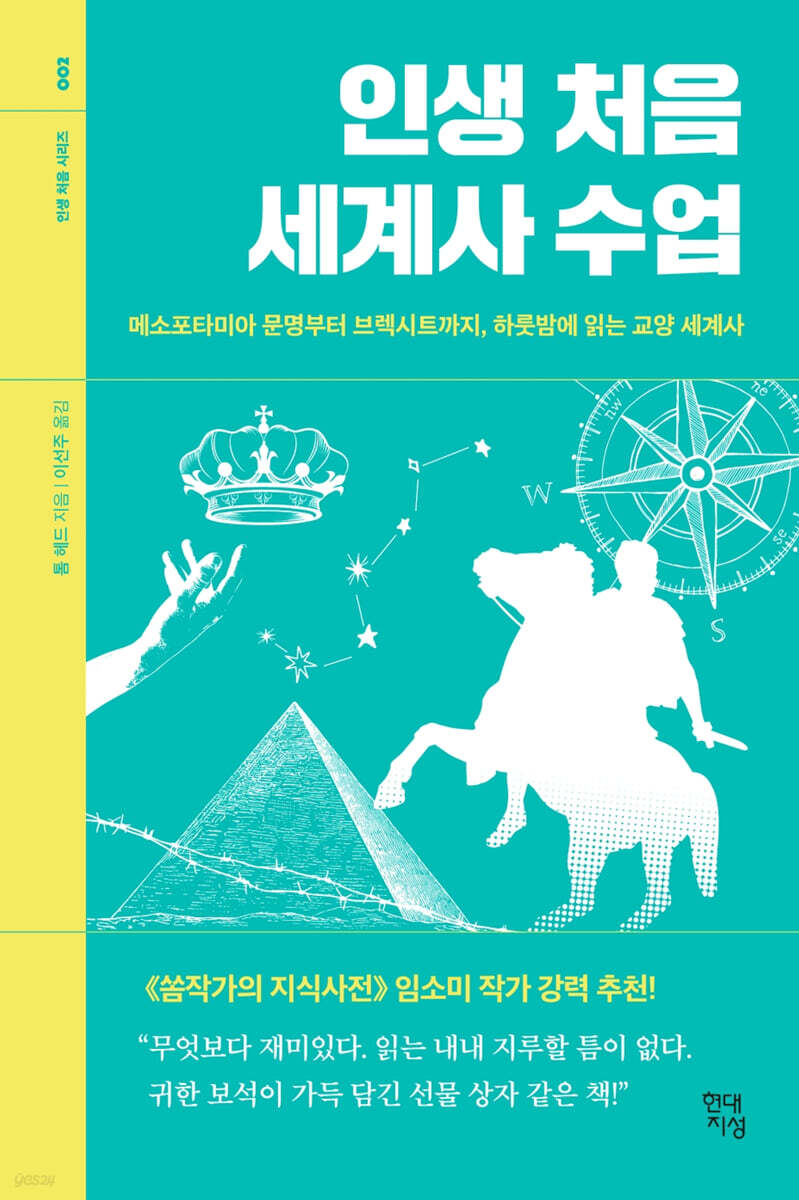
My first world history class
 |
Description
Book Introduction
Choi Tae-seong and Im So-mi strongly recommend!
“It would be perfect for anyone who wants to start studying world history.”
Choi Tae-seong (author of "Minimum Korean History")
“This book is like a gift box filled with precious jewels.”
―Im So-mi (author of "A Minimum World History for Adults Today")
With excellent writing skills and rich visual materials
A guide that solidifies the framework of world history!
We encounter world history on a daily basis through YouTube channels and educational programs such as Sapiens Studio and Naked World History.
We nod our heads as we look at the rise of the ancient Persian Empire or the French Revolution, but as time goes by, only parts of it come to mind vaguely, and world history remains difficult.
Even if you search using keywords such as world history or liberal arts history, it is difficult to find content that summarizes the overall flow.
"Studying World History for the First Time in Your Life" is a friendly guide for readers who want to study world history but are at a loss as to where to start.
A single volume that summarizes 6,000 years of world history, from the emergence of human civilization to the recent issue of Brexit.
Among the countless civilizations, people, and events throughout history, we've compiled the most frequently mentioned and essential information into 63 keywords.
Even readers new to world history will gain a solid understanding of the flow of history and a solid foundation after reading this book.
By covering the hidden histories of various continents, including Africa, South America, and Asia, rather than focusing on the West, such as Europe and the United States, a balanced perspective on the world will be developed.
“It would be perfect for anyone who wants to start studying world history.”
Choi Tae-seong (author of "Minimum Korean History")
“This book is like a gift box filled with precious jewels.”
―Im So-mi (author of "A Minimum World History for Adults Today")
With excellent writing skills and rich visual materials
A guide that solidifies the framework of world history!
We encounter world history on a daily basis through YouTube channels and educational programs such as Sapiens Studio and Naked World History.
We nod our heads as we look at the rise of the ancient Persian Empire or the French Revolution, but as time goes by, only parts of it come to mind vaguely, and world history remains difficult.
Even if you search using keywords such as world history or liberal arts history, it is difficult to find content that summarizes the overall flow.
"Studying World History for the First Time in Your Life" is a friendly guide for readers who want to study world history but are at a loss as to where to start.
A single volume that summarizes 6,000 years of world history, from the emergence of human civilization to the recent issue of Brexit.
Among the countless civilizations, people, and events throughout history, we've compiled the most frequently mentioned and essential information into 63 keywords.
Even readers new to world history will gain a solid understanding of the flow of history and a solid foundation after reading this book.
By covering the hidden histories of various continents, including Africa, South America, and Asia, rather than focusing on the West, such as Europe and the United States, a balanced perspective on the world will be developed.
- You can preview some of the book's contents.
Preview
index
Recommendation letter… 6
Introduction: A truly easy-to-understand world history, with key keywords and fascinating stories… 8
① The birth and fall of civilizations and empires, ancient times
The First Modern Humans: Ethiopian Remains Reveal Prehistory… 19
Mesopotamian Civilization: The First Civilization to Emerge in the Middle East… 26
Egyptian Civilization: The People Who Left Pyramids and Mummies… 32
Indus Valley Civilization: India's History in Stone… 38
The Hittite Empire: The First Powerful Armed State… 43
Egypt's New Kingdom: The Golden Age of Ancient Egypt… 47
Assyria and Babylonia: Empires that Rise in Mesopotamia… 53
The Olmec Civilization: A Central American Mystery… 59
The Persian Empire: Cyrus the Great and Zoroastrianism… 64
Kush: Africa's Secret Civilization… 71
Greek City-States: Athens vs. Sparta, the Peloponnesian War… 76
Alexander the Great: Laying the Foundations of Cosmopolitanism… 83
China's Warring States Period: Qin Shi Huang, Confucius, Sun Tzu… 91
Emperor Ashoka: A Buddhist Conqueror… 96
The Roman Republic: The City Built on Seven Hills… 101
The Roman Empire: Caesar and Augustus… 106
The Birth of Christianity: The Martyrdom of Jesus Christ… 114
China's Six Dynasties: The Chaotic Age of Six Dynasties… 119
Pax Romana and the Fall of the West: The Roman Empire Divided in Two… 122
② The Middle Ages, a time when diverse cultures and religions were intertwined
The Gupta Empire of India: A Land of Religion, Literature, and Chess… 131
Maya Civilization: Rulers of Central America… 134
The Birth of Islam: Muhammad and the Qur'an… 138
Sassanid Empire: The Last Dynasty of the Persian Empire… 143
Shintoism in Japan: The Land of the Rising Sun… 147
The Viking Conquest of Europe: The Brave Warriors of Scandinavia… 150
The Birth of the Holy Roman Empire: Charlemagne and the Spirit of Chivalry… 154
The Great Schism: Roman Catholicism and Eastern Orthodoxy Split… 159
The Crusades and the Inquisition: The Violence of Medieval Christianity… 163
The Caliphate of Cordoba: Islamic Culture in the Iberian Peninsula… 169
Great Zimbabwe: Mysterious Relics of Medieval Africa… 172
Genghis Khan and the Mongol Empire: The World's Largest Nation… 176
The Black Death: Europe's Doomsday… 179
The Fall of the Byzantine Empire: The Roman Empire Ends… 186
③ The spread of imperialism and the era of revolution, modern times
Aztec Civilization: The Most Powerful State in Central American History… 191
The New World and the Slave Trade: The Beginnings of Imperialism… 194
The Birth of Anglicanism and Protestantism: From the Tudor Dynasty to the Thirty Years' War… 200
Unification of Japan: The Age of the Samurai and the Shogun… 211
The French Revolution: Robespierre and the Declaration of the Rights of Man… 215
The American Declaration of Independence: Emancipation of Slaves and Civil Rights for Black People… 221
Emperor Napoleon: The Ruler Who Left a Code of Laws… 229
The German Empire: From Bismarck to the Weimar Republic … 234
The Ottoman Empire: The Turkish Republic, Yesterday and Today… 238
The Industrial Revolution: The Rise of Amazing Inventions… 242
The Beginnings of the Women's Movement: Feminism and World Order… 246
The Age of Imperialism: The World's Last Empires… 251
④ Constant conflict and reconciliation, modern times
World War I: The Gunfire of Sarajevo… 257
The Birth of the Soviet Union: A Communist State… 263
China's Modernization: The Republic of China and the People's Republic of China… 267
Soviet Stalinism: A Horrible Dictator Who Distorted Ideology… 271
World War II: The Most Horrific War in Human History… 274
The Founding of Israel: Zionism and the Jewish State… 281
The North Atlantic Treaty and the Warsaw Pact: The Iron Curtain Descent over Europe… 285
United Nations: The Universal Declaration of Human Rights and Genocide… 290
Nonviolent Movements: Sophie Scholl, Mohandas Gandhi, Martin Luther King… 297
The End of Imperialism: The Age of Independence… 302
The Progress of the Women's Movement: Feminism after World War II… 306
The Cold War: Korea, Vietnam, Afghanistan… 309
Neoliberalism and Neoconservatism: Political and Economic Ideologies of the Late 20th Century… 313
The Decline of Iranian Democracy: The White Revolution and the Ayatollahs… 318
The Dissolution of the Soviet Union: The Collapse of the Communist System… 323
Ending Apartheid: Nelson Mandela, the First Black President… 327
Terrorism and Religious Conflict: A Vicious Cycle of Violence… 333
The European Union's Crisis: Globalism and Nationalism… 337
Article: History You Need to Know for the Future… 343
Source of the illustration … 349
Introduction: A truly easy-to-understand world history, with key keywords and fascinating stories… 8
① The birth and fall of civilizations and empires, ancient times
The First Modern Humans: Ethiopian Remains Reveal Prehistory… 19
Mesopotamian Civilization: The First Civilization to Emerge in the Middle East… 26
Egyptian Civilization: The People Who Left Pyramids and Mummies… 32
Indus Valley Civilization: India's History in Stone… 38
The Hittite Empire: The First Powerful Armed State… 43
Egypt's New Kingdom: The Golden Age of Ancient Egypt… 47
Assyria and Babylonia: Empires that Rise in Mesopotamia… 53
The Olmec Civilization: A Central American Mystery… 59
The Persian Empire: Cyrus the Great and Zoroastrianism… 64
Kush: Africa's Secret Civilization… 71
Greek City-States: Athens vs. Sparta, the Peloponnesian War… 76
Alexander the Great: Laying the Foundations of Cosmopolitanism… 83
China's Warring States Period: Qin Shi Huang, Confucius, Sun Tzu… 91
Emperor Ashoka: A Buddhist Conqueror… 96
The Roman Republic: The City Built on Seven Hills… 101
The Roman Empire: Caesar and Augustus… 106
The Birth of Christianity: The Martyrdom of Jesus Christ… 114
China's Six Dynasties: The Chaotic Age of Six Dynasties… 119
Pax Romana and the Fall of the West: The Roman Empire Divided in Two… 122
② The Middle Ages, a time when diverse cultures and religions were intertwined
The Gupta Empire of India: A Land of Religion, Literature, and Chess… 131
Maya Civilization: Rulers of Central America… 134
The Birth of Islam: Muhammad and the Qur'an… 138
Sassanid Empire: The Last Dynasty of the Persian Empire… 143
Shintoism in Japan: The Land of the Rising Sun… 147
The Viking Conquest of Europe: The Brave Warriors of Scandinavia… 150
The Birth of the Holy Roman Empire: Charlemagne and the Spirit of Chivalry… 154
The Great Schism: Roman Catholicism and Eastern Orthodoxy Split… 159
The Crusades and the Inquisition: The Violence of Medieval Christianity… 163
The Caliphate of Cordoba: Islamic Culture in the Iberian Peninsula… 169
Great Zimbabwe: Mysterious Relics of Medieval Africa… 172
Genghis Khan and the Mongol Empire: The World's Largest Nation… 176
The Black Death: Europe's Doomsday… 179
The Fall of the Byzantine Empire: The Roman Empire Ends… 186
③ The spread of imperialism and the era of revolution, modern times
Aztec Civilization: The Most Powerful State in Central American History… 191
The New World and the Slave Trade: The Beginnings of Imperialism… 194
The Birth of Anglicanism and Protestantism: From the Tudor Dynasty to the Thirty Years' War… 200
Unification of Japan: The Age of the Samurai and the Shogun… 211
The French Revolution: Robespierre and the Declaration of the Rights of Man… 215
The American Declaration of Independence: Emancipation of Slaves and Civil Rights for Black People… 221
Emperor Napoleon: The Ruler Who Left a Code of Laws… 229
The German Empire: From Bismarck to the Weimar Republic … 234
The Ottoman Empire: The Turkish Republic, Yesterday and Today… 238
The Industrial Revolution: The Rise of Amazing Inventions… 242
The Beginnings of the Women's Movement: Feminism and World Order… 246
The Age of Imperialism: The World's Last Empires… 251
④ Constant conflict and reconciliation, modern times
World War I: The Gunfire of Sarajevo… 257
The Birth of the Soviet Union: A Communist State… 263
China's Modernization: The Republic of China and the People's Republic of China… 267
Soviet Stalinism: A Horrible Dictator Who Distorted Ideology… 271
World War II: The Most Horrific War in Human History… 274
The Founding of Israel: Zionism and the Jewish State… 281
The North Atlantic Treaty and the Warsaw Pact: The Iron Curtain Descent over Europe… 285
United Nations: The Universal Declaration of Human Rights and Genocide… 290
Nonviolent Movements: Sophie Scholl, Mohandas Gandhi, Martin Luther King… 297
The End of Imperialism: The Age of Independence… 302
The Progress of the Women's Movement: Feminism after World War II… 306
The Cold War: Korea, Vietnam, Afghanistan… 309
Neoliberalism and Neoconservatism: Political and Economic Ideologies of the Late 20th Century… 313
The Decline of Iranian Democracy: The White Revolution and the Ayatollahs… 318
The Dissolution of the Soviet Union: The Collapse of the Communist System… 323
Ending Apartheid: Nelson Mandela, the First Black President… 327
Terrorism and Religious Conflict: A Vicious Cycle of Violence… 333
The European Union's Crisis: Globalism and Nationalism… 337
Article: History You Need to Know for the Future… 343
Source of the illustration … 349
Detailed image

Into the book
This one book is not enough to contain all the infinite stories of world history.
But this is enough to understand the major flow of world history.
This book has compiled essential keywords that must be known, such as Gilgamesh, the Mayan civilization, the birth of Anglicanism and Protestantism, and the Cold War, so even those new to world history will be able to nod their heads and pretend to know something after reading it.
Because the keywords of world history will be mapped in your head, you will be able to grasp the outline of world history.
---From "Introductory Text: A Very Easy World History with Key Words and Exciting Stories"
Geneticists explain that all humans around the world have the same genes and are essentially descended from the same origin.
Although climate has caused mutations in some areas, modern humans originated from a single ancestor and have not changed much.
Our ancestors stayed in the same area for a long time, and we can all see ourselves as the same race.
---From "The First Modern Humans: Prehistory as Revealed by Ethiopian Remains"
Most Indians refer to their country as 'Bharat'.
It means a fire that burns constantly under the protection of the people and the ruler.
Just as America is named after the Italian explorer and cartographer Amerigo Vespucci, Bharat is named after the legendary ancient emperor Bharata.
According to legend, he inherited a unified Indian empire and ruled it well for a long time.
His life is roughly described in the ancient Indian epic Mahabharata.
---From "Indus Civilization: A History of India Carved in Stone"
Those who know a little about world history will first think of the large, heavy basalt heads when they think of the Olmec civilization.
Seventeen giant human head statues have been discovered throughout Mexico.
The heads are quite elaborate and specifically carved, suggesting they were intended to depict specific individuals, but they are so old and lacking in records that it is still unclear who they are or whether they were actually made by the Olmecs.
---From "Olmecan Civilization: The Mystery of Central America"
The conflict between Carthage and Rome concerned land, particularly the island of Sicily in southern Italy.
When Carthage attempted to control the 3.2-kilometer-wide Strait of Messina between Sicily and the Italian peninsula, Rome realized that it could be blocked by the enemy's overwhelming military force.
Before that, Rome had launched a preemptive attack on Carthage and fought three wars that historians call the Punic Wars.
The word Punic comes from Phoenician.
This is because Carthage was a country founded by Phoenicians who came from the eastern Mediterranean coast.
---From "The Roman Republic: A City Built on Seven Hills"
The Muslims formed small military groups for self-defense rather than to conquer their surroundings, but these groups gradually grew in size.
It was an inevitable thing to do in order to compete with other powers in the region.
After Muhammad's death in 632, the Islamic Empire, under the rule of a series of well-trained soldiers, continued through the era of the four legitimate caliphs, until the Umayyad Caliphate in 750, when the empire dominated the entire Middle East and the Mediterranean, from Afghanistan in the east to Spain and Morocco in the west.
And for some 14 centuries, up to the present day, Islam has remained the dominant religion in the region.
---From "The Birth of Islam: Muhammad and the Quran"
Great Zimbabwe was a large city with a population of 18,000 at its peak between the 12th and 15th centuries.
Gold mining and trading were major industries, and it is estimated that over 540,000 kilograms of gold were extracted from over 4,000 gold mines.
That's a staggering 40 percent of the world's gold supply mined over centuries.
Great Zimbabwe is more impressive than any ruins or historical site.
However, little is known about it other than that it was rich in gold.
Considering the enormous production and market demand for gold, it seems surprising that so little is known about it.
---From "Great Zimbabwe: Mysterious Ruins of Medieval Africa"
The Soviet Union (USSR), the largest country in human history, was the first communist state in human history, established after the collapse of the Russian Empire.
The history of the Soviet Union is marked by brutal repression, purges, and ideologically motivated events, ultimately leading to its dissolution and division into Russia and its neighbors.
Yet, under a political philosophy that was still largely untested, the Soviet Union endured more casualties than any other nation in repelling Nazi Germany, and endured the Cold War for four decades, confronting the United States at the height of its power and influence.
---From "The Birth of the Soviet Union: A State Advocating Communism"
For the past 500 years, Europe has been the world's economic and military power.
They colonized many parts of the world, leaving almost no place untouched by their influence.
The United States and Russia, which dominated the world in the 20th century, can also be considered to be part of the European powers.
Russia straddles Europe and Asia, and America was founded by Europeans crossing the Atlantic.
But now other countries around the world are also growing and developing rapidly.
As a result, Europe's economic and military advantages are diminishing.
Experts predict that China and Japan will become the world's economic powerhouses by 2050.
The Southern Hemisphere, including Central America and sub-Saharan Africa, will also grow into a significant presence.
Islam in the Middle East could potentially surpass Christianity, which dominates Europe, to become the world's largest religion.
But this is enough to understand the major flow of world history.
This book has compiled essential keywords that must be known, such as Gilgamesh, the Mayan civilization, the birth of Anglicanism and Protestantism, and the Cold War, so even those new to world history will be able to nod their heads and pretend to know something after reading it.
Because the keywords of world history will be mapped in your head, you will be able to grasp the outline of world history.
---From "Introductory Text: A Very Easy World History with Key Words and Exciting Stories"
Geneticists explain that all humans around the world have the same genes and are essentially descended from the same origin.
Although climate has caused mutations in some areas, modern humans originated from a single ancestor and have not changed much.
Our ancestors stayed in the same area for a long time, and we can all see ourselves as the same race.
---From "The First Modern Humans: Prehistory as Revealed by Ethiopian Remains"
Most Indians refer to their country as 'Bharat'.
It means a fire that burns constantly under the protection of the people and the ruler.
Just as America is named after the Italian explorer and cartographer Amerigo Vespucci, Bharat is named after the legendary ancient emperor Bharata.
According to legend, he inherited a unified Indian empire and ruled it well for a long time.
His life is roughly described in the ancient Indian epic Mahabharata.
---From "Indus Civilization: A History of India Carved in Stone"
Those who know a little about world history will first think of the large, heavy basalt heads when they think of the Olmec civilization.
Seventeen giant human head statues have been discovered throughout Mexico.
The heads are quite elaborate and specifically carved, suggesting they were intended to depict specific individuals, but they are so old and lacking in records that it is still unclear who they are or whether they were actually made by the Olmecs.
---From "Olmecan Civilization: The Mystery of Central America"
The conflict between Carthage and Rome concerned land, particularly the island of Sicily in southern Italy.
When Carthage attempted to control the 3.2-kilometer-wide Strait of Messina between Sicily and the Italian peninsula, Rome realized that it could be blocked by the enemy's overwhelming military force.
Before that, Rome had launched a preemptive attack on Carthage and fought three wars that historians call the Punic Wars.
The word Punic comes from Phoenician.
This is because Carthage was a country founded by Phoenicians who came from the eastern Mediterranean coast.
---From "The Roman Republic: A City Built on Seven Hills"
The Muslims formed small military groups for self-defense rather than to conquer their surroundings, but these groups gradually grew in size.
It was an inevitable thing to do in order to compete with other powers in the region.
After Muhammad's death in 632, the Islamic Empire, under the rule of a series of well-trained soldiers, continued through the era of the four legitimate caliphs, until the Umayyad Caliphate in 750, when the empire dominated the entire Middle East and the Mediterranean, from Afghanistan in the east to Spain and Morocco in the west.
And for some 14 centuries, up to the present day, Islam has remained the dominant religion in the region.
---From "The Birth of Islam: Muhammad and the Quran"
Great Zimbabwe was a large city with a population of 18,000 at its peak between the 12th and 15th centuries.
Gold mining and trading were major industries, and it is estimated that over 540,000 kilograms of gold were extracted from over 4,000 gold mines.
That's a staggering 40 percent of the world's gold supply mined over centuries.
Great Zimbabwe is more impressive than any ruins or historical site.
However, little is known about it other than that it was rich in gold.
Considering the enormous production and market demand for gold, it seems surprising that so little is known about it.
---From "Great Zimbabwe: Mysterious Ruins of Medieval Africa"
The Soviet Union (USSR), the largest country in human history, was the first communist state in human history, established after the collapse of the Russian Empire.
The history of the Soviet Union is marked by brutal repression, purges, and ideologically motivated events, ultimately leading to its dissolution and division into Russia and its neighbors.
Yet, under a political philosophy that was still largely untested, the Soviet Union endured more casualties than any other nation in repelling Nazi Germany, and endured the Cold War for four decades, confronting the United States at the height of its power and influence.
---From "The Birth of the Soviet Union: A State Advocating Communism"
For the past 500 years, Europe has been the world's economic and military power.
They colonized many parts of the world, leaving almost no place untouched by their influence.
The United States and Russia, which dominated the world in the 20th century, can also be considered to be part of the European powers.
Russia straddles Europe and Asia, and America was founded by Europeans crossing the Atlantic.
But now other countries around the world are also growing and developing rapidly.
As a result, Europe's economic and military advantages are diminishing.
Experts predict that China and Japan will become the world's economic powerhouses by 2050.
The Southern Hemisphere, including Central America and sub-Saharan Africa, will also grow into a significant presence.
Islam in the Middle East could potentially surpass Christianity, which dominates Europe, to become the world's largest religion.
---From "The Crisis of the European Union: Globalism and Nationalism"
Publisher's Review
Over 120 color images and an easy-to-read writing style,
A very easy world history that flows in your head
"My First World History Class" is an introductory book that conveys the core content of world history in an easy and fun way.
If you know just the 63 keywords in this book, you can quickly catch up with 6,000 years of world history.
Author Tom Head, a PhD in humanities and historical storyteller, takes readers on a journey through some of the most significant times and places in world history.
It conveys a balanced perspective on the history of not only classics of world history such as Mesopotamian civilization and the Roman Empire, but also the history of lesser-known regions such as Mexico's mysterious Olmec civilization and Africa's medieval ruins of Great Zimbabwe.
This book is packed with insights into today's international issues, including the recurring racism and white supremacy in Europe and the United States, and the decline of democracy in Iran. As you read, you'll find yourself grasping the overall flow of world history.
A variety of visual aids also aid the reader's understanding.
Over 120 color images and maps provide detailed explanations of major countries, events, and people, bringing historical scenes to life.
The "One Step Further" tip boxes inserted throughout the text will satisfy the curiosity of readers who want to know more, covering not only world history knowledge but also philosophical thought, international issues, and liberal arts.
It will broaden your perspective on the world
63 World History Hub Knowledge
Francis Fukuyama, a professor of political science at Stanford University, wrote in his 1992 book, The End of History, that “human history will end when the era of peace arrives.”
Because once democracy takes root around the world and conflict and discord end, there will be no more major events worth recording and studying.
But today, 30 years later, the world seems to have entered a period of division and conflict again, rather than peace.
In 2022, the Russo-Ukrainian War broke out, still affecting the world, and in 2023, the Israel-Hamas War broke out, resulting in countless casualties.
Even if you listen to foreign media and local news to find the cause of the conflict, it is difficult to find clues as to why this conflict occurred or how to deal with it based on only fragmentary news.
Many of the challenges facing modern society have close connections to world history.
So, studying world history broadens your perspective on the world and gives you judgment and insight.
The long-standing conflict between Russia and Ukraine dates back to the Cold War, the North Atlantic Treaty, and the collapse of the Soviet Union.
To understand the Israel-Hamas war, one must look back to the medieval Crusades, which were fought to take control of the Levant, the Holocaust during World War II, and the founding of Israel.
In history, we can find the reasons for conflict and the clues to reconciliation.
In this way, world history provides a starting point for understanding complex issues and international relations.
Knowing world history makes the world look different than it did before.
The 63 keywords introduced in this book serve as a knowledge hub for world history in their own right.
For example, if we look at the "Persian Empire" entry, the fact that Cyrus the Great (King Cyrus in the Bible) and Zoroastrianism practiced democratic values 2,500 years before modern democracy completely shatters our ignorance and prejudice that simply because it was an Islamic empire, it must be a ruthless villain.
I realized that I had been misunderstanding things based on the fragmentary images I saw in various media, and I was amazed to learn that the Persian Empire had already introduced more advanced systems than I had thought in ancient times.
In this way, by using the 63 keywords in this book as the backbone of history, we can obtain a framework for interpreting most of the world's current historical events.
Enrich your everyday conversations
An interesting and colorful story of world history
From the journeys of the ancient hero Gilgamesh to the medieval Crusades, the modern Industrial Revolution, and two World Wars, major events in world history have fascinating backgrounds and narratives.
These stories continue to be the subject of movies and novels, reinterpreted in online games, and vividly brought to life in educational programs.
World history not only enriches our knowledge and broadens our thinking, but it is also an interesting story in itself.
If you were Caesar, would you cross the Rubicon and march on Rome? Imagine you were Robespierre, the radical leader of the French Revolution, and think about what policies you might have pursued.
If the Soviet Union hadn't collapsed, would the Cold War between the United States and the Soviet Union have persisted to this day? As such, the material for stories to be gleaned from world history is endless.
This isn't just about huge, amazing content.
Humans have instinctively created and told stories.
Events and figures from world history naturally permeate our daily lives, enriching and enriching small talk with colleagues, tea time with long-lost acquaintances, and meals with family.
This book will go beyond simply providing historical knowledge; it will enrich your everyday conversations and even serve as a helpful guide when pondering and making decisions about life's problems.
A very easy world history that flows in your head
"My First World History Class" is an introductory book that conveys the core content of world history in an easy and fun way.
If you know just the 63 keywords in this book, you can quickly catch up with 6,000 years of world history.
Author Tom Head, a PhD in humanities and historical storyteller, takes readers on a journey through some of the most significant times and places in world history.
It conveys a balanced perspective on the history of not only classics of world history such as Mesopotamian civilization and the Roman Empire, but also the history of lesser-known regions such as Mexico's mysterious Olmec civilization and Africa's medieval ruins of Great Zimbabwe.
This book is packed with insights into today's international issues, including the recurring racism and white supremacy in Europe and the United States, and the decline of democracy in Iran. As you read, you'll find yourself grasping the overall flow of world history.
A variety of visual aids also aid the reader's understanding.
Over 120 color images and maps provide detailed explanations of major countries, events, and people, bringing historical scenes to life.
The "One Step Further" tip boxes inserted throughout the text will satisfy the curiosity of readers who want to know more, covering not only world history knowledge but also philosophical thought, international issues, and liberal arts.
It will broaden your perspective on the world
63 World History Hub Knowledge
Francis Fukuyama, a professor of political science at Stanford University, wrote in his 1992 book, The End of History, that “human history will end when the era of peace arrives.”
Because once democracy takes root around the world and conflict and discord end, there will be no more major events worth recording and studying.
But today, 30 years later, the world seems to have entered a period of division and conflict again, rather than peace.
In 2022, the Russo-Ukrainian War broke out, still affecting the world, and in 2023, the Israel-Hamas War broke out, resulting in countless casualties.
Even if you listen to foreign media and local news to find the cause of the conflict, it is difficult to find clues as to why this conflict occurred or how to deal with it based on only fragmentary news.
Many of the challenges facing modern society have close connections to world history.
So, studying world history broadens your perspective on the world and gives you judgment and insight.
The long-standing conflict between Russia and Ukraine dates back to the Cold War, the North Atlantic Treaty, and the collapse of the Soviet Union.
To understand the Israel-Hamas war, one must look back to the medieval Crusades, which were fought to take control of the Levant, the Holocaust during World War II, and the founding of Israel.
In history, we can find the reasons for conflict and the clues to reconciliation.
In this way, world history provides a starting point for understanding complex issues and international relations.
Knowing world history makes the world look different than it did before.
The 63 keywords introduced in this book serve as a knowledge hub for world history in their own right.
For example, if we look at the "Persian Empire" entry, the fact that Cyrus the Great (King Cyrus in the Bible) and Zoroastrianism practiced democratic values 2,500 years before modern democracy completely shatters our ignorance and prejudice that simply because it was an Islamic empire, it must be a ruthless villain.
I realized that I had been misunderstanding things based on the fragmentary images I saw in various media, and I was amazed to learn that the Persian Empire had already introduced more advanced systems than I had thought in ancient times.
In this way, by using the 63 keywords in this book as the backbone of history, we can obtain a framework for interpreting most of the world's current historical events.
Enrich your everyday conversations
An interesting and colorful story of world history
From the journeys of the ancient hero Gilgamesh to the medieval Crusades, the modern Industrial Revolution, and two World Wars, major events in world history have fascinating backgrounds and narratives.
These stories continue to be the subject of movies and novels, reinterpreted in online games, and vividly brought to life in educational programs.
World history not only enriches our knowledge and broadens our thinking, but it is also an interesting story in itself.
If you were Caesar, would you cross the Rubicon and march on Rome? Imagine you were Robespierre, the radical leader of the French Revolution, and think about what policies you might have pursued.
If the Soviet Union hadn't collapsed, would the Cold War between the United States and the Soviet Union have persisted to this day? As such, the material for stories to be gleaned from world history is endless.
This isn't just about huge, amazing content.
Humans have instinctively created and told stories.
Events and figures from world history naturally permeate our daily lives, enriching and enriching small talk with colleagues, tea time with long-lost acquaintances, and meals with family.
This book will go beyond simply providing historical knowledge; it will enrich your everyday conversations and even serve as a helpful guide when pondering and making decisions about life's problems.
GOODS SPECIFICS
- Date of issue: June 25, 2024
- Page count, weight, size: 352 pages | 140*210*30mm
- ISBN13: 9791139716788
- ISBN10: 1139716786
You may also like
카테고리
korean


korean

![GQ KOREA Mark (Monthly): December [2025]](http://librairie.coreenne.fr/cdn/shop/files/8ef265dbbfbf186523ed75ba7319009d.jpg?v=1765340328&width=3840)


