

Yoshida Shoin, Rebelling Against the Times
 |
Description
Book Introduction
▶ Yoshida Shoin and the students of Shokasonjuku
The unfinished story
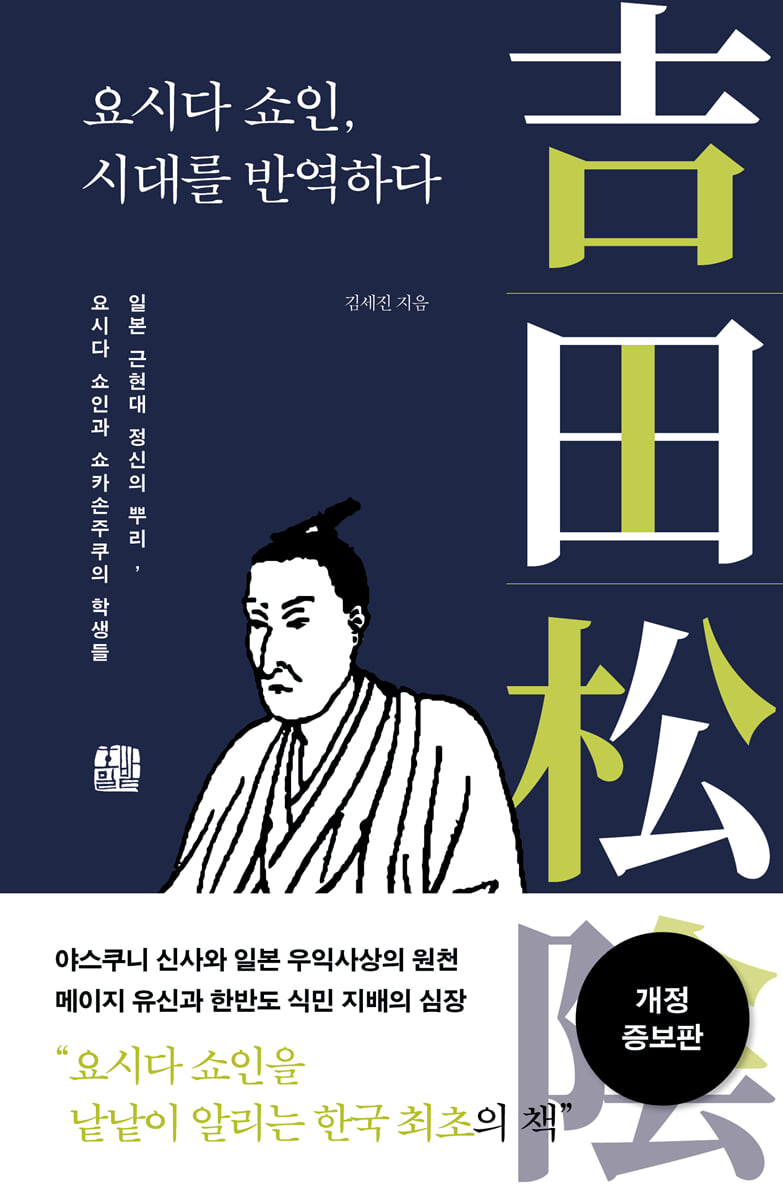
Since its debut on Liberation Day in 2018, "Yoshida Shoin, Betraying the Times," which has consistently garnered readers' attention, has returned in a revised and expanded edition.
On August 15, 2018, Liberation Day, I published this book and said goodbye to Yoshida Shoin.
But it seems like Shoin either hasn't decided to break up or can't.
They keep coming from all over the place.
After the book was published, the number of times Yoshida Shoin was mentioned in Korean society increased rapidly.
He gave lectures all over the country and met with various people to introduce 'Yoshida Shoin and the others.'
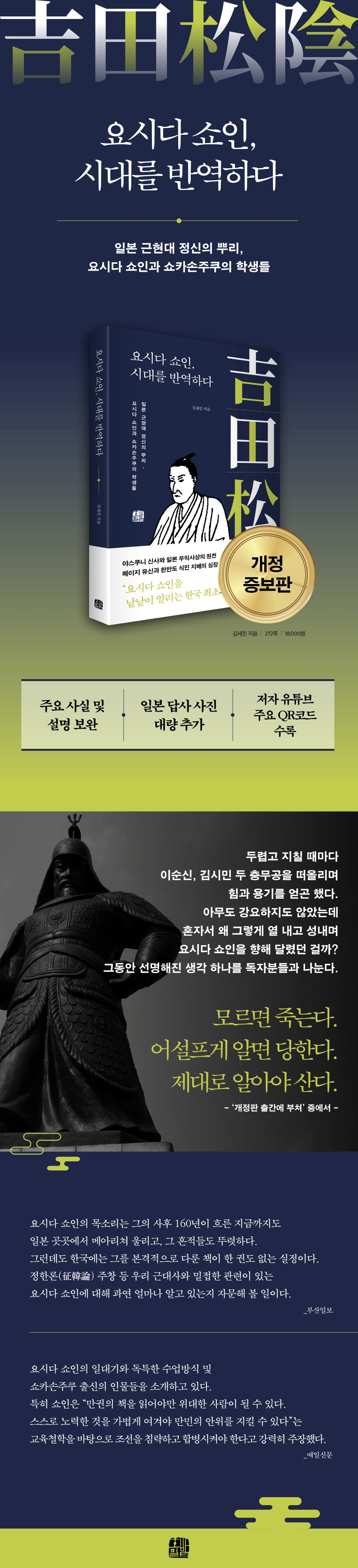
Whenever there was a commotion in Korea-Japan relations, Yoshida Shoin appeared in major media outlets, and he received particular attention in 2019 when a nationwide anti-Japanese movement swept through the country.
From 'On the Publication of the Revised Edition'
This book has attempted to preserve the content and framework of the first edition as much as possible.
The author wanted to convey the thoughts and feelings he had while exploring and researching Shoin as they were.
However, let's briefly look at the differences from the first edition as it has been revised and expanded. First of all, it contains about 50 photos acquired from various places in Japan (Tokyo, Yokosuka, Osaka, Kyoto, Fukuoka, Nagasaki, Hagi, Shimonoseki, etc.) that were visited and surveyed after publication.
It supplements parts that were lacking or missing from the first edition, and also includes information on the commemorative facilities completed after Shoin's school (Shokasonjuku) was registered as a UNESCO World Heritage Site in 2015.
In addition, we have added references from research conducted after publication, and have added field trip videos uploaded to the author's YouTube channel 'Korea Sejin' as an appendix for easy access.
In short, it was organized to enable a more three-dimensional and vivid understanding of Yoshida Shoin and Shokasonjuku than the first edition.
The unfinished story
Since its debut on Liberation Day in 2018, "Yoshida Shoin, Betraying the Times," which has consistently garnered readers' attention, has returned in a revised and expanded edition.
On August 15, 2018, Liberation Day, I published this book and said goodbye to Yoshida Shoin.
But it seems like Shoin either hasn't decided to break up or can't.
They keep coming from all over the place.
After the book was published, the number of times Yoshida Shoin was mentioned in Korean society increased rapidly.
He gave lectures all over the country and met with various people to introduce 'Yoshida Shoin and the others.'
Whenever there was a commotion in Korea-Japan relations, Yoshida Shoin appeared in major media outlets, and he received particular attention in 2019 when a nationwide anti-Japanese movement swept through the country.
From 'On the Publication of the Revised Edition'
This book has attempted to preserve the content and framework of the first edition as much as possible.
The author wanted to convey the thoughts and feelings he had while exploring and researching Shoin as they were.
However, let's briefly look at the differences from the first edition as it has been revised and expanded. First of all, it contains about 50 photos acquired from various places in Japan (Tokyo, Yokosuka, Osaka, Kyoto, Fukuoka, Nagasaki, Hagi, Shimonoseki, etc.) that were visited and surveyed after publication.
It supplements parts that were lacking or missing from the first edition, and also includes information on the commemorative facilities completed after Shoin's school (Shokasonjuku) was registered as a UNESCO World Heritage Site in 2015.
In addition, we have added references from research conducted after publication, and have added field trip videos uploaded to the author's YouTube channel 'Korea Sejin' as an appendix for easy access.
In short, it was organized to enable a more three-dimensional and vivid understanding of Yoshida Shoin and Shokasonjuku than the first edition.
- You can preview some of the book's contents.
Preview
index
On the publication of the revised edition
Opening remarks
On the way to meet Yoshida Shoin
Chapter 1.
The Edo period and the Choshu Domain (Yamaguchi Prefecture)
The Edo Period and the Choshu Domain (Yamaguchi Prefecture) │ Modern and Contemporary Japan
Chapter 2.
Yoshida Shoin's Life: 29 Fiery Years
29 Years of Burning Heat │ Yoshida Shoin's Thoughts 108
Chapter 3.
UNESCO World Heritage Site, Shokasonjuku
Shokasonjuku │ The Trend and Role of Private Schools │ History of Shokasonjuku │ Student Structure │ Teaching Methods │ Educational Features │ Evaluation │ Quotes from Yoshida Shoin
Chapter 4.
Students of Shokasonjuku: "Japan's Sprouts"
Japanese sprouts
Chapter 5.
Yoshida Shoin, who is still alive today
The Dark Shadow of Yoshida Shoin │ For the True Self-Knowledge of the Enemy
Closing remarks
Acknowledgements
supplement
References
Opening remarks
On the way to meet Yoshida Shoin
Chapter 1.
The Edo period and the Choshu Domain (Yamaguchi Prefecture)
The Edo Period and the Choshu Domain (Yamaguchi Prefecture) │ Modern and Contemporary Japan
Chapter 2.
Yoshida Shoin's Life: 29 Fiery Years
29 Years of Burning Heat │ Yoshida Shoin's Thoughts 108
Chapter 3.
UNESCO World Heritage Site, Shokasonjuku
Shokasonjuku │ The Trend and Role of Private Schools │ History of Shokasonjuku │ Student Structure │ Teaching Methods │ Educational Features │ Evaluation │ Quotes from Yoshida Shoin
Chapter 4.
Students of Shokasonjuku: "Japan's Sprouts"
Japanese sprouts
Chapter 5.
Yoshida Shoin, who is still alive today
The Dark Shadow of Yoshida Shoin │ For the True Self-Knowledge of the Enemy
Closing remarks
Acknowledgements
supplement
References
Detailed image
Into the book
Why did I run towards Yoshida Shoin, so agitated and angry, without anyone forcing me to do so? Years have passed, but I still don't understand.
Maybe life will bring the answer.
Still, I conclude my reunion with Yoshida Shoin by sharing with readers one thought that has become clearer over time.
If you don't know, you die.
If you know it poorly, you will suffer.
You have to know it properly to live.'
--- p.15
The resentment that the Choshu clan had harbored toward the Edo shogunate for over 200 years, combined with the ideology of Sonno Joi (respect the emperor and defeat the Western powers) that was triggered by the emergence of Western powers in the 19th century, spurred young samurai to action.
And the powerful leader who had a great influence on them was Yoshida Shoin.
--- p.30
Yoshida Shoin traveled throughout Japan for three and a half years in his early twenties, covering 13,000 li.
I was able to broaden my horizons by observing the customs and topography of each region, meeting various scholars, and reading and discussing books together.
Even though he knew better than anyone that he would be severely punished, Shoin's spirit of challenge, courage, and ability to act with only one goal in mind: "We must save Japan" were truly remarkable, and Shoin's actions began to become known throughout Japan.
--- p.61~62
Shoin particularly strongly advocated for the invasion and annexation of Joseon, and his disciples Kido Takayoshi, Ito Hirobumi, and Yamagata Aritomo later developed this logic into a major policy of the Meiji government.
In particular, Prime Minister Yamagata Aritomo led the invasion policy by claiming at the first meeting of the Imperial Diet of Japan that “Japan’s interests lie in the Korean Peninsula.”
--- p.113
In today's Japan, the aggressive ideology and violence of Yoshida Shoin, the "god of education," are not often discussed.
He is glorified as a great educator and thinker, and all his claims tend to be rationalized as being 'for the good of Japan.'
To embrace both the success and failure of education, as well as its light and dark sides, it is important to shed the veil of praise and idealization, and to observe objectively, free from the shackles of emotion.
--- p.141
Of course, not all students at Shokasonjuku achieved success, but 30.6% of its students went on to become leading figures in various fields such as politics, economics, national defense, diplomacy, law, and society, including Prime Ministers Ito Hirobumi and Yamagata Aritomo, who became the leaders of Japan, and Meiji government ministers Maehara Issei, Yamada Akiyoshi, Nomura Yasushi, and Shinagawa Yajiro. This was an achievement that no other educational institution in Japan could match.
--- p.146
The original name of Yasukuni Shrine, which symbolizes Japan's right-wing ideology and historical perception, was 'creepily' Choshu Shrine.
Students of Shokasonjuku, including Ito Hirobumi, and people born in Choshu built Choshu Shrines (Shōkonsha) throughout Japan.
Among them, in August 1869, the memorial tablets of Yoshida Shoin and Takasuki Shinsaku were brought to Chiyoda Ward in Tokyo.
--- p.205
If you type in Yoshida Shoin's name on Amazon Japan's online bookstore, you can find over 1,200 books.
On the other hand, in South Korea, there is not a single book that deals with the subject of Yoshida Shoin.
In books dealing with Japanese history or thought, Shoin is only briefly mentioned, and there are only a few papers written by historians.
--- p.223
Yesterday is a mirror that reflects today, and tomorrow is created today.
Whether we seek to cultivate healthy relations with Japan or prepare for its regressive behavior, we must break free from all preconceived notions and emotional frameworks to prevent a tragedy that runs counter to the currents of the times.
We must look at yesterday accurately and illuminate today.
To suffer through ignorance is a greater sin than to suffer through knowledge.
There is a joke that says, "When you think it's too late, it's really too late," but now is the time to be objective and cool-headed and know yourself and your enemy.
Maybe life will bring the answer.
Still, I conclude my reunion with Yoshida Shoin by sharing with readers one thought that has become clearer over time.
If you don't know, you die.
If you know it poorly, you will suffer.
You have to know it properly to live.'
--- p.15
The resentment that the Choshu clan had harbored toward the Edo shogunate for over 200 years, combined with the ideology of Sonno Joi (respect the emperor and defeat the Western powers) that was triggered by the emergence of Western powers in the 19th century, spurred young samurai to action.
And the powerful leader who had a great influence on them was Yoshida Shoin.
--- p.30
Yoshida Shoin traveled throughout Japan for three and a half years in his early twenties, covering 13,000 li.
I was able to broaden my horizons by observing the customs and topography of each region, meeting various scholars, and reading and discussing books together.
Even though he knew better than anyone that he would be severely punished, Shoin's spirit of challenge, courage, and ability to act with only one goal in mind: "We must save Japan" were truly remarkable, and Shoin's actions began to become known throughout Japan.
--- p.61~62
Shoin particularly strongly advocated for the invasion and annexation of Joseon, and his disciples Kido Takayoshi, Ito Hirobumi, and Yamagata Aritomo later developed this logic into a major policy of the Meiji government.
In particular, Prime Minister Yamagata Aritomo led the invasion policy by claiming at the first meeting of the Imperial Diet of Japan that “Japan’s interests lie in the Korean Peninsula.”
--- p.113
In today's Japan, the aggressive ideology and violence of Yoshida Shoin, the "god of education," are not often discussed.
He is glorified as a great educator and thinker, and all his claims tend to be rationalized as being 'for the good of Japan.'
To embrace both the success and failure of education, as well as its light and dark sides, it is important to shed the veil of praise and idealization, and to observe objectively, free from the shackles of emotion.
--- p.141
Of course, not all students at Shokasonjuku achieved success, but 30.6% of its students went on to become leading figures in various fields such as politics, economics, national defense, diplomacy, law, and society, including Prime Ministers Ito Hirobumi and Yamagata Aritomo, who became the leaders of Japan, and Meiji government ministers Maehara Issei, Yamada Akiyoshi, Nomura Yasushi, and Shinagawa Yajiro. This was an achievement that no other educational institution in Japan could match.
--- p.146
The original name of Yasukuni Shrine, which symbolizes Japan's right-wing ideology and historical perception, was 'creepily' Choshu Shrine.
Students of Shokasonjuku, including Ito Hirobumi, and people born in Choshu built Choshu Shrines (Shōkonsha) throughout Japan.
Among them, in August 1869, the memorial tablets of Yoshida Shoin and Takasuki Shinsaku were brought to Chiyoda Ward in Tokyo.
--- p.205
If you type in Yoshida Shoin's name on Amazon Japan's online bookstore, you can find over 1,200 books.
On the other hand, in South Korea, there is not a single book that deals with the subject of Yoshida Shoin.
In books dealing with Japanese history or thought, Shoin is only briefly mentioned, and there are only a few papers written by historians.
--- p.223
Yesterday is a mirror that reflects today, and tomorrow is created today.
Whether we seek to cultivate healthy relations with Japan or prepare for its regressive behavior, we must break free from all preconceived notions and emotional frameworks to prevent a tragedy that runs counter to the currents of the times.
We must look at yesterday accurately and illuminate today.
To suffer through ignorance is a greater sin than to suffer through knowledge.
There is a joke that says, "When you think it's too late, it's really too late," but now is the time to be objective and cool-headed and know yourself and your enemy.
--- p.240
Publisher's Review
▶ Yoshida Shoin, who was obscured by anti-Japanese sentiment
The first Korean book detailing his life and accomplishments
Yoshida Shoin, the mentor of Ito Hirobumi, the spiritual leader of Shinzo Abe (former Japanese Prime Minister), and the father of Japanese right-wing thought who developed the theory of the need to conquer the Korean Peninsula.
This book examines the lives of Shoin and the students who attended his school, Shokasonjuku, and provides a broader and more comprehensive view of modern and contemporary history in Japan and Korea.
The Japanese remember and revere him as a thinker and revolutionary, an educator who nurtured Japan's most outstanding leaders since the modern era, a curious explorer who risked his life to travel abroad because even Japan itself was not enough, a writer whose spirited writings touched the hearts of many, a patriot whose only concern was Japan, and a man whose actions inspired humanity.
In this way, Yoshida Shoin is a figure who is still respected by many Japanese leaders and is like the root of modern Japanese thought.
Shinzo Abe, who symbolized Japan's far-right politics, visited Yoshida Shoin's grave in 2013, knelt down in prayer, and pledged to "faithfully carry on Mr. Shoin's will," and quoted Yoshida Shoin's "Twenty-One Oath" story in the National Assembly at the end of 2016.
Among Shoin's disciples, the one best known to us is Ito Hirobumi, the first prime minister of modern Japan.
Although Yoshida Shoin is a figure that many Japanese people pay attention to, he is not well known in Korea.
He is only known as the teacher of Ito Hirobumi and the person who compiled the Seikanron (theory of conquering Korea), which advocated for the conquest of the Korean Peninsula.
Even if you know the name Yoshida Shoin, you are generally unaware of the fact that the Yasukuni Shrine, which symbolizes the diplomatic friction between Korea and Japan today, was originally built to honor Shoin and others, that he is considered equal to Pestalozzi, the father of education, and is considered the father of Japanese right-wing ideology, and that he is even related to the claim to Dokdo.
▶ Looking back on yesterday accurately
Creating a better tomorrow today
In Japan, there are nearly 1,200 books that directly or indirectly deal with Yoshida Shoin.
However, before the publication of “Yoshida Shoin, Rebel to the Times,” there was not a single book about him in Korea.
The disciples who received Shoin's teachings played a central role in the Meiji Restoration, and many people still consider him an ideological pillar, but few Koreans actually know the details of his actions.
Why do we not know about Yoshida Shoin even after so much time has passed?
Why has his name and ideology, so closely intertwined with the history of the Korean Peninsula, been so elusive? Before answering this question, we need to consider whether, while proclaiming "know your enemy and know yourself," we've been caught up in a sentiment that ignores our enemies.
This book examines the lives of Yoshida Shoin and his students at his school, Shokasonjuku, and provides a broader and more comprehensive perspective on modern and contemporary history in Japan and Korea.
Also, by introducing the actions of Shoin and the sayings he left behind, it makes us look back on what a true Jipigigi is.
It is a point where we should seriously reflect on whether we have been only seeing what we wanted to see and hearing what we wanted to hear.
When we objectively recognize the history of our country and its neighbors, we can truly communicate and build healthier relationships.
As the author says, whether we will become masters of history and lead it, or whether we will be observers or bystanders of the history created by others and be led by them, depends on our sincere reflection and the desire to know others and ourselves.
The first Korean book detailing his life and accomplishments
Yoshida Shoin, the mentor of Ito Hirobumi, the spiritual leader of Shinzo Abe (former Japanese Prime Minister), and the father of Japanese right-wing thought who developed the theory of the need to conquer the Korean Peninsula.
This book examines the lives of Shoin and the students who attended his school, Shokasonjuku, and provides a broader and more comprehensive view of modern and contemporary history in Japan and Korea.
The Japanese remember and revere him as a thinker and revolutionary, an educator who nurtured Japan's most outstanding leaders since the modern era, a curious explorer who risked his life to travel abroad because even Japan itself was not enough, a writer whose spirited writings touched the hearts of many, a patriot whose only concern was Japan, and a man whose actions inspired humanity.
In this way, Yoshida Shoin is a figure who is still respected by many Japanese leaders and is like the root of modern Japanese thought.
Shinzo Abe, who symbolized Japan's far-right politics, visited Yoshida Shoin's grave in 2013, knelt down in prayer, and pledged to "faithfully carry on Mr. Shoin's will," and quoted Yoshida Shoin's "Twenty-One Oath" story in the National Assembly at the end of 2016.
Among Shoin's disciples, the one best known to us is Ito Hirobumi, the first prime minister of modern Japan.
Although Yoshida Shoin is a figure that many Japanese people pay attention to, he is not well known in Korea.
He is only known as the teacher of Ito Hirobumi and the person who compiled the Seikanron (theory of conquering Korea), which advocated for the conquest of the Korean Peninsula.
Even if you know the name Yoshida Shoin, you are generally unaware of the fact that the Yasukuni Shrine, which symbolizes the diplomatic friction between Korea and Japan today, was originally built to honor Shoin and others, that he is considered equal to Pestalozzi, the father of education, and is considered the father of Japanese right-wing ideology, and that he is even related to the claim to Dokdo.
▶ Looking back on yesterday accurately
Creating a better tomorrow today
In Japan, there are nearly 1,200 books that directly or indirectly deal with Yoshida Shoin.
However, before the publication of “Yoshida Shoin, Rebel to the Times,” there was not a single book about him in Korea.
The disciples who received Shoin's teachings played a central role in the Meiji Restoration, and many people still consider him an ideological pillar, but few Koreans actually know the details of his actions.
Why do we not know about Yoshida Shoin even after so much time has passed?
Why has his name and ideology, so closely intertwined with the history of the Korean Peninsula, been so elusive? Before answering this question, we need to consider whether, while proclaiming "know your enemy and know yourself," we've been caught up in a sentiment that ignores our enemies.
This book examines the lives of Yoshida Shoin and his students at his school, Shokasonjuku, and provides a broader and more comprehensive perspective on modern and contemporary history in Japan and Korea.
Also, by introducing the actions of Shoin and the sayings he left behind, it makes us look back on what a true Jipigigi is.
It is a point where we should seriously reflect on whether we have been only seeing what we wanted to see and hearing what we wanted to hear.
When we objectively recognize the history of our country and its neighbors, we can truly communicate and build healthier relationships.
As the author says, whether we will become masters of history and lead it, or whether we will be observers or bystanders of the history created by others and be led by them, depends on our sincere reflection and the desire to know others and ourselves.
GOODS SPECIFICS
- Date of issue: May 27, 2024
- Page count, weight, size: 272 pages | 462g | 141*216*18mm
- ISBN13: 9791168261518
- ISBN10: 1168261511
You may also like
카테고리
korean


korean

![GQ KOREA Mark (Monthly): December [2025]](http://librairie.coreenne.fr/cdn/shop/files/8ef265dbbfbf186523ed75ba7319009d.jpg?v=1765340328&width=3840)


