

How to Work with AI
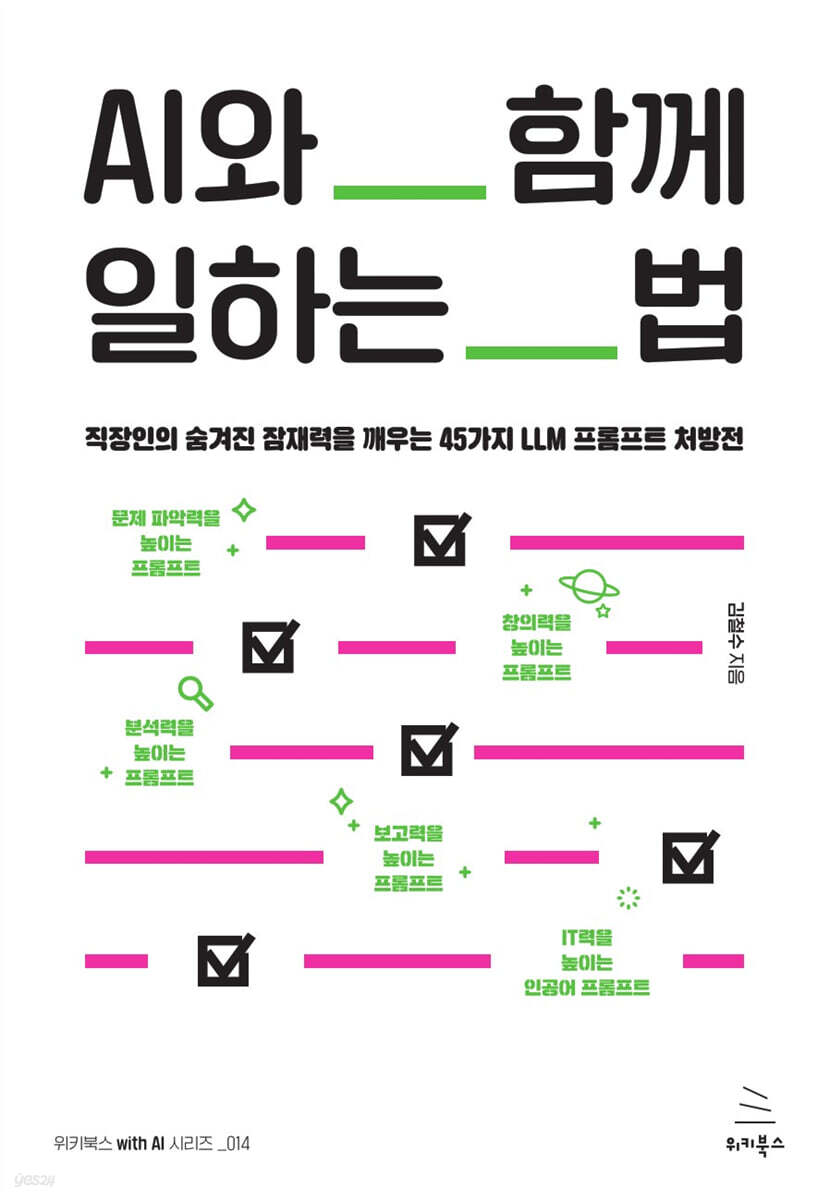 |
Description
Book Introduction
We cover the secrets of how high-performing people communicate effectively with AI!
People who are good at their jobs are also good at using AI.
Why is that? First, people who are good at their jobs often research, ask questions, and make requests.
On the other hand, people who can't work don't have that much.
Now, people who are good at their jobs ask questions, make requests, and ask LLMs to do research first.
Second, successful professionals seek alternatives, not the right answers. The LLM is not a tool designed to provide answers, but rather to provide recommendations.
A recommendation is called a 'proposal'.
People who are good at their jobs ask for recommendations for LLM.
Third, people who are good at their jobs apply a methodology to any task.
We work using a framework to determine from what perspective we will analyze.
So I always ask LLMs about new methodologies and frameworks.
Fourth, people who are good at their jobs have no omissions or duplications.
So, I talk to LLM regularly to see if I missed anything or if there is anything unusual.
Fifth, always review and select people who are good at their jobs.
Be sure to check if the logic is correct and if it is realistic.
Do not simply use or report the results of the LLM as is.
People who are good at their jobs are also good at using AI.
Why is that? First, people who are good at their jobs often research, ask questions, and make requests.
On the other hand, people who can't work don't have that much.
Now, people who are good at their jobs ask questions, make requests, and ask LLMs to do research first.
Second, successful professionals seek alternatives, not the right answers. The LLM is not a tool designed to provide answers, but rather to provide recommendations.
A recommendation is called a 'proposal'.
People who are good at their jobs ask for recommendations for LLM.
Third, people who are good at their jobs apply a methodology to any task.
We work using a framework to determine from what perspective we will analyze.
So I always ask LLMs about new methodologies and frameworks.
Fourth, people who are good at their jobs have no omissions or duplications.
So, I talk to LLM regularly to see if I missed anything or if there is anything unusual.
Fifth, always review and select people who are good at their jobs.
Be sure to check if the logic is correct and if it is realistic.
Do not simply use or report the results of the LLM as is.
- You can preview some of the book's contents.
Preview
index
▣ Chapter 1: How People Who Are Originally Good at Their Jobs Can Also Use AI Well
01 _ People who are good at their jobs ask questions and make requests.
02_ Don't ask for the right answer, ask for recommendations.
03 _ Let's ask about the methodology first and then make a request.
04 _ Let's first ask what you want to know
05 _ Let me ask you questions step by step
06 _ Let's make simple requests to the AI that makes the inferences.
07 _ Add AI capabilities to domains and processes
▣ Chapter 2: Prompts to Improve the Problem-Solving Ability of the Average Office Worker
08 _ Write a problem statement that defines the problem
09 _ Determining whether a problem is a problem or not
10_ Understanding the problem in terms of past, present, and future
11_ Raising Issues in the Organization
12_ Designing a User Group Interview (FGI)
13_ Estimating the size of the new product market
14_ Creating a Business Model Canvas
▣ Chapter 3: Prompts to Boost Creativity in Ordinary Office Workers
15_ Discover, explain, and validate ideas
16 _ Getting Ideas with Innovative Problem Solving Techniques (TRIZ)
17 _ Generating Ideas with Customer Core Requirement (CTQ) Analysis
18 _ Find factors (causes) without duplication or omission
19 _ Finding the root cause of the problem
20_ Ask 'Why?' five times (5 Whys technique) to find the root of the problem
▣ Chapter 4: Prompts to Improve the Analytical Skills of the Average Office Worker
21 _ Research and analysis with framework
22_ Understanding a company through strengths/weaknesses/opportunities/risks (SWOT) analysis
23 _ Analyzing the external environment (PESTLE) such as society/economy/technology
24 _ Analyzing the competitive landscape within the industry (5 Forces)
25_ Analyzing Excel Data Statistics
26 _ Classify data and gain insights
27 _ Analyzing Unstructured Data
28 _ Gaining Insights from Charts
29 _ Breaking down and managing work using WBS
▣ Chapter 5: Prompts to Improve the Reporting Ability of Ordinary Office Workers
30_ Write the background, purpose, and expected results of the report
31 _ Summarize, excerpt, and synthesize long content and report
32 _ Proofreading the report
33_ Identifying and Preparing for Expected Stakeholder Questions
34 _ Drafting technical documentation without missing important information
35 _ Ranking the listings in technical documentation
36 _ Reporting with a 2by2 matrix
37 _ Choosing a Data Representation Method
▣ Chapter 6: Artificial language prompts to improve the IT skills of ordinary office workers
38 _ Let's actively use various artificial languages.
39 _ Automating Repetitive Tasks in Excel with VBA
40_ Automating Windows File Management with VBA
41 _ Change PowerPoint format at once with VBA
42 _ Creating an executable file with VBScript
43_ Scheduling tasks with VBS and Task Scheduler
44 _ Drawing charts with JavaScript libraries
45 _ Drawing a diagram with Mermaid text
01 _ People who are good at their jobs ask questions and make requests.
02_ Don't ask for the right answer, ask for recommendations.
03 _ Let's ask about the methodology first and then make a request.
04 _ Let's first ask what you want to know
05 _ Let me ask you questions step by step
06 _ Let's make simple requests to the AI that makes the inferences.
07 _ Add AI capabilities to domains and processes
▣ Chapter 2: Prompts to Improve the Problem-Solving Ability of the Average Office Worker
08 _ Write a problem statement that defines the problem
09 _ Determining whether a problem is a problem or not
10_ Understanding the problem in terms of past, present, and future
11_ Raising Issues in the Organization
12_ Designing a User Group Interview (FGI)
13_ Estimating the size of the new product market
14_ Creating a Business Model Canvas
▣ Chapter 3: Prompts to Boost Creativity in Ordinary Office Workers
15_ Discover, explain, and validate ideas
16 _ Getting Ideas with Innovative Problem Solving Techniques (TRIZ)
17 _ Generating Ideas with Customer Core Requirement (CTQ) Analysis
18 _ Find factors (causes) without duplication or omission
19 _ Finding the root cause of the problem
20_ Ask 'Why?' five times (5 Whys technique) to find the root of the problem
▣ Chapter 4: Prompts to Improve the Analytical Skills of the Average Office Worker
21 _ Research and analysis with framework
22_ Understanding a company through strengths/weaknesses/opportunities/risks (SWOT) analysis
23 _ Analyzing the external environment (PESTLE) such as society/economy/technology
24 _ Analyzing the competitive landscape within the industry (5 Forces)
25_ Analyzing Excel Data Statistics
26 _ Classify data and gain insights
27 _ Analyzing Unstructured Data
28 _ Gaining Insights from Charts
29 _ Breaking down and managing work using WBS
▣ Chapter 5: Prompts to Improve the Reporting Ability of Ordinary Office Workers
30_ Write the background, purpose, and expected results of the report
31 _ Summarize, excerpt, and synthesize long content and report
32 _ Proofreading the report
33_ Identifying and Preparing for Expected Stakeholder Questions
34 _ Drafting technical documentation without missing important information
35 _ Ranking the listings in technical documentation
36 _ Reporting with a 2by2 matrix
37 _ Choosing a Data Representation Method
▣ Chapter 6: Artificial language prompts to improve the IT skills of ordinary office workers
38 _ Let's actively use various artificial languages.
39 _ Automating Repetitive Tasks in Excel with VBA
40_ Automating Windows File Management with VBA
41 _ Change PowerPoint format at once with VBA
42 _ Creating an executable file with VBScript
43_ Scheduling tasks with VBS and Task Scheduler
44 _ Drawing charts with JavaScript libraries
45 _ Drawing a diagram with Mermaid text
Detailed image

GOODS SPECIFICS
- Date of issue: March 12, 2025
- Page count, weight, size: 256 pages | 152*220*14mm
- ISBN13: 9791158395926
You may also like
카테고리
korean


korean

![ELLE 엘르 A형 (여성월간) : 1월 [2026]](http://librairie.coreenne.fr/cdn/shop/files/3b70e1cf77cf67d6da56e0eb041901e8.jpg?v=1767265322&width=3840)


