

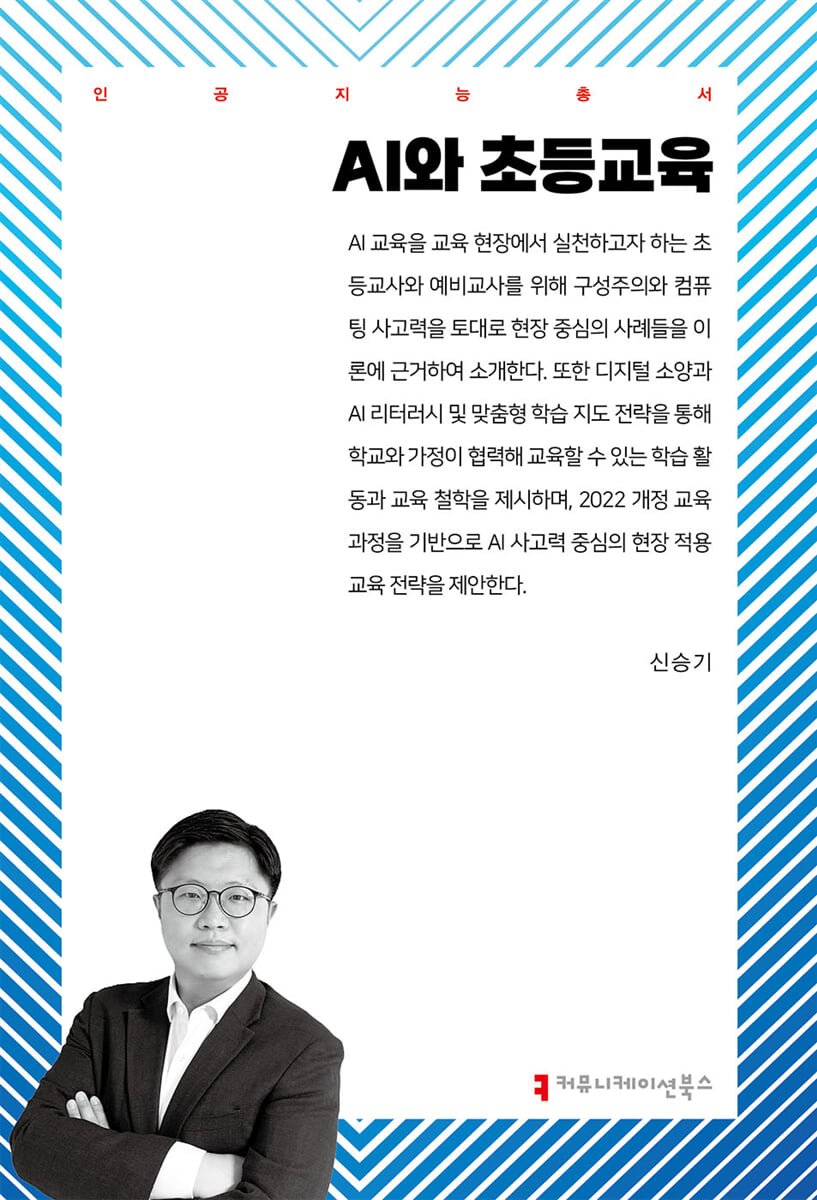
AI and Elementary Education
 |
Description
Book Introduction
We present concrete strategies that can be implemented in the classroom and at home, focusing on computational thinking, digital literacy, and AI convergence education.
It is a guide to future education that addresses the changing role of teachers and ethical challenges.
Artificial Intelligence Encyclopedia.
You can find the artificial intelligence knowledge you need at aiseries.oopy.io.
It is a guide to future education that addresses the changing role of teachers and ethical challenges.
Artificial Intelligence Encyclopedia.
You can find the artificial intelligence knowledge you need at aiseries.oopy.io.
- You can preview some of the book's contents.
Preview
index
AI and Elementary Education
01 AI and the Future Society: The Role of Primary Education
02 Computational Thinking: A Core Competency in the AI Era
03 Constructivism and AI Education: Learning Principles in the Digital Age
04 2022 Revised Curriculum and AI Education
05 AI + X: Convergence Education in Elementary Schools
06 Digital Literacy and AI Literacy
07 Three Perspectives on the Use of AI in Elementary Schools
08 AI and the Changing Role of Elementary School Teachers
09 Collaboration between schools and families for AI education
10 Educational Philosophy and Ethics in the AI Era
01 AI and the Future Society: The Role of Primary Education
02 Computational Thinking: A Core Competency in the AI Era
03 Constructivism and AI Education: Learning Principles in the Digital Age
04 2022 Revised Curriculum and AI Education
05 AI + X: Convergence Education in Elementary Schools
06 Digital Literacy and AI Literacy
07 Three Perspectives on the Use of AI in Elementary Schools
08 AI and the Changing Role of Elementary School Teachers
09 Collaboration between schools and families for AI education
10 Educational Philosophy and Ethics in the AI Era
Into the book
AI literacy refers to the ability to understand what AI is, how it works, what impact it has, and what ethical issues it poses (Tan et al., 2025).
This involves not only imparting technical knowledge, but also understanding attitudes toward technology and its social context.
For example, elementary school students can explore the boundaries between humans and machines and develop creative and critical perspectives by asking questions like, “Can AI think like humans?” and “Are AI-created artworks truly art?”
Additionally, AI literacy education is also linked to the ability to judge the reliability of information.
The internet is overflowing with algorithmically manipulated information, provocative content designed to elicit clicks, and artificial intelligence-generated misinformation. The ability to distinguish and judge these must be established from elementary school onward.
The Ministry of Education's "Comprehensive Plan for Transition to Digital-Based Education" (2023) also states that AI literacy needs to be fostered starting from elementary school, and this can be achieved through education on AI and the integration of AI into curricula.
--- From "01_“AI and the Future Society: The Role of Elementary Education”"
Dewey's constructivist philosophy still holds strong practical value in today's educational environment, especially in the rapidly expanding field of AI technology. As AI technology is integrated into education, teaching and learning methods are evolving into increasingly individualized, data-driven, and interactive structures.
But the important thing is that these technological advances should not be used to replace the essence of education, but rather to assist in realizing that essence more effectively.
At this point, Dewey's philosophy serves as a philosophical compass that suggests the direction in which education in the AI era should proceed.
--- From "03_“Constructivism and AI Education: Learning Principles in the Digital Age”"
As digital technology becomes an integral part of human life, school education must go beyond simply using technology to address how to understand and utilize it, and how to think and act responsibly in the process.
The core competency being emphasized in this context is ‘digital literacy.’
Digital literacy emerged in the late 1990s with the proliferation of the Internet, but today it has expanded beyond simple computer skills to include critical information literacy, creative use of information, and ethical digital citizenship.
In particular, as digital society is built on a complex technological foundation of generative artificial intelligence, big data, and social platforms, the ability to accept, produce, and interact with information within it has become a fundamental competency that all citizens must possess.
In line with this trend, international organizations are also defining digital literacy as a core civic competency for the 21st century.
--- From “06_“Digital Literacy and AI Literacy””
Digital literacy isn't just about being able to use a smartphone or tablet.
It is a comprehensive competency that includes a critical attitude toward information, ethical responsibility for technology use, and civic sensitivity as a member of a digital society.
To encourage children to question and reflect on their use of AI technology, parents must first have a basic understanding of the technology's structure and social context.
For example, if a child doesn't understand how the learning AI chatbot they're using processes information and how its answers are generated based on data, it's difficult to prevent them from taking the AI's answers as absolute truth.
Moreover, if parents are sensitive to issues such as privacy protections and the potential bias of algorithms collected through AI-based content, their children can naturally develop a critical attitude toward technology.
Ultimately, parents' digital literacy is the most effective educational resource for expanding their children's AI literacy.
This involves not only imparting technical knowledge, but also understanding attitudes toward technology and its social context.
For example, elementary school students can explore the boundaries between humans and machines and develop creative and critical perspectives by asking questions like, “Can AI think like humans?” and “Are AI-created artworks truly art?”
Additionally, AI literacy education is also linked to the ability to judge the reliability of information.
The internet is overflowing with algorithmically manipulated information, provocative content designed to elicit clicks, and artificial intelligence-generated misinformation. The ability to distinguish and judge these must be established from elementary school onward.
The Ministry of Education's "Comprehensive Plan for Transition to Digital-Based Education" (2023) also states that AI literacy needs to be fostered starting from elementary school, and this can be achieved through education on AI and the integration of AI into curricula.
--- From "01_“AI and the Future Society: The Role of Elementary Education”"
Dewey's constructivist philosophy still holds strong practical value in today's educational environment, especially in the rapidly expanding field of AI technology. As AI technology is integrated into education, teaching and learning methods are evolving into increasingly individualized, data-driven, and interactive structures.
But the important thing is that these technological advances should not be used to replace the essence of education, but rather to assist in realizing that essence more effectively.
At this point, Dewey's philosophy serves as a philosophical compass that suggests the direction in which education in the AI era should proceed.
--- From "03_“Constructivism and AI Education: Learning Principles in the Digital Age”"
As digital technology becomes an integral part of human life, school education must go beyond simply using technology to address how to understand and utilize it, and how to think and act responsibly in the process.
The core competency being emphasized in this context is ‘digital literacy.’
Digital literacy emerged in the late 1990s with the proliferation of the Internet, but today it has expanded beyond simple computer skills to include critical information literacy, creative use of information, and ethical digital citizenship.
In particular, as digital society is built on a complex technological foundation of generative artificial intelligence, big data, and social platforms, the ability to accept, produce, and interact with information within it has become a fundamental competency that all citizens must possess.
In line with this trend, international organizations are also defining digital literacy as a core civic competency for the 21st century.
--- From “06_“Digital Literacy and AI Literacy””
Digital literacy isn't just about being able to use a smartphone or tablet.
It is a comprehensive competency that includes a critical attitude toward information, ethical responsibility for technology use, and civic sensitivity as a member of a digital society.
To encourage children to question and reflect on their use of AI technology, parents must first have a basic understanding of the technology's structure and social context.
For example, if a child doesn't understand how the learning AI chatbot they're using processes information and how its answers are generated based on data, it's difficult to prevent them from taking the AI's answers as absolute truth.
Moreover, if parents are sensitive to issues such as privacy protections and the potential bias of algorithms collected through AI-based content, their children can naturally develop a critical attitude toward technology.
Ultimately, parents' digital literacy is the most effective educational resource for expanding their children's AI literacy.
--- From “09_“Cooperation between Schools and Homes for AI Education””
Publisher's Review
The Future of Elementary Education with AI
In the age of artificial intelligence, we present a concrete direction for elementary education.
Beyond a simple learning tool, AI is a key element in realizing learner-centered education and creating personalized learning environments.
It presents lesson design methods and real-world examples that reflect the latest trends, such as computational thinking, digital literacy, and AI + X convergence education, to teachers, prospective teachers, parents, and educators.
It explores the principles of constructivist learning and the organization of AI education according to the 2022 revised curriculum, and includes ways to cultivate creativity, critical thinking, and collaboration skills necessary for the AI era.
It also specifically introduces three perspectives on utilizing AI as a tutor, tutee, and tool in the classroom, the changing role of teachers, and a model of cooperation between home and school.
Furthermore, we explore ways to realize human-centered education, encompassing AI ethics education and new educational philosophies.
It will serve as a guide and roadmap for future education for all those seeking to effectively introduce AI into elementary education.
In the age of artificial intelligence, we present a concrete direction for elementary education.
Beyond a simple learning tool, AI is a key element in realizing learner-centered education and creating personalized learning environments.
It presents lesson design methods and real-world examples that reflect the latest trends, such as computational thinking, digital literacy, and AI + X convergence education, to teachers, prospective teachers, parents, and educators.
It explores the principles of constructivist learning and the organization of AI education according to the 2022 revised curriculum, and includes ways to cultivate creativity, critical thinking, and collaboration skills necessary for the AI era.
It also specifically introduces three perspectives on utilizing AI as a tutor, tutee, and tool in the classroom, the changing role of teachers, and a model of cooperation between home and school.
Furthermore, we explore ways to realize human-centered education, encompassing AI ethics education and new educational philosophies.
It will serve as a guide and roadmap for future education for all those seeking to effectively introduce AI into elementary education.
GOODS SPECIFICS
- Date of issue: October 10, 2025
- Page count, weight, size: 193 pages | 128*188*10mm
- ISBN13: 9791143008886
You may also like
카테고리
korean


korean

![ELLE 엘르 A형 (여성월간) : 1월 [2026]](http://librairie.coreenne.fr/cdn/shop/files/3b70e1cf77cf67d6da56e0eb041901e8.jpg?v=1767265322&width=3840)


