

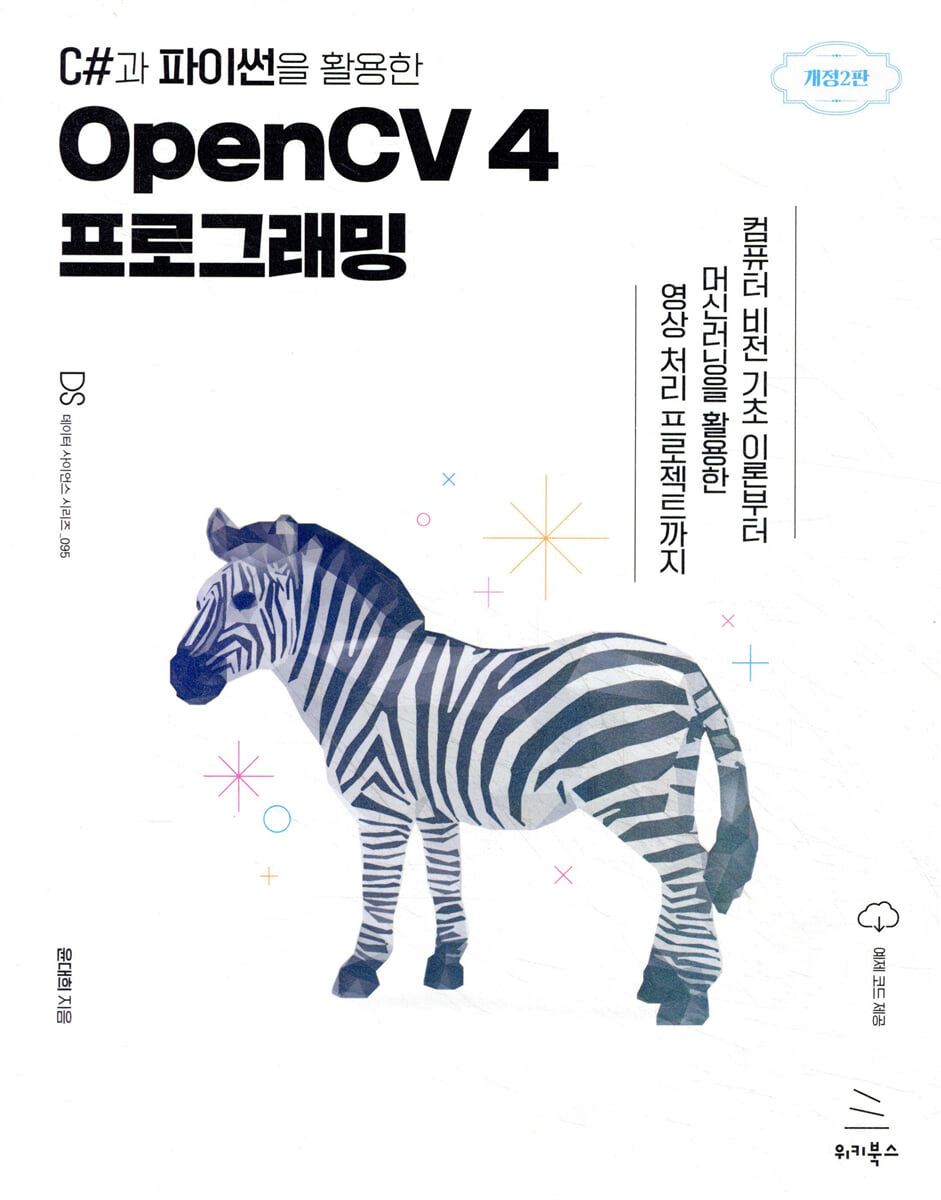
OpenCV 4 Programming with C# and Python
 |
Description
Book Introduction
This book covers the fundamentals of computer vision, details the most widely used functions in OpenCV, and covers how to extract meaningful information from image data.
This book is written in two languages, C# and Python, so it allows for comparison between the two languages. It is an introductory book on image processing that allows C# or Python developers to easily learn OpenCV.
This book covers everything from basic computer vision algorithms to machine learning and deep learning, enabling you to utilize OpenCV broadly.
It covers the overall scope of supervised and unsupervised learning, as well as examples of how to apply various deep learning models using OpenCV, such as image classification, object detection, segmentation, face detection, landmark detection, and style transfer.
This book covers the entire OpenCV and shows how to apply it in real-world situations through practical examples.
Each topic is covered with intuitive and concrete examples, enabling readers to clearly understand the concepts and learn how to apply them in practice.
This book is written in two languages, C# and Python, so it allows for comparison between the two languages. It is an introductory book on image processing that allows C# or Python developers to easily learn OpenCV.
This book covers everything from basic computer vision algorithms to machine learning and deep learning, enabling you to utilize OpenCV broadly.
It covers the overall scope of supervised and unsupervised learning, as well as examples of how to apply various deep learning models using OpenCV, such as image classification, object detection, segmentation, face detection, landmark detection, and style transfer.
This book covers the entire OpenCV and shows how to apply it in real-world situations through practical examples.
Each topic is covered with intuitive and concrete examples, enabling readers to clearly understand the concepts and learn how to apply them in practice.
- You can preview some of the book's contents.
Preview
index
[Part 1] OpenCV Theory
▣ Chapter 1: Understanding Computer Vision
01.
What is computer vision?
___What is computer vision?
___The need for image processing
___Limitations of image processing
___Data transformation
___image data
___What is OpenCV?
___History of OpenCV
02.
Algorithm design
___Prerequisites for problem solving
___Choosing hardware and software
___system design
___Development Rules
03.
digital image processing
___Preprocessing Algorithm
___Noise and Denoise
___Feature and Similarity Detection
04.
Image processing field
___movie
___medical field
___Image Translation
___Using OpenCV
05.
Installing C# OpenCvSharp
Installing the ___.NET Framework
Install ___.NET
Installing the ___native wrapper
___Using OpenCvSharp
___Extension namespace
06.
Installing Python OpenCV
Install the ___package manager
___Using OpenCV
___Expansion Package
▣ Chapter 2: Getting Started with OpenCV
01.
Image size
___Image size property
___Image size expression method
02.
Precision
___ bit representation
___Precision expression method
03.
channel
___color expression
___channel expression
04.
Areas of interest
___Why use a single channel?
05.
Channel of Interest
06.
Histogram
07.
Understanding OpenCV Code Structure
▣ Chapter 3: Data Types and Operations
01.
Basic data
___Basic data types used in C# OpenCvSharp
___Basic data types used in Python OpenCV
02.
Mat data
___dense matrix
___sparse matrix
___Area of Interest
___Channel of Interest
03.
NumPy data
___ndarray class
___Array operations
___Matrix class
___Area of Interest
___Channel of Interest
[Part 2] C# & Python Functions
▣ Chapter 4: Basic Examples
01.
Image data
___Enter image
___Image Output
02.
Video data
___video output
___camera output
03.
Data manipulation and visualization
___Image link
Draw a shape
___mouse callback
___trackbar
04.
Data storage
___Save image
___Save video
▣ Chapter 5: Image Processing
01.
Color space conversion
___HSV color space
___Channel Splitting and Merging
___color detection
02.
Binary transformation
___Otsu's algorithm
___Triangle Algorithm
___Adaptive binarization algorithm
03.
Image operations
___pixel operations
___filtering
___Fourier transform
___high frequency filter
___low frequency filter
___morphological transformation
04.
Image conversion
___Image Pyramid
___Resize image
___Image Mirroring and Rotation
___geometric transformations
▣ Chapter 6: Image Detection
01.
Contour detection
___hierarchy
___Data Extraction
___Drawing the outline
___polygon approximation
___Outline Information
02.
Feature detection
___corner detection
___line detection
___won detection
___QR code detection
03.
Feature matching
___background difference
___Template Matching
___optical flow
___Key Point Matching
[Part 3] Practical Examples
▣ Chapter 7: Machine Learning
01.
K-means clustering algorithm
02.
K-nearest neighbor algorithm
___Fashion-MNIST
Applying the ___K-nearest neighbor algorithm
___Actual data evaluation
03.
Support Vector Machine
___SVM kernel
___SVM type
___Application of support vector machine
___-direction gradient histogram
04.
deep neural networks
___Cafe: Image Classification (Google Net)
___Darknet: Object Detection (YOLO)
___TensorFlow: Segmentation (Mask R-CNN)
___ONNX: Face Detection and Landmarks (YuNet)
▣ Chapter 8: C# - Business Card Detection
01.
Angle calculation
02.
Rectangle detection
03.
Square transformation
04.
Optical Character Recognition (Tesseract)
▣ Chapter 9: Python - Style Transition
01.
Person Segmentation (PP-HumanSeg)
02.
Fast Neural Style
03.
PyTorch model conversion
04.
Apply style
▣ Appendix
A color code chart
B Mat data type
▣ Chapter 1: Understanding Computer Vision
01.
What is computer vision?
___What is computer vision?
___The need for image processing
___Limitations of image processing
___Data transformation
___image data
___What is OpenCV?
___History of OpenCV
02.
Algorithm design
___Prerequisites for problem solving
___Choosing hardware and software
___system design
___Development Rules
03.
digital image processing
___Preprocessing Algorithm
___Noise and Denoise
___Feature and Similarity Detection
04.
Image processing field
___movie
___medical field
___Image Translation
___Using OpenCV
05.
Installing C# OpenCvSharp
Installing the ___.NET Framework
Install ___.NET
Installing the ___native wrapper
___Using OpenCvSharp
___Extension namespace
06.
Installing Python OpenCV
Install the ___package manager
___Using OpenCV
___Expansion Package
▣ Chapter 2: Getting Started with OpenCV
01.
Image size
___Image size property
___Image size expression method
02.
Precision
___ bit representation
___Precision expression method
03.
channel
___color expression
___channel expression
04.
Areas of interest
___Why use a single channel?
05.
Channel of Interest
06.
Histogram
07.
Understanding OpenCV Code Structure
▣ Chapter 3: Data Types and Operations
01.
Basic data
___Basic data types used in C# OpenCvSharp
___Basic data types used in Python OpenCV
02.
Mat data
___dense matrix
___sparse matrix
___Area of Interest
___Channel of Interest
03.
NumPy data
___ndarray class
___Array operations
___Matrix class
___Area of Interest
___Channel of Interest
[Part 2] C# & Python Functions
▣ Chapter 4: Basic Examples
01.
Image data
___Enter image
___Image Output
02.
Video data
___video output
___camera output
03.
Data manipulation and visualization
___Image link
Draw a shape
___mouse callback
___trackbar
04.
Data storage
___Save image
___Save video
▣ Chapter 5: Image Processing
01.
Color space conversion
___HSV color space
___Channel Splitting and Merging
___color detection
02.
Binary transformation
___Otsu's algorithm
___Triangle Algorithm
___Adaptive binarization algorithm
03.
Image operations
___pixel operations
___filtering
___Fourier transform
___high frequency filter
___low frequency filter
___morphological transformation
04.
Image conversion
___Image Pyramid
___Resize image
___Image Mirroring and Rotation
___geometric transformations
▣ Chapter 6: Image Detection
01.
Contour detection
___hierarchy
___Data Extraction
___Drawing the outline
___polygon approximation
___Outline Information
02.
Feature detection
___corner detection
___line detection
___won detection
___QR code detection
03.
Feature matching
___background difference
___Template Matching
___optical flow
___Key Point Matching
[Part 3] Practical Examples
▣ Chapter 7: Machine Learning
01.
K-means clustering algorithm
02.
K-nearest neighbor algorithm
___Fashion-MNIST
Applying the ___K-nearest neighbor algorithm
___Actual data evaluation
03.
Support Vector Machine
___SVM kernel
___SVM type
___Application of support vector machine
___-direction gradient histogram
04.
deep neural networks
___Cafe: Image Classification (Google Net)
___Darknet: Object Detection (YOLO)
___TensorFlow: Segmentation (Mask R-CNN)
___ONNX: Face Detection and Landmarks (YuNet)
▣ Chapter 8: C# - Business Card Detection
01.
Angle calculation
02.
Rectangle detection
03.
Square transformation
04.
Optical Character Recognition (Tesseract)
▣ Chapter 9: Python - Style Transition
01.
Person Segmentation (PP-HumanSeg)
02.
Fast Neural Style
03.
PyTorch model conversion
04.
Apply style
▣ Appendix
A color code chart
B Mat data type
Detailed image

Publisher's Review
★ What this book covers ★
◎ Understanding computer vision and in-depth practice using OpenCV
◎ OpenCV data types and matrix and array operations in C# and Python
◎ Input/output and result storage using images, videos, and cameras
◎ Data manipulation and visualization using GUI
◎ Image preprocessing for image processing and image transformation for information exploration
◎ Information detection and recognition through image filtering
◎ Feature detection such as corners, straight lines, circles, and QR codes
◎ Image manipulation and object detection using feature matching
◎ How to use machine learning algorithms such as K-means, KNN, and SVM
◎ How to apply deep learning modules using Cafe, Darknet, TensorFlow, and ONNX models
◎ Project using Tesseract-OCR and C# OpenCvSharp4
◎ Converting PyTorch models to Python OpenCV for character segmentation and style transfer projects
◎ Understanding computer vision and in-depth practice using OpenCV
◎ OpenCV data types and matrix and array operations in C# and Python
◎ Input/output and result storage using images, videos, and cameras
◎ Data manipulation and visualization using GUI
◎ Image preprocessing for image processing and image transformation for information exploration
◎ Information detection and recognition through image filtering
◎ Feature detection such as corners, straight lines, circles, and QR codes
◎ Image manipulation and object detection using feature matching
◎ How to use machine learning algorithms such as K-means, KNN, and SVM
◎ How to apply deep learning modules using Cafe, Darknet, TensorFlow, and ONNX models
◎ Project using Tesseract-OCR and C# OpenCvSharp4
◎ Converting PyTorch models to Python OpenCV for character segmentation and style transfer projects
GOODS SPECIFICS
- Date of issue: May 30, 2024
- Page count, weight, size: 616 pages | 188*240*24mm
- ISBN13: 9791158394868
You may also like
카테고리
korean


korean

![ELLE 엘르 A형 (여성월간) : 1월 [2026]](http://librairie.coreenne.fr/cdn/shop/files/3b70e1cf77cf67d6da56e0eb041901e8.jpg?v=1767265322&width=3840)


