

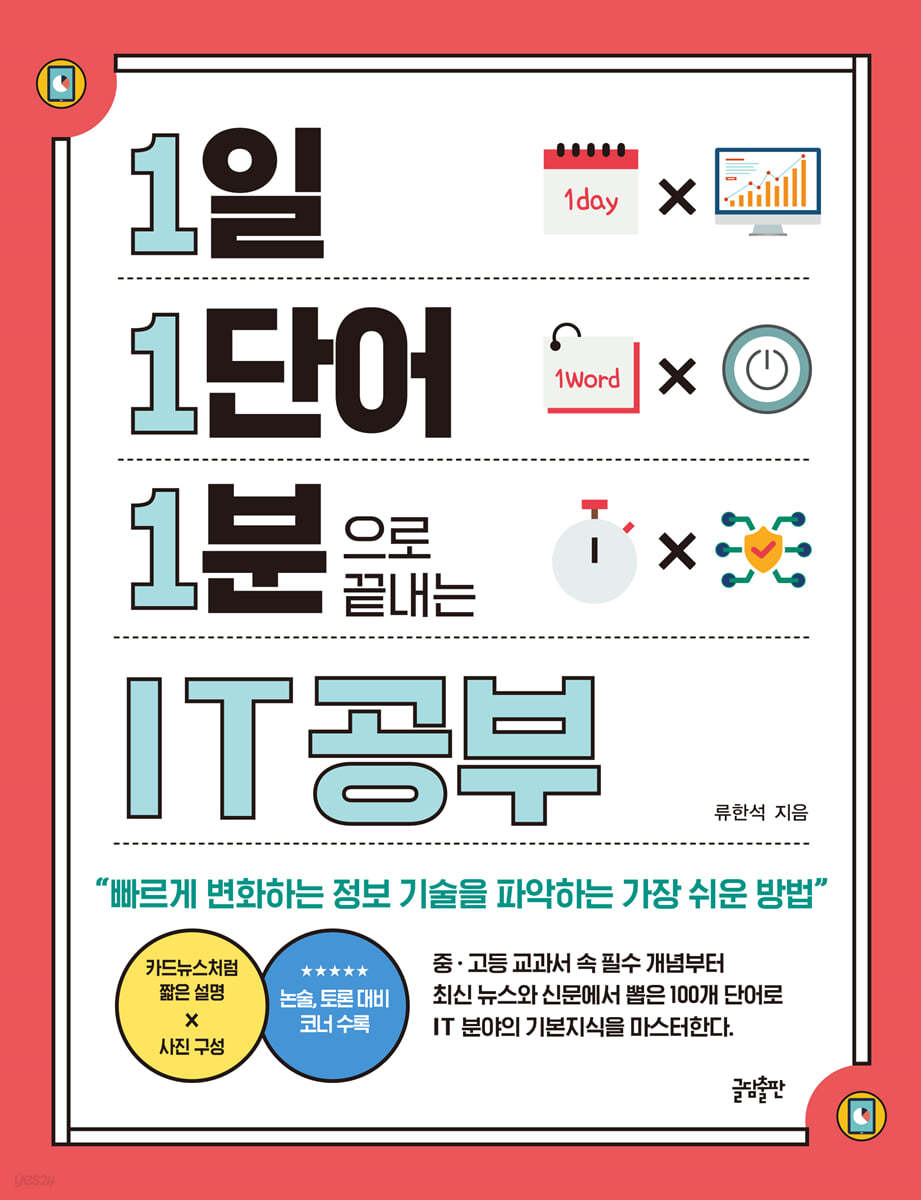
IT study in one minute, one word a day
 |
Description
Book Introduction
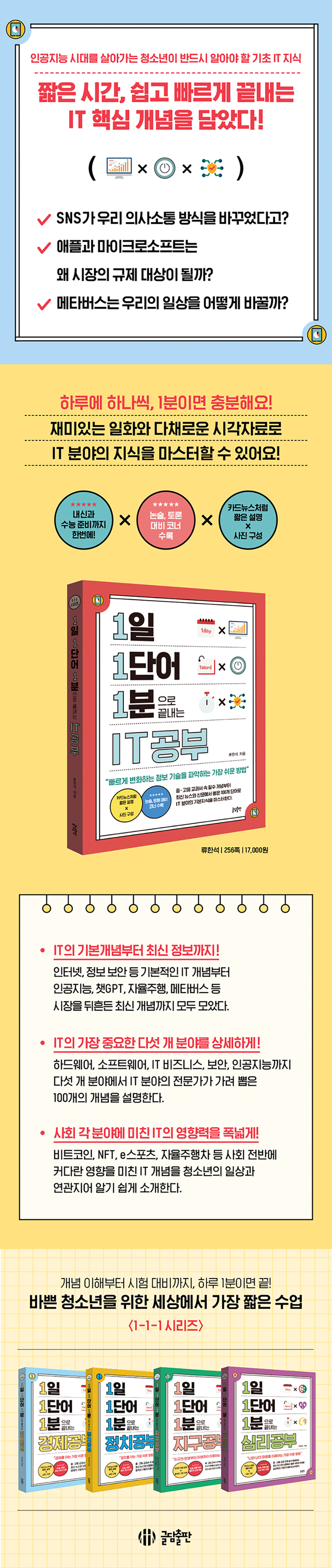
Just reading for 1 minute a day will help you build basic IT knowledge!
Keep the explanations short and fun, like a news card! Rich in visuals!
Complete your school report card, entrance exam, and essay preparation all in one go!
NFTs, big tech, self-driving cars, chat GPT, cloud computing, etc. – now, without IT knowledge, you can't understand newspapers and news.
In this rapidly changing era of artificial intelligence, is there a way to easily and simply acquire IT knowledge? "One Word a Day, One Minute IT Study," the fifth book in the "1·1·1 Series" of short educational books for teenagers, introduces essential IT knowledge in today's society, where mobile phones and computers have become necessities.
Information technology, commonly referred to as IT, is a core technology that will open the future and is commonly used in everyday life, but not many people actually have proper knowledge about it.
This book covers a wide range of IT knowledge, from the basic components of smart devices to programming knowledge, economic concepts like Bitcoin and NFTs, and the latest information on the metaverse and ChatGTP.
The addition of various visual aids makes the content easier to understand, and the ability to examine the latest IT trends will be of great help in developing the common sense needed for writing and discussing.
Additionally, each chapter includes a 'Reading the World through IT' section, covering the latest economic and social issues arising in the IT field.
By studying IT concepts in relation to current issues, we can gain a broader understanding of the society we live in.
Keep the explanations short and fun, like a news card! Rich in visuals!
Complete your school report card, entrance exam, and essay preparation all in one go!
NFTs, big tech, self-driving cars, chat GPT, cloud computing, etc. – now, without IT knowledge, you can't understand newspapers and news.
In this rapidly changing era of artificial intelligence, is there a way to easily and simply acquire IT knowledge? "One Word a Day, One Minute IT Study," the fifth book in the "1·1·1 Series" of short educational books for teenagers, introduces essential IT knowledge in today's society, where mobile phones and computers have become necessities.
Information technology, commonly referred to as IT, is a core technology that will open the future and is commonly used in everyday life, but not many people actually have proper knowledge about it.
This book covers a wide range of IT knowledge, from the basic components of smart devices to programming knowledge, economic concepts like Bitcoin and NFTs, and the latest information on the metaverse and ChatGTP.
The addition of various visual aids makes the content easier to understand, and the ability to examine the latest IT trends will be of great help in developing the common sense needed for writing and discussing.
Additionally, each chapter includes a 'Reading the World through IT' section, covering the latest economic and social issues arising in the IT field.
By studying IT concepts in relation to current issues, we can gain a broader understanding of the society we live in.
- You can preview some of the book's contents.
Preview
index
preface
Chapter 1 IT Concepts and Hardware
001 Digital: How has digital technology revolutionized our daily lives?
002 Bits and Bytes: What are the basic units of data?
003 Computers: What's the difference between PCs, embedded systems, mainframes, and supercomputers?
004 Data, Information, and Content: How does data become information and content?
005 Technology: What are the characteristics of technology that brings about continuous innovation?
006 Information Technology (IT): What does IT mean?
007 Moore's Law: How Fast Will Computer Technology Advance?
Platform 008: What does the term platform, which originated from the platform of a train station, mean?
009 Hardware: What physical components determine the performance of a computer system?
010 CPU: How does the computer's brain work?
011 GPU: Why is this essential gaming device also being used in AI?
012 Application Processor (AP): What is the core component of a smartphone?
013 Input Devices: Why is sensor technology important in keyboards, mice, touchscreens, etc.?
014 Output Devices: Why Do Output Devices Affect Productivity and Satisfaction?
015 4K vs. 8K: Which Screen Resolution Is Right for My Needs?
016 Memory: How do RAM, ROM, and cache affect system performance?
017 Hard Disk Drives (HDDs): Are newer drives always better?
018 SSD: What are the pros and cons of a storage device that is faster than a hard disk?
019 Blu-ray: What's the Future of High-Quality Video Storage?
020 USB: Can't we consolidate the different connectors for each device into one?
021 Smartphones: How did the first smartphones appear?
022 Tablets: How have tablets influenced the way we consume media?
023 Smart Speakers: How will smart speakers like Amazon Echo and KT Giga Genie evolve?
024 RFID: How are tolls automatically paid on highway Hi-Pass?
025 NFC: How does paying with a smartphone work?
Reading the World Through IT I: How Can We Prevent Environmental Pollution Caused by Digital Products? - E-Waste
Reading the World Through IT II: Why Does the Digital Divide Cause Social Problems? - Digital Literacy and Digital Citizenship
Chapter 2 Software and Programming
026 Software: What is the difference between system software and applications?
027 Open Source: What's the Difference Between Proprietary and Open Source Software?
028 Operating System (OS): Can I use a computer without Windows?
029 File System: How does the system store and manage data?
030 Database: How to Process and Manage Data?
031 Windows: How did the #1 desktop operating system in market share emerge?
032 Linux: How did the open-source operating system become popular?
033 iOSㆍiPadOSㆍmacOS: Which operating system made by Apple is good?
034 Google Android: How it almost became Samsung Android?
035 App Store and Play Store: How to install apps on your mobile device?
036 Encoding and Decoding: How to save and load image and video files?
037 Virtual Machine: How to use Windows and macOS simultaneously on one computer?
038 Programming and Development: What's the Difference Between Programmers and Developers?
039 Programming Languages: Why Are There So Many Different Programming Languages?
040 C/C++: What is the most used programming language for systems programming?
041 Java: Why Are Developers So Passionate About Java?
042 C#: Why did Microsoft create a programming language?
043 Python: What is the world's most used programming language?
044 Algorithm: A step-by-step procedure that a computer uses to solve a problem?
045 User Experience (UX): What is the persona technique used in UX design?
046 Bugs and Debugging: How do I fix errors or defects that occur in my product?
047 Raspberry Pi: An inexpensive computer designed for coding education?
048 Arduino: Is there a platform that makes it easy to create electrical and electronic projects?
Reading the World Through IT I: Why Did Epic Games File a Lawsuit Against Apple? - The App Store Fee Dispute
Reading the World Through IT II: Did Google's Android OS Infringe Java Copyright? - The Conflict Surrounding Java
Chapter 3: IT Business and Big Tech
049 Social Media: How Has Social Media Changed the Way We Communicate?
050 E-commerce: Who Uses Alibaba, the B2B E-commerce Platform?
051 Online Advertising: How are costs calculated when advertising online?
052 Fintech: How does fintech differ from the traditional financial industry?
053 Crowdfunding: How to Fund Music, Games, and Tech Products
054 OTT: How did Netflix become successful?
055 eSports: How popular are eSports?
056 Startup: Why Are Startups Important?
057 Silicon Valley: What's the Unique Culture of This Hub of Technology and Innovation?
058 Big Tech: Why Are Companies with Large Market Power Subject to Regulation?
059 Microsoft: Is there a company with a market capitalization greater than our country's annual GDP?
060 Google (Alphabet): What are Google's main sources of revenue, with its search engine, YouTube, and Android?
061 Meta (Facebook): How did Facebook capture people's hearts?
062 Amazon: Why is the world's largest online retailer being criticized?
063 Apple: What Makes the World's Most Valuable Company Different?
Reading the World Through IT I: How Does FOMO Cause Addiction? - Social Media Addiction
Reading the World Through IT II: Why Are Concerns and Criticisms Growing About Big Tech? - Big Tech Regulation
Chapter 4 Internet and Security
064 Network: What is the difference between LAN, WLAN, and WAN?
065 IP Address: How do computers identify each other on a network?
066 Domain Names: Who Manages Domain Names?
067 URL: How is a web page address structured?
068 DNS: Why can I access a website if I know its domain name?
069 HTTP and HTTPS: What are the basic protocols for exchanging information on the web?
070 WiFi: What are the pros and cons of 2.4GHz and 5GHz?
071 Internet Router: How to connect multiple devices to the Internet simultaneously?
072 5G and 6G Mobile Communications: What's Different About 5G?
073 HTML and XML: What are markup languages and what do web developers do with them?
074 Web Browser: Are there any Chrome siblings built on open source projects?
075 JavaScript: How is it different from Java?
076 Search Engines: How do search engines make money?
077 P2P: What is the difference between a centralized model and P2P?
078 Encryption: How to Protect Your Data?
079 Information Security: What's the Difference Between Information Security, Physical Security, and Financial Security?
080 Malware: What's the Difference Between Viruses, Worms, Trojans, Spyware, Ransomware, and Adware?
081 Hacking and Hackers: What Hacking Techniques Are There?
082 Social Engineering: Are there any attack techniques that exploit human psychology, trust, and authority to cause harm?
Reading the World Through IT I: Will the Internet Be Open and Free in the Future? - The Net Neutrality Issue
Reading the World Through IT II: How to Respond to Cyber Espionage - Cybercrime
Chapter 5: Latest IT and Artificial Intelligence
083 Cloud Computing: What Are the Benefits of Using the Cloud?
084 Big Data: How Big Is Big Data?
085 Internet of Things: How Important Is the Internet of Things in Smart Cities?
086 Smart Home: How will smart homes transform our living spaces?
087 Blockchain: What is the decentralization and consensus mechanism of blockchain?
088 Cryptocurrencies and Virtual Assets: What's the Difference Between Cryptocurrencies, Virtual Currency, and Virtual Assets?
089 NFT: How Can Art Be Digitally Assetized?
090 Extended Reality: What's the Difference Between Virtual Reality, Augmented Reality, and Mixed Reality?
091 Metaverse: How will the way we work, learn, play, and interact change?
092 Service Robots: How will robots that serve people evolve?
093 Self-Driving Cars: Will Self-Driving Cars Ever Become Popular?
094 Virtual Humans: Why Are Virtual Employees and Virtual Influencers Being Created?
095 Quantum Computers: How Are Quantum Computers Different from Regular Computers?
096 Artificial Intelligence: What is the difference between narrow AI, general AI, and super AI?
097 Machine Learning and Deep Learning: What Advances Have Deep Neural Networks and Reinforcement Learning Brought?
098 Virtual Assistants and Chatbots: What Do Virtual Assistants Do?
099 ChatGPT: How did AI learn to answer questions better than humans?
100 Technological Singularity: What happens when technological progress accelerates so rapidly?
Reading the World Through IT I: Why Convenient and Smart IoT Devices Are Dangerous - IoT Security Issues
Reading the World Through IT II: Who Owns Creative Works Generated Through AI? - AI and Copyright
Photo source
Chapter 1 IT Concepts and Hardware
001 Digital: How has digital technology revolutionized our daily lives?
002 Bits and Bytes: What are the basic units of data?
003 Computers: What's the difference between PCs, embedded systems, mainframes, and supercomputers?
004 Data, Information, and Content: How does data become information and content?
005 Technology: What are the characteristics of technology that brings about continuous innovation?
006 Information Technology (IT): What does IT mean?
007 Moore's Law: How Fast Will Computer Technology Advance?
Platform 008: What does the term platform, which originated from the platform of a train station, mean?
009 Hardware: What physical components determine the performance of a computer system?
010 CPU: How does the computer's brain work?
011 GPU: Why is this essential gaming device also being used in AI?
012 Application Processor (AP): What is the core component of a smartphone?
013 Input Devices: Why is sensor technology important in keyboards, mice, touchscreens, etc.?
014 Output Devices: Why Do Output Devices Affect Productivity and Satisfaction?
015 4K vs. 8K: Which Screen Resolution Is Right for My Needs?
016 Memory: How do RAM, ROM, and cache affect system performance?
017 Hard Disk Drives (HDDs): Are newer drives always better?
018 SSD: What are the pros and cons of a storage device that is faster than a hard disk?
019 Blu-ray: What's the Future of High-Quality Video Storage?
020 USB: Can't we consolidate the different connectors for each device into one?
021 Smartphones: How did the first smartphones appear?
022 Tablets: How have tablets influenced the way we consume media?
023 Smart Speakers: How will smart speakers like Amazon Echo and KT Giga Genie evolve?
024 RFID: How are tolls automatically paid on highway Hi-Pass?
025 NFC: How does paying with a smartphone work?
Reading the World Through IT I: How Can We Prevent Environmental Pollution Caused by Digital Products? - E-Waste
Reading the World Through IT II: Why Does the Digital Divide Cause Social Problems? - Digital Literacy and Digital Citizenship
Chapter 2 Software and Programming
026 Software: What is the difference between system software and applications?
027 Open Source: What's the Difference Between Proprietary and Open Source Software?
028 Operating System (OS): Can I use a computer without Windows?
029 File System: How does the system store and manage data?
030 Database: How to Process and Manage Data?
031 Windows: How did the #1 desktop operating system in market share emerge?
032 Linux: How did the open-source operating system become popular?
033 iOSㆍiPadOSㆍmacOS: Which operating system made by Apple is good?
034 Google Android: How it almost became Samsung Android?
035 App Store and Play Store: How to install apps on your mobile device?
036 Encoding and Decoding: How to save and load image and video files?
037 Virtual Machine: How to use Windows and macOS simultaneously on one computer?
038 Programming and Development: What's the Difference Between Programmers and Developers?
039 Programming Languages: Why Are There So Many Different Programming Languages?
040 C/C++: What is the most used programming language for systems programming?
041 Java: Why Are Developers So Passionate About Java?
042 C#: Why did Microsoft create a programming language?
043 Python: What is the world's most used programming language?
044 Algorithm: A step-by-step procedure that a computer uses to solve a problem?
045 User Experience (UX): What is the persona technique used in UX design?
046 Bugs and Debugging: How do I fix errors or defects that occur in my product?
047 Raspberry Pi: An inexpensive computer designed for coding education?
048 Arduino: Is there a platform that makes it easy to create electrical and electronic projects?
Reading the World Through IT I: Why Did Epic Games File a Lawsuit Against Apple? - The App Store Fee Dispute
Reading the World Through IT II: Did Google's Android OS Infringe Java Copyright? - The Conflict Surrounding Java
Chapter 3: IT Business and Big Tech
049 Social Media: How Has Social Media Changed the Way We Communicate?
050 E-commerce: Who Uses Alibaba, the B2B E-commerce Platform?
051 Online Advertising: How are costs calculated when advertising online?
052 Fintech: How does fintech differ from the traditional financial industry?
053 Crowdfunding: How to Fund Music, Games, and Tech Products
054 OTT: How did Netflix become successful?
055 eSports: How popular are eSports?
056 Startup: Why Are Startups Important?
057 Silicon Valley: What's the Unique Culture of This Hub of Technology and Innovation?
058 Big Tech: Why Are Companies with Large Market Power Subject to Regulation?
059 Microsoft: Is there a company with a market capitalization greater than our country's annual GDP?
060 Google (Alphabet): What are Google's main sources of revenue, with its search engine, YouTube, and Android?
061 Meta (Facebook): How did Facebook capture people's hearts?
062 Amazon: Why is the world's largest online retailer being criticized?
063 Apple: What Makes the World's Most Valuable Company Different?
Reading the World Through IT I: How Does FOMO Cause Addiction? - Social Media Addiction
Reading the World Through IT II: Why Are Concerns and Criticisms Growing About Big Tech? - Big Tech Regulation
Chapter 4 Internet and Security
064 Network: What is the difference between LAN, WLAN, and WAN?
065 IP Address: How do computers identify each other on a network?
066 Domain Names: Who Manages Domain Names?
067 URL: How is a web page address structured?
068 DNS: Why can I access a website if I know its domain name?
069 HTTP and HTTPS: What are the basic protocols for exchanging information on the web?
070 WiFi: What are the pros and cons of 2.4GHz and 5GHz?
071 Internet Router: How to connect multiple devices to the Internet simultaneously?
072 5G and 6G Mobile Communications: What's Different About 5G?
073 HTML and XML: What are markup languages and what do web developers do with them?
074 Web Browser: Are there any Chrome siblings built on open source projects?
075 JavaScript: How is it different from Java?
076 Search Engines: How do search engines make money?
077 P2P: What is the difference between a centralized model and P2P?
078 Encryption: How to Protect Your Data?
079 Information Security: What's the Difference Between Information Security, Physical Security, and Financial Security?
080 Malware: What's the Difference Between Viruses, Worms, Trojans, Spyware, Ransomware, and Adware?
081 Hacking and Hackers: What Hacking Techniques Are There?
082 Social Engineering: Are there any attack techniques that exploit human psychology, trust, and authority to cause harm?
Reading the World Through IT I: Will the Internet Be Open and Free in the Future? - The Net Neutrality Issue
Reading the World Through IT II: How to Respond to Cyber Espionage - Cybercrime
Chapter 5: Latest IT and Artificial Intelligence
083 Cloud Computing: What Are the Benefits of Using the Cloud?
084 Big Data: How Big Is Big Data?
085 Internet of Things: How Important Is the Internet of Things in Smart Cities?
086 Smart Home: How will smart homes transform our living spaces?
087 Blockchain: What is the decentralization and consensus mechanism of blockchain?
088 Cryptocurrencies and Virtual Assets: What's the Difference Between Cryptocurrencies, Virtual Currency, and Virtual Assets?
089 NFT: How Can Art Be Digitally Assetized?
090 Extended Reality: What's the Difference Between Virtual Reality, Augmented Reality, and Mixed Reality?
091 Metaverse: How will the way we work, learn, play, and interact change?
092 Service Robots: How will robots that serve people evolve?
093 Self-Driving Cars: Will Self-Driving Cars Ever Become Popular?
094 Virtual Humans: Why Are Virtual Employees and Virtual Influencers Being Created?
095 Quantum Computers: How Are Quantum Computers Different from Regular Computers?
096 Artificial Intelligence: What is the difference between narrow AI, general AI, and super AI?
097 Machine Learning and Deep Learning: What Advances Have Deep Neural Networks and Reinforcement Learning Brought?
098 Virtual Assistants and Chatbots: What Do Virtual Assistants Do?
099 ChatGPT: How did AI learn to answer questions better than humans?
100 Technological Singularity: What happens when technological progress accelerates so rapidly?
Reading the World Through IT I: Why Convenient and Smart IoT Devices Are Dangerous - IoT Security Issues
Reading the World Through IT II: Who Owns Creative Works Generated Through AI? - AI and Copyright
Photo source
Detailed image
Into the book
The GPU, or graphics processing unit, performs a unique role in a computer system, distinct from the CPU. A GPU is a chip specifically designed to process graphics information, particularly for 3D modeling.
3D modeling refers to the process of creating a three-dimensional model in 3D space, i.e. three spatial dimensions such as width, height, and depth, through the x, y, and z axes.
--- p.36
Everything we do on a computer is stored on storage devices.
A storage device is a hardware device used to store and retrieve data.
RAM is fast, but data is lost when the computer is turned off, while storage devices are relatively slow, but data is retained even when the computer is turned off.
--- p.48
NFC is a technology used to easily pay bills with a smartphone or open doors by tagging a card.
NFC, a type of short-range wireless communication technology, uses electromagnetic fields to exchange data over short distances of just a few centimeters. NFC is already widely used in everyday life.
A representative example is contactless payment. Using an NFC-enabled smartphone, you can make safe and convenient payments at convenience stores, restaurants, and other locations.
NFC can be used to conveniently pay public transportation fares. NFC is also used to control access to buildings, offices, and other restricted areas, as well as to control and automate home appliances.
--- p.64
If a program is a collection of instructions written to perform a specific task, software refers to the sum total of data and other resources, including the program, required for execution.
That is, software is a term with a broader meaning.
Although a program is a part of software, they are generally used interchangeably without a strict distinction.
--- p.96
A programming language is a language used to send instructions to a computer to perform a specific task. Programmers use it to write code that can be executed on a computer and develop various programs.
It is one of the most important technologies used in various industries, from website development to self-driving cars, medical robots, and even rockets launched into space.
There are many different types of programming languages, each with its own rules, strengths, and weaknesses.
Also, programming languages have their own unique syntax to determine whether the code written by the programmer is valid.
The grammar is designed to be easy for programmers to write and understand, as well as to be clearly interpreted by computers.
--- p.98
Social media is a general term for services that allow individuals to interact by sharing photos, information, ideas, and interests via the Internet.
(…) In Korea, the term SNS is more commonly used, but overseas, the term social media is mainly used.
In fact, SNS refers to social media specialized in social networking, such as Facebook or Instagram, but in Korea, it is used with a similar meaning to social media.
--- p.124
There are many reasons why social media addiction occurs.
Essentially, social media is designed to trigger the release of dopamine, a neurotransmitter associated with pleasure and reward.
Social media addiction can also be triggered by social pressure to be with friends and colleagues.
The fear of missing out on something interesting or important is called Fear of Missing Out, or FOMO.
FOMO is the anxiety that occurs when you perceive that other people are experiencing something enjoyable without you.
It's the fear of being left out.
FOMO can lead to excessive social media use, and social media use can further increase FOMO, which can further amplify feelings of anxiety, jealousy, and disappointment.
--- p.155
Smart Cities leverage IoT technologies across the city to improve the efficiency of urban infrastructure, reduce traffic congestion, enhance public safety, optimize energy use, and support sustainability—the balancing of environmental, social, and economic factors for future generations.
For example, IoT streetlights could use sensors to adjust lighting levels based on pedestrian and vehicle traffic, reducing energy consumption and improving public safety.
3D modeling refers to the process of creating a three-dimensional model in 3D space, i.e. three spatial dimensions such as width, height, and depth, through the x, y, and z axes.
--- p.36
Everything we do on a computer is stored on storage devices.
A storage device is a hardware device used to store and retrieve data.
RAM is fast, but data is lost when the computer is turned off, while storage devices are relatively slow, but data is retained even when the computer is turned off.
--- p.48
NFC is a technology used to easily pay bills with a smartphone or open doors by tagging a card.
NFC, a type of short-range wireless communication technology, uses electromagnetic fields to exchange data over short distances of just a few centimeters. NFC is already widely used in everyday life.
A representative example is contactless payment. Using an NFC-enabled smartphone, you can make safe and convenient payments at convenience stores, restaurants, and other locations.
NFC can be used to conveniently pay public transportation fares. NFC is also used to control access to buildings, offices, and other restricted areas, as well as to control and automate home appliances.
--- p.64
If a program is a collection of instructions written to perform a specific task, software refers to the sum total of data and other resources, including the program, required for execution.
That is, software is a term with a broader meaning.
Although a program is a part of software, they are generally used interchangeably without a strict distinction.
--- p.96
A programming language is a language used to send instructions to a computer to perform a specific task. Programmers use it to write code that can be executed on a computer and develop various programs.
It is one of the most important technologies used in various industries, from website development to self-driving cars, medical robots, and even rockets launched into space.
There are many different types of programming languages, each with its own rules, strengths, and weaknesses.
Also, programming languages have their own unique syntax to determine whether the code written by the programmer is valid.
The grammar is designed to be easy for programmers to write and understand, as well as to be clearly interpreted by computers.
--- p.98
Social media is a general term for services that allow individuals to interact by sharing photos, information, ideas, and interests via the Internet.
(…) In Korea, the term SNS is more commonly used, but overseas, the term social media is mainly used.
In fact, SNS refers to social media specialized in social networking, such as Facebook or Instagram, but in Korea, it is used with a similar meaning to social media.
--- p.124
There are many reasons why social media addiction occurs.
Essentially, social media is designed to trigger the release of dopamine, a neurotransmitter associated with pleasure and reward.
Social media addiction can also be triggered by social pressure to be with friends and colleagues.
The fear of missing out on something interesting or important is called Fear of Missing Out, or FOMO.
FOMO is the anxiety that occurs when you perceive that other people are experiencing something enjoyable without you.
It's the fear of being left out.
FOMO can lead to excessive social media use, and social media use can further increase FOMO, which can further amplify feelings of anxiety, jealousy, and disappointment.
--- p.155
Smart Cities leverage IoT technologies across the city to improve the efficiency of urban infrastructure, reduce traffic congestion, enhance public safety, optimize energy use, and support sustainability—the balancing of environmental, social, and economic factors for future generations.
For example, IoT streetlights could use sensors to adjust lighting levels based on pedestrian and vehicle traffic, reducing energy consumption and improving public safety.
--- p.209
Publisher's Review
From coding, OTT, metaverse, self-driving cars, and machine learning,
A quick and easy concept dictionary to acquire the latest knowledge in the IT field.
This is a dictionary of IT concepts written by IT experts that even young people can quickly and easily understand.
Today, with ChatGPT ushering in the era of artificial intelligence, IT knowledge is essential for understanding the society we live in. The latest technologies and knowledge in IT now directly impact the market, creating new added value and ultimately influencing society as a whole.
This can be seen from the example of how smartphones became widespread after Apple released the iPhone, changing the landscape of the smart phone market and significantly changing our daily lives.
Social media platforms like Instagram and Facebook are now considered essential elements in advertising and marketing, and RFID, used in highway toll passes, and NFC, which enables payment of tolls with smartphones, are also changing our lives in ways we never imagined before.
Why are there so many different programming languages?
How does fintech differ from the traditional financial industry?
Why are virtual employees and virtual influencers being created?
This book covers five major topics: basic IT concepts, hardware, software, IT business, internet security, and artificial intelligence.
First, in Chapter 1, we will learn about basic IT concepts such as digital, bit, and platform.
We will also look at the hardware elements of smart devices we use, such as PCs, smartphones, and tablets, and explain concepts that are essential to know when purchasing or using computers and smart devices.
Chapter 2 covers software and programming, introducing the operating systems (OS) of IT devices we use on a daily basis, coding concepts, and programming languages.
It provides detailed explanations of the most commonly used programming languages by type, based on the principles of computer algorithms and specific purposes and characteristics of each language, making it a great help to those who are just starting to learn coding or young people who need a general basic knowledge of what programming is.
Chapter 3 introduces IT knowledge frequently discussed in the economic field.
In particular, we examine IT companies with significant market power and a significant economic impact on our society, as well as their main business areas.
We'll also explore how marketing works online, how to raise funding to start a new business, and how the financial industry is evolving in the IT sector.
Young people who find IT terms introduced in newspapers and news difficult will be able to reorganize their current affairs knowledge through this chapter.
Chapter 4 introduces basic Internet security methods, basic knowledge of mobile communications such as Wi-Fi and 5G, and problems such as phishing and smishing and ways to prevent them.
Chapter 5 covers the latest information, including artificial intelligence, a hot topic in the IT field.
It introduces concepts such as ChatGPT, an artificial intelligence that speaks more naturally than humans, as well as the Internet of Things (IoT), which has permeated our daily lives, and digital assets such as Bitcoin and NFT, in an easy-to-understand manner.
We also introduce what the metaverse is, which companies are rushing to enter, how self-driving cars will develop, and the differences between virtual reality, augmented reality, and mixed reality.
It provides essential knowledge to young people who need basic knowledge to understand current issues.
The latest IT knowledge you need to know for the CSAT, school grades, and debates!
This book provides basic knowledge that allows us to imagine how IT has changed our lives and the world, is changing it, and will continue to change it.
It also covers a wide range of IT topics that have emerged as hot-button issues across society, including social media addiction, the digital divide, cybercrime, and copyright issues related to artificial intelligence, helping students develop the fundamental knowledge needed for writing and debate.
A quick and easy concept dictionary to acquire the latest knowledge in the IT field.
This is a dictionary of IT concepts written by IT experts that even young people can quickly and easily understand.
Today, with ChatGPT ushering in the era of artificial intelligence, IT knowledge is essential for understanding the society we live in. The latest technologies and knowledge in IT now directly impact the market, creating new added value and ultimately influencing society as a whole.
This can be seen from the example of how smartphones became widespread after Apple released the iPhone, changing the landscape of the smart phone market and significantly changing our daily lives.
Social media platforms like Instagram and Facebook are now considered essential elements in advertising and marketing, and RFID, used in highway toll passes, and NFC, which enables payment of tolls with smartphones, are also changing our lives in ways we never imagined before.
Why are there so many different programming languages?
How does fintech differ from the traditional financial industry?
Why are virtual employees and virtual influencers being created?
This book covers five major topics: basic IT concepts, hardware, software, IT business, internet security, and artificial intelligence.
First, in Chapter 1, we will learn about basic IT concepts such as digital, bit, and platform.
We will also look at the hardware elements of smart devices we use, such as PCs, smartphones, and tablets, and explain concepts that are essential to know when purchasing or using computers and smart devices.
Chapter 2 covers software and programming, introducing the operating systems (OS) of IT devices we use on a daily basis, coding concepts, and programming languages.
It provides detailed explanations of the most commonly used programming languages by type, based on the principles of computer algorithms and specific purposes and characteristics of each language, making it a great help to those who are just starting to learn coding or young people who need a general basic knowledge of what programming is.
Chapter 3 introduces IT knowledge frequently discussed in the economic field.
In particular, we examine IT companies with significant market power and a significant economic impact on our society, as well as their main business areas.
We'll also explore how marketing works online, how to raise funding to start a new business, and how the financial industry is evolving in the IT sector.
Young people who find IT terms introduced in newspapers and news difficult will be able to reorganize their current affairs knowledge through this chapter.
Chapter 4 introduces basic Internet security methods, basic knowledge of mobile communications such as Wi-Fi and 5G, and problems such as phishing and smishing and ways to prevent them.
Chapter 5 covers the latest information, including artificial intelligence, a hot topic in the IT field.
It introduces concepts such as ChatGPT, an artificial intelligence that speaks more naturally than humans, as well as the Internet of Things (IoT), which has permeated our daily lives, and digital assets such as Bitcoin and NFT, in an easy-to-understand manner.
We also introduce what the metaverse is, which companies are rushing to enter, how self-driving cars will develop, and the differences between virtual reality, augmented reality, and mixed reality.
It provides essential knowledge to young people who need basic knowledge to understand current issues.
The latest IT knowledge you need to know for the CSAT, school grades, and debates!
This book provides basic knowledge that allows us to imagine how IT has changed our lives and the world, is changing it, and will continue to change it.
It also covers a wide range of IT topics that have emerged as hot-button issues across society, including social media addiction, the digital divide, cybercrime, and copyright issues related to artificial intelligence, helping students develop the fundamental knowledge needed for writing and debate.
GOODS SPECIFICS
- Date of issue: August 1, 2023
- Page count, weight, size: 248 pages | 540g | 170*225*15mm
- ISBN13: 9791191309454
- ISBN10: 1191309452
You may also like
카테고리
korean


korean

![GQ KOREA Mark (Monthly): December [2025]](http://librairie.coreenne.fr/cdn/shop/files/8ef265dbbfbf186523ed75ba7319009d.jpg?v=1765340328&width=3840)


