

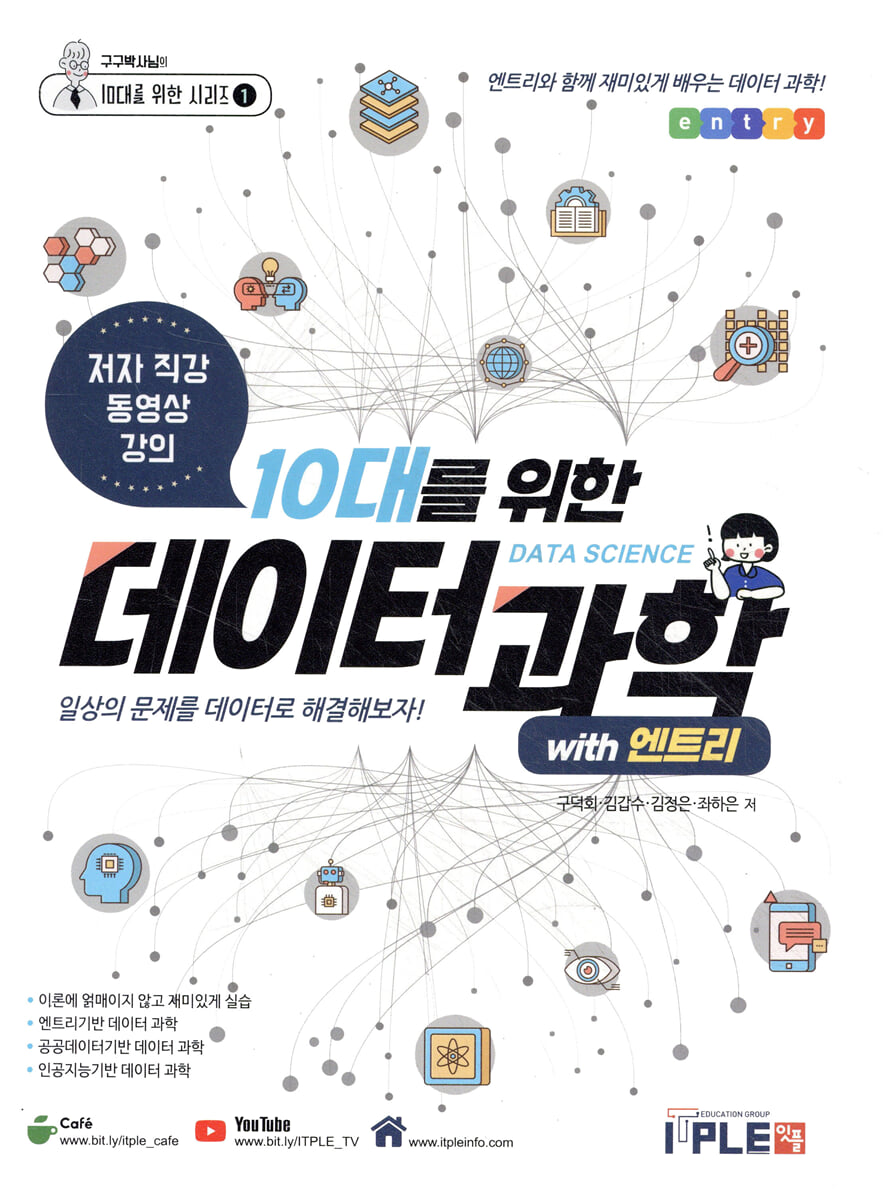
Data Science for Teens with Entry
 |
Description
Book Introduction
In the coming era of artificial intelligence, data science is essential knowledge for young people. This book is more of a hands-on, step-by-step guide to data science than a theoretical book. This book allows young people new to data science to enjoyably follow the content without being bogged down in complex theories, and before they know it, they'll be able to apply data science in their daily lives. |
- You can preview some of the book's contents.
Preview
index
preface
How should I study this book?
How to use entries
Download Reference Materials
One Step Closer to Data Science _13
Chapter 1.
What is Data Science? _14
Chapter 2.
How to do data science? _20
Chapter 3.
We're all data scientists! _24
Two Steps, Entry-Level Data Science _29
Chapter 4.
Two-Step Warm-Up! _30
Chapter 5.
What kind of songs do people enjoy listening to in spring? _41
Chapter 6.
Where does it rain the most? _59
Chapter 7.
What month is best for a picnic? _91
Chapter 8.
Which region should I go to to help harvest cabbage? _112
Three Steps: Data Science Based on Public Data _133
Chapter 9.
Three Step Warm-Up! _134
Chapter 10.
What is the average height of your peers? _138
Chapter 11.
Which district has the most people? _167
Chapter 12.
In which month are mosquitoes most prevalent? _199
Chapter 13.
Which local beach would you recommend for a trip? _230
Chapter 14.
When is the least crowded time to go to an amusement park? _254
Chapter 15.
Where is the nearest school to my house? _276
Four Steps: AI-Based Data Science _299
Chapter 16.
Four-Step Warm-Up! _300
Chapter 17.
What size should I wear? _304
Chapter 18.
What will our country's population be in 2050? _332
Chapter 19.
Want to become a data scientist? _364
solution
How should I study this book?
How to use entries
Download Reference Materials
One Step Closer to Data Science _13
Chapter 1.
What is Data Science? _14
Chapter 2.
How to do data science? _20
Chapter 3.
We're all data scientists! _24
Two Steps, Entry-Level Data Science _29
Chapter 4.
Two-Step Warm-Up! _30
Chapter 5.
What kind of songs do people enjoy listening to in spring? _41
Chapter 6.
Where does it rain the most? _59
Chapter 7.
What month is best for a picnic? _91
Chapter 8.
Which region should I go to to help harvest cabbage? _112
Three Steps: Data Science Based on Public Data _133
Chapter 9.
Three Step Warm-Up! _134
Chapter 10.
What is the average height of your peers? _138
Chapter 11.
Which district has the most people? _167
Chapter 12.
In which month are mosquitoes most prevalent? _199
Chapter 13.
Which local beach would you recommend for a trip? _230
Chapter 14.
When is the least crowded time to go to an amusement park? _254
Chapter 15.
Where is the nearest school to my house? _276
Four Steps: AI-Based Data Science _299
Chapter 16.
Four-Step Warm-Up! _300
Chapter 17.
What size should I wear? _304
Chapter 18.
What will our country's population be in 2050? _332
Chapter 19.
Want to become a data scientist? _364
solution
Detailed image

Publisher's Review
This book is organized as follows:
One step is to become familiar with data science.
Explore what data science is, learn the processes of data science, and discover how to become a data scientist.
The second step is to experience data science as an entry level.
Solve given missions according to data science procedures using data provided by the entry.
The third step is to experience data science by utilizing public data.
Experience various public datasets and collect data yourself to solve given missions.
The four steps are the steps that connect artificial intelligence and data science.
We create a program that predicts data by combining the artificial intelligence block and data analysis block of the entry.
Introductory hands-on books that teach young people how to solve problems with data science are rare.
This book focuses on helping young people develop their own problem-solving skills using data science.
We hope you'll enjoy challenging yourself with this book, see the results, and grow into a data science expert.
How to study this book
In this book, you'll experience data science with data science expert Dr. Gugu and his curious friends, Jeong-eun and Ha-eun.
Embark on your journey to becoming a data scientist, guided by these three figures.
As you solve problems around you one by one using data science procedures, you'll soon grow into a great data scientist.
In particular, Dr. Gugu's "Data Science Knowledge Plus" that you encounter every time you read the book will provide clues to solving the problems in the book.
Open your eyes wide and check.
1.
Think for yourself
Your problem-solving skills will improve! As you read the book, various questions will appear for you.
What would be a good answer to this question? Think of a word that would fit in the blank and write it down.
Once you've written everything down, compare your guess with the correct answer listed in the answer sheet. Thinking and writing on your own can help you develop your problem-solving skills!
2.
Let's follow along.
Develop your data analysis skills! This book provides detailed illustrations and explanations on how to solve everyday problems using data science.
Rather than reading with your eyes, try following along step by step, moving your hands together.
You can naturally learn the procedures of data science by trying them out yourself!
3.
Be creative.
Develop creative thinking skills! In the final stage of data science, "problem solving," you'll create an entry-level program to solve the problem.
Try out the example work in the book and create your own entry program similar to the work.
You can freely modify objects and code to create your own amazing results!
One step is to become familiar with data science.
Explore what data science is, learn the processes of data science, and discover how to become a data scientist.
The second step is to experience data science as an entry level.
Solve given missions according to data science procedures using data provided by the entry.
The third step is to experience data science by utilizing public data.
Experience various public datasets and collect data yourself to solve given missions.
The four steps are the steps that connect artificial intelligence and data science.
We create a program that predicts data by combining the artificial intelligence block and data analysis block of the entry.
Introductory hands-on books that teach young people how to solve problems with data science are rare.
This book focuses on helping young people develop their own problem-solving skills using data science.
We hope you'll enjoy challenging yourself with this book, see the results, and grow into a data science expert.
How to study this book
In this book, you'll experience data science with data science expert Dr. Gugu and his curious friends, Jeong-eun and Ha-eun.
Embark on your journey to becoming a data scientist, guided by these three figures.
As you solve problems around you one by one using data science procedures, you'll soon grow into a great data scientist.
In particular, Dr. Gugu's "Data Science Knowledge Plus" that you encounter every time you read the book will provide clues to solving the problems in the book.
Open your eyes wide and check.
1.
Think for yourself
Your problem-solving skills will improve! As you read the book, various questions will appear for you.
What would be a good answer to this question? Think of a word that would fit in the blank and write it down.
Once you've written everything down, compare your guess with the correct answer listed in the answer sheet. Thinking and writing on your own can help you develop your problem-solving skills!
2.
Let's follow along.
Develop your data analysis skills! This book provides detailed illustrations and explanations on how to solve everyday problems using data science.
Rather than reading with your eyes, try following along step by step, moving your hands together.
You can naturally learn the procedures of data science by trying them out yourself!
3.
Be creative.
Develop creative thinking skills! In the final stage of data science, "problem solving," you'll create an entry-level program to solve the problem.
Try out the example work in the book and create your own entry program similar to the work.
You can freely modify objects and code to create your own amazing results!
GOODS SPECIFICS
- Publication date: October 20, 2022
- Page count, weight, size: 376 pages | 816g | 185*257*16mm
- ISBN13: 9791191198256
- ISBN10: 1191198251
You may also like
카테고리
korean


korean

![GQ KOREA Mark (Monthly): December [2025]](http://librairie.coreenne.fr/cdn/shop/files/8ef265dbbfbf186523ed75ba7319009d.jpg?v=1765340328&width=3840)


