

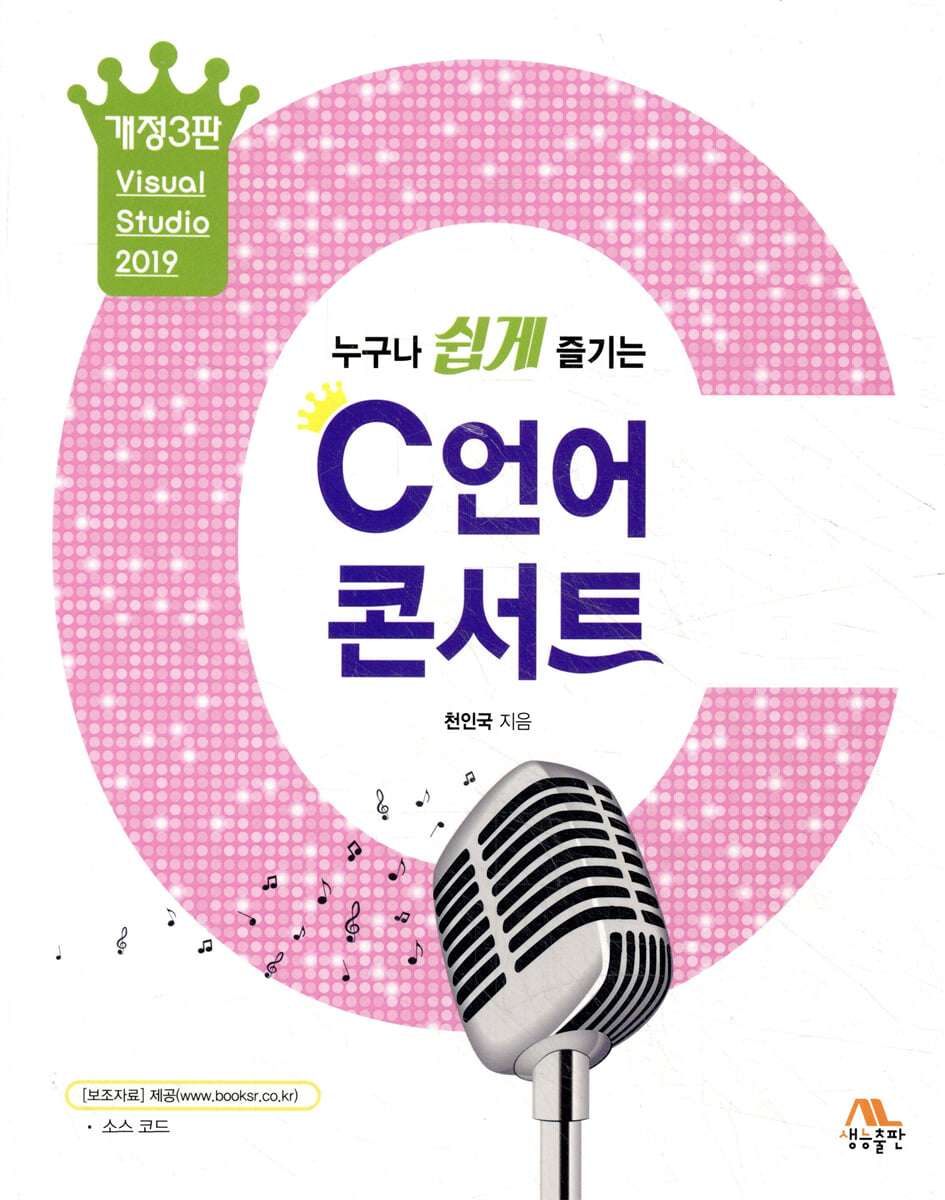
C Language Concert
 |
Description
Book Introduction
Looking at self-driving cars and artificial intelligence computers like AlphaGo, which have become recent hot topics, we realize anew how important software is in the computer field.
C language is an important language that allows you to get a feel for how computer hardware works.
Even in the age of artificial intelligence, the C language, which boasts fast speed and provides an efficient array structure, is still a language that provides considerable value.
The biggest reason I wrote this book was to help beginners who want to learn programming enter the world of programming in a more fun way.
- We tried to create a more friendly, less boring, and easier to understand teaching material by using as many appropriate illustrations as possible.
Beginners can understand related concepts more easily and quickly through pictures.
- For each topic, the concepts and principles were explained in detail, and the explanations were made in a question-and-answer format to make it easy to understand.
- A LAB section allows students to create programs applicable to real-life situations. A MINI PROJECT section allows students to utilize the program as a project assignment.
- Provides a variety of sufficient practice problems.
Programming problems are marked with difficulty and topic for reference.
- Color was used to make the teaching material familiar and not boring.
C language is an important language that allows you to get a feel for how computer hardware works.
Even in the age of artificial intelligence, the C language, which boasts fast speed and provides an efficient array structure, is still a language that provides considerable value.
The biggest reason I wrote this book was to help beginners who want to learn programming enter the world of programming in a more fun way.
- We tried to create a more friendly, less boring, and easier to understand teaching material by using as many appropriate illustrations as possible.
Beginners can understand related concepts more easily and quickly through pictures.
- For each topic, the concepts and principles were explained in detail, and the explanations were made in a question-and-answer format to make it easy to understand.
- A LAB section allows students to create programs applicable to real-life situations. A MINI PROJECT section allows students to utilize the program as a project assignment.
- Provides a variety of sufficient practice problems.
Programming problems are marked with difficulty and topic for reference.
- Color was used to make the teaching material familiar and not boring.
index
Chapter 01 Introduction to Programming
1.
The program we will create in this chapter
2.
What is a program?
Moving the Lab Robot
3.
Language that computers understand
4.
C language
5.
Algorithm
6.
Program development process
7.
Install Visual Studio
8.
Writing your first program
Practice problems
Chapter 02 Basics
1.
The program we will create in this chapter
2.
First program description
3.
Screen output
4.
Programs with operations
5.
Program with input and output
6.
Error Fixing and Debugging
Lab 4 Rules of Operation
Mini Project Travel Cost Calculation
Practice problems
Programming
Chapter 03 Variables and Data Types
1.
The program we will create in this chapter
2.
variable
3.
Data type
4.
Integer type
Convert Lab Dollars to Won
Calculating Lab Assets
Swapping values of Lab variables
Controlling Hardware with Lab Hexadecimal
5.
floating point type
Lab Sunlight Reach Time
Convert Lab to Fahrenheit
Let's calculate the area of a circle
6.
Text type
Selecting a Mini Project Data Type
Practice problems
Programming
Chapter 04 Formulas and Operators
1.
The program we will create in this chapter
2.
Formulas are everywhere!
3.
Concept of formulas and operators
4.
Arithmetic operators
Convert Lab Work Days to Years, Weeks, or Days
Lab Vending Machine Program
5.
Assignment operator
6.
Relational operators
7.
bitwise operators
8.
Operator precedence and associativity rules
9.
Type conversion
Lab Quadratic Function Calculation
Mini Project Compound Interest Calculation
Practice problems
Programming
Chapter 05 Conditional Statements
1.
The program we will create in this chapter
2.
Three basic control structures
3.
if-else statement
4.
if-else statement using complex conditional expressions
Lab Coin Toss Game
Lab Leap Year Determination Program Development
5.
Consecutive if statements
Lab Find the larger number among three integers
6.
switch statement
Check the Lab membership requirements
Lab Valid Triangle Test
Lab Calculating the Roots of a Quadratic Equation
Outputting the weather based on Lab temperature
Mini Project Rock Paper Scissors Game
Practice problems
Programming
Chapter 06 Loops
1.
The program we will create in this chapter
2.
What is repetition?
3.
while statement
Lab Origami
Let's make a lab digital clock
4.
do-while statement
Lab Number Matching
Calculating the number of digits in a Lab integer
5.
for statement
The fear of lab welfare
Finding Lab factors
Calculating Lab Harmonic Sequences
6.
Nested loops
Lab multiplication table output
7.
break and continue
Lab math problems automatically generated
Lab Let's find all the prime numbers from 1 to n.
Let's calculate Lab Pi
Mini Project NIM game
Practice problems
Programming
Chapter 07 Array
1.
The program we will create in this chapter
2.
What is an array?
3.
Array initialization
Record attendance in the Lab array
Lab Find the cheapest items
Searching for a specific value in a Lab array
4.
Bubble sort
Representing Lab Bubble Sort in a Pictorial Form
5.
multidimensional array
Addition of Lab matrices
Mini Project Tic-Tac-Toe Game
Practice problems
Programming
Chapter 08 Functions
1.
The program we will create in this chapter
2.
Why are functions needed?
3.
Definition of a function
4.
Let's start by creating a function
5.
Let's call the function
6.
Function prototype declaration
Lab temperature conversion function
Writing a Lab prime number check function
7.
Local and global variables
Finding the sum of Lab primes
8.
static variables
9.
circular call
Lab Fibonacci Sequence Calculation (Circular Version)
10.
library functions
Lab Lotto Program
Calculating Lab Taylor Series
Creating a Mini Project ATM
Practice problems
Programming
Chapter 09 Pointers
1.
The program we will create in this chapter
2.
What is a pointer?
3.
Pointer arithmetic
4.
Functions and Pointers
Writing a Lab swap() function
5.
Things to keep in mind when using pointers
6.
Arrays and Pointers
Lab Writing Useful Array Functions
Mini Project: Creating an Adventure Game
Practice problems
Programming
Chapter 10 Strings
1.
The program we will create in this chapter
2.
string
Preprocessing Lab strings
3.
Character input/output
Get password from Lab user
Lab arrow key input
4.
String input/output
5.
String processing
Lab Short Answer Quiz Grading
6.
Strings and Pointers
Lab Hangman
Lab Word Anagram Game
7.
array of strings
Implementation of the Lab Korean-English Dictionary
Let's sort the Lab strings.
Mini Project Text Encryption
Mini Project Text Compression
Practice problems
Programming
Chapter 11 Structures, Unions, and Enumerations
1.
The program we will create in this chapter
2.
What is a structure?
3.
Defining, initializing, and using structures
Let's represent the Lab point as a structure
4.
Assignment and comparison of structure variables
5.
Array of structures
Lab 4: Creating a Multiple Choice Quiz System
6.
Structures and functions
7.
Structures and Pointers
8.
common body
9.
enumeration
10.
typedef
Mini Project Library Management Program
Practice problems
Programming
Chapter 12 File Input/Output
1.
The program we will create in this chapter
2.
Stream
3.
The basis of the file
4.
Reading and writing text files
Copying Lab Text Files
5.
Formatted input/output
Recording Lab Grades to a File
6.
binary file
Reading and displaying Lab image files
7.
random access
Encrypting Mini Project Files
Practice problems
Programming
Chapter 13 Dynamic Memory
1.
The program we will create in this chapter
2.
What is dynamically allocated memory?
3.
malloc() and free()
Let's create an array of the size that the Lab user inputs.
Let's fill a Lab dynamic array with random numbers.
4.
Let's try dynamic creation of a structure
Lab dynamic structure array
Creating a Mini Project Linked List
Practice problems
Programming
Chapter 14 Preprocessors and Split Compilation
1.
The program we will create in this chapter
2.
What is a preprocessor?
3.
Simple macro
Change Lab && to and
4.
Function Macro
Manipulating Lab Beats
5.
#ifdef, #endif
Using Lab function macros
6.
#if and #endif
Prevent duplicate inclusion of Lab header files
7.
Multiple source files
8.
Program acquisition
Mini Project Calendar Program Development
Practice problems
Programming
1.
The program we will create in this chapter
2.
What is a program?
Moving the Lab Robot
3.
Language that computers understand
4.
C language
5.
Algorithm
6.
Program development process
7.
Install Visual Studio
8.
Writing your first program
Practice problems
Chapter 02 Basics
1.
The program we will create in this chapter
2.
First program description
3.
Screen output
4.
Programs with operations
5.
Program with input and output
6.
Error Fixing and Debugging
Lab 4 Rules of Operation
Mini Project Travel Cost Calculation
Practice problems
Programming
Chapter 03 Variables and Data Types
1.
The program we will create in this chapter
2.
variable
3.
Data type
4.
Integer type
Convert Lab Dollars to Won
Calculating Lab Assets
Swapping values of Lab variables
Controlling Hardware with Lab Hexadecimal
5.
floating point type
Lab Sunlight Reach Time
Convert Lab to Fahrenheit
Let's calculate the area of a circle
6.
Text type
Selecting a Mini Project Data Type
Practice problems
Programming
Chapter 04 Formulas and Operators
1.
The program we will create in this chapter
2.
Formulas are everywhere!
3.
Concept of formulas and operators
4.
Arithmetic operators
Convert Lab Work Days to Years, Weeks, or Days
Lab Vending Machine Program
5.
Assignment operator
6.
Relational operators
7.
bitwise operators
8.
Operator precedence and associativity rules
9.
Type conversion
Lab Quadratic Function Calculation
Mini Project Compound Interest Calculation
Practice problems
Programming
Chapter 05 Conditional Statements
1.
The program we will create in this chapter
2.
Three basic control structures
3.
if-else statement
4.
if-else statement using complex conditional expressions
Lab Coin Toss Game
Lab Leap Year Determination Program Development
5.
Consecutive if statements
Lab Find the larger number among three integers
6.
switch statement
Check the Lab membership requirements
Lab Valid Triangle Test
Lab Calculating the Roots of a Quadratic Equation
Outputting the weather based on Lab temperature
Mini Project Rock Paper Scissors Game
Practice problems
Programming
Chapter 06 Loops
1.
The program we will create in this chapter
2.
What is repetition?
3.
while statement
Lab Origami
Let's make a lab digital clock
4.
do-while statement
Lab Number Matching
Calculating the number of digits in a Lab integer
5.
for statement
The fear of lab welfare
Finding Lab factors
Calculating Lab Harmonic Sequences
6.
Nested loops
Lab multiplication table output
7.
break and continue
Lab math problems automatically generated
Lab Let's find all the prime numbers from 1 to n.
Let's calculate Lab Pi
Mini Project NIM game
Practice problems
Programming
Chapter 07 Array
1.
The program we will create in this chapter
2.
What is an array?
3.
Array initialization
Record attendance in the Lab array
Lab Find the cheapest items
Searching for a specific value in a Lab array
4.
Bubble sort
Representing Lab Bubble Sort in a Pictorial Form
5.
multidimensional array
Addition of Lab matrices
Mini Project Tic-Tac-Toe Game
Practice problems
Programming
Chapter 08 Functions
1.
The program we will create in this chapter
2.
Why are functions needed?
3.
Definition of a function
4.
Let's start by creating a function
5.
Let's call the function
6.
Function prototype declaration
Lab temperature conversion function
Writing a Lab prime number check function
7.
Local and global variables
Finding the sum of Lab primes
8.
static variables
9.
circular call
Lab Fibonacci Sequence Calculation (Circular Version)
10.
library functions
Lab Lotto Program
Calculating Lab Taylor Series
Creating a Mini Project ATM
Practice problems
Programming
Chapter 09 Pointers
1.
The program we will create in this chapter
2.
What is a pointer?
3.
Pointer arithmetic
4.
Functions and Pointers
Writing a Lab swap() function
5.
Things to keep in mind when using pointers
6.
Arrays and Pointers
Lab Writing Useful Array Functions
Mini Project: Creating an Adventure Game
Practice problems
Programming
Chapter 10 Strings
1.
The program we will create in this chapter
2.
string
Preprocessing Lab strings
3.
Character input/output
Get password from Lab user
Lab arrow key input
4.
String input/output
5.
String processing
Lab Short Answer Quiz Grading
6.
Strings and Pointers
Lab Hangman
Lab Word Anagram Game
7.
array of strings
Implementation of the Lab Korean-English Dictionary
Let's sort the Lab strings.
Mini Project Text Encryption
Mini Project Text Compression
Practice problems
Programming
Chapter 11 Structures, Unions, and Enumerations
1.
The program we will create in this chapter
2.
What is a structure?
3.
Defining, initializing, and using structures
Let's represent the Lab point as a structure
4.
Assignment and comparison of structure variables
5.
Array of structures
Lab 4: Creating a Multiple Choice Quiz System
6.
Structures and functions
7.
Structures and Pointers
8.
common body
9.
enumeration
10.
typedef
Mini Project Library Management Program
Practice problems
Programming
Chapter 12 File Input/Output
1.
The program we will create in this chapter
2.
Stream
3.
The basis of the file
4.
Reading and writing text files
Copying Lab Text Files
5.
Formatted input/output
Recording Lab Grades to a File
6.
binary file
Reading and displaying Lab image files
7.
random access
Encrypting Mini Project Files
Practice problems
Programming
Chapter 13 Dynamic Memory
1.
The program we will create in this chapter
2.
What is dynamically allocated memory?
3.
malloc() and free()
Let's create an array of the size that the Lab user inputs.
Let's fill a Lab dynamic array with random numbers.
4.
Let's try dynamic creation of a structure
Lab dynamic structure array
Creating a Mini Project Linked List
Practice problems
Programming
Chapter 14 Preprocessors and Split Compilation
1.
The program we will create in this chapter
2.
What is a preprocessor?
3.
Simple macro
Change Lab && to and
4.
Function Macro
Manipulating Lab Beats
5.
#ifdef, #endif
Using Lab function macros
6.
#if and #endif
Prevent duplicate inclusion of Lab header files
7.
Multiple source files
8.
Program acquisition
Mini Project Calendar Program Development
Practice problems
Programming
Publisher's Review
Structure and features of this book
- Conveying concepts through pictures
Important programming concepts and principles are explained in a user-friendly manner using illustrations so that they can be easily understood at a glance.
- Use of various learning tools
We have provided detailed explanations to make learning interesting by appropriately placing notes, cautions, and useful tips.
- Midterm inspection
To review the basic concepts and terms that appear in each section, we have included a quiz consisting of short-answer questions.
- LAB and SOLUTION
Based on what you have learned, you can write a program that can be applied to real life in the lab and compare it with your own answer in the solution.
- MINI PROJECT
This is an open project format problem with no given answer, so it can be used as an assignment or project during class.
- Practice problems
Practice problems consist of analyzing programs or writing partial programs.
- Programming problems
A variety of programming problems are included to allow learners to practice designing and implementing programs.
- Conveying concepts through pictures
Important programming concepts and principles are explained in a user-friendly manner using illustrations so that they can be easily understood at a glance.
- Use of various learning tools
We have provided detailed explanations to make learning interesting by appropriately placing notes, cautions, and useful tips.
- Midterm inspection
To review the basic concepts and terms that appear in each section, we have included a quiz consisting of short-answer questions.
- LAB and SOLUTION
Based on what you have learned, you can write a program that can be applied to real life in the lab and compare it with your own answer in the solution.
- MINI PROJECT
This is an open project format problem with no given answer, so it can be used as an assignment or project during class.
- Practice problems
Practice problems consist of analyzing programs or writing partial programs.
- Programming problems
A variety of programming problems are included to allow learners to practice designing and implementing programs.
GOODS SPECIFICS
- Publication date: July 23, 2021
- Page count, weight, size: 552 pages | 190*240*35mm
- ISBN13: 9788970504933
- ISBN10: 8970504931
You may also like
카테고리
korean


korean

![ELLE 엘르 A형 (여성월간) : 1월 [2026]](http://librairie.coreenne.fr/cdn/shop/files/3b70e1cf77cf67d6da56e0eb041901e8.jpg?v=1767265322&width=3840)


