

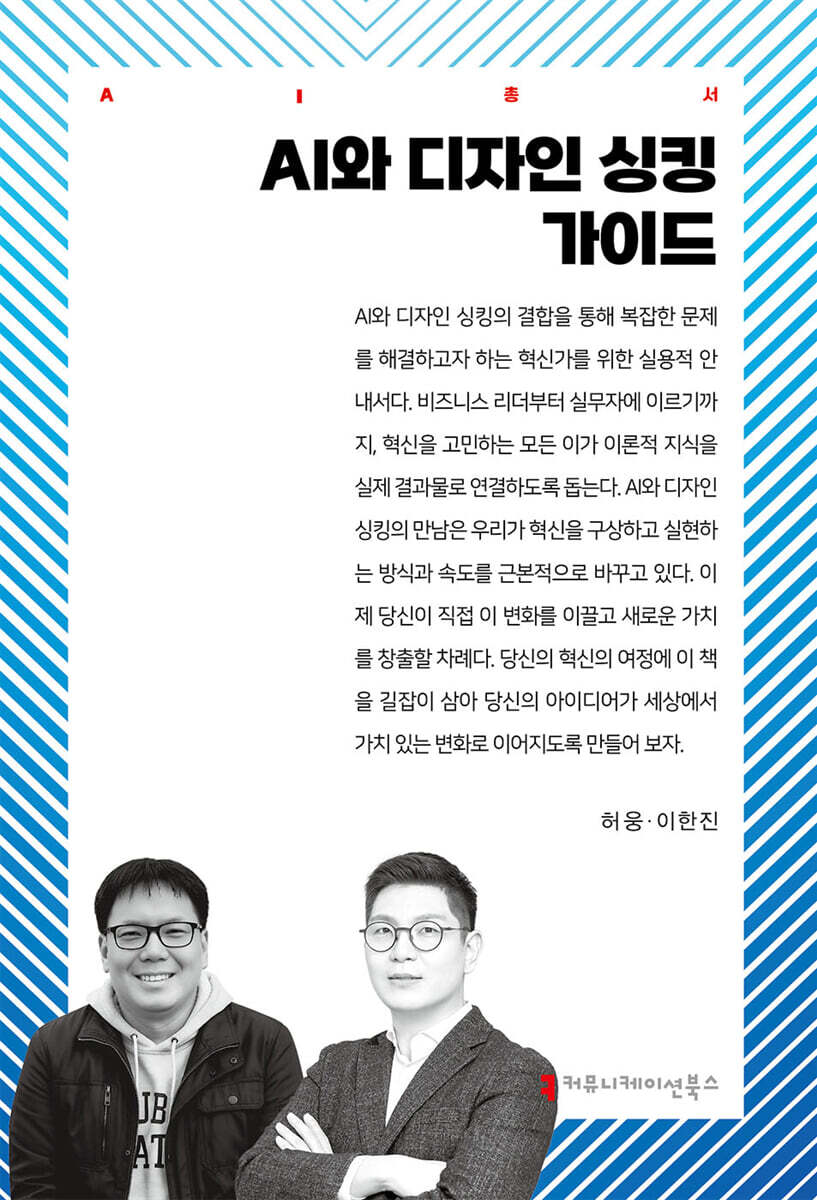
AI and Design Thinking Guide
 |
Description
Book Introduction
We present a method for rapidly developing and validating data-driven hypotheses by connecting AI to all stages of empathy, problem definition, ideation, prototyping, and testing.
We combine core tools such as Empathy Maps, Personas, Service Blueprints, Kano Models, and Ambidextrous Organizational Design with AI to make them immediately applicable in practice.
This book provides a detailed blueprint for innovation workshops for practitioners and leaders seeking to leverage AI, focusing on people rather than technology. The AI Encyclopedia
You can find the artificial intelligence knowledge you need at aiseries.oopy.io.
We combine core tools such as Empathy Maps, Personas, Service Blueprints, Kano Models, and Ambidextrous Organizational Design with AI to make them immediately applicable in practice.
This book provides a detailed blueprint for innovation workshops for practitioners and leaders seeking to leverage AI, focusing on people rather than technology. The AI Encyclopedia
You can find the artificial intelligence knowledge you need at aiseries.oopy.io.
- You can preview some of the book's contents.
Preview
index
At the intersection of creativity and technology
01 New Map of Thought
02 Window to the user's mind
03 Lens through which to view the problem
04 Idea Choir
05 The Aesthetics of Rapid Experimentation
06 Deep conversation with users
07 Designing a personalized experience
08 Service Journey Map
09 Architect of Innovation
10 Sustainable Innovation Design
01 New Map of Thought
02 Window to the user's mind
03 Lens through which to view the problem
04 Idea Choir
05 The Aesthetics of Rapid Experimentation
06 Deep conversation with users
07 Designing a personalized experience
08 Service Journey Map
09 Architect of Innovation
10 Sustainable Innovation Design
Into the book
Design thinking is an innovation methodology systematized as a business approach by Tim Brown of IDEO and developed into an educational program by the Stanford d.school.
This methodology is based on a human-centered design philosophy that directly observes and understands what users want from life.
By examining user preferences and inconveniences throughout the entire process, from product development to sales and support, we can find opportunities for innovation.
It also connects user needs, technical feasibility, and actionable business strategies to create customer value and market opportunities.
--- From “01_“New Map of Thought””
When creating POV sentences, leveraging AI can help clarify the problem definition process.
Simply input your user research results and ask them to “write a problem statement that includes your users, needs, and insights.”
If you add, "Please give me three different perspectives," you can get multiple forms of problem definitions based on the same data.
This process allows us to derive a balanced perspective that considers various situations without being biased towards one perspective. Leveraging AI tools goes beyond simply accelerating analysis.
It helps broaden the scope of problem definition by reclassifying and interpreting customer feedback from various perspectives.
--- From “03_“A Lens to View Problems””
For user testing to be effective, it must be observation-centric.
When developers directly observe users' actual reactions, they can concretely identify the product's problems and potential.
Information that cannot be obtained through questions and answers alone emerges from actions, and within these, clues for improvement can be found.
Developers can interpret these behaviors within context and repetitive patterns, and refine their products based on the results.
Testing goes beyond simple verification and becomes an opportunity for learning, and as learning accumulates, the product evolves.
--- From “06_“Deep Dialogue with Users””
Organizations believe that "adopting better technology will solve problems," but they face a paradox: the more they invest in technology, the wider the gap between expectations and reality.
This gap stems from a perspective that approaches technology adoption and organizational change separately.
Organizations can transform with technology adoption only when collaboration methods, decision-making authority, and information flows are redesigned.
Leaders must focus on creating an environment where the organization can learn and change through communication, collaboration, and execution.
Only when strategic thinking, human-centered values, and execution are integrated can real change be achieved.
This methodology is based on a human-centered design philosophy that directly observes and understands what users want from life.
By examining user preferences and inconveniences throughout the entire process, from product development to sales and support, we can find opportunities for innovation.
It also connects user needs, technical feasibility, and actionable business strategies to create customer value and market opportunities.
--- From “01_“New Map of Thought””
When creating POV sentences, leveraging AI can help clarify the problem definition process.
Simply input your user research results and ask them to “write a problem statement that includes your users, needs, and insights.”
If you add, "Please give me three different perspectives," you can get multiple forms of problem definitions based on the same data.
This process allows us to derive a balanced perspective that considers various situations without being biased towards one perspective. Leveraging AI tools goes beyond simply accelerating analysis.
It helps broaden the scope of problem definition by reclassifying and interpreting customer feedback from various perspectives.
--- From “03_“A Lens to View Problems””
For user testing to be effective, it must be observation-centric.
When developers directly observe users' actual reactions, they can concretely identify the product's problems and potential.
Information that cannot be obtained through questions and answers alone emerges from actions, and within these, clues for improvement can be found.
Developers can interpret these behaviors within context and repetitive patterns, and refine their products based on the results.
Testing goes beyond simple verification and becomes an opportunity for learning, and as learning accumulates, the product evolves.
--- From “06_“Deep Dialogue with Users””
Organizations believe that "adopting better technology will solve problems," but they face a paradox: the more they invest in technology, the wider the gap between expectations and reality.
This gap stems from a perspective that approaches technology adoption and organizational change separately.
Organizations can transform with technology adoption only when collaboration methods, decision-making authority, and information flows are redesigned.
Leaders must focus on creating an environment where the organization can learn and change through communication, collaboration, and execution.
Only when strategic thinking, human-centered values, and execution are integrated can real change be achieved.
--- From “09_“Architect of Innovation””
Publisher's Review
Redrawing the Innovation Challenge Map with AI
This is an era where organizations that rapidly repeat small experiments will survive, rather than grand strategies that attempt to solve complex problems all at once.
The speed and depth of innovation are simultaneously changing as AI's analytical and generative capabilities are added to the five coordinates of design thinking: empathy, problem definition, idea generation, prototype, and testing.
Feeding AI with vast amounts of qualitative and quantitative data—interview transcripts, customer reviews, market reports—can uncover hidden patterns and insights, significantly refining empathy maps, personas, and JTBD definitions. With AI providing dozens of solutions for everything from HMW questions and SCAMPER/TRIZ ideation to prototype design, teams can focus their energies on better choices and combinations.
During the testing phase, you can analyze user behavior data and feedback in real time to immediately see which elements drive true conversions and where drop-offs occur.
This practical guide helps companies from startups to large corporations design a virtuous cycle of strategy, empathy, and execution that connects "head, heart, and hands" even within limited personnel and budgets.
This is an era where organizations that rapidly repeat small experiments will survive, rather than grand strategies that attempt to solve complex problems all at once.
The speed and depth of innovation are simultaneously changing as AI's analytical and generative capabilities are added to the five coordinates of design thinking: empathy, problem definition, idea generation, prototype, and testing.
Feeding AI with vast amounts of qualitative and quantitative data—interview transcripts, customer reviews, market reports—can uncover hidden patterns and insights, significantly refining empathy maps, personas, and JTBD definitions. With AI providing dozens of solutions for everything from HMW questions and SCAMPER/TRIZ ideation to prototype design, teams can focus their energies on better choices and combinations.
During the testing phase, you can analyze user behavior data and feedback in real time to immediately see which elements drive true conversions and where drop-offs occur.
This practical guide helps companies from startups to large corporations design a virtuous cycle of strategy, empathy, and execution that connects "head, heart, and hands" even within limited personnel and budgets.
GOODS SPECIFICS
- Date of issue: November 28, 2025
- Page count, weight, size: 177 pages | 128*188*7mm
- ISBN13: 9791143015143
You may also like
카테고리
korean


korean

![ELLE 엘르 A형 (여성월간) : 1월 [2026]](http://librairie.coreenne.fr/cdn/shop/files/3b70e1cf77cf67d6da56e0eb041901e8.jpg?v=1767265322&width=3840)


